



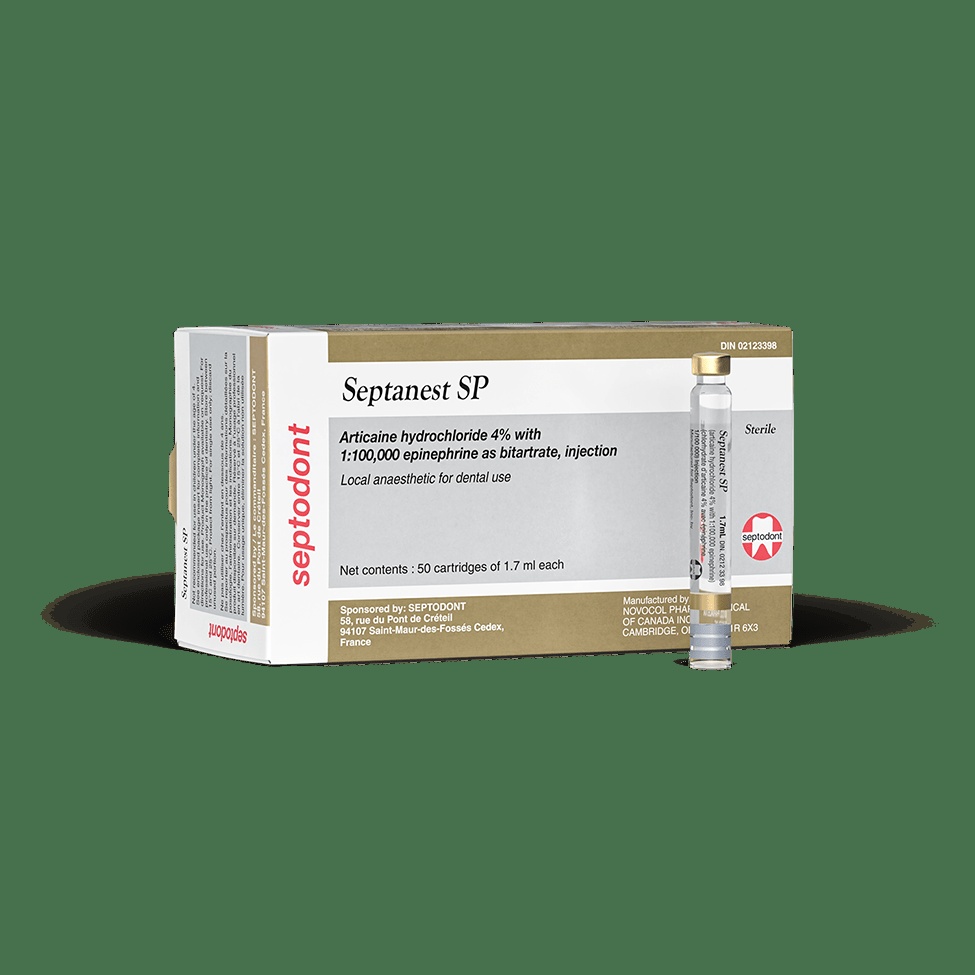
SEPTANEST <40 MG/ML + 10 MICROGRAMMI/ML Injectable solution

Запит на рецепт онлайн
Лікар розгляне ваш випадок і визначить, чи є рецепт медично доцільним.

Поговоріть з лікарем про ці ліки
Обговоріть симптоми та можливі подальші кроки під час короткої онлайн-консультації.



Інструкція із застосування SEPTANEST
Зміст інструкції
- Septanest with Adrenaline 1/100,000, A.T.C. N01BB58
- Septanest with Adrenaline 1/200,000, A.T.C. N01BB58
Septanest with Adrenaline 1/100,000, A.T.C. N01BB58
injectable solution
Articaine + Adrenaline
Septanest with Adrenaline 1/200,000, A.T.C. N01BB58
injectable solution
Articaine + Adrenaline
Anesthesia by infiltration and regional block in case of dental interventions
Composition
1.7 ml of injectable solution contains:
SEPTANEST 1/100,000 SEPTANEST 1/200,000
Articaine Hydrochloride .............................. 68.000 mg 68.000 mg
Epinephrine Bitartrate ............................. 0.031 mg 0.0155 mg
(corresponding to Epinephrine base) ..... (0.017 mg) (0.0085 mg)
Excipients
Sodium metabisulfite............................... 0.85 mg 0.85 mg
(corresponding to 0.57 mg of S0)
Sodium chloride
Sodium edetate
Sodium hydroxide
Water for injectable preparations q.s.
Pharmaceutical form
Injectable solution in ampoule-vial (tubofiale) of 1.7 ml.
Activity
SEPTANEST is composed of Articaine, a local anesthetic of the amide type characterized
by being chemically the only thiophene derivative among local anesthetics, and Epinephrine (adrenaline)
as a vasoconstrictor, in two dosages.
Marketing Authorisation Holder, Manufacturer and controller
SEPTODONT 58, rue du Pont de Créteil
94107 Saint-Maur-des-Fossés Cedex (France).
Representative for sales in Italy
GIOVANNI OGNA & FIGLI s.p.a..
Via Figni 41 - 20053 MUGGIO’ (MI)
Indications
Anesthesia by infiltration and regional block in case of dental interventions such as:
- simple or multiple extractions,
- cavity preparations,
- apical resections, alveolar ridge resections,
- pulpectomy,
- cyst removals,
- interventions on the gums. Depending on the degree of local ischemia required by each intervention, the doctor will decide on the use of one or the other preparation.
Contraindications
- As with all injectable anesthetics containing epinephrine (adrenaline), intravascular injection is strictly contraindicated. It is therefore absolutely necessary to ensure that the needle used for the injection is not engaged in a blood vessel.
- Treatment with monoamine oxidase inhibitors (MAOIs), tricyclic antidepressants and beta-blockers.
- Children under 4 years of age.
- Severe cardiovascular disorders: * recent myocardial infarction, * rhythm disturbances, * conduction disturbances, * acute decompensated heart failure, * hypertension.
- Essential migraine,
- Confirmed or suspected pregnancy. Breastfeeding
- Known hypersensitivity to: * articaine or other local anesthetics of the amide type * epinephrine (adrenaline).
- The product should not be administered to asthmatics who present a hypersensitivity to sulfites.
- Due to the presence of epinephrine (adrenaline), the use of the product is contraindicated: * in diabetic patients, * in patients suffering from closed-angle glaucoma, * in patients affected by paroxysmal tachycardia and absolute arrhythmia with high frequency, * in severe arteriopathies, * in ischemic manifestations of any kind. * in hyperthyroidism.
- Given the mechanism of metabolism and elimination, the administration of the product must, in case of renal and hepatic insufficiency, be accompanied by particular precautions.
- Never use the product in anesthesias at the level of the terminal circulatory zone.
Precautions for use
Use during pregnancy and breastfeeding.
The product should not be administered in case of pregnancy or breastfeeding because there is not sufficient data
relating to the administration of the product to pregnant women and it is not yet known whether the
active ingredients contained in the drug pass into breast milk.
Effect on the ability to drive and operate machinery.
The doctor must decide in each individual case whether the patient is fit to drive or
operate machinery.
Before use, the doctor must ascertain the state of the circulatory conditions of the subjects to be treated.
Any overdose of anesthetic must be avoided and two maximum doses of
the latter must not be administered without an interval of at least 24 hours having elapsed. It is necessary, however, to use the
lowest doses and concentrations that can allow to obtain the desired effect.
The anesthetic solution must be injected with caution in small doses after about 10 seconds from a
preventive aspiration.
Especially when infiltrating highly vascularized areas, it is advisable to wait
about two minutes before proceeding with the actual regional block. The patient must be
kept under careful monitoring, immediately suspending administration at the first sign of
alarm (e.g. changes in sensorium).
The immediate availability of equipment and drugs and qualified personnel for
emergency treatment is necessary, as rare cases of severe reactions, sometimes with fatal outcome, have been reported following the use of local anesthetics, even in the absence of individual hypersensitivity in the medical history.
Interactions with other drugs
- The product may interact with drugs capable of modifying the subject's response to epinephrine (adrenaline).
- Opioids routinely used for premedication and supplementary medication or other analgesics, atropine, psychotropic drugs or peripheral stimulants have not determined effects different from those desired, and, in case of supplementary general anesthesia, barbiturates, inhalation anesthetics, ketamine and neuroleptanalgesics. The hypertensive action of vasoconstrictors of the sympathomimetic type, such as adrenaline, can be potentiated by tricyclic antidepressants or MAOIs. Interactions of this type have been reported with the use of norepinephrine at a concentration of 1:25,000 and adrenaline at a concentration of 1:80,000. The concentration of adrenaline contained in SEPTANEST 1:200,000 and SEPTANEST 1:100,000 is lower. Nevertheless, the possibility of such interference must be considered. Therefore, the use of the product should be avoided during treatment with MAOI or tricyclic antidepressant drugs.
Warnings
- As with all injectable anesthetics containing epinephrine (adrenaline), intravascular injection must be absolutely avoided. It is therefore necessary to ensure that the needle used for the injection is not engaged in a blood vessel.
- The patient can only consume food once sensitivity has returned.
- Opened ampoule-vials must no longer be used (risk of hepatitis). The product contains sodium metabisulfite; this substance can cause allergic-type reactions and severe asthma attacks in sensitive subjects and particularly in asthmatics.
- Protect from light.
Dosage, method and time of administration
The injection must be performed slowly (about 1 ml/min).
In general, a single administration is sufficient.
- Adults
- For most common interventions, an infiltration of 1.7 ml of solution is sufficient. In any case, the injection must be done slowly (about 1 ml/min).
- For an infiltration at the level of the interdental septum, a quantity of 0.3 - 0.5 ml is indicated and generally sufficient. Do not exceed the equivalent of 7 mg of articaine hydrochloride per kilogram of body weight, which corresponds for a subject of 60 kg to about 6 standard ampoule-vials of 1.7 ml. In case of serial extractions of adjacent teeth, a reduction of the dose is often possible. The duration of anesthesia during which an intervention can be carried out is at least 45 minutes (SEPTANEST 1/200,000) and 75 minutes (SEPTANEST 1/100,000).
- Children
- Do not administer to children under 4 years of age.
- The amount of product injected must be adjusted according to the child's weight.
- In general: In children with a body weight between 20 and 30 Kg:doses of 0.25 to 1 ml are sufficient. Do not exceed the dose of 1.5 ml during the intervention and the dose of 2.5 ml within 24 hours.
In children with a body weight between 30 and 45 Kg:
doses of 0.5 to 2 ml are sufficient.
Do not exceed the dose of 2 ml during the intervention and the dose of 5 ml within 24 hours.
Overdose treatment
At the first sign of alarm, administration must be stopped, the patient placed in a
horizontal position and ensuring the patency of the airways by administering oxygen in case of severe dyspnea
or performing artificial ventilation (Ambu bag).
The use of bulb stimulants must be avoided so as not to worsen the situation by increasing oxygen consumption.
Any convulsions can be controlled with the use of diazepam in a dose of 10-20 mg intravenously; barbiturates are instead discouraged as they can exacerbate bulbar depression.
The circulation can be supported with the administration of corticosteroids in appropriate doses intravenously; diluted solutions of alpha-beta stimulants with vasoconstrictor action (mefentermine, metaraminol and others) or atropine sulfate can be added.
Sodium bicarbonate in targeted concentration can be used as an acidifier, intravenously.
Undesirable effects
Toxic and allergic reactions can occur both to the anesthetic and to the vasoconstrictor. Among
the former, phenomena of central nervous stimulation with excitation, tremors,
disorientation, dizziness, mydriasis, increased metabolism and body temperature and, for very high doses,
trismus and convulsions are reported; if the medulla oblongata is involved, there is participation of the
cardiovascular, respiratory and emetic centers with sweating, arrhythmias, hypertension, tachypnea,
bronchodilation, nausea and vomiting. Peripheral-type effects can affect the
cardiovascular system with bradycardia and vasodilation.
Allergic reactions occur mostly in hypersensitive subjects but many cases are reported with
no individual hypersensitivity in the medical history. Local manifestations include
skin eruptions of various types, urticaria, itching, those of a general nature bronchospasm, laryngeal edema
up to cardiorespiratory collapse from anaphylactic shock.
The vasoconstrictor, due to its action on the circulation, can determine abnormal effects of various types, especially
in subjects not normal from a cardiovascular point of view: anxiety, sweating, ambuspiratory breathing,
cardiac arrhythmias, hypertension (particularly severe in subjects already hypertensive and hyperthyroid), acute headache,
photophobia, retrosternal and pharyngeal pain, vomiting; if symptoms of this type appear, the
administration must be stopped immediately.
Caution
Do not use after the expiry date indicated on the packaging.
Special precautions for storage
Store at a temperature below 25°c and protected from light.
Protect from the cold.
Packaging
SEPTANEST 1/100,000 box of 50 ampoule-vials of 1.7 ml in blisters.
SEPTANEST 1/200,000 box of 50 ampoule-vials of 1.7 ml in blisters.
July 1998

Не впевнені, чи підходить вам цей лікарський засіб?
Обговоріть симптоми та можливі варіанти лікування з лікарем онлайн.

Виникли питання під час прийому ліків?
Обговоріть свої симптоми та лікування з лікарем онлайн.
- Країна реєстрації
- Лікарська формаInjectable solution, <40 MG/ML + 10 MICROGRAMMI/ML
- Код АТХN01BB58
- Діюча речовина
- Потрібен рецептТак
- Виробник
- Ця інформація надана лише для ознайомлення і не є медичною порадою. Рішення щодо лікування завжди приймає лікар.
- Альтернативи до SEPTANESTЛікарська форма: Injectable solution, 40 MG/ML + 10 MICROGRAMMI/MLДіюча речовина: articaine, combinationsВиробник: PIERREL S.P.A.Рецепт не потрібенЛікарська форма: Injectable solution, 40 MG/ML + 10 MICROGRAMMI/MLДіюча речовина: articaine, combinationsВиробник: GIOVANNI OGNA E FIGLI S.R.L.Потрібен рецептЛікарська форма: Injectable solution, 40 MG/ML + 5 MICROGRAMMI/MLДіюча речовина: articaine, combinationsВиробник: OMNIA S.R.L.Потрібен рецепт
Аналоги SEPTANEST в інших країнах
Препарати з тією самою діючою речовиною, доступні в інших країнах.
Аналог SEPTANEST у Польща
Аналог SEPTANEST у Україна
Аналог SEPTANEST у Іспанія
Лікарі онлайн щодо SEPTANEST
Застосування, безпека та можливість призначення рецепта — за результатами медичної оцінки.









Отримайте рецепт на SEPTANEST онлайн
Заповніть форму за 2 хвилини
Розкажіть про симптоми, історію хвороби та потрібний препарат.
Оберіть лікаря або ми призначимо
Оберіть спеціаліста або ми підберемо найближчого доступного лікаря.
Лікар розглядає ваш випадок
Зазвичай протягом 30 хвилин. Може ставити уточнювальні запитання в чаті.
Отримайте в будь-якій аптеці
Електронний рецепт надсилається на вашу пошту — дійсний по всій Польщі.
Часті запитання
SEPTANEST потребує рецепта в Італія. Ви можете обговорити з лікарем онлайн, чи підходить цей лікарський засіб для вашої ситуації.
Діюча речовина у SEPTANEST — articaine, combinations. Це допомагає визначити препарати з тим самим складом, але під іншими торговими назвами.
SEPTANEST виробляється компанією SEPTODONT. Назва бренду та упаковка можуть відрізнятися залежно від дистрибʼютора.
Лікарі, зокрема Сімейні лікарі, Психіатри, Дерматологи, Кардіологи, Ендокринологи, Гастроентерологи, Пульмонологи, Нефрологи, Ревматологи, Гематологи, Інфекціоністи, Алергологи, Геріатри, Педіатри, Онкологи, можуть оцінити доцільність застосування SEPTANEST з урахуванням вашого стану та місцевих правил. Ви можете записатися на онлайн-консультацію, щоб обговорити симптоми та можливі подальші кроки.
Польща має добре розвинену систему охорони здоров'я у великих містах, таких як Варшава, Краків, Вроцлав і Гданськ. Аптеки широко доступні та працюють відповідно до чинного законодавства, забезпечуючи доступ до рецептурних препаратів.
Ви можете придбати SEPTANEST у Варшаві, Кракові, Вроцлаві або Гданську в будь-якій аптеці за наявності дійсного рецепта.
Щоб отримати рецепт, ви можете скористатися Oladoctor:
Інші препарати з тією самою діючою речовиною (articaine, combinations) включають ARTIKAINA KON ADRENALINA PIERREL, ARTIKAINA ONYA, ARTIN. Вони можуть відрізнятися торговою назвою або формою випуску, але містять той самий терапевтичний компонент. Перед зміною або початком прийому нового препарату варто проконсультуватися з лікарем.
