



DUROGESIC 25 MICROGRAMS/HOUR Transdermal patch

Запит на рецепт онлайн
Лікар розгляне ваш випадок і визначить, чи є рецепт медично доцільним.

Поговоріть з лікарем про ці ліки
Обговоріть симптоми та можливі подальші кроки під час короткої онлайн-консультації.



Інструкція із застосування DUROJESIK
Зміст інструкції
DUROGESIC 12 micrograms/hour transdermal patch, 25 micrograms/hour transdermal patch, 50 micrograms/hour transdermal patch, 75 micrograms/hour transdermal patch
DUROGESIC 100 micrograms/hour transdermal patch
fentanil
Read this leaflet carefully before you use this medicine as it contains important information for you.
- Keep this leaflet. You may need to read it again.
- If you have any questions, ask your doctor, pharmacist or nurse.
- This medicine has been prescribed for you only. Do not pass it on to others, even if their symptoms are the same as yours, as it could be harmful.
- If you get any side effects, even those not listed in this leaflet, tell your doctor, pharmacist or nurse. See section 4.
Contents of this leaflet
- 1. What DUROGESIC is and what it is used for
- 2. What you need to know before you use DUROGESIC
- 3. How to use DUROGESIC
- 4. Possible side effects
- 5. How to store DUROGESIC
- 6. Contents of the pack and other information
1. What is DUROGESIC and what is it used for
The name of this medicine is DUROGESIC
The patches help to relieve very strong and long-lasting pain:
- in adults who need continuous treatment for pain
- in children over 2 years of age who are already using opioid medicines and who need continuous treatment for pain.
DUROGESIC contains a medicine called fentanyl, which belongs to a group of powerful painkillers
called opioids.
2. Cosa deve sapere prima di usare DUROGESIC
Non usi DUROGESIC
- Se è allergico al fentanil o a uno qualsiasi degli altri componenti di questo medicinale (elencati al paragrafo 6).
- Se il dolore è di breve durata, come un dolore improvviso o un dolore postoperatorio.
- Se ha difficoltà a respirare, con respiro lento o corto. Non usi questo medicinale se uno qualsiasi dei punti sopra elencati riguarda lei o il suo bambino. Se ha dubbi si rivolga al medico, al farmacista o all’infermiere prima di usare DUROGESIC.
Avvertenze e precauzioni
- DUROGESIC può avere effetti indesiderati pericolosi per la vita nelle persone che non stanno già usando regolarmente medicinali oppioidi prescritti.
- DUROGESIC è un medicinale che potrebbe essere pericoloso per la vita dei bambini, anche se i cerotti sono già stati utilizzati. Bisogna tenere presente che un cerotto appiccicoso (nuovo o usato) potrebbe attrarre un bambino, e che se si attaccasse alla pelle del bambino o se il bambino lo mettesse in bocca il risultato potrebbe essere fatale.
- Conservi questo medicinale in un luogo sicuro e protetto, a cui le altre persone non possono accedere - vedere paragrafo 5 per maggiori informazioni.
Trasferimento del cerotto a un’altra persona
Il cerotto deve essere utilizzato solo sulla cute della persona a cui è stato prescritto. Sono stati riportati
casi di adesione accidentale del cerotto a un familiare mentre era a stretto contatto fisico o condivideva
lo stesso letto con la persona che utilizzava il cerotto. Un cerotto che si attacca accidentalmente a
un’altra persona (soprattutto se un bambino) può comportare che il medicinale contenuto nel cerotto
passi attraverso la pelle dell’altra persona e causi gravi effetti indesiderati, come la difficoltà a
respirare, con respiro lento e superficiale, che può essere fatale. In caso il cerotto si incolli alla cute di
un’altra persona, tolga il cerotto immediatamente e si rivolga al medico.
Precauzioni particolari con DUROGESIC
Si rivolga al medico o al farmacista prima di usarequesto medicinale se una qualsiasi delle
condizioni elencate sotto la riguarda, poiché il medico potrebbe aver bisogno di controllarla più
attentamente.
- Se ha mai avuto problemi polmonari o di respirazione.
- Se ha mai avuto problemi al cuore, al fegato, ai reni, o ha/ha avuto la pressione bassa.
- Se ha mai avuto un tumore al cervello.
- Se ha mai avuto cefalee persistenti o una lesione alla testa.
- Se è anziano, poiché può essere più sensibile agli effetti di questo medicinale.
- Se ha una condizione chiamata ‘miastenia grave’ in cui i muscoli vanno incontro ad indebolimento e facile affaticamento.
Se una qualsiasi delle condizioni elencate sopra la riguarda (o ha dubbi su questo fatto) si rivolga al
medico, al farmacista o all’infermiere prima di usare DUROGESIC.
Durante l'utilizzo del cerotto, informi il medico se ha problemi respiratori durante il sonno.Gli
oppioidi come DUROGESIC possono causare disturbi respiratori legati al sonno come apnea notturna
(pause respiratorie durante il sonno) e ipossiemia correlata al sonno (basso livello di ossigeno nel
sangue). Informi il medico se lei, il suo partner o la persona che si occupa di lei nota una delle seguenti
condizioni:
- pause respiratorie durante il sonno
- risveglio notturno dovuto alla mancanza di respiro
- difficoltà a rimanere addormentati
- sonnolenza eccessiva durante il giorno. Il medico potrebbe decidere di modificare la dose.
Durante l’uso del cerotto, informi il medico se nota un cambiamento del dolore che sente.Se lei
sente:
- che il dolore non è più alleviato dal cerotto
- un aumento del dolore
- un cambiamento del modo in cui prova il dolore (per esempio, prova dolore in un’altra parte del corpo)
- dolore quando qualcuno la tocca in un modo che non dovrebbe farle male.
Non modifichi la dose da solo. Il medico potrebbe decidere di modificare la dose del medicinale o di
cambiare trattamento.
Effetti indesiderati e DUROGESIC
- DUROGESIC può farla sentire insolitamente assonnato, e può rendere la respirazione più lenta e superficiale. Molto raramente questi problemi di respirazione possono essere pericolosi per la vita o persino fatali, soprattutto in persone che non hanno mai usato prima degli antidolorifici oppioidi forti (come DUROGESIC o morfina). Se lei o qualcun altro si accorge che la persona che utilizza il cerotto mostra una sonnolenza insolita, con respiro lento o superficiale:
- rimuovere il cerotto
- chiamare immediatamente il medico, o andare all’ospedale più vicino
- fare in modo che la persona si muova e parli il più possibile
- Se le viene la febbre mentre sta usando DUROGESIC, avverta il medico, poiché la febbre può aumentare la quantità di medicinale che attraversa la pelle.
- DUROGESIC può causare stipsi, si rivolga al medico o al farmacista per consigli su come prevenire o alleviare la stipsi. Vedere paragrafo 4 per un elenco completo dei possibili effetti indesiderati.
DUROGESIC, come altri oppioidi, può influenzare la normale produzione di ormoni nel corpo, come
il cortisolo, la prolattina o gli ormoni sessuali, soprattutto se ha assunto DUROGESIC per lunghi
periodi di tempo. Gli effetti di questi cambiamenti ormonali possono includere sensazione di nausea o
nausea (incluso vomito), perdita di appetito, stanchezza, debolezza, vertigini, bassa pressione
sanguigna, infertilità o diminuzione del desiderio sessuale. Inoltre, pazienti di sesso femminile
possono sperimentare variazioni nel ciclo mestruale, mentre i pazienti maschi possono manifestare
impotenza o ingrossamento del tessuto mammario. Se nota uno di questi segni, parli con il suo
medico.
Quando sta indossando il cerotto non si esponga a fonti di calore diretto, come termofori, coperte
elettriche, borse di acqua calda, letti ad acqua riscaldati o lampade termiche o abbronzanti. Eviti di
prendere il sole e di fare lunghi bagni caldi o saune o idromassaggi termali caldi. Facendolo, la
quantità di medicinale assorbita dal cerotto potrebbe aumentare.
Uso a lungo termine e tolleranza
Questo medicinale contiene fentanil, un medicinale oppioide. L’uso ripetuto di antidolorifici oppioidi
può rendere il medicinale meno efficace (ci si abitua ad esso, un fenomeno noto come tolleranza al
farmaco). È possibile anche diventare più sensibili al dolore durante l’uso di DUROGESIC. Questo è
noto come iperalgesia. L’aumento della dose dei cerotti può aiutare a ridurre ulteriormente il dolore
per un po’ di tempo, ma può anche essere dannoso. Se nota che il medicinale diventa meno efficace, si
rivolga al medico. Il medico deciderà se è meglio aumentare la dose o ridurre gradualmente l’uso di
DUROGESIC.
Dipendenza e tossicodipendenza
L’uso ripetuto di DUROGESIC può anche portare a dipendenza, abuso e tossicodipendenza, che
possono provocare un sovradosaggio potenzialmente fatale. Il rischio di questi effetti indesiderati può
aumentare con una dose più elevata e una durata d’uso prolungata. La dipendenza o la
tossicodipendenza può darle la sensazione di non avere più il controllo della quantità di medicinale
necessario o della frequenza con cui deve usarlo. Può avvertire la necessità di continuare a usare il
medicinale, anche se non aiuta ad alleviare il dolore.
Il rischio di sviluppare dipendenza o tossicodipendenza varia da persona a persona. Può
avere un rischio maggiore di diventare dipendente o tossicodipendente da DUROGESIC se:
- lei o un suo familiare ha sofferto in passato di abuso o dipendenza da alcol, medicinali su prescrizione o sostanze illegali (“tossicodipendenza”).
- lei è un fumatore.
- lei ha avuto in passato problemi dell’umore (depressione, ansia o un disturbo della personalità) o è stato in trattamento da uno psichiatra per altre malattie mentali.
La comparsa di uno qualsiasi dei seguenti segni durante l’uso di DUROGESIC può essere un segno di
dipendenza o tossicodipendenza.
- Ha la necessità di usare il medicinale per un periodo più lungo di quello indicato dal medico
- Ha la necessità di usare una dose superiore a quella raccomandata
- Usa il medicinale per ragioni diverse da quelle prescritte, ad esempio “per restare Calmo” o “per favorire il sonno”
- Ha tentato più volte di interrompere o di controllare l’uso di questo medicinale, senza successo
- Quando interrompe il trattamento con il medicinale si sente male, e quando riprende a usarlo si sente meglio (“effetti da astinenza”). Se nota uno qualsiasi di questi segni, si rivolga al medico per discutere il miglior percorso terapeutico per lei, compresi i casi in cui è opportuno interrompere il trattamento e come interromperlo in modo sicuro.
Sintomi da astinenza quando si interrompe DUROGESIC
Non interrompa improvvisamente l'assunzione di questo medicinale. Possono verificarsi sintomi da
astinenza come irrequietezza, difficoltà a dormire, irritabilità, agitazione, ansia, sentire il proprio
battito cardiaco (palpitazioni), aumento della pressione sanguigna, sensazione di malessere, diarrea,
perdita di appetito, tremore, brividi o sudorazione. Se desidera interrompere l'assunzione di questo
medicinale, parli prima con il medico. Il medico le dirà come fare, di solito riducendo la dose
gradualmente in modo da ridurre al minimo eventuali effetti di astinenza spiacevoli.
Altri medicinali e DUROGESIC
Informi il medico o il farmacista se sta assumendo, ha recentemente assunto o potrebbe assumere
qualsiasi altro medicinale.
Questi includono i medicinali che si acquistano senza prescrizione e i preparati a base di piante
medicinali. Inoltre, deve informare il farmacista che sta usando DUROGESIC quando acquista
qualsiasi medicinale in farmacia.
Il medico saprà indicare quali medicinali sono sicuri se presi insieme a DUROGESIC. Se sta
prendendo o se smette di prendere qualche tipo di medicinale elencato qui sotto, potrebbe essere
necessario un monitoraggio accurato, poiché ciò può influenzare la dose di DUROGESIC necessaria
per lei.
In particolare, avverta il medico o il farmacista se sta prendendo:
- altri medicinali per il dolore, come altri antidolorifici oppioidi (come buprenorfina, nalbufina o pentazocina) e alcuni antidolorifici per il dolore ai nervi (gabapentin e pregabalin).
- medicinali che aiutano a dormire (come temazepam, zaleplon o zolpidem)
- medicinali contro l’ansia (tranquillanti come alprazolam, clonazepam, diazepam, idrossizina o lorazepam) e medicinali per condizioni mentali (antipsicotici come aripiprazolo, aloperidolo, olanzapina, risperidone o fenotiazine)
- medicinali per rilassare i muscoli (come ciclobenzaprina o diazepam)
- alcuni medicinali usati per il trattamento della depressione chiamati SSRI o SNRI (come citalopram, duloxetina, escitalopram, fluoxetina, fluvoxamina, paroxetina, sertralina o venlafaxina) - per maggiori informazioni vedere sotto
- alcuni medicinali usati per il trattamento della depressione o per la malattia di Parkinson chiamati IMAO (come isocarbossazide, fenelzina, selegilina o tranilcipromina). Non deve usare DUROGESIC nei 14 giorni successivi all’interruzione di questi medicinali - per maggiori informazioni vedere sotto
- alcuni antistaminici, soprattutto quelli che provocano sonnolenza (come clorfeniramina, clemastina, ciproeptadina, difenidramina o idrossizina)
- alcuni antibiotici usati per il trattamento delle infezioni (come eritromicina o claritromicina)
- medicinali usati per il trattamento delle infezioni fungine (come itraconazolo, ketoconazolo, fluconazolo o voriconazolo)
- medicinali usati per il trattamento dell’infezione da HIV (come ritonavir)
- medicinali usati per il trattamento dell’aritmia (battito cardiaco irregolare) (come amiodarone, diltiazem e verapamil)
- medicinali usati per il trattamento della tubercolosi (come rifampicina)
- alcuni medicinali usati per il trattamento dell’epilessia (come carbamazepina, fenobarbital o fenitoina)
- alcuni medicinali usati per il trattamento della nausea o della cinetosi (mal di mare o d’auto) (come fenotiazine)
- alcuni medicinali usati per il trattamento del bruciore di stomaco o dell’ulcera (come cimetidina)
- alcuni medicinali usati per trattare l'angina (dolore al petto) o pressione alta (come nicardipina)
- alcuni farmaci usati per trattare il cancro del sangue (come idelalisib).
DUROGESIC con antidepressivi
Il rischio di effetti indesiderati aumenta se sta assumendo medicinali come alcuni antidepressivi.
DUROGESIC può interagire con questi medicinali e potrebbero verificarsi alterazioni dello stato
mentale, come sentirsi agitato, vedere cose o sentire suoni o odori che non esistono (allucinazioni) e
altri effetti come variazioni della pressione sanguigna, battiti cardiaci accelerati, temperatura corporea
alta, iperreflessia (riflessi eccessivi), mancanza di coordinazione, rigidità muscolare, nausea, vomito e
diarrea (questi potrebbero essere segni della Sindrome Serotoninergica). Se usati insieme, il medico
potrebbe volerla monitorare attentamente per tali effetti collaterali, in particolare quando si inizia il
trattamento o quando si modifica la dose del medicinale.
Use with central nervous system depressants, including alcohol and certain narcotic drugs
The concomitant use of DUROGESIC and sedative medicines such as benzodiazepines or related drugs
increases the risk of drowsiness, breathing difficulties (respiratory depression), coma and may be
life-threatening. For this reason, concomitant use should only be considered when other treatment
options are not possible.
However, if your doctor prescribes DUROGESIC together with sedative medicines, the dose and duration of
concomitant treatment must be limited by the doctor.
Tell your doctor about all sedative medicines you are taking and carefully follow your
doctor's recommendations on dosage. It may be helpful to inform friends or family members to be
aware of the signs and symptoms mentioned above. Contact your doctor when these symptoms occur.
Do not drink alcohol while using DUROGESIC unless you have spoken to your doctor.
Surgery
If you think you will need anesthesia, tell your doctor or dentist that you are using
DUROGESIC.
Pregnancy and breastfeeding
If you are pregnant, suspect or are planning a pregnancy, or if you are breastfeeding, ask your doctor or
pharmacist for advice before using this medicine.
DUROGESIC should not be used during pregnancy unless you have discussed it with your doctor.
DUROGESIC should not be used during labour as the medicine may affect the
baby's breathing.
Prolonged use of DUROGESIC during pregnancy may cause withdrawal symptoms in the newborn
(such as acute crying, agitation, convulsions, poor feeding and diarrhoea) which may
be potentially fatal if not recognised and treated. Tell your doctor immediately if you think
your baby may have withdrawal symptoms.
Do not use DUROGESIC if you are breastfeeding. You should not breastfeed for 3 days
after removing the DUROGESIC patch. This is because the medicine can pass into breast milk.
Driving and operating machinery
DUROGESIC may interfere with your ability to drive vehicles or operate machinery or tools because
it can cause drowsiness or dizziness. If this happens, do not drive and do not use any tools or
machinery. Do not drive vehicles while using this medicine until you know what effect it will have
on you.
Ask your doctor or pharmacist if you have any doubts about the safety of driving while using this
medicine.
3. How to use DUROGESIC
Use this medicine following the doctor’s instructions exactly. If you have any doubts, consult your
doctor or pharmacist.
The doctor will decide which dosage of DUROGESIC is most suitable for you, taking into account the intensity of
pain, your general health conditions and the type of pain treatment you have received so far.
Before starting treatment and regularly during treatment, the doctor will also discuss with you
what you might expect from using DUROGESIC, when and for how long it is necessary to use it,
when to contact the doctor and when you should stop treatment (see also paragraph 2,
Withdrawal symptoms when stopping DUROGESIC).
Application and replacement of the patch
- Each patch contains enough medicine for 3 days (72 hours).
- You should change the patch every three days, unless otherwise indicated by your doctor.
- Always remove the old patch beforeapplying a new one.
- Always change the patch at the same timeof dayevery 3 days (72 hours).
- If you are using more than one patch, change them all at the same time.
- Make a note of the day, date and time when you apply a patch, so you can remember when you need to replace it.
- The following table shows when to change the patch:
If you apply the patchChange the patch
Monday Thursday
Tuesday Friday
Wednesday Saturday
Thursday Sunday
Friday Monday
Saturday Tuesday
Sunday Wednesday
Where to apply the patch
Adults
- Apply the patch to a flat part of the trunk or arm (not on a joint).
Children
- Always apply the patch to the upper back to make it difficult for the child to touch or remove it.
- However, check frequently that the patch remains firmly attached to the skin.
- It is important that the child does not remove the patch and does not put it in their mouth, as this would be life-threatening or even fatal.
- Observe the child carefully for 48 hours after
- the first patch has been applied
- a patch with a higher dose has been applied
- The patch may take some time to reach its maximum effect. Therefore, the child may need to use other pain relievers until the patch becomes effective. The doctor will talk to you about this.
Adults and children:
Do not apply the patch
- To the same place twice in a row.
- To areas that move a lot (joints), irritated skin or with wounds.
- To areas with a lot of hair. Existing hair should not be shaved (shaving irritates the skin), but cut with scissors as close to the skin as possible.
How to put on the patch
Step 1: Prepare the skin
- Make sure the skin is completely dry, clean and cool before applying the patch.
- If you need to clean the skin, use only cold water.
- Do not use soap or any other detergent, or creams, moisturizers, oils or talcum powder before applying the patch.
- Do not apply a patch immediately after a hot bath or shower.
Step 2: Open the pouch
- Each patch is sealed in its pouch.
- Tear or cut to open the pouch at the notch indicated by the arrow.
- Gently tear or cut completely along the edge of the pouch (if using scissors, cut close to the sealed edge to avoid damaging the patch).
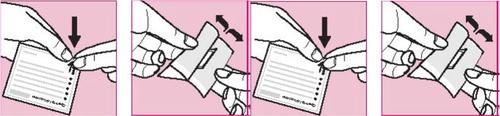
- Grasp both sides of the open pouch and peel them apart.
- Remove the patch and use it immediately.
- Keep the empty pouch to dispose of the used patch later.
- Use each patch only once.
- Do not remove the patch from the pouch until you are ready to use it.
- Inspect the patch to see if it is damaged.
- Do not use the patch if it is split, cut or appears damaged.
- Never split or cut the patch
Step 3: Peel and press
- Make sure the patch will be covered by comfortable clothing and is not blocked by a tight or elastic bandage.
- Carefully peel off one half of the shiny plastic backing starting from the center of the patch. Try not to touch the adhesive side of the patch.
- Press this adhesive part of the patch onto the skin.
- Remove the other half of the plastic backing and press the entire patch onto the skin with the palm of your hand.
- Hold the pressure for at least 30 seconds, making sure the patch adheres well, especially along the edges.
Step 4: Disposing of the patch
- As soon as you remove a patch, fold it firmly in half, with the adhesive side stuck to itself.
- Put it back in the original pouch and dispose of the pouch according to the pharmacist’s instructions.
- Keep used patches out of the sight and reach of children, as even used patches contain some medicine, which can be dangerous and even fatal for children.
Step 5: Wash
- Always wash your hands using only running water after touching the patch.
Other information for using DUROGESIC
Daily activities when using the patch
- The patch is waterproof.
- You can shower or bathe while wearing the patch, but do not rub it.
- If your doctor allows it, you can exercise or play sports while wearing the patch.
- You can also swim while wearing the patch, but:
- do not use hot thermal whirlpools
- do not put tight or elastic bandages over the patch
- While wearing the patch, do not expose it to direct heat sources such as hot water bottles, thermal blankets, hot water bags, heated waterbeds, heat lamps or sunbeds. Do not sunbathe, take hot baths or saunas for prolonged periods, otherwise the amount of medicine released from the patch may increase.
How long does it take for the patch to work?
- The first patch may take some time to reach its maximum effect.
- The doctor will provide you with other pain relievers for the first day or as needed
- After this period, the patch should help relieve pain continuously, so you can stop the other pain relievers. However, the doctor may always prescribe you additional pain relievers from time to time
How long will you have to use the patches?
- DUROGESIC patches are indicated for long-term pain. The doctor will be able to tell you how long they expect you to use the patches.
If the pain gets worse
- If the pain suddenly gets worse after applying your last patch, check your patch. If it is not attached well or has come off, replace the patch ( See also theparagraph If a patch comes off)
- If the pain gets worse over time while you are using these patches, the doctor may try a patch with a higher dose, or prescribe additional pain relievers (or both).
- If increasing the patch dose does not help, the doctor may decide to stop using the patches.
If you use too many patches or a patch with the wrong dosage
If you have applied too many patches or a patch with the wrong dosage, remove the patch and inform your
doctor immediately.
Signs of overdose include: difficulty breathing or shallow breathing, fatigue,
extreme drowsiness, inability to think clearly, walk or speak normally, and
feeling faint, dizzy or confused. An overdose can also cause a
brain disorder known as toxic leukoencephalopathy.
If you forget to change the patch
- If you forgot, change the patch as soon as you remember and note the day and time. Change again after 3 days (72 hours)as usual.
- If it is long overdue to change the patch, contact your doctor as you may need additional pain relievers, but do notapply an extra patch.
If the patch comes off
- If a patch comes off before you need to change it, apply a new one immediately and note the day and time. Use a new part of skin on:
- trunk or arm
- upper back (in a child).
- Tell your doctor what happened and leave the patch in place for 3 days (72 hours)or as directed by your doctor, before changing the patch as usual.
- If the patches continue to fall off, talk to your doctor, pharmacist or nurse.
If you want to stop using the patches
- Do not stop taking this medicine suddenly. If you want to stop taking this medicine, talk to your doctor first. The doctor will tell you how to do it, usually by gradually reducing the dose to minimize any unpleasant withdrawal symptoms. See also paragraph 2 ‘ Withdrawal symptoms when stopping DUROGESIC’
- If you stop using the patches, do not start again without first consulting your doctor. You may need a patch with a different dosage when you restart.
If you have any other questions about using this medicine, ask your doctor or pharmacist.
4. Possible side effects
Like all medicines, this medicine can cause side effects, although not everybody gets them.
If you, or someone else, notices that the person using the patch shows any of the following
symptoms, remove the patch and immediately call a doctor, or go to the nearest hospital,
because they may need urgent medical attention.
- Unusual drowsiness, with slower or shallower breathing than normal. Follow the recommendations above and keep the person who was using the patch as active as possible and make them talk. Very rarely, these breathing difficulties can be life-threatening or even fatal, especially in people who have never used strong opioid painkillers before (such as DUROGESIC or morphine). (Uncommon, may affect up to 1 in 100 people)
- Sudden redness of the face or throat, severe irritation, redness or blistering of the skin. These may be signs of a serious allergic reaction. (frequency cannot be estimated from available clinical data)
- Convulsions (seizures). (Uncommon, may affect up to 1 in 100 people)
- Decreased level of consciousness or loss of consciousness (Uncommon, may affect up to 1 in 100 people)
The following side effects have also been reported.
Very common (may affect more than 1 in 10 people)
- Nausea, vomiting, constipation
- Feeling sleepy (drowsiness)
- Feeling dizzy
- Headache
Common (may affect up to 1 in 10 people)
- Allergic reaction
- Loss of appetite
- Difficulty sleeping
- Depression
- Anxiety or confusion
- Seeing things, hearing sounds or smelling odors that are not there (hallucinations)
- Tremors or muscle spasms
- Unusual skin sensations, such as tingling or numbness (paresthesia)
- Feeling of spinning (vertigo)
- Fast or irregular heartbeat (palpitations, tachycardia)
- High blood pressure
- Shortness of breath (dyspnea)
- Diarrhea
- Dry mouth
- Stomach pain or indigestion
- Excessive sweating
- Itching, rash or redness of the skin
- Inability to urinate or to completely empty the bladder
- Feeling tired, weak or unwell
- Feeling cold
- Swelling of the hands, ankles or feet (peripheral edema)
Uncommon (may affect up to 1 in 100 people)
- Feeling agitated or disoriented
- Feeling extremely happy (euphoria)
- Decreased sensitivity, especially to the skin (hypoesthesia)
- Memory loss
- Blurred vision
- Slow heartbeat (bradycardia) or low blood pressure
- Bluish discoloration of the skin caused by a lack of oxygen in the blood (cyanosis)
- Loss of bowel contractions (ileus)
- Itchy rash (eczema), allergic reaction or other skin disorder where the patch is located
- Flu-like illness
- Feeling of change in body temperature
- Fever
- Muscle spasm
- Difficulty achieving or maintaining an erection (impotence) or problems during sexual intercourse
- Difficulty swallowing
Rare side effects (may affect up to 1 in 1,000 people)
- Constriction of the pupils (miosis)
- Interruption of breathing from time to time (apnea)
The following side effects have also been reported but their frequency is unknown:
- Lack of male sex hormones (androgen deficiency)
- Delirium (symptoms may include a combination of agitation, restlessness, disorientation, confusion, fear, seeing or hearing things that are not there, sleep disturbances, nightmares)
- You may become dependent on DUROGESIC (see section 2).
You may notice the presence of rash, redness or mild itching of the skin at the patch site. These
disorders are usually mild and disappear after you remove the patch. If this does not
happen, or if the patch severely irritates the skin, tell your doctor.
Repeated use of the patches may make the medicine less effective (you become tolerant or more sensitive to
pain) or you may become dependent on it.
If you switch to DUROGESIC from a different painkiller or if you suddenly stop using
DUROGESIC, you may experience withdrawal effects, such as vomiting, nausea, diarrhea, anxiety or chills.
Tell your doctor if any of these effects occur.
Withdrawal effects have also been reported in newborns after mothers have used
DUROGESIC for a long time during pregnancy.
Reporting of side effects
If you get any side effects, talk to your doctor, pharmacist or nurse. You can also report side effects directly
through the national reporting system at www.aifa.gov.it/content/segnalazioni-
reazioni-avverse.
By reporting side effects you can help provide more information on the safety of
this medicine.
5. How to store DUROGESIC
Where to store the patches
Keep all patches (used and unused) out of sight and reach of children.
Store in the original packaging to protect from light. This medicine does not require
particular temperature conditions for storage.
Keep this medicine in a safe and secure place, inaccessible to other people. Accidental or intentional
intake of this medicine by other people to whom it has not been prescribed
can cause serious harm and be fatal.
How long to store DUROGESIC
Do not use DUROGESIC after the expiry date stated on the carton and sachet. The expiry date refers to the last day of that month. If the patches are expired, they must be taken to
a pharmacy.
How to dispose of used patches or patches you no longer use
A used or unused patch that accidentally sticks to another person, especially a
child, can be fatal.
Used patches must be firmly folded in half so that the adhesive part of the patch sticks to itself. Subsequently, they must be stored securely in their original
sachet and kept out of sight and reach of other people, especially children, until their
safe disposal. Ask your pharmacist how to dispose of medicines you no longer use.
Do not dispose of any medicine in the drain water and household waste. These measures will help to
protect the environment.
6. Package Contents and Other Information
What DUROGESIC contains
DUROGESIC 12 μg / hour
The active ingredient of DUROGESIC is fentanyl. Each patch contains 2.1 mg of fentanyl, which releases
a dose of 12 micrograms / hour.
DUROGESIC 25 μg / hour
The active ingredient of DUROGESIC is fentanyl. Each patch contains 4.2 mg of fentanyl, which releases
a dose of 25 micrograms / hour.
DUROGESIC 50 μg / hour
The active ingredient of DUROGESIC is fentanyl. Each patch contains 8.4 mg of fentanyl, which releases
a dose of 50 micrograms / hour.
DUROGESIC 75 μg / hour
The active ingredient of DUROGESIC is fentanyl. Each patch contains 12.6 mg of fentanyl, which releases
a dose of 75 micrograms / hour.
DUROGESIC 100 μg / hour
The active ingredient of DUROGESIC is fentanyl. Each patch contains 16.8 mg of fentanyl, which releases
a dose of 100 micrograms / hour.
Other components of the patch are:
Support layer: film, vinyl acetate polyester / ethylene copolymer,
Protective liner: film, siliconized polyester,
Drug layer: polyacrylate adhesive.
Inks (on support)
DUROGESIC 12 µg/hour also containing printable ink, orange.
DUROGESIC 25 µg/hour also containing printable ink, red.
DUROGESIC 50 µg/hour also containing printable ink, green.
DUROGESIC 75 µg/hour also containing printable ink, blue.
DUROGESIC 100 µg/hour also containing printable ink, grey.
Description of the appearance of DUROGESIC and contents of the pack
DUROGESIC 12 μg / hour
DUROGESIC is a translucent rectangular patch with rounded corners. Each patch is 5.25 cm and
is marked with a border and "DUROGESIC 12 μg of fentanyl / h" in orange ink.
DUROGESIC 25 μg / hour
DUROGESIC is a translucent rectangular patch with rounded corners. Each patch is 10.5 cm and
is marked with a border and "DUROGESIC 25 μg of fentanyl / h" in red ink.
DUROGESIC 50 μg / hour
DUROGESIC is a translucent rectangular patch with rounded corners. Each patch is 21.0 cm and is
marked with a border and "DUROGESIC 50 μg of fentanyl / h" in green ink.
DUROGESIC 75 μg / hour
DUROGESIC is a translucent rectangular patch with rounded corners. Each patch is 31.5 cm, and is
marked with a border and "DUROGESIC 75 μg of fentanyl / h" in blue ink.
DUROGESIC 100 μg / hour
DUROGESIC is a translucent rectangular patch with rounded corners. Each patch is 42.0 cm, and is
marked with a border and "DUROGESIC 100 μg fentanyl / h" in grey ink.
The patches are individually packaged in heat-sealed pouches (acrylonitrile film or cyclic olefin copolymer) and are supplied in cartons containing 3, 4, 5, 8, 10, 16, 20 or 30 patches.
Not all pack sizes may be marketed.
Marketing Authorisation Holder and Manufacturer
Janssen-Cilag SpA
Viale Fulvio Testi, 280/6
20126 Milan MI
Manufacturer
Janssen Pharmaceutica NV - Turnhoutseweg 30, 2340 Beerse – Belgium
This medicinal product is authorised in the Member States of the European Economic Area and the United Kingdom
(Northern Ireland) with the following names:
| Austria, Belgium, Croatia, Cyprus, Czech Republic, Denmark, Finland, France, Greece, Hungary, Iceland, Italy, Luxembourg, Netherlands, Norway, Poland, Portugal, Slovenia, Sweden | Durogesic or c |
| Germany | Durogesic SMAT |
| Ireland, United Kingdom (Northern Ireland) | a Durogesic DTrans |
| Spain | Durogesic Matrix |

Не впевнені, чи підходить вам цей лікарський засіб?
Обговоріть симптоми та можливі варіанти лікування з лікарем онлайн.

Виникли питання під час прийому ліків?
Обговоріть свої симптоми та лікування з лікарем онлайн.

- Країна реєстрації
- Лікарська формаTransdermal patch, 25 MICROGRAMS/HOUR
- Код АТХN02AB03
- Діюча речовина
- Потрібен рецептТак
- Виробник
- Ця інформація надана лише для ознайомлення і не є медичною порадою. Рішення щодо лікування завжди приймає лікар.
- Альтернативи до DUROJESIKЛікарська форма: Sublingual tablet, 100 MCGДіюча речовина: фентанилВиробник: GRUNENTHAL ITALIA S.R.L.Потрібен рецептЛікарська форма: Orally disintegrating tablet, 200 MICROGRAMSДіюча речовина: фентанилВиробник: TEVA ITALIA S.R.L.Потрібен рецептЛікарська форма: Transdermal patch, 25MCG/ORAДіюча речовина: фентанилПотрібен рецепт
Аналоги DUROJESIK в інших країнах
Препарати з тією самою діючою речовиною, доступні в інших країнах.
Аналог DUROJESIK у Іспанія
Аналог DUROJESIK у Польща
Аналог DUROJESIK у Україна
Лікарі онлайн щодо DUROJESIK
Застосування, безпека та можливість призначення рецепта — за результатами медичної оцінки.









Отримайте рецепт на DUROJESIK онлайн
Заповніть форму за 2 хвилини
Розкажіть про симптоми, історію хвороби та потрібний препарат.
Оберіть лікаря або ми призначимо
Оберіть спеціаліста або ми підберемо найближчого доступного лікаря.
Лікар розглядає ваш випадок
Зазвичай протягом 30 хвилин. Може ставити уточнювальні запитання в чаті.
Отримайте в будь-якій аптеці
Електронний рецепт надсилається на вашу пошту — дійсний по всій Польщі.
Часті запитання
DUROJESIK потребує рецепта в Італія. Ви можете обговорити з лікарем онлайн, чи підходить цей лікарський засіб для вашої ситуації.
Діюча речовина у DUROJESIK — фентанил. Це допомагає визначити препарати з тим самим складом, але під іншими торговими назвами.
DUROJESIK виробляється компанією JANSSEN CILAG S.P.A.. Назва бренду та упаковка можуть відрізнятися залежно від дистрибʼютора.
Лікарі, зокрема Сімейні лікарі, Психіатри, Дерматологи, Кардіологи, Ендокринологи, Гастроентерологи, Пульмонологи, Нефрологи, Ревматологи, Гематологи, Інфекціоністи, Алергологи, Геріатри, Педіатри, Онкологи, можуть оцінити доцільність застосування DUROJESIK з урахуванням вашого стану та місцевих правил. Ви можете записатися на онлайн-консультацію, щоб обговорити симптоми та можливі подальші кроки.
Польща має добре розвинену систему охорони здоров'я у великих містах, таких як Варшава, Краків, Вроцлав і Гданськ. Аптеки широко доступні та працюють відповідно до чинного законодавства, забезпечуючи доступ до рецептурних препаратів.
Ви можете придбати DUROJESIK у Варшаві, Кракові, Вроцлаві або Гданську в будь-якій аптеці за наявності дійсного рецепта.
Щоб отримати рецепт, ви можете скористатися Oladoctor:
Інші препарати з тією самою діючою речовиною (фентанил) включають ABSTRAL, AKTIQ, ALJEDON. Вони можуть відрізнятися торговою назвою або формою випуску, але містять той самий терапевтичний компонент. Перед зміною або початком прийому нового препарату варто проконсультуватися з лікарем.
