



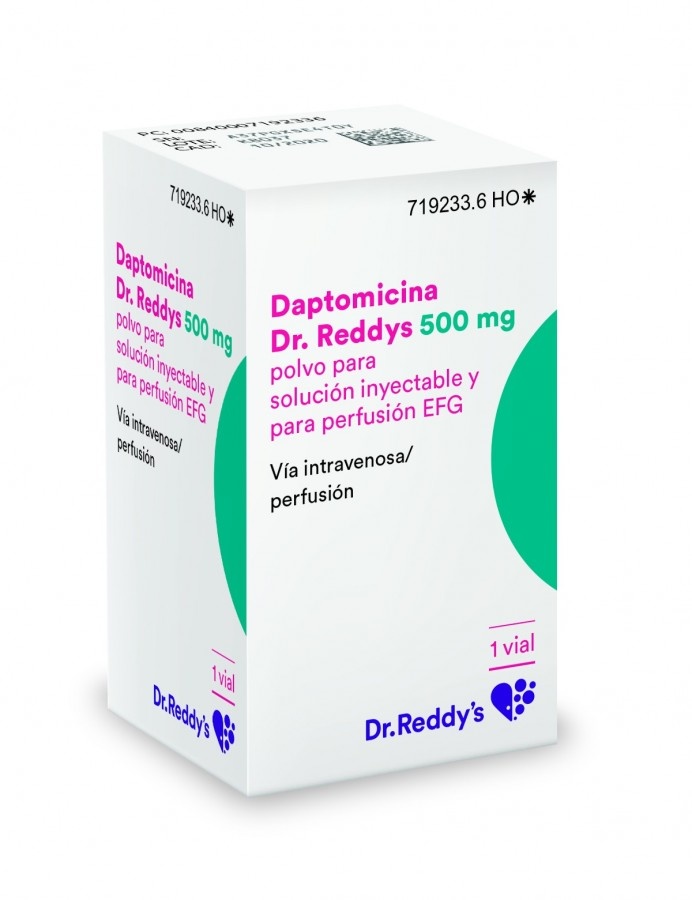
DAPTOMICINA 350 mg Powder For Injectable/Infusion Solution

Запит на рецепт онлайн
Лікар розгляне ваш випадок і визначить, чи є рецепт медично доцільним.

Поговоріть з лікарем про ці ліки
Обговоріть симптоми та можливі подальші кроки під час короткої онлайн-консультації.



Інструкція із застосування DAPTOMIKINA DR. REDDY'S
Зміст інструкції
- Daptomicina Dr. Reddy’s 350 mg powder for injectable solution or for infusion, 500 mg powder for injectable solution or for infusion
- Daptomicina Dr. Reddy's 500 mg powder for injectable solution or for
Daptomicina Dr. Reddy’s 350 mg powder for injectable solution or for infusion, 500 mg powder for injectable solution or for infusion
Read this leaflet carefully before you start using this medicine as it contains important
information for you.
- Keep this leaflet. You may need to read it again.
- If you have any questions, ask your doctor or nurse.
- This medicine has been prescribed for you only. Do not pass it on to others, even if their symptoms are the same as yours, as it may be harmful.
- If you get any side effects, even if not listed in this leaflet, tell your doctor or nurse. See section 4.
Contents of this leaflet:
1. What is Daptomicina Dr. Reddy’s and what it is used for
2. What you need to know before you are given Daptomicina Dr. Reddy’s
3. How Daptomicina Dr. Reddy’s is given
4. Possible side effects
5. How to store Daptomicina Dr. Reddy’s
6. Contents of the pack and other information
1. What is Daptomicina Dr. Reddy’s and what it is used for
The active substance of Daptomicina Dr. Reddy’s powder for injectable solution or for infusion is
daptomycin. Daptomycin is an antibacterial medicine that can stop the growth of some bacteria.
Daptomicina Dr. Reddy’s is used in adults and children and adolescents (age from 1 to 17 years)
to treat skin and soft tissue infections. It is also used in adults for the
treatment of infections of the tissues lining the inside of the heart (including heart valves)
caused by a bacterium called Staphyloccocus aureusand for the treatment of blood infections caused by the same bacterium when they are associated with skin and soft tissue
infections.
Depending on the type of infection(s) you have, your doctor may also prescribe other
antibacterial medicines during treatment with Daptomicina Dr. Reddy’s.
2. What you need to know before you are given Daptomicina Dr. Reddy’s
You must not be given Daptomicina Dr. Reddy’s
- If you are allergic to daptomicin or sodium hydroxide or to any of the other ingredients of this medicine (listed in section 6). If this is the case, inform your doctor or nurse. If you think you may be allergic, consult your doctor or nurse.
Warnings and precautions
Consult your doctor or nurse before you are given Daptomicina Dr. Reddy’s:
- If you have or have previously had kidney problems. Your doctor may need to adjust the
- Patients treated with daptomicin sometimes experience muscle suffering or pain or muscle weakness
your doctor. The doctor will ensure that you undergo a blood test and will advise you if
you should continue or discontinue the administration of daptomicin. The symptoms, as a rule, disappear within a few
days after stopping daptomicin.
- If you are overweight. It is possible that levels of daptomicin in the blood may be higher than those observed in people of average weight, so you may need to be monitored more closely for side effects. If you fall into one of these categories, inform your doctor or nurse before you are given Daptomicina Dr. Reddy’s.
Tell your doctor immediately if you develop any of the following symptoms:
- Severe acute allergic reactions have been observed in patients treated with almost all antibacterial medicines, including daptomicin. Tell your doctor or nurse immediately if you experience symptoms that may suggest an allergic reaction, such as wheezing, difficulty breathing, swelling of the face, neck and throat, skin rashes and hives, fever (see
- Unusual tingling or numbness in the hands or feet, loss of sensation or difficulty moving. If this happens, inform your doctor who will decide whether to continue treatment.
- Diarrhea, especially if you notice the presence of blood or mucus, or if the diarrhea becomes severe or persistent.
- Onset or worsening of fever, cough or difficulty breathing. These may be signs of a rare but serious lung disease called eosinophilic pneumonia. The doctor will check the condition of your lungs and decide whether or not to continue treatment with daptomicin.
Daptomicin can interfere with laboratory tests performed to measure blood coagulation.
The results may suggest a difficulty in blood coagulation, even if there is actually no
problem. It is therefore important that your doctor is aware that you are taking
daptomicin. Inform your doctor that you are being treated with daptomicin.
The doctor will perform blood tests to check the condition of your muscles both before
starting treatment and frequently during treatment with daptomicin.
Children and adolescents
Daptomicin should not be given to children under one year of age as studies
conducted on animals have indicated that serious adverse effects may occur in this age group.
Use in the elderly
People over 65 years of age can take the same dose as adults, provided
they have normal kidney function.
Other medicines and Daptomicina Dr. Reddy’s
Tell your doctor or nurse if you are taking, have recently taken or might take
any other medicine. It is particularly important that you tell them if you are taking:
- Medicines called statins or fibrates (to lower cholesterol) or cyclosporine (a medicine used in transplants to prevent organ rejection or in other conditions such as rheumatoid arthritis or atopic dermatitis). If you take these medicines (and others that can cause effects on muscles) during therapy with daptomicin, the risk of adverse effects on muscles may be increased. The doctor may decide not to prescribe daptomicin or to stop the use of other medicines for a certain period of time.
- Pain relievers called non-steroidal anti-inflammatory drugs (NSAIDs) or COX-2 inhibitors (e.g. celecoxib). These may interfere with the effects of daptomicin on the kidneys.
- Oral anticoagulants (e.g. warfarin) which are medicines that prevent blood from clotting. Your doctor may need to check your bleeding time.
Pregnancy and breastfeeding
Daptomicin is not generally given to pregnant women. If you are pregnant, suspect or are planning a pregnancy, or if you are breastfeeding, ask
your doctor or pharmacist for advice before you are given this medicine.
Do not breastfeed if you are taking daptomicin, as daptomicin passes into breast milk and
consequently, may have effects on the baby.
Driving and operating machinery
Daptomicin has no known effects on the ability to drive and operate machinery.
3. How Daptomicina Dr. Reddy’s is administered
Daptomicina is usually administered by a doctor or nurse.
The dose administered depends on your weight and the type of infection to be treated. In adults, the usual
dose is 4 mg per kilogram (kg) of body weight, administered once a day for
skin infections or 6 mg per kg of body weight administered once a day for
a heart infection or a blood infection associated with skin or heart infection. In
adult patients, this dose is injected directly into the bloodstream (into the vein) or as
an infusion lasting approximately 30 minutes or as an injection lasting approximately 2 minutes. The same dose
is recommended for people over 65 years of age, provided they have normal kidney function.
Children and adolescents (from 1 to 17 years)
The dose for children and adolescents (from 1 to 17 years of age) to be used for the treatment of skin
infections depends on the patient's age. The recommended doses based on age are shown in the
table below:
| Age group | n Dosage | Treatment duration |
| 12 to 17 years | a 5 mg/kg once every 24 hours to be administered by infusion over 30 minutes | Up to 14 days |
| 7 to 11 years | i 7 mg/kg once every 24 hours to be administered by infusion over 30 minutes | |
| 2 to 6 years | l a 9 mg/kg once every 24 hours to be administered by infusion over 60 minutes | |
| 1 to < 2 years | t 10 mg/kg once every 24 hours to be administered by infusion over 60 minutes |
If your kidney function is impaired, you may take daptomicina less frequently, e.g. on
alternate days. If you are on dialysis and the next dose of daptomicina needs to be administered on the same
day, you will usually be given daptomicina at the end of dialysis.
Usually, for skin infections, a treatment cycle lasts from 1 to 2 weeks. For
blood or heart infections and skin infections, the doctor will decide how long you should
be treated.
4. Possible side effects
Like all medicines, this medicine can cause side effects, although not everybody gets them.
The more serious side effects are described below:
Very rare serious side effects(may affect up to 1 in 10,000 people)
- In some cases, a hypersensitivity reaction (severe allergic reaction including anaphylaxis, angioedema, drug reaction with eosinophilia and systemic symptoms (DRESS)) has been reported during the administration of daptomicina. This severe allergic reaction requires immediate medical attention. Tell your doctor or nurse immediately if you experience any of the following symptoms:
- Chest pain or tightness
- Skin rash with blistering that, sometimes, affects the mouth and genitals
- Swelling around the throat
- Fast or weak heartbeat
- Wheezing
- Fever
- Chills or tremors
- Hot flushes
- Dizziness
- Fainting
- Metallic taste in the mouth
If you notice the unexplained onset of muscle pain, tenderness, or weakness, tell your doctor
immediately. Muscle problems have been reported very rarely (in less than 1 in 10,000 patients) and can be
severe, including muscle breakdown (rhabdomyolysis) which can cause kidney damage.
Serious side effects with frequency not known(frequency cannot be estimated from the available
data)
A rare but potentially serious lung disease, called eosinophilic pneumonia, has been reported
in patients receiving daptomicina, most often after more than 2 weeks of
treatment. Symptoms may include difficulty breathing, onset or worsening of cough, or
onset or worsening of fever. If you experience these symptoms, tell your doctor or
nurse immediately.
If you experience raised, fluid-filled spots on a large area of your body, tell your
doctor or nurse immediately.
The more frequently reported side effects are described below:
Common side effects(may affect up to 1 in 10 people)
- Fungal infections such as candidiasis,
- Urinary tract infections,
- Reduced number of red blood cells in the blood (anemia),
- Dizziness, anxiety, difficulty sleeping,
- Headache,
- Fever, weakness (asthenia),
- High or low blood pressure,
- Constipation, abdominal pain,
- Diarrhea, feeling sick (nausea) or being sick (vomiting),
- Flatulence,
- Abdominal bloating or distension,
- Skin rash or itching,
- Pain, itching or redness at the infusion site,
- Arm or leg pain,
- Increased levels of liver enzymes or creatine phosphokinase (CPK) shown in blood tests. Other side effects that may occur following treatment with daptomicina are described below:
Uncommon side effects(may affect up to 1 in 100 people)
- Changes in blood tests (e.g. increase in the number of small particles called platelets, which may increase the tendency to bleed, or increase in the levels of certain types of white blood cells),
- Loss of appetite
- Tingling or numbness in the hands and feet, altered taste,
- Tremor
- Changes in heart rate, hot flushes
- Indigestion (dyspepsia), inflammation of the tongue
- Itchy skin rash
- Muscle pain, cramps or weakness, muscle inflammation (myositis), joint pain
- Kidney problems
- Inflammation and irritation of the vagina
- General pain or weakness, fatigue
- Blood tests showing increased levels of blood sugar, serum creatinine, myoglobin or lactate dehydrogenase (LDH), prolonged bleeding time or electrolyte imbalance,
- Itchy eyes.
Rare side effects(may affect up to 1 in 1,000 people)
- Yellowing of the skin and eyes,
- Prolonged prothrombin time. Frequency not known(frequency cannot be estimated from the available data) Antibiotic-associated colitis, including pseudomembranous colitis (severe and persistent diarrhea containing blood and/or mucus, associated with abdominal pain or fever), easy bruising, bleeding gums or nosebleeds.
Reporting of side effects
If you get any side effects, talk to your doctor or nurse. This includes any side effects not listed in this
leaflet. You can also report side effects directly through the national reporting system at
www.agenziafarmaco.gov.it/content/come-segnalare-una-sospetta-reazione-avversa. By reporting side
effects you can help provide more information on the safety of this medicine.
5. How to store Daptomicina Dr. Reddy’s
Keep this medicine out of the sight and reach of children.
Store in a refrigerator (2°C – 8°C).
After reconstitution: The chemical and physical stability during use of the reconstituted solution in the vial
has been demonstrated for 12 hours at 25°C and up to 48 hours at 2°C-8°C. The chemical and physical stability of the
reconstituted solution in the infusion bag has been established for 12 hours at 25°C or 24 hours at 2°C-8°C.
For intravenous infusion lasting 30 minutes, the overall storage period
(reconstituted solution in the vial and diluted solution in the infusion bag; see section 6.6)
should not exceed 12 hours at 25 °C (24 hours at 2°C-8°C).
For intravenous injection of 2 minutes, the storage period of the reconstituted solution in the
vial (see section 6.6) should not exceed 12 hours at 25°C (or 48 hours at 2°C-8°C).
However, from a microbiological point of view, the medicine must be used immediately.
No preservative or bacteriostatic agent is present in this product. If not used
immediately, the user is responsible for the storage period during use which, as a rule, should not exceed 24 hours at 2 °C-8 °C, unless the reconstitution/dilution has been
carried out under controlled and validated aseptic conditions.
Do not use this medicine after the expiry date which is stated on the carton and label after
Exp. The expiry date refers to the last day of that month.
Do not use this medicine if you notice visible signs of deterioration.
Do not dispose of any medicine in wastewater or household waste. Ask your pharmacist how to
dispose of medicines you no longer use. This will help protect the environment.
6. Contents of the pack and other information
What Daptomicina Dr. Reddy’s contains
The active ingredient is daptomycin.
A vial of powder contains 350 mg of daptomycin.
After reconstitution with 7 ml of sodium chloride 9 mg/ml (0.9%) solution, one ml provides 50 mg of
daptomycin.
A vial of powder contains 500 mg of daptomycin.
After reconstitution with 10 ml of sodium chloride 9 mg/ml (0.9%) solution, one ml provides 50 mg of
daptomycin.
The other component is sodium hydroxide.
Description of the appearance of Daptomicina Dr. Reddy’s and contents of the pack
Daptomicina Dr. Reddy’s powder for injectable solution or for infusion is supplied as a lyophilized or
powder of a light yellow to light brown colour in a glass vial. Before
administration it is mixed with a solvent to form a liquid.
Daptomicina Dr. Reddy’s is available in packs of 1 vial.
Marketing Authorisation Holder
DR. REDDY'S S.R.L.
PIAZZA SANTA MARIA BELTRADE 1, 20123 MILANO
Manufacturer
Dr. Reddy’s Laboratories (UK) Ltd
6 Riverview Road, Beverley, HU17 0LD
United Kingdom
betapharm Arzneimittel GmbH
Kobelweg 95, Augsburg, 86156
Germany
This medicinal product is authorised in the Member States of the European Economic Area with the
following denominations:
Germany Daptomycin beta 350 mg, Pulver zur Herstellung einer Injektionslösung
oder einer Infusionslösung
Daptomycin beta 500 mg, Pulver zur Herstellung einer Injektionslösung
oder einer Infusionslösung
Spain Daptomicina Dr. Reddy 350 mg, powder for solution for perfusion
Daptomicina Dr. Reddy 500 mg, powder for solution for perfusion
United Kingdom Daptomycin Dr. Reddy's 350 mg Powder For Solution For Injection Or
Infusion
Daptomycin Dr. Reddy's 500 mg Powder For Solution For Injection Or
Infusion
Italy Daptomicina Dr. Reddy's 350 mg powder for injectable solution or for
infusion
Daptomicina Dr. Reddy's 500 mg powder for injectable solution or for
infusion
This package insert has been updated on
The following information is intended exclusively for healthcare professionals
Important:
Before prescribing, consult the Summary of Product Characteristics
Instructions for use and handling
Daptomycin can be administered intravenously as an infusion lasting 30 or 60
minutes or as an injection lasting 2 minutes. Preparing the solution for infusion
requires further dilution, as described below.
Administration of Daptomicina Dr. Reddy’s as an intravenous infusion lasting 30 or
60 minutes
A concentration of 50 mg/ml of Daptomicina Dr. Reddy’s for infusion is obtained by
reconstituting the lyophilized powder with 7 ml (for Daptomicina Dr. Reddy’s 350 mg powder) or 10 ml (for
Daptomicina Dr. Reddy’s 500 mg powder) of sodium chloride 9 mg/ml (0.9%) injectable solution.
Approximately 15 minutes are required to dissolve the lyophilized powder. The fully
reconstituted medicine has a clear appearance and some bubbles or foam may be present around the edges
of the vial.
To prepare Daptomicina Dr. Reddy’s for intravenous infusion, follow these
instructions: Throughout the entire reconstitution process of Daptomicina Dr. Reddy’s
lyophilized powder, aseptic technique must be used.
- 1. Remove the polypropylene flip-off cap to expose the center of the rubber stopper. Clean the top of the rubber stopper with a swab soaked in alcohol or another antiseptic solution and allow to dry. After cleaning, do not touch the rubber stopper or allow it to touch any other surface. Using a sterile transfer needle 21 gauge or smaller, or a needle-free device, draw 7 ml (for Daptomicina Dr. Reddy’s 350 mg powder) or 10 ml (for Daptomicina Dr. Reddy’s 500 mg powder) of sodium chloride 9 mg/ml (0.9%) injectable solution into a syringe and slowly inject it into the vial, inserting the needle into the center of the rubber stopper with the tip directed towards the wall of the vial.
- 2. Gently rotate the vial to ensure that the product is completely wetted by the liquid, then let it stand for 10 minutes.
- 3. Finally, gently rotate the vial for a few minutes until a clear reconstituted solution is obtained. Avoid vigorous shaking/shaking of the vial to prevent foam formation.
- 4. Before use, the reconstituted solution must be carefully checked to ensure that the product is completely dissolved and inspected visually for the absence of particulate matter. The color of the reconstituted solution of Daptomicina Dr. Reddy’s may range from pale yellow to light brown.
- 5. Slowly remove the reconstituted liquid (50 mg of daptomycin/ml) from the vial using a sterile needle 21 gauge or smaller and a new syringe, as described in point 6.
- 6. Invert the vial to allow the solution to flow towards the stopper. Using the new syringe, insert the needle into the inverted vial. Keeping the vial inverted, keep the tip of the needle at the bottom of the solution while drawing the solution into the syringe. Before removing the needle from the vial, pull back the plunger to the end of the syringe body to aspirate all the solution from the inverted vial.
- 7. The reconstituted solution must then be diluted with sodium chloride 9 mg/ml (0.9%) (typical volume 50 ml).
- 8. For intravenous infusion administered with a syringe, replace the needle with a new needle.
- 9. Expel air, large bubbles and excess solution until the required dose is obtained.
- 10. The reconstituted and diluted solution must then be administered by intravenous infusion over 30 or 60 minutes.
The overall storage period (reconstituted solution in the vial and diluted solution in the
infusion bag) must not exceed 12 hours at 25°C (24 hours if stored in the refrigerator).
The stability of the diluted solution in the infusion bag is 12 hours at 25°C or 24 hours if stored
in a refrigerator at 2°C-8°C.
Administration of Daptomicina Dr. Reddy’s by intravenous injection lasting 2
minutes (adult patients only)
Water should not be used to reconstitute Daptomicina Dr. Reddy’s for intravenous injection. Daptomicina Dr. Reddy’s must only be reconstituted with sodium chloride 9 mg/ml (0.9%).
A concentration of 50 mg/ml of Daptomicina Dr. Reddy’s for injection is obtained by
reconstituting the lyophilized powder with 7 ml (for Daptomicina Dr. Reddy’s 350 mg powder) or 10 ml (for
Daptomicina Dr. Reddy’s 500 mg powder) of sodium chloride 9 mg/ml (0.9%) injectable solution.
Approximately 15 minutes are required to dissolve the lyophilized powder. The fully
reconstituted medicine has a clear appearance and some bubbles or foam may be present around the edges
of the vial.
To prepare Daptomicina Dr. Reddy’s for intravenous injection, follow these
instructions:
Throughout the entire reconstitution process of Dapotmicina Dr. Reddy’s lyophilized powder, aseptic technique must be used.
- 1. Remove the polypropylene flip-off cap to expose the center of the rubber stopper. Clean the top of the rubber stopper with a swab soaked in alcohol or another antiseptic solution and allow to dry. After cleaning, do not touch the rubber stopper or allow it to touch any other surface. Using a sterile transfer needle 21 gauge or smaller, or a needle-free device, draw 7 ml (for Daptomicina Dr. Reddy’s 350 mg powder) or 10 ml (for Daptomicina Dr. Reddy’s 500 mg powder) of sodium chloride 9 mg/ml (0.9%) injectable solution into a syringe and slowly inject it into the vial, inserting the needle into the center of the rubber stopper with the tip directed towards the wall of the vial.
- 2. Gently rotate the vial to ensure that the product is completely wetted by the liquid and then let it stand for 10 minutes.
- 3. Finally, gently rotate the vial for a few minutes until a clear reconstituted solution is obtained. Avoid shaking or vigorously shaking the vial to prevent foam formation.
- 4. Before use, the reconstituted solution must be carefully checked to ensure that the product is completely dissolved and inspected visually for the absence of particulate matter. The color of the reconstituted solution of Daptomicina Dr. Reddy’s may range from pale yellow to light brown.
- 5. Slowly remove the reconstituted liquid (50 mg of daptomycin/ml) from the vial using a sterile needle 21 gauge or smaller and a new syringe, as described in point 6.
- 6. Invert the vial to allow the solution to flow towards the stopper. Using a new syringe, insert the needle into the inverted vial. Keeping the vial inverted, position the tip of the needle at the bottom of the solution while drawing the solution into the syringe. Before removing the needle from the vial, pull back the plunger to the end of the syringe body to aspirate all the solution from the inverted vial.
- 7. Replace the needle with a new needle for intravenous injection.
- 8. Expel air, large bubbles and excess solution until the required dose is obtained.
- 9. The reconstituted solution must then be injected slowly intravenously over 2 minutes.
The chemical-physical stability during use of the reconstituted solution in the vial has been demonstrated
for 12 hours at 25°C and up to 48 hours if stored in the refrigerator (2°C - 8°C).
However, from a microbiological point of view, the product must be used immediately. If not
used immediately, the user is responsible for the storage period during use
which, as a rule, must not exceed 24 hours at 2°C – 8°C, unless the reconstitution/dilution has been
carried out under controlled and validated aseptic conditions.
This medicine must not be mixed with other medicinal products except those mentioned
above.
Daptomicina Dr. Reddy’s is for single use only. Any unused solution remaining in the vial
must be discarded.

Не впевнені, чи підходить вам цей лікарський засіб?
Обговоріть симптоми та можливі варіанти лікування з лікарем онлайн.

Виникли питання під час прийому ліків?
Обговоріть свої симптоми та лікування з лікарем онлайн.
- Країна реєстрації
- Лікарська формаPowder for injectable/infusion solution, 350 MG
- Код АТХJ01XX09
- Діюча речовина
- Потрібен рецептТак
- Виробник
- Ця інформація надана лише для ознайомлення і не є медичною порадою. Рішення щодо лікування завжди приймає лікар.
- Альтернативи до DAPTOMIKINA DR. REDDY'SЛікарська форма: Powder and solvent for injectable solution, 350 MGДіюча речовина: ДаптомицинВиробник: ACCORD HEALTHCARE, S.L.U.Потрібен рецептЛікарська форма: Powder for injectable/infusion solution, 350 MGДіюча речовина: ДаптомицинВиробник: Eugia Pharma (Malta) LimitedПотрібен рецептЛікарська форма: Powder for injectable/infusion solution, 350 MGДіюча речовина: ДаптомицинВиробник: FOSUN PHARMA SP ZOOПотрібен рецепт
Аналоги DAPTOMIKINA DR. REDDY'S в інших країнах
Препарати з тією самою діючою речовиною, доступні в інших країнах.
Аналог DAPTOMIKINA DR. REDDY'S у Іспанія
Аналог DAPTOMIKINA DR. REDDY'S у Польща
Аналог DAPTOMIKINA DR. REDDY'S у Україна
Лікарі онлайн щодо DAPTOMIKINA DR. REDDY'S
Застосування, безпека та можливість призначення рецепта — за результатами медичної оцінки.









Отримайте рецепт на DAPTOMIKINA DR. REDDY'S онлайн
Заповніть форму за 2 хвилини
Розкажіть про симптоми, історію хвороби та потрібний препарат.
Оберіть лікаря або ми призначимо
Оберіть спеціаліста або ми підберемо найближчого доступного лікаря.
Лікар розглядає ваш випадок
Зазвичай протягом 30 хвилин. Може ставити уточнювальні запитання в чаті.
Отримайте в будь-якій аптеці
Електронний рецепт надсилається на вашу пошту — дійсний по всій Польщі.
Часті запитання
DAPTOMIKINA DR. REDDY'S потребує рецепта в Італія. Ви можете обговорити з лікарем онлайн, чи підходить цей лікарський засіб для вашої ситуації.
Діюча речовина у DAPTOMIKINA DR. REDDY'S — Даптомицин. Це допомагає визначити препарати з тим самим складом, але під іншими торговими назвами.
DAPTOMIKINA DR. REDDY'S виробляється компанією DR. REDDY'S S.R.L.. Назва бренду та упаковка можуть відрізнятися залежно від дистрибʼютора.
Лікарі, зокрема Сімейні лікарі, Психіатри, Дерматологи, Кардіологи, Ендокринологи, Гастроентерологи, Пульмонологи, Нефрологи, Ревматологи, Гематологи, Інфекціоністи, Алергологи, Геріатри, Педіатри, Онкологи, можуть оцінити доцільність застосування DAPTOMIKINA DR. REDDY'S з урахуванням вашого стану та місцевих правил. Ви можете записатися на онлайн-консультацію, щоб обговорити симптоми та можливі подальші кроки.
Польща має добре розвинену систему охорони здоров'я у великих містах, таких як Варшава, Краків, Вроцлав і Гданськ. Аптеки широко доступні та працюють відповідно до чинного законодавства, забезпечуючи доступ до рецептурних препаратів.
Ви можете придбати DAPTOMIKINA DR. REDDY'S у Варшаві, Кракові, Вроцлаві або Гданську в будь-якій аптеці за наявності дійсного рецепта.
Щоб отримати рецепт, ви можете скористатися Oladoctor:
Інші препарати з тією самою діючою речовиною (Даптомицин) включають DAPTOMIKINA AKKORD, DAPTOMIKINA EUJIA, DAPTOMIKINA FOSUN PARMA. Вони можуть відрізнятися торговою назвою або формою випуску, але містять той самий терапевтичний компонент. Перед зміною або початком прийому нового препарату варто проконсультуватися з лікарем.
