



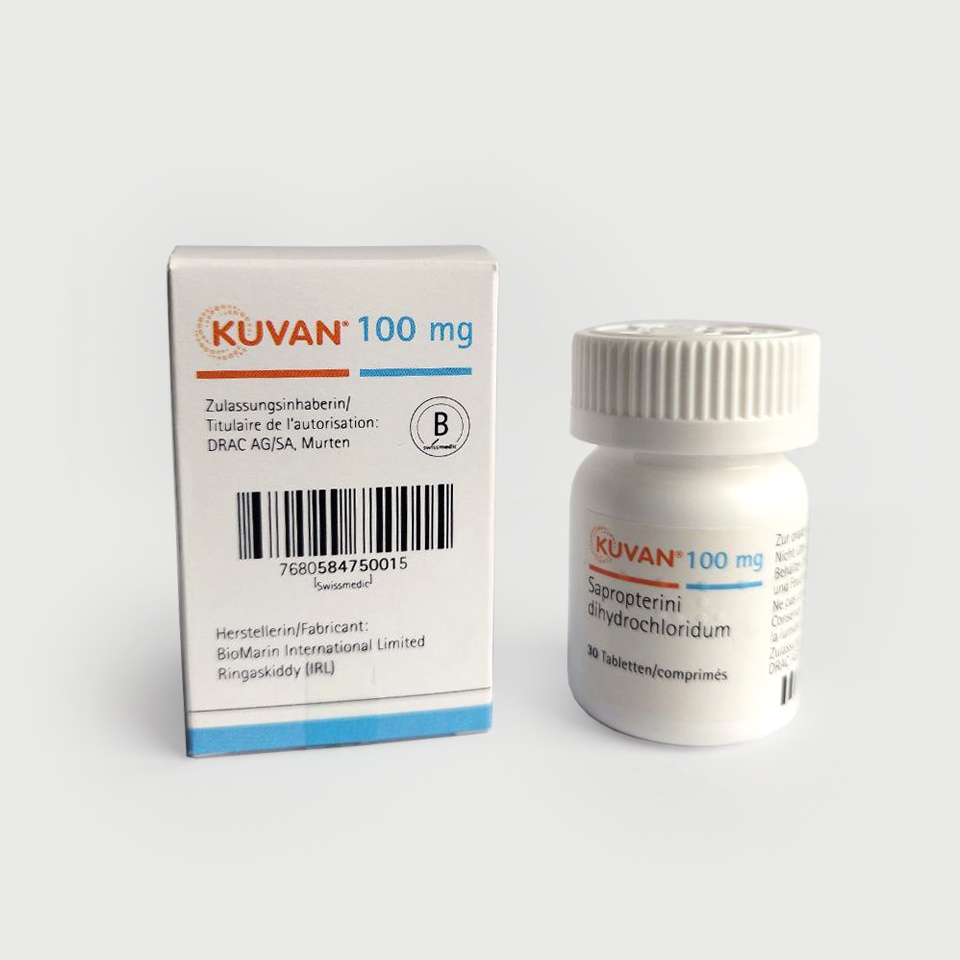
KUVAN 100 mg Soluble Tablet

Запит на рецепт онлайн
Лікар розгляне ваш випадок і визначить, чи є рецепт медично доцільним.

Поговоріть з лікарем про ці ліки
Обговоріть симптоми та можливі подальші кроки під час короткої онлайн-консультації.



Інструкція із застосування KUVAN
Зміст інструкції
- Kuvan 100 mg soluble tablets
- Kuvan 100 mg powder for oral solution
- Kuvan 500 mg powder for oral solution
Kuvan 100 mg soluble tablets
Sapropterin dihydrochloride
Read this leaflet carefully before you start taking this medicine because it contains
important information for you.
- Keep this leaflet. You may need to read it again.
- If you have any questions, ask your doctor or pharmacist.
- This medicine has been prescribed for you only. Do not pass it on to others, even if they have the same symptoms as you, as it may be harmful.
- If you get any side effects, even those not listed in this leaflet, tell your doctor or pharmacist. See section 4.
Contents of this leaflet:
- 1. What Kuvan is and what it is used for
- 2. What you need to know before you take Kuvan
- 3. How to take Kuvan
- 4. Possible side effects
- 5. How to store Kuvan
- 6. Contents of the pack and other information
1. What is Kuvan and what it is used for
Kuvan contains the active ingredient sapropterin, which is a synthetic copy of a substance present in our
body and called tetrahydrobiopterin (BH4). The purpose of the BH4 molecule is to help the
body use an amino acid called phenylalanine to transform it into another amino acid
called tyrosine.
Kuvan is used to treat hyperphenylalaninemia (HPA) or phenylketonuria (PKU) in patients of
any age. HPA and PKU are due to abnormally high levels of phenylalanine in the blood,
which can be harmful. Kuvan reduces these levels in some patients who respond to BH4 and can
help to increase the amount of phenylalanine that can be included in the dietary intake.
This medicine is also used to treat an inherited disease called BH4 deficiency, in
patients of any age, in which our body does not produce enough BH4. Due to very low levels of BH4, phenylalanine is not used appropriately and its levels
increase causing harmful effects. By replacing the BH4 that our body does not produce,
Kuvan reduces the harmful effects of excess phenylalanine in the blood and increases the tolerance of
phenylalanine in the dietary intake.
2. What you need to know before taking Kuvan
Do not take Kuvan
If you are allergic to sapropterin or any of the other ingredients of this medicine (listed in
section 6).
Warnings and precautions
Talk to your doctor or pharmacist before taking Kuvan, especially if:
- you are over 65 years old
- you have problems with your kidneys or liver
- you are unwell. Consulting your doctor is recommended as phenylalanine levels may increase during illness
- you have a history of seizures
During treatment with Kuvan, your doctor will perform blood tests to determine the levels of phenylalanine and tyrosine present in it and may decide, if necessary, to
modify the dosage of Kuvan or your diet.
You must continue your dietary treatment as recommended by your doctor. Do not change your
diet without contacting your doctor. Even if you take Kuvan, serious neurological problems may occur if phenylalanine levels in the blood are not kept under control. During treatment
with Kuvan, the doctor must continue to frequently monitor phenylalanine levels in the blood,
to ensure that they are not too high or too low.
Other medicines and Kuvan
Tell your doctor or pharmacist if you are taking, have recently taken or might take
any other medicines. In particular, you should inform your doctor if you are using:
- levodopa (used to treat Parkinson's disease)
- medicines used to treat cancer (e.g. methotrexate)
- medicines used to treat bacterial infections (e.g. trimethoprim)
- medicines that cause dilation of blood vessels (such as glyceryl trinitrate (GTN), isosorbide dinitrate (ISDN), sodium nitroprusside (SNP), molsidomine, minoxidil).
Pregnancy and breastfeeding
If you are pregnant, suspect you are pregnant or are planning to become pregnant, or if you are breastfeeding with
breast milk, ask your doctor or pharmacist for advice before taking this medicine.
If you are pregnant, your doctor will tell you how to adequately control your phenylalanine levels. If phenylalanine levels are not well controlled before or during pregnancy, this can harm you and your baby. The doctor will monitor the limitation of phenylalanine
taken through diet before and during pregnancy.
If a strict diet does not allow you to adequately reduce the amount of phenylalanine in your blood, the
doctor will decide whether you should take this medicine.
You should not take this medicine during breastfeeding.
Driving and using machines
It is not believed that the use of Kuvan interferes with the ability to drive or operate machinery.
Important information about some of the excipients in Kuvan
This medicine contains less than 1 mmol of sodium (23 mg) per tablet, i.e. essentially
‘sodium-free’.
3. How to take Kuvan
Take this medicine following exactly the instructions of your doctor. If you have any doubts, consult your doctor.
Dosage for PKU
The recommended initial dose of Kuvan in patients with PKU is 10 mg for each kg of body weight.
Take Kuvan once a day, with meals to increase absorption, always at the same time and preferably in the morning. Your doctor may adjust your dose, usually between 5 and 20 mg per day for each kg of body weight, depending on your needs.
Dosage for BH4 deficiency
The recommended initial dose of Kuvan in patients with BH4 deficiency is between 2 and 5 mg
for each kg of body weight. Take Kuvan with meals to increase absorption. Divide the total daily dose into 2 or 3 doses, taken throughout the day. The
doctor may adjust your dose up to 20 mg per day for each kg of body weight, depending on your
needs.
The table below is an example of how an appropriate dose is calculated
Method of administration
For patients with PKU, the total daily dose should be taken once a day, always
at the same time and preferably in the morning.
For patients with BH4 deficiency, the total daily dose is divided into 2 or 3 doses throughout the
day.
Use in all patients
Transfer the prescribed number of tablets into a glass or cup of water, as described in
detail below, and mix until dissolved.
The tablets may take a few minutes to dissolve. To speed up dissolution, the
tablets may be crushed. Some small particles may be visible within the
solution but they will not affect the effectiveness of the medicine. Drink the dissolved Kuvan preparation in
conjunction with a meal, within 15 or 20 minutes of preparation.
Do not ingest the desiccant capsule contained in the bottle.
Use in patients with body weight over 20 kg
Place the tablets in a glass or cup of water (120 - 240 mL) stirring until dissolved.
Use in children with body weight up to 20 kg
The dose depends on body weight, which changes as your child grows. Your doctor will tell you:
- the number of Kuvan tablets needed for a dose
- the amount of water needed to prepare a dose of Kuvan
- the amount of solution to give your child for the prescribed dose.
Your child must drink the solution with a meal.
Give your child the prescribed amount of solution within 15 or 20 minutes after dissolution. If you cannot give your child the dose within 15 or 20 minutes of dissolving the tablets, you will need to prepare
a new solution, because the unused solution should not be used after 20
minutes have elapsed.
Material needed to prepare and give your child the dose of Kuvan
- The number of Kuvan tablets needed for a dose
- A graduated glass with markings at 20, 40, 60 and 80 mL
| Body weight (kg) | Number of 100 mg tablets (Dose for 10 mg/kg) | Number of 100 mg tablets (Dose for 20 mg/kg) |
| 10 | 1 | 2 |
| 20 | 2 | 4 |
| 30 | 3 | 6 |
| 40 | 4 | 8 |
| 50 | 5 | 10 |
- A glass or cup
- A teaspoon or clean utensil for stirring
- An oral dispensing syringe (with 1 mL markings) (10 mL syringe for administering volumes ≤10 mL or 20 mL syringe for administering volumes >10 mL)
If you do not have the graduated glass to dissolve the tablets and the 10 mL or 20 mL syringe, request them from your doctor.
Steps for preparing and taking the dose:
- Transfer the prescribed number of tablets into the graduated glass. Pour into the graduated glass the amount of water indicated by your doctor (for example, your doctor told you to use 20 mL to dissolve one Kuvan tablet). Make sure the amount of liquid corresponds to the amount indicated by your doctor. Mix with the teaspoon or clean utensil until the tablets dissolve.
- If your doctor told you to administer only a portion of the solution, immerse the tip of the oral dispensing syringe into the measuring glass. Slowly retract the plunger to draw up the amount indicated by your doctor.
- Transfer the solution by slowly pressing on the plunger until all the solution contained in the oral use syringe is transferred into a glass or cup for administration (for example, if your doctor told you to dissolve two Kuvan tablets in 40 mL of water and give 30 mL to your child, you must use the 20 mL oral use syringe twice to aspirate 30 mL (for example 20 mL + 10 mL) of solution and transfer them to a glass or cup for administration). Use a 10 mL oral use syringe for administering volumes ≤10 mL and a 20 mL oral use syringe for administering volumes >10 mL.
- If your baby is too small to drink from a glass or cup, you can administer the solution with the oral dispensing syringe. Aspirate the prescribed volume from the solution prepared in the graduated glass and place the tip of the oral dispensing syringe in your baby's mouth. Direct the tip of the oral dispensing syringe towards the cheek. Press slowly on the plunger and administer the quantity little by little, until the total administration of the solution contained in the oral dispensing syringe.
- Discard any remaining solution. Remove the plunger from the body of the oral dispensing syringe. Wash the two components of the oral dispensing syringe and the graduated glass with warm water and let them air dry. When the oral dispensing syringe is dry, reinsert the plunger into the body of the syringe. Store the oral dispensing syringe and graduated glass for subsequent use.
If you take more Kuvan than you should
If you take a dose of Kuvan higher than that prescribed, side effects such as headache and dizziness may occur. If you take a dose of Kuvan higher than that
prescribed, contact your doctor or pharmacist immediately.
If you forget to take Kuvan
Do not take a double dose to make up for a missed dose. Take the next dose
at the usual time.
If you stop taking Kuvan
Do not stop taking Kuvan without first consulting your doctor as this may
lead to an increase in phenylalanine levels in the blood.
If you have any doubts about the use of this medicine, ask your doctor or pharmacist.
4. Possible side effects
Like all medicines, this medicine can cause side effects, although not everybody gets them.
Few cases of allergic reactions (such as, for example, skin rashes and severe reactions) have been reported.
Their frequency is not known (frequency cannot be estimated from the available data).
If you experience reddened, itchy, and raised skin areas (urticaria), runny nose, rapid or irregular
pulse, swelling of the tongue and throat, sneezing, wheezing, severe breathing difficulties or
dizziness, this may indicate a severe allergic reaction to the medicine. If you observe these
symptoms, seek medical attention immediately.
Very common side effects (may affect more than 1 in 10 people)
Headache and runny nose.
Common side effects (may affect up to 1 in 10 people)
Sore throat, nasal congestion or blocked nose, cough, diarrhoea, vomiting, stomach pain, low levels of
phenylalanine in the blood, indigestion and nausea (see section 2: “Warnings and
precautions”).
Side effects with unknown frequency (frequency cannot be estimated from the available data)
Gastritis (inflammation of the inner lining of the stomach), esophagitis (inflammation of the
inner lining of the esophagus).
Reporting of side effects
If you get any side effects, talk to your doctor, pharmacist or nurse. You can also report side effects
directly through the national reporting system listed in Annex V. By reporting side effects you can
help to provide more information on the safety of this medicine.
5. How to store Kuvan
Keep this medicine out of sight and reach of children.
Do not use this medicine after the expiry date which is stated on the bottle and the packaging after
“Exp.”. The expiry date refers to the last day of that month.
Store at a temperature below 25°C.
Keep the bottle tightly closed to protect the medicine from moisture.
Do not dispose of any medicine in wastewater or household waste. Ask your pharmacist how to
dispose of medicines you no longer use. This will help protect the environment.
6. Contents of the pack and other information
What Kuvan contains
- The active ingredient is sapropterin dihydrochloride. Each tablet contains 100 mg of sapropterin dihydrochloride equivalent to 77 mg of sapropterin.
- The other ingredients are: mannitol (E421), anhydrous calcium hydrogen phosphate, crospovidone type A, ascorbic acid (E300), sodium stearyl fumarate and riboflavin (E101).
Description of Kuvan and contents of the pack
Kuvan 100 mg soluble tablets are whitish-yellowish in colour with “177” imprinted on one side.
It is available in child-resistant closure bottles containing 30, 120 or 240 soluble tablets. Each
bottle contains a small plastic tube of desiccant (silica gel).
Not all pack sizes may be marketed.
Marketing Authorisation Holder
BioMarin International Limited
Shanbally, Ringaskiddy
County Cork
Ireland
Manufacturer
BioMarin International Limited
Shanbally, Ringaskiddy
County Cork
Ireland
Other sources of information
More detailed information on this medicine is available on the European Medicines Agency website: http://www.ema.europa.eu. Furthermore, links to other websites on rare diseases and related therapeutic treatments are provided.
Kuvan 100 mg powder for oral solution
Sapropterin dihydrochloride
(Sapropterini dihydrochloridum)
Read this leaflet carefully before you start to take this medicine because it contains
important information for you.
- Keep this leaflet. You may need to read it again.
- If you have any questions, ask your doctor or pharmacist.
- This medicine has been prescribed for you only. Do not pass it on to others, even if their symptoms are the same as yours, as it may be harmful.
- If you get any side effects, even those not listed in this leaflet, tell your doctor or pharmacist. See section 4.
Contents of this leaflet
- 1. What Kuvan is and what it is used for
- 2. What you need to know before you take Kuvan
- 3. How to take Kuvan
- 4. Possible side effects
- 5. How to store Kuvan
- 6. Contents of the pack and other information
1. What is Kuvan and what it is used for
Kuvan contains the active substance sapropterin, which is a synthetic copy of a substance present in
our body called tetrahydrobiopterin (BH4). The purpose of the BH4 molecule is to help
the body use an amino acid called phenylalanine to transform it into another amino acid
called tyrosine.
Kuvan is used to treat hyperphenylalaninemia (HPA) or phenylketonuria (PKU) in patients of
any age. HPA and PKU are due to abnormally high levels of phenylalanine in the blood,
which can be harmful. Kuvan reduces these levels in some patients who respond to BH4 and can
help to increase the amount of phenylalanine that can be included in the dietary intake.
This medicine is also used to treat an inherited disease called BH4 deficiency, in
patients of any age, in which our body does not produce enough BH4. Due to very low levels
of BH4, phenylalanine is not used appropriately and its levels
increase causing harmful effects. By replacing the BH4 that our body does not produce,
Kuvan reduces the harmful effects of excess phenylalanine in the blood and increases the tolerance of
phenylalanine in the dietary intake.
2. What you need to know before taking Kuvan
Do not take Kuvan
- if you are allergic to sapropterin or any of the other ingredients of this medicine (listed in section 6).
Warnings and precautions
Talk to your doctor or pharmacist before taking Kuvan, especially:
- if you are over 65 years of age
- if you have problems with your kidneys or liver
- if you are unwell. Consulting your doctor is recommended as phenylalanine levels may increase during illness
- if you have a predisposition to convulsions
During treatment with Kuvan, your doctor will perform blood tests to
determine the level of phenylalanine and tyrosine present in it and may decide, if necessary, to
modify the dosage of Kuvan or the dietary regimen.
You must continue your dietary treatment as recommended by your doctor. Do not change your
diet without contacting your doctor. Even if you take Kuvan, serious neurological problems may occur if phenylalanine levels in the blood are not kept under control. During treatment
with Kuvan, the doctor must continue to frequently monitor phenylalanine levels in the blood,
to ensure that they are not too high or too low.
Other medicines and Kuvan
Tell your doctor or pharmacist if you are taking, have recently taken or might take
any other medicines. In particular, you should tell your doctor if you are using:
- levodopa (used to treat Parkinson's disease)
- medicines used to treat cancer (e.g. methotrexate)
- medicines used to treat bacterial infections (e.g. trimethoprim)
- medicines that cause dilation of blood vessels (such as glyceryl trinitrate (GTN), isosorbide dinitrate (ISDN), sodium nitroprusside (SNP), molsidomine, minoxidil).
Pregnancy and breastfeeding
If you are pregnant, suspect you may be pregnant, or are planning to become pregnant, or if you are breastfeeding
with breast milk, ask your doctor or pharmacist for advice before taking this medicine.
If you are pregnant, your doctor will tell you how to adequately control the level of
phenylalanine. If the level of phenylalanine is not well controlled before or during pregnancy, this may harm you and the baby. The doctor will monitor the limitation of phenylalanine
taken through diet before and during pregnancy.
If a strict diet does not allow you to adequately reduce the amount of phenylalanine in the blood, the
doctor will decide whether you should take this medicine.
You should not take this medicine during breastfeeding.
Driving and using machines
It is not believed that the use of Kuvan interferes with the ability to drive or operate machinery.
Kuvan contains potassium citrate (E332)
This medicine contains 0.3 mmol (12.6 mg) of potassium per sachet. This should be taken into consideration
in people with impaired renal function or who are following a low-potassium diet.
3. How to take Kuvan
Take this medicine following exactly the instructions of your doctor. If you have any doubts consult your
doctor.
Dosage for PKU
The recommended initial dose of Kuvan in patients affected by PKU is 10 mg for each kg of body
weight. Take Kuvan once a day, with meals to increase
absorption, always at the same time and preferably in the morning. Your doctor may modify your dose,
usually between 5 and 20 mg per day for each kg of body weight, depending on your needs.
Dosage for BH4 deficiency
The recommended initial dose of Kuvan in patients affected by BH4 deficiency is between 2 and 5 mg
for each kg of body weight. Take Kuvan with meals to increase
absorption. Divide the total daily dose into 2 or 3 doses, taken throughout the
day. Your doctor may modify your dose up to 20 mg per day for each kg of body weight, depending on your
needs.
The table below is an example of how an appropriate dose is calculated
Method of administration
For patients affected by PKU, the total daily dose must be taken once a day, always
at the same time and preferably in the morning.
For patients with BH4 deficiency, the total daily dose is divided into 2 or 3 doses throughout the
day.
Use in patients with body weight over 20 kg
Make sure you know the dose of Kuvan powder prescribed by your doctor. For higher doses, your
doctor may also prescribe Kuvan 500 mg powder for oral solution. Make sure you know whether you need
to use Kuvan 100 mg powder for oral solution or both medicines to prepare the
dose. Open the sachet(s) only when you are ready to use it/them.
Preparation of the sachet(s)
- Open the Kuvan powder for oral solution sachet(s) by folding and tearing or cutting along the dotted line in the upper right corner of the sachet.
- Empty the contents of the sachet(s) into 120-240 mL of water. After dissolving the Kuvan powder in water, the solution should appear clear, from colorless to yellow.
Taking the medicine
- Drink the solution within 30 minutes.
Use in children with body weight up to 20 kg
For the preparation of Kuvan for children with body weight up to 20 kg, use only 100 mg sachets.
The dose depends on body weight, which changes as your child grows. Your doctor will tell you:
- the number of Kuvan 100 mg sachets needed for a dose
- the amount of water needed to prepare a dose of Kuvan
- the amount of solution to give to your child for the prescribed dose.
Your child must drink the solution with a meal.
Give your child the prescribed amount of solution within 30 minutes after dissolving it. If you cannot
give the dose to your child within 30 minutes of dissolving the powder, you will have to prepare a new
solution, because the unused solution should not be used after 30 minutes have elapsed.
Material needed to prepare and give your child the dose of Kuvan
- The number of Kuvan 100 mg sachets needed for a dose
- A graduated glass with markings at 20, 40, 60 and 80 mL
| Body weight (kg) | Number of 100 mg sachets (Dose for 10 mg/kg) | m Number of 100 mg sachets (Dose for 20 mg/kg) |
| 10 | 1 | 2 |
| 20 | 2 | r 4 |
| 30 | 3 | 6 |
| 40 | 4 | a 8 |
- A glass or cup
- A teaspoon or clean utensil for stirring
- An oral administration syringe (with markings from 1 mL) (10 mL syringe for administering volumes ≤10 mL or 20 mL syringe for administering volumes >10 mL)
If you do not have the measuring glass to dissolve the powder and the 10 mL or 20 mL oral administration syringe, ask your doctor for them.
Steps for preparing and taking the dose:
- Transfer the prescribed number of Kuvan 100 mg sachets into the measuring glass. Pour the amount of water indicated by your doctor into the measuring glass (for example, your doctor told you to use 20 mL to dissolve one Kuvan sachet). Make sure that the amount of liquid corresponds to the amount indicated by your doctor. Stir with the teaspoon or clean utensil until the powder dissolves. After dissolving the powder in water, the solution should appear clear, from colorless to yellow.
- If your doctor told you to administer only a part of the solution, immerse the tip of the oral administration syringe into the measuring glass. Slowly retract the plunger to draw up the amount indicated by your doctor.
- Transfer the solution by slowly pressing the plunger until all the solution contained in the oral administration syringe is transferred into a glass or cup for administration (for example, if your doctor told you to dissolve two 100 mg Kuvan sachets in 40 mL of water and give 30 mL to your child, you must use the 20 mL oral administration syringe twice to draw up 30 mL (for example 20 mL + 10 mL) of solution and transfer it into a glass or cup for administration). Use a 10 mL oral administration syringe for administering volumes ≤10 mL and a 20 mL oral administration syringe for administering volumes >10 mL.
- If your baby is too small to drink from a glass or cup, you can administer the solution with the oral administration syringe. Draw up the prescribed volume from the prepared solution in the graduated glass and place the tip of the oral administration syringe in your baby's mouth. Direct the tip of the oral administration syringe towards the cheek. Press the plunger slowly and administer the quantity little by little, until all the solution contained in the oral administration syringe has been administered.
- Discard any remaining solution. Remove the plunger from the body of the oral administration syringe. Wash the two components of the oral administration syringe and the graduated glass with warm water and let them air dry. When the oral administration syringe is dry, reinsert the plunger into the body of the syringe. Store the oral administration syringe and measuring glass for subsequent use.
If you take more Kuvan than you should
If you take a dose of Kuvan higher than that prescribed, you may experience adverse effects such as
headache and dizziness. If you take a dose of Kuvan higher than that
prescribed, contact your doctor or pharmacist immediately.
If you forget to take Kuvan
Do not take a double dose to make up for the missed dose. Take the next dose
at the usual time.
If you stop taking Kuvan
Do not stop taking Kuvan without first consulting your doctor as this may
lead to an increase in the level of phenylalanine in the blood.
If you have any doubts about the use of this medicine, ask your doctor or pharmacist.
4. Possible side effects
Like all medicines, this medicine can cause side effects, although not everybody gets them.
Few cases of allergic reactions (such as for example skin rashes and severe reactions) have been reported.
Their frequency is not known (frequency cannot be estimated from available data).
If you experience reddened, itchy, and raised skin areas (urticaria), runny nose, rapid or irregular
pulse, swelling of the tongue and throat, sneezing, wheezing, severe breathing difficulties or
dizziness, this may indicate a severe allergic reaction to the medicine. If you observe these
symptoms, seek medical attention immediately.
Very common side effects (may affect more than 1 in 10 people)
Headache and runny nose.
Common side effects (may affect up to 1 in 10 people)
Sore throat, nasal congestion or stuffy nose, cough, diarrhea, vomiting, stomach pain, low levels of
phenylalanine in the blood, indigestion and nausea (see section 2: “Warnings and
precautions”).
Side effects with unknown frequency (frequency cannot be estimated from available data)
Gastritis (inflammation of the inner lining of the stomach), esophagitis (inflammation of the
inner lining of the esophagus).
Reporting of side effects
If you get any side effects, talk to your doctor, pharmacist or nurse. You can also report side effects
directly through the national reporting system listed in Annex V. By reporting side effects you can
help provide more information on the safety of this medicine.
5. How to store Kuvan
Keep this medicine out of sight and reach of children.
Do not use this medicine after the expiry date which is stated on the sachet and the pack after
“Exp.”. The expiry date refers to the last day of that month.
Store at a temperature below 25°C.
Do not dispose of any medicine in waste water or household waste. Ask your pharmacist how to
dispose of medicines you no longer use. This will help protect the environment.
6. Contents of the pack and other information
What Kuvan contains
- The active ingredient is sapropterin dihydrochloride. Each sachet contains 100 mg of sapropterin dihydrochloride equivalent to 77 mg of sapropterin.
- The other ingredients are: mannitol (E421), potassium citrate (E332), sucralose (E955) and ascorbic acid (E300).
Description of the appearance of Kuvan and contents of the pack
The oral solution powder is transparent, off-white to yellowish in colour. The powder is enclosed
in single-dose sachets containing 100 mg of sapropterin dihydrochloride.
Each pack contains 30 sachets.
Marketing authorisation holder and manufacturer
BioMarin International Limited
Shanbally, Ringaskiddy
County Cork
Ireland
Other sources of information
More detailed information on this medicine is available on the website of the European Medicines
Agency: http://www.ema.europa.eu. Furthermore, links to other websites on rare diseases
and related therapeutic treatments are provided.

Не впевнені, чи підходить вам цей лікарський засіб?
Обговоріть симптоми та можливі варіанти лікування з лікарем онлайн.
Kuvan 500 mg powder for oral solution
Sapropterin dihydrochloride
(Sapropterini dihydrochloridum)
Read this leaflet carefully before taking this medicine as it contains
important information for you.
- Keep this leaflet. You may need to read it again.
- If you have any questions, ask your doctor or pharmacist.
- This medicine has been prescribed for you only. Do not pass it on to others, even if their symptoms are the same as yours, as it could be harmful.
- If you get any side effects, even those not listed in this leaflet, tell your doctor or pharmacist. See section 4.
Contents of this leaflet
- 1. What Kuvan is and what it is used for
- 2. What you need to know before you take Kuvan
- 3. How to take Kuvan
- 4. Possible side effects
- 5. How to store Kuvan
- 6. Contents of the pack and other information
1. What is Kuvan and what it is used for
Kuvan contains the active ingredient sapropterin, which is a synthetic copy of a substance present in our
body and called tetrahydrobiopterin (BH4). The purpose of the BH4 molecule is to help the
body use an amino acid called phenylalanine to transform it into another amino acid
called tyrosine.
Kuvan is used to treat hyperphenylalaninemia (HPA) or phenylketonuria (PKU) in patients of
any age. HPA and PKU are due to abnormally high levels of phenylalanine in the blood,
which can be harmful. Kuvan reduces these levels in some patients who respond to BH4 and can
help to increase the amount of phenylalanine that can be included in the dietary intake.
This medicine is also used to treat a hereditary disease called BH4 deficiency, in
patients of any age, in which our body does not produce enough BH4. Due to very low levels of BH4, phenylalanine is not used appropriately and its levels
increase, causing harmful effects. By replacing the BH4 that our body does not produce,
Kuvan reduces the harmful effects of excess phenylalanine in the blood and increases the tolerance of
phenylalanine in the dietary intake.
2. What you need to know before taking Kuvan
Do not take Kuvan
- if you are allergic to sapropterin or any of the other ingredients of this medicine (listed in section 6).
Warnings and precautions
Talk to your doctor or pharmacist before taking Kuvan, especially:
- if you are over 65 years of age
- if you have problems with your kidneys or liver
- if you are unwell. Consulting your doctor is recommended as phenylalanine levels may increase during illness
- if you have a history of seizures
During treatment with Kuvan, your doctor will perform blood tests to
determine the level of phenylalanine and tyrosine present in it and may decide, if necessary, to
modify the dosage of Kuvan or your diet.
You must continue your dietary treatment as recommended by your doctor. Do not change your
diet without contacting your doctor. Even if you take Kuvan, serious neurological problems may occur if phenylalanine levels in the blood are not kept under control. During treatment
with Kuvan, the doctor must continue to frequently monitor phenylalanine levels in the blood,
to ensure that they are not too high or too low.
Other medicines and Kuvan
Tell your doctor or pharmacist if you are taking, have recently taken or might take
any other medicines. In particular, you should tell your doctor if you are using:
- levodopa (used to treat Parkinson's disease)
- medicines used to treat cancer (e.g. methotrexate)
- medicines used to treat bacterial infections (e.g. trimethoprim)
- medicines that cause dilation of blood vessels (such as glyceryl trinitrate (GTN), isosorbide dinitrate (ISDN), sodium nitroprusside (SNP), molsidomine, minoxidil).
Pregnancy and breastfeeding
If you are pregnant, suspect you may be pregnant, are planning to become pregnant, or are breastfeeding
with breast milk, ask your doctor or pharmacist for advice before taking this medicine.
If you are pregnant, your doctor will tell you how to adequately control your phenylalanine level. If your phenylalanine level is not well
controlled before or during pregnancy, this may harm you and your baby. The doctor will monitor the restriction of phenylalanine
taken through diet before and during pregnancy.
If a strict diet does not allow you to adequately reduce the amount of phenylalanine in your blood, the
doctor will decide whether you should take this medicine.
You should not take this medicine during breastfeeding.
Driving and using machines
It is not believed that the use of Kuvan interferes with the ability to drive or operate machines.
Kuvan contains potassium citrate (E332)
This medicine contains 1.6 mmol (62.7 mg) of potassium per sachet. This should be taken into consideration
in people with impaired kidney function or who are following a low-potassium diet.
3. How to take Kuvan
Kuvan 500 mg must be used exclusively in patients with a body weight greater than 25 kg.
Take this medicine following exactly the instructions of your doctor. If you have any doubts consult
your doctor.
Dosage for PKU
The recommended initial dose of Kuvan in patients affected by PKU is 10 mg for each kg of body
weight. Take Kuvan once a day, with meals to increase
absorption, always at the same time and preferably in the morning. Your doctor may adjust your dose,
usually between 5 and 20 mg per day for each kg of body weight, depending on your needs.
Dosage for BH4 deficiency
The recommended initial dose of Kuvan in patients affected by BH4 deficiency is between 2 and 5 mg
for each kg of body weight. Take Kuvan with meals to increase
absorption. Divide the total daily dose into 2 or 3 doses, taken throughout the day. The
doctor may adjust your dose up to 20 mg per day for each kg of body weight, depending on
your needs.
Method of administration
For patients affected by PKU, the total daily dose must be taken once a day, always
at the same time and preferably in the morning.
For patients with BH4 deficiency, the total daily dose is divided into 2 or 3 doses throughout the
day.
Make sure you know the dose of Kuvan powder prescribed by your doctor. For the exact dose, your doctor
may also prescribe Kuvan 100 mg powder for oral solution. Make sure you know whether you need to
use only Kuvan 500 mg powder for oral solution or both medicines to
prepare the dose. Open the sachet(s) only when you are ready to use it/them.
Preparation of the sachet(s):
- Open the Kuvan powder for oral solution sachet(s) by folding and tearing or cutting along the dotted line in the upper right corner of the sachet.
- Empty the contents of the sachet(s) into 120-240 mL of water. After dissolving the powder in water, the solution should appear clear, from colorless to yellow.
Taking the medicine
- Drink the solution within 30 minutes.
If you take more Kuvan than you should
If you take a dose of Kuvan higher than that prescribed, you may experience side
effects such as headache and dizziness. If you take a dose of Kuvan higher than that
prescribed, contact your doctor or pharmacist immediately.
If you forget to take Kuvan
Do not take a double dose to make up for a missed dose. Take the next dose
at the usual time.
If you stop taking Kuvan
Do not stop taking Kuvan without first consulting your doctor as this may
lead to an increase in phenylalanine levels in the blood.
If you have any questions about the use of this medicine, ask your doctor or pharmacist.
4. Possible side effects
Like all medicines, this medicine can cause side effects, although not everybody gets them.
Few cases of allergic reactions (such as for example skin rashes and severe reactions) have been reported.
Their frequency is not known (frequency cannot be estimated from available data).
If you experience reddened, itchy, and raised skin areas (urticaria), runny nose, rapid or irregular
pulse, swelling of the tongue and throat, sneezing, wheezing, severe breathing difficulties or
dizziness, this may indicate a severe allergic reaction to the medicine. If you observe these
symptoms, seek medical attention immediately.
Very common side effects (may affect more than 1 in 10 people)
Headache and runny nose.
Common side effects (may affect up to 1 in 10 people)
Sore throat, nasal congestion or blocked nose, cough, diarrhoea, vomiting, stomach pain, low levels of
phenylalanine in the blood, indigestion and nausea (see section 2: “Warnings and
precautions”).
Side effects with unknown frequency (frequency cannot be estimated from available data)
Gastritis (inflammation of the inner lining of the stomach), esophagitis (inflammation of the
inner lining of the esophagus).
Reporting of side effects
If you get any side effects, talk to your doctor, pharmacist or nurse. You can also report side effects
directly through the national reporting system listed in Annex V. By reporting side effects you can
help provide more information on the safety of this medicine.
5. How to store Kuvan
Keep this medicine out of sight and reach of children.
Do not use this medicine after the expiry date which is stated on the sachet and the pack after
“Exp.”. The expiry date refers to the last day of that month.
Store at a temperature below 25°C.
Do not dispose of any medicine in wastewater or household waste. Ask your pharmacist how to
dispose of medicines you no longer use. This will help protect the environment.
6. Contents of the pack and other information
What Kuvan contains
- The active ingredient is sapropterin dihydrochloride. Each sachet contains 500 mg of sapropterin dihydrochloride (equivalent to 384 mg of sapropterin).
- The other ingredients are: mannitol (E421), potassium citrate (E332), sucralose (E955) and ascorbic acid (E300).
Description of the appearance of Kuvan and contents of the pack
The oral solution powder is transparent, off-white to yellowish in colour. The powder is enclosed
in single-dose sachets containing 500 mg of sapropterin dihydrochloride.
Each pack contains 30 sachets.
Marketing authorisation holder and manufacturer
BioMarin International Limited
Shanbally, Ringaskiddy
County Cork
Ireland
Other sources of information
More detailed information on this medicinal product is available on the website of the European
Medicines Agency: http://www.ema.europa.eu. Furthermore, links to other websites on rare diseases
and related therapeutic treatments are provided.

Виникли питання під час прийому ліків?
Обговоріть свої симптоми та лікування з лікарем онлайн.
- Країна реєстрації
- Лікарська формаSoluble tablet, 100 MG
- Код АТХA16AX07
- Діюча речовина
- Потрібен рецептТак
- Виробник
- Ця інформація надана лише для ознайомлення і не є медичною порадою. Рішення щодо лікування завжди приймає лікар.
- Альтернативи до KUVANЛікарська форма: Soluble tablet, 100 mgДіюча речовина: СапроптеринВиробник: Dipharma Arzneimittel GmbHПотрібен рецептЛікарська форма: Tablet, 500 MGДіюча речовина: Фенилбутират натрияВиробник: IMMEDICA PHARMA ABРецепт не потрібенЛікарська форма: Hard capsule, 84 MGДіюча речовина: ЭлиглюстатВиробник: SANOFI B.V.Потрібен рецепт
Аналоги KUVAN в інших країнах
Препарати з тією самою діючою речовиною, доступні в інших країнах.
Аналог KUVAN у Іспанія
Аналог KUVAN у Україна
Лікарі онлайн щодо KUVAN
Застосування, безпека та можливість призначення рецепта — за результатами медичної оцінки.









Отримайте рецепт на KUVAN онлайн
Заповніть форму за 2 хвилини
Розкажіть про симптоми, історію хвороби та потрібний препарат.
Оберіть лікаря або ми призначимо
Оберіть спеціаліста або ми підберемо найближчого доступного лікаря.
Лікар розглядає ваш випадок
Зазвичай протягом 30 хвилин. Може ставити уточнювальні запитання в чаті.
Отримайте в будь-якій аптеці
Електронний рецепт надсилається на вашу пошту — дійсний по всій Польщі.
Часті запитання
KUVAN потребує рецепта в Італія. Ви можете обговорити з лікарем онлайн, чи підходить цей лікарський засіб для вашої ситуації.
Діюча речовина у KUVAN — Сапроптерин. Це допомагає визначити препарати з тим самим складом, але під іншими торговими назвами.
KUVAN виробляється компанією BIOMARIN INTERNATIONAL LIMITED. Назва бренду та упаковка можуть відрізнятися залежно від дистрибʼютора.
Лікарі, зокрема Сімейні лікарі, Психіатри, Дерматологи, Кардіологи, Ендокринологи, Гастроентерологи, Пульмонологи, Нефрологи, Ревматологи, Гематологи, Інфекціоністи, Алергологи, Геріатри, Педіатри, Онкологи, можуть оцінити доцільність застосування KUVAN з урахуванням вашого стану та місцевих правил. Ви можете записатися на онлайн-консультацію, щоб обговорити симптоми та можливі подальші кроки.
Польща має добре розвинену систему охорони здоров'я у великих містах, таких як Варшава, Краків, Вроцлав і Гданськ. Аптеки широко доступні та працюють відповідно до чинного законодавства, забезпечуючи доступ до рецептурних препаратів.
Ви можете придбати KUVAN у Варшаві, Кракові, Вроцлаві або Гданську в будь-якій аптеці за наявності дійсного рецепта.
Щоб отримати рецепт, ви можете скористатися Oladoctor:
Інші препарати з тією самою діючою речовиною (Сапроптерин) включають SAPROPTERINA DIPARMA, AMMONAPS, KERDELGA. Вони можуть відрізнятися торговою назвою або формою випуску, але містять той самий терапевтичний компонент. Перед зміною або початком прийому нового препарату варто проконсультуватися з лікарем.
