



AMMONAPS 500 mg Tablet

Запит на рецепт онлайн
Лікар розгляне ваш випадок і визначить, чи є рецепт медично доцільним.

Поговоріть з лікарем про ці ліки
Обговоріть симптоми та можливі подальші кроки під час короткої онлайн-консультації.



Інструкція із застосування AMMONAPS
Зміст інструкції
AMMONAPS 500 mg tablets
Sodium phenylbutyrate
Read this leaflet carefully before you start taking this medicine as it contains important information for you.
- Keep this leaflet. You may need to read it again.
- If you have any questions, ask your doctor or pharmacist.
- This medicine has been prescribed for you only. Do not pass it on to others, even if their symptoms are the same as yours, as it could be harmful.
- If you get any side effects, even those not listed in this leaflet, tell your doctor or pharmacist. See section 4.
Contents of this leaflet:
- 1. What AMMONAPS is and what it is used for
- 2. What you need to know before you take AMMONAPS
- 3. How to take AMMONAPS
- 4. Possible side effects
- 5. How to store AMMONAPS
- 6. Contents of the pack and other information
1. What is AMMONAPS and what is it used for
AMMONAPS is prescribed to patients suffering from urea cycle disorders. Patients with this
rare type of disorder have a deficiency of certain liver enzymes and therefore are unable to
eliminate nitrogenous waste. Nitrogen is a constituent element of proteins and therefore after
ingestion of proteins, an accumulation of nitrogen occurs in the body. Nitrogenous waste, present under
the form of ammonia, is particularly toxic to the brain and, in severe cases, can lead to
a decrease in levels of consciousness up to coma.
AMMONAPS helps the body eliminate nitrogenous waste by reducing the amount of ammonia
present in the body.
2. What you need to know before taking AMMONAPS
Do not take AMMONAPS:
- if you are pregnant;
- if you are breastfeeding;
- if you are allergic to sodium phenylbutyrate or any of the other ingredients of this medicine (listed in section 6).
Warnings and precautions
Talk to your doctor before taking AMMONAPS
- if you have difficulty swallowing, because AMMONAPS tablets may get stuck in the esophagus and cause ulcers. If you have difficulty swallowing, we recommend using AMMONAPS granules instead of tablets;
- if you suffer from heart failure, impaired kidney function or other diseases in which the retention of sodium salt contained in this medicine may worsen your condition;
- if you have impaired liver or kidney function, as AMMONAPS is eliminated from the body through the kidney and liver;
- with small children, as they may not be able to swallow the tablets and therefore choke. It is recommended to use AMMONAPS granules instead of tablets.
AMMONAPS must be associated with a diet with a reduced protein content specifically designed
for you or your child by the doctor and the dietitian. Carefully follow this diet.
AMMONAPS does not completely prevent the occurrence of an acute episode of excess ammonia
in the blood (hyperammonemia) and is not suitable for the treatment of this condition, which is
a medical emergency.
If you are going to have laboratory tests, it is important that you remind your doctor that you are taking
AMMONAPS, as sodium phenylbutyrate affects certain laboratory test results.
Other medicines and AMMONAPS
Tell your doctor or pharmacist if you are taking, have recently taken or might take
any other medicine.
It is particularly important that you tell your doctor if you are taking medicines containing:
- valproic acid (an anti-epileptic drug),
- haloperidol (used in certain psychotic disorders),
- corticosteroids (medicines similar to cortisone used to relieve inflamed areas of the body),
- probenecid (for the treatment of hyperuricemia associated with gout).
These medicines can alter the effect of AMMONAPS and you will therefore need to have more frequent
blood tests. If you are not sure whether your medicines contain these substances, check with your
doctor or pharmacist.
Pregnancy and breastfeeding
Do not use AMMONAPS if you are pregnant, as this medicine may harm the fetus. If you are
a woman of childbearing potential, you must use reliable contraceptive methods during treatment with
AMMONAPS.
Do not use AMMONAPS while breastfeeding, as this medicine may pass into breast
milk and harm the newborn.
Driving and using machines
No studies have been performed on the effects on the ability to drive and operate machines.
AMMONAPS contains sodium
Each AMMONAPS tablet contains 62 mg of sodium.
Tell your doctor or pharmacist if you need to take 6 or more tablets a day for a prolonged
period, especially if you have been advised to follow a low-salt (sodium) diet.
3. How to take AMMONAPS
Take this medicine following exactly the instructions of your doctor. If you have any doubts, ask your
doctor or pharmacist.
Dosage
The daily dose of AMMONAPS will be calculated based on your protein tolerance, the diet you
follow, your body weight or your body surface area. Therefore, regular blood tests will be necessary to
determine the exact daily dose. Your doctor will tell you the daily amount of
tablets to take.
Method of administration
It is recommended to take AMMONAPS orally in equally divided doses during each meal
(for example three times a day). It is recommended to take AMMONAPS with an abundant
amount of water.
Remember that AMMONAPS must be taken following a special low-protein diet.
AMMONAPS tablets should not be administered to children who are unable to
swallow the tablets. Therefore, it is recommended to use the AMMONAPS granules.
You will need to follow the treatment and a diet for life, unless you undergo a
successful liver transplant.
If you take more AMMONAPS than you should
In patients who have taken very high doses of AMMONAPS, the following have occurred
- drowsiness, fatigue, feeling lightheaded and, less commonly, confusion,
- headache,
- altered sense of taste,
- decreased hearing,
- disorientation,
- memory problems
- worsening of existing neurological conditions.
If any of these symptoms occur, contact your doctor or the emergency room of the
nearest hospital immediately for supportive treatment.
If you forget to take AMMONAPS
Take a dose as soon as possible with the next meal. Make sure at least 3 hours pass between
doses. Do not take a double dose to make up for a missed dose.
If you have any questions about the use of this medicine, ask your doctor or pharmacist.
4. Possible side effects
Like all medicines, this medicine can cause side effects, although not everybody gets them.
Below is a list of the frequency of possible side effects.
Very common: may affect more than 1 in 10 people
Common: may affect up to 1 in 10 people
Uncommon: may affect up to 1 in 1,000 people
Rare: may affect up to 1 in 10,000 people
Very rare: may affect up to 1 in 10,000 people
Not known: frequency cannot be estimated from the available data
Very common side effects: irregular menstrual cycles and disappearance of menstrual cycles. If you are
sexually active and your period stops completely, do not immediately assume that this is due to AMMONAPS. Instead, talk to your doctor, as the absence
of your period may instead be caused by pregnancy (see the section above
Pregnancy and breastfeeding).
Common side effects: changes in blood cell counts (red blood cells, white
blood cells and platelets), loss of appetite, depression, irritability, headache, fainting, fluid retention
(swelling), changes in taste, abdominal pain, vomiting, nausea, constipation, abnormal skin odor, rash, abnormal kidney function, weight gain and altered laboratory test
values.
Uncommon side effects: decrease in red blood cells due to bone marrow depression,
bruising, altered heart rhythm, rectal bleeding, gastric irritation, gastric ulcer,
inflammation of the pancreas.
If vomiting persists, contact your doctor or pharmacist immediately.
Reporting of side effects
If you get any side effects, talk to your doctor or pharmacist. This includes any side effects not listed in this leaflet. You can also report side effects directly through the
national reporting system as detailed in Annex V.
By reporting side effects you can help provide more information on the safety
of this medicine.
5. How to store AMMONAPS
Keep this medicine out of sight and reach of children.
Do not use this medicine after the expiry date which is stated on the carton and on the label of the
bottle after “Exp.”. The expiry date refers to the last day of the month.
Do not store at a temperature above 30°C.
Do not dispose of any medicine in waste water or household waste. Ask your pharmacist how to
dispose of medicines you no longer use. This will help protect the environment.
6. Contents of the pack and other information
What AMMONAPS contains
- The active ingredient is sodium phenylbutyrate. Each AMMONAPS tablet contains 500 mg of sodium phenylbutyrate.
- The other ingredients are microcrystalline cellulose, magnesium stearate and anhydrous colloidal silicon dioxide.
Description of the appearance of AMMONAPS and contents of the pack
AMMONAPS tablets are whitish, oval and imprinted with the abbreviation "UCY 500".
The tablets are packaged in plastic bottles with child-resistant caps. Each bottle
contains 250 or 500 tablets.
Marketing Authorisation Holder
Immedica Pharma AB
SE-113 29 Stockholm
Sweden
Manufacturer
PATHEON France – BOURGOIN JALLIEU
40 boulevard de Champaret
BOURGOIN JALLIEU
38300
France
More detailed information on this medicinal product is available on the website of the European
Medicines Agency: http://www.ema.europa.eu
AMMONAPS 940 mg/g of granules
Sodium phenylbutyrate
Read this leaflet carefully before you start taking this medicine as it contains important information for you.
- Keep this leaflet. You may need to read it again.
- If you have any questions, ask your doctor or pharmacist.
- This medicine has been prescribed for you only. Do not pass it on to others, even if their symptoms are the same as yours, as it could be harmful.
- If you get any side effects, even those not listed in this leaflet, tell your doctor or pharmacist. See section 4.
Contents of this leaflet:
- 1. What AMMONAPS is and what it is used for
- 2. What you need to know before you take AMMONAPS
- 3. How to take AMMONAPS
- 4. Possible side effects
- 5. How to store AMMONAPS
- 6. Contents of the pack and other information
1. What is AMMONAPS and what is it used for
AMMONAPS is prescribed to patients suffering from urea cycle disorders. Patients with this
rare type of disorder have a deficiency of certain liver enzymes and therefore are unable to
eliminate nitrogenous waste. Nitrogen is a constituent element of proteins and therefore after
ingestion of proteins, an accumulation of nitrogen occurs in the body. Nitrogenous waste, present under
the form of ammonia, is particularly toxic to the brain and, in severe cases, can lead to
a decrease in levels of consciousness up to coma.
AMMONAPS helps the body eliminate nitrogenous waste by reducing the amount of ammonia
present in the body.
2. What you need to know before taking AMMONAPS
Do not take AMMONAPS:
- if you are pregnant;
- if you are breastfeeding;
- if you are allergic to sodium phenylbutyrate or any of the other ingredients of this medicine (listed in section 6).
Warnings and precautions
Talk to your doctor before taking AMMONAPS
- if you suffer from heart failure, decreased kidney function or other diseases in which the retention of sodium salt contained in this medicine may worsen your condition;
- if you have decreased liver or kidney function, as AMMONAPS is eliminated from the body through the kidney and liver.
AMMONAPS must be associated with a diet with a reduced protein content specifically designed
for you or your child by the doctor and the dietitian. Carefully observe this diet.
AMMONAPS does not completely prevent the occurrence of an acute episode of excess ammonia
in the blood (hyperammonemia) and is not suitable for the treatment of this condition, which is
a medical emergency.
If you need to have laboratory tests, it is important that you remind your doctor that you are taking
AMMONAPS, as sodium phenylbutyrate affects certain laboratory test results.
Other medicines and AMMONAPS
Tell your doctor or pharmacist if you are taking, have recently taken or might take
any other medicine.
It is particularly important that you inform your doctor if you are taking medicines containing:
- valproic acid (an antiepileptic drug),
- haloperidol (used in certain psychotic disorders),
- corticosteroids (medicines similar to cortisone used to relieve inflamed areas of the body),
- probenecid (for the treatment of hyperuricemia associated with gout).
These medicines can alter the effect of AMMONAPS and you will need to undergo more frequent blood tests. If you are not sure whether your medicines contain these substances, check
with your doctor or pharmacist.
Pregnancy and breastfeeding
Do not use AMMONAPS during pregnancy, as this medicine may harm the fetus. If you are
a woman of childbearing potential, you must use reliable contraceptive methods during treatment with AMMONAPS.
Do not use AMMONAPS while breastfeeding, as this medicine may pass into breast
milk and harm the newborn.
Driving and using machines
No studies have been performed on the effects on the ability to drive and operate machinery.
AMMONAPS contains sodium
One small white measuring scoop of AMMONAPS granules contains 149 mg of sodium.
One medium yellow measuring scoop of AMMONAPS granules contains 408 mg of sodium.
One large blue measuring scoop of AMMONAPS granules contains 1200 mg of sodium.
Tell your pharmacist or doctor if you need to take 2 or more small white measuring scoops or 1 or more medium yellow or large blue measuring scoops a day for a prolonged period, especially if you have been advised to
follow a low-salt (sodium) diet.
3. How to take AMMONAPS
Take this medicine following exactly the instructions of your doctor. If you have any doubts, ask your
doctor or pharmacist.
Dosage
The daily dose of AMMONAPS will be calculated based on your protein tolerance, the diet you
follow, your body weight or your body surface area. Regular blood tests will therefore be necessary to
determine the exact daily dose. The doctor will tell you the daily amount of
granules to take.
Method of administration
It is recommended to take AMMONAPS, in equally divided doses, orally or via gastrostomy (the
tube that goes from the abdomen to the stomach) or through a nasogastric tube (the tube that goes
from the nose to the stomach).
AMMONAPS must be taken with a low-protein diet.
Administer AMMONAPS with each meal or feeding. For small children, the frequency may be
from 4 to 6 times a day.
To measure the dose:
- gently shake the bottle before opening it.
- Use the appropriate measuring device to administer the following amounts of Ammonaps: 1.2 g = small white measuring device; 3.3 g = medium yellow measuring device and 9.7 g = large blue measuring device.
- Completely fill the measuring device with granules, taking it from the bottle.
- Level the measuring device with a flat surface, such as the underside of a knife blade, to remove excess granules.
- The granules remaining in the measuring device are equivalent to one spoonful.
- Take the correct number of spoonfuls of granules from the bottle.
In case of oral administration
Mix the dose with solid foods (e.g. mashed potatoes or applesauce) or with liquid foods (e.g. water,
apple juice, orange juice or protein-free infant formula) and ingest immediately after
mixing.
Patients with gastrostomy or nasogastric tube
Dissolve the granules in water until no dry powder remains (it is recommended to shake the solution
to facilitate the dissolution of the granules). When the granules have dissolved in the water, you will obtain a
milky white liquid. Drink the solution immediately after mixing.
You will need to follow the treatment and a diet for life, unless you undergo a successful
liver transplant.
If you take more AMMONAPS than you should
In patients who have taken very high doses of AMMONAPS, the following have occurred:
- drowsiness, fatigue, dizziness and, less commonly, confusion,
- headache,
- altered sense of taste,
- hearing loss,
- disorientation,
- memory problems,
- worsening of existing neurological conditions.
If any of these symptoms occur, contact your doctor or the nearest hospital emergency room immediately for
supportive treatment.
If you forget to take AMMONAPS
Take a dose as soon as possible with the next meal. Make sure at least 3 hours pass between
doses. Do not take a double dose to make up for a missed dose.
If you have any questions about the use of this medicine, ask your doctor or pharmacist.
4. Possible side effects
Like all medicines, this medicine can cause side effects, although not everybody gets them.
Below is a list of the frequency of possible side effects.
Very common: may affect more than 1 in 10 people
Common: may affect up to 1 in 10 people
Uncommon: may affect up to 1 in 1,000 people
Rare: may affect up to 1 in 10,000 people
Very rare: may affect less than 1 in 10,000 people
Not known: frequency cannot be estimated from available data.
Very common side effects: irregular menstrual cycles and disappearance of menstrual cycles. If you are
sexually active and your period stops completely, do not immediately assume that this is due to AMMONAPS. Instead, talk to your doctor, as the absence
of your period may instead be caused by pregnancy (see the section above
Pregnancy and breastfeeding).
Common side effects: changes in blood cell counts (red blood cells, white
blood cells and platelets), loss of appetite, depression, irritability, headache, fainting, fluid retention
(swelling), changes in taste, abdominal pain, vomiting, nausea, constipation, abnormal skin odor, rash, abnormal kidney function, weight gain and altered laboratory test
values.
Uncommon side effects: decrease in red blood cells due to bone marrow depression,
bruising, altered heart rate, rectal bleeding, stomach irritation, gastric ulcer,
pancreatitis.
If vomiting persists, contact your doctor or pharmacist immediately.
Reporting of side effects
If you get any side effects, talk to your doctor or pharmacist. This includes any side effects not listed in this leaflet. You can also report side effects directly through the national reporting system indicated in Appendix V.
By reporting side effects you can help provide more information on the safety
of this medicine.
5. How to store AMMONAPS
Keep this medicine out of the sight and reach of children.
Do not use this medicine after the expiry date which is stated on the carton and on the label of the
bottle after “Exp.”. The expiry date refers to the last day of the month.
Do not store at a temperature above 25°C.
Do not dispose of any medicine in wastewater or household waste. Ask your pharmacist how to
dispose of medicines you no longer use. This will help protect the environment.
6. Contents of the pack and other information
What AMMONAPS contains
- The active ingredient is sodium phenylbutyrate. One gram of AMMONAPS granules contains 940 mg of sodium phenylbutyrate.
- The other ingredients are calcium stearate and anhydrous colloidal silica.
Description of the appearance of AMMONAPS and contents of the pack
AMMONAPS granules are whitish in colour.
The granules are packaged in plastic bottles with child-resistant caps. Each bottle contains
266 g or 532 g of granules. Three measuring scoops (one small white, one medium yellow and one
large blue) are included for measuring the daily dose.
Marketing Authorisation Holder
Immedica Pharma AB
SE-113 29 Stockholm
Sweden
Manufacturer
PATHEON France – BOURGOIN JALLIEU
40 boulevard de Champaret
BOURGOIN JALLIEU
38300
France
More detailed information on this medicine is available on the European Medicines Agency website: http://www.ema.europa.eu

Не впевнені, чи підходить вам цей лікарський засіб?
Обговоріть симптоми та можливі варіанти лікування з лікарем онлайн.

Виникли питання під час прийому ліків?
Обговоріть свої симптоми та лікування з лікарем онлайн.
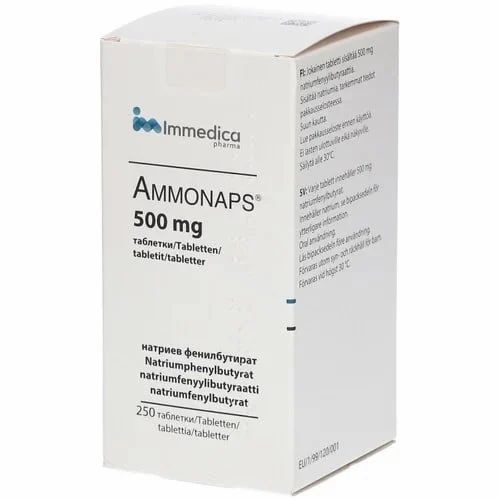
- Країна реєстрації
- Лікарська формаTablet, 500 MG
- Код АТХA16AX03
- Діюча речовина
- Потрібен рецептНі
- Виробник
- Ця інформація надана лише для ознайомлення і не є медичною порадою. Рішення щодо лікування завжди приймає лікар.
- Альтернативи до AMMONAPSЛікарська форма: Granules, 483 MG/GДіюча речовина: Фенилбутират натрияВиробник: EUROCEPT INTERNATIONAL B.V.Рецепт не потрібенЛікарська форма: Hard capsule, 84 MGДіюча речовина: ЭлиглюстатВиробник: SANOFI B.V.Потрібен рецептЛікарська форма: Hard capsule, 200 MGДіюча речовина: trientineВиробник: UNIVAR SOLUTION BVПотрібен рецепт
Аналоги AMMONAPS в інших країнах
Препарати з тією самою діючою речовиною, доступні в інших країнах.
Аналог AMMONAPS у Іспанія
Аналог AMMONAPS у Україна
Лікарі онлайн щодо AMMONAPS
Застосування, безпека та можливість призначення рецепта — за результатами медичної оцінки.









Отримайте рецепт на AMMONAPS онлайн
Заповніть форму за 2 хвилини
Розкажіть про симптоми, історію хвороби та потрібний препарат.
Оберіть лікаря або ми призначимо
Оберіть спеціаліста або ми підберемо найближчого доступного лікаря.
Лікар розглядає ваш випадок
Зазвичай протягом 30 хвилин. Може ставити уточнювальні запитання в чаті.
Отримайте в будь-якій аптеці
Електронний рецепт надсилається на вашу пошту — дійсний по всій Польщі.
Часті запитання
AMMONAPS не потребує рецепта в Італія. Ви можете обговорити з лікарем онлайн, чи підходить цей лікарський засіб для вашої ситуації.
Діюча речовина у AMMONAPS — Фенилбутират натрия. Це допомагає визначити препарати з тим самим складом, але під іншими торговими назвами.
AMMONAPS виробляється компанією IMMEDICA PHARMA AB. Назва бренду та упаковка можуть відрізнятися залежно від дистрибʼютора.
Лікарі, зокрема Сімейні лікарі, Психіатри, Дерматологи, Кардіологи, Ендокринологи, Гастроентерологи, Пульмонологи, Нефрологи, Ревматологи, Гематологи, Інфекціоністи, Алергологи, Геріатри, Педіатри, Онкологи, можуть оцінити доцільність застосування AMMONAPS з урахуванням вашого стану та місцевих правил. Ви можете записатися на онлайн-консультацію, щоб обговорити симптоми та можливі подальші кроки.
Польща має добре розвинену систему охорони здоров'я у великих містах, таких як Варшава, Краків, Вроцлав і Гданськ. Аптеки широко доступні та працюють відповідно до чинного законодавства, забезпечуючи доступ до рецептурних препаратів.
Ви можете придбати AMMONAPS у Варшаві, Кракові, Вроцлаві або Гданську в будь-якій аптеці за наявності дійсного рецепта.
Щоб отримати рецепт, ви можете скористатися Oladoctor:
Інші препарати з тією самою діючою речовиною (Фенилбутират натрия) включають PEBURANE, KERDELGA, KUFENKE. Вони можуть відрізнятися торговою назвою або формою випуску, але містять той самий терапевтичний компонент. Перед зміною або початком прийому нового препарату варто проконсультуватися з лікарем.
