



CINRYZE 500 U Powder and solvent for injectable solution

Запит на рецепт онлайн
Лікар розгляне ваш випадок і визначить, чи є рецепт медично доцільним.

Поговоріть з лікарем про ці ліки
Обговоріть симптоми та можливі подальші кроки під час короткої онлайн-консультації.



Інструкція із застосування KINRYTSE
Зміст інструкції
Cinryze 500 IU powder and solvent for injectable solution
human C1 esterase inhibitor
Read this leaflet carefully before you start to use this medicine because it contains
important information for you.
- Keep this leaflet. You may need to read it again.
- If you have any questions, ask your doctor or pharmacist.
- This medicine has been prescribed for you only. Do not pass it on to others, even if their symptoms are the same as yours, as it could be harmful.
- If you get any side effects, even those not listed in this leaflet, tell your doctor or pharmacist. See section 4.
Contents of this leaflet
- 1. What Cinryze is and what it is used for
- 2. What you need to know before you use Cinryze
- 3. How to use Cinryze
- 4. Possible side effects
- 5. How to store Cinryze
- 6. Contents of the pack and other information
1. What is Cinryze and what is it used for
Cinryze contains a human protein called “C1 esterase inhibitor” as the active ingredient.
C1 esterase inhibitor is a protein naturally present in the blood. If you have a low level
of C1 esterase inhibitor in your blood, or if the C1 esterase inhibitor is not working correctly,
this can lead to swelling attacks (called angioedema). Symptoms may include
stomach pain and swelling of:
- hands and feet
- face, eyelids, lips or tongue
- larynx, which can make breathing difficult
- genitals
In adults and children, Cinryze can increase the amount of C1 esterase inhibitor in the blood
and prevent (before undergoing medical or dental procedures) the occurrence of these swelling attacks or stop the attacks once they have started.
In adults, adolescents and children (from 6 years of age), Cinryze can increase the
amount of C1 esterase inhibitor in the blood and routinely prevent the occurrence of these swelling attacks.
2. What you need to know before you take Cinryze
Do not take Cinryze
- if you are allergic to C1 esterase inhibitor or any of the other ingredients of this medicine (listed in section 6). It is important to inform your doctor if you think you have had an allergic reaction to any of the excipients of Cinryze in the past.
Warnings and precautions
- Before treatment with Cinryze, it is important to inform your doctor if you have, or have had in the past, problems with blood clotting (thrombotic events). In this case, you will be kept under close observation.
- If rash, chest tightness, wheezing or rapid heartbeat occur after taking Cinryze, you should inform your doctor immediately. See section 4.
- When medicines are derived from human blood or plasma, certain measures are taken to prevent the transmission of infections to patients. These include careful selection of blood and plasma donors, to ensure that donors at risk of carrying infections are excluded, and testing of each donation and plasma pool for signs of viruses/infections. The relevant manufacturers also provide procedures during the processing of blood or plasma that can inactivate or remove viruses. Despite these measures, when administering medicines prepared from human blood or plasma, the possibility of transmitting an infection cannot be completely excluded. This also applies to any viruses or other types of infections that are unknown or emerging.
- The measures taken are considered effective for enveloped viruses, such as human immunodeficiency virus (HIV), hepatitis B virus and hepatitis C virus, and for non-enveloped viruses such as hepatitis A virus and parvovirus B19.
- Your doctor may recommend vaccination against hepatitis A and B if you receive Cinryze regularly or repeatedly.
- In order to improve the traceability of biological medicines, the name and batch number of the product administered must be clearly recorded by the nurse or doctor.
Children
The use of Cinryze for the routine prevention of angioedema attacks is not indicated in children under the age of 6 years.
Other medicines and Cinryze
Tell your doctor if you are taking, have recently taken or might take any other medicines.
Pregnancy and breastfeeding
If you are pregnant, suspect you are pregnant, are planning to become pregnant, or are breastfeeding, ask your doctor for advice before taking this medicine. There is limited information on the safety of Cinryze use during pregnancy and breastfeeding. Your doctor will discuss the risks and benefits of using this medicine with you.
Driving and using machines
Cinryze has a slight effect on the ability to drive and use machines.
Cinryze contains sodium
This medicine contains 11.5 mg of sodium (the main component of table salt) per vial. This is equivalent to 0.5% of the maximum recommended daily intake of sodium with the diet for an adult.
3. How to take Cinryze
Treatment will be initiated and managed under the supervision of a physician experienced in the care of patients
with hereditary angioedema (HAE).
A physician or nurse will prepare and inject Cinryze for you. If the physician believes that you can
perform self-administration, the physician or nurse will provide you or a family member with instructions on
preparing and injecting Cinryze. The physician will periodically review the preparation or administration process with you, with a family member or your caregiver.
The recommended dose of Cinryze for adults, adolescents, children, elderly patients, or patients with kidney or liver problems is as follows:
Use in adults and adolescents (starting from 12 years)
Treatment of swelling attacks
- A dose of 1,000 IU (two vials) of Cinryze should be injected at the first sign of a swelling attack.
- A second injection of 1,000 IU may be administered if symptoms do not improve after 60 minutes.
- If a severe attack occurs, particularly laryngeal edema, or if the initiation of treatment is delayed, the second 1,000 IU dose may be administered before 60 minutes have elapsed from the first dose, depending on the clinical response.
- Cinryze must be injected intravenously (into a vein).
Routine prevention of swelling attacks
- A dose of 1,000 IU (two vials) of Cinryze should be injected every 3 or 4 days, for the routine prevention of swelling attacks.
- The dosing interval may be adjusted by the physician depending on the response to Cinryze.
- Cinryze must be injected intravenously (into a vein).
Prevention of swelling attacks before surgery
- A dose of 1,000 IU (two vials) of Cinryze should be injected up to 24 hours before a medical, dental, or surgical procedure.
- Cinryze must be injected intravenously (into a vein).
Use in children
Reconstitution and method of administration
Cinryze is usually injected into a vein (intravenously) by a physician or nurse.
You or your caregiver may also administer Cinryze as an injection, but only after receiving
adequate training. If you perform the injection yourself, always follow the doctor's instructions exactly. If you have any doubts, consult your doctor. If the physician believes that you are suitable for
home treatment, you will be provided with detailed instructions. You should keep a diary to
document each treatment received at home, and bring it to every visit to the doctor. Your injection technique/your caregiver's injection technique will be reviewed periodically to ensure that the
treatment is always correct.
If you have any doubts about the use of this medicine, ask your doctor or pharmacist.
4. Possible side effects
Like all medicines, this medicine can cause side effects, although not everybody gets them.
Possible side effects may include allergic-type reactions.
Tell your doctor immediatelyif any of the following symptoms occur after taking
the medicine. Even if rare, these symptoms can be serious.
Sudden wheezing, difficulty breathing, swelling of the eyelids, face or lips,
skin rash or itching (especially if it affects the whole body).
Very common side effects (may affect more than 1 in 10 people): headache, nausea.
Common side effects (may affect up to 1 in 10 people): hypersensitivity, dizziness,
vomiting, rash, itching or redness of the skin, rash or pain at the injection site, fever.
| Treatment of attacks of angioedema | Prevention before attacks of angioedema | Routine prevention of attacks of angioedema |
|
| o c
|
Uncommon side effects (may affect up to 1 in 100 people): high blood sugar level,
blood clots, pain in the veins, hot flushes, cough, stomach pain, diarrhea, scaling, swelling and pain in
the joints, muscle pain and chest discomfort.
Side effects in children and adolescents are expected to be similar to those observed
in adults.
Reporting of side effects
If you get any side effects, talk to your doctor or nurse. You can also report side effects directly through
the national reporting system listed in Annex V. By reporting side effects you can help provide more
information on the safety of this medicine.
5. How to store Cinryze
Keep this medicine out of the sight and reach of children.
Do not use this medicine after the expiry date which is stated on the package and vials
after “Exp.”
Store at a temperature below 25 C. Do not freeze. Store in the original package to
protect the medicine from light.
Once reconstituted, the Cinryze solution must be used immediately.
Do not dispose of any medicine in wastewater or household waste. Ask your pharmacist how to
dispose of medicines you no longer use. This will help protect the environment.
6. Contents of the pack and other information
What Cinryze contains
The active ingredient is human C1 esterase inhibitor produced from the plasma of human donors. Each
vial of powder contains 500 IU of human C1 esterase inhibitor. After reconstitution, one
vial contains 500 IU of human C1 esterase inhibitor in every 5 ml, corresponding to a
concentration of 100 IU/ml. Two vials of reconstituted Cinryze contain 1,000 IU of human C1 esterase inhibitor
in every 10 ml, corresponding to a concentration of 100 IU/ml.
The total protein content of the reconstituted solution is 15 ± 5 mg/ml.
One international unit (IU) is equivalent to the amount of C1 esterase inhibitor present in 1 ml
of normal human plasma.
The other ingredients are sodium chloride, sucrose, sodium citrate, L-valine, L-alanine and L-threonine
(see section 2).
Solvent: water for injections
Description of Cinryze and contents of the pack
Powder and solvent for solution for injection.
Cinryze is a white powder contained in a vial.
Once dissolved with water for injections, the solution is clear and colourless or
slightly bluish.
Each pack contains:
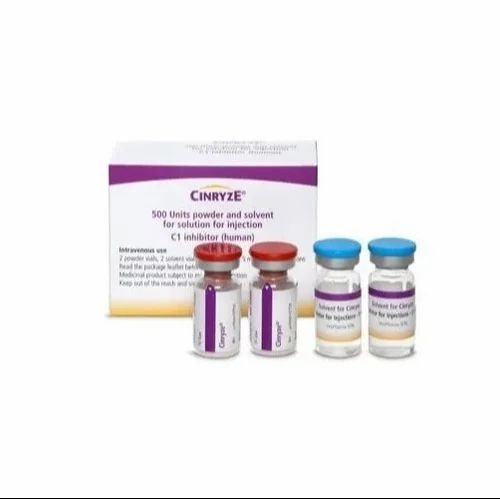
2 vials of Cinryze 500 IU powder for solution for injection
2 vials of water for injections (5 ml each)
2 transfer filter devices
2 single-use 10 ml syringes
2 venipuncture sets
2 protective mats
For the administration of the medicine, use only a silicone-free syringe (supplied
in the pack).
Marketing Authorisation Holder and Manufacturer
Marketing Authorisation Holder
Takeda Manufacturing Austria AG
Industriestrasse 67
1221 Vienna
Austria
Manufacturer
Takeda Manufacturing Austria AG
Industriestrasse 67
1221 Vienna
Austria
Shire International Licensing B.V.
Mercuriusplein 11
2132 HA Hoofddorp
Netherlands
For further information about this medicine, contact the local representative of the Marketing
Authorisation Holder:
België/Belgique/Belgien
Takeda Belgium NV
Tél/Tel: +32 2 464 06 11
[email protected]
Lietuva
Takeda, UAB
Tel: +370 521 09 070
[email protected]
България
Такеда България ЕООД
Тел.: +359 2 958 27 36
[email protected]
Luxembourg/Luxemburg
Takeda Belgium NV
Tél/Tel: +32 2 464 06 11
[email protected]
Česká republika
Takeda Pharmaceuticals Czech Republic s.r.o.
Tel: +420 234 722 722
[email protected]
Magyarország
Takeda Pharma Kft.
Tel.: +36 1 270 7030
[email protected]
Danmark
Takeda Pharma A/S
Tlf.: +45 46 77 10 10
[email protected]
Malta
Τakeda HELLAS S.A.
Tel: +30 210 6387800
[email protected]
Deutschland
Takeda GmbH
Tel: +49 (0)800 825 3325
[email protected]
Nederland
Takeda Nederland B.V.
Tel: +31 20 203 5492
[email protected]
Eesti
Takeda Pharma OÜ
Tel: +372 6177 669
[email protected]
Norge
Takeda AS
Tlf: +47 800 800 30
[email protected]
Ελλάδα
Τakeda ΕΛΛΑΣ Α.Ε.
Tηλ: +30 210 6387800
[email protected]
Österreich
Takeda Pharma Ges.m.b.H.
Tel: +43 (0) 800-20 80 50
[email protected]
España
Takeda Farmacéutica España S.A.
Tel: +34 917 90 42 22
[email protected]
Polska
Takeda Pharma Sp. z o.o.
Tel.: +48223062447
[email protected]
France
Takeda France SAS
Tél: + 33 1 40 67 33 00
[email protected]
Portugal
Takeda Farmacêuticos Portugal, Lda.
Tel: + 351 21 120 1457
[email protected]
Hrvatska
Takeda Pharmaceuticals Croatia d.o.o.
Tel: +385 1 377 88 96
[email protected]
România
Takeda Pharmaceuticals SRL
Tel: +40 21 335 03 91
[email protected]
Ireland
Takeda Products Ireland Ltd
Tel: 1800 937 970
[email protected]
Slovenija
Takeda Pharmaceuticals farmacevtska družba d.o.o.
Tel: + 386 (0) 59 082 480
[email protected]
Ísland
Vistor ehf.
Sími: +354 535 7000
[email protected]
Slovenská republika
Takeda Pharmaceuticals Slovakia s.r.o.
Tel: +421 (2) 20 602 600
[email protected]
Italia
Takeda Italia S.p.A.
Tel: +39 06 502601
[email protected]
Suomi/Finland
Takeda Oy
Puh/Tel: 0800 774 051
[email protected]
Κύπρος
Τakeda ΕΛΛΑΣ Α.Ε.
Τηλ: +30 210 6387800
[email protected]
Sverige
Takeda Pharma AB
Tel: 020 795 079
[email protected]
Latvija
Takeda Latvia SIA
Tel: +371 67840082
[email protected]
Other sources of information
More detailed information on this medicine is available on the website of the European Medicines Agency, https://www.ema.europa.eu. Additionally, links to other websites on rare diseases and related therapeutic treatments are provided.
---------------------------------------------------------------------------------------------------------------------------
The following information is intended exclusively for healthcare professionals:
Reconstitution and administration of Cinryze
Reconstitution, administration of the medicine, and handling of the administration kit and needles must be performed with caution.
Use the transfer filter device provided with Cinryze, or a commercially available double-hub needle.
For administering the medicine, use only a silicone-free syringe (provided in the package).
Preparation and handling
Cinryze is intended for intravenous (into a vein) administration, after reconstitution with water for injectable preparations.
The Cinryze vial is for single use only.
Reconstitution
For a 500 IU dose, you need: 1 vial of powder, 1 vial of solvent, 1 transfer filter device, 1 single-use 10 ml syringe, 1 venipuncture set, and 1 protective mat. Keep the remaining vial and administration materials for the next dose.
For a 1,000 IU dose, you need: 2 vials of powder, 2 vials of solvent, 2 transfer filter devices, 1 single-use 10 ml syringe, 1 venipuncture set, and 1 protective mat.
Each vial of medicine must be reconstituted with 5 ml of water for injectable preparations.
One reconstituted Cinryze vial corresponds to a dose of 500 IU. Therefore, only one Cinryze vial should be reconstituted for a 500 IU dose.
Two reconstituted Cinryze vials correspond to a 1,000 IU dose. Therefore, two vials are combined to obtain a 1,000 IU dose.
- 1. Use the provided mat and wash your hands before the following procedures.
- 2. Aseptic technique must be used during the reconstitution procedure.
- 3. Ensure that the powder vial and solvent vial are at room temperature (15ºC – 25ºC).
- 4. Remove the label from the powder vial by pulling the purple strip indicated by the arrow.
- 5. Remove the plastic caps from the powder and solvent vials.
- 6. Clean the stoppers with a disinfecting wipe and let them dry before use.
- 7. Remove the protective wrapper from the top of the transfer device package. Do not remove the device from the package.
- 8. Note: The transfer device must be applied to the solvent vial before being applied to the powder vial, in order to avoid loss of vacuum in the latter. Place the solvent vial on a flat surface and insert the blue end of the transfer device into the solvent vial, pushing until the perforator penetrates the center of the rubber stopper of the solvent vial and the device clicks into place. The transfer device must be in a vertical position before penetrating the closing stopper.
- 9. Remove the plastic packaging from the transfer device and discard it. Be careful not to touch the exposed end of the transfer device.
- 10. Place the powder vial on a flat surface. Invert the transfer device and the solvent vial containing water for injectable preparations and insert the transparent end of the transfer device into the powder vial, pressing down until the perforator penetrates the rubber stopper and the transfer device clicks into place. The transfer device must be in a vertical position before penetrating the closing stopper of the powder vial. The vacuum in the powder vial will draw in the solvent. If there is no vacuum in the vial, do not use the medicine.
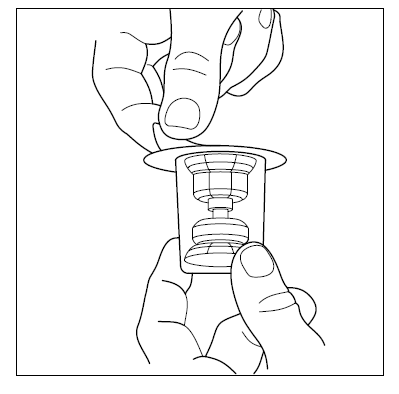
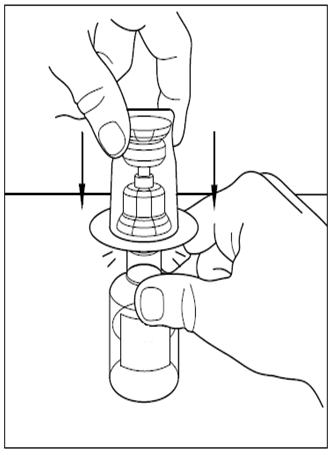
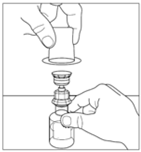
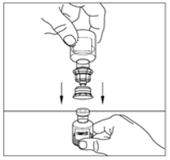
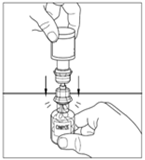
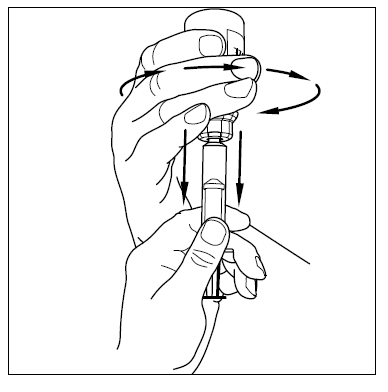
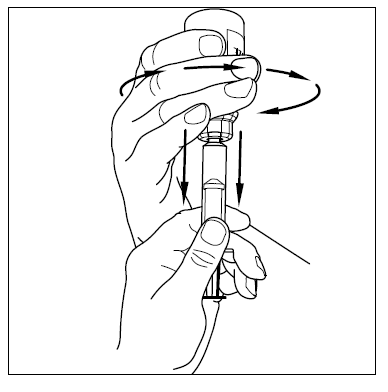
- 11. Gently rotate the powder vial until all the powder is dissolved. Do not shake the powder vial. Ensure that all the powder is completely dissolved.
- 12. Detach the solvent vial by rotating it counterclockwise. Do not remove the transparent end of the transfer device from the powder vial.
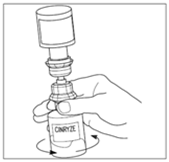
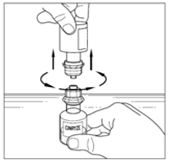
A reconstituted Cinryze vial contains 500 IU of C1 esterase inhibitor in 5 ml,
producing a concentration of 100 IU/ml. Proceed to the administration procedure if patients
need to receive a 500 IU dose.
Two Cinryze powder vials must be reconstituted to obtain a dose (1,000 IU/10 ml).
Therefore, repeat the instructions from 1 to 12 above using another package containing a
transfer device to reconstitute the second of the two powder vials. Do not reuse the
transfer device. Once the two vials have been reconstituted, proceed to the administration procedure if patients need to receive a 1,000 IU dose.
Administration procedure for a 500 IU dose
- 1. Aseptic technique must be used during the administration procedure.
- 2. After reconstitution, the Cinryze solution is colorless or slightly bluish and clear. Do not use the product if the solution is cloudy or has a change in color.
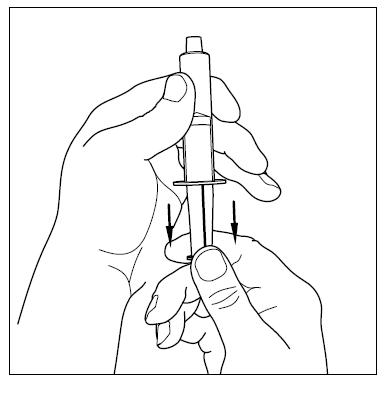
- 3. Using a sterile 10 ml syringe, pull back the plunger to draw approximately 5 ml of air into the syringe.
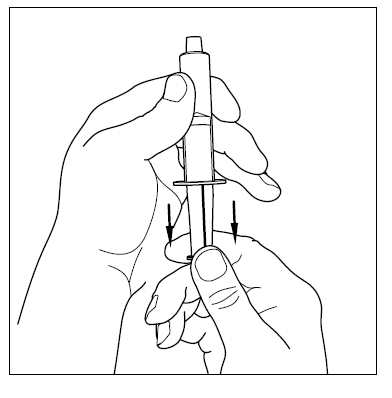
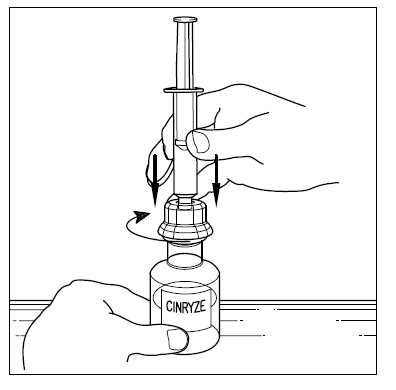
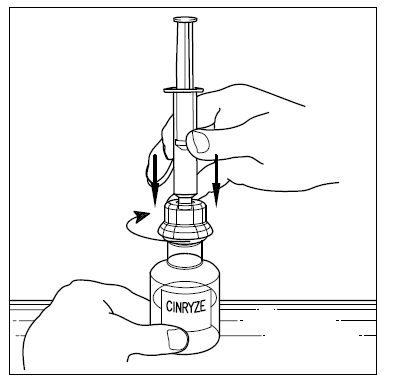
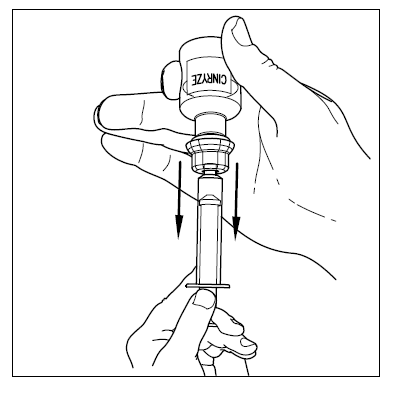
- 4. Apply the syringe to the top of the transparent end of the transfer device, rotating clockwise.
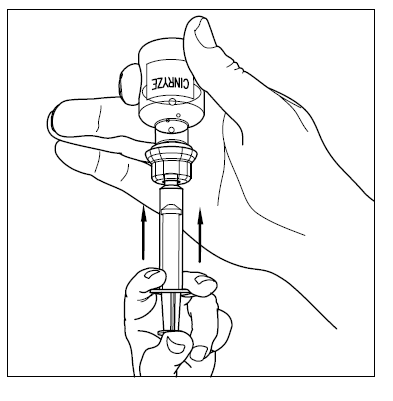
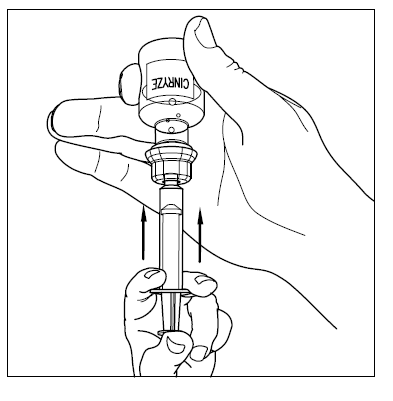
- 5. Gently invert the vial and inject air into the solution, then slowly aspirate the reconstituted Cinryze solution into the syringe.
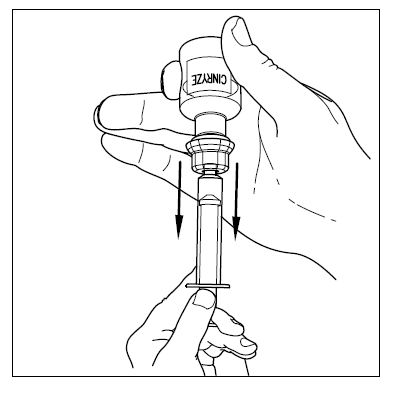
- 6. Detach the syringe from the vial by rotating it counterclockwise and releasing it from the transparent end of the transfer device.
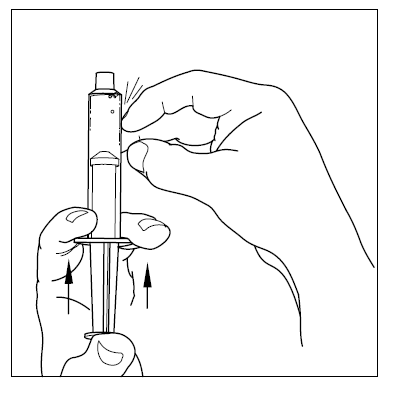
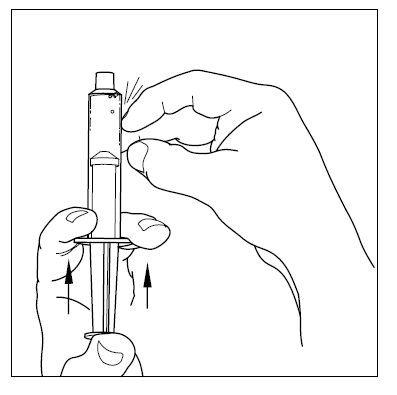
- 7. Before administration, inspect the reconstituted Cinryze solution for the presence of particulate matter; do not use if particles are observed.
- 8. Connect the venipuncture set to the syringe containing the Cinryze solution and inject intravenously into the patient. Administer 500 IU (reconstituted in 5 ml of water for injectable preparations) of Cinryze by intravenous injection, at a rate of 1 ml per minute, over 5 minutes.
Administration procedure for a 1,000 IU dose
- 1. Aseptic technique must be used during the administration procedure.
- 2. After reconstitution, the Cinryze solution is colorless or slightly bluish and clear. Do not use the product if the solution is cloudy or has a change in color.
- 3. Using a sterile 10 ml syringe, pull back the plunger to draw approximately 5 ml of air into the syringe.
- 4. Apply the syringe to the top of the transparent end of the transfer device, rotating clockwise.
- 5. Gently invert the vial and inject air into the solution, then slowly aspirate the reconstituted Cinryze solution into the syringe.
- 6. Detach the syringe from the vial by rotating it counterclockwise and releasing it from the transparent end of the transfer device.
- 7. Using the same syringe, repeat operations 3 to 6 with a second reconstituted Cinryze vial to obtain a complete 10 ml dose.
- 8. Before administration, inspect the reconstituted Cinryze solution for the presence of particulate matter; do not use if particles are observed.
- 9. Connect the venipuncture set to the syringe containing the Cinryze solution and inject intravenously (into a vein) into the patient. Administer 1,000 IU (reconstituted in 10 ml of water for injectable preparations) of Cinryze by intravenous injection (into a vein), at a rate of 1 ml per minute, over 10 minutes.
Unused medicine and waste derived from such medicine must be disposed of in accordance with
current local regulations.

Не впевнені, чи підходить вам цей лікарський засіб?
Обговоріть симптоми та можливі варіанти лікування з лікарем онлайн.

Виникли питання під час прийому ліків?
Обговоріть свої симптоми та лікування з лікарем онлайн.
- Країна реєстрації
- Лікарська формаPowder and solvent for injectable solution, 500 U
- Код АТХB06AC01
- Діюча речовина
- Потрібен рецептТак
- Виробник
- Ця інформація надана лише для ознайомлення і не є медичною порадою. Рішення щодо лікування завжди приймає лікар.
- Альтернативи до KINRYTSEЛікарська форма: Powder and solvent for injectable/infusion solution, <500 IUДіюча речовина: c1-inhibitor, plasma derivedВиробник: CSL BEHRING GMBHПотрібен рецептЛікарська форма: Solution for infusion in pre-filled syringe, 200 mgДіюча речовина: Drugs used in hereditary angioedemaВиробник: CSL BEHRING GMBHПотрібен рецептЛікарська форма: Injectable solution, 30 MGДіюча речовина: ИкатибантПотрібен рецепт
Аналоги KINRYTSE в інших країнах
Препарати з тією самою діючою речовиною, доступні в інших країнах.
Аналог KINRYTSE у Польща
Аналог KINRYTSE у Україна
Аналог KINRYTSE у Іспанія
Лікарі онлайн щодо KINRYTSE
Застосування, безпека та можливість призначення рецепта — за результатами медичної оцінки.









Отримайте рецепт на KINRYTSE онлайн
Заповніть форму за 2 хвилини
Розкажіть про симптоми, історію хвороби та потрібний препарат.
Оберіть лікаря або ми призначимо
Оберіть спеціаліста або ми підберемо найближчого доступного лікаря.
Лікар розглядає ваш випадок
Зазвичай протягом 30 хвилин. Може ставити уточнювальні запитання в чаті.
Отримайте в будь-якій аптеці
Електронний рецепт надсилається на вашу пошту — дійсний по всій Польщі.
Часті запитання
KINRYTSE потребує рецепта в Італія. Ви можете обговорити з лікарем онлайн, чи підходить цей лікарський засіб для вашої ситуації.
Діюча речовина у KINRYTSE — c1-inhibitor, plasma derived. Це допомагає визначити препарати з тим самим складом, але під іншими торговими назвами.
KINRYTSE виробляється компанією TAKEDA MANUFACTURING AUSTRIA AG. Назва бренду та упаковка можуть відрізнятися залежно від дистрибʼютора.
Лікарі, зокрема Сімейні лікарі, Психіатри, Дерматологи, Кардіологи, Ендокринологи, Гастроентерологи, Пульмонологи, Нефрологи, Ревматологи, Гематологи, Інфекціоністи, Алергологи, Геріатри, Педіатри, Онкологи, можуть оцінити доцільність застосування KINRYTSE з урахуванням вашого стану та місцевих правил. Ви можете записатися на онлайн-консультацію, щоб обговорити симптоми та можливі подальші кроки.
Польща має добре розвинену систему охорони здоров'я у великих містах, таких як Варшава, Краків, Вроцлав і Гданськ. Аптеки широко доступні та працюють відповідно до чинного законодавства, забезпечуючи доступ до рецептурних препаратів.
Ви можете придбати KINRYTSE у Варшаві, Кракові, Вроцлаві або Гданську в будь-якій аптеці за наявності дійсного рецепта.
Щоб отримати рецепт, ви можете скористатися Oladoctor:
Інші препарати з тією самою діючою речовиною (c1-inhibitor, plasma derived) включають BERINERT, ANDEMBRY, FIRATSYR. Вони можуть відрізнятися торговою назвою або формою випуску, але містять той самий терапевтичний компонент. Перед зміною або початком прийому нового препарату варто проконсультуватися з лікарем.
