



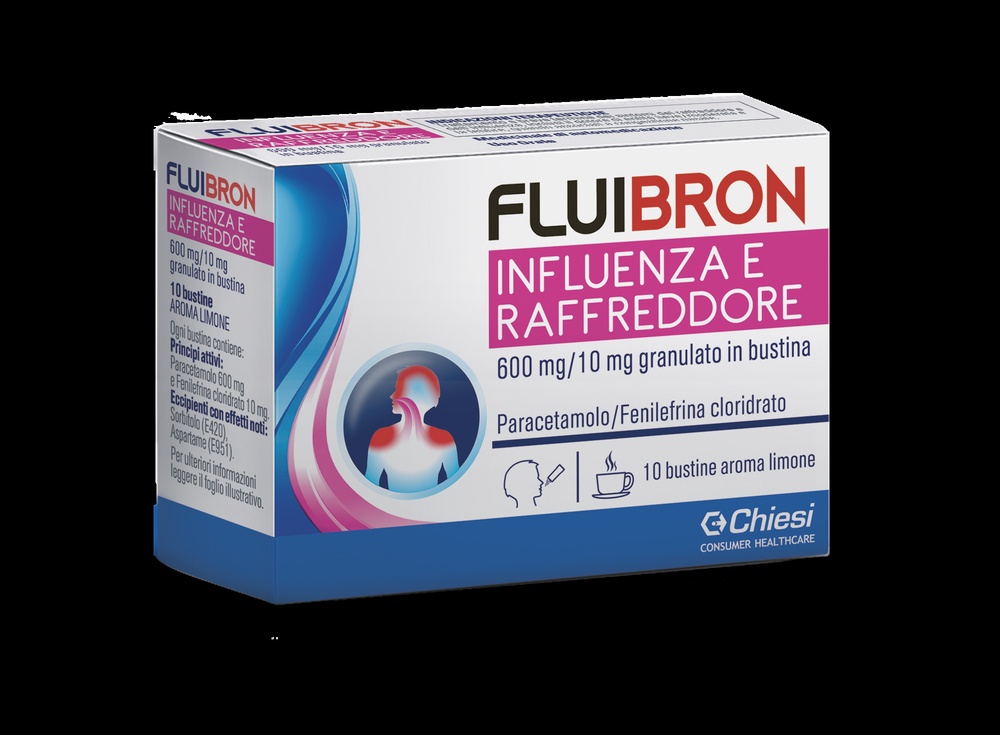
FLUIBRON 600 mg/10 mg Granulki

Ocena recepty online
Lekarz przeanalizuje Twój przypadek i zdecyduje, czy wystawienie recepty jest medycznie uzasadnione.

Porozmawiaj z lekarzem o tym leku
Omów swoje objawy i opcje leczenia podczas szybkiej konsultacji online.



Jak stosować FLUIBRON INFLUENTSA E RAFFREDDORE
Treść ulotki
FLUIBRON INFLUENZA E RAFFREDDORE 600 mg/10 mg granules for oral solution
paracetamol/phenylephrine hydrochloride
Read this leaflet carefully before taking this medicine as it contains important
information for you.
Always take this medicine exactly as described in this leaflet or as your doctor or
pharmacist has told you.
- Keep this leaflet. You may need to read it again.
- If you want more information or advice, ask your pharmacist.
- If any side effects occur, including those not listed in this leaflet, tell your doctor or pharmacist. See section 4.
- See a doctor if you do not feel better or if your symptoms worsen after a short period of treatment.
Contents of this leaflet:
- 1. What FLUIBRON INFLUENZA E RAFFREDDORE is and what it is used for
- 2. What you need to know before you take FLUIBRON INFLUENZA E RAFFREDDORE
- 3. How to take FLUIBRON INFLUENZA E RAFFREDDORE
- 4. Possible side effects
- 5. How to store FLUIBRON INFLUENZA E RAFFREDDORE
- 6. Contents of the pack and other information
1. What is FLUIBRON INFLUENZA E RAFFREDDORE and what is it used for?
FLUIBRON INFLUENZA E RAFFREDDORE is a medicine containing the active ingredients
paracetamol and phenylephrine hydrochloride which is used for the treatment of pain, fever and
congestion.
FLUIBRON INFLUENZA E RAFFREDDORE is used for the short-term treatment of
cold and flu symptoms, including mild/moderate pain and fever, when
associated with nasal congestion.
FLUIBRON INFLUENZA E RAFFREDDORE is indicated for adults and children over
12 years.
See a doctor if you do not feel better or if you feel worse after 3 days.
2. What you need to know before taking FLUIBRON INFLUENZA E RAFFREDDORE
Do not take FLUIBRON INFLUENZA E RAFFREDDORE
- if you are allergic to paracetamol, phenylephrine hydrochloride or any of the other ingredients of this medicine (listed in section 6);
- if you are taking beta-blockers (used to treat high blood pressure or heart disease);
- if you are taking tricyclic antidepressants (medicines used to treat depression);
- if you are taking monoamine oxidase inhibitors (medicines used to treat depression) or have taken them in the last two weeks;
- if you suffer from bronchial asthma;
- if you suffer from pheochromocytoma (a tumor of the adrenal glands);
- if you suffer from glaucoma (an eye condition often associated with increased intraocular pressure);
- if you are taking other sympathomimetic medicines (such as decongestants, appetite suppressants and psychostimulants similar to amphetamines);
- if you suffer from severe hepatic insufficiency;
- if you have liver or kidney problems;
- if you suffer from diabetes;
- if you have an overactive thyroid (hyperthyroidism);
- if you have high blood pressure or heart or circulatory problems;
- if you have glucose-6-phosphate dehydrogenase deficiency (an inherited disease that leads to a decrease in red blood cell count);
- if you suffer from severe hemolytic anemia (abnormal breakdown of blood cells). Do not use the medicine in children under 12 years of age.
Warnings and precautions
Consult your doctor or pharmacist before taking FLUIBRON INFLUENZA E RAFFREDDORE:
- if you are taking other medicines (see also “Other medicines and FLUIBRON INFLUENZA E RAFFREDDORE”);
- if you have an enlarged prostate gland;
- if you have an occlusive vascular disease (blockage of the arteries, e.g. Raynaud's syndrome);
- if you have reduced kidney function (FLUIBRON INFLUENZA E RAFFREDDORE contains sodium).
During treatment with FLUIBRON INFLUENZA E RAFFREDDORE, immediately inform your
doctor:
- if you suffer from serious illnesses, including severe kidney impairment or sepsis (when bacteria and their toxins circulate in the blood causing organ damage) or malnutrition, chronic alcoholism or if you are also taking flucloxacillin (an antibiotic). Patients in these situations have reported a serious condition called metabolic acidosis (an abnormality of the blood and fluids) when paracetamol is used at regular doses for a prolonged period or when paracetamol is taken in combination with flucloxacillin. Symptoms of metabolic acidosis may include: severe difficulty breathing with rapid deep breathing, drowsiness, nausea and vomiting.
Do not use FLUIBRON INFLUENZA E RAFFREDDORE for more than 3 consecutive days without consulting
your doctor.
Do not drink alcohol during treatment with FLUIBRON INFLUENZA E RAFFREDDORE.
If you are taking anti-inflammatory drugs, the use of FLUIBRON INFLUENZA E RAFFREDDORE is
not recommended (see section 2 “Other medicines and FLUIBRON INFLUENZA E RAFFREDDORE”).
Do not take in combination with other medicines containing paracetamol. If paracetamol is taken
in high doses, serious adverse reactions may occur, including severe liver damage and alterations
in the kidneys and blood.
Paracetamol may interfere with tests to determine blood sugar levels (in
people with diabetes) and uric acid levels (in people with gout).
Other medicines and FLUIBRON INFLUENZA E RAFFREDDORE
Tell your doctor or pharmacist if you are taking, have recently taken or might take
any other medicines.
In particular, it is important to tell your doctor or pharmacist if you are taking any of the following
medicines:
- medicines that can alter liver function, such as zidovudine or isoniazid, which may increase the harmful effect of paracetamol on the liver;
- medicines that can alter the urinary excretion of paracetamol, such as probenecid;
- medicines that contain rifampicin (used in the treatment of tuberculosis), cimetidine (used in the treatment of stomach ulcers) or medicines such as glutethimide, phenobarbital, carbamazepine (used in the treatment of epilepsy); when taken together with paracetamol, these medicines must be used with extreme caution and under strict medical supervision;
- medicines used in the treatment of eye infections such as chloramphenicol;
- medicines used to delay blood clotting or prevent coagulation, e.g. warfarin, as paracetamol taken at high doses may lead to an increased risk of bleeding;
- medicines that can accelerate (e.g. metoclopramide, domperidone) or reduce/delay (e.g. cholestyramine, anticholinergics) the absorption of paracetamol;
- medicines used in the treatment of high blood pressure that contain beta-blockers;
- medicines that contain monoamine oxidase inhibitors (see also the section “Do not take FLUIBRON INFLUENZA E RAFFREDDORE);
- medicines that contain tricyclic antidepressants or sympathetic amine mimetics;
- medicines prescribed for heart failure (digoxin);
- medicines used in the treatment of migraine such as ergotamine and methysergide;
- anti-inflammatory drugs;
- flucloxacillin (antibiotic), due to a serious risk of alterations in the blood and fluids (called metabolic acidosis with high anion gap) which must be treated urgently. Pregnancy and breastfeedingIf you are pregnant, suspect you are pregnant or are planning a pregnancy, or if you are breastfeeding, ask your doctor or pharmacist for advice before taking this medicine. The use of FLUIBRON INFLUENZA E RAFFREDDORE is not recommended during pregnancy and breastfeeding; use FLUIBRON INFLUENZA E RAFFREDDORE only after consulting your doctor.
Driving and using machines
FLUIBRON INFLUENZA E RAFFREDDORE does not impair your ability to drive or operate
machinery. However, if you experience dizziness, you should not drive or operate machinery.
FLUIBRON INFLUENZA E RAFFREDDORE contains sorbitol and aspartame:
This medicine contains:
- 42 mg of sorbitol per sachet;
- 25 mg of Aspartame per sachet. Aspartame is a source of phenylalanine. It may be harmful if you have phenylketonuria, a rare genetic disorder that causes a buildup of phenylalanine because the body cannot process it properly.
Sodium content
This medicine contains less than 1 mmol (23 mg) of sodium per dose, i.e. essentially “sodium-free”.
3. How to take FLUIBRON INFLUENZA E RAFFREDDORE
Take this medicine following exactly as indicated in this leaflet or as instructed by your doctor or pharmacist. If you have any doubts, consult your doctor or pharmacist.
Dosage
Adults and children over 12 years of age: 1 sachet every 4-6 hours, up to a maximum of 3 sachets in 24 hours.
Use in children
Use is contraindicated in children under 12 years of age.
Do not take more than the recommended dose without consulting your doctor.
Instructions for use
Place the granules directly on the tongue and swallow. FLUIBRON INFLUENZA E RAFFREDDORE dissolves with saliva: this allows its use without water.
You can also dissolve the contents of one sachet in a glass of warm (not boiling) water, mixing with a teaspoon. If desired, you can dilute with cold water to cool and sweeten.
Once prepared, drink the solution within a few minutes.
Warning:This product should be used for a short period of treatment.
Do not take for more than 3 consecutive days without consulting your doctor.
Consult your doctor if symptoms persist or if you notice any new change in their characteristics.
If you take more FLUIBRON INFLUENZA E RAFFREDDORE than you should
If you or someone else takes more FLUIBRON INFLUENZA E RAFFREDDORE than you should, or if you think a child has swallowed the contents of the sachet, go immediately to the nearest hospital or doctor, even if you feel well, and bring this leaflet, the remaining sachets and the box with you. In case of accidental intake of high doses of this medicine, pallor, nausea, vomiting, loss of appetite (anorexia), abdominal pain, alteration of blood sugar levels (glucose metabolism anomalies) and accumulation of acids in the body (metabolic acidosis) may occur.
In severe poisoning, liver failure may be complicated by brain damage (encephalopathy, cerebral edema), blood loss (hemorrhage), reduced blood glucose (hypoglycemia), and death. Even in the absence of severe liver damage, a reduction in kidney function (acute renal failure) may occur, which manifests with kidney damage (acute tubular necrosis), blood loss in the urine (hematuria) and protein loss in the urine (proteinuria). Alterations of the heartbeat (cardiac arrhythmias) and inflammation of the pancreas (pancreatitis) may also occur.
Irritability, headache (cephalalgia), and increased blood pressure may also occur. In more severe cases, confusion, hallucinations and convulsions may occur. High doses of the medicine can cause a short-lived liquid diarrhea (transient osmotic diarrhea).
If you have any doubts about the use of this medicine, ask your doctor or pharmacist.
4. Possible side effects
Like all medicines, this medicine can cause side effects, although not everybody gets them.
The following list includes the side effects of paracetamol and phenylephrine.
The side effects are presented in order of decreasing frequency:
Very common (may affect more than 1 in 10 people)
Common (may affect up to 1 in 10 people)
Uncommon (may affect up to 1 in 100 people)
Rare (may affect up to 1 in 1,000 people)
Very rare (may affect up to 1 in 10,000 people)
Not known: frequency cannot be estimated from the available data.
Immediately stop taking FLUIBRON INFLUENZA E RAFFREDDORE and contact your doctor or go to the hospital immediately if you notice any of the following side effects:
- allergic reactions or hypersensitivity, anaphylactic shock (severe allergic reactions causing difficulty breathing or dizziness);
- very rare cases of severe skin reactions have been reported: severe rash or blistering or ulcers in the mouth (toxic epidermal necrolysis, Stevens-Johnson syndrome, erythema multiforme or polymorphous);
- breathing problems (bronchospasm). If you experience any of these side effects, contact your doctor or pharmacist.Common (may affect up to 1 in 10 people):
- loss of appetite;
- nausea and vomiting. Rare (may affect up to 1 in 1,000 people):
- blood disorders that may appear as unexplained bruising, paleness or poor resistance to infection; decrease in specific blood cells (agranulocytosis, leucopenia, thrombocytopenia);
- tachycardia (increased heart rate), palpitations (feeling of heartbeats in the chest);
- abnormal liver function (increased liver transaminases);
- hypersensitivity, including skin rashes, angioedema (sudden swelling of the skin and mucous membranes). Very rare (may affect up to 1 in 10,000 people):
- insomnia (difficulty sleeping), nervousness, anxiety, agitation, confusion, irritability;
- tremor (shaking), dizziness, headache;
- with prolonged use of high doses of paracetamol, interstitial nephritis (kidney inflammation) and kidney-related side effects may occur. Not known (frequency cannot be estimated from the available data):
- anemia (decreased hemoglobin levels in the blood);
- mydriasis (pupil dilation), acute angle-closure glaucoma (an eye disease often associated with increased fluid pressure in the eye);
- laryngeal edema (swelling of the throat);
- diarrhea, gastrointestinal discomfort;
- liver diseases, hepatitis (yellowing of the skin and/or eyes);
- kidney disorders (worsening of renal failure), blood in the urine (hematuria),
- difficulty urinating (anuria, urinary retention);
- increased blood pressure (hypertension);
- severe condition that can make the blood more acidic (called metabolic acidosis), in patients with a serious illness who use paracetamol (see section 2).
Reporting of side effects
If you get any side effects, talk to your doctor or pharmacist. You can also report side effects directly through the national reporting system at www.aifa.gov.it/content/segnalazioni-reazioni-avverse .
By reporting side effects you can help provide more information on the safety of this medicine.
5. How to store FLUIBRON INFLUENZA E RAFFREDDORE
This medicine does not require any particular storage temperature.
Store in the original container to protect the medicine from humidity and light.
Do not use this medicine after the expiry date that is reported on the package. The expiry date refers to the last day of that month.
It is important to always have the product information with you. Keep the package and the leaflet.
Do not dispose of any medicine in the wastewater and household waste. Ask your pharmacist how to dispose of medicines that you no longer use. This will help protect the environment.
Keep this medicine out of the sight and reach of children.
6. Contents of the pack and other information
What FLUIBRON INFLUENZA E RAFFREDDORE contains
The active ingredients are: paracetamol 600 mg and phenylephrine hydrochloride 10 mg (equivalent to phenylephrine 8.2 mg).
The other ingredients are: mannitol (E 421), Xylitab 200 (xylitol, carboxymethylcellulose), lemon aroma,
sorbitol (E 420) ascorbic acid, citric acid, hydrated colloidal silica, aspartame (E 951)
sodium saccharin.
Description of the appearance of FLUIBRON INFLUENZA E RAFFREDDORE and contents of the
pack
FLUIBRON INFLUENZA E RAFFREDDORE is presented in sachets containing a granular powder of
colour from white to ivory.
FLUIBRON INFLUENZA E RAFFREDDORE is available in packs containing 10 and 16 sachets.
Marketing Authorisation Holder and Manufacturer
Marketing Authorisation Holder: Chiesi Italia S.p.A. – Via Giacomo Chiesi 1 – 43122 Parma
Manufacturer: E-Pharma Trento S.p.A. - Via Provina 2 - 38123 Trento.

Nie jesteś pewien, czy ten lek jest odpowiedni dla ciebie?
Omów swoje objawy i leczenie z lekarzem online.

Zacząłeś przyjmować lek i masz pytania?
Omów swoje objawy i leczenie z lekarzem online.
- Kraj rejestracji
- Postać farmaceutycznaGranules, 600 MG/10 MG
- Kod ATCN02BE51
- Substancja czynna
- Wymaga receptyNie
- Producent
- Te treści mają charakter wyłącznie informacyjny i nie zastępują konsultacji lekarskiej.
- Zamienniki FLUIBRON INFLUENTSA E RAFFREDDOREPostać farmaceutyczna: Tablet, 500 MG + 60 MGSubstancja czynna: paracetamol, combinations excl. psycholepticsProducent: KENVUE ITALIA S.P.A.Bez receptyPostać farmaceutyczna: Tablet, 300MG + 200MGSubstancja czynna: paracetamol, combinations excl. psycholepticsBez receptySubstancja czynna: paracetamol, combinations excl. psycholepticsProducent: TEOFARMA S.R.L.Bez recepty
Odpowiedniki FLUIBRON INFLUENTSA E RAFFREDDORE w innych krajach
Leki z tą samą substancją czynną dostępne w innych krajach.
Odpowiednik FLUIBRON INFLUENTSA E RAFFREDDORE w Hiszpania
Odpowiednik FLUIBRON INFLUENTSA E RAFFREDDORE w Polska
Odpowiednik FLUIBRON INFLUENTSA E RAFFREDDORE w Ukraina
Lekarze online w sprawie FLUIBRON INFLUENTSA E RAFFREDDORE
Omów stosowanie FLUIBRON INFLUENTSA E RAFFREDDORE, bezpieczeństwo i ocenę zasadności recepty zgodnie z obowiązującymi przepisami.









Uzyskaj receptę na FLUIBRON INFLUENTSA E RAFFREDDORE online
Wypełnij 2-minutowy formularz
Opisz swoje objawy, historię choroby i lek, o który prosisz.
Wybierz lekarza lub pozwól nam przydzielić
Wybierz specjalistę lub dopasujemy Cię do najbliższego dostępnego lekarza.
Lekarz analizuje Twój przypadek
Zazwyczaj w ciągu 30 minut. Może zadawać dodatkowe pytania przez czat.
Odbierz w dowolnej aptece
Recepta elektroniczna wysłana na Twój e-mail — ważna w całej Polsce.
Często zadawane pytania
FLUIBRON INFLUENTSA E RAFFREDDORE nie wymaga recepty w Włochy. Możesz skonsultować się z lekarzem online, aby sprawdzić, czy ten lek może być odpowiedni w Twojej sytuacji.
Substancją czynną w FLUIBRON INFLUENTSA E RAFFREDDORE jest paracetamol, combinations excl. psycholeptics. Informacja ta pomaga rozpoznać leki o tym samym składzie, ale pod różnymi nazwami handlowymi.
FLUIBRON INFLUENTSA E RAFFREDDORE jest produkowany przez CHIESI ITALIA S.P.A. Nazwy handlowe i opakowania mogą się różnić w zależności od dystrybutora.
Lekarze, tacy jak Lekarze rodzinni, Psychiatrzy, Dermatolodzy, Kardiolodzy, Endokrynolodzy, Gastroenterolodzy, Pulmonolodzy, Nefrolodzy, Reumatolodzy, Hematolodzy, Zakaźnicy, Alergolodzy, Geriatrzy, Pediatrzy, Onkolodzy, mogą ocenić, czy stosowanie FLUIBRON INFLUENTSA E RAFFREDDORE jest odpowiednie w Twoim przypadku, w zależności od sytuacji klinicznej i lokalnych przepisów. Możesz umówić konsultację online, aby omówić objawy i możliwe dalsze kroki.
Polska posiada dobrze rozwiniętą infrastrukturę ochrony zdrowia w dużych miastach, takich jak Warszawa, Kraków, Wrocław i Gdańsk. Apteki są łatwo dostępne i działają zgodnie z obowiązującymi przepisami, zapewniając dostęp do leków na receptę.
Możesz kupić FLUIBRON INFLUENTSA E RAFFREDDORE w Warszawie, Krakowie, Wrocławiu lub Gdańsku w każdej aptece, posiadając ważną receptę.
Aby uzyskać receptę, możesz skorzystać z Oladoctor:
Inne leki zawierające tę samą substancję czynną (paracetamol, combinations excl. psycholeptics) to m.in. AKTIGRIP JIORNO & NOTTE, ALGOPIRINA, ANTIREUMINA. Mogą one różnić się nazwą handlową lub postacią, ale zawierają ten sam składnik terapeutyczny. Przed zmianą lub rozpoczęciem nowego leku skonsultuj się z lekarzem.
