



ALGOPIRINA 300 mg/200 mg Tabletki

Ocena recepty online
Lekarz przeanalizuje Twój przypadek i zdecyduje, czy wystawienie recepty jest medycznie uzasadnione.

Porozmawiaj z lekarzem o tym leku
Omów swoje objawy i opcje leczenia podczas szybkiej konsultacji online.



Jak stosować ALGOPIRINA
Treść ulotki
ALGOPIRINA 300mg + 200mg tablets
acetylsalicylic acid and paracetamol
Generic medicine
Read this leaflet carefully before taking this medicine as it contains important
information for you.
Always take this medicine exactly as described in this leaflet or as your doctor or
pharmacist has told you to do.
- Keep this leaflet. You may need to read it again.
- If you have any questions, ask your pharmacist.
- If any side effects occur, including those not listed in this leaflet, tell your doctor or pharmacist. See section 4.
- Talk to your doctor if you do not feel better or if your symptoms worsen after 5-7 days.
Contents of this leaflet
- 1.What Algopirina is and what it is used for
- 2.What you need to know before you take Algopirina
- 3.How to take Algopirina
- 4.Possible side effects
- 5.How to store Algopirina
- 6.Contents of the pack and other information
1. What is ALGOPIRINA and what is it used for
Algopirina contains the active ingredients acetylsalicylic acid and paracetamol.
Acetylsalicylic acid and paracetamol belong to a group of drugs called analgesics and
antipyretics. Both exert a rapid antipyretic and analgesic (pain-relieving) action, to which an
anti-inflammatory action is associated.
Algopirina is indicated for the treatment of flu and cold symptoms; for the symptomatic treatment
of headache, nerve inflammation (neuralgia), toothache, menstrual pain and joint pain.
See your doctor if you do not feel better or if you feel worse after 5-7 consecutive days of treatment.
Take Algopirina on a full stomach.
2. What you need to know before taking Algopirina
Do not take Algopirina
- If you are allergic to the active ingredients, to substances related to them, or to any of the other ingredients of this medicine listed in paragraph 6.
- If you have suffered in the past from gastrointestinal bleeding (hemorrhages) or lacerations due to previous treatments, or have suffered from frequent gastrointestinal bleeding/laceration (ulcer) (two or more distinct episodes of demonstrated ulceration or bleeding).
- If you have a confirmed tendency to develop bleeding, stomach diseases (e.g., gastroduodenal ulcer), asthma, reduced kidney function; abnormally reduced levels of phosphate in the blood (hypophosphatemia).
- If you suffer from severe heart failure.
- If you are affected by a condition known as glucose-6-phosphate dehydrogenase enzyme deficiency (an enzyme whose absence, genetically determined, results in a disease characterized by reduced survival
of red blood cells), or if you suffer from a condition called hemolytic anemia (the pathological condition in which there is
low hemoglobin concentration in the blood).
- If you suffer from severe liver problems.
- During the third trimester of pregnancy at doses higher than 100 mg/day.
Warnings and precautions
Consult your doctor or pharmacist before taking Algopirina
- If you are already taking any other non-steroidal anti-inflammatory (NSAID) medication;
- If you are an elderly patient and/or have suffered from gastrointestinal bleeding, especially if complicated by lacerations (see “Do not take Algopirina”), if you are using acetylsalicylic acid or other medications that can cause damage to the gastrointestinal tract. The risk of gastrointestinal bleeding or perforation is higher with high doses of NSAIDs. Your doctor will therefore advise you to start treatment with the lowest available dose and also use drugs that protect the stomach walls (misoprostol or proton pump inhibitors) at the same time (see below and “Other medicines and Algopirina”). For these patients with a history of damage to the gastrointestinal tract and especially for the elderly, it is recommended to keep your doctor constantly informed of any unusual gastrointestinal symptoms, especially during the early stages of treatment.
- If you are taking corticosteroids orally, or medications to reduce blood clot formation (anticoagulants) such as warfarin, or antidepressants (selective serotonin reuptake inhibitors) or agents that reduce platelet aggregation in the blood (antiplatelet agents) such as acetylsalicylic acid. Caution is advised before using Algopirina because these medications may increase the risk of developing bleeding/lacerations in the stomach or intestines (see “Other medicines and Algopirina”).
- If you suffer from gastrointestinal diseases, such as ulcerative colitis or Crohn's disease. Your doctor will advise you on the most suitable therapy because the concomitant use of non-steroidal anti-inflammatory drugs (NSAIDs) can exacerbate these pathological conditions (see paragraph 4).
- If you suffer from a condition known as glucose-6-phosphate dehydrogenase enzyme deficiency, from gastric or intestinal disorders, or from impaired kidney function, or if you are pregnant.
- If you suffer from high blood pressure, and/or impaired heart function. Concomitant use of NSAIDs can cause fluid retention and swelling due to an accumulation of fluids in the intracellular spaces (edema).
- In case of infections caused by viruses, such as influenza or varicella. Consult your doctor before administering the product to children.
- In children under 12 years of age. The product should only be administered on medical prescription.
- If you suffer from kidney or liver problems.
- If you are already using a medicine containing the same active ingredient paracetamol; in fact, if paracetamol is taken in high doses, serious adverse reactions can occur. Your doctor will tell you whether you can or cannot take other medicines while taking Algopirina (see “Other medicines and Algopirina”).
During the use of Algopirina, always keep in mind that:
- Adverse effects can be minimized by using the medicine at the lowest effective dose and for the shortest treatment duration capable of controlling the symptoms.
- Elderly patients are more likely to develop adverse effects from NSAIDs, especially bleeding and gastrointestinal perforations, which can be fatal (See paragraph 3).
- At any time, with or without warning symptoms or a previous history of serious gastrointestinal events, during treatment with all NSAIDs, gastrointestinal bleeding, lesion and perforation have been reported, which can be life-threatening. When such events occur, stop treatment immediately and inform your doctor or go to the nearest hospital.
- You should not use Algopirina for prolonged treatments.
- You should consult your doctor if, after a period of continuous treatment of 5-7 days, you do not show appreciable improvement in your condition.
- High or prolonged doses of the product can cause liver disease at high risk and alterations in the kidney and blood, even serious.
- In case of infections caused by viruses, such as influenza or varicella, if prolonged vomiting or profound drowsiness occur during treatment, stop the treatment and contact your doctor.
- Use before an operation may interfere with any attempts to stop bleeding (hemostasis) during an operation.
- In case of an allergic reaction, stop taking Algopirina.
- Very rarely, cases of severe skin reactions, some of which have been fatal, such as severe widespread skin irritation and with skin peeling (exfoliative dermatitis), severe skin reaction with peeling and swelling of the skin, blisters on the skin, mouth, eyes, genitals (Stevens-Johnson Syndrome), and severe and extensive skin rash with fever (toxic epidermal necrolysis) have been reported (see paragraph 4). Patients appear to be at higher risk in the early stages of therapy: the reaction occurs in most cases within the first month of treatment. Stop treatment when you notice the first appearance of a rash, skin lesion or any other sign of allergy and contact your doctor.
During treatment with Algopirina, immediately inform your doctor:
If you suffer from serious illnesses, including severe kidney impairment or sepsis (when bacteria and their toxins
circulate in the blood causing organ damage) or malnutrition, chronic alcoholism or if you are taking
also flucloxacillin (an antibiotic). Patients in these situations have reported a serious
condition called metabolic acidosis (an abnormality of the blood and fluids) when paracetamol is
used at regular doses for a prolonged period or when paracetamol is taken in association with
flucloxacillin. Symptoms of metabolic acidosis may include: severe difficulty breathing with
rapid, deep breathing, drowsiness, nausea and vomiting.
Children
In children under 12 years of age, the product should only be administered on medical prescription.
Other medicines and Algopirina
Tell your doctor or pharmacist if you are taking, have recently taken or might take any
other medicine.
Inform your doctor or pharmacist before taking Algopirina if you are taking:
- Corticosteroid medicines. Concomitant use with Algopirina increases the risk of gastrointestinal lesions or bleeding (see “Warnings and precautions”);
- Anticoagulant medicines. NSAIDs may increase the effects of anticoagulants such as warfarin (see “Warnings and precautions”);
- Antiplatelet agents and antidepressant medicines (selective serotonin reuptake inhibitors (SSRIs)). When administered together with Algopirina, they increase the risk of gastrointestinal bleeding (see “Warnings and precautions”);
- Other anti-inflammatory medicines;
- Uricosuric medicines (used for the treatment of gout), sulfonylureas (used in the therapy of diabetes), hypoglycemic agents (which lower blood sugar levels). Algopirina interferes with these medicines;
- Medicines with systemic alkalizing action (which raise blood pH). These medicines accelerate the elimination of salicylic acid drugs (e.g. acetylsalicylic acid) and therefore reduce their effectiveness;
- Probenecid (used in the treatment of gout and high uric acid levels in the blood, hyperuricemia) or acetazolamide (used to lower blood pressure). These medicines facilitate the accumulation of salicylates in the blood.
- Diuretics (which promote diuresis) and antihypertensive medicines (which lower blood pressure), especially antihypertensives belonging to the class of ACE inhibitors or angiotensin II antagonists. NSAIDs can reduce their effect. In some patients with impaired kidney function (for example, dehydrated patients or elderly patients with impaired kidney function), the co-administration of Algopirina with an ACE inhibitor or an angiotensin II antagonist may lead to a further deterioration of kidney function. In these cases, it is recommended to drink plenty of fluids and consult your doctor, who may consider monitoring your kidney function throughout the concomitant therapy;
- Medicines that can facilitate the activation of certain liver enzymes (hepatic monooxygenases) or in case of exposure to substances that can have this effect (for example, rifampicin, cimetidine, antiepileptic drugs such as glutethimide, phenobarbital, carbamazepine);
- Metamizole (a substance used to reduce pain and fever) may decrease the effect of acetylsalicylic acid on platelet aggregation (blood cells that attach and form a blood clot), if taken at the same time. Therefore, this combination should be used with caution in patients taking aspirin at low doses for cardioprotection;
- flucloxacillin (antibiotic), due to a serious risk of blood and fluid abnormality (called metabolic acidosis with elevated anion gap) that needs to be treated urgently (see paragraph 2).
Do not take Algopirina if you are going to undergo tests to determine uric acid levels in
blood (uricemia) (using the phosphotungstic acid method), or tests to determine sugar levels in
blood (using the glucose-oxidase-peroxidase method). In fact, the administration of
paracetamol may interfere with these tests.
Pregnancy, breastfeeding and fertility
If you are pregnant, suspect you are pregnant or are planning to become pregnant, ask your doctor or
pharmacist for advice before taking this medicine.
Do not use Algopirina in the last three months of pregnancy to avoid delaying labor, unless use is
specifically prescribed by your doctor.
Acetylsalicylic acid contained in Algopirina can negatively interfere with a pregnancy and/or
with embryo/fetal development,
During the first and second trimester of pregnancy, acetylsalicylic acid should not be administered unless
absolutely necessary.
If you are planning a pregnancy or during the first and second trimester of pregnancy, the dose and duration
of treatment should be kept as low as possible.
During the third trimester of pregnancy, all medicines that act with the same mechanism of action
of acetylsalicylic acid (prostaglandin synthesis inhibitors) can expose the fetus to:
- increased risk of heart and lung malformations (premature closure of the ductus arteriosus and pulmonary hypertension);
- kidney malfunction that can progress to kidney failure with reduced amniotic fluid (oligo-hydramnios); the mother and newborn, at the end of pregnancy, to:
- possible prolongation of bleeding time, and antiplatelet effect that can occur even with very low doses;
- inhibition of uterine contractions with consequent delay or prolongation of labor. Therefore, during the third trimester of pregnancy, do not take acetylsalicylic acid at doses higher than 100 mg per day.
Driving and using machines
Algopirina does not impair the ability to drive vehicles or operate machinery .
3. How to take Algopirina
Take this medicine following exactly the instructions of your doctor or pharmacist. If you have
any doubts, consult your doctor or pharmacist.
The recommended dose is 1 tablet, three to four times a day.
It should be taken on a full stomach.
Do not exceed the recommended doses. Elderly patients should adhere to the minimum dose indicated above.
Use in children
The use of Algopirina in children under 12 years of age is not recommended, unless expressly prescribed
by your doctor.
If you take more Algopirina than you should
In the event of accidental intake of excessive doses of Algopirina, contact your doctor immediately or
go to the nearest hospital.
Taking excessive amounts of paracetamol (one of the two active ingredients of Algopirina) can
cause liver cell death, with possible general and
irreversible deterioration.
If you forget to take Algopirina
If you forget to take Algopirina, do not take a double dose to compensate for the missed
dose.
If you stop taking Algopirina
Ask your doctor or pharmacist for advice before stopping treatment.
If you have any doubts about the use of this medicine, ask your doctor or pharmacist.
4. Possible side effects
Like all medicines, this medicine can cause side effects, although not everybody gets them.
manifest.
If you experience any of the following serious side effects, stop treatment with Algopirina and
immediately inform your doctor:
- peptic ulcers, perforation or gastrointestinal bleeding, sometimes fatal, especially in the elderly (see “Warnings and precautions”);
- allergic reactions such as, for example, severe and sudden swelling of the skin or mucous membranes such as swelling of hands, feet and ankles, swelling around the eyes, face, lips, tongue and/or throat (angioedema), severe allergic reaction with sudden onset (anaphylactic shock). Gastrointestinal side effects are the most commonly reported with the use of Algopirina.
Other side effects that may occur with Algopirina are:
- nausea, vomiting, diarrhea, flatulence, constipation, indigestion, abdominal pain, passage of black stools (melena), bleeding from the stomach through vomiting (hematemesis), inflammation with lesion of the oral cavity, worsening of gastrointestinal diseases such as colitis and Crohn's disease (see “Warnings and precautions”);
- gastritis (less frequently);
- gastrointestinal disorders, dizziness, allergic skin rashes.
- reduction in the number of all blood cells (thrombocytopenia, leukopenia, anemia, agranulocytosis), serious liver problems (alterations of liver function and hepatitis), serious kidney problems (acute renal failure, interstitial nephritis, hematuria, anuria).
Due to the presence of acetylsalicylic acid, the following may occur:
- ear disorders (such as ringing in the ears, etc.), bleeding episodes (epistaxis, gum bleeding, etc.), delayed labor (see "Pregnancy and breastfeeding") and reduced number of platelets in the blood.
Due to the presence of paracetamol, the following may occur:
- severe skin reactions, some of which are fatal, such as severe skin inflammation (erythema multiforme), severe widespread skin irritation with skin peeling (exfoliative dermatitis), severe skin reaction with peeling and swelling of the skin, skin blisters, mouth, eyes, genitals (Stevens-Johnson syndrome), and severe and extensive skin rash with fever (toxic epidermal necrolysis).
- Frequency not known (cannot be defined on the basis of available data): a serious condition that can make the blood more acidic (called metabolic acidosis), in patients with a serious illness who use paracetamol (see section 2).
Reporting of side effects
If you get any side effects, even those not listed in this leaflet, tell your
doctor or pharmacist. You can also report side effects directly through the national reporting system at https://www.aifa.gov.it/content/segnalazioni-reazioni-avverse.
By reporting side effects you can help provide more information on the safety of this
medicine.
5. How to store Algopirina
Keep this medicine out of sight and reach of children.
Do not use this medicine after the expiry date which is stated on the pack after “Scad.”. The expiry date refers to the last day of that month. The expiry date refers to the product in
intact packaging correctly stored.
Store in the original packaging to protect the product from heat.
Do not dispose of any medicine in wastewater or household waste. Ask your pharmacist how to dispose of
medicines you no longer use. This will help protect the environment.
6. Contents of the pack and other information
What Algopirina contains
The active ingredients are acetylsalicylic acid and paracetamol.
One tablet of Algopirinacontains 300 mg of acetylsalicylic acid and 200 mg of paracetamol.
The other ingredients are: dibasic calcium phosphate dihydrate and magnesium stearate.
Description of the appearance of Algopirina and contents of the pack
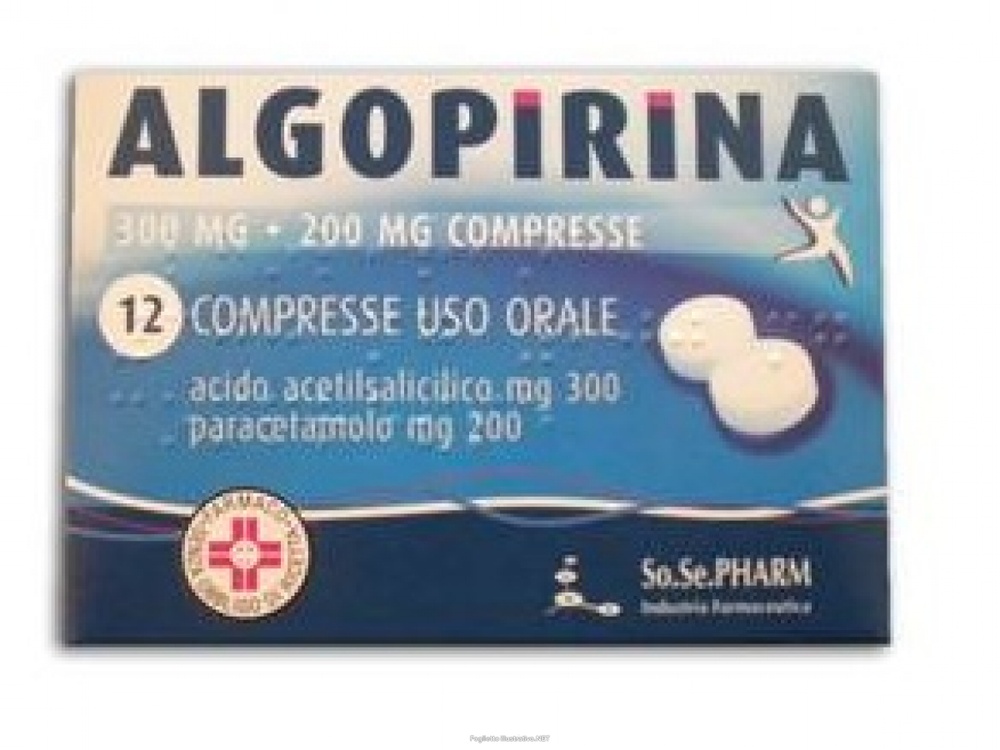
Algopirina 300 mg + 200 mg tabletsis available in a pack containing a blister of 12 tablets.
To remove the tablet, apply slight pressure to the raised part of the blister, tearing
the aluminum foil.
Marketing authorization holder and manufacturer
Marketing authorization holder
So.Se.PHARM S.r.l.
Via dei Castelli Romani, 22
00071 Pomezia (Roma)
Italy
Manufacturer
Special Product’s Line S.p.A.
Via Fratta Rotonda Vado Largo, 1
03012 Anagni (FR)
Italy

Nie jesteś pewien, czy ten lek jest odpowiedni dla ciebie?
Omów swoje objawy i leczenie z lekarzem online.

Zacząłeś przyjmować lek i masz pytania?
Omów swoje objawy i leczenie z lekarzem online.
- Kraj rejestracji
- Postać farmaceutycznaTablet, 300MG + 200MG
- Kod ATCN02BE51
- Substancja czynna
- Wymaga receptyNie
- Producent
- Te treści mają charakter wyłącznie informacyjny i nie zastępują konsultacji lekarskiej.
- Zamienniki ALGOPIRINAPostać farmaceutyczna: Tablet, 500 MG + 60 MGSubstancja czynna: paracetamol, combinations excl. psycholepticsProducent: KENVUE ITALIA S.P.A.Bez receptySubstancja czynna: paracetamol, combinations excl. psycholepticsProducent: TEOFARMA S.R.L.Bez receptyPostać farmaceutyczna: Syrup, 2,4 G/100 ML + 0,015 G/100 MLSubstancja czynna: paracetamol, combinations excl. psycholepticsProducent: BRUNO FARMACEUTICI S.P.A.Wymaga recepty
Odpowiedniki ALGOPIRINA w innych krajach
Leki z tą samą substancją czynną dostępne w innych krajach.
Odpowiednik ALGOPIRINA w Hiszpania
Odpowiednik ALGOPIRINA w Polska
Odpowiednik ALGOPIRINA w Ukraina
Lekarze online w sprawie ALGOPIRINA
Omów stosowanie ALGOPIRINA, bezpieczeństwo i ocenę zasadności recepty zgodnie z obowiązującymi przepisami.









Uzyskaj receptę na ALGOPIRINA online
Wypełnij 2-minutowy formularz
Opisz swoje objawy, historię choroby i lek, o który prosisz.
Wybierz lekarza lub pozwól nam przydzielić
Wybierz specjalistę lub dopasujemy Cię do najbliższego dostępnego lekarza.
Lekarz analizuje Twój przypadek
Zazwyczaj w ciągu 30 minut. Może zadawać dodatkowe pytania przez czat.
Odbierz w dowolnej aptece
Recepta elektroniczna wysłana na Twój e-mail — ważna w całej Polsce.
Często zadawane pytania
ALGOPIRINA nie wymaga recepty w Włochy. Możesz skonsultować się z lekarzem online, aby sprawdzić, czy ten lek może być odpowiedni w Twojej sytuacji.
Substancją czynną w ALGOPIRINA jest paracetamol, combinations excl. psycholeptics. Informacja ta pomaga rozpoznać leki o tym samym składzie, ale pod różnymi nazwami handlowymi.
ALGOPIRINA jest produkowany przez SO.SE.PHARM S.R.L. SOCIETA' DI SERVIZIO PER L'INDUSTRIA FARMACEUTICA ED AFFINI. Nazwy handlowe i opakowania mogą się różnić w zależności od dystrybutora.
Lekarze, tacy jak Lekarze rodzinni, Psychiatrzy, Dermatolodzy, Kardiolodzy, Endokrynolodzy, Gastroenterolodzy, Pulmonolodzy, Nefrolodzy, Reumatolodzy, Hematolodzy, Zakaźnicy, Alergolodzy, Geriatrzy, Pediatrzy, Onkolodzy, mogą ocenić, czy stosowanie ALGOPIRINA jest odpowiednie w Twoim przypadku, w zależności od sytuacji klinicznej i lokalnych przepisów. Możesz umówić konsultację online, aby omówić objawy i możliwe dalsze kroki.
Polska posiada dobrze rozwiniętą infrastrukturę ochrony zdrowia w dużych miastach, takich jak Warszawa, Kraków, Wrocław i Gdańsk. Apteki są łatwo dostępne i działają zgodnie z obowiązującymi przepisami, zapewniając dostęp do leków na receptę.
Możesz kupić ALGOPIRINA w Warszawie, Krakowie, Wrocławiu lub Gdańsku w każdej aptece, posiadając ważną receptę.
Aby uzyskać receptę, możesz skorzystać z Oladoctor:
Inne leki zawierające tę samą substancję czynną (paracetamol, combinations excl. psycholeptics) to m.in. AKTIGRIP JIORNO & NOTTE, ANTIREUMINA, BABY RINOLO K.M.. Mogą one różnić się nazwą handlową lub postacią, ale zawierają ten sam składnik terapeutyczny. Przed zmianą lub rozpoczęciem nowego leku skonsultuj się z lekarzem.
