



ELETTROLITICA 50 ML Roztwór do infuzji

Ocena recepty online
Lekarz przeanalizuje Twój przypadek i zdecyduje, czy wystawienie recepty jest medycznie uzasadnione.

Porozmawiaj z lekarzem o tym leku
Omów swoje objawy i opcje leczenia podczas szybkiej konsultacji online.



Jak stosować ELETTROLITIKA BILANKIATA DI MANTENIMENTO KON LUKOSIO MONIKO
Treść ulotki
- BALANCED MAINTENANCE ELECTROLYTIC SOLUTION WITH MONOHYDRATE GLUCOSE
- What is ELETTROLITICA BILANCIATA DI MANTENIMENTO CON GLUCOSIO MONICO and what is it for?
- What you need to know before using ELETTROLITICA BILANCIATA DI MANTENIMENTO CON
- How to use ELETTROLITICA BILANCIATA DI MANTENIMENTO CON GLUCOSIO MONICO
- Possible side effects
- How to store ELETTROLITICA BILANCIATA DI MANTENIMENTO CON GLUCOSIO MONICO
- Package contents and other information
BALANCED MAINTENANCE ELECTROLYTIC SOLUTION WITH MONOHYDRATE GLUCOSE
Solution for infusion I
Solution for infusion II
Sodium chloride, potassium acetate, magnesium acetate, glucose monohydrate
Equivalent medicinal product
Read this leaflet carefully before using this medicine as it contains important
information for you.
- Keep this leaflet. You may need to read it again.
- If you have any questions, ask your doctor, pharmacist or nurse.
- This medicine has been prescribed for you only. Do not pass it on to others, even if they have the same symptoms as you, as it may be harmful.
- If you get any side effects, even those not listed in this leaflet, tell your doctor, pharmacist or nurse. See section 4.
Contents of this leaflet:
- 1. What is ELETTROLITICA BILANCIATA DI MANTENIMENTO CON GLUCOSIO MONICO and what it is used for
- 2. What you need to know before you use ELETTROLITICA BILANCIATA DI MANTENIMENTO CON GLUCOSIO MONICO
- 3. How to use ELETTROLITICA BILANCIATA DI MANTENIMENTO CON GLUCOSIO MONICO
- 4. Possible side effects
- 5. How to store ELETTROLITICA BILANCIATA DI MANTENIMENTO CON GLUCOSIO MONICO
- 6. Contents of the pack and other information
1. What is ELETTROLITICA BILANCIATA DI MANTENIMENTO CON GLUCOSIO MONICO and what is it for?
Purpose
ELETTROLITICA BILANCIATA DI MANTENIMENTO CON GLUCOSIO MONICO is a solution for
infusion to be injected directly into a vein (intravenous infusion), which contains a
combination of active ingredients: sodium chloride, potassium acetate, magnesium acetate and glucose
monohydrate.
This medicine is indicated to provide the body with water and mineral salts in those situations in
which it is necessary to ensure a caloric intake for the body and for the treatment of mild or
moderate states of metabolic acidosis, a condition in which there is an increase in blood acidity.
2. What you need to know before using ELETTROLITICA BILANCIATA DI MANTENIMENTO CON
GLUCOSIO MONICO
Do not use ELETTROLITICA BILANCIATA DI MANTENIMENTO CON GLUCOSIO MONICO
- if you are allergic to the active ingredients or to any of the other ingredients of this medicine (listed in section 6);
- if you have high levels of potassium in your blood (hyperkalemia) or reduced ability to eliminate potassium (potassium retention);
- if you have severe liver problems (severe hepatic insufficiency) which determine the inability to metabolize the acetate ion;
- if you have severe kidney problems (severe renal insufficiency);
- if you have problems with urination (oliguric renal insufficiency, anuria);
- if you have severe heart problems (severe myocardial disease);
- if you have an increase in blood pH (metabolic and respiratory alkalosis);
- if you have problems breathing (respiratory rate less than 16 breaths per minute);
- if you have circulatory problems due to an increased tendency of the blood to coagulate (hypercoagulability);
- if you are taking cardiac glycosides, medicines used to treat heart problems;
- if you experience bleeding in the spinal cord or brain tissue (spinal or intracranial hemorrhage);
- if you suffer from mental problems characterized by hallucinations, tremors, sweating (delirium tremens), especially if you are dehydrated;
- if you have low fluid levels in the body (dehydration);
- if the patient is in a coma;
- if you suffer from a disease of the adrenal glands (Addison's disease) and are not following therapy to treat it;
- if you experience painful, short-lived muscle cramps (heat cramps).
If you have simultaneously undergone blood transfusions, the medicine should not be administered to you through the same infusion catheter with whole blood due to the possible risk of red blood cell aggregation (pseudoagglutination).
Warnings and precautions
Consult your doctor, pharmacist or nurse before you are given ELETTROLITICA BILANCIATA DI MANTENIMENTO CON GLUCOSIO MONICO.
This medicine must be administered to you viaa very slow infusion directly into a vein (intravenous infusion), as potassium intoxication may occur, which can lead to death due to loss of heart function (cardiac depression), irregular heartbeat (arrhythmias) up to cardiac arrest (see section “How to use ELETTROLITICA BILANCIATA DI MANTENIMENTO CON GLUCOSIO MONICO”).
Due to the presence of sodium, this medicine must be administered with caution in the following cases:
- if you have heart problems (congestive heart failure, cardiac insufficiency) or kidney problems (severe renal insufficiency, reduced renal function);
- if you have fluid accumulation (edema with salt retention) both in the lungs (pulmonary edema), and associated with swelling of the legs and ankles (peripheral edema);
- if you are taking medicines for the heart (cardiotropic drugs) or anti-inflammatory corticosteroids or corticotropic medicines;
- if you have high blood pressure (hypertension);
- if you suffer from a disease characterized by high blood pressure, swelling due to fluid accumulation and the presence of protein in the urine (pre-eclampsia), or other conditions associated with sodium accumulation.
Due to the presence of potassium, this medicine must be administered with caution in the following cases:
- if you have kidney problems (renal insufficiency), because potassium retention may worsen;
- if you have heart problems (heart failure) and are taking other medicines for the heart (digitalis);
- if you have problems with the adrenal glands (adrenal insufficiency);
- if you have liver problems (hepatic insufficiency);
- if someone in your family suffers from a disorder characterized by sudden muscle weakness (periodic paralysis);
- if you suffer from a disease characterized by muscle stiffness (congenital myotonia);
- if you have recently undergone surgery (early postoperative phase).
Due to the presence of magnesium, the medicine must be administered with caution in the following cases:
- if you have kidney problems (renal insufficiency);
- if you have heart problems (heart failure) and are taking other medicines for the heart (digitalis);
- if you have a muscle disease (myasthenia gravis);
- if you are being treated with sedatives and hypnotics (central nervous system depressant drugs) and drugs used to block muscles during surgery (neuromuscular blockers). The concentration of magnesium in the blood must be monitored frequently to ensure that it does not increase too much.
Due to the presence of acetate, the medicine must be used with caution in people who have an increase in pH (metabolic and respiratory alkalosis) or levels of acetate in the blood, such as in people with liver problems (mild or moderate hepatic insufficiency).
Due to the presence of glucose, the medicine must be administered with caution in people who suffer from diabetes mellitus or glucose intolerance and in people who take anti-inflammatory corticosteroids (corticosteroids) or corticotropin.
During treatment, it is necessary to monitor glucose levels in the blood and urine and, if required, administer insulin to minimize the risk of increased glucose levels in the blood (hyperglycemia) and urine (glycosuria). During prolonged use of glucose solutions, fluid accumulation (fluid overload, congestion) and a deficiency of mineral salts in the blood (electrolyte deficiency) may occur.
Consult your doctor, pharmacist or nurse before you are given ELETTROLITICA BILANCIATA DI MANTENIMENTO CON GLUCOSIO MONICO if you are in one of the following conditions that can cause high levels of vasopressin, a hormone that regulates the fluids in your body:
you have an acute illness;
you have pain;
you have undergone surgery;
you have infections, burns;
you have brain diseases;
you have liver, heart and kidney diseases.
This may increase the risk of low sodium levels in the blood (hyponatremia) and may lead to headache, nausea, seizures, lethargy, vomiting and cerebral edema. Cerebral edema increases the risk of dangerous brain damage.
People with a higher risk of cerebral edema are:
children;
women (especially of childbearing age);
people with altered fluid levels in the brain (e.g. due to meningitis, bleeding in the skull or brain contusion).
During treatment with this medicine, the doctor will periodically check the function of the heart by means of serial electrocardiograms and the levels of mineral salts in the blood (plasma osmolarity), glucose (glycemia), fluids and the pH of the blood (acid-base balance). In addition, it is good practice to keep blood pressure and osteotendinous reflexes under control, in order to monitor any paralysis of the respiratory muscles.
Use immediately after opening the container. The solution must be clear, colorless or slightly straw-yellow and free from visible particles. It is for single and uninterrupted administration and any residue cannot be used.
Children
This medicine must be administered with caution in children, especially in newborns and in children with low body weight, because glucose levels in the blood (hyperglycemia) may increase. In addition, in children with low body weight, rapid or excessive intravenous infusion can cause an increase in the concentration of mineral salts in the blood (serum osmolarity) and bleeding in the brain due to rupture of blood vessels (intracerebral hemorrhage).
Other medicines and ELETTROLITICA BILANCIATA DI MANTENIMENTO CON GLUCOSIO MONICO
Tell your doctor or nurse if you are taking, have recently taken or might take any other medicine.
This medicine, which contains sodium salts, must be administered with cautionif you are taking:
- medicines used to lower blood pressure such as potassium-sparing diuretics, ACE inhibitors or other medicines that cause a decrease in aldosterone hormone levels, because they can lead to increased potassium in the blood (hyperkalemia) and reduced ability to eliminate potassium (potassium retention), especially in people with kidney problems (renal dysfunction); in such cases, it is necessary to closely monitor potassium levels in the blood;
- anti-inflammatory steroid medicines (corticosteroids) that can cause sodium and water retention, resulting in fluid accumulation (edema) and increased pressure (hypertension); corticosteroids and corticotropin are associated with decreased glucose tolerance with possible manifestation of latent diabetes mellitus, therefore the patient must be carefully monitored in case of simultaneous administration of glucose.
- medicines that act on the vasopressin hormone, e.g. chlorpropamide, clofibrate, carbamazepine, vincristine, selective serotonin reuptake inhibitors, 3,4-methylenedioxymethamphetamine, ifosfamide, antipsychotics, narcotics, NSAIDs, cyclophosphamide, desmopressin, oxytocin, vasopressin, terlipressin, diuretics in general and oxcarbazepine because they can increase the risk of hyponatremia.
Due to the presence of magnesium, be particularly careful if you are using the following medicines:
- drugs that depress the central nervous system such as barbiturates, narcotics or other hypnotics (or systemic anesthetics); in this case the dosage must be modified with caution because magnesium potentiates the depressive effect on the central nervous system; this depressive effect on the central nervous system, caused by magnesium, can be counteracted by calcium;
- medicines used for heart problems (cardiac glycosides, digoxin and digitoxin); in the event that calcium needs to be administered to treat possible magnesium intoxication, disturbances in heart conduction may occur that can evolve into irregular heartbeat (arrhythmias);
- medicines used to block muscles during surgery (competitive and depolarizing neuromuscular blockers), such as rocuronium, because their effect may be potentiated by magnesium chloride;
- aminoglycoside antibiotics, used against bacterial infections, because their effect may be additive to that of magnesium;
- eltrombopag, a medicine used to treat low platelet levels in the blood, because eltrombopag levels may decrease;
- labetalol, a medicine used to treat irregular heartbeat (arrhythmias), because administration with magnesium can cause decreased heart rate (bradycardia) and decreased cardiac output (stroke volume);
- medicines used to treat high blood pressure (isradipine, felodipine, nicardipine and nifedipine), because concomitant use with magnesium can cause a sharp drop in pressure (hypotension).
Pregnancy and breastfeeding
If you are pregnant, suspect you are pregnant or are planning to become pregnant, or if you are breastfeeding, ask your doctor for advice before you are given this medicine.
This medicine should not be used during pregnancy and during breastfeeding unless absolutely necessary.
If you are pregnant, this medicine must be administered with particular caution during labor due to the risk of hyponatremia, especially if administered in association with a medicine that induces labor (oxytocin).
Due to the presence of magnesium, this medicine should not be administered 2 hours before delivery. If magnesium chloride is administered (especially for more than 24 hours before delivery), newborns may show signs of magnesium toxicity, including neuromuscular and respiratory depression.
Driving and operating machinery
The medicine does not impair the ability to drive vehicles or operate machinery.
3. How to use ELETTROLITICA BILANCIATA DI MANTENIMENTO CON GLUCOSIO MONICO
This medicine will be prepared by a doctor, pharmacist or nurse and will not be
mixed, nor will it be administered simultaneously with other incompatible medicines.
Before and during administration, the doctor will monitor your fluid levels in the body, glucose
and salts, particularly sodium in the blood.
This medicine must be administered directly into a vein (intravenous infusion) by
specialized medical personnel. It must not be injected through other routes of administration
(intramuscular, subcutaneous or into perivascular tissues).
Shake well before administration.
The dose will be adjusted based on age, weight, mineral salt levels in the blood and your
health conditions.
Generally the infusion rate is approximately 500 ml of solution per hour. The medicine must
be administered only with intact renal function and at a rate not exceeding 10 mEq
of potassium/hour and 0.4 – 0.8 g of glucose per kilogram of body weight per hour.
After administration of the medicine, remain lying down for a short period of time.
Infusions that are too rapid can cause local pain and the infusion rate must be
adjusted according to your needs.
Administration must be stopped if you experience pain or redness at the injection site, as
this may be caused by leakage of the medicine from the vein (extravasation of the
drug).
Use in children
In children, the safety and efficacy of the medicine have not been determined.
The dosage and rate of administration of glucose must be chosen based on age, weight and
the patient's health conditions. Particular caution is required in newborns and children
with low body weight (see section “Children”).
Preparation of the medicine:use the solution immediately after opening the container. It is
intended for a single and uninterrupted administration and any remaining residue cannot be used.
Shake well before administration. Do not use the medicine if the solution does not appear
clear, colorless or slightly straw-yellow in color or if it contains particles.
Adopt all usual precautions to maintain sterility before and during intravenous infusion.
If you use more ELETTROLITICA BILANCIATA DI MANTENIMENTO CON GLUCOSIO MONICO than
you should
Because this medicine will be administered by a doctor or specialized personnel, it is
unlikely that you will be given an excessive dose. However, if you think that you have been
given an excessive dose of ELETTROLITICA BILANCIATA DI MANTENIMENTO CON
GLUCOSIO MONICO, immediately inform your doctor or another healthcare professional.
Following the administration of an excessive dose of this medicine, the following may occur:
- increased levels of potassium in the blood (hyperkalemia), which can lead to death due to heart damage (cardiac depression, arrhythmias or arrest);
- increased levels of sodium (hypernatremia) and the volume of blood in circulation (hypervolemia); if the levels of sodium in the blood increase too much, a loss of fluids from the internal organs (dehydration) may occur, particularly from the brain, and an accumulation of fluids that can affect the cerebral, pulmonary and peripheral circulation, leading to an accumulation of fluid around the lung (pulmonary edema) or swelling in the legs and ankles (peripheral edema).
In case of administration of high doses of magnesium, the following symptoms of
intoxication may occur: flushing, sweating, reduction of blood pressure (hypotension), paralysis of
some muscles such as the respiratory muscles (flaccid paralysis), reduction of body temperature
(hypothermia), circulatory collapse, cardiac and central nervous system depression which may
evolve into respiratory paralysis.
Magnesium intoxication manifests with a sudden increase in blood pressure,
difficulty breathing (respiratory paralysis) and disappearance of the extension response of the leg
after a percussion stimulus (patellar reflex).
In case of prolonged administration of glucose, accumulation of
fluids (hyperhydration) and solute overload may occur.
In case of overdose, immediately stop administering the medicine and
establish corrective therapy to reduce glucose and excess salt levels in the blood and
restore, if necessary, the acid-base balance.
If you have any doubts about the use of this medicine, ask your doctor, pharmacist or
nurse.
4. Possible side effects
Like all medicines, this medicine can cause side effects, although not everyone will experience them.
The following side effects may occur.
Not known(frequency cannot be estimated from available data):
- allergic reactions and urticaria;
- stomach and intestinal disorders (gastrointestinal disorders, delayed intestinal transit and paralytic ileus), nausea, vomiting, diarrhoea, abdominal pain, constipation;
- thirst, reduced salivation, metallic taste, chalky taste;
- nerve and muscle disorders (neuromuscular disorders), muscle stiffness, altered sensitivity of the limbs (paresthesia), paralysis of some muscles such as the respiratory muscles (flaccid paralysis), weakness;
- mental confusion, headache, dizziness, restlessness, irritability;
- convulsions, coma, death;
- bleeding in the brain due to rupture of blood vessels (cerebral haemorrhage);
- brain damage caused by poor blood circulation to the tissues that compose it (cerebral ischemia);
- drowsiness, confused states, mental disorders, brain swelling (hyponatremic encephalopathy)*;
- irregular heartbeat (arrhythmias), increased heart rate (tachycardia), decreased heart rate (bradycardia), conduction disturbances, disappearance of the P wave, widening of the QRS complex on the electrocardiogram, syncope, ventricular fibrillation, cardiac arrest;
- reduction or increase in blood pressure (hypotension or hypertension), swelling of the legs and ankles (peripheral edema), flushing, sweating and shock, dilation of blood vessels;
- increased levels of sodium (hypernatremia), potassium (hyperkalemia) and chlorine (hyperchloremia) in the blood;
- increased volume (hypervolemia) and osmolarity (hyperosmolarity) of the blood;
- reduced levels of calcium in the blood (hypocalcemia);
- reduced levels of sodium in the blood (hospital-acquired hyponatremia)*;
- increased pH of the blood (alkalosis);
- breathing problems (dyspnea, respiratory arrest);
- accumulation of fluid in the lungs (pulmonary edema) and air in the membrane surrounding the lung (pneumothorax);
- reduced tear production;
- kidney problems (renal failure) and excessive urine production (polyuria);
- muscle weakness;
- increased metabolic rate, increased or decreased blood glucose levels (hyperglycemia or hypoglycemia), increased insulin levels, increased adrenaline levels;
- fever, infection at the infusion site, pain or local reaction, redness, skin irritation (rash), venous irritation, formation of blood clots in the veins (venous thrombosis);
- inflammation of the veins (venous phlebitis) extending from the infusion site;
- leakage of the injected solution from the vein (extravasation);
- tissue damage and death (tissue necrosis);
- inflammation due to pus accumulation (abscess). *Hospital-acquired hyponatremia can cause irreversible brain damage and death due to the development of acute hyponatremic encephalopathy.
Reporting of side effects
If you experience any side effects, including those not listed in this leaflet, please
tell your doctor or pharmacist. You can also report side effects directly
through the national reporting system at
www.agenziafarmaco.gov.it/content/come-segnalare-una-sospetta-reazione-avversa. By reporting
side effects you can help provide more information on the safety of this
medicine.
5. How to store ELETTROLITICA BILANCIATA DI MANTENIMENTO CON GLUCOSIO MONICO
Keep this medicine out of the sight and reach of children.
Do not use this medicine after the expiry date which is stated on the packaging after “Exp.”.
The expiry date refers to the last day of that month.
Store in the original packaging and in a tightly closed container. Do not refrigerate or
freeze.
Do not dispose of any medicine in wastewater or household waste. Ask your pharmacist how to
dispose of medicines you no longer use. This will help protect the environment.
6. Package contents and other information
What contains ELETTROLITICA BILANCIATA DI MANTENIMENTO CON GLUCOSIO MONICO
Solution for infusion I
- The active ingredients are: sodium chloride, potassium acetate, magnesium acetate, glucose monohydrate. 1000 ml of solution contain: 2.34 g of sodium chloride, 0.98 g of potassium acetate, 0.21 g of magnesium acetate, 55.0 g of glucose monohydrate (corresponding to 50 g of glucose). Each liter of solution contains: 40 mEq of sodium, 10 mEq of potassium, 3 mEq of magnesium, 40 mEq of chloride, 13 mEq of acetate and 278 mmol of glucose. pH: 5.0 ÷ 7.0.
- The other components are water for injections and hydrochloric acid.
Solution for infusion II
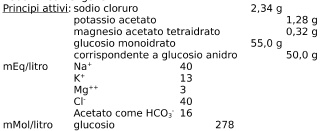
- The active ingredients are: sodium chloride, potassium acetate, magnesium acetate, glucose monohydrate. 1000 ml of solution contain: 2.34 g of sodium chloride, 1.28 g of potassium acetate, 0.21 g of magnesium acetate, 55.0 g of glucose monohydrate (corresponding to 50 g of glucose). Each liter of solution contains: 40 mEq of sodium, 13 mEq of potassium, 3 mEq of magnesium, 40 mEq of chloride, 16 mEq of acetate and 278 mmol of glucose. pH: 5.0 ÷ 7.0.
- The other components are water for injections and hydrochloric acid.
Description of the appearance of ELETTROLITICA BILANCIATA DI MANTENIMENTO CON GLUCOSIO
MONICO and contents of the pack
ELETTROLITICA BILANCIATA DI MANTENIMENTO CON GLUCOSIO – Solution for infusion I
Glass vials of 50 ml, 100 ml, 250 ml, 500 ml, 1000 ml.
Plastic bags of 50 ml, 100 ml, 250 ml, 500 ml, 1000 ml.
ELETTROLITICA BILANCIATA DI MANTENIMENTO CON GLUCOSIO – Solution for infusion II
Glass vials of 50 ml, 100 ml, 250 ml, 500 ml, 1000 ml.
Plastic bags of 50 ml, 100 ml, 250 ml, 500 ml, 1000 ml.
Marketing Authorisation Holder and Manufacturer
Monico spa
Via Ponte di Pietra 7, 30173 Venezia Mestre - Italy
__________________________________________________________________________
The following information is intended exclusively for healthcare professionals
Warnings and precautions
Monitoring of serum sodium is particularly important for physiologically
hypotonic solutions. ELETTROLITICA BILANCIATA DI MANTENIMENTO CON GLUCOSIO MONICO may
become extremely hypotonic after administration, due to the metabolism of
glucose in the body.
Patients with non-osmotic vasopressin release (e.g. in the acute phase of the disease, pain,
post-operative stress, infections, burns and diseases of the central nervous system), patients with
heart disease, liver disease and kidney disease and patients treated with vasopressin agonists, are
particularly at risk of acute hyponatremia following infusion of hypotonic solutions.
Acute hyponatremia can cause acute hyponatremic encephalopathy (cerebral edema)
characterized by headache, nausea, seizures, lethargy and vomiting. Patients with cerebral
edema are particularly at risk of severe, irreversible and life-threatening brain injury. Children, women of childbearing potential and patients with reduced cerebral compliance (e.g. meningitis,
intracranial hemorrhage and cerebral contusion) are particularly at risk of severe and life-threatening cerebral
edema caused by acute hyponatremia.
Interactions
The following list indicates the drugs that increase the effect of vasopressin,
causing a reduction in the excretion of free water from renal electrolytes and an increase in the
risk of hospital-acquired hyponatremia following treatment not adequately
balanced with intravenous solutions.
- Drugs stimulating vasopressin release, for example: chlorpropamide, clofibrate, carbamazepine, vincristine, selective serotonin reuptake inhibitors, 3,4-methylenedioxy-N-methamphetamine, ifosfamide, antipsychotics, narcotics.
- Drugs that enhance the action of vasopressin, for example: chlorpropamide, NSAIDs, cyclophosphamide.
- Vasopressin analogues: desmopressin, oxytocin, vasopressin, terlipressin. Other drugs that increase the risk of hyponatremia also include diuretics in general and antiepileptics such as oxcarbazepine.
Pregnancy
ELETTROLITICA BILANCIATA DI MANTENIMENTO CON GLUCOSIO MONICO should be
administered with particular caution in pregnant women during labor, especially
if administered in association with oxytocin, due to the risk of hyponatremia.

Nie jesteś pewien, czy ten lek jest odpowiedni dla ciebie?
Omów swoje objawy i leczenie z lekarzem online.

Zacząłeś przyjmować lek i masz pytania?
Omów swoje objawy i leczenie z lekarzem online.
- Kraj rejestracji
- Postać farmaceutycznaInfusion solution, 50 ML
- Kod ATCB05BB02
- Substancja czynna
- Wymaga receptyTak
- Producent
- Te treści mają charakter wyłącznie informacyjny i nie zastępują konsultacji lekarskiej.
- Zamienniki ELETTROLITIKA BILANKIATA DI MANTENIMENTO KON LUKOSIO MONIKOPostać farmaceutyczna: Infusion solution, 50 MLSubstancja czynna: electrolytes with carbohydratesProducent: BAXTER S.P.A.Wymaga receptyPostać farmaceutyczna: Infusion solution, 50 MLSubstancja czynna: electrolytes with carbohydratesWymaga receptyPostać farmaceutyczna: Infusion solution, 500 MLSubstancja czynna: electrolytes with carbohydratesProducent: S.A.L.F. SPA LABORATORIO FARMACOLOGICOWymaga recepty
Odpowiedniki ELETTROLITIKA BILANKIATA DI MANTENIMENTO KON LUKOSIO MONIKO w innych krajach
Leki z tą samą substancją czynną dostępne w innych krajach.
Odpowiednik ELETTROLITIKA BILANKIATA DI MANTENIMENTO KON LUKOSIO MONIKO w Polska
Odpowiednik ELETTROLITIKA BILANKIATA DI MANTENIMENTO KON LUKOSIO MONIKO w Ukraina
Odpowiednik ELETTROLITIKA BILANKIATA DI MANTENIMENTO KON LUKOSIO MONIKO w Hiszpania
Lekarze online w sprawie ELETTROLITIKA BILANKIATA DI MANTENIMENTO KON LUKOSIO MONIKO
Omów stosowanie ELETTROLITIKA BILANKIATA DI MANTENIMENTO KON LUKOSIO MONIKO, bezpieczeństwo i ocenę zasadności recepty zgodnie z obowiązującymi przepisami.









Uzyskaj receptę na ELETTROLITIKA BILANKIATA DI MANTENIMENTO KON LUKOSIO MONIKO online
Wypełnij 2-minutowy formularz
Opisz swoje objawy, historię choroby i lek, o który prosisz.
Wybierz lekarza lub pozwól nam przydzielić
Wybierz specjalistę lub dopasujemy Cię do najbliższego dostępnego lekarza.
Lekarz analizuje Twój przypadek
Zazwyczaj w ciągu 30 minut. Może zadawać dodatkowe pytania przez czat.
Odbierz w dowolnej aptece
Recepta elektroniczna wysłana na Twój e-mail — ważna w całej Polsce.
Często zadawane pytania
ELETTROLITIKA BILANKIATA DI MANTENIMENTO KON LUKOSIO MONIKO wymaga recepty w Włochy. Możesz skonsultować się z lekarzem online, aby sprawdzić, czy ten lek może być odpowiedni w Twojej sytuacji.
Substancją czynną w ELETTROLITIKA BILANKIATA DI MANTENIMENTO KON LUKOSIO MONIKO jest electrolytes with carbohydrates. Informacja ta pomaga rozpoznać leki o tym samym składzie, ale pod różnymi nazwami handlowymi.
ELETTROLITIKA BILANKIATA DI MANTENIMENTO KON LUKOSIO MONIKO jest produkowany przez MONICO S.P.A.. Nazwy handlowe i opakowania mogą się różnić w zależności od dystrybutora.
Lekarze, tacy jak Lekarze rodzinni, Psychiatrzy, Dermatolodzy, Kardiolodzy, Endokrynolodzy, Gastroenterolodzy, Pulmonolodzy, Nefrolodzy, Reumatolodzy, Hematolodzy, Zakaźnicy, Alergolodzy, Geriatrzy, Pediatrzy, Onkolodzy, mogą ocenić, czy stosowanie ELETTROLITIKA BILANKIATA DI MANTENIMENTO KON LUKOSIO MONIKO jest odpowiednie w Twoim przypadku, w zależności od sytuacji klinicznej i lokalnych przepisów. Możesz umówić konsultację online, aby omówić objawy i możliwe dalsze kroki.
Polska posiada dobrze rozwiniętą infrastrukturę ochrony zdrowia w dużych miastach, takich jak Warszawa, Kraków, Wrocław i Gdańsk. Apteki są łatwo dostępne i działają zgodnie z obowiązującymi przepisami, zapewniając dostęp do leków na receptę.
Możesz kupić ELETTROLITIKA BILANKIATA DI MANTENIMENTO KON LUKOSIO MONIKO w Warszawie, Krakowie, Wrocławiu lub Gdańsku w każdej aptece, posiadając ważną receptę.
Aby uzyskać receptę, możesz skorzystać z Oladoctor:
Inne leki zawierające tę samą substancję czynną (electrolytes with carbohydrates) to m.in. ELETTROLITIKA BILANKIATA DI MANTENIMENTO KON LUKOSIO BAXTER, ELETTROLITIKA BILANKIATA DI MANTENIMENTO KON LUKOSIO BIOINDUSTRIA L.I.M., ELETTROLITIKA BILANKIATA DI MANTENIMENTO KON LUKOSIO S.A.L.F.. Mogą one różnić się nazwą handlową lub postacią, ale zawierają ten sam składnik terapeutyczny. Przed zmianą lub rozpoczęciem nowego leku skonsultuj się z lekarzem.
