



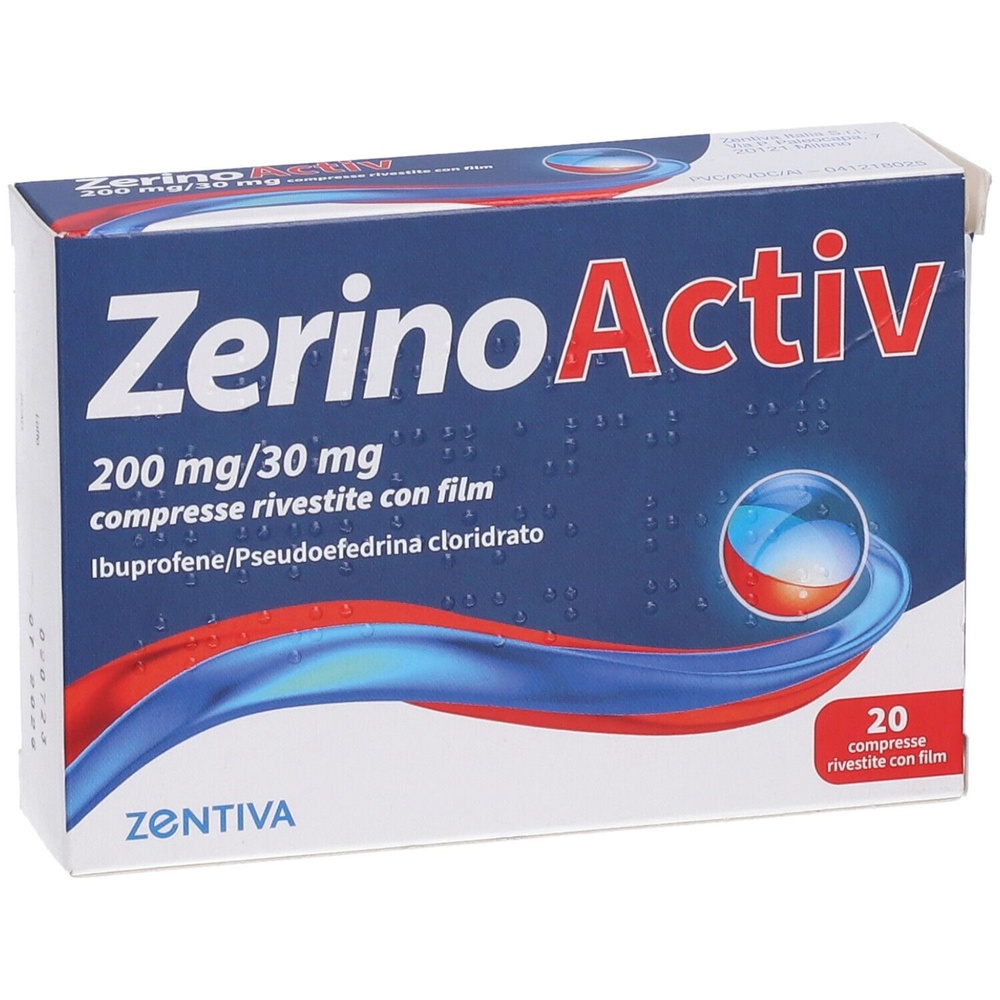
ZERINOACTIV 200 mg/30 mg Film-Coated Tablets

Запит на рецепт онлайн
Лікар розгляне ваш випадок і визначить, чи є рецепт медично доцільним.

Поговоріть з лікарем про ці ліки
Обговоріть симптоми та можливі подальші кроки під час короткої онлайн-консультації.



Інструкція із застосування TSERINOAKTIV
Зміст інструкції
- ZERINOACTIV 200 mg/30 mg film-coated tablets
- ZERINOACTIV is a film-coated tablet, white in color and round in shape.
ZERINOACTIV 200 mg/30 mg film-coated tablets
Ibuprofen/pseudoephedrine hydrochloride
Read this leaflet carefully before taking this medicine as it contains important information for you.
Always take this medicine exactly as described in this leaflet or as your doctor or pharmacist has told you.
- Keep this leaflet. You may need to read it again.
- If you want more information or advice, ask your pharmacist.
- If any side effects occur, including those not listed in this leaflet, tell your doctor or pharmacist. See section 4.
- See a doctor if you do not feel better or if your symptoms worsen after 5 days.
Contents of this leaflet:
- 1. What ZERINOACTIV is and what it is used for
- 2. What you need to know before you take ZERINOACTIV
- 3. How to take ZERINOACTIV
- 4. Possible side effects
- 5. How to store ZERINOACTIV
- 6. Contents of the pack and other information
1. What is ZERINOACTIV and what is it used for
ZERINOACTIV film-coated tablets contains two active ingredients: ibuprofen and
pseudoephedrine.
Ibuprofen belongs to a class of drugs called non-steroidal anti-inflammatory drugs
(NSAIDs). NSAIDs provide relief by reducing pain and lowering fever. Pseudoephedrine
belongs to a class of drugs called vasoconstrictors, which act on the blood vessels
inside the nose to relieve nasal congestion.
ZERINOACTIV film-coated tablets is indicated for the symptomatic treatment of
nasal congestion associated with headache and/or fever in adults and adolescents over the age of
15 years who are suffering from the common cold.
You should only take this combination if you have a stuffy nose with pain or fever. If you have only one
of these symptoms, you should consult your pharmacist or doctor regarding the use of ibuprofen
or pseudoephedrine alone.
See a doctor if you do not feel better or if you feel worse after 5 days.
2. What you need to know before taking ZERINOACTIV
Do not take ZERINOACTIV
- If you are allergic to ibuprofen or pseudoephedrine hydrochloride or to any of the other ingredients of this medicine (listed in section 6).
- If you have ever had a previous allergic reaction or asthma, skin rash, runny and itchy nose or facial swelling when taking this product, ibuprofen, acetylsalicylic acid or other similar medicines.
- If you have a history of recurrent gastric or duodenal ulcer or have had gastrointestinal bleeding related to previous therapy with NSAIDs.
- If you suffer from severe liver disease.
- If you suffer from severe acute (sudden) or chronic (long-term) kidney disease or kidney failure.
- If you have heart problems (such as coronary heart disease).
- If you have very high blood pressure (severe hypertension) or hypertension not controlled by medication.
- If you have a history of seizures (epileptic fits).
- If you suffer from disorders of the production of blood components of unknown origin.
- If you suffer from increased intraocular pressure (closed-angle glaucoma).
- If you suffer from difficulty urinating related to problems with the prostate.
- If you have been diagnosed with systemic lupus erythematosus (SLE), a disease that affects the immune system and causes joint pain, skin changes and other problems.
- If you are taking:
- other nasal decongestants (vasoconstrictors) administered orally or nasally (e.g. phenylpropanolamine, phenylephrine, ephedrine, xylometazoline or oxymetazoline);
- medicines against depression, such as non-selective monoamine oxidase inhibitors (known as MAOIs, e.g. iproniazide) or if you have taken them in the last 14 days.
- If you suffer from significant dehydration due to vomiting, diarrhea or insufficient fluid intake.
- If you are between the 28th and 40th week of pregnancy (third trimester of pregnancy).
Warnings and precautions
You must discuss the therapy with your doctor or pharmacist before taking ZERINOACTIV:
- if you suffer from asthma; the use of this medicine can cause an asthma attack;
- if you have a history of gastrointestinal diseases (such as hiatal hernia, gastrointestinal bleeding, peptic or duodenal ulcer) and chronic inflammatory bowel diseases (ulcerative colitis, Crohn's disease)
- if you have heart problems including heart attack, angina (chest pain) or if you have a history of heart attack, coronary bypass surgery, peripheral artery disease (poor circulation in the legs or feet due to narrowing or blockage of the arteries) or any type of stroke (including ‘mini stroke’ or “TIA”, transient ischemic attack);
- if you have high blood pressure, diabetes, high cholesterol, a family history of heart disease or stroke, or if you are a smoker;
- if you suffer from hyperthyroidism (overactive thyroid);
- if you have systemic lupus erythematosus (connective tissue disease), and mixed connective tissue disease, or congenital disorder of porphyrin metabolism;
- if you are taking medicines that interact with ZERINOACTIV, see the list below;
- if you have an infection - see section “Infections” below.
- if you develop a skin rash or skin symptoms, you should immediately stop taking ibuprofen, consult a doctor immediately and inform the doctor that you are taking this medicine.
Anti-inflammatory/pain-relieving drugs such as ibuprofen may be associated with a
modest increase in the risk of heart attack or stroke, especially if administered in
high doses. Do not exceed the recommended dose or duration of treatment.
Signs of an allergic reaction to this medicine, including breathing problems, swelling of the face and neck (angioedema) and chest pain, have been reported with ibuprofen.
Immediately stop ZERINOACTIV and contact your doctor or emergency health service immediately if you notice any of these signs.
Skin reactions
Serious skin reactions including exfoliative dermatitis, erythema multiforme, Stevens-Johnson syndrome, toxic epidermal necrolysis, drug reaction with eosinophilia and systemic symptoms (DRESS), acute generalized exanthematous pustulosis (AGEP) have been reported in association with treatment with ibuprofen. Stop using ZERINOACTIV
and contact your doctor immediately if you notice any of the symptoms related to
these serious skin reactions described in section 4.
Sudden abdominal pain or rectal bleeding may occur with
ZERINOACTIV, due to inflammation of the colon (ischemic colitis). If you develop these
gastro-intestinal symptoms, stop taking ZERINOACTIV and contact your doctor or
seek immediate medical assistance. See section 4.
In very rare cases, serious skin reactions have been reported when using an NSAID. The
patients appear to be at greater risk at the beginning of therapy; the onset of the
reaction occurs in most cases within the first month of treatment. Stop
taking ZERINOACTIV and contact your doctor or go immediately to a
medical care facility if you develop a rash or lesions of the mucous membranes.
Infections
ZERINOACTIV can mask the symptoms of infections such as fever and pain. Therefore,
it is possible that ZERINOACTIV may delay adequate treatment of the infection, which could
increase the risk of complications. This has been observed in pneumonia caused
by bacteria and bacterial skin infections related to varicella. If you take this
medicine while you have an infection and the symptoms of the infection persist or worsen, seek
immediate medical attention.
During a varicella infection, it is advisable to avoid the use of this medicine.
In patients with systemic lupus erythematosus and mixed connective tissue diseases, there may
be an increased risk of aseptic meningitis or hepatitis.
Prolonged use of any type of pain reliever for headache may worsen this
condition. If you experience frequent or daily headaches despite (or because of) the use
of regular headache medications, consult your doctor before taking another
pain reliever. Treatment should be discontinued if a diagnosis of medication-overuse headache is made.
Contact your doctor in case of prolonged treatment with ibuprofen, as liver and kidney function, as well as blood count, must be checked regularly.
Regular use of pain relievers, especially the combination of different pain-relieving medicines,
can lead to permanent kidney damage with the risk of kidney failure
(analgesic nephropathy). This risk may be increased under physical exertion associated with
salt loss and dehydration. Therefore, this should be avoided.
Cases of reversible posterior encephalopathy syndrome (PRES) and
reversible cerebral vasoconstriction syndrome (RCVS) have been reported following the use of medicines
containing pseudoephedrine. PRES and RCVS are rare conditions that can lead to a
reduced blood supply to the brain. Stop using ZERINOACTIV immediately and
seek immediate medical assistance if you develop symptoms that may be signs of PRES
or RCVS (see section 4 "Possible side effects" for symptoms).
A reduction in blood flow to the optic nerve may occur with ZERINOACTIV.
If you experience sudden loss of vision, stop taking ZERINOACTIV and
seek immediate medical attention or go to a healthcare facility. See
section 4.
Interference with blood tests
Pseudoephedrine can potentially interfere with some diagnostic blood tests.
You should inform your doctor that you are taking this medicine if you are undergoing a blood
test.
Children and adolescents
ZERINOACTIV should not be given to children under 15 years of age.
There is a risk of kidney damage in adolescents who are dehydrated.
Other medicines and ZERINOACTIV
Tell your doctor or pharmacist if you are taking, have recently taken or might
take any other medicines .
ZERINOACTIV can affect or be affected by other medicines. For example:
- medicines that have an anticoagulant effect (i.e. substances that thin the blood preventing the formation of clots, e.g. aspirin/acetylsalicylic acid, warfarin, ticlopidine);
- medicines that lower high blood pressure (ACE inhibitors such as captopril, beta-blockers such as atenolol, angiotensin II receptor antagonists such as losartan).
Some other medicines can also affect or be affected by treatment with
ZERINOACTIV. Therefore, always consult your doctor or pharmacist before using
ZERINOACTIV with other medicines.
In particular, tell your doctor or pharmacist if you are taking:
- antiplatelet and oral anticoagulant medicines (thin the blood/prevent coagulation, e.g. acetylsalicylic acid, warfarin, ticlopidine);
- other NSAIDs, including high-dose acetylsalicylic acid;
- cardiac glycosides (e.g. digoxin);
- corticosteroids;
- injectable heparin;
- some medicines against depression (e.g. lithium, selective serotonin reuptake inhibitors (SSRIs), monoamine oxidase inhibitors (MAOIs);
- high-dose methotrexate (more than 20 mg per week);
- quinolone antibiotics (used to treat a wide range of infections);
- cyclosporine, tacrolimus and trimethoprim;
- medicines for the treatment of hypertension (high blood pressure);
- any medicine for migraine (including medicines derived from ergot alkaloids) or methylphenidate;
- zidovudine (a medicine for the treatment of HIV/AIDS);
- preparations containing Ginkgo biloba;
- CYP2C9 inhibitors (e.g. voriconazole, fluconazole);
- mifepristone (for medical abortion).
ZERINOACTIV should not be used in combination with:
- other vasoconstrictors used as nasal decongestants, administered orally or nasally (e.g. phenylpropanolamine, phenylephrine and ephedrine);
- non-selective monoamine oxidase inhibitors (MAOIs) (such as iproniazide), prescribed for the treatment of certain depressive disorders.
The administration of pseudoephedrine can cause an acute hypertensive response in
the perioperative period. Therefore, stop treatment with ZERINOACTIV several days
before surgery and inform the anesthesiologist.
ZERINOACTIV with food, drinks and alcohol
The film-coated tablets should not be taken with drinks containing alcohol.
Pregnancy, breastfeeding and fertility
Do not take ZERINOACTIV in the last 3 months of pregnancy, as it may harm
the fetus or cause problems during childbirth. It may cause kidney and heart problems in the fetus.
It may affect your tendency to bleed and that of your baby and
delay or prolong labor longer than expected. You should not take ZERINOACTIV during
the first 6 months of pregnancy, unless strictly necessary and under the advice of
your doctor. If you need treatment during this period or while trying to
become pregnant, the lowest dose should be used for the shortest possible time.
From the 20th week of pregnancy, if taken for more than a few days, ZERINOACTIV can
cause kidney problems in the fetus that can lead to a reduction in the levels of amniotic fluid
surrounding the baby (oligohydramnios) or constriction of a blood vessel
(ductus arteriosus) in the baby's heart. If you need treatment for more than a few
days, your doctor may recommend additional monitoring.
ZERINOACTIV is contraindicated during the third trimester of pregnancy.
Athletes
For those who engage in sports: the use of the drug without therapeutic necessity constitutes
doping and may still result in positive doping tests.
Driving and using machines
ZERINOACTIV may cause dizziness and/or blurred vision and therefore may
temporarily affect the ability to drive and operate machinery.
ZERINOACTIV contains lactose and sodium
If your doctor has diagnosed you with intolerance to certain sugars, contact him before
taking this medicine.
This medicine contains less than 1 mmol (23 mg) of sodium per tablet, i.e. it is
essentially “sodium-free”.
3. How to take ZERINOACTIV
Take this medicine following exactly as indicated in this leaflet or by your doctor or pharmacist. If you have doubts, consult your doctor or pharmacist. This product should only be used for short periods of treatment. The lowest effective dose should be used for the shortest period necessary to relieve symptoms. If you have an infection, consult your doctor immediately if symptoms (such as fever and pain) persist or worsen (see section 2). Do not take the product for more than 5 days, unless prescribed by your doctor.
The recommended dose is:
Adults and adolescents aged 15 years and over: 1 film-coated tablet every 6 hours, if necessary. In case of more severe symptoms, take 2 film-coated tablets every 6 hours, if necessary.
Never exceed the maximum daily dose of 6 film-coated tablets per day (corresponding to 1200 mg of ibuprofen and 180 mg of pseudoephedrine hydrochloride).
The film-coated tablets should be taken, without chewing, with a glass of water, preferably during meals.
Use in children and adolescents
ZERINOACTIV should not be administered to children and adolescents under the age of 15 years.
If the use of the medicine is necessary for more than 3 days in adolescents, or if symptoms worsen, a doctor should be consulted.
If you take more ZERINOACTIV than you should
If you have taken more ZERINOACTIV than you should or if your child has taken this medicine by mistake, always contact a doctor or the nearest hospital to receive an opinion on the risk and advice on what actions to take.
Symptoms may include nausea, stomach pain, vomiting (possibly with traces of blood), headache, ringing in the ears, confusion and uncontrolled eye movements. At high doses, drowsiness, chest pain, palpitations, loss of consciousness, seizures (especially in children), weakness and dizziness, blood in the urine, feeling of coldness in the body and breathing problems have been reported.
4. Possible side effects
Like all medicines, ZERINOACTIV can cause side effects, although not everybody gets them.
Stop taking ZERINOACTIV immediately and contact your doctor immediately if any of the following occur:
- Signs of intestinal bleedingsuch as: bright red stools (faeces), black stools, vomiting blood or vomit that looks like coffee grounds.
- Signs of a severe allergic reactionsuch as: severe skin rash, blistering or peeling of the skin, facial swelling, difficulty breathing, wheezing, tendency to bruise easily.
- reddish-purple, non-raised, target-like or circular spots on the trunk, often with central blisters, skin peeling, ulcers of the mouth, throat, nose, genitals and eyes. These severe skin rashes may be preceded by fever and flu-like symptoms (exfoliative dermatitis, erythema multiforme, Stevens-Johnson syndrome, toxic epidermal necrolysis).
- widespread rash, high body temperature and swollen lymph nodes (DRESS syndrome).
- widespread, red and scaly rash with bumps under the skin and blisters, accompanied by fever. Symptoms usually appear early in treatment (acute generalized exanthematous pustulosis).
Frequency “not known”
- serious conditions affecting the blood vessels in the brain known as posterior reversible encephalopathy syndrome (PRES) and reversible cerebral vasoconstriction syndrome (RCVS) Stop taking ZERINOACTIV immediately and urgently contact your doctor if you develop symptoms that could be signs of posterior reversible encephalopathy syndrome (PRES) and reversible cerebral vasoconstriction syndrome (RCVS). These include:
- severe sudden onset headache
- nausea
- vomiting
- confusion
- seizures
- changes in vision
- Inflammation of the colon due to insufficient blood supply (ischemic colitis).
- Reduced blood flow to the optic nerve (ischemic optic neuropathy) Stop using ZERINOACTIV if you develop these symptoms and contact your doctor immediately. See also section 2.
Tell your doctor if you get any of these side effects, if they get worse or if you notice any side effects not listed.
Common (may affect up to 1 in 10 people):
- indigestion, heartburn, abdominal pain, nausea, vomiting, flatulence, diarrhoea, constipation.
Uncommon (may affect up to 1 in 100 people):
- headache, dizziness, difficulty sleeping, agitation, irritability or fatigue;
- impaired vision;
- gastric or intestinal ulcers, sometimes with bleeding and perforation, worsening of colitis and Crohn's disease;
- skin rashes.
Rare (may affect up to 1 in 10,000 people):
- tinnitus (ringing in the ears);
- kidney damage.
Very rare (may affect up to 1 in 10,000 people):
- problems with the production of blood cells which can lead to bruising easily or make you more susceptible to infections;
- severe allergic reactions;
- psychotic reactions and depression;
- high blood pressure, palpitations, heart attack;
- inflammation of blood vessels (vasculitis)
- liver damage;
- severe skin reactions;
- kidney damage or difficulty urinating.
Not known (frequency cannot be estimated from the available data)
- increased sensitivity of the skin to sunlight
- Seizures (convulsions), drowsiness, tremors
- Thirst, chest pain, physical weakness or lack of energy
- Difficulty completely emptying the bladder
- Fixed drug eruption (such as round or oval patches of redness and swelling of the skin), itching.
- Chest pain, which may be a sign of a potentially serious allergic reaction called Kounis syndrome
Reporting of side effects
If you get any side effects, talk to your doctor or pharmacist. This includes any side effects not listed in this leaflet. You can also report side effects directly through the national reporting system at
https://www.aifa.gov.it/content/segnalazioni-reazioni-avverse . By reporting side effects you can help provide more information on the safety of this
medicine.
5. How to store ZERINOACTIV
Keep this medicine out of the sight and reach of children.
Do not use this medicine after the expiry date which is stated on the package or blister
after (Exp.). The expiry date refers to the last day of that month.
Store at a temperature below 25°C.
Store in the original package. Keep the blister in the outer packaging.
Do not dispose of any medicine in wastewater or household waste. Ask your pharmacist
how to dispose of medicines you no longer use. This will help protect the environment.
6. Contents of the pack and other information
What ZERINOACTIV contains
The active ingredients are ibuprofen 200 mg and pseudoephedrine hydrochloride 30 mg.
The other ingredients are:
Core
lactose monohydrate
microcrystalline cellulose
sodium starch glycolate (type A)
colloidal anhydrous silica
magnesium stearate
Coating
polyvinyl alcohol
titanium dioxide (E 171)
macrogol type 3350
talc
Description of the appearance of ZERINOACTIV and contents of the pack
ZERINOACTIV is a film-coated tablet, white in color and round in shape.
One pack contains 10 or 20 film-coated tablets.
Marketing authorization holder and manufacturer
Marketing authorization holder:
Zentiva Italia S.r.l.
Via P. Paleocapa, 7 – 20121 Milano
Italy
Manufacturer:
Przedsiebiorstwo Produkcji Farmaceutycznej Hasco – Lek S.A.,
Żmigrodzka 242 E, 51-131 Wroclaw
Poland
This medicinal product is authorized in the Member States of the European Economic Area with the
following denominations
- Austria: BoxaGrippal 200 mg/30 mg Filmtabletten
- Germany: BoxaGrippal Erkältungstabletten 200 mg/30 mg Filmtabletten
- Italy: ZERINOACTIV 200 mg/30 mg film-coated tablets
- Portugal: Bisolgripal 200 mg + 30 mg film-coated tablets

Не впевнені, чи підходить вам цей лікарський засіб?
Обговоріть симптоми та можливі варіанти лікування з лікарем онлайн.

Виникли питання під час прийому ліків?
Обговоріть свої симптоми та лікування з лікарем онлайн.
- Країна реєстрації
- Лікарська формаFilm-coated tablet, 200 MG/30 MG
- Код АТХM01AE51
- Діюча речовина
- Потрібен рецептНі
- Виробник
- Ця інформація надана лише для ознайомлення і не є медичною порадою. Рішення щодо лікування завжди приймає лікар.
- Альтернативи до TSERINOAKTIVЛікарська форма: Film-coated tablet, 400 MG/100 MGДіюча речовина: ibuprofen, combinationsВиробник: OPELLA HEALTHCARE ITALY S.R.L.Рецепт не потрібенЛікарська форма: Film-coated tablet, 200 MG/30 MGДіюча речовина: ibuprofen, combinationsРецепт не потрібенЛікарська форма: Film-coated tablet, 200 MG + 30 MGДіюча речовина: ibuprofen, combinationsРецепт не потрібен
Аналоги TSERINOAKTIV в інших країнах
Препарати з тією самою діючою речовиною, доступні в інших країнах.
Аналог TSERINOAKTIV у Іспанія
Аналог TSERINOAKTIV у Польща
Аналог TSERINOAKTIV у Україна
Лікарі онлайн щодо TSERINOAKTIV
Застосування, безпека та можливість призначення рецепта — за результатами медичної оцінки.









Отримайте рецепт на TSERINOAKTIV онлайн
Заповніть форму за 2 хвилини
Розкажіть про симптоми, історію хвороби та потрібний препарат.
Оберіть лікаря або ми призначимо
Оберіть спеціаліста або ми підберемо найближчого доступного лікаря.
Лікар розглядає ваш випадок
Зазвичай протягом 30 хвилин. Може ставити уточнювальні запитання в чаті.
Отримайте в будь-якій аптеці
Електронний рецепт надсилається на вашу пошту — дійсний по всій Польщі.
Часті запитання
TSERINOAKTIV не потребує рецепта в Італія. Ви можете обговорити з лікарем онлайн, чи підходить цей лікарський засіб для вашої ситуації.
Діюча речовина у TSERINOAKTIV — ibuprofen, combinations. Це допомагає визначити препарати з тим самим складом, але під іншими торговими назвами.
TSERINOAKTIV виробляється компанією ZENTIVA ITALIA S.R.L.. Назва бренду та упаковка можуть відрізнятися залежно від дистрибʼютора.
Лікарі, зокрема Сімейні лікарі, Психіатри, Дерматологи, Кардіологи, Ендокринологи, Гастроентерологи, Пульмонологи, Нефрологи, Ревматологи, Гематологи, Інфекціоністи, Алергологи, Геріатри, Педіатри, Онкологи, можуть оцінити доцільність застосування TSERINOAKTIV з урахуванням вашого стану та місцевих правил. Ви можете записатися на онлайн-консультацію, щоб обговорити симптоми та можливі подальші кроки.
Польща має добре розвинену систему охорони здоров'я у великих містах, таких як Варшава, Краків, Вроцлав і Гданськ. Аптеки широко доступні та працюють відповідно до чинного законодавства, забезпечуючи доступ до рецептурних препаратів.
Ви можете придбати TSERINOAKTIV у Варшаві, Кракові, Вроцлаві або Гданську в будь-якій аптеці за наявності дійсного рецепта.
Щоб отримати рецепт, ви можете скористатися Oladoctor:
Інші препарати з тією самою діючою речовиною (ibuprofen, combinations) включають BUSKOAKTFOKUS, MOMENXSIN, NUROFEN INFLUENTSA E RAFFREDDORE. Вони можуть відрізнятися торговою назвою або формою випуску, але містять той самий терапевтичний компонент. Перед зміною або початком прийому нового препарату варто проконсультуватися з лікарем.
