



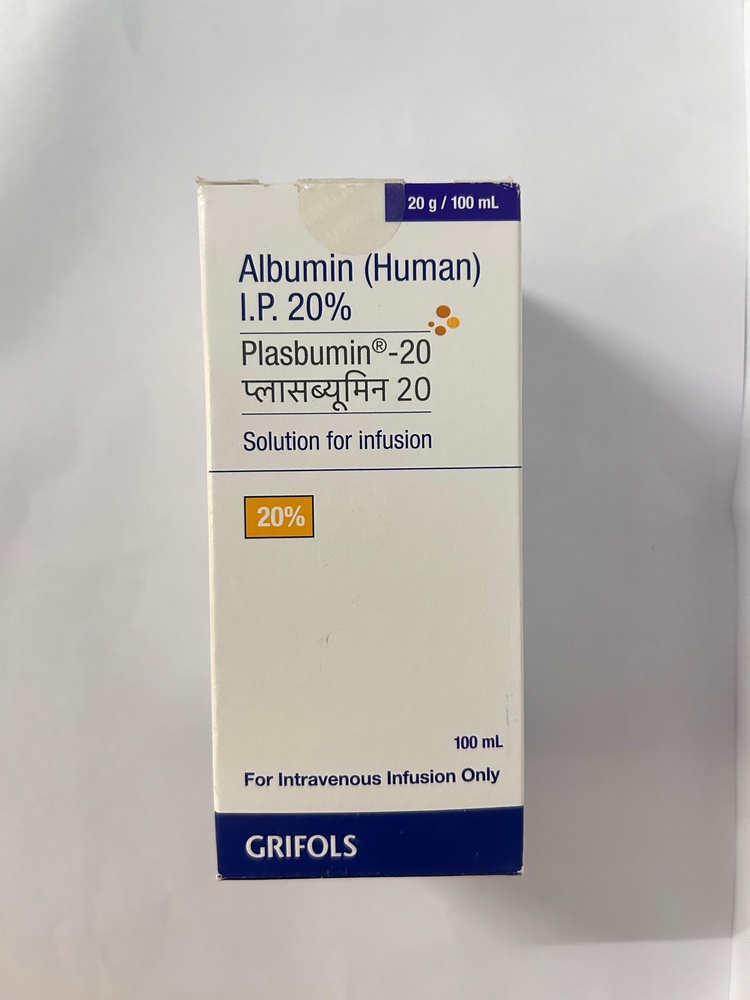
PLASBUMIN 200 G/L Infusion solution

Запит на рецепт онлайн
Лікар розгляне ваш випадок і визначить, чи є рецепт медично доцільним.

Поговоріть з лікарем про ці ліки
Обговоріть симптоми та можливі подальші кроки під час короткої онлайн-консультації.



Інструкція із застосування PLASBUMIN
Зміст інструкції
Plasbumin 200 g/l solution for infusion
Human albumin from human plasma
Read this leaflet carefully before you use this medicine as it contains important
information for you.
- Keep this leaflet. You may need to read it again.
- If you have any questions, ask your doctor, pharmacist or nurse.
- This medicine has been prescribed for you only. Do not pass it on to others, even if they have the same symptoms as you, as it may be harmful.
- If you get any side effects, even those not listed in this leaflet, tell your doctor, pharmacist or nurse. See section 4.
Contents of this leaflet:
- 1. What Plasbumin is and what it is used for
- 2. What you need to know before you use Plasbumin
- 3. How to use Plasbumin
- 4. Possible side effects
- 5. How to store Plasbumin
- 6. Contents of the pack and other information
1. What is Plasbumin and what is it used for
Plasbumin 200 g/l contains:
active substance: 200 g/l of plasma proteins consisting of at least 95% human albumin
Human albumin is used for the restoration and maintenance of circulating blood volume where
hypovolemia has been demonstrated and the use of a colloid is appropriate.
The choice of albumin rather than artificial colloids will depend on the individual patient's clinical condition
according to official recommendations.
2. What you need to know before using Plasbumin
Do not use Plasbumin
If you are allergic (hypersensitive) to human albumin or to any of the ingredients of this medicine (listed in section 6).
Warnings and precautions
Talk to your doctor before using Plasbumin.
If you have previously experienced an allergic reaction to albumin, inform your doctor or nurse immediately.
If allergic reactions or anaphylactic reactions occur during the infusion, it must be stopped immediately and appropriate treatment adopted. In case of shock, treatment must follow current guidelines for shock therapy.
Albumin should be used with caution in conditions where increased blood volume (hypervolemia) and its consequences or its dilution (hemodilution) may pose a particular risk to the patient.
Examples of such conditions are:
- decompensated heart failure (reduced cardiac output)
- arterial hypertension (increased blood pressure)
- esophageal varices (dilation of the veins of the esophagus)
- pulmonary edema (accumulation of fluid in the lungs)
- hemorrhagic diathesis (predisposition to bleeding)
- severe anemia (marked reduction of red blood cells and/or the protein that carries oxygen)
- renal and post-renal anuria (absence of urine production)
Human albumin solution for infusion is more concentrated than plasma normally present in the body; therefore, when administering concentrated human albumin, particular attention should be paid to ensuring adequate hydration of the patient. Patients using albumin should be carefully monitored by trained healthcare personnel to avoid overhydration and vascular overload.
20% albumin solutions are relatively poor in electrolytes compared to 5% solutions.
Therefore, when administering albumin, the patient's electrolyte status must be monitored (see section Dosage, method and duration of administration) and measures must be taken to restore or maintain normal electrolyte balance.
Albumin solutions must not be diluted with water for injectable preparations, as this may cause hemolysis (red blood cell rupture) in the patient.
If relatively large volumes need to be replenished, coagulation parameters and hematocrit (the cell component in the blood) must be checked. Necessary attention must be paid to ensure adequate replenishment of other blood components (coagulation factors, electrolytes, platelets, red blood cells).
If the dosage and infusion rate are not adjusted to the patient's circulatory situation, an increase in blood volume (hypervolemia) may occur. At the first clinical signs of cardiovascular overload: headache, difficulty breathing (dyspnea), jugular vein congestion, increased blood pressure, increased central venous pressure and pulmonary edema, the infusion must be stopped immediately.
Albumin may increase the risk of death in patients with brain injury or burns. In patients with severe brain injury and burns, treatment with albumin must be carefully evaluated in consideration of the risk/benefit profile.
Caution is necessary when the product is administered to diabetics, due to its glucose content.
Viral safety
When medicines are produced from human blood or plasma, specific measures are put in place to prevent the transmission of infections to patients. These measures include:
- careful selection of blood and plasma donors to ensure that potentially infected donors are excluded.
- testing of each donation and plasma pool for the presence of viruses/infections.
- the inclusion of certain steps in the processing of blood or plasma capable of inactivating or removing viruses. Despite these measures, the possibility of transmission of infectious agents cannot be completely excluded when administering medicinal products prepared from human blood or plasma. This also applies to viruses or other types of infectious agents, emerging or unknown.
There are no reports of viral transmissions with albumin produced according to established processes and with specifications in accordance with those of the European Pharmacopoeia.
It is strongly recommended that each time you receive a dose of PLASBUMIN, the name and batch number of the product are recorded, in order to maintain traceability of the batch used.
Attention for those who practice sports: the active substance contained in this preparation is included in the list of prohibited substances for doping.
Other medicines and Plasbumin
No drug interactions with other medicinal products are known, however, inform your doctor or pharmacist if you are taking, have recently taken or might take any other medicine.
Plasbumin 200 g/l must not be mixed with other drugs, whole blood or concentrated red blood cells.
It must not be mixed with protein hydrolysates, amino acid solutions or solutions containing alcohol.
It can be mixed with standard solutions of carbohydrates and electrolytes for intravenous use.
Concentrated albumin solutions must not be diluted with water for injectable solutions, as this may cause red blood cell rupture (hemolysis) in the patient.
Pregnancy, breastfeeding and fertility
If you are pregnant, suspect you are pregnant, are planning a pregnancy, or are breastfeeding, ask your doctor or pharmacist for advice before taking this medicine.
The safety of Plasbumin during pregnancy has not been established in controlled clinical studies.
However, clinical experience with albumin suggests no harmful effects on the course of pregnancy, the fetus or the newborn.
Animal studies are insufficient to demonstrate safety with regard to reproduction, embryo-fetal development, the course of pregnancy and peri- and postnatal development.
Albumin is, however, a normal constituent of human blood.
Driving and using machines
No effects have been observed that may affect the ability to drive vehicles or use other machinery.
3. How to use Plasbumin
For Instructions on correct Use and Dosage, refer to the section “The following information is intended exclusively for healthcare professionals”
Always use this medicine exactly as described in this leaflet or as instructed by your doctor, pharmacist or nurse. If you have any doubts, ask your doctor or pharmacist.
The dosage of albumin preparations required and the infusion rate must be established based on individual patient needs, the severity of trauma or illness and the loss of fluids and proteins.
If you use more Plasbumin than you should
If the dose or infusion rate is too high, an increase in blood volume (hypervolemia) may occur. In this case, some symptoms resulting from cardiovascular overload may appear, such as headache, difficulty breathing (dyspnea), swelling of the neck veins (jugular vein congestion), increased blood pressure (hypertension), increased central venous pressure and fluid accumulation in the lungs (pulmonary edema). As soon as any of these conditions occur, the patient must inform the healthcare professional and the infusion must be stopped immediately and the patient's hemodynamic parameters carefully monitored.
4. Possible side effects
Like all medicines, this medicine can cause side effects, although not everyone will experience them.
If you experience any of the following side effects, contact your doctor immediately or go to the
nearest hospital.
Serious adverse reactions such as shock are rare; in these cases, the infusion must be stopped
immediately and appropriate treatment for these cases must be initiated.
Other mild side effects include: redness, urticaria, fever, and nausea. These reactions of mild
intensity occur rarely and usually disappear with a slowing of the infusion rate or
discontinuation of the infusion itself.
For information on viral safety, see section 2 “What I need to know before using
Plasbumin”.
Reporting of side effects
If you experience any side effect, including those not listed in this leaflet,
talk to your doctor or nurse. You can also report side effects directly
through the national reporting system at
http://www.agenziafarmaco.gov.it/it/responsabili. Reporting side effects can help
provide more information on the safety of this medicine.
5. How to store Plasbumin
KEEP OUT OF THE SIGHT AND REACH OF CHILDREN
Do not use this medicine after the expiry date which is stated on the label and the packaging. The
expiry date refers to the last day of that month.
Do not use this medicine from vials that have already been opened or are damaged, or whose contents appear
cloudy, as microbial contamination may have occurred.
Do not store at temperatures above 30° C.
Do not freeze.
Store the vial in its original packaging and protect it from light.
Once the container has been opened, the contents must be used immediately. Any
unused solutions must be discarded due to the risk of bacterial contamination.
Cracked vials or those that have been previously opened or damaged must not be used, as
microbial contamination may have occurred.
6. Package contents and other information
What Plasbumin 200 g/l contains
Active ingredient: 200 g/l of plasma proteins consisting of at least 95% human albumin.
Other components and excipients are:
Water for injections
Total sodium 130 - 160 mmol/l (equivalent to 0.58 mmol/g of protein).
Aluminum < 200 μg/l
Stabilizing agents:
sodium caprylate 16mmol/l
acetyltryptophan 16mmol/l
Description of the appearance of Plasbumin and contents of the pack
Plasbumin is a solution for infusion, it appears slightly viscous and clear, almost
colorless, yellow, amber or green.
50 ml vial of 20% albumin solution
100 ml vial of 20% albumin solution
Do not use if the solution is turbid or if deposits have formed. This may indicate that the protein
is unstable or that the solution has been contaminated.
Marketing authorization holder
Instituto Grifols S.A. - c/Can Guasc, 2 – Parets del Vallès, 08150 Barcelona - Spain
Manufacturer responsible for batch release:
Instituto Grifols S.A. - c/Can Guasc, 2 – Parets del Vallès, 08150 Barcelona – Spain
or
Grifols Deutschland GmbH, Lyoner Strasse 15, 60528 Frankfurt, Germany
The following information is intended only for physicians or healthcare professionals:
- Plasbumin must be administered intravenously, directly or diluted with an isotonic solution (e.g. 5% glucose or 0.9% sodium chloride). Perform mixing with electrolytic solutions under aseptic conditions.
- Do not dilute albumin solutions with water for injections, as this may cause hemolysis in the patient.
- The solution should be clear or slightly opalescent. Do not use turbid solutions with deposits. This may indicate that the proteins are unstable or that the solution has been contaminated. Once the vial has been opened, the contents must be infused immediately.
- Remove the tamper-evident plastic band. Remove the seal to expose the stopper. Always clean the top of the stopper with an appropriate antiseptic immediately before piercing the vial.
- The infusion is carried out intravenously using a sterile, pyrogen-free, single-use infusion set. Before inserting the set into the vial stopper, disinfect the stopper using an antiseptic solution. Once the vial has been opened, the contents must be infused immediately.
- The infusion rate must be adjusted according to the individual case and indications. During plasmapheresis, the infusion rate must be adjusted to the rate of removal. Hypervolemia may occur if the dosage and infusion rate are not adapted to the patient's circulatory status. At the first signs of cardiovascular overload
(headache, dyspnea, jugular vein congestion), or increased blood pressure
arterial or venous and pulmonary edema, immediately stop the infusion.
- If large volumes are to be administered, the product must be brought to room or body temperature before use.
- When administering concentrated albumin, adequate hydration of the patient must be ensured. Patients should be carefully monitored to avoid circulatory overload and overhydration.
- When administering albumin, the patient's electrolyte status must be monitored and the electrolyte balance restored or maintained.
- It is necessary to ensure adequate replacement of other blood components (coagulation factors, electrolytes, platelets and red blood cells).
Unused solutions must be disposed of in accordance with local regulations.
Plasbumin 250 g/l solution for infusion
Human albumin from human plasma
Read this leaflet carefully before you use this medicine as it contains important
information for you.
- Keep this leaflet. You may need to read it again.
- If you have any questions, ask your doctor, pharmacist or nurse.
- This medicine has been prescribed for you only. Do not pass it on to others, even if they have the same symptoms as you, as it may be harmful.
- If you get any side effects, even those not listed in this leaflet, tell your doctor, pharmacist or nurse. See section 4.
Contents of this leaflet:
- 1. What Plasbumin is and what it is used for
- 2. What you need to know before you use Plasbumin
- 3. How to use Plasbumin
- 4. Possible side effects
- 5. How to store Plasbumin
- 6. Contents of the pack and other information
1. What is Plasbumin and what is it used for
Human albumin fractionated from human plasma
Plasbumin 250 g/l contains:
active substance: 250 g/l of plasma proteins consisting of at least 95% of human albumin
Human albumin is used for the restoration and maintenance of circulating blood volume where
hypovolemia has been demonstrated and the use of a colloid is appropriate.
The choice of albumin rather than artificial colloids will depend on the clinical status of the individual patient
according to official recommendations.
2. What you need to know before using Plasbumin
Do not use Plasbumin
If you are allergic (hypersensitive) to human albumin or to any of the ingredients of this medicine (listed in section 6).
Warnings and precautions
Talk to your doctor before using Plasbumin.
If you have previously experienced an allergic reaction to albumin, inform your doctor or nurse immediately.
If allergic reactions or anaphylactic reactions occur during the infusion, it must be stopped immediately and appropriate treatment adopted. In case of shock, treatment must follow current guidelines for shock therapy.
Albumin should be used with caution in conditions where increased blood volume (hypervolemia) and its consequences or its dilution (hemodilution) may pose a particular risk to the patient.
Examples of such conditions are:
- decompensated heart failure (reduced cardiac output)
- arterial hypertension (high blood pressure)
- esophageal varices (dilation of the veins of the esophagus)
- pulmonary edema (fluid accumulation in the lungs)
- bleeding diathesis (predisposition to bleeding)
- severe anemia (marked reduction of red blood cells and/or the protein that carries oxygen)
- renal and post-renal anuria (absence of urine production)
Human albumin solution for infusion is more concentrated than plasma normally present in the body; therefore, when administering concentrated human albumin, particular attention should be paid to ensuring adequate hydration of the patient. Patients using albumin should be carefully monitored by qualified healthcare personnel to avoid overhydration and vascular overload.
25% albumin solutions are relatively poor in electrolytes compared to 5% solutions.
Therefore, when administering albumin, the patient's electrolyte status must be monitored (see section Dosage, method and duration of administration) and measures must be taken to restore or maintain normal electrolyte balance.
Albumin solutions must not be diluted with water for injectable preparations, as this may cause hemolysis (red blood cell rupture) in the patient.
If relatively large volumes need to be replenished, coagulation parameters and hematocrit (the cell component in the blood) must be checked. Necessary attention must be paid to ensure adequate replenishment of other blood components (coagulation factors, electrolytes, platelets, red blood cells).
If the dosage and infusion rate are not adjusted to the patient's circulatory situation, an increase in blood volume (hypervolemia) may occur. At the first clinical signs of cardiovascular overload: headache, difficulty breathing (dyspnea), congestion of the jugular veins, increased blood pressure, increased central venous pressure and pulmonary edema, the infusion must be stopped immediately.
Albumin may increase the risk of death in patients with brain injury or burns. In patients with severe brain injury and burns, treatment with albumin must be carefully evaluated in consideration of the risk/benefit profile.
Caution is needed when the product is administered to diabetics, due to its glucose content.
Viral safety
When medicines are produced from human blood or plasma, specific measures are put in place to prevent the transmission of infections to patients. These measures include:
- careful selection of blood and plasma donors to ensure that potentially infected donors are excluded.
- testing each donation and plasma pool for the presence of viruses/infections.
- the inclusion of certain steps in the processing of blood or plasma capable of inactivating or removing viruses. Despite these measures, the possibility of transmission of infectious agents cannot be completely excluded when specialty medicines prepared from human blood or plasma are administered. This also applies to viruses or other types of infectious agents, emerging or unknown.
No reports of viral transmissions have been reported with albumin produced according to established processes and with specifications compliant with those of the European Pharmacopoeia.
It is strongly recommended that each time you receive a dose of PLASBUMIN, the name and batch number of the product are recorded, in order to maintain traceability of the batch used.
Attention for those who practice sports: the active ingredient contained in this preparation is included in the list of prohibited substances for doping.
Other medicines and Plasbumin
No drug interactions with other medicinal products are known; however, inform your doctor or pharmacist if you are taking, have recently taken or might take any other medicine.
Plasbumin 250 g/l must not be mixed with other drugs, whole blood or concentrated red blood cells.
It must not be mixed with protein hydrolysates, amino acid solutions or solutions containing alcohol.
It can be mixed with standard solutions of carbohydrates and electrolytes for intravenous use.
Concentrated albumin solutions must not be diluted with water for injectable solutions, as this may cause red blood cell rupture (hemolysis) in the patient.
Pregnancy, breastfeeding and fertility
If you are pregnant, suspect you are pregnant, are planning to become pregnant, or are breastfeeding, ask your doctor or pharmacist for advice before taking this medicine.
The safety of Plasbumin during pregnancy has not been established in controlled clinical studies.
However, clinical experience with albumin suggests the absence of harmful effects on the course of pregnancy, the fetus or the newborn.
Studies in laboratory animals are not sufficient to demonstrate safety with regard to reproduction, embryo-fetal development, the course of pregnancy and peri- and postnatal development.
Albumin is, however, a normal constituent of human blood.
Driving and operating machinery
No effects have been observed that may affect the ability to drive vehicles or operate other machinery.
3. How to use Plasbumin
For Instructions on correct Use and Dosage, refer to the section “The following information is intended exclusively for healthcare professionals”
Always use this medicine exactly as described in this leaflet or as instructed by your doctor, pharmacist or nurse. If you have any doubts, ask your doctor or pharmacist.
The dosage of albumin preparations required and the infusion rate must be established based on the individual needs of the patients, the severity of the trauma or illness and the loss of fluids and proteins.
If you use more Plasbumin than you should
If the dose or infusion rate is too high, an increase in blood volume (hypervolemia) may occur. In this case, some symptoms resulting from cardiovascular overload may appear, such as headache, difficulty breathing (dyspnea), swelling of the neck veins (jugular vein congestion), increased blood pressure (hypertension), increased central venous pressure and fluid accumulation in the lungs (pulmonary edema). As soon as any of these conditions occur, the patient must report it to the healthcare professional and the infusion must be stopped immediately and the patient's hemodynamic parameters carefully monitored.
4. Possible side effects
Like all medicines, this medicine can cause side effects, although not everybody gets them.
If any of the following side effects occur, contact your doctor immediately or go to the nearest
hospital.
Serious adverse reactions such as shock are rare; in these cases, the infusion must be stopped
immediately and appropriate treatment for these cases must be initiated.
Other mild side effects include: redness, hives, fever and nausea. These reactions of mild
intensity occur rarely and usually disappear with a slowing of the infusion rate or
discontinuation of the infusion itself.
For information on viral safety, see section 2 “What you need to know before using
Plasbumin”.
Reporting of side effects
If any side effect occurs, including those not listed in this leaflet,
contact your doctor or nurse. You can also report side effects directly
through the national reporting system at
http://www.agenziafarmaco.gov.it/it/responsabili. By reporting side effects you can help
to provide more information on the safety of this medicine.
5. How to store Plasbumin
KEEP OUT OF SIGHT AND REACH OF CHILDREN
Do not use this medicine after the expiry date which is stated on the label and the packaging. The
expiry date refers to the last day of that month.
Do not use this medicine from vials that have already been opened or are damaged, or whose contents appear
cloudy, as microbial contamination may have occurred.
Do not store at temperatures above 30° C.
Do not freeze.
Store the vial in its original packaging and protect it from light.
Once the container has been opened, the contents must be used immediately. Any unused solutions must be
discarded due to the risk of bacterial contamination.
Cracked vials or those that have been previously opened or damaged must not be used, as microbial
contamination may have occurred.
6. Contents of the pack and other information
What Plasbumin contains
Active ingredient: 250 g/l of plasma proteins consisting of at least 95% human albumin.
Other components and excipients are:
Water for injections
Total sodium 130 - 160 mmol/l (equivalent to 0.58 mmol/g of protein).
Aluminum < 200 μg/l
Stabilizing agents:
sodium caprylate 20 mmol/l
acetyltryptophan 20 mmol/l
Description of the appearance of Plasbumin and contents of the pack
Plasbumin is a solution for infusion, it appears slightly viscous and clear, almost
colorless, yellow, amber or green.
Vial of 50 ml of solution at 25% albumin
Vial of 100 ml of solution at 25% albumin
Do not use if the solution is turbid or if deposits have formed. This may indicate that the protein
is unstable or that the solution has been contaminated
Marketing authorization holder
Instituto Grifols S.A. - c/Can Guasc, 2 – Parets del Vallès, 08150 Barcelona - Spain
Manufacturer responsible for batch release:
Instituto Grifols S.A. - c/Can Guasc, 2 – Parets del Vallès, 08150 Barcelona – Spain
or
Grifols Deutschland GmbH, Lyoner Strasse 15, 60528 Frankfurt, Germany
The following information is intended only for doctors or healthcare professionals:
- Plasbumin must be administered intravenously, directly or diluted with an isotonic solution (e.g. 5% glucose or 0.9% sodium chloride). Carry out mixing with electrolytic solutions under aseptic conditions.
- Do not dilute albumin solutions with water for injections, as this may cause hemolysis in the patient.
- The solution should be transparent or slightly opalescent. Do not use turbid solutions with deposits. This may indicate that the proteins are unstable or that the solution has been contaminated. Once the vial has been opened, the contents must be infused immediately.
- Remove the tamper-evident plastic band. Remove the seal to reveal the stopper. Always clean the top of the stopper with a suitable antiseptic immediately before piercing the vial.
- The infusion is carried out intravenously using a sterile, apyrogenic, single-use infusion set. Before inserting the set into the vial stopper, disinfect the stopper using an antiseptic solution. Once the vial has been opened, the contents must be infused
immediately.
- The infusion rate must be adjusted according to the case and indications. During plasmapheresis, the infusion rate must be adjusted based on the elimination rate. Hypervolemia may occur if the dosage and infusion rate are not adapted to the patient's circulatory status. At the first signs of cardiovascular overload (headache, dyspnea, jugular vein congestion), or increased arterial or venous blood pressure and pulmonary edema, stop the infusion immediately.
- If large volumes are to be administered, the product must be brought to room or body temperature before use.
- When administering concentrated albumin, adequate patient hydration must be ensured. Patients should be carefully monitored to avoid circulatory overload and overhydration.
- When administering albumin, the patient's electrolyte status must be monitored and the electrolyte balance must be restored or maintained.
- It is necessary to ensure adequate replacement of other blood components (coagulation factors, electrolytes, platelets and red blood cells).
Unused solutions must be disposed of in accordance with local regulations.

Не впевнені, чи підходить вам цей лікарський засіб?
Обговоріть симптоми та можливі варіанти лікування з лікарем онлайн.

Виникли питання під час прийому ліків?
Обговоріть свої симптоми та лікування з лікарем онлайн.
- Країна реєстрації
- Лікарська формаInfusion solution, 200 G/L
- Код АТХB05AA01
- Діюча речовина
- Потрібен рецептТак
- Виробник
- Ця інформація надана лише для ознайомлення і не є медичною порадою. Рішення щодо лікування завжди приймає лікар.
- Альтернативи до PLASBUMINЛікарська форма: Infusion solution, 5% (50G/L)Діюча речовина: АльбуминВиробник: BIOTEST PHARMA GMBHПотрібен рецептЛікарська форма: Infusion solution, 250 G/LДіюча речовина: АльбуминВиробник: KEDRION S.P.A.Потрібен рецептЛікарська форма: Infusion solution, 200 G/LДіюча речовина: АльбуминВиробник: CSL BEHRING S.P.A.Потрібен рецепт
Аналоги PLASBUMIN в інших країнах
Препарати з тією самою діючою речовиною, доступні в інших країнах.
Аналог PLASBUMIN у Іспанія
Аналог PLASBUMIN у Польща
Аналог PLASBUMIN у Україна
Лікарі онлайн щодо PLASBUMIN
Застосування, безпека та можливість призначення рецепта — за результатами медичної оцінки.









Отримайте рецепт на PLASBUMIN онлайн
Заповніть форму за 2 хвилини
Розкажіть про симптоми, історію хвороби та потрібний препарат.
Оберіть лікаря або ми призначимо
Оберіть спеціаліста або ми підберемо найближчого доступного лікаря.
Лікар розглядає ваш випадок
Зазвичай протягом 30 хвилин. Може ставити уточнювальні запитання в чаті.
Отримайте в будь-якій аптеці
Електронний рецепт надсилається на вашу пошту — дійсний по всій Польщі.
Часті запитання
PLASBUMIN потребує рецепта в Італія. Ви можете обговорити з лікарем онлайн, чи підходить цей лікарський засіб для вашої ситуації.
Діюча речовина у PLASBUMIN — Альбумин. Це допомагає визначити препарати з тим самим складом, але під іншими торговими назвами.
PLASBUMIN виробляється компанією INSTITUTO GRIFOLS S.A.. Назва бренду та упаковка можуть відрізнятися залежно від дистрибʼютора.
Лікарі, зокрема Сімейні лікарі, Психіатри, Дерматологи, Кардіологи, Ендокринологи, Гастроентерологи, Пульмонологи, Нефрологи, Ревматологи, Гематологи, Інфекціоністи, Алергологи, Геріатри, Педіатри, Онкологи, можуть оцінити доцільність застосування PLASBUMIN з урахуванням вашого стану та місцевих правил. Ви можете записатися на онлайн-консультацію, щоб обговорити симптоми та можливі подальші кроки.
Польща має добре розвинену систему охорони здоров'я у великих містах, таких як Варшава, Краків, Вроцлав і Гданськ. Аптеки широко доступні та працюють відповідно до чинного законодавства, забезпечуючи доступ до рецептурних препаратів.
Ви можете придбати PLASBUMIN у Варшаві, Кракові, Вроцлаві або Гданську в будь-якій аптеці за наявності дійсного рецепта.
Щоб отримати рецепт, ви можете скористатися Oladoctor:
Інші препарати з тією самою діючою речовиною (Альбумин) включають ALBIOMIN, ALBITAL, ALBUMEON. Вони можуть відрізнятися торговою назвою або формою випуску, але містять той самий терапевтичний компонент. Перед зміною або початком прийому нового препарату варто проконсультуватися з лікарем.
