



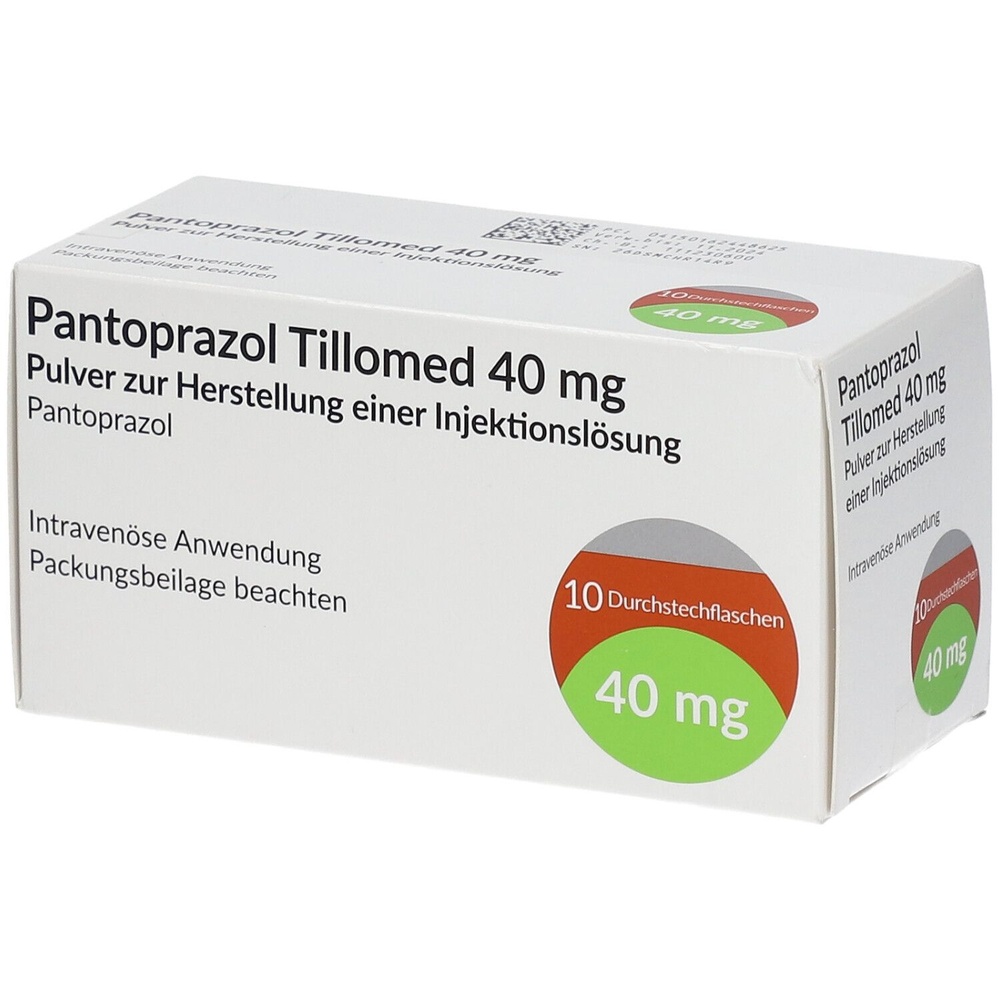
PANTOPRAZOLO 40 mg Powder For Injectable Solution

Запит на рецепт онлайн
Лікар розгляне ваш випадок і визначить, чи є рецепт медично доцільним.

Поговоріть з лікарем про ці ліки
Обговоріть симптоми та можливі подальші кроки під час короткої онлайн-консультації.



Інструкція із застосування PANTOPRATSOLO TILLOMED
Зміст інструкції
Pantoprazolo Tillomed 40 mg, powder for injectable solution
pantoprazolo
Generic medicine
Read this leaflet carefully before using this medicine, as it contains important
information for you.
- Keep this leaflet. You may need to read it again.
- If you have any questions, ask your doctor or pharmacist.
- If any side effects occur, including those not listed in this leaflet, tell your doctor or pharmacist. See section 4.
Contents of this leaflet
- 1.What is Pantoprazolo Tillomed and what it is used for
- 2.What you need to know before Pantoprazolo Tillomed is administered to you
- 3.How Pantoprazolo Tillomed is administered
- 4.Possible side effects
- 5.How to store Pantoprazolo Tillomed
- 6.Contents of the pack and other information
1. What is Pantoprazolo Tillomed and what is it used for
Pantoprazolo Tillomed contains the active ingredient pantoprazole (as sesquihydrate sodium).
Pantoprazolo Tillomed is a selective "proton pump inhibitor", a medicine that reduces the
amount of acid produced in the stomach. It is used for the treatment of diseases related to
acidity in the stomach and intestines.
This medicine is injected into a vein and will only be administered to you if the doctor believes that
injections of pantoprazole are currently more suitable for you than pantoprazole tablets.
As soon as the doctor deems it appropriate, the injections will be replaced with tablets.
Pantoprazolo Tillomed is used to treat:
- Reflux esophagitis. This is an inflammation of the esophagus (the part of the digestive tract that connects the throat to the stomach) associated with gastroesophageal reflux.
- Gastric and duodenal ulcers
- Zollinger-Ellison syndrome and other conditions in which too much acid is produced in the stomach.
2. What you need to know before you are given Pantoprazolo Tillomed
Do not use Pantoprazolo Tillomed
- If you are allergic to pantoprazole or to any of the other ingredients of this medicine (listed in section 6)
- If you are allergic to medicines containing other proton pump inhibitors.
Warnings and precautions
Talk to your doctor or pharmacist before taking Pantoprazolo Tillomed:
- If you suffer from severe liver problems. Tell your doctor if you have ever had liver problems. Liver enzymes will be checked more often. If liver enzymes increase, treatment must be stopped.
- If you are taking HIV protease inhibitors, such as atazanavir (used to treat HIV infection). Ask your doctor for specific advice.
- Taking a proton pump inhibitor such as pantoprazole, especially for more than one year, may slightly increase the risk of fractures of the hip, wrist or spine. Tell your doctor if you have osteoporosis (for example, because you are taking steroids).
- If you are taking Pantoprazolo Tillomed for more than three months, the levels of magnesium in your blood may decrease. Low levels of magnesium can manifest as fatigue, involuntary muscle contractions, disorientation, convulsions, dizziness, increased heart rate. If you experience any of these symptoms, inform your doctor immediately. Low levels of magnesium can also lead to a reduction in potassium or calcium levels in the blood. Your doctor may decide to perform regular blood tests to monitor your levels.
- If you have ever had a skin reaction after treatment with a medicine that reduces stomach acid similar to Pantoprazolo Tillomed.
- If you develop a skin rash, especially in areas where the skin has been exposed to the sun. Tell your doctor as soon as possible. It may be necessary to interrupt treatment with Pantoprazolo Tillomed. Remember to report any other flu-like symptoms, such as joint pain.
- Severe skin reactions such as Stevens-Johnson syndrome, toxic epidermal necrolysis, drug reaction with eosinophilia and systemic symptoms (DRESS) and multiforme erythema have been reported in association with treatment with pantoprazole. Stop using pantoprazole and consult your doctor immediately if you notice any of the symptoms associated with these severe skin reactions, described in section 4.
- If you need to undergo a specific blood test (chromogranin A).
Tell your doctor immediately, before or after taking this medicine, if you notice any of the
following symptoms, which could be a sign of a more serious illness:
- unintentional weight loss
- vomiting, especially if repeated
- blood in the vomit, which may appear as the appearance of dark clumps similar to coffee grounds in the vomit;
- presence of blood in the stool, which may appear black or tarry
- difficulty swallowing or pain when swallowing
- paleness and feeling of weakness (anemia)
- chest pain
- stomach pain
- severe and/or persistent diarrhea, as this medicine has been associated with a slight increase in diarrhea, caused by an infection.
The doctor may decide that you need some tests to rule out the presence of a malignant disease, as pantoprazole also relieves the symptoms of cancer; this could cause a delay
in diagnosis. If the symptoms persist despite treatment, further investigations will be considered.
Children and adolescents
The use of Pantoprazolo Tillomed is not recommended in children, as its effectiveness has not been demonstrated
in children under 18 years of age
Other medicines and Pantoprazolo Tillomed
Tell your doctor or pharmacist if you are taking, have recently taken or might take
any other medicines, including those without a prescription. Including herbal medicines.
Tell your doctor if you are taking any of the following medicines:
- Medicines such as ketoconazole, itraconazole and posaconazole (used to treat fungal infections) or erlotinib (used in the treatment of some types of cancer), as Pantoprazolo Tillomed may prevent these and other medicines from working properly.
- Warfarin and phenprocoumone, which affect blood coagulation or thinning. You may need to undergo further control tests.
- Medicines used to treat HIV infection (such as atazanavir).
- Methotrexate (used to treat rheumatoid arthritis (a type of rheumatism), psoriasis (a skin disease. The skin is red and dry, with scaling) and cancer) - if you are taking methotrexate, your doctor may temporarily suspend treatment with Pantoprazolo Tillomed because pantoprazole may increase methotrexate levels in the blood.
- Fluvoxamine (used to treat depression and other psychiatric conditions). If you are taking fluvoxamine, your doctor may reduce the dose.
- Rifampicin (used to treat infections).
- St John's Wort ( Hypericum perforatum) (used to treat mild depression).
- If you need to undergo a specific urine test (for THC, tetrahydrocannabinol), consult your doctor before taking Pantoprazolo Tillomed.
Pregnancy and breastfeeding
If you are pregnant, suspect you may be pregnant or are planning a pregnancy, or if you are breastfeeding with
breast milk, ask your doctor or pharmacist for advice before taking this medicine.
Pregnancy
There are no adequate data on the use of pantoprazole in pregnant women. You should use this
medicine only if your doctor believes that the benefit to you outweighs the potential risk to the
unborn child.
Breastfeeding
Excretion in breast milk has been reported. You should use this medicine only if your doctor believes
that the benefit to you outweighs the potential risk to the baby.
Driving and using machines
Pantoprazole does not alter or negligibly alters the ability to drive and use machines. If
you experience side effects such as dizziness or visual disturbances, you should not drive or use
machinery.
Pantoprazolo Tillomed contains sodium
This medicine contains less than 1 mmol of sodium (23 mg) per vial, i.e., it is essentially
"sodium-free".
3. How Pantoprazolo Tillomed is administered
The nurse or doctor will administer the daily dose in the form of an intravenous injection over a
time interval of 2-15 minutes.
The recommended dose is:
Adults
- For peptic ulcers, duodenal ulcers and reflux esophagitis. One vial (40 mg of pantoprazole) per day.
- For the long-term treatment of Zollinger-Ellison syndrome and other conditions in whichtoo much acid is produced in the stomach.
Two vials (80 mg of pantoprazole) per day.
The doctor may subsequently modify the dose, based on the amount of gastric acid that is
producing. If you have been prescribed more than two vials (80 mg) per day, the injections will be
divided into two equal administrations. The doctor may temporarily prescribe a dose
higher than four vials (160 mg) per day. If it is necessary to rapidly control the
levels of acid in the stomach, the initial dose of 160 mg (four vials) will be sufficient to reduce
adequately the production of acid.
Patients with liver problems
If you suffer from severe liver problems, the daily dose to be injected will be only 20 mg (half a
vial).
Use in children and adolescents
These injections are not recommended in children and adolescents under 18 years of age.
If you take more Pantoprazolo Tillomed than you should
These doses are carefully monitored by the nurse or doctor, so an overdose is
extremely unlikely. No symptoms of overdose are known.
If you have any doubts about the use of this medicine, ask your doctor or pharmacist.
4. Possible side effects
Like all medicines, this medicine can cause side effects, although not everyone will experience them.
If you experience any of the following side effects, inform your doctor immediately or go to the
nearest hospital emergency room:
- Severe allergic reactions (rare frequency: may affect up to 1 in 1,000 people): swelling of the tongue and/or throat, difficulty swallowing, hives (nettle rash), difficulty breathing, allergic swelling of the face (angioedema/Quincke's edema), severe dizziness with a very fast heartbeat and profuse sweating.
- Severe skin conditions (frequency not known: frequency cannot be defined based on available data): You may experience one or more of the following symptoms: formation of blisters on the skin and rapid worsening of general health conditions, erosion (including mild bleeding) of eyes, nose, mouth/lips or genitals, or skin rash, especially on skin exposed to light/sun. You may also experience joint pain or flu-like symptoms, fever, swollen lymph nodes (e.g. under the armpit) and blood tests may show changes in white blood cell count or liver enzymes.
- reddish, non-raised, circular or target-shaped spots on the trunk, often with blisters in the center, skin peeling, ulcers on the mouth, throat, nose, genitals and eyes. These severe skin reactions may be preceded by fever and flu-like symptoms (Stevens-Johnson syndrome, Lyell's syndrome [TEN]).
- widespread rash, high body temperature and swollen lymph nodes (drug reaction with eosinophilia and systemic symptoms (DRESS), drug hypersensitivity syndrome).
- Other serious conditions (frequency not known): yellowing of the skin or whites of the eyes (severe liver cell damage, jaundice) or fever, rash and swelling of the kidneys, sometimes with pain when urinating and lower back pain (severe kidney inflammation), which can lead to possible kidney failure.
Other side effects include:
- Common(may affect up to 1 in 10 people)
Inflammation of the artery walls and formation of blood clots (thrombophlebitis) at the injection site
of the medicine; benign polyps in the stomach.
- Uncommon(may affect up to 1 in 100 people) Headache; dizziness; diarrhea; feeling unwell, vomiting; abdominal bloating and flatulence; constipation; dry mouth; pain and discomfort in the upper abdomen; appearance of itchy rash (skin rash, exanthema, eruptions); itching; feeling of weakness, exhaustion or general malaise; sleep disturbances; hip, wrist or vertebral fractures
- Rare(may affect up to 1 in 1,000 people) Alteration or complete loss of the sense of taste; visual disturbances, such as blurred vision; hives (nettle rash); joint pain; muscle pain; changes in weight; increased body temperature; high fever; swelling of the arms and/or legs (peripheral edema); allergic reactions; depression; breast enlargement in men.
- Very Rare(may affect up to 1 in 10,000 people) Disorientation
- Not known(frequency cannot be defined based on available data) Hallucinations, confusion (especially in patients with a history of these symptoms); tingling, prickling, pins and needles sensation, burning or numbness, skin rash, possibly with joint pain; inflammation in the colon, causing persistent watery diarrhea
Side effects identified through blood tests
- Uncommon(may affect up to 1 in 100 people) Increased liver enzymes
- Rare(may affect up to 1 in 1,000 people) Increased bilirubin; increased levels of fats in the blood; sudden decrease in circulating granular white blood cells, associated with high fever.
- Very Rare(may affect up to 1 in 10,000 people) A reduction in the number of platelets, which can cause more than normal bleeding or bruising more often; a reduction in the number of white blood cells, which can lead to more frequent infections; a combination of abnormal reduction in the number of red blood cells and white blood cells, as well as platelets.
- Not known(frequency cannot be estimated from available data) Decrease in levels of sodium, magnesium, calcium or potassium in the blood (see section 2).
Side effects
If you experience any side effect, including those not listed in this leaflet, tell your
doctor or pharmacist. You can also report side effects directly through the national
reporting system at https://www.aifa.gov.it/content/segnalazioni-reazioni-avverse .
By reporting side effects you can help provide more information on the safety of
this medicine.
5. How to store Pantoprazolo Tillomed
Keep this medicine out of the sight and reach of children.
Do not use this medicine after the expiry date which is stated on the pack and the vial, after
“Exp”. The expiry date refers to the last day of that month.
Do not store at a temperature above 25°C.
Keep the vial in the outer packaging to protect the medicine from light.
Use the reconstituted and diluted solution within 12 hours.
From a microbiological point of view, the product must be used immediately. If not used
immediately, the storage times and conditions before use are the responsibility
of the user and normally should not exceed 12 hours, at no more than 25°C.
Do not use Pantoprazolo Tillomed if you notice an altered appearance (for example, if you observe cloudiness or
precipitates).
Do not dispose of any medicine in wastewater or household waste. Ask your pharmacist how to
dispose of medicines you no longer use. This will help protect the environment.
6. Contents of the pack and other information
What Pantoprazolo Tillomed contains
- The active ingredient is pantoprazole. Each vial contains 40 mg of pantoprazole (as sodium sesquihydrate).
- The other ingredients are: mannitol and trisodium phosphate dodecahydrate (for pH adjustment)
Description of the appearance of Pantoprazolo Tillomed and contents of the pack
Pantoprazolo Tillomed is a powder for injectable solution from white to off-white. It is presented in a
10 ml clear glass vial, sealed with an aluminium cap and a grey rubber stopper
containing 40 mg of powder for injectable solution.
Pantoprazolo Tillomed is available in packs of 1, 5, 10, 20 vials of powder for injectable
solution or in multipack packs of 50 (5 x 10) vials of powder for injectable solution; sale of
partial quantities is not permitted.
Not all pack sizes may be marketed.
Marketing Authorisation Holder
Tillomed Italia S.r.l.
Viale G. Richard 1, Torre A
20143 Milano (MI), Italy
Manufacturer
MIAS Pharma Limited
Suite 2, Stafford House, Strand Road
Portmarnock, Co. Dublin
Ireland
This medicinal product is authorised in the Member States of the European Economic
Area under the following denominations:
Netherlands: Pantoprazol ADOH 40 mg, powder for solution for injection
Germany: Pantoprazol Tillomed 40 mg Pulver zur Herstellung einer Injektionslösung
France: PANTOPRAZOLE TILLOMED 40 mg, poudre pour solution injectable
Italy Pantoprazolo Tillomed
The following information is intended exclusively for doctors or healthcare professionals:
The ready-to-use solution should be prepared by injecting 10 ml of sodium chloride injectable
solution 9 mg/ml (0.9%) into the vial containing the powder. This solution can be administered
directly or after dilution with 100 ml of sodium chloride injectable solution 9 mg/ml
(0.9%) or glucose injectable solution 55 mg/ml (5%). Glass or plastic containers should be used
for dilution.
Pantoprazolo Tillomed must not be reconstituted or diluted with solvents other than those
indicated above.
After reconstitution, the solution must be used within 12 hours. From a
microbiological point of view, the product must be used immediately. If not used
immediately, the storage times and conditions before use are the responsibility of the
user and should normally not exceed 12 hours, at a temperature not exceeding
25°C.
The medicine must be administered intravenously in 2 - 15 minutes.
The contents of the vial are exclusively for a single intravenous administration. Any product
remaining in the vial or container or whose visual appearance has changed (e.g. if
turbidity or precipitate is observed) must be discarded.

Не впевнені, чи підходить вам цей лікарський засіб?
Обговоріть симптоми та можливі варіанти лікування з лікарем онлайн.

Виникли питання під час прийому ліків?
Обговоріть свої симптоми та лікування з лікарем онлайн.
- Країна реєстрації
- Лікарська формаPowder for injectable solution, 40 mg
- Код АТХA02BC02
- Діюча речовина
- Потрібен рецептТак
- Виробник
- Ця інформація надана лише для ознайомлення і не є медичною порадою. Рішення щодо лікування завжди приймає лікар.
- Альтернативи до PANTOPRATSOLO TILLOMEDЛікарська форма: Enteric-coated tablet, 20 MGДіюча речовина: ПантопразолВиробник: TAKEDA GMBHРецепт не потрібенЛікарська форма: Enteric-coated tablet, 20 MGДіюча речовина: ПантопразолВиробник: RATIOPHARM GMBHРецепт не потрібенЛікарська форма: Enteric-coated tablet, 20 MGДіюча речовина: ПантопразолВиробник: HALEON ITALY S.R.L.Потрібен рецепт
Аналоги PANTOPRATSOLO TILLOMED в інших країнах
Препарати з тією самою діючою речовиною, доступні в інших країнах.
Аналог PANTOPRATSOLO TILLOMED у Іспанія
Аналог PANTOPRATSOLO TILLOMED у Польща
Аналог PANTOPRATSOLO TILLOMED у Україна
Лікарі онлайн щодо PANTOPRATSOLO TILLOMED
Застосування, безпека та можливість призначення рецепта — за результатами медичної оцінки.









Отримайте рецепт на PANTOPRATSOLO TILLOMED онлайн
Заповніть форму за 2 хвилини
Розкажіть про симптоми, історію хвороби та потрібний препарат.
Оберіть лікаря або ми призначимо
Оберіть спеціаліста або ми підберемо найближчого доступного лікаря.
Лікар розглядає ваш випадок
Зазвичай протягом 30 хвилин. Може ставити уточнювальні запитання в чаті.
Отримайте в будь-якій аптеці
Електронний рецепт надсилається на вашу пошту — дійсний по всій Польщі.
Часті запитання
PANTOPRATSOLO TILLOMED потребує рецепта в Італія. Ви можете обговорити з лікарем онлайн, чи підходить цей лікарський засіб для вашої ситуації.
Діюча речовина у PANTOPRATSOLO TILLOMED — Пантопразол. Це допомагає визначити препарати з тим самим складом, але під іншими торговими назвами.
PANTOPRATSOLO TILLOMED виробляється компанією TILLOMED ITALIA SRL. Назва бренду та упаковка можуть відрізнятися залежно від дистрибʼютора.
Лікарі, зокрема Сімейні лікарі, Психіатри, Дерматологи, Кардіологи, Ендокринологи, Гастроентерологи, Пульмонологи, Нефрологи, Ревматологи, Гематологи, Інфекціоністи, Алергологи, Геріатри, Педіатри, Онкологи, можуть оцінити доцільність застосування PANTOPRATSOLO TILLOMED з урахуванням вашого стану та місцевих правил. Ви можете записатися на онлайн-консультацію, щоб обговорити симптоми та можливі подальші кроки.
Польща має добре розвинену систему охорони здоров'я у великих містах, таких як Варшава, Краків, Вроцлав і Гданськ. Аптеки широко доступні та працюють відповідно до чинного законодавства, забезпечуючи доступ до рецептурних препаратів.
Ви можете придбати PANTOPRATSOLO TILLOMED у Варшаві, Кракові, Вроцлаві або Гданську в будь-якій аптеці за наявності дійсного рецепта.
Щоб отримати рецепт, ви можете скористатися Oladoctor:
Інші препарати з тією самою діючою речовиною (Пантопразол) включають KONTROLOK KONTROL, EUGASTROL REFLUSSO, GASTROLOK. Вони можуть відрізнятися торговою назвою або формою випуску, але містять той самий терапевтичний компонент. Перед зміною або початком прийому нового препарату варто проконсультуватися з лікарем.
