



ORFADIN 2 mg Hard Capsule

Запит на рецепт онлайн
Лікар розгляне ваш випадок і визначить, чи є рецепт медично доцільним.

Поговоріть з лікарем про ці ліки
Обговоріть симптоми та можливі подальші кроки під час короткої онлайн-консультації.



Інструкція із застосування ORFADIN
Зміст інструкції
- Orfadin 2 mg hard capsules, 5 mg hard capsules, 10 mg hard capsules, 20 mg hard capsules
- Orfadin 4 mg/ml oral suspension
Orfadin 2 mg hard capsules, 5 mg hard capsules, 10 mg hard capsules, 20 mg hard capsules
nitisinone
Read this leaflet carefully before taking this medicine as it contains important information for you.
- Keep this leaflet. You may need to read it again.
- If you have any questions, ask your doctor, pharmacist or nurse.
- This medicine has been prescribed for you only. Do not pass it on to others, even if they have the same symptoms as you, as it could be harmful.
- If you get any side effects, even those not listed in this leaflet, tell your doctor, pharmacist or nurse. See section 4.
Contents of this leaflet
- 1. What Orfadin is and what it is used for
- 2. What you need to know before you take Orfadin
- 3. How to take Orfadin
- 4. Possible side effects
- 5. How to store Orfadin
- 6. Contents of the pack and other information
1. What is Orfadin and what is it used for
Orfadin contains the active ingredient nitisinone. Orfadin is used to treat:
- a rare disease called hereditary tyrosinemia type 1 in adults, adolescents and children (of any age)
- a rare disease called alkaptonuria (AKU) in adults
If you suffer from these disorders, your body is unable to completely break down the amino acid tyrosine
(amino acids are the basic building blocks of proteins), and this results in the formation of harmful
substances that accumulate in the body. Orfadin blocks the breakdown of tyrosine, preventing
the formation of these harmful substances.
For the treatment of hereditary tyrosinemia type 1, since tyrosine will remain in the body, you will need to
follow a specific low-tyrosine and phenylalanine (another amino acid) diet during
taking this medicine.
For the treatment of AKU, your doctor may advise you to follow a special diet.
2. What you need to know before taking Orfadin
Do not take Orfadin
- if you are allergic to nitisinone or any of the other ingredients of this medicine (listed in section 6).
Do not breastfeed during the period of taking this medicine, see section
“Pregnancy and breastfeeding”.
Warnings and precautions
Talk to your doctor or pharmacist before taking Orfadin.
- Your eyes will be checked by an ophthalmologist before treatment with nitisinone and regularly during treatment. If your eyes become red or you notice any other eye effects, consult your doctor immediately for an eye examination. Eye problems may be a symptom of inadequate dietary control (see section 4).
During treatment, blood samples will be taken so that the doctor can
check if the treatment is appropriate and ensure that there are no undesirable effects that
could cause changes in blood composition.
If you receive Orfadin for the treatment of hereditary tyrosinemia type 1, you will undergo regular liver checks, as the disease affects the liver.
Every 6 months, the doctor must perform check-up visits. If any
undesirable effects occur, shorter intervals are recommended.
Other medicines and Orfadin
Tell your doctor or pharmacist if you are taking, have recently taken or might take
any other medicines.
Orfadin may interfere with the effect of other medicines, such as:
- Medicines for epilepsy (such as phenytoin)
- Anticoagulant medicines (such as warfarin)
Orfadin with food
If you start treatment by taking it with food, it is recommended to continue taking it
with food for the entire duration of treatment.
Pregnancy and breastfeeding
The safety of this medicine in pregnant and breastfeeding women has not been studied.
If you are planning a pregnancy, talk to your doctor. If you become pregnant, you should contact
your doctor immediately.
You should not breastfeed during the period of taking this medicine, see
section “Do not take Orfadin”.
Driving and using machines
This medicine slightly impairs the ability to drive and use machines. However, if
you experience adverse reactions that affect your vision, do not drive or use machines until you
have recovered normal visual ability (see section 4 “Possible side effects”).
3. How to take Orfadin
Take this medicine following exactly the instructions of your doctor. If you have any doubts, ask your
doctor or pharmacist.
For hereditary tyrosinemia type 1, treatment with this medicine must be started and
followed by a doctor experienced in the treatment of the disease.
For hereditary tyrosinemia type 1, the recommended total daily dose is 1 mg/kg of
body weight, administered orally. The doctor will adjust the dose individually.
It is recommended to administer the dose once a day. Data in patients with body weight
<20 kg are limited, therefore, in this patient population it is recommended to divide the total
daily dose into two daily administrations.
For AKU, the recommended dose is 10 mg once a day.
If you have difficulty swallowing the capsules, you can open them and mix the powder with a small amount of
water or with a meal replacement drink just before taking it.
If you take more Orfadin than you should
If you take more medicine than you should, contact your doctor or pharmacist as soon as possible.
If you forget to take Orfadin
Do not take a double dose to make up for a missed dose. If you forget to take a dose,
contact your doctor or pharmacist.
If you stop taking Orfadin
If you feel that the medicine is not working as it should, tell your doctor. Do not change the doses
or stop treatment without informing your doctor.
If you have any further questions on the use of this medicine, ask your doctor, pharmacist or
nurse.
4. Possible side effects
Like all medicines, this medicine can cause side effects, although not everybody gets them.
If you notice the appearance of any side effects concerning the eyes and vision, consult your
doctor immediately for an ophthalmological examination. Treatment with nitisinone determines higher
levels of tyrosine in the blood which can cause symptoms affecting the eyes. In patients with
hereditary tyrosinemia type 1, commonly reported eye-related side effects (which
may affect more than 1 in 100 people) caused by increased tyrosine levels are
eye inflammation (conjunctivitis), opacity and inflammation of the cornea (keratitis), sensitivity
to light (photophobia) and eye pain. Inflammation of the eyelids (blepharitis) is an uncommon side
effect (may affect up to 1 in 100 people).
In patients with AKU, eye irritation (keratopathy) and eye pain are very commonly reported side effects
(may affect more than 1 in 10 people).
Other side effects reported in patients with hereditary tyrosinemia type 1 are listed below:
Other common side effects
- Reduced number of platelets (thrombocytopenia) and leukocytes (leukopenia), decrease of some specific white blood cells (granulocytopenia).
Other uncommon side effects
- Increased number of white blood cells (leukocytosis).
- Itching, skin inflammation (exfoliative dermatitis), skin rashes.
Other side effects reported in patients with AKU are listed below:
Other common side effects
- bronchitis
- pneumonia
- itching, skin rash
Reporting of side effects
If you get any side effects, even those not listed in this leaflet, tell your doctor, pharmacist or
nurse. You can also report side effects directly through the national reporting system detailed in
Appendix V. By reporting side effects you can help provide more information on the safety of
this medicine.
5. How to store Orfadin
Keep this medicine out of the sight and reach of children.
Do not use this medicine after the expiry date which is stated on the bottle and the carton after
“EXP” and “Scad.” respectively. The expiry date refers to the last day of that month.
Store in a refrigerator (2°C – 8°C).
This medicine can be stored for a single period of 2 months (for the 2 mg capsules) or
3 months (for the 5 mg, 10 mg and 20 mg capsules) at a temperature not exceeding 25°C, after which it must be disposed of.
Once taken from the refrigerator, do not forget to note the date on the bottle.
Do not dispose of any medicine in wastewater or household waste. Ask your pharmacist how to
dispose of medicines you no longer use. This will help protect the environment.
6. Contents of the pack and other information
What Orfadin contains
- The active ingredient is nitisinone. Orfadin 2 mg:each capsule contains 2 mg of nitisinone. Orfadin 5 mg:each capsule contains 5 mg of nitisinone. Orfadin 10 mg:each capsule contains 10 mg of nitisinone. Orfadin 20 mg:each capsule contains 20 mg of nitisinone.
- The other ingredients are: Capsule content: starch, pregelatinized (from corn). Capsule shell: gelatin, titanium dioxide (E 171). Printed inscription: iron oxide (E 172), lacquer, propylene glycol, ammonium hydroxide.
Description of the appearance of Orfadin and contents of the pack
The hard capsules are opaque white in color, marked with the inscription in black “NTBC” and the
dosage “2 mg”, “5 mg”, “10 mg” or “20 mg”. The capsules contain a white or
off-white powder.
The capsules are packaged in plastic bottles with tamper-evident closures. Each bottle
contains 60 capsules.
Marketing Authorisation Holder
Swedish Orphan Biovitrum International AB
SE-112 76 Stockholm
Sweden
Manufacturer
Apotek Produktion & Laboratorier AB
Prismavägen 2
SE-141 75 Kungens Kurva
Sweden
More detailed information on this medicine is available on the website of the European
Medicines Agency, http://www.ema.europa.eu/ . Furthermore, links to other websites on rare diseases
and related therapeutic treatments are provided.
Orfadin 4 mg/ml oral suspension
nitisinone
Read this leaflet carefully before taking this medicine as it contains
important information for you.
- Keep this leaflet. You may need to read it again.
- If you have any questions, ask your doctor, pharmacist or nurse.
- This medicine has been prescribed for you only. Do not pass it on to others, even if their symptoms are the same as yours, as it could be harmful.
- If you get any side effects, even those not listed in this leaflet, tell your doctor, pharmacist or nurse. See section 4.
Contents of this leaflet
- 1. What Orfadin is and what it is used for
- 2. What you need to know before you take Orfadin
- 3. How to take Orfadin
- 4. Possible side effects
- 5. How to store Orfadin
- 6. Contents of the pack and other information
1. What is Orfadin and what is it used for
Orfadin contains the active substance nitisinone. Orfadin is used to treat:
- a rare disease called hereditary tyrosinemia type 1 in adults, adolescents and children (of any age)
- a rare disease called alkaptonuria (AKU) in adults
If you suffer from these disorders, your body is unable to completely break down the amino acid tyrosine
(amino acids are the basic building blocks of proteins), and this leads to the formation
of harmful substances that accumulate in the body. Orfadin blocks the breakdown of tyrosine,
thus preventing the formation of the harmful substances.
For the treatment of hereditary tyrosinemia type 1, since tyrosine will remain in the body,
you will need to follow a specific low-tyrosine and phenylalanine (another amino acid) diet
while taking this medicine.
For the treatment of AKU, your doctor may advise you to follow a special diet.
2. What you need to know before taking Orfadin
Do not take Orfadin
- if you are allergic to nitisinone or any of the other ingredients of this medicine (listed in section 6).
Do not breastfeed during the period of taking this medicine, see section
“Pregnancy and breastfeeding”.
Warnings and precautions
Talk to your doctor or pharmacist before taking Orfadin.
- Your eyes will be checked by an ophthalmologist before treatment with nitisinone and regularly during treatment. If your eyes become red or you notice any other eye effects, contact
your doctor immediately for an eye examination. Eye problems may be the
symptom of inadequate dietary control (see section 4).
During treatment, blood samples will be taken so that your doctor can
check if the treatment is appropriate and ensure that there are no undesirable effects that
could cause changes in blood composition.
If you are receiving Orfadin for the treatment of hereditary tyrosinemia type 1, you will undergo liver function tests at regular intervals, as the disease affects the liver.
Every 6 months, your doctor should perform check-up visits. If any adverse
effects occur, shorter intervals are recommended.
Other medicines and Orfadin
Tell your doctor or pharmacist if you are taking, have recently taken or might take
any other medicines.
Orfadin can interfere with the effect of other medicines, such as:
- Medicines for epilepsy (such as phenytoin)
- Anticoagulant medicines (such as warfarin)
Orfadin with food
It is recommended to take the oral suspension with food.
Pregnancy and breastfeeding
The safety of this medicine in pregnant and breastfeeding women has not been studied.
If you are planning a pregnancy, talk to your doctor. If you become pregnant, you should contact
your doctor immediately.
You should not breastfeed during the period of taking this medicine, see
section “Do not take Orfadin”.
Driving and using machines
This medicine slightly impairs the ability to drive and use machines. However, if
you experience adverse reactions that affect your vision, do not drive or use machines until
you have recovered normal visual acuity (see section 4 “Possible side effects”).
Orfadin contains sodium, glycerol and sodium benzoate
This medicine contains 0.7 mg (0.03 mmol) of sodium per ml.
A dose of 20 ml (10 g of glycerol) or higher of oral suspension may cause headache, gastrointestinal
disorders and diarrhoea.
Sodium benzoate may increase jaundice (yellowing of the skin and eyes) in premature and term newborns
with jaundice and cause kernicterus (brain damage due to
bilirubin deposition in the brain). Blood bilirubin levels (a substance that at high levels is
responsible for the yellowing of the skin) in newborns will be carefully monitored.
If these levels are significantly higher than normal, especially in premature infants with
risk factors such as acidosis (blood pH too low) and low albumin levels (a protein
present in the blood), the possibility of treatment with Orfadin capsules instead of
the oral suspension until bilirubin levels in plasma normalize will be evaluated.
3. How to take Orfadin
Take this medicine following exactly the instructions of your doctor. If you have any doubts, ask your doctor or pharmacist.
In order to ensure that the correct dose is administered, strictly adhere to the instructions below for preparing and administering the dose.
For hereditary tyrosinemia type 1, treatment with this medicine must be started and followed by a doctor experienced in the treatment of the disease.
For hereditary tyrosinemia type 1, the recommended total daily dose is 1 mg/kg of body weight, administered orally. The doctor will adjust the dose individually.
It is recommended to administer the dose once a day. Data in patients with body weight <20 kg are limited, therefore, in this patient population it is recommended to divide the total daily dose into two daily administrations.
For AKU, the recommended dose is 10 mg once a day.
The oral suspension is administered with an oral syringe directly into the mouth, without dilution.
Orfadin must not be injected. Do not attach a needle to the syringe.
How to prepare the dose to be administered
The dose prescribed by the doctor must be administered in ml of suspensionand not in mg, as the oral syringe used to draw up the correct dose from the bottle is marked in ml. If your prescription is in mg, contact your pharmacist or doctor for information.
The package contains a bottle of medicine with a cap, an adapter and three oral syringes (1 ml, 3 ml and 5 ml). Always use one of the provided oral syringes to take the medicine.
- The 1 ml oral syringe (the smallest oral syringe) is marked from 0.1 ml to 1 ml with smaller graduations of 0.01 ml. It is used to measure lower doses or up to 1 ml.
- The 3 ml oral syringe (the medium-sized oral syringe) is marked from 1 ml to 3 ml with smaller graduations of 0.1 ml. It is used to measure doses greater than 1 ml and up to 3 ml.
- The 5 ml oral syringe (the largest oral syringe) is marked from 1 ml to 5 ml with smaller graduations of 0.2 ml. It is used to measure doses greater than 3 ml.
It is important to use the correct oral syringe when taking the medicine. Your doctor, pharmacist or nurse will tell you which oral syringe to use based on the dose that has been prescribed for you.
How to prepare a new bottle of medicine for first use:
Before taking the first dose, the bottle must be shaken vigorously as, during prolonged storage, the particles form a solid agglomerate at the bottom. Follow the instructions below:
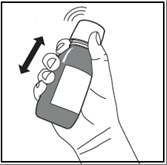
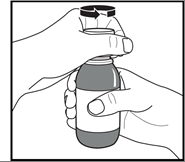

Figure A. Figure B. Figure C.
- 1. Remove the bottle from the refrigerator. Note on the bottle label the date of removal of the bottle from the refrigerator.
- 2. Shake the bottle vigorously for at least 20 secondsuntil the solid agglomerate at the bottom of the bottle is completely dispersed (Figure A).
- 3. Remove the child-resistant screw cap by pressing it firmly downwards and turning it counterclockwise (Figure B).
- 4. Place the open bottle upright on a table. Push the plastic adapter as far as possible onto the neck (Figure C). Close the bottle with the child-resistant screw cap.
For subsequent dosages, follow the instructions below “How to prepare a dose of medicine”.
How to prepare a dose of medicine
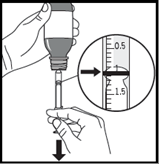
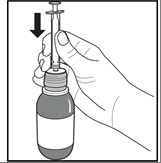
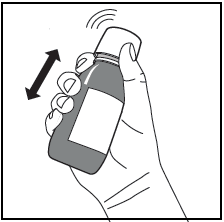
Figure D. Figure E. Figure F.
- 1. Shake the bottle vigorously for at least 5 seconds(Figure D).
- 2. Immediately afterwards, open the bottle by removing the child-resistant screw cap.
- 3. Fully depress the plunger inside the oral syringe.
- 4. Hold the bottle upright and firmly insert the oral syringe into the hole in the adapter, at the top of the bottle (Figure E).
- 5. Carefully turn the bottle upside down while keeping the oral syringe in place (Figure F).
- 6. To draw up the prescribed dose (ml), pull the plunger slowlyuntil the top edge of the black ring is exactly in line with the dose mark (Figure F). If air bubbles are observed inside the filled oral syringe, push the plunger upwards again until the air bubbles are expelled. Then pull the plunger again until the black ring is exactly in line with the dose mark.
- 7. Return the bottle to the upright position. Detach the oral syringe by gently rotating it and pulling it out of the bottle.
- 8. The dose must be administered into the mouth immediately (without dilution) to avoid agglomeration in the oral syringe. The oral syringe must be emptied slowlyto allow swallowing; rapid administration of the medicine may cause choking.
- 9. Replace the child-resistant screw cap immediately after use. Do not remove the bottle adapter.
- 10. The bottle can be stored at room temperature (not exceeding 25°C).
Cleaning:
Clean the oral syringe with water immediately. Separate the cylinder and plunger and rinse both with water. Shake off excess water and leave the disassembled oral syringe to dry before reassembling it for the next dosage.
If you take more Orfadin than you should
If you take more medicine than you should, contact your doctor or pharmacist as soon as possible.
If you forget to take Orfadin
Do not take a double dose to make up for a missed dose. If you forget a dose, contact your doctor or pharmacist.
If you stop taking Orfadin
If you feel that the medicine is not working as it should, tell your doctor. Do not change the doses or stop treatment without informing your doctor.
If you have any doubts about using this medicine, ask your doctor, pharmacist or nurse.
4. Possible side effects
Like all medicines, this medicine can cause side effects, although not everybody gets them.
If you notice the appearance of any side effects concerning the eyes and vision, consult
your doctor immediately for an ophthalmological examination. Treatment with nitisinone determines higher
levels of tyrosine in the blood which can cause symptoms affecting the eyes. In patients with
hereditary tyrosinemia type 1, eye-related side effects commonly reported (which
may affect more than 1 in 100 people) caused by increased levels of tyrosine are
eye inflammation (conjunctivitis), opacity and inflammation of the cornea (keratitis), sensitivity
to light (photophobia) and eye pain. Inflammation of the eyelids (blepharitis) is an uncommon side
effect (may affect up to 1 in 100 people).
In patients with AKU, eye irritation (keratopathy) and eye pain are very commonly reported side effects
(may affect more than 1 in 10 people).
Other side effects reported in patients with hereditary tyrosinemia type 1 are listed below:
Other common side effects
- Reduced number of platelets (thrombocytopenia) and leukocytes (leukopenia), decrease of some specific white blood cells (granulocytopenia).
Other uncommon side effects
- Increased number of white blood cells (leukocytosis).
- Itching, skin inflammation (exfoliative dermatitis), skin rashes.
Other side effects reported in patients with AKU are listed below:
Other common side effects
- bronchitis
- pneumonia
- itching, skin rash
Reporting of side effects
If you get any side effects, even those not listed in this leaflet, tell your doctor, pharmacist or nurse. You can also report side effects
directly through the national reporting system detailed in Annex V.
By reporting side effects you can help provide more information on the safety of
this medicine.
5. How to store Orfadin
Keep this medicine out of the sight and reach of children.
Do not use this medicine after the expiry date which is stated on the bottle and the carton after
“EXP” and “Scad.” respectively. The expiry date refers to the last day of that month.
Store in a refrigerator (2°C – 8°C).
Do not freeze.
Keep the bottle in an upright position.
After first opening, this medicine can be stored for a single period of 2 months and at
a temperature not exceeding 25°C, after which it must be disposed of.
Once taken from the refrigerator, do not forget to note the date on the bottle.
Do not dispose of any medicine in wastewater or household waste. Ask your pharmacist how to
dispose of medicines you no longer use. This will help protect the environment.
6. Contents of the pack and other information
What Orfadin contains
- The active ingredient is nitisinone. Each ml contains 4 mg of nitisinone.
- The other ingredients are hydroxypropyl methylcellulose, glycerol (see section 2), polysorbate 80, sodium benzoate (E211) (see section 2), citric acid monohydrate, sodium citrate (see section 2), strawberry flavour (artificial) and purified water.
Description of the appearance of Orfadin and contents of the pack
The oral suspension is a white, opaque, slightly dense suspension. Before being shaken,
Orfadin oral suspension may appear as a solid agglomerate at the bottom of the bottle and a
slightly opalescent liquid.
The suspension is contained in a dark glass bottle of 100 ml with a white, child-resistant screw cap.
Each bottle contains 90 ml of suspension.
Each pack contains one bottle, one adapter and three syringes for oral use.
Marketing authorisation holder
Swedish Orphan Biovitrum International AB
SE-112 76 Stockholm
Sweden
Manufacturer
Apotek Produktion & Laboratorier AB
Celsiusgatan 43
SE-212 14 Malmö
Sweden
Apotek Produktion & Laboratorier AB
Prismavägen 2
SE-141 75 Kungens Kurva
Sweden
More detailed information on this medicine is available on the website of the European Medicines
Agency, http://www.ema.europa.eu/. Furthermore, links to other websites on rare diseases
and related therapeutic treatments are provided.

Не впевнені, чи підходить вам цей лікарський засіб?
Обговоріть симптоми та можливі варіанти лікування з лікарем онлайн.

Виникли питання під час прийому ліків?
Обговоріть свої симптоми та лікування з лікарем онлайн.
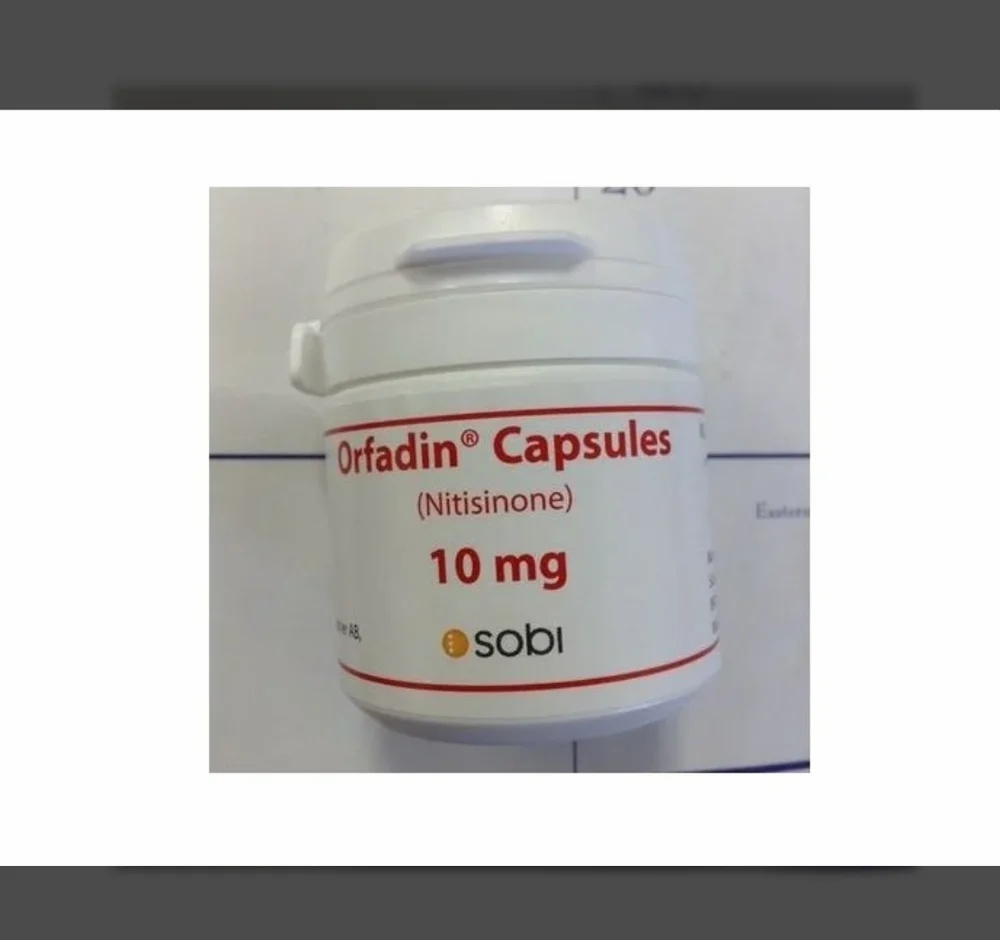
- Країна реєстрації
- Лікарська формаHard capsule, 2 MG
- Код АТХA16AX04
- Діюча речовина
- Потрібен рецептТак
- Виробник
- Ця інформація надана лише для ознайомлення і не є медичною порадою. Рішення щодо лікування завжди приймає лікар.
- Альтернативи до ORFADINЛікарська форма: Hard capsule, 5 MGДіюча речовина: НитисинонВиробник: Dipharma Arzneimittel GmbHПотрібен рецептЛікарська форма: Tablet, 500 MGДіюча речовина: Фенилбутират натрияВиробник: IMMEDICA PHARMA ABРецепт не потрібенЛікарська форма: Hard capsule, 84 MGДіюча речовина: ЭлиглюстатВиробник: SANOFI B.V.Потрібен рецепт
Аналоги ORFADIN в інших країнах
Препарати з тією самою діючою речовиною, доступні в інших країнах.
Аналог ORFADIN у Україна
Аналог ORFADIN у Іспанія
Лікарі онлайн щодо ORFADIN
Застосування, безпека та можливість призначення рецепта — за результатами медичної оцінки.









Отримайте рецепт на ORFADIN онлайн
Заповніть форму за 2 хвилини
Розкажіть про симптоми, історію хвороби та потрібний препарат.
Оберіть лікаря або ми призначимо
Оберіть спеціаліста або ми підберемо найближчого доступного лікаря.
Лікар розглядає ваш випадок
Зазвичай протягом 30 хвилин. Може ставити уточнювальні запитання в чаті.
Отримайте в будь-якій аптеці
Електронний рецепт надсилається на вашу пошту — дійсний по всій Польщі.
Часті запитання
ORFADIN потребує рецепта в Італія. Ви можете обговорити з лікарем онлайн, чи підходить цей лікарський засіб для вашої ситуації.
Діюча речовина у ORFADIN — Нитисинон. Це допомагає визначити препарати з тим самим складом, але під іншими торговими назвами.
ORFADIN виробляється компанією SWEDISH ORPHAN BIOVITRUM INTERNATIONAL AB. Назва бренду та упаковка можуть відрізнятися залежно від дистрибʼютора.
Лікарі, зокрема Сімейні лікарі, Психіатри, Дерматологи, Кардіологи, Ендокринологи, Гастроентерологи, Пульмонологи, Нефрологи, Ревматологи, Гематологи, Інфекціоністи, Алергологи, Геріатри, Педіатри, Онкологи, можуть оцінити доцільність застосування ORFADIN з урахуванням вашого стану та місцевих правил. Ви можете записатися на онлайн-консультацію, щоб обговорити симптоми та можливі подальші кроки.
Польща має добре розвинену систему охорони здоров'я у великих містах, таких як Варшава, Краків, Вроцлав і Гданськ. Аптеки широко доступні та працюють відповідно до чинного законодавства, забезпечуючи доступ до рецептурних препаратів.
Ви можете придбати ORFADIN у Варшаві, Кракові, Вроцлаві або Гданську в будь-якій аптеці за наявності дійсного рецепта.
Щоб отримати рецепт, ви можете скористатися Oladoctor:
Інші препарати з тією самою діючою речовиною (Нитисинон) включають NITISINONE DIPARMA, AMMONAPS, KERDELGA. Вони можуть відрізнятися торговою назвою або формою випуску, але містять той самий терапевтичний компонент. Перед зміною або початком прийому нового препарату варто проконсультуватися з лікарем.
