



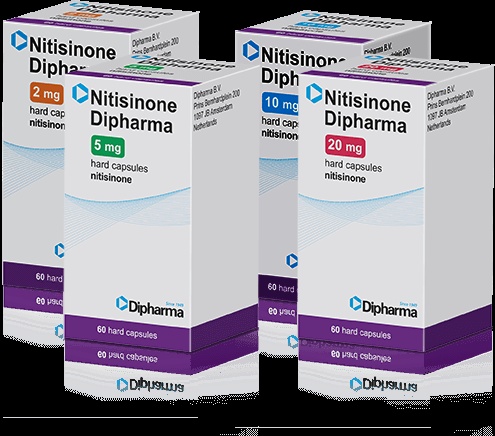
NITISINONE 5 mg Hard Capsule

Запит на рецепт онлайн
Лікар розгляне ваш випадок і визначить, чи є рецепт медично доцільним.

Поговоріть з лікарем про ці ліки
Обговоріть симптоми та можливі подальші кроки під час короткої онлайн-консультації.



Інструкція із застосування NITISINONE DIPARMA
Зміст інструкції
- Nitisinone Dipharma 5 mg hard capsules, 10 mg hard capsules
- Nitisinone Dipharma 2 mg hard capsules, 20 mg hard capsules
Nitisinone Dipharma 5 mg hard capsules, 10 mg hard capsules
Nitisinone
Equivalent Medicinal Product
Read this leaflet carefully before taking this medicine as it contains important information for you.
- Keep this leaflet. You may need to read it again.
- If you have any questions, ask your doctor, pharmacist or nurse.
- This medicine has been prescribed for you only. Do not pass it on to others, even if they have the same symptoms as you, as it may be harmful.
- If you get any side effects, even those not listed in this leaflet, tell your doctor, pharmacist or nurse. See section 4.
Contents of this leaflet:
- 1. What Nitisinone Dipharma is and what it is used for
- 2. What you need to know before you take Nitisinone Dipharma
- 3. How to take Nitisinone Dipharma
- 4. Possible side effects
- 5. How to store Nitisinone Dipharma
- 6. Contents of the pack and other information
1. What is Nitisinone Dipharma and what it is used for
- The active substance contained in Nitisinone Dipharma is nitisinone. This medicine is used in adults, adolescents and children (of any age) for the treatment of a rare disease called hereditary tyrosinemia type 1. If you suffer from this disorder, the body is unable to completely break down the amino acid tyrosine (amino acids are the basic building blocks of proteins), and this leads to the formation of harmful substances that accumulate in the body. Nitisinone Dipharma blocks the breakdown of tyrosine, thus preventing the formation of harmful substances.
Because tyrosine will remain in the body, you will need to follow a specific low-tyrosine and phenylalanine (another amino acid) diet while taking this medicine.
2. What you need to know before taking Nitisinone Dipharma
Do not take Nitisinone Dipharma
- if you are allergic to nitisinone or to any of the other ingredients of this medicine (listed in section 6). Do not breastfeed during the period of taking this medicine, see section “Pregnancy and breastfeeding”.
Warnings and precautions
Talk to your doctor or pharmacist before taking Nitisinone Dipharma.
- If your eyes become red or you notice any other eye effects. See your doctor immediately for an eye examination. Eye disorders may be a symptom of inadequate dietary control (see section 4).
During treatment, blood samples will be taken so that the doctor can
check if the treatment is appropriate and ensure that there are no undesirable effects that
could cause changes in the composition of the blood.
You will undergo regular liver function tests, as the disease affects the liver.
Every 6 months, your doctor should perform check-up visits. If any adverse
effect occurs, shorter intervals are recommended.
Other medicines and Nitisinone Dipharma
Tell your doctor or pharmacist if you are taking, have recently taken or might take
any other medicines.
Nitisinone Dipharma with food
If you start treatment with Nitisinone Dipharma by taking it with food, it is recommended to
continue taking it with food for the entire duration of treatment.
Pregnancy and breastfeeding
The safety of this medicine in pregnant and breastfeeding women has not been studied.
If you are planning a pregnancy, talk to your doctor. If you become pregnant, you should contact
your doctor immediately.
You must not breastfeed during the period of taking this medicine, see
section “Do not take Nitisinone Dipharma”.
Driving and using machines
This medicine slightly impairs the ability to drive and use machines. However, if
you experience adverse reactions that affect your vision, do not drive or use machines until you
have recovered normal visual acuity (see section 4 “Possible side effects”).
3. How to take Nitisinone Dipharma
Take this medicine following exactly the instructions of your doctor. If you have any doubts, ask your
doctor or pharmacist.
Treatment with this medicine must be started and monitored by a doctor experienced in the
treatment of the disease (hereditary tyrosinemia type 1).
The recommended total daily dose is 1 mg/kg of body weight, administered orally. The doctor will
individually adjust the dose.
It is recommended to administer the dose once a day. Data in patients with body weight <20
kg are limited, therefore, in this patient population it is recommended to divide the total daily
dose into two daily administrations.
If you have difficulty swallowing the capsules, you can open them and mix the powder with a small
amount of water or with a meal replacement drink immediately before taking it.
If you take more Nitisinone Dipharma than you should
If you take more medicine than you should, contact your doctor or pharmacist as soon as possible.
If you forget to take Nitisinone Dipharma
Do not take a double dose to make up for a missed dose. If you forget to take a dose,
contact your doctor or pharmacist.
If you stop taking Nitisinone Dipharma
If you feel that the medicine is not working as it should, tell your doctor. Do not change the doses
or stop treatment without informing your doctor.
If you have any further questions on the use of this medicine, ask your doctor, or pharmacist.
4. Possible side effects
Like all medicines, this medicine can cause side effects, although not everybody gets them.
If you notice the appearance of any side effects concerning the eyes and vision, consult your doctor
immediately for an ophthalmological examination. Treatment with nitisinone determines higher levels of
tyrosine in the blood which can cause symptoms affecting the eyes. Common side effects
related to the eyes (which can affect more than 1 in 10 people) caused by the increased levels of
tyrosine are eye inflammation (conjunctivitis), opacity and inflammation of the cornea (keratitis),
sensitivity to light (photophobia) and eye pain. Inflammation of the eyelids (blepharitis) is an
uncommon side effect (can affect up to 1 in 100 people).
Other common side effects
- Reduced number of platelets (thrombocytopenia) and leukocytes (leukopenia), decrease of some specific white blood cells (granulocytopenia).
Other uncommon side effects
- Increased number of white blood cells (leukocytosis).
- Itching, skin inflammation (exfoliative dermatitis), skin rashes.
- Reporting of side effectsIf you get any side effects, even those not listed in this leaflet, tell your doctor or pharmacist. You can also report side effects directly through
report-a-suspected-adverse-reaction.
By reporting side effects you can help to provide more information on the safety of
this medicine.
5. How to store Nitisinone Dipharma
Keep this medicine out of the sight and reach of children.
Do not use this medicine after the expiry date which is stated on the package and the bottle (after
EXP.). The expiry date refers to the last day of that month.
Store at a temperature not exceeding 30°C.
Do not dispose of any medicine in wastewater or household waste. Ask your pharmacist how to
dispose of medicines you no longer use. This will help protect the environment.
6. Package Contents and Other Information
What Nitisinone Dipharma Contains
- The active ingredient is nitisinone. Nitisinone Dipharma 5 mg:each capsule contains 5 mg of nitisinone .Nitisinone Dipharma 10 mg:each capsule contains 10 mg of nitisinone .
- The other ingredients are: Capsule content Hard capsule Pregelatinized corn starch
Stearic acid
Capsule shell
Gelatin
Titanium dioxide (E171)
Printed inscription
Lacquer
Propylene glycol
Aluminum indigotine (E132)
Description of the appearance of Nitisinone Dipharma and package contents
The hard capsules are white, opaque, printed with the inscription “5” or “10” and the “company logo” in dark blue. The capsules contain a white or off-white powder.
Nitisinone Dipharma is available in plastic bottles with child-resistant closures containing 60 capsules
and OPA / Alu / PVC – Alu divisible blisters for single doses of 60 capsules.
Not all pack sizes may be marketed.
Marketing Authorisation Holder:
Dipharma Arzneimittel GmbH
Offheimer Weg 33
65549 Limburg a.d. Lahn
Germany
Manufacturer
Doppel Farmaceutici S.r.l.
Via Volturno 48
20089 Quinto de’ Stampi - Rozzano (MI), Italy
This medicinal product is authorised in the Member States of the European Economic Area under the
following denominations:
Austria Nitisinon Dipharma
Belgium Nitisinone Dipharma
Denmark Nitisinone Dipharma
France Nitisinone Dipharma
Germany Nitisinone Dipharma
Ireland Nitisinone Dipharma
Italy Nitisinone Dipharma
Norway Nitisinone Dipharma
Netherlands Nitisinone Dipharma
Portugal Nitisinona Dipharma
Spain Nitisinona Dipharma
Sweden Nitisinone Dipharma
Other sources of information
More detailed information on this medicinal product is available on the website of the Italian Medicines Agency at the website: http://www.agenziafarmaco.gov
Nitisinone Dipharma 2 mg hard capsules, 20 mg hard capsules
Nitisinone
Equivalent Medicinal Product
Read this leaflet carefully before you start taking this medicine as it contains
important information for you.
- Keep this leaflet. You may need to read it again.
- If you have any questions, ask your doctor, pharmacist or nurse.
- This medicine has been prescribed for you only. Do not pass it on to others, even if they have the same symptoms as you, as it may be harmful.
- If you get any side effects, even those not listed in this leaflet, tell your doctor, pharmacist or nurse. See section 4.
Contents of this leaflet:
- 1. What Nitisinone Dipharma is and what it is used for
- 2. What you need to know before you take Nitisinone Dipharma
- 3. How to take Nitisinone Dipharma
- 4. Possible side effects
- 5. How to store Nitisinone Dipharma
- 6. Contents of the pack and other information
1. What is Nitisinone Dipharma and what is it used for
- The active substance contained in Nitisinone Dipharma is nitisinone. This medicine is used in adults, adolescents and children (of any age) for the treatment of a rare disease called hereditary tyrosinemia type 1. If you suffer from this disorder, the body is unable to completely break down the amino acid tyrosine (amino acids are the basic building blocks of proteins), and this leads to the formation of harmful substances that accumulate in the body. Nitisinone Dipharma blocks the degradation of tyrosine, thus preventing the formation of these harmful substances.
Because tyrosine will remain in the body, you will need to follow a specific low-tyrosine and phenylalanine (another amino acid) diet while taking this medicine.
2. What you need to know before taking Nitisinone Dipharma
Do not take Nitisinone Dipharma
- if you are allergic to nitisinone or to any of the other ingredients of this medicine (listed in section 6). Do not breastfeed during the period of taking this medicine, see section “Pregnancy and breastfeeding”.
Warnings and precautions
Talk to your doctor or pharmacist before taking Nitisinone Dipharma.
- Your eyes will be checked by an ophthalmologist before treatment with nitisinone and regularly during treatment. If your eyes become red or you notice any other eye effects, consult your doctor immediately for an eye examination. Eye disorders may be a symptom of inadequate dietary control (see section 4).
During treatment, blood samples will be taken so that the doctor can
check if the treatment is appropriate and ensure that there are no undesirable effects that
could cause changes in blood composition.
You will undergo liver checks at regular intervals, as the disease affects the liver.
Every 6 months, the doctor must perform check-up visits. If any adverse
effects occur, shorter intervals are recommended.
Other medicines and Nitisinone Dipharma
Tell your doctor or pharmacist if you are taking, have recently taken or might take
any other medicines.
Nitisinone Dipharma may interfere with the effect of other medicines, such as:
- Medicines for epilepsy (such as phenytoin)
- Anticoagulant medicines (such as warfarin)
Nitisinone Dipharma with food
If you start treatment by taking it with food, it is recommended to continue taking it
with food for the entire duration of treatment.
Pregnancy and breastfeeding
The safety of this medicine in pregnant and breastfeeding women has not been studied.
If you are planning a pregnancy, talk to your doctor. If you become pregnant, you should contact
your doctor immediately.
You should not breastfeed during the period of taking this medicine, see
section “Do not take Nitisinone Dipharma”.
Driving and operating machinery
This medicine slightly alters the ability to drive and operate machinery. However, if
you experience adverse reactions that affect your vision, do not drive or operate machinery until
you have recovered normal visual acuity (see section 4 “Possible side effects”).
3. How to take Nitisinone Dipharma
Take this medicine following exactly the instructions of your doctor. If you have any doubts, ask your
doctor or pharmacist.
Treatment with this medicine must be started and monitored by a doctor experienced in the
treatment of the disease (hereditary tyrosinemia type 1).
The recommended total daily dose is 1 mg/kg of body weight, administered orally. The doctor will
individually adjust the dose.
It is recommended to administer the dose once a day. Data in patients with body weight <20
kg are limited, therefore, in this patient population it is recommended to divide the total daily
dose into two daily administrations.
If you have difficulty swallowing the capsules, you can open them and mix the powder with a small
amount of water or with a meal replacement drink immediately before taking it.
If you take more Nitisinone Dipharma than you should
If you take more medicine than you should, contact your doctor or pharmacist as soon as possible.
If you forget to take Nitisinone Dipharma
Do not take a double dose to make up for a missed dose. If you forget to take a dose,
contact your doctor or pharmacist.
If you stop taking Nitisinone Dipharma
If you feel that the medicine is not working as it should, tell your doctor. Do not change the doses
or stop treatment without informing your doctor.
If you have any further questions on the use of this medicine, ask your doctor, pharmacist or
nurse.
4. Possible side effects
Like all medicines, this medicine can cause side effects, although not everybody gets them.
If you notice any side effects concerning the eyes and vision, contact your doctor immediately for an
ophthalmological examination. Treatment with nitisinone determines higher levels of tyrosine in the
blood which can cause symptoms affecting the eyes. Common side effects related to the eyes (which may
affect more than 1 in 10 people) caused by the increased levels of tyrosine are eye inflammation
(conjunctivitis), opacity and inflammation of the cornea (keratitis), sensitivity to light (photophobia) and
eye pain. Inflammation of the eyelids (blepharitis) is an uncommon side effect (may affect up to 1 in
100 people).
Other common side effects
- Reduced number of platelets (thrombocytopenia) and leukocytes (leukopenia), decrease of some specific
white blood cells (granulocytopenia). Other uncommon side effects - Increased number of white blood cells (leukocytosis).
- Itching, skin inflammation (exfoliative dermatitis), skin rashes.
Reporting of side effects
If you get any side effects, even those not listed in this leaflet, tell your doctor or pharmacist. You can
also report side effects directly through adverse .
By reporting side effects you can help to provide more information on the safety of this medicine.
5. How to store Nitisinone Dipharma
Keep this medicine out of the sight and reach of children.
Do not use this medicine after the expiry date which is stated on the package and the bottle (after
EXP.). The expiry date refers to the last day of that month.
Store at a temperature below 30°C.
Do not dispose of any medicine in waste water or household waste. Ask your pharmacist how to
dispose of medicines you no longer use. This will help protect the environment.
6. Package contents and other information
What Nitisinone Dipharma contains
- The active ingredient is nitisinone. Nitisinone Dipharma 2 mg:each hard capsule contains 2 mg of nitisinone. Nitisinone Dipharma 20 mg:each hard capsule contains 20 mg of nitisinone
- The other ingredients are: Hard capsule content Pregelatinized starch Stearic acid
Capsule shell
Gelatin
Titanium dioxide (E171)
Printed inscription
Lacquer
Propylene glycol
Indigotine aluminium lake (E132)
Description of the appearance of Nitisinone Dipharma and package contents
The hard capsules are white, opaque, printed with the inscription “2” or “20” and the “company logo” in dark blue. The capsules contain a white or off-white powder.
Nitisinone Dipharma is available in plastic bottles with child-resistant closure containing 60 capsules
and OPA / Alu / PVC – Alu blisters divisible for single doses of 60 capsules.
Not all pack sizes may be marketed.
Marketing Authorisation Holder:
Dipharma Arzneimittel GmbH
Offheimer Weg 33
65549 Limburg a.d. Lahn
Germany
Manufacturer
Doppel Farmaceutici S.r.l.
Via Volturno 48
20089 Quinto de’ Stampi - Rozzano (MI), Italy
This medicinal product is authorised in the Member States of the European Economic Area with the
following denominations:
Austria Nitisinon Dipharma
Belgium Nitisinone Dipharma
Denmark Nitisinone Dipharma
France Nitisinone Dipharma
Germany Nitisinone Dipharma
Ireland Nitisinone Dipharma
Italy Nitisinone Dipharma
Norway Nitisinone Dipharma
Netherlands Nitisinone Dipharma
Portugal Nitisinona Dipharma
Spain Nitisinona Dipharma
Sweden Nitisinone Dipharma
Other sources of information
More detailed information on this medicinal product is available on the website of the Italian Medicines Agency at the website: http://www.aifa.gov.it

Не впевнені, чи підходить вам цей лікарський засіб?
Обговоріть симптоми та можливі варіанти лікування з лікарем онлайн.

Виникли питання під час прийому ліків?
Обговоріть свої симптоми та лікування з лікарем онлайн.
- Країна реєстрації
- Лікарська формаHard capsule, 5 MG
- Код АТХA16AX04
- Діюча речовина
- Потрібен рецептТак
- Виробник
- Ця інформація надана лише для ознайомлення і не є медичною порадою. Рішення щодо лікування завжди приймає лікар.
- Альтернативи до NITISINONE DIPARMAЛікарська форма: Hard capsule, 2 MGДіюча речовина: НитисинонПотрібен рецептЛікарська форма: Tablet, 500 MGДіюча речовина: Фенилбутират натрияВиробник: IMMEDICA PHARMA ABРецепт не потрібенЛікарська форма: Hard capsule, 84 MGДіюча речовина: ЭлиглюстатВиробник: SANOFI B.V.Потрібен рецепт
Аналоги NITISINONE DIPARMA в інших країнах
Препарати з тією самою діючою речовиною, доступні в інших країнах.
Аналог NITISINONE DIPARMA у Україна
Аналог NITISINONE DIPARMA у Іспанія
Лікарі онлайн щодо NITISINONE DIPARMA
Застосування, безпека та можливість призначення рецепта — за результатами медичної оцінки.









Отримайте рецепт на NITISINONE DIPARMA онлайн
Заповніть форму за 2 хвилини
Розкажіть про симптоми, історію хвороби та потрібний препарат.
Оберіть лікаря або ми призначимо
Оберіть спеціаліста або ми підберемо найближчого доступного лікаря.
Лікар розглядає ваш випадок
Зазвичай протягом 30 хвилин. Може ставити уточнювальні запитання в чаті.
Отримайте в будь-якій аптеці
Електронний рецепт надсилається на вашу пошту — дійсний по всій Польщі.
Часті запитання
NITISINONE DIPARMA потребує рецепта в Італія. Ви можете обговорити з лікарем онлайн, чи підходить цей лікарський засіб для вашої ситуації.
Діюча речовина у NITISINONE DIPARMA — Нитисинон. Це допомагає визначити препарати з тим самим складом, але під іншими торговими назвами.
NITISINONE DIPARMA виробляється компанією Dipharma Arzneimittel GmbH. Назва бренду та упаковка можуть відрізнятися залежно від дистрибʼютора.
Лікарі, зокрема Сімейні лікарі, Психіатри, Дерматологи, Кардіологи, Ендокринологи, Гастроентерологи, Пульмонологи, Нефрологи, Ревматологи, Гематологи, Інфекціоністи, Алергологи, Геріатри, Педіатри, Онкологи, можуть оцінити доцільність застосування NITISINONE DIPARMA з урахуванням вашого стану та місцевих правил. Ви можете записатися на онлайн-консультацію, щоб обговорити симптоми та можливі подальші кроки.
Польща має добре розвинену систему охорони здоров'я у великих містах, таких як Варшава, Краків, Вроцлав і Гданськ. Аптеки широко доступні та працюють відповідно до чинного законодавства, забезпечуючи доступ до рецептурних препаратів.
Ви можете придбати NITISINONE DIPARMA у Варшаві, Кракові, Вроцлаві або Гданську в будь-якій аптеці за наявності дійсного рецепта.
Щоб отримати рецепт, ви можете скористатися Oladoctor:
Інші препарати з тією самою діючою речовиною (Нитисинон) включають ORFADIN, AMMONAPS, KERDELGA. Вони можуть відрізнятися торговою назвою або формою випуску, але містять той самий терапевтичний компонент. Перед зміною або початком прийому нового препарату варто проконсультуватися з лікарем.
