



OCTANINE 500 IU Powder and solvent for injectable solution

Запит на рецепт онлайн
Лікар розгляне ваш випадок і визначить, чи є рецепт медично доцільним.

Поговоріть з лікарем про ці ліки
Обговоріть симптоми та можливі подальші кроки під час короткої онлайн-консультації.



Інструкція із застосування OKTANINE
Зміст інструкції
OCTANINE 500 IU / 1000 IU, Powder and Solvent for Injectable Solution
HUMAN BLOOD COAGULATION FACTOR IX.
Read this leaflet carefully before you start to use this medicine as it contains important
information for you.
- Keep this leaflet. You may need to read it again.
- If you have any questions, ask your doctor, pharmacist or nurse.
- This medicine has been prescribed for you only. Do not pass it on to others, even if their symptoms are the same as yours, as it could be harmful.
- If you get any side effects, even those not listed in this leaflet, tell your doctor, pharmacist or nurse. See section 4.
Contents of this leaflet:
- 1. What OCTANINE is and what it is used for.
- 2. What you need to know before you use OCTANINE
- 3. How to use OCTANINE
- 4. Possible side effects
- 5. How to store OCTANINE
- 6. Contents of the pack and other information.
1. WHAT IS OCTANINE AND WHAT IT IS USED FOR
OCTANINE belongs to the group of medicines called coagulation factors and contains human blood coagulation Factor
IX. This is a special protein that increases the blood’s ability
to form a clot.
OCTANINE is used for the treatment and prevention of bleeding in patients with coagulation disorders (Hemophilia B). This is a clinical condition in which bleeding may continue for
longer than expected. This is due to a hereditary deficiency of blood coagulation factor IX.
OCTANINE is presented as powder and solvent for injectable solution. After reconstitution, it is infused
intravenously (injected into a vein).
2. WHAT YOU NEED TO KNOW BEFORE YOU TAKE OCTANINE
Do not use OCTANINE:
- if you are allergic to human blood coagulation factor IX or any of the other ingredients of this medicine (listed in section 6).
- If you suffer from heparin-induced type II thrombocytopenia, which consists of a reduction in the number of platelets in the blood after administration of heparin. Platelets are blood cells that help stop bleeding. Heparin is a drug used to prevent blood clots.
Warnings and precautions
Talk to your doctor or pharmacist before using OCTANINE.
- As with all products containing proteins, and which are administered intravenously, allergic hypersensitivity reactions are possible. OCTANINE contains a very small amount of human proteins in addition to Factor IX and heparin. Early signs of hypersensitivity are:
- urticaria (hives)
- skin rash (urticaria)
- chest tightness
- dyspnea (difficulty breathing)
- low blood pressure
- acute, severe allergic reactions (anaphylaxis, when one or all of the above symptoms develop rapidly and are intense)
If these symptoms occur, stop the infusion immediately and consult your doctor. In case of
anaphylactic shock, medical treatment should be started as soon as possible.
- Your doctor may recommend that you consider vaccination against hepatitis A and B if you regularly and/or repeatedly take products with factor IX, derived from human plasma.
- It is known that individuals with hemophilia B can develop inhibitors (neutralizing antibodies) to factor IX, produced by cells of the immune system. Inhibitors can increase the risk of experiencing anaphylactic shock (severe allergic reactions). Therefore, if you experience an allergic reaction, you should be tested for the presence of an inhibitor. Patients with factor IX inhibitors may be at higher risk of anaphylaxis if treated with factor IX. Your doctor may therefore decide to administer the first injection of factor IX under medical supervision so that they can provide you, if necessary, with appropriate medical care for allergic reactions.
- Factor IX protein concentrates can cause obstruction of blood vessels with a clot. Due to this risk, which is higher for low-purity products, you must be monitored to detect signs of blood clot formation following administration of factor IX products if you:
- show signs of fibrinolysis (blood clots that have dissolved)
- present with disseminated intravascular coagulation (blood clotting throughout the blood vessels)
- have been diagnosed with liver disease (hepatic)
- have documented cardiovascular risk factors
- have recently undergone surgery
- have an increased risk of clot formation or disseminated intravascular coagulation.
If you are at real risk of developing any of the above conditions, your doctor will administer OCTANINE to you only if the benefits outweigh the risks.
- After repeated treatment with human coagulation factor IX-based products, patients should be monitored for the development of neutralizing antibodies (inhibitors) which must be quantified in Bethesda Units (BU) using appropriate laboratory tests.
Viral safety of plasma-based human products.
- When medicines are made from human blood or plasma, certain measures are taken to prevent the transmission of infections to patients. These include careful selection of plasma or blood donors to ensure that those at risk of carrying infections are excluded, and testing each donation and plasma pools for viruses. Manufacturers of such products include during the processing of blood or plasma stages of production that inactivate or remove viruses. Despite these measures, when administering medicines prepared from human blood or plasma, the possibility of transmission of infectious agents cannot be completely excluded. This also applies to unknown or emerging viruses or other types of infections.
- The measures taken are considered effective for enveloped viruses such as the human immunodeficiency virus (HIV), hepatitis B virus (HBV) and hepatitis C virus (HCV), and for non-enveloped viruses such as hepatitis A virus (HAV). The measures taken may have limited effectiveness against non-enveloped viruses such as parvovirus B19. Parvovirus B19 infection can be severe for pregnant women (fetal infection) and for people with a depressed immune system or who suffer from certain types of anemia (e.g., sickle cell anemia or hemolytic anemia). It is strongly recommended that, each time you are administered OCTANINE, you record the name and batch number of the product in order to maintain a link between patient and batch of product used.
Children
If OCTANINE is administered to a newborn, the child must be closely monitored for signs of
disseminated intravascular coagulation.
Other medicines and OCTANINE
- As far as is known, human blood coagulation factor IX products do not interact with other medicines. Tell your doctor or pharmacist if you are taking, have recently taken or might take any other medicines.
Pregnancy and breastfeeding
There is no experience with the use of factor IX during pregnancy and breastfeeding.
Therefore, factor IX should only be administered during pregnancy and breastfeeding if clearly
indicated.
Ask your doctor or pharmacist for advice before taking this medicine.
Driving and operating machinery
No effects on the ability to drive and operate machinery have been observed.
OCTANINE contains sodium
This medicine contains up to 69 mg of sodium (the main component of table salt) per vial
of OCTANINE 500 IU, equivalent to 3.45% of the recommended maximum daily intake of 2 g of
sodium with the diet of an adult,
and up to 138 mg of sodium per vial of OCTANINE 1000 IU, equivalent to 6.9% of the recommended
maximum daily intake of 2 g of sodium with the diet of an adult, per dose. Keep this in mind if you are following a low-sodium diet.
3. HOW TO TAKE OCTANINE
Use OCTANINE always following exactly the doctor's instructions. If you have any doubts, consult your doctor or
pharmacist.
OCTANINE must be administered intravenously (injected into a vein) after reconstitution with the
provided solvent.
Use only the supplied infusion set. The use of other injection/infusion equipment may cause
additional risks and treatment failure.
Treatment should be initiated under the supervision of a physician experienced in the treatment of hemophilia.
How much OCTANINE you need and how long the replacement therapy should continue depends on the
severity of your factor IX deficiency. This also depends on the site and extent of the bleeding, as well
as your clinical condition.
Dose Calculation:
Your doctor will tell you how often and how much OCTANINE you need to be injected.
The dose of factor IX is expressed in international units (IU). The factor IX activity in plasma refers to
the amount of factor IX present in the plasma, and is expressed as a percentage (compared to normal human blood plasma) or in International Units (referenced to an international standard for factor IX in blood plasma).
One International Unit (IU) of factor IX activity is equivalent to the amount of factor IX in 1 ml of
normal human plasma. The calculation of the required factor IX dose is based on the finding that 1 IU of
Factor IX per kg of body weight increases the activity of factor IX in blood plasma by 1% compared to
normal activity. To calculate the dose you need, the level of factor IX activity in your blood plasma is measured. This indicates how much the activity needs to be increased.
The required dosage is calculated using the following formula:
Units required = body weight (kg) x desired increase in factor IX (%) (IU/dl) x 0.8
The amount to be administered and the frequency of administrations will depend on how you respond to the drug and
will be decided by your doctor. It is rare to have to administer factor IX-based products more than once a
day.
Your response to factor IX-based products may vary. Therefore, during treatment, your factor IX levels should be measured to calculate the correct dose and infusion frequency. Especially in the case of
surgery, the doctor will use blood tests (plasma factor IX activity) to monitor
the replacement therapy more precisely.
Prophylaxis of bleeding:
If you suffer from severe hemophilia B, you should be given a dose of 20 to 40 IU of factor IX per kg of
body weight, twice a week for long-term prophylaxis. The dose should be
adjusted based on your response. In some cases, especially in younger patients, shorter administration intervals or higher dosages may be necessary.
Use in children:
In a study conducted on children under 6 years of age, the average daily dose administered
of treatment was 40 IU / kg of body weight.
If your bleeding cannot be stopped due to inhibitors:
If the expected factor IX activity is not achieved after administration or the bleeding does not stop
after the correct dose, you should inform your doctor, who will evaluate and verify if you have developed
inhibitors (antibodies) against the factor IX protein, through appropriate laboratory tests. These inhibitors
can reduce the activity of factor IX. In this case, a different treatment may be necessary. The doctor will discuss this with you and recommend, if necessary, further treatment.
If you take more OCTANINE than you should.
No symptoms of overdose with human coagulation factor IX have been reported. However, the recommended dose should not be exceeded.
For “Instructions for home treatment” please refer to the kit device packaging.
4. POSSIBLE SIDE EFFECTS
Like all medicines, this medicine can cause side effects, although not everyone will experience them.
- Hypersensitivity or allergic reactions have been rarely observed in patients treated with products containing factor IX. These may include:
- involuntary contraction of blood vessels (spasms) with swelling of the face, mouth and throat (angioedema)
- burning and irritation at the infusion site
- chills
- hot flashes
- rash
- headache
- urticaria
- low blood pressure (hypotension)
- fatigue
- feeling unwell
- restlessness
- fast heartbeat (tachycardia)
- chest tightness (thoracic constriction)
- tingling sensation
- vomiting
- shortness of breath (dyspnea). In some cases, these allergic reactions can lead to a serious reaction called anaphylaxis, which can lead to shock. These reactions are mostly associated with the development of factor IX inhibitors. If you experience any of the above symptoms, tell your doctor.
- If you suffer from hemophilia B, you may develop neutralizing antibodies (inhibitors) to factor IX. These antibodies can counteract the proper functioning of the medicine. Your doctor will discuss this with you and may, if necessary, recommend further treatment. A study was conducted on 25 children with hemophilia B, including 6 patients who had not been previously treated. During the study, the development of inhibitors was not observed. The tolerability of all injections was assessed as "very good" or "good".
- Some patients with hemophilia B undergoing immune tolerance induction therapy due to the development of factor IX inhibitors and with a history of allergic reactions have developed nephrotic syndrome (a condition of severe kidney dysfunction).
- Fever has been observed rarely.
- Products with low-purity factor IX can, in rare cases, cause the formation of blood clots in blood vessels. This can lead to any of the following complications:
- heart attack
- disseminated intravascular coagulation (diffuse coagulation in the blood vessels)
- blood clots in the veins (venous thrombosis)
- blood clots in the lungs (pulmonary embolism).
These side effects are more common if you use factor IX from low-purity products and only
rarely occur if you use high-purity products, such as OCTANINE.
- Heparin in the preparation can cause a sudden drop in the number of platelets in the blood below 100,000 per microliter or less than 50% of the starting number. This is an allergic reaction called "heparin-induced type II thrombocytopenia". In rare cases, in patients not previously hypersensitive to heparin, this sharp decrease in platelet count can occur 6-14 days after the start of treatment. In patients with previous hypersensitivity to heparin, this alteration can develop within a few hours of starting treatment. This severe form of platelet reduction in the blood may be accompanied by, or cause:
- blood clots in the arteries or veins (thrombosis)
- obstruction of a blood vessel by a clot formed in another area (embolism)
- a serious disorder of blood coagulation called consumptive coagulopathy
- Skin gangrene in the injection area (necrosis)
- flea bite-like bleeding (petechiae)
- purple bruises (purple hematomas)
- tarry stools (melena).
If you notice these allergic reactions, stop treatment with OCTANINE immediately
and do not use medicines containing heparin in the future.Due to this rare effect on blood
platelets, your doctor must carefully monitor the number of platelets in your blood, especially
at the beginning of treatment.
For safety against transmissible infectious agents, see paragraph 2.
Reporting of side effects
If you experience any side effects, including those not listed in this leaflet, please inform your
doctor or pharmacist or nurse. You can also report side effects directly through
the national reporting system at the website:
https://www.aifa.gov.it/content/segnalazioni-reazioni-avverse
5. HOW TO STORE OCTANINE
Keep this medicine out of the sight and reach of children.
Store at a temperature below 25°C.
Do not freeze.
Keep the vial inside the outer packaging to protect the medicine from light.
Do not use this medicine after the expiry date which is stated on the label and the carton. The expiry date refers to the last day of that month.
It is recommended to use the reconstituted product immediately, and in any case to use it within and no later than 8 hours
from reconstitution stored at room temperature (25 °C).
Use OCTANINE for a single administration. Do not use this medicine if you notice that the solutions are
cloudy or with the presence of deposits.
Do not dispose of any medicine in the wastewater and household waste. Ask your pharmacist how to eliminate the
medicines that you no longer use. This will help protect the environment
6. CONTENT OF THE PACK AND OTHER INFORMATION.
What OCTANINE contains
The active substanceis human plasma coagulation factor IX.
The other ingredientsare: heparin, sodium chloride, sodium citrate, arginine hydrochloride, lysine hydrochloride.
Description of the appearance of OCTANINE and contents of the pack
OCTANINE is supplied in two packs with the following dosage:
- OCTANINE 500 IU is presented as powder and solvent for injectable solution containing nominally 500 IU of human coagulation factor IX per vial.
The product contains approximately 100 IU / ml of human coagulation factor IX after reconstitution with 5 ml
of water for injections.
- OCTANINE 1000 IU is presented as powder and solvent for injectable solution containing nominally 1000 IU of human coagulation factor IX per vial.
The product contains approximately 100 IU / ml of human coagulation factor IX when reconstituted with 10 ml
of water for injections.
OCTANINE is produced from the plasma of human donors.
The potency (IU) is determined by a one-stage coagulation assay of the European Pharmacopoeia, using
the World Health Organization (WHO) international standard as reference. The specific activity of OCTANINE is approximately 100 IU / mg of protein.
Pack description:
OCTANINE is sold in a pack consisting of two boxes held together by a cellophane
film:
The other box contains the vial with the solvent (water for injections); 5 ml for
OCTANINE 500 IU and 10 ml for OCTANINE 1000 IU.
This pack also contains the following medical devices:
- 1 intravenous administration kit (1 transfer set, 1 infusion set, 1 disposable syringe)
- 2 alcohol swabs
Marketing Authorisation Holder and Manufacturer
For further information on this medicinal product, contact the local representative of the Marketing
Authorisation Holder.
OCTAPHARMA ITALY S.p.A.
Via Cisanello, 145
56124 Pisa (IT)
Manufacturers
Octapharma Pharmazeutika Produktionsges.m.b.H.
Oberlaaer Str. 235
A-1100 Vienna - Austria
or
Octapharma S.A.S
70-72 Rue du Maréchal Foch
BP 33, F - 67381 Lingolsheim - France
Instructions for Home Treatment
- Please read all instructions and follow them carefully!
- Sterility must be maintained during the procedure described below!
- Do not use OCTANINE after the expiry date which is stated on the label and the carton.
- The reconstituted medicinal product must be visually inspected for particulate matter and colour changes before administration.
- The solution in the syringe must be clear or slightly pearly. Do not inject solutions thatare cloudy or contain deposits.
- Use the prepared solution immediately to avoid microbial contamination.
- Use only the supplied infusion set. The use of other injection/infusion equipmentmay cause additional risks and treatment failure.
Instructions for preparing the solution:
- 1. Do not use the product immediately after removing it from the refrigerator. Allow the solvent and powder in the closed vials to reach room temperature.
- 2. Remove the tear-off caps from both vials and clean the rubber stoppers with one of the supplied alcohol swabs.
- 3. The transfer set is shown in Fig. 1: Place the solvent vial on a flat surface and hold it firmly. Take the transfer set and turn it upside down. Place the blue part of the transfer set on top of the solvent vial and, without rotating it, press down firmly until it locks (Fig. 2 + 3).
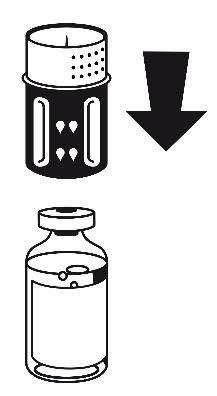

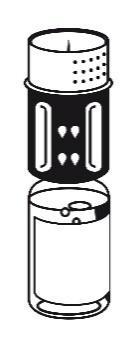
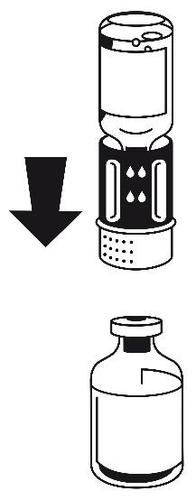
- 4. Place the powder vial on a flat surface and hold it firmly. Take the solvent vial attached to the transfer set and turn it upside down. Place the white part on top of the powder vial and, without rotating it, press down firmly until it locks (Fig. 4). The solvent will automatically pass into the powder vial.
- 5. With both vials still attached, gently turn the
powder vial until the product is dissolved.
Dissolution occurs in less than 10 minutes at room temperature.
The formation of slight foam may occur during preparation.
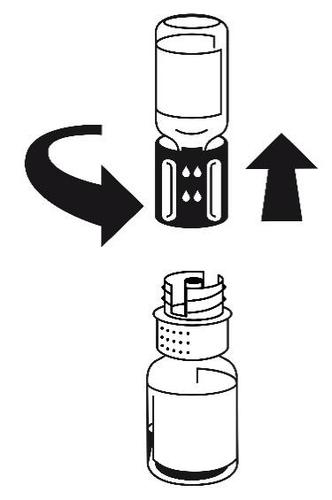
Unscrew the transfer set into two parts (Fig. 5).
The foam formation will disappear.
Dispose of the empty solvent vial with the blue part of the
transfer set
Instructions for injection
As a precaution, the heart rate should be monitored before and during the injection. If a marked
increase in heart rate occurs, reduce the injection rate or interrupt the administration for a
short period.
- 1. Connect the syringe to the white part of the transfer set. Turn the vial upside down and draw the solution into the syringe (Fig. 6). The solution should be clear or slightly opalescent. Once the solution has been transferred, hold the syringe plunger firmly (pointing downwards) and remove the syringe from the transfer set (Fig. 7). Dispose of the empty vial with the white part of the transfer set.
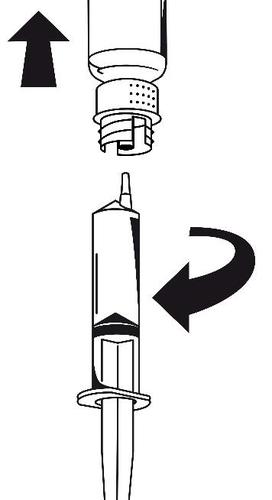
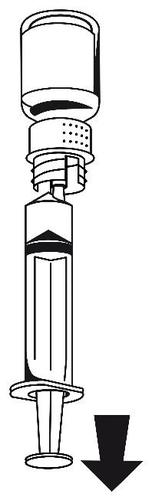
- 2. Clean the chosen injection site with one of the supplied alcohol swabs
- 3. Attach the supplied infusion set to the syringe.
- 4. Insert the injection needle into the chosen vein. If you have used a tourniquet to make the vein more visible, the tourniquet should be released before starting the OCTANINE injection.
- 5. Blood must not flow back into the syringe due to the risk of fibrin clot formation.
- 6. Inject the solution into the vein at a slow rate, no faster than 2-3 ml per minute.
If you are using more than one vial of OCTANINE powder for a single treatment, you can reuse
the same infusion set and the same syringe. The transfer set is for single use only.
Unused medicinal product and waste material derived from such medicinal product should be disposed of in accordance with
local regulations.

Не впевнені, чи підходить вам цей лікарський засіб?
Обговоріть симптоми та можливі варіанти лікування з лікарем онлайн.

Виникли питання під час прийому ліків?
Обговоріть свої симптоми та лікування з лікарем онлайн.
- Країна реєстрації
- Лікарська формаPowder and solvent for injectable solution, 500 IU
- Код АТХB02BD04
- Діюча речовина
- Потрібен рецептТак
- Виробник
- Ця інформація надана лише для ознайомлення і не є медичною порадою. Рішення щодо лікування завжди приймає лікар.
- Альтернативи до OKTANINEЛікарська форма: Powder and solvent for intravenous infusion solution, 500 U.I.Діюча речовина: фактор свертывания крови человека IXВиробник: KEDRION S.P.A.Потрібен рецептЛікарська форма: Powder and solvent for intravenous infusion solution, 500 IU/10 MLДіюча речовина: фактор свертывания крови человека IXВиробник: GRIFOLS ITALIA S.P.A.Потрібен рецептЛікарська форма: Powder and solvent for injectable solution, 250 IUДіюча речовина: фактор свертывания крови человека IXВиробник: SWEDISH ORPHAN BIOVITRUM AB (PUBL)Потрібен рецепт
Аналоги OKTANINE в інших країнах
Препарати з тією самою діючою речовиною, доступні в інших країнах.
Аналог OKTANINE у Іспанія
Аналог OKTANINE у Польща
Аналог OKTANINE у Україна
Лікарі онлайн щодо OKTANINE
Застосування, безпека та можливість призначення рецепта — за результатами медичної оцінки.









Отримайте рецепт на OKTANINE онлайн
Заповніть форму за 2 хвилини
Розкажіть про симптоми, історію хвороби та потрібний препарат.
Оберіть лікаря або ми призначимо
Оберіть спеціаліста або ми підберемо найближчого доступного лікаря.
Лікар розглядає ваш випадок
Зазвичай протягом 30 хвилин. Може ставити уточнювальні запитання в чаті.
Отримайте в будь-якій аптеці
Електронний рецепт надсилається на вашу пошту — дійсний по всій Польщі.
Часті запитання
OKTANINE потребує рецепта в Італія. Ви можете обговорити з лікарем онлайн, чи підходить цей лікарський засіб для вашої ситуації.
Діюча речовина у OKTANINE — фактор свертывания крови человека IX. Це допомагає визначити препарати з тим самим складом, але під іншими торговими назвами.
OKTANINE виробляється компанією OCTAPHARMA ITALY S.P.A.. Назва бренду та упаковка можуть відрізнятися залежно від дистрибʼютора.
Лікарі, зокрема Сімейні лікарі, Психіатри, Дерматологи, Кардіологи, Ендокринологи, Гастроентерологи, Пульмонологи, Нефрологи, Ревматологи, Гематологи, Інфекціоністи, Алергологи, Геріатри, Педіатри, Онкологи, можуть оцінити доцільність застосування OKTANINE з урахуванням вашого стану та місцевих правил. Ви можете записатися на онлайн-консультацію, щоб обговорити симптоми та можливі подальші кроки.
Польща має добре розвинену систему охорони здоров'я у великих містах, таких як Варшава, Краків, Вроцлав і Гданськ. Аптеки широко доступні та працюють відповідно до чинного законодавства, забезпечуючи доступ до рецептурних препаратів.
Ви можете придбати OKTANINE у Варшаві, Кракові, Вроцлаві або Гданську в будь-якій аптеці за наявності дійсного рецепта.
Щоб отримати рецепт, ви можете скористатися Oladoctor:
Інші препарати з тією самою діючою речовиною (фактор свертывания крови человека IX) включають AIMAFIX, ALPANINE, ALPROLIX. Вони можуть відрізнятися торговою назвою або формою випуску, але містять той самий терапевтичний компонент. Перед зміною або початком прийому нового препарату варто проконсультуватися з лікарем.
