



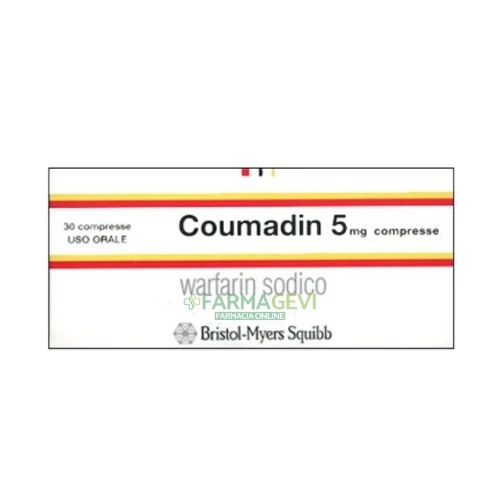
COUMADIN 5 mg Coated Tablet

Запит на рецепт онлайн
Лікар розгляне ваш випадок і визначить, чи є рецепт медично доцільним.

Поговоріть з лікарем про ці ліки
Обговоріть симптоми та можливі подальші кроки під час короткої онлайн-консультації.



Інструкція із застосування KOUMADIN
Зміст інструкції
COUMADIN 5 mg tablets
warfarin sodic
Read this leaflet carefully before taking this medicine as it contains important information for you.
- Keep this leaflet. You may need to read it again.
- If you have any questions, ask your doctor or pharmacist.
- This medicine has been prescribed for you only. Do not pass it on to others, even if their symptoms are the same as yours, as it could be harmful.
- If you get any side effects, even those not listed in this leaflet, tell your doctor or pharmacist. See section 4.
Contents of this leaflet:
- 1. What COUMADIN is and what it is used for
- 2. What you need to know before you take COUMADIN
- 3. How to take COUMADIN
- 4. Possible side effects
- 5. How to store COUMADIN
- 6. Contents of the pack and other information
1. What is COUMADIN and what it is used for
COUMADIN is an anticoagulant, meaning it helps prevent the formation of blood clots (thrombi).
COUMADIN is a medicine with a narrow therapeutic index, which means that small variations in the
dose can have serious consequences, in fact too much medicine can cause bleeding, too little
medicine can lead to the formation of dangerous blood clots.
Your doctor has prescribed COUMADIN to prevent the formation of clots. These clots are
dangerous because they can block the normal blood flow. For example, if a clot reaches the
brain it can cause a stroke (interruption of blood flow to the brain).
COUMADIN is used to treat and prevent clots:
- in the legs and lungs;
- associated with an irregular and fast heartbeat, called “atrial fibrillation”;
- associated with heart valve replacement.
If you have had a heart attack (myocardial infarction) COUMADIN is used to:
- reduce the risk of having another heart attack;
- reduce the risk of stroke;
- reduce the risk of clots reaching the legs or lungs.
Contact your doctor if you do not feel better or if you feel worse.
2. What you need to know before taking COUMADIN
Do not take COUMADIN
- If you are allergic to warfarin sodium or any of the other ingredients of this medicine (listed in section 6).
- If you have a risk of bleeding or are currently bleeding.
- If you are pregnant or might become pregnant.
- If you are a woman of childbearing potential who is not using contraception.
- If you are pregnant and are at risk of losing the baby or have very high blood pressure.
- If you have recently undergone or are about to undergo surgery, even under local anesthesia (pain relief in a part of the body).
- If you are to undergo a procedure in hospital, including a spinal puncture.
- If you suffer from very high blood pressure, which can cause damage to the eyes (malignant hypertension).
- If you are taking preparations based on St. John's wort - Hypericum perforatum (herbal medicine for treating depression) (see section Other medicines and COUMADIN).
Warnings and precautions
Talk to your doctor or pharmacist before taking COUMADIN:
- If you notice any unusual bleeding or if you experience signs or symptoms of bleeding (see section 4. Possible side effects).
- If you have or have had in the past international normalized ratio (INR) values, an index of blood coagulation, greater than 4.0 or very variable.
- If you have had bleeding of the stomach and intestines.
- If you suffer from high blood pressure.
- If you suffer from a disease of the blood vessels of the head.
- If you suffer from a decrease in the levels of hemoglobin, a protein that carries oxygen to the tissues, in the blood (anemia).
- If you have a malignant tumor (cancer).
- If you suffer from a kidney disease.
- If someone in your family suffers from a blood disease.
- If you are elderly (age 65 years or older). Your doctor will decide what the right dose is for you. This dose may change from time to time.
- If your toes become blue and painful. Stop therapy with COUMADIN and consult your doctor who will prescribe another medicine (see section 4 Possible side effects).
- If you suffer from a decrease in the number of platelets, a type of blood cell, following treatment with heparin, a medicine to make the blood more fluid.
- If you suffer from a liver disease, from mild to severe. Your doctor will decide what the right dose is for you.
- If you experience vomiting, diarrhea or an infection during therapy with COUMADIN.
- If you notice that a part of your body or skin becomes black (skin or tissue necrosis) during therapy with COUMADIN (see section 4 Possible side effects).
- If you notice painful and itchy spots or nodules on the skin during therapy with COUMADIN. Sometimes these lesions can worsen and cause swelling, paleness or blackish discoloration, up to ulceration and infection of the affected area (calciphylaxis) (see section 4 Possible side effects).
- If a catheter (small, flexible tube) has been applied to you.
- If you have a disease concerning protein C, a protein naturally present in the body that makes the blood more fluid.
- If you are to undergo eye surgery.
- If you hit your head or have a bad fall.
- If you suffer from an increase in blood cells, detectable by blood tests.
- If you have high levels of phosphorus or calcium in the blood (hyperphosphatemia, hypercalcemia).
- If you have low levels of albumin (a type of protein) in the blood.
- If you suffer from inflammation of the blood vessels.
- If you suffer from diabetes mellitus (increased blood sugar levels).
- If you eat very little.
- If you suffer from a vitamin K deficiency.
- If you are taking medicines or foods that contain vitamin K (see sections Other medicines and COUMADIN; COUMADIN with food, drinks and alcohol).
- If you are to undergo surgery, even by the dentist. Inform any healthcare provider providing you with care (including the dentist) that you are taking COUMADIN, as COUMADIN therapy must be suspended or reduced before, during and immediately after the procedure.
Other medicines and COUMADIN
Tell your doctor or pharmacist if you are taking, have recently taken or might take
any other medicine.
Tell your doctor if you notice any change in your health status, make changes to both
the medicines you are taking and your lifestyle (travel, environmental conditions, physical activity).
In particular, tell your doctor if you are taking:
- herbal preparations, especially Hypericum perforatum (used to treat depression) (see section 2 Do not take COUMADIN)
- medicines to treat infections (amoxicillin, benzylpenicillin, penicillin G, piperacillin, ticarcillin, cefaclor, cefamandole, cefazolin, cefixime, cefotetan, cefonicid, cefotiam, cefoxitin, ceftriaxone, cefuroxime, doxycycline, tetracycline, tigecycline, azithromycin, clarithromycin, erythromycin, roxithromycin, telithromycin, neomycin, ciprofloxacin, levofloxacin, nalidixic acid, moxifloxacin, norfloxacin, pefloxacin, ofloxacin, sulfadoxine, sulfafurazole, sulfamethizole, sulfamethoxazole/trimethoprim, sulfisoxazole, aminosalicylic acid, isoniazid, chloramphenicol, vancomycin, clindamycin, dicloxacillin, nafcillin, rifampicin, rifapentine)
- medicines to treat infections caused by fungi (miconazole, econazole, fluconazole, ketoconazole, itraconazole, voriconazole, griseofulvin)
- medicines to prevent and treat infections caused by parasites (proguanil, metronidazole, nimorazole, tinidazole, quinine)
- medicines to treat infections caused by viruses (delavirdine, efavirenz, etravirine, nevirapine, atazanavir, ritonavir, peginterferon alfa-2b, ribavirin, darunavir)
- medicines to treat organ rejection in transplant patients (cyclosporine)
- medicines to treat inflammation and pain (paracetamol, acetylsalicylic acid, diflunisal, propoxyphene, tramadol, diclofenac, indometacin, ketorolac, sulindac, fenoprofen, ibuprofen, ketoprofen, naproxen, oxaprozin, celecoxib, etoricoxib, lumiracoxib, rofecoxib, mefenamic acid, meclofenamic acid, lornoxicam, piroxicam, glucosamine, desamethasone, methylprednisolone, prednisone, cortisone)
- medicines to make the blood more fluid (prasugrel, ticlopidine, abciximab, tirofiban, heparin, argatroban, bivalirudin, desirudin, lepirudin)
- medicines to dissolve blood clots (streptokinase, alteplase)
- medicines to treat depression (desvenlafaxine, duloxetine, venlafaxine, citalopram, escitalopram, fluoxetine, fluvoxamine, paroxetine, sertraline, viloxazine, trazodone)
- medicines to treat epilepsy, a disease characterized by uncontrolled movements of the body and loss of consciousness (valproic acid, valproate, fosphenytoin, phenytoin, phenobarbital, primidone, carbamazepine)
- medicines to treat mental disorders and anxiety (haloperidol, chlordiazepoxide)
- medicines to treat Parkinson's disease, a disease of the central nervous system that manifests, for example, with tremor, muscle stiffness, slowing of movements, difficulty maintaining balance (entacapone, tolcapone, ropinirole)
- medicines to treat dementia, a disease characterized by memory loss, disorientation in space and time, difficulty speaking (Ginkgo biloba, memantine)
- medicines that stimulate brain activity (methylphenidate)
- medicines to treat insomnia (chloral hydrate, glutethimide, butobarbital, pentobarbital, secobarbital)
- medicines to treat lung diseases (zafirlukast)
- medicines to treat cough (noscapine, oxolamine)
- medicines to treat women's disorders related to menopause (definitive cessation of the menstrual cycle) (tibolone, lasofoxifene, raloxifene)
- medicines to treat tumors (tamoxifen, toremifene, megestrol, bicalutamide, flutamide, nilutamide, cyclophosphamide, ifosfamide, carboplatin, capecitabine, fluorouracil, tegafur, paclitaxel, trastuzumab, etoposide, erlotinib, gefitinib, imatinib, sorafenib, romidepsin, vorinostat, aminoglutethimide, mercaptopurine, mitotane)
- contraceptive medicines (pill) (medroxyprogesterone, oral contraceptives containing estrogen)
- medicines to treat sexual disorders (testosterone)
- medicines to treat irregular female cycles (danazol)
- medicines that increase metabolism (methandienone, oxandrolone, oxymetholone, stanozolol)
- vaccines (influenza vaccine)
- vitamins (vitamin E, C, K)
- medicines to treat skin diseases (isotretinoin, etretinate, benzethonium chloride)
- medicines to treat alcohol dependence (disulfiram)
- ointments to treat pain (methyl salicylate ointment, trolamine salicylate ointment)
- medicines to treat obesity (orlistat)
- medicines to treat high blood sugar levels (diabetes) (exenatide)
- medicines to treat low blood sugar levels (glucagon)
- medicines to treat thyroid diseases, a gland in the neck (levothyroxine, liothyronine, thyroid extracts, methimazole, propylthiouracil)
- medicines to treat inability to retain urine (urinary incontinence) (tolterodine)
- medicines to treat enlargement of the prostate, the gland that in men produces seminal fluid (tamsulosin)
- medicines to treat rheumatoid arthritis, a disease characterized by inflammation of the joints, swelling, difficulty moving and pain (leflunomide, azathioprine)
- medicines to treat heart rhythm disorders (quinidine, propafenone, amiodarone, disopyramide)
- medicines to treat high blood pressure (propanolol, pentoxifylline, benziodarone)
- medicines to treat high blood pressure in the pulmonary artery (bosentan)
- medicines to treat heart disease (ethacrynic acid, tienilic acid, spironolactone, chlortalidone)
- medicines to treat the lack of coenzyme Q10, a substance useful to the body (ubiquinone or ubidecarenone)
- medicines to treat high levels of fats in the blood (bezafibrate, clofibrate, ciprofibrate, fenofibrate, gemfibrozil, atorvastatin, fluvastatin, lovastatin, pravastatin, rosuvastatin, simvastatin, ezetimibe, colesevelam, colestyramine)
- medicines to treat heartburn (cimetidine, ranitidine, esomeprazole, lansoprazole, omeprazole, pantoprazole, rabeprazole, sucralfate)
- medicines to treat vomiting (aprepitant, fosaprepitant)
- medicines to treat gallstones, stones in the gallbladder, an organ that stores bile, a substance important in digestive processes (chenodiol)
- medicines to treat digestive disorders (cisapride)
- medicines to treat inflammation of the intestines (olsalazine)
- medicines to treat uric acid build-up that causes pain in the joints (gout) (allopurinol, benzbromarone, sulfinpyrazone)
- corticotropin, diagnostic medicine
- medicines containing alcohol (see section COUMADIN with food, drinks and alcohol)
COUMADIN with food, drinks and alcohol
- Do not start a diet without first consulting your doctor.
- Do not make sudden changes to your eating habits, such as starting to eat large amounts of foods containing vitamin K (green leafy vegetables such as spinach, lettuce, broccoli, cauliflower, Brussels sprouts and, in smaller amounts, cereals, meat and dairy products)
- If the child is taking infant formula, therapy with COUMADIN may be affected.
- Do not take garlic, Ginkgo biloba, ginseng, echinacea, grapefruit juice and hydrastis during treatment with COUMADIN. For a complete list of foods and herbs to avoid, consult your doctor.
- Avoid consuming alcohol.
Pregnancy and breastfeeding
Pregnancy
Do nottake COUMADIN during pregnancy, if you suspect you are pregnant or may become
pregnant.
If you are a woman of childbearing potential who is not using contraception.
This medicine can cause harm to the unborn child.
If you are taking COUMADIN, talk to your doctor before planning a pregnancy.
Breastfeeding
COUMADIN does not pass into breast milk and newborns breastfed by mothers taking
COUMADIN have not had changes in prothrombin time. Take COUMADIN with caution
during breastfeeding and monitor the newborn for bruising and bleeding.
Driving and operating machinery
COUMADIN therapy does not affect your ability to drive or operate machinery.
COUMADIN contains lactose
This medicine contains lactose (milk sugar). If your doctor has diagnosed you with
lactose intolerance, contact him before taking this medicine.
3. How to take COUMADIN
Take this medicine following exactly the instructions of your doctor and at the same time each
day. You can take COUMADIN with or without food. The dose you take may vary over
time, based on your response to COUMADIN and based on the condition of your liver.
- To decide what dose to administer to you, your doctor will prescribe a blood test to measure the prothrombin time (PT); the prothrombin time values are often recorded as INR (International Normalized Ratio), which is a standard way of expressing them.
- Tests to evaluate PT/INR are very important, as they help the doctor understand how long it takes for the blood to clot and to assess whether they need to change the dose of COUMADIN.
- When you start therapy with COUMADIN you will need to have PT/INR checks very often, afterwards they may be spaced out. However, this will not happen if you suffer from a kidney disease. These tests, and regular visits to your doctor, are very important for the success of therapy with COUMADIN. Throughout the course of therapy with COUMADIN you should check the PT/INR periodically (about once a month) and keep it within the best range for your health conditions. If you have any doubts, consult your doctor or pharmacist. The tablet can be divided into equal parts.
If you take more COUMADIN than you should
If you have taken too much COUMADIN, contact your doctor or a
healthcare facility immediately to receive adequate support.
Signs and symptoms of an overdose may be: suspected or manifest abnormal bleeding (e.g.
presence of blood in the stool or urine, hematuria, excessive menstrual flow, dark and
foul-smelling stools (melena), small red spots on the skin (petechiae), tendency to bruise, or
persistent bleeding from superficial wounds, unexplained decrease in hemoglobin.
If you forget to take COUMADIN
Always try to take COUMADIN as prescribed by your doctor. If you happen to
miss a dose, inform your doctor immediately. Take the forgotten dose on the same day as soon as you
remember. If it is already time to take the next dose, do not take the forgotten one as well, but
continue with your normal dosing schedule.
If you stop taking COUMADIN
If you have any doubts about the use of this medicine, ask your doctor or pharmacist.
4. Possible side effects
Like all medicines, this medicine can cause side effects, although not everybody gets them.
Serious side effects include:
- bleeding (haemorrhage) in various parts of the body (around the heart, of the adrenal gland, of the eye, of the intestine, of the back of the abdomen, of the liver, of the head, in the lung)
- a part of the body or skin becomes black (skin or other tissue necrosis)
- blockage of a blood vessel due to fat (systemic atheroembolism and cholesterol microemboli). In this case, you may notice that the toes become blue and painful (Blue Toe Syndrome)*
- painful skin rash. In rare cases, warfarin can cause serious skin conditions, including one called calciphylaxis, which may initially manifest as a painful skin rash but can
cause other serious complications. This adverse reaction occurs more frequently in patients with
chronic kidney disease
If you experience any of the above side effects, STOP taking
COUMADIN and contact your doctor immediately.
In addition, the side effects that can be observed, indicated according to their frequency, are:
Common (may affect up to 1 in 10 people)
- decrease in haemoglobin, a protein that carries oxygen to the tissues, in the blood (anaemia)*
- chest pain*
- bleeding (haemorrhage) of the eye
- abdominal pain*, diarrhoea, bleeding gums, nausea, bleeding (haemorrhage) of the rectum, vomiting
- weakness (asthenia)*, fatigue*, swelling caused by fluid retention (oedema)*, fever (pyrexia)
- joint pain (arthralgia)*, muscle pain (myalgia)*
- dizziness*, headache*
- blood in the urine (haematuria)
- nosebleed (epistaxis), difficulty breathing (dyspnoea)*, blood with a cough (haemoptysis)
- bruising (ecchymosis), itching, skin rash
- bleeding (haemorrhage), low blood pressure (hypotension)*, fainting (syncope)*
Uncommon (may affect up to 1 in 100 people)
- metallic taste in the mouth (dysgeusia), swelling in the abdominal area (abdominal distension), difficulty swallowing (dysphagia)*, passing gas (flatulence), vomiting blood (haematemesis), blood in the stool (haematochezia), dark and foul-smelling stools (melena)
- chills, unwell*, pain*
- allergy (hypersensitivity)
- alteration of blood tests (increased liver enzyme)
- collection of blood around a joint (haemarthrosis)
- bleeding (haemorrhage) of the head, numbness (paresthesia)*
- deep sleep with reduced response to normal stimuli (lethargy)*
- vaginal bleeding
- blood collection in the chest (haemothorax)
- hair loss (alopecia), skin irritation (dermatitis), skin spots (petechiae), red skin accompanied by itching (urticaria)
Rare (may affect up to 1 in 1,000 people)
- bleeding (haemorrhage) of the back of the abdomen
- inflammation of the liver (hepatitis), yellowish discoloration of the skin (jaundice)
- allergic reaction (anaphylactic)
- total or partial loss of movement (paralysis)*
- bleeding (haemorrhage) in the lung
- a part of the skin becomes black (skin necrosis)
- inflammation of blood vessels (vasculitis), decrease in blood pressure with severe reduction in heart function (shock)*
Very rare (may affect up to 1 in 10,000 people)
- bleeding (haemorrhage) around the heart
- bleeding (haemorrhage) of the adrenal gland
- pallor*
- bleeding (haemorrhage) of the liver
- collection of blood around the spine (vertebral haematoma)
- excessive blood loss during the menstrual cycle (menorrhagia)
- deposition of calcium salts in the lung (lung calcification)
- skin irritation with blisters (bullous dermatitis)
- blue toe syndrome (foot)*, blockage of an artery caused by an obstacle to normal blood flow, which may be a blood clot or an air bubble (arterial embolism), blockage of a blood vessel due to fat (fat embolism), a part of the body becomes black (necrosis)
Frequency not known
- painful and itchy spots or nodules on the skin. Sometimes these lesions can worsen and cause swelling, pallor or blackish discoloration, up to ulceration and infection of the affected area (calciphylaxis).
- acute kidney injury.
The side effects marked with an asterisk (*) are symptoms or conditions resulting
from bleeding.
- Changes in the levels of haemoglobin (a protein that carries oxygen to the tissues), haematocrit (percentage of blood occupied by red blood cells) and enzymes indicating the state of the liver and biliary tract (hepatobiliary) may also occur, which can be detected by blood tests.
Reporting of side effects
If you get any side effects, even those not listed in this leaflet, tell your
doctor. You can also report side effects directly through the national reporting system at www.agenziafarmaco.gov.it/content/come-segnalare-una-sospetta-reazione-
avversa.
By reporting side effects you can help provide more information on the safety of
this medicine.
5. How to store COUMADIN
Do not store at a temperature above 30°C.
Keep in the original packaging.
Keep this medicine out of the sight and reach of children. Healthcare professionals who are pregnant should avoid exposure to crushed or broken COUMADIN tablets.
Do not use this medicine after the expiry date which is stated on the pack after Exp.
The expiry date refers to the last day of that month.
Do not dispose of any medicine in wastewater or household waste. Ask your pharmacist how to dispose of medicines you no longer use. This will help protect the environment.
6. Contents of the pack and other information
What COUMADIN contains
- The active ingredient is warfarin sodium.
- The other ingredients are starch, magnesium stearate, stearic acid, lactose(see section 2 "COUMADIN contains lactose").
Description of the appearance of COUMADIN and contents of the pack
COUMADIN is available in the form of divisible tablets.
COUMADIN is available in packs of 30 tablets each containing 5 mg of warfarin sodium.
Marketing Authorisation Holder
Teofarma S.r.l.
Via F.lli Cervi, 8
27010 Valle Salimbene (PV)
Manufacturer
VIANEX S.A. 15th km Marathonos Ave.
153 44 Pallini Attiki - Athens - Greece

Не впевнені, чи підходить вам цей лікарський засіб?
Обговоріть симптоми та можливі варіанти лікування з лікарем онлайн.

Виникли питання під час прийому ліків?
Обговоріть свої симптоми та лікування з лікарем онлайн.
- Країна реєстрації
- Лікарська формаCoated tablet, 5 MG
- Код АТХB01AA03
- Діюча речовина
- Потрібен рецептТак
- Виробник
- Ця інформація надана лише для ознайомлення і не є медичною порадою. Рішення щодо лікування завжди приймає лікар.
- Альтернативи до KOUMADINЛікарська форма: Coated tablet, 4 MGДіюча речовина: acenocoumarolВиробник: Merus Labs Luxco II S.a.r.l.Потрібен рецептЛікарська форма: Enteric-coated tablet, 100 MGДіюча речовина: Ацетилсалициловая кислотаВиробник: AUROBINDO PHARMA (ITALIA) S.R.L.Потрібен рецептЛікарська форма: Enteric-coated tablet, 100 MGДіюча речовина: Ацетилсалициловая кислотаВиробник: DOC GENERICI SRLПотрібен рецепт
Аналоги KOUMADIN в інших країнах
Препарати з тією самою діючою речовиною, доступні в інших країнах.
Аналог KOUMADIN у Польща
Аналог KOUMADIN у Україна
Аналог KOUMADIN у Іспанія
Лікарі онлайн щодо KOUMADIN
Застосування, безпека та можливість призначення рецепта — за результатами медичної оцінки.









Отримайте рецепт на KOUMADIN онлайн
Заповніть форму за 2 хвилини
Розкажіть про симптоми, історію хвороби та потрібний препарат.
Оберіть лікаря або ми призначимо
Оберіть спеціаліста або ми підберемо найближчого доступного лікаря.
Лікар розглядає ваш випадок
Зазвичай протягом 30 хвилин. Може ставити уточнювальні запитання в чаті.
Отримайте в будь-якій аптеці
Електронний рецепт надсилається на вашу пошту — дійсний по всій Польщі.
Часті запитання
KOUMADIN потребує рецепта в Італія. Ви можете обговорити з лікарем онлайн, чи підходить цей лікарський засіб для вашої ситуації.
Діюча речовина у KOUMADIN — warfarin. Це допомагає визначити препарати з тим самим складом, але під іншими торговими назвами.
KOUMADIN виробляється компанією TEOFARMA S.R.L.. Назва бренду та упаковка можуть відрізнятися залежно від дистрибʼютора.
Лікарі, зокрема Сімейні лікарі, Психіатри, Дерматологи, Кардіологи, Ендокринологи, Гастроентерологи, Пульмонологи, Нефрологи, Ревматологи, Гематологи, Інфекціоністи, Алергологи, Геріатри, Педіатри, Онкологи, можуть оцінити доцільність застосування KOUMADIN з урахуванням вашого стану та місцевих правил. Ви можете записатися на онлайн-консультацію, щоб обговорити симптоми та можливі подальші кроки.
Польща має добре розвинену систему охорони здоров'я у великих містах, таких як Варшава, Краків, Вроцлав і Гданськ. Аптеки широко доступні та працюють відповідно до чинного законодавства, забезпечуючи доступ до рецептурних препаратів.
Ви можете придбати KOUMADIN у Варшаві, Кракові, Вроцлаві або Гданську в будь-якій аптеці за наявності дійсного рецепта.
Щоб отримати рецепт, ви можете скористатися Oladoctor:
Інші препарати з тією самою діючою речовиною (warfarin) включають SINTROM, AKIDO AKETILSALIKILIKO AUROBINDO, AKIDO AKETILSALIKILIKO DOK JENERIKI. Вони можуть відрізнятися торговою назвою або формою випуску, але містять той самий терапевтичний компонент. Перед зміною або початком прийому нового препарату варто проконсультуватися з лікарем.
