



AMIPED 10% Infusion solution

Запит на рецепт онлайн
Лікар розгляне ваш випадок і визначить, чи є рецепт медично доцільним.

Поговоріть з лікарем про ці ліки
Обговоріть симптоми та можливі подальші кроки під час короткої онлайн-консультації.



Інструкція із застосування AMIPED
Зміст інструкції
- What is Amiped and what is it used for
- What you need to know before your child takes Amiped
- How to use Amiped
- Possible side effects
- How to store Amiped
- Contents of the pack and other information
Amiped, solution for infusion
For use in children (0-11 years)
Amino acids
Read this leaflet carefully before using this medicine as it contains important
information for you.
- Keep this leaflet. You may need to read it again.
- If you have any questions, ask your doctor or nurse.
- This medicine has been prescribed only for your child. Do not give it to other people, even if their symptoms are the same as those of your child, as it could be dangerous.
- If your child experiences any side effects, including those not listed in this leaflet, ask your doctor or nurse. See section 4.
Contents of this leaflet
- 1. What Amiped is and what it is used for
- 2. What you need to know before your child takes Amiped
- 3. How to use Amiped
- 4. Possible side effects
- 5. How to store Amiped
- 6. Contents of the pack and other information
1. What is Amiped and what is it used for
Amiped is a solution administered through a small tube with a cannula inserted into a vein
(intravenous infusion).
The solution contains amino acids which are essential for the growth or recovery
of the body.
The solution is suitable for meeting the specific needs of term and preterm newborns, infants,
toddlers and children.
They will receive this medicine if they cannot eat food normally and cannot
be fed through a tube inserted into the stomach. They may also receive other nutrients in
association with Amiped, such as glucose solutions or lipid emulsions.
2. What you need to know before your child takes Amiped
Do not use Amiped if your child:
- is allergic to any of the active ingredients or any of the other ingredients of this medicine (listed in section 6).
- suffers from a congenital disorder of protein and/or amino acid metabolism.
- presents with severe, potentially life-threatening circulatory disorders (shock).
- presents with insufficient oxygen supply (hypoxia).
- presents with accumulated acidic substances in the blood (acidosis).
- suffers from a severe liver disease (severe hepatic insufficiency).
- suffers from severe kidney failure (severe renal insufficiency) not adequately treated with artificial kidney or similar therapies.
- suffers from heart failure with marked impairment of blood circulation (decompensated heart failure).
- presents with fluid accumulation in the lungs (acute pulmonary edema).
- presents with disturbances of the balance of salts (electrolytes) and fluids in the body.
Warnings and precautions
Consult your doctor or nurse before using Amiped if your child:
- suffers from an impairment of protein and amino acid metabolism caused by any condition other than those mentioned above (see section “Do not use Amiped if your child…”).
- suffers from impaired liver and/or kidney function.
- suffers from impaired cardiac function.
- presents with an abnormally high concentration of blood serum (elevated serum osmolarity).
In case of disturbances of water or salt balance in your child's body, this condition must first be corrected before administering this medicine to your child. Examples of this condition include simultaneous lack of water and salts (hypotonic dehydration) or a lack of sodium (hyponatremia) or potassium (hypokalemia).
Before and during the period in which children receive this solution, the doctor will check the levels of salts and sugar in the blood, water balance and acid-base balance. Blood protein levels and kidney and liver function will also be monitored. To this end, blood samples will be taken and urine samples will be collected for analysis.
Amino acid-based solutions are only one component of parenteral nutrition. In general, children receive Amiped as part of intravenous nutrition that also includes additional sources of non-protein energy (carbohydrate solutions, lipid emulsions), essential fatty acids, electrolytes, vitamins, fluids and trace elements.
Other medicines and Amiped
Inform your doctor or nurse if your child is taking, has recently taken or might take any other medicine.
Pregnancy and breastfeeding
Amiped is intended for use only in children (under twelve years of age).
Driving and operating machinery
Not applicable.

Не впевнені, чи підходить вам цей лікарський засіб?
Обговоріть симптоми та можливі варіанти лікування з лікарем онлайн.
3. How to use Amiped
Amiped is administered by healthcare professionals.
The doctor will carefully adjust the dosage of this medicine based on the child's age, stage of development and
the actual type of disease.
The amounts that can be administered will be approximately as follows:
Premature infants: 40 mL per kg of body weight per day
Full-term newborns (0–27 days): 30 mL per kg of body weight per day
Infants and toddlers (from 28 days to 23 months): 25 mL per kg of body weight per day
Children (from 2 to 11 years): 20 mL per kg of body weight per day
Children in critical condition may be given a higher amount (up to 30 mL per
kg of body weight per day).
Patients with renal or hepatic insufficiency
If liver or kidney disease is present, the dosages will be adjusted according to the individual needs
of the child.
Duration of use
This medicine can be administered as long as your child needs parenteral nutrition.
Method of administration
This medicine will be administered to your child through a small tube inserted into a vein
(intravenous infusion).
If your child receives more Amiped than they should
It is unlikely that this will happen as the doctor will determine the daily doses for
your child. However, if your child were to receive an overdose or if the
solution were administered too quickly, your child may experience a
feeling of discomfort, episodes of vomiting, chills or headache.
In addition, your child may have an excessive amount of acidic substances (metabolic acidosis) or ammonia (hyperammonemia) in the blood and, in this case, lose amino acids in the
urine.
Your child may also suffer from an excessive amount of fluid in the body (hyperhydration),
electrolyte imbalances and fluid in the lungs
(pulmonary edema). In these cases, the infusion will be stopped and resumed later at a
lower rate.
If you have any doubts about the use of this medicine, please consult your doctor or nurse.
4. Possible side effects
Like all medicines, this medicine can cause side effects, although not everybody gets them.
These side effects are not specifically associated with Amiped, but may occur with
any type of intravenous nutrition, especially in the initial stages of therapy.
The following side effects may be serious. If your child experiences any of the
following side effects, seek immediate medical attention, as your doctor will stop
giving this medicine to your child:
Not known (frequency cannot be estimated from available data)
- Allergic reactions
Other side effects
Uncommon (may affect up to 1 in 100 people):
- Vomiting, malaise
[to be completed at national level]
Reporting of side effects
If your child gets any side effects, talk to your doctor or nurse. You can also report side effects directly
through the national reporting system at: http://www.aifa.gov.it/content/come-
segnalare-una-sospetta-reazione-avversa.. Reporting side effects helps to provide
more information on the safety of this medicine.

Виникли питання під час прийому ліків?
Обговоріть свої симптоми та лікування з лікарем онлайн.
5. How to store Amiped
Keep this medicine out of the sight and reach of children.
Do not use this medicine after the expiry date which is stated on the vial and the label of the
pack. The expiry date refers to the last day of that month.
This medicine does not require particular precautions for storage.
Do not freeze.
After infusion, do not store the remaining solution for later use.
6. Contents of the pack and other information
What Amiped contains
The active ingredients are amino acids.
This medicine contains:
| Amino Acids | per 1 mL | per 100 mL | per 250 mL |
| Isoleucine | 5.10 mg | 0.51 g | l 1.28 g |
| Leucine | 7.60 mg | 0.76 g | 1.90 g |
| Lysine monohydrate (equivalent to lysine) | 9.88 mg (8.80 mg) | 0.99 g (0.88 g) | e 2.47 g (2.20 g) |
| Methionine | 2.00 mg | 0.20 g | d 0.50 g |
| Phenylalanine | 3.10 mg | 0.31 g | 0.78 g |
| Threonine | 5.10 mg | 0.51 g | 1.28 g |
| Tryptophan | 4.00 mg | a 0.40 g | 1.00 g |
| Valine | 6.10 mg | 0.61 g | 1.53 g |
| Arginine | 9.10 mg | n 0.91 g | 2.28 g |
| Histidine | 4.60 mg | 0.46 g | 1.15 g |
| Alanine | 15.90 mg | a 1.59 g | 3.98 g |
| Glycine | 2.00 mg | i 0.20 g | 0.50 g |
| Aspartic acid | 6.60 mg | 0.66 g | 1.65 g |
| Glutamic acid | 9.30 mg | l 0.93 g | 2.33 g |
| Proline | a 6.10 mg | 0.61 g | 1.53 g |
| Serine | 2.00 mg | 0.20 g | 0.50 g |
| N-acetyl tyrosine (equivalent to tyrosine) | t I 1.30 mg (1.06 mg) | 0.13 g (0.11 g) | 0.33 g (0.27 g) |
| Acetylcysteine (equivalent to cysteine) | a 0.700 mg (0.520 mg) i | 0.070 g (0.052 g) | 0.175 g (0.13 g) |
| Taurine | 0.300 mg | 0.030 g | 0.075 g |
| per 1 mL | per 100 mL | per 250 mlL | |
| n Total amino acids | 0.1 g | 10 g | 25 g |
| Total nitrogen | 0.0152 g | 1.52 g | 3.8 g |
| Energy (kJ/L [kcal/L]) | 1700 (406) |
| g Theoretical osmolarity [mOsm/L] | 790 |
| A Acidity (titration at pH 7.4) [mmol NaOH/L] | 23 |
| pH | approximately 6.1 |
The other components are citric acid monohydrate (for pH correction) and water for injections.
iniettabili.
Description of Amiped and contents of the pack
Amiped is a clear and colourless or light yellow solution.
It is supplied in flexible bags containing 100 mL or 250 mL of amino acid solution. The bags are
made of a multilayer film. The innermost layer in contact with the solution is made of
polypropylene.
The container is PVC, DEHP and latex free.
The bag is inserted into a second protective plastic bag. An oxygen absorber (containing
powdered iron hydroxide) is placed between the bag and the outer packaging.
The different container sizes are contained in cartons of 12 bags. Packs: 12 x 100 mL and
12 x 250 mL.
Not all pack sizes may be marketed.
Marketing Authorisation Holder and Manufacturer
- B. Braun Melsungen AG Carl-Braun-Straße 1 34212 Melsungen, Germany
Postal address:
34209 Melsungen, Germany
Tel.: +49/5661/71-0
Fax: +49/5661/71-4567
This medicine is authorised in the Member States of the European Economic Area with the
following denominations:
Austria, Aminoplasmal Paed 10% Infusionslösung
Belgium Aminoplasmal Paediatric oplossing voor infusie
Czech Republic Amiped
Denmark Amiped
Germany Aminoplasmal Paed 10% Infusionslösung
Greece Aminoplasmal Paed 10%
Italy Amiped
Luxembourg Aminoplasmal Paed 10%
Netherlands Aminoplasmal Paed 10% mg/ml, oplossing voor
infusie
Norway Amiped
Poland Aminoplasmal Paed 10%
Portugal Aminoplasmal Paed, 100 mg/ml, Solução para
perfusão
Slovak Republic Amiped 10 % infúzny roztok
Slovenia Aminoplasmal Paed 100 mg/ml raztopina za
infundiranje
Spain Aminoplasmal paed 10%, solucion para perfusion
United Kingdom Aminoplasmal Paediatric 10% solution for infusion
[To be completed at national level]
---------------------------------------------------------------------------------------------------------------------------
The following information is intended exclusively for doctors or healthcare professionals:
Dosage
Route of administration
Intravenous use
For central venous infusion only.
Paediatric population
The dosages for these age groups as indicated below represent the average guideline values. The
exact dosage must be adjusted individually depending on age, stage of development and the
underlying disease.
Administration should be started below the target rate of infusion and may
be increased to the target value within the first hour.
Amino acid supply via parenteral route considered suitable for most paediatric patients:
Daily dose for premature infants:
1.5-4.0 g of amino acids/kg body weight ≙ 15-40 mL/kg body weight
Daily dose for term infants(0-27 days):
1.5-3.0 g/kg body weight ≙ 15-30 mL/kg body weight
Daily dose for infants and toddlers (from 28 days to 23 months):
1.0-2.5 g/kg body weight ≙ 10-25 mL/kg body weight
Daily dose for children(from 2 to 11 years):
1.0-2.0 g/kg body weight ≙ 10-20 mL/kg body weight
Instructions for handling
Use a sterile administration set for the infusion of Amiped.
If, as part of a complete parenteral nutrition regimen, other nutrients such as carbohydrates, lipids, vitamins
and trace elements need to be added to this medicine, mixing must be carried out under strictly
aseptic conditions. Mix thoroughly after adding any additive. Amiped can only be mixed with other
nutrients for which compatibility has been documented. The manufacturer can provide, on request, data
on the compatibility of the medicine with different additives and the corresponding shelf life of the
obtained mixtures.
Special precautions for storage
Do not use if the solution is not clear and colourless or light yellow, is not free of
particles or if the vial and its closure are damaged.
The containers are for single use only. After use, dispose of the container and any unused content.
Period of validity after mixing the medicine with additives
From a microbiological point of view, mixtures must be administered immediately after
preparation. If not administered immediately, the duration and conditions of storage of the mixtures
before use are the responsibility of the user and should not normally exceed
24 hours at 2°C–8°C, unless the mixing has been carried out under controlled and validated aseptic
conditions.
For complete information on this medicine, see the Summary of Product Characteristics.
Amiped:Handling
Figure A:Bag and overpack
Opening notches Overpack
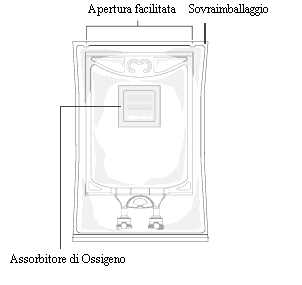
Oxygen absorber
Figure B:Bag
Bag hook
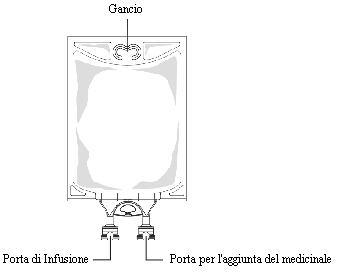
Infusion port Port for adding medicines
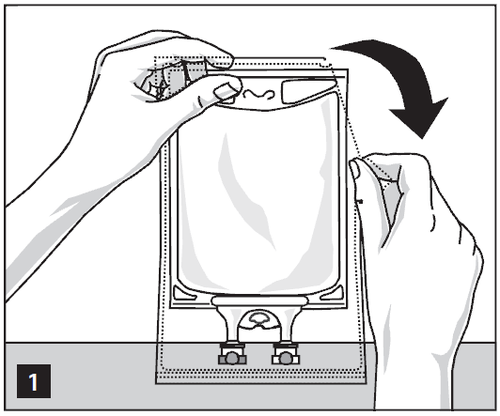
To open:
Remove the bag from its protective overpack by grasping it at the opening notches at the top and
pulling out the container containing the solution (figure 1). Dispose of the
overpack and the oxygen absorber.
Check for any leaks. If the bag
has any leaks, dispose of the product as sterility may be compromised.
To add medicines:
The addition of additives must be carried out using strictly aseptic techniques.
Compatible medicine can be added through the medicine port (transparent colour).
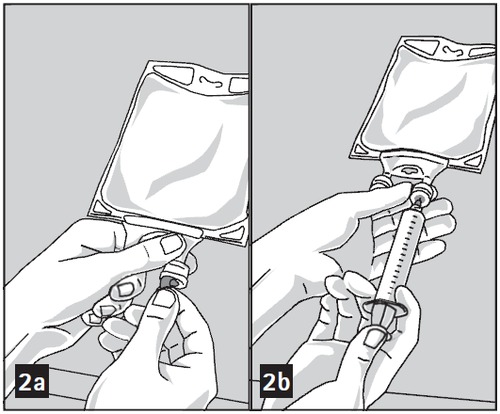
- 1. Prepare the medicine port (transparent colour) by removing the aluminium film (figure 2a). Note: the area under the film of the medicine port is sterile.
- 2. Puncture the resealable port for adding medicines and inject the additive(s) (figure 2b).
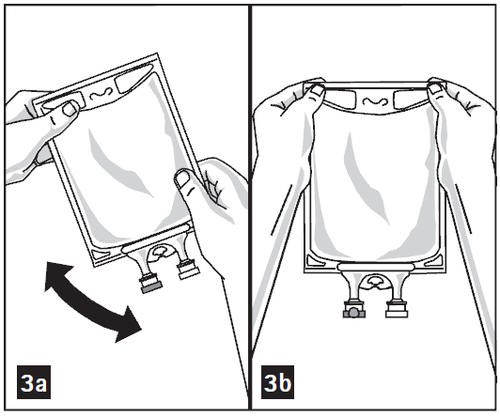
- 3. Mix the solution and the medicine thoroughly (figure 3a).
- 4. The medicine port can be cleaned with a swab soaked in a disinfectant (e.g. isopropanol) before making a new puncture.
- 5. Visually inspect the mixture to exclude the presence of particles (figure 3b).
Preparation for administration:
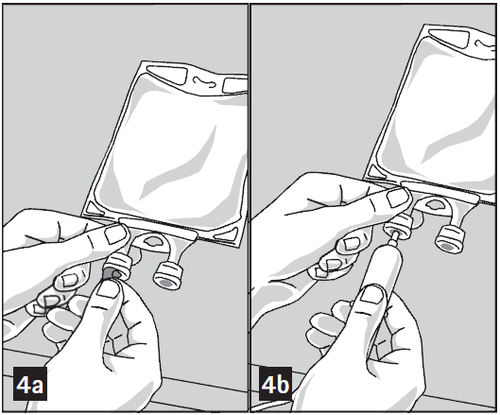
- 1. Remove the aluminium film from the infusion port (green colour) at the bottom of the container (figure 4a) and attach the infusion set (figure 4b): use an infusion set without an air vent or close the air vent, if present. Follow the instructions for use of the infusion set. Note: the area under the film of the infusion port is sterile.
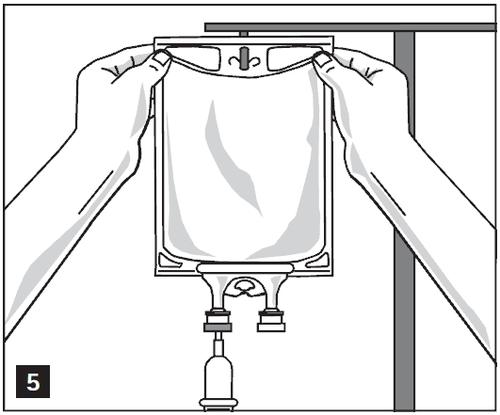
- 2. Hang the bag on an infusion pole (figure 5).
- Країна реєстрації
- Лікарська формаInfusion solution, 10%
- Код АТХB05BA01
- Діюча речовина
- Потрібен рецептТак
- Виробник
- Ця інформація надана лише для ознайомлення і не є медичною порадою. Рішення щодо лікування завжди приймає лікар.
- Альтернативи до AMIPEDЛікарська форма: Infusion solution, 500 MLДіюча речовина: аминокислотыВиробник: MONICO S.P.A.Потрібен рецептЛікарська форма: Infusion solution, 4 G/100 MLДіюча речовина: аминокислотыПотрібен рецептЛікарська форма: Infusion solution, 500 MLДіюча речовина: аминокислотыПотрібен рецепт
Аналоги AMIPED в інших країнах
Препарати з тією самою діючою речовиною, доступні в інших країнах.
Аналог AMIPED у Польща
Аналог AMIPED у Україна
Аналог AMIPED у Іспанія
Лікарі онлайн щодо AMIPED
Застосування, безпека та можливість призначення рецепта — за результатами медичної оцінки.









Отримайте рецепт на AMIPED онлайн
Заповніть форму за 2 хвилини
Розкажіть про симптоми, історію хвороби та потрібний препарат.
Оберіть лікаря або ми призначимо
Оберіть спеціаліста або ми підберемо найближчого доступного лікаря.
Лікар розглядає ваш випадок
Зазвичай протягом 30 хвилин. Може ставити уточнювальні запитання в чаті.
Отримайте в будь-якій аптеці
Електронний рецепт надсилається на вашу пошту — дійсний по всій Польщі.
Часті запитання
AMIPED потребує рецепта в Італія. Ви можете обговорити з лікарем онлайн, чи підходить цей лікарський засіб для вашої ситуації.
Діюча речовина у AMIPED — аминокислоты. Це допомагає визначити препарати з тим самим складом, але під іншими торговими назвами.
AMIPED виробляється компанією B. BRAUN MELSUNGEN AG. Назва бренду та упаковка можуть відрізнятися залежно від дистрибʼютора.
Лікарі, зокрема Сімейні лікарі, Психіатри, Дерматологи, Кардіологи, Ендокринологи, Гастроентерологи, Пульмонологи, Нефрологи, Ревматологи, Гематологи, Інфекціоністи, Алергологи, Геріатри, Педіатри, Онкологи, можуть оцінити доцільність застосування AMIPED з урахуванням вашого стану та місцевих правил. Ви можете записатися на онлайн-консультацію, щоб обговорити симптоми та можливі подальші кроки.
Польща має добре розвинену систему охорони здоров'я у великих містах, таких як Варшава, Краків, Вроцлав і Гданськ. Аптеки широко доступні та працюють відповідно до чинного законодавства, забезпечуючи доступ до рецептурних препаратів.
Ви можете придбати AMIPED у Варшаві, Кракові, Вроцлаві або Гданську в будь-якій аптеці за наявності дійсного рецепта.
Щоб отримати рецепт, ви можете скористатися Oladoctor:
Інші препарати з тією самою діючою речовиною (аминокислоты) включають AMINOAKIDI A KATENA RAMIFIKATA MONIKO, AMINOAKIDI A KATENA RAMIFIKATA, AMINOAKIDI KR BIOINDUSTRIA L.I.M.. Вони можуть відрізнятися торговою назвою або формою випуску, але містять той самий терапевтичний компонент. Перед зміною або початком прийому нового препарату варто проконсультуватися з лікарем.
