



RHOPHYLAC 200 MICROGRAMS Инъекционный раствор

Рассмотрение рецепта онлайн
Врач рассмотрит ваш случай и примет решение о назначении рецепта, если это медицински оправдано.

Поговорите с врачом об этом лекарстве
Обсудите симптомы и возможные дальнейшие шаги на онлайн-консультации.



Инструкция по применению ROPYLAK
Содержание инструкции
Rhophylac 200 micrograms/2 ml
Injectable solution in pre-filled syringe
Human anti-D immunoglobulin
Read this leaflet carefully before you use this medicine as it contains
important information for you.
- Keep this leaflet. You may need to read it again.
- If you have any questions, ask your doctor or healthcare professional.
- If you get any side effects, talk to your doctor or healthcare professional
See section 4.
Contents of this leaflet:
- 1. What Rhophylac 200 is and what it is used for
- 2. What you need to know before you use Rhophylac 200
- 3. How to use Rhophylac 200
- 4. Possible side effects
- 5. How to store Rhophylac 200
- 6. Contents of the pack and other information
1. WHAT RHOPHYLAC 200 IS AND WHAT IT IS USED FOR
What is Rhophylac 200
This medicine is a ready-to-use injectable solution, presented in a pre-filled syringe. The solution contains special proteins, isolated from human plasma. These proteins belong to the class of "immunoglobulins", also called antibodies. The active ingredient of Rhophylac 200 is a specific antibody, called "anti-D (Rh) immunoglobulin". This antibody inhibits the Rhesus D factor.
What is the Rhesus D factor
The Rhesus factor defines special characteristics of human red blood cells. Approximately 85% of the population carries the so-called Rhesus D factor (abbreviated as "Rh(D)"). Individuals belonging to this group are said to be Rh(D)-positive. Conversely, those in whom this Rhesus D factor is not present are defined as Rh(D)-negative.
What is anti-D (Rh) immunoglobulin
Anti-D (Rh) immunoglobulin is an antibody produced in humans by the immune system, which inhibits the Rhesus D factor. When an Rh(D)-negative individual receives Rh(D)-positive blood, their immune system will recognize the Rh(D)-positive red blood cells as "foreign" and attempt to destroy them, producing antibodies specifically directed against the Rhesus D factor. This process, defined as "immunization", takes some time (2–3 weeks). Therefore, Rh(D)-positive red blood cells will not be destroyed immediately upon first contact, nor will typical symptoms generally be evident. However, when the same Rh(D)-negative individual receives Rh(D)-positive blood for the second time, the antibodies will be "ready to attack" and their immune system will immediately destroy the foreign Rh(D)-positive red blood cells.
How does Rhophylac 200 work
Immunization against the Rhesus D factor can be prevented by administering a sufficient amount of human anti-D (Rh) immunoglobulin to the Rh(D)-negative individual. This effect can be achieved by starting treatment with Rhophylac 200 before the first contact with Rh(D)-positive red blood cells, or at least shortly after such contact. The anti-D (Rh) immunoglobulins contained in this medicine will immediately destroy the foreign Rh(D)-positive red blood cells. Consequently, the individual's immune system will not be stimulated to produce specific antibodies.
What is Rhophylac 200 used for
This medicine finds application in two different situations:
A) If you are an Rh(D)-negative pregnant patient and the fetus is Rh(D)-positive
In this particular situation, you may become immunized by fetal Rh(D)-positive red blood cells that have passed into your bloodstream. In this case, the firstborn child will usually not be involved and will be perfectly healthy. However, in the case of a second Rh(D)-positive child, your antibodies will destroy the baby's red blood cells during pregnancy. This situation can lead to serious consequences for the development of your next child, including its possible death.
For this reason, you may receive Rhophylac 200:
- while you are still pregnant or have just given birth to an Rh(D)-positive baby;
- if you are unable to carry your pregnancy to term with an Rh(D)-positive fetus (intrauterine fetal death, abortion or threatened abortion);
- in the presence of serious complications of pregnancy (ectopic pregnancy or pregnancy with a non-viable fertilized egg (hydatidiform mole));
- when fetal Rh(D)-positive red blood cells are likely to have passed into your bloodstream (transplacental hemorrhage resulting from antepartum bleeding). This can occur, for example, in the event of vaginal bleeding during pregnancy;
- when your doctor requires tests to detect any fetal abnormalities (amniocentesis, chorionic villus biopsy, cordocentesis);
- when your doctor or midwife deems it necessary to attempt to move the fetus from the outside (e.g. correction of an abnormal fetal presentation or other obstetric manipulative procedures);
- in case of impacts involving the stomach or abdomen (abdominal trauma).
This medicine is also used if you are an Rh(D)-negative pregnant woman and it is not known whether your fetus is Rh(D) positive.
B) If you are an adult, child or adolescent (0-18 years) who is Rh(D)-negative and has accidentally received infusions (transfusions) of Rh(D)-positive blood or other preparations containing Rh(D)-positive red blood cells such as "platelet concentrate" (transfusion error).
2. WHAT YOU NEED TO KNOW BEFORE RECEIVING RHOPHYLAC 200
►Read this paragraph carefully. The information provided must be taken into consideration by you and your doctor before this medicine is administered to you.
You must not receive Rhophylac 200
- If you are allergic (hypersensitive) to human immunoglobulins or to any of the excipients of this medicine (listed in section 6). ► Before treatment, tell your doctor or healthcare professional about any medicine you have previously not tolerated.
- You must not receive intramuscular injections if you suffer from a severe reduction in the number of platelets (thrombocytopenia) or any serious blood coagulation disorder. ► Before treatment, tell your doctor or healthcare professional if you suffer from one or both of the conditions mentioned above. In this case, you may only receive this medicine with an intravenous injection.
Warnings and precautions
► Talk to your doctor or healthcare professional before taking Rhophylac 200.
- To protect Rh(D)-negative women after the delivery of an Rh(D)-positive newborn, this medicine must always be administered to the mother, never to the newborn.
- This medicine should not be used in Rh(D)-positive individuals, nor in individuals already immunized against the Rh(D) antigen. When it may be necessary to stop administration
- Rhophylac 200 may cause hypersensitivity reactions (allergic type). In rare cases, allergic reactions may occur, such as a sudden drop in blood pressure or shock (see also section 4 "Possible side effects") even if you have previously received human immunoglobulins and tolerated them well. ► Immediately inform your doctor or healthcare professional if such reactions occur. They will immediately stop administering the medicine and start the necessary treatment, which will depend on the nature and severity of the adverse event.
Your doctor or healthcare professional will take particular care
- If you have a low level of IgA type immunoglobulins, you are more likely to have a hypersensitivity reaction ►Tell your doctor or healthcare professional if your level of IgA type immunoglobulins is low. They will carefully assess the benefit of treatment with this medicine compared to the increased risk of hypersensitivity reactions.
- If you are being treated with this medicine after an incompatible transfusion, you may need a large amount of product (up to 3,000 micrograms, equivalent to 30 ml or 15 syringes). In this case, you may experience a so-called hemolytic reaction. This is due to the expected destruction of foreign (Rh)D-positive red blood cells present in your blood. For this reason, your doctor or healthcare professional will monitor you carefully and it may be necessary to perform specific blood tests.
- If your body mass index (BMI) is greater than or equal to 30 (calculated by dividing body weight by the square of your height), injection of Rhophylac into a muscle may not be fully effective. In this case, the doctor or healthcare professional should preferably inject the medicine intravenously. Safety information regarding infections This medicine is made from human blood plasma (the liquid part of the blood). In the case of medicines derived from blood or human plasma, measures are taken to prevent infections from being transmitted to patients. These include:
- careful selection of blood and plasma donors with exclusion of those who present a potential risk of infection
- control tests on each individual donation and on plasma pools for viral infections
- the inclusion of blood or plasma processing steps that can inactivate or remove viruses. However, when medicines derived from blood or human plasma are administered, the possibility of transmitting infections cannot be completely excluded. This concept also applies to unknown or emerging viruses or other types of infection.
The measures taken are considered effective against enveloped viruses such as the human immunodeficiency virus (HIV, AIDS virus), hepatitis B virus and hepatitis C virus.
The measures taken may be of limited value against non-enveloped viruses such as the hepatitis A virus and parvovirus B19.
Immunoglobulins are not associated with the transmission of hepatitis A or parvovirus B19 infections, perhaps because the antibodies against these infections, which are contained in the product, are protective.
It is strongly recommended that, each time you receive a dose of Rhophylac 200, the name and batch number of the product are recorded, in order to establish a link with the batch used.
Blood tests
►Inform your doctor or healthcare professional that you have been treated with Rhophylac 200 if you or your newborn needs to undergo any blood tests (serological tests).
After you have received this medicine, the results of some blood tests may be altered for a certain period of time. If you are a mother who received the medicine before delivery, the results of some blood tests in your newborn may be affected.
Other medicines and Rhophylac 200
►Tell your doctor or healthcare professional if you are taking, have recently taken or may take any other medicines. This also applies to medicines obtained without a prescription.
Vaccinations
►Tell your doctor or healthcare professional before treatment if you have recently received a vaccination in the last 2-4 weeks.
After treatment, also inform the doctor who performed the vaccination. They will then be able to plan a check of the effectiveness of the vaccination you received.
This medicine may compromise the effectiveness of vaccinations with live virus vaccines, for example those against measles, mumps, rubella (German measles) or chickenpox. Therefore, such vaccinations should not be administered for the next 3 months after the last date you received Rhophylac 200.
Pregnancy and breastfeeding
This medicine is used during pregnancy or immediately after childbirth.
Immunoglobulins are excreted in human milk. In clinical studies conducted on 432 mothers treated with this medicine before delivery and 256 of them treated again after delivery, no adverse events were observed in their children.
Driving and operating machinery
No effects on the ability to drive and operate machinery are expected with Rhophylac 200.
Rhophylac contains sodium
This medicine contains less than 1 mmol of sodium (23 mg) per syringe, therefore it is essentially “sodium-free”.
3. HOW TO USE RHOPHYLAC 200
The injection of this medicine will be performed by your doctor or healthcare professional via
intramuscular or intravenous route. Your doctor will decide the dosage of Rhophylac 200 that
must be infused and which route of administration will be the most appropriate. For example, if your
body mass index (BMI) is greater than or equal to 30, he/she should preferably inject the
medicine directly into a vein (see also paragraph 2).
The syringe must be brought to room temperature (25°C) before use.
One syringemust be used only once and for one patient only(even if some product remains in the syringe).
You must be monitored for at least 20 minutes after you have received Rhophylac.
If you receive a quantity of Rhophylac 200 higher than you should
No data are available regarding the consequences of an overdose
4. POSSIBLE SIDE EFFECTS
Like all medicines, this medicine can cause side effects, although not everybody gets them. These side effects may occur even if you have previously received human immunoglobulins and they were well tolerated. Allergic reactions (hypersensitivity reactions) have been observed rarely(affects 1 to 10 patients per 10,000). The first signs may appear as small itchy blisters on your skin (urticaria) or all over your body (generalised urticaria). These can progress to severe hypersensitivity/anaphylactic reactions, such as a sudden drop in blood pressure or shock (for example, you may feel lightheaded, dizzy, weak when standing up, cold hands and feet, a feeling of an abnormal heartbeat or chest pain, a feeling of tightness in the chest, wheezing and blurred vision), even if you have not shown hypersensitivity to previous administrations.
►Inform your doctor or healthcare professional immediately if you notice these symptoms during the administration of Rhophylac. They will decide to stop the administration completely and start appropriate treatment.
If this medicine is administered into a muscle, you may experience localised pain and tenderness at the injection site.
The following side effects have a not commonfrequency (1 to 10 treated subjects per
- 1,000)
- fever and chills (shivering),
- general feeling of discomfort,
- headache,
- skin reactions, redness of the skin (erythema), itching. The following side effects have a Rarefrequency (1 to 10 treated subjects per 10,000):
- allergic reactions, anaphylactic shock,
- nausea and/or vomiting,
- low blood pressure (hypotension),
- fast heartbeat or pulse (tachycardia),
- joint pain (arthralgia ),
- difficulty breathing (dyspnoea),
- local reactions at the site of administration. Reporting of side effects►If you get any side effects, talk to your doctor or healthcare professional. You can also report side effects
web: http://www.agenziafarmaco.gov.it/content/come-segnalare-una-sospetta-reazione-avversa.
By reporting side effects you can help provide more information on the safety of this medicine.
5. HOW TO STORE RHOPHYLAC 200
►Keep out of the sight and reach of children.
►Store in a refrigerator (from +2 to +8 °C).
►Do not freeze.
►Keep the syringe (in its sealed plastic wrapper) in the carton to protect it from light.
► Do not use this medicine if you notice that the solution is cloudy or contains deposits.
► Do not use this medicine after the expiry date which is stated on the outer packaging and on the syringe label after the abbreviation EXP. The expiry date refers to the last day of the month.
► Do not dispose of any medicine in wastewater or household waste. Ask your pharmacist how to dispose of medicines you no longer use. These measures will help protect the environment.
6. PACK CONTENT AND OTHER INFORMATION
What this medicine contains
- The active substance is human anti-D (Rh) immunoglobulin (IgG type antibodies against the D type Rhesus factor).
- Other excipients are human albumin, glycine, sodium chloride and water for injections.
- The product contains a maximum of 25 mg/ml of human plasma proteins, of which 10 mg/ml consist of human albumin as a stabilizer. At least 95% of the other plasma proteins are human immunoglobulins (antibodies) of the IgG type. Rhophylac 200 contains no more than 5 micrograms/ml of human immunoglobulins (antibodies) of the IgA type.
- Rhophylac does not contain preservatives.
Description of the appearance of Rhophylac 200 and content of the pack
This medicine is a clear or slightly pearly and colourless or pale yellow
injectable solution. Rhophylac 200 is supplied in a pre-filled glass syringe with 2 ml of sterile
solution ready for use containing 200 micrograms (1,000 IU) of anti-D immunoglobulin.
Each pack contains 1 pre-filled syringe and 1 injection needle, both contained in a
blister (clear sealed plastic container with a paper backing).
Marketing Authorisation Holder
CSL Behring GmbH
Emil-von Behring-Strasse, 76
35041 Marburg - Germany
This leaflet was last updated on
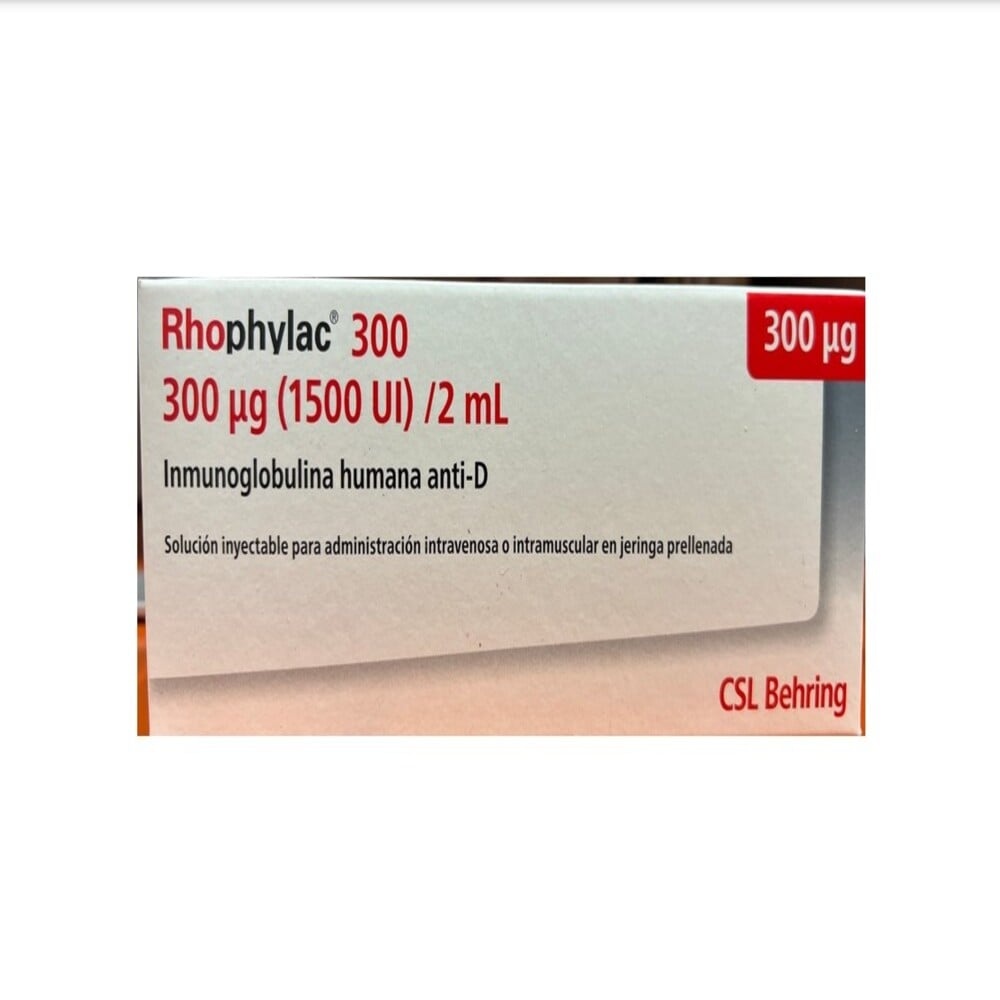
Rhophylac 300 micrograms/2 ml
Injectable solution in pre-filled syringe
Human anti-D immunoglobulin
Read this leaflet carefully before using this medicineas it contains
important information for you.
- Keep this leaflet. You may need to read it again.
- If you have any questions, ask your doctor or healthcare professional.
- If you experience any side effects, ask your doctor or healthcare professional
See section 4.
Contents of this leaflet:
- 1. What Rhophylac 300 is and what it is used for
- 2. What you need to know before you use Rhophylac 300
- 3. How to use Rhophylac 300
- 4. Possible side effects
- 5. How to store Rhophylac 300
- 6. Contents of the pack and other information
1. WHAT RHOPHYLAC 300 IS AND WHAT IT IS USED FOR
What is Rhophylac 300
This medicine is a ready-to-use injectable solution, presented in a pre-filled syringe. The solution contains special proteins, isolated from human plasma. These proteins belong to the class of "immunoglobulins", also called antibodies. The active ingredient of Rhophylac 300 is a specific antibody, called "anti-D (Rh) immunoglobulin". This antibody inhibits the Rhesus D factor.
What is the Rhesus D factor
The Rhesus factor defines special characteristics of human red blood cells. Approximately 85% of the population carries the so-called Rhesus D factor (abbreviated as "Rh(D)"). Individuals belonging to this group are said to be Rh(D)-positive. Conversely, those in whom this Rhesus D factor is not present are defined as Rh(D)-negative.
What is anti-D (Rh) immunoglobulin
Anti-D (Rh) immunoglobulin is an antibody produced in humans by the immune system, which inhibits the Rhesus D factor. When an Rh(D)-negative individual receives Rh(D)-positive blood, their immune system will recognize the Rh(D)-positive red blood cells as "foreign" and attempt to destroy them, producing antibodies specifically directed against the Rhesus D factor. This process, defined as "immunization", takes some time (2–3 weeks). Therefore, Rh(D)-positive red blood cells will not be destroyed immediately upon first contact, nor will typical symptoms generally be evident. But, when the same Rh(D)-negative individual receives Rh(D)-positive blood for the second time, the antibodies will be "ready to attack" and their immune system will immediately destroy the foreign Rh(D)-positive red blood cells.
How does Rhophylac 300 work
Immunization against the Rhesus D factor can be prevented by administering a sufficient amount of human anti-D (Rh) immunoglobulin to the Rh(D)-negative individual. This effect can be achieved by starting treatment with Rhophylac 300 before the first contact with Rh(D)-positive red blood cells occurs, or at least shortly after such contact. The anti-D (Rh) immunoglobulins contained in this medicine will immediately destroy the foreign Rh(D)-positive red blood cells. Consequently, the individual's immune system will not be stimulated to produce specific antibodies.
What is Rhophylac 300 used for
This medicine finds application in two different situations:
A) If you are an Rh(D)-negative pregnant patient and the fetus is Rh(D)-positive
In this particular situation, you may become immunized by fetal Rh(D)-positive red blood cells that have passed into your bloodstream. In this case, the firstborn child will usually not be involved and will be perfectly healthy. However, in the case of a second Rh(D)-positive child, your antibodies will destroy the baby's red blood cells during pregnancy. This situation can lead to serious consequences for the development of your next child, including its possible death.
For this reason, you may receive Rhophylac 300:
- while you are still pregnant or have just given birth to an Rh(D)-positive baby;
- if you are unable to carry your pregnancy to term with an Rh(D)-positive fetus (intrauterine fetal death, miscarriage or threatened miscarriage);
- in the presence of a seriously complicated pregnancy (ectopic pregnancy or pregnancy with a non-viable fertilized egg (hydatidiform mole));
- when fetal red blood cells are likely to have passed into your bloodstream (transplacental hemorrhage resulting from pre-labor bleeding). This can occur, for example, in the event of vaginal bleeding during pregnancy;
- when the attending physician requires tests to ascertain any fetal abnormalities (amniocentesis, chorionic villus biopsy, cordocentesis);
- when the attending physician or midwife recognizes the need to attempt to move the unborn child by acting from the outside (e.g. correction of abnormal fetal presentation or other obstetric manipulation procedures);
- in case of impacts involving the stomach or abdomen (abdominal trauma).
This medicine is also used if you are a pregnant Rh(D)-negative woman and it is not known whether your fetus is Rh(D) positive.
B) If you are an adult, child or adolescent (0-18 years) who is Rh(D)-negative and has accidentally received infusions (transfusions) of Rh(D)-positive blood or other preparations containing Rh(D)-positive red blood cells such as "platelet concentrate" (transfusion error).
2. WHAT YOU NEED TO KNOW BEFORE RECEIVING RHOPHYLAC 300
►Read this section carefully. The information provided must be taken into consideration by you and your doctor before this medicine is administered to you.
You must not receive Rhophylac 300
- If you are allergic (hypersensitive) to human immunoglobulins or any of the excipients of this medicine (listed in section 6). ► Before treatment, tell your doctor or healthcare professional about any medicine you have previously not tolerated.
- You must not receive intramuscular injections if you suffer from a severe reduction in the number of platelets (thrombocytopenia) or any serious blood coagulation disorder. ► Before treatment, tell your doctor or healthcare professional if you suffer from one or both of the conditions mentioned above. In this case, you may only receive this medicine with an intravenous injection.
Warnings and precautions
►Talk to your doctor or healthcare professional before taking Rhophylac 300.
- For the protection of Rh(D)-negative women after the delivery of an Rh(D)-positive newborn, this medicine must always be administered to the mother, never to the newborn.
- This medicine must not be used in Rh(D)-positive individuals, nor in individuals already immunised against the Rh(D) antigen. When it may be necessary to stop administration
- Rhophylac 300 may cause hypersensitivity reactions (allergic type). In rare cases, allergic reactions may occur, such as a sudden drop in blood pressure or shock (see also section 4 "Possible side effects") even if you have previously received human immunoglobulins and tolerated them well. ►Immediately inform your doctor or healthcare professional if such reactions occur. They will immediately stop administering the medicine and start the necessary treatment, which will depend on the nature and severity of the adverse event.
Your doctor or healthcare professional will take particular care
- If you have a low level of IgA type immunoglobulins, you are more likely to have a hypersensitivity reaction. ►Tell your doctor or healthcare professional if your level of IgA type immunoglobulins is low. They will carefully assess the benefit of treatment with this medicine compared to the increased risk of hypersensitivity reactions.
- If you are being treated with this medicine after an incompatible transfusion, you may need a large amount of product (up to 3,000 micrograms, equivalent to 20 ml or 10 syringes). In this case, you may experience a so-called hemolytic reaction. This is due to the expected destruction of foreign (RhD)-positive red blood cells present in your blood. For this reason, your doctor or healthcare professional will monitor you carefully and it may be necessary to perform specific blood tests.
- If your body mass index (BMI) is greater than or equal to 30 (calculated by dividing body weight by the square of your height), the injection of Rhophylac into a muscle may not be fully effective. In this case, the doctor or healthcare professional should preferably inject the medicine intravenously.
Safety information regarding infections
This medicine is produced from human blood plasma (the liquid part of blood).
In the case of medicines derived from blood or human plasma, measures are taken to
prevent the transmission of infections that can be transmitted to patients.
These include:
- careful selection of blood and plasma donors with exclusion of those presenting a potential risk of infection,
- testing of each individual donation and plasma pools for viral infections,
- the inclusion of blood or plasma processing steps that can inactivate or remove viruses. However, when medicines derived from blood or human plasma are administered, the possibility of transmitting infections cannot be completely excluded. This concept also applies to unknown or emerging viruses and other types of infection.
The measures taken are considered effective against enveloped viruses such as the human immunodeficiency virus (HIV, AIDS virus), hepatitis B virus and hepatitis C virus.
The measures taken may be of limited value against non-enveloped viruses such as the hepatitis A virus and parvovirus B19.
Immunoglobulins are not associated with the transmission of hepatitis A or parvovirus B19 infections, possibly because the antibodies against these infections, which are contained in the product, are
protective.
It is strongly recommended that, each time you receive a dose of Rhophylac 300, the
name and batch number of the product are recorded, in order to establish a link with the batch
used.
Blood tests
►Inform your doctor or healthcare professional that you have been treated with Rhophylac 300 if you or
your newborn needs to undergo any blood tests (serological tests).
After you have received this medicine, the results of some blood tests may be
altered for a certain period of time. If you are a mother who received the medicine before
delivery, the results of some blood tests in your newborn may be affected.
Other medicines and Rhophylac 300
►Inform your doctor or healthcare professional if you are taking, have recently taken or
may take any other medicines. This also applies to medicines obtained
without a prescription.
Vaccinations
►Inform your doctor or healthcare professional before treatment if you have recently received a
vaccination in the last 2-4 weeks.
After treatment, also inform the doctor who performed the vaccination. They can then
plan a check of the effectiveness of the vaccination you received.
This medicine may impair the effectiveness of vaccinations with live virus vaccines, for
example those against measles, mumps, rubella (German measles) or varicella. Therefore,
such vaccinations should not be administered within the next 3 months from the last date you
received Rhophylac 300.
Pregnancy and breastfeeding
This medicine is used during pregnancy or immediately after delivery.
Immunoglobulins are excreted in human milk. In clinical studies conducted on 432 mothers treated
with this medicine before delivery and 256 of them treated again after delivery, no
adverse events were observed in their children.
Driving and operating machinery
No effects on the ability to drive and operate machinery are expected with Rhophylac 300.
Rhophylac contains sodium
This medicine contains less than 1 mmol of sodium (23 mg) per syringe, therefore it is
essentially “sodium-free”.
3. HOW TO USE RHOPHYLAC 300
The injection of this medicine will be performed by your doctor or healthcare professional via
intramuscular or intravenous route. Your doctor will decide the dosage of Rhophylac 300 that
must be infused and which route of administration will be the most appropriate. For example, if your
body mass index (BMI) is greater than or equal to 30, he/she should preferably inject the
medicine directly into the vein (see also paragraph 2).
The syringe must be brought to room temperature (25°C) before use.
One syringemust be used only once and for one patient only(even if some product remains in the syringe).
You must be monitored for at least 20 minutes after you have received Rhophylac.
If you receive a quantity of Rhophylac 300 higher than you should
No data are available regarding the consequences of an overdose.
4. POSSIBLE SIDE EFFECTS
Like all medicines, this medicine can cause side effects, although not everyone gets them.
These side effects may occur even if you have received previous administrations of human
immunoglobulins and they were well tolerated. Allergic reactions (hypersensitivity reactions) have
been observed rarely(affecting 1 to 10 patients per 10,000). The first signs may appear as
small itchy blisters on your skin (urticaria) or all over your body (generalized urticaria). These may
progress to severe hypersensitivity/anaphylactic reactions, such as a sudden drop in blood
pressure or shock (for example, you may feel lightheaded, dizzy, weak when standing up, cold
hands and feet, a feeling of abnormal heartbeat or chest pain, a feeling of tightness in the chest,
wheezing and blurred vision), even if you have not shown hypersensitivity to previous
administrations.
►Immediately inform your doctor or healthcare professional if you notice these symptoms during the
administration of Rhophylac. They will decide to completely stop the administration and start
appropriate treatment.
If this medicine is administered into a muscle, you may experience localized pain and
tenderness at the injection site.
The following side effects have a uncommonfrequency (1 to 10 treated subjects per
- 1,000).
- fever and chills (tremor),
- general feeling of discomfort,
- headache,
- skin reactions, redness of the skin (erythema), itching. The following side effects have a Rarefrequency (1 to 10 treated subjects per 10,000):
- allergic reactions, anaphylactic shock,
- nausea and/or vomiting,
- lowering of blood pressure (hypotension),
- fast heartbeat or pulse (tachycardia),
- joint pain (arthralgia ),
- difficulty breathing (dyspnea),
- localized reactions at the site of administration.
Reporting of side effects
►If you get any side effects, talk to your doctor or healthcare professional. This includes any side
effects not listed in this leaflet. You can also report side effects directly to the website:
http://www.agenziafarmaco.gov.it/content/come-segnalare-una-sospetta-reazione-avversa.
By reporting side effects you can help provide more information on the safety of this medicine.
5. HOW TO STORE RHOPHYLAC 300
- Keep out of the sight and reach of children.
- Store in a refrigerator (from +2 to +8 °C).
- Do not freeze.
- Store the syringe (in its sealed plastic wrapper) in the cardboard packaging to protect it from light.
- Do not use this medicine if you notice that the solution is cloudy or contains deposits.
- Do not use this medicine after the expiry date which is stated on the outer packaging and on the syringe label after the abbreviation EXP. The expiry date refers to the last day of the month.
- Do not dispose of any medicine in wastewater or household waste. Ask your pharmacist how to dispose of medicines you no longer use. These measures will help protect the environment.
6. PACKAGE CONTENTS AND OTHER INFORMATION
What this medicine contains
- The active ingredient is human anti-D (Rh) immunoglobulin (IgG antibodies against the D Rh factor).
- Other excipients are human albumin, glycine, sodium chloride, water for injections.
- The product contains a maximum of 30 mg/ml of human plasma proteins, of which 10 mg/ml are made up of human albumin as a stabilizer. At least 95% of the other plasma proteins are human immunoglobulins (antibodies) of the IgG type. Rhophylac 300 contains no more than 5 micrograms/ml of human immunoglobulins (antibodies) of the IgA type.
- Rhophylac does not contain preservatives.
Description of the appearance of Rhophylac 300 and contents of the pack
This medicine is a clear or slightly pearly and colorless to pale yellow
injectable solution. Rhophylac 300 is supplied in a pre-filled glass syringe with 2 ml of sterile
solution ready for use containing 300 micrograms (1,500 IU) of anti-D immunoglobulin.
Rhophylac 300 is available in single packs containing 1 pre-filled syringe and 1 injection needle
both contained in a blister (clear sealed plastic container with a paper foil) or in multipacks, containing 5 single packs. Not all pack sizes may be
marketed.
Marketing Authorisation Holder
CSL Behring GmbH
Emil-von Behring-Strasse, 76
35041 Marburg - Germany
This leaflet was last updated on

Не уверены, подходит ли вам это лекарство?
Обсудите симптомы и варианты лечения с врачом онлайн.

Уже начали прием и появились вопросы?
Обсудите свое состояние и дальнейшие шаги с врачом онлайн.
- Страна регистрации
- Форма выпускаInjectable solution, 200 MICROGRAMS
- Код АТХJ06BB01
- Действующее вещество
- Отпускается по рецептуДа
- Производитель
- Информация на этой странице носит справочный характер и не является медицинской консультацией. Перед началом приема лекарства обязательно проконсультируйтесь с врачом.
- Аналоги ROPYLAKФорма выпуска: Injectable solution, 1500 IU/2 MLДействующее вещество: анти-D иммуноглобулин человекаПроизводитель: INSTITUTO GRIFOLS S.A.Отпускается по рецептуФорма выпуска: Powder and solvent for injectable solution, 300 MCGДействующее вещество: анти-D иммуноглобулин человекаПроизводитель: KEDRION S.P.A.Отпускается по рецептуФорма выпуска: Injectable solution, 625 IU/mLДействующее вещество: анти-D иммуноглобулин человекаПроизводитель: OCTAPHARMA ITALY S.P.A.Отпускается по рецепту
Аналоги ROPYLAK в других странах
Лекарства с тем же действующим веществом, доступные в других странах.
Аналог ROPYLAK в Польша
Аналог ROPYLAK в Украина
Аналог ROPYLAK в Испания
Врачи онлайн по ROPYLAK
Обсудите применение ROPYLAK и возможные следующие шаги — по оценке врача.









Получите рецепт на ROPYLAK онлайн
Заполните форму за 2 минуты
Расскажите о симптомах, истории болезни и нужном препарате.
Выберите врача или мы назначим
Выберите специалиста или мы подберём ближайшего доступного врача.
Врач рассматривает ваш случай
Обычно в течение 30 минут. Может задать уточняющие вопросы в чате.
Получите в любой аптеке
Электронный рецепт отправляется на вашу почту — действителен по всей Польше.
Часто задаваемые вопросы
ROPYLAK требует рецепта в Италия. Вы можете уточнить у врача онлайн, подходит ли это лекарство для вашей ситуации.
Действующее вещество ROPYLAK — анти-D иммуноглобулин человека. Эта информация помогает определить лекарства с тем же составом под другими торговыми названиями.
ROPYLAK производится компанией CSL BEHRING GMBH. Упаковка и торговое название могут отличаться в зависимости от дистрибьютора.
Врачи, включая Семейные врачи, Психиатры, Дерматологи, Кардиологи, Эндокринологи, Гастроэнтерологи, Пульмонологи, Нефрологи, Ревматологи, Гематологи, Инфекционисты, Аллергологи, Гериатры, Педиатры, Онкологи, могут оценить целесообразность применения ROPYLAK с учетом вашей ситуации и местных правил. Вы можете записаться на онлайн-консультацию, чтобы обсудить возможные варианты.
Польша имеет хорошо развитую систему здравоохранения в крупных городах, таких как Варшава, Краков, Вроцлав и Гданьск. Аптеки широко доступны и работают в соответствии с действующим законодательством, обеспечивая доступ к рецептурным препаратам.
Вы можете купить ROPYLAK в Варшаве, Кракове, Вроцлаве или Гданьске в любой аптеке при наличии действующего рецепта.
Чтобы получить рецепт, вы можете воспользоваться Oladoctor:
Другие лекарства с тем же действующим веществом (анти-D иммуноглобулин человека) включают IGAMAD, IMMUNORO, RESONATIV. Они могут отличаться торговым названием или формой выпуска, но содержат одинаковый терапевтический компонент. Перед изменением лечения рекомендуется проконсультироваться с врачом.
