



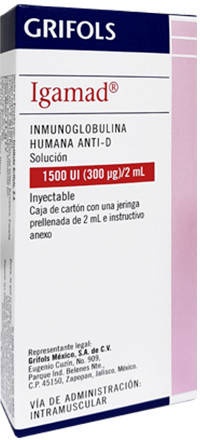
IGAMAD 1500 IU/2 ML Инъекционный раствор

Рассмотрение рецепта онлайн
Врач рассмотрит ваш случай и примет решение о назначении рецепта, если это медицински оправдано.

Поговорите с врачом об этом лекарстве
Обсудите симптомы и возможные дальнейшие шаги на онлайн-консультации.



Инструкция по применению IGAMAD
Содержание инструкции
Igamad 1500 IU/2 ml injectable solution in pre-filled syringe for intramuscular use
Human anti-D immunoglobulin
Read this leaflet carefully before you use this medicine as it contains important
information for you.
- Keep this leaflet. You may need to read it again.
- If you have any questions, ask your doctor, pharmacist or nurse.
- This medicine has been prescribed for you only. Do not pass it on to others, even if their symptoms are the same as yours, as it could be harmful.
- If you get any side effects, even those not listed in this leaflet, tell your doctor, pharmacist or nurse. See section 4.
Contents of this leaflet:
- 1. What Igamad is and what it is used for
- 2. What you need to know before you use Igamad
- 3. How to use Igamad
- 4. Possible side effects
- 5. How to store Igamad
- 6. Contents of the pack and other information
1. What Igamad is and what it is used for
Igamad is an injectable solution for intramuscular use. It is supplied in a pre-filled syringe
containing human anti-D (Rh) immunoglobulins, which are specific antibodies against the D (Rh) antigen
of human red blood cells.
The medicine belongs to the pharmacotherapeutic group: immune sera and immunoglobulins.
The administration of Igamad is indicated for:
Prophylaxis of Rh(D) immunisation in Rh(D) negative women.
- Prenatal prophylaxis
- Planned prenatal prophylaxis.
- Prenatal prophylaxis following pregnancy complications, including:
Abortion/threatened abortion, ectopic pregnancy or hydatidiform mole, intrauterine fetal death,
transplacental haemorrhage resulting from antepartum haemorrhage, amniocentesis, chorionic
biopsy, obstetric manipulation procedures (e.g. external cephalic version,
invasive procedures, cordocentesis, blunt abdominal trauma or therapeutic intervention
on the fetus).
- Postnatal prophylaxis
- Delivery of an Rh(D) positive baby (D, D , D ).
Treatment of Rh(D) negative subjects after incompatible transfusions of Rh(D) positive blood or other
products containing Rh(D) positive red blood cells, such as platelet concentrates.
2. What you need to know before using Igamad
Do not use Igamad
If you are allergic to human immunoglobulin or any of the other ingredients of this medicine (listed in section 6).
Warnings and precautions
Talk to your doctor, pharmacist or nurse before using Igamad.
- Make sure that Igamad is not administered intravenously, as it may cause shock.
- Injections must be given intramuscularly, taking care to aspirate with the syringe before the injection, to be sure that the needle is not in a blood vessel.
- In the case of postpartum use, the product must be administered to the mother. It must not be administered to the newborn.
- The product must not be administered to Rh(D) positive women or women previously immunized against the Rh(D) antigen.
- Your doctor will keep you under observation for at least 20 minutes after administration.
- Hypersensitivity reactions, up to anaphylactic shock, are rare and include urticaria, widespread urticaria, chest tightness, wheezing, lowering of blood pressure (hypotension). Allergic-type reactions to anti-D immunoglobulins can still occur.
- Igamad contains a small amount of IgA. If you are deficient in IgA, you may develop antibodies against IgA and may have anaphylactic reactions after administration of medicines derived from plasma, which contain IgA. The doctor will assess the benefit of treatment with Igamad against the potential risk of hypersensitivity reactions.
- Rarely, human anti-D (Rh) immunoglobulin can induce a lowering of blood pressure with anaphylactic reaction (hypovolemic shock), even in patients who have previously tolerated treatment with human immunoglobulin well.
- If symptoms of allergic or anaphylactic reactions appear, the doctor will immediately stop administering the medicine and start the necessary treatment, which will depend on the type and severity of the reactions.
- If you receive an incompatible transfusion and if you receive high doses of human anti-D (Rh) immunoglobulin, your doctor will monitor your clinical and laboratory parameters, due to the risk of hemolytic reaction.
Viral safety
When medicines are produced from human blood or plasma, particular safety measures are applied to prevent the transmission of infectious agents to patients. These measures include:
- careful selection of blood and plasma donors, to ensure that potential carriers of infections are excluded;
- analysis of each donation and plasma pool to detect signs of the presence of viruses/infections;
- inclusion of procedures in the blood or plasma processing process that can inactivate or remove viruses. Despite these measures, when medicines prepared from human blood or plasma are administered, the possibility of transmitting infections cannot be completely excluded. This also applies to viruses of unknown or emerging nature or other types of infections.
The measures taken are considered effective for enveloped viruses such as the human immunodeficiency virus (HIV), hepatitis B virus (HBV) and hepatitis C virus (HCV), and for the non-enveloped hepatitis A virus (HAV). The measures taken may have limited value against viruses without an envelope like parvovirus B19.
Immunoglobulins have not been associated with the transmission of hepatitis A or parvovirus B19 infections, probably because the antibodies against these infections contained in the product perform a protective function.
It is strongly recommended that each time Igamad is administered, the name and lot number of the product are recorded in order to maintain traceability between the patient and the lot of product used.
Children and adolescents
The same warnings mentioned for adults are expected to apply to the pediatric population.
Other medicines and Igamad
Tell your doctor or pharmacist if you are taking, have recently taken or might take any other medicines, including over-the-counter medicines.
Interference with vaccinations
Igamad may reduce the effectiveness of some types of vaccines, such as vaccines with live attenuated viruses (e.g. measles, mumps, rubella and varicella vaccine). The administration of these vaccines must be carried out 3 months after the last administration of Igamad.
In the case of vaccination for measles, this impairment can last up to a year. Therefore, patients receiving the measles vaccine should be subjected to checks of antibody levels.
If it is necessary to administer human anti-D (Rh) immunoglobulin within 2-4 weeks of a vaccination with a live attenuated virus, the effectiveness of that vaccination may be decreased.
Interference with blood tests
Tell your doctor or nurse if you are having blood tests after taking Igamad.
After administration of human anti-D (Rh) immunoglobulins, a transient increase in various antibodies in your blood may occur, which may lead to an alteration in the results of laboratory tests, including the Coombs test or blood and antibody typing.
Pregnancy, breastfeeding and fertility
If you are pregnant, suspect you are pregnant or are planning to become pregnant, or if you are breastfeeding, ask your doctor for advice before using this medicine.
Pregnancy
Igamad is intended for use during pregnancy.
Breastfeeding
Igamad can be used during breastfeeding.
Fertility
No studies on fertility in animals have been conducted using Igamad. From clinical experience with human anti-D (Rh) immunoglobulin, it is expected that there will be no adverse effects on fertility.
Driving and using machines
No effects on the ability to drive or operate machinery have been observed.
Igamad contains sodium
This medicine contains less than 23 mg (1 mmol) of sodium per dose, i.e. it is practically “sodium-free”.
3. How to use Igamad
Use this medicine following the instructions of your doctor exactly. If you have any doubts, consult your
doctor or pharmacist.
Igamad must be administered with a slow injection via intramuscular route.
If the administration of a high dose is required (> 2 ml for children or > 5 ml for adults)
this will be administered in fractionated doses and at different anatomical sites.
If intramuscular administration is contraindicated (due to coagulation disorders) you will be
administered other products.
After the injection, accurate manual pressure must be applied to the injection site using
a gauze pad.
Igamad must not be mixed with other medicines.
The recommended dose of Igamad must be determined based on the level of exposure to Rh(D) positive red
blood cells and is based on the fact that 0.5 ml of concentrated Rh(D) positive red blood cells or 1 ml of
Rh(D) positive whole blood are neutralized by approximately 10 micrograms (50 IU) of human anti-D (Rh) immunoglobulin.
The following information is intended exclusively for doctors or healthcare professionals.”
If you use more Igamad than you should
No data are available regarding overdose.
If you take a higher than allowed dose, inform your doctor or pharmacist immediately.
If you forget to use Igamad
Do not use a double dose to make up for a missed dose.
4. Possible side effects
Like all medicines, this medicine can cause side effects, although not everyone will experience them.
As with all normal human immunoglobulins administered intramuscularly, the following reactions may occur:
- Pain and local hypersensitivity (swelling, erythema, redness, hardening, itching, rash and a feeling of warmth) may occur at the injection site; this can be avoided by administering higher doses at different injection sites.
- Occasionally, fever, malaise, headache, nausea, vomiting, skin reactions, chills and joint pain may occur.
- In rare cases, the following have been reported: hypotension and allergic or anaphylactic reactions, including difficulty breathing (dyspnea) and shock, even when the patient had not previously shown hypersensitivity to administration. From post-marketing experience with the use of Igamad, the following adverse reactions have been reported: hypersensitivity, erythema, arthralgia, pruritus and urticaria with frequencies not known.
In addition, the following side effects have also been reported following the administration of human anti-D immunoglobulins intramuscularly: tachycardia and malaise.
Reporting of side effects
If you experience any side effects, including those not listed in this leaflet, please inform your doctor, pharmacist or nurse. You can also report side effects directly to
http://www.agenziafarmaco.gov.it/it/responsabili . By reporting side effects you can help provide more information on the safety of this medicine.
5. How to store Igamad
Keep this medicine out of the sight and reach of children.
Do not use this medicine after the expiry date which is stated on the label after the inscription Exp.
The expiry date refers to the last day of that month.
The expiry date refers to the product in intact packaging and stored as prescribed.
Store in a refrigerator (2 ºC-8 ºC) in the outer packaging. Do not freeze.
The colour may vary from colourless to pale yellow to light brown. A slight
opalescence or a small amount of particulate matter may occur during
storage.
The solution must be visually inspected before administration.
Do not use Igamad if you notice that the solution is cloudy or contains deposits.
Do not dispose of any medicine in wastewater or household waste. Ask your pharmacist how to
dispose of medicines you no longer use. This will help protect the environment.
6. Package contents and other information
What Igamad contains
- The active ingredient is: Human anti-D (Rh) Immunoglobulin 1500 IU (300 micrograms *) * 100 micrograms of human anti-D (Rh) immunoglobulin correspond to 500 International Units (IU).
The human protein content is 320 mg, of which at least 95% are Immunoglobulin G (IgG).
The IgA content is less than 1 mg/ml.
- The other components are: glycine, sodiumchloride and water for injections.
(See section 2 for more information on excipients).
Description of the appearance of Igamad and package contents
IGAMAD “1500 IU/2 ml injectable solution for intramuscular use” pre-filled syringe.
Package: one pre-filled syringe of 1500 IU/2 ml.
Igamad is an injectable solution for intramuscular use. The solution is clear and
from pale yellow to light brown. During storage it may show slight opalescence or
a small precipitation of particulate matter.
Marketing authorisation holder and manufacturer
Instituto Grifols, S.A.
Can Guasch, 2 - Parets del Vallès
08150 Barcelona - SPAIN
----------------------------------------------------------------------------------------------------------------------------
The following information is intended exclusively for doctors or healthcare professionals:
Dosage
The recommended dose of Igamad should be determined based on the level of exposure to Rh(D) positive red blood cells and is based on the fact that 0.5 ml of Rh(D) positive concentrated red blood cells or 1 ml of
Rh(D) positive whole blood are neutralized by approximately 10 micrograms (50 IU) of human anti-D (Rh) immunoglobulin.
Prevention of Rh(D) immunisation in Rh(D) negative women
- Prenatal prophylaxis:in accordance with general recommendations, the dose to be administered is between 50-330 micrograms or 250-1650 IU.
- Planned prenatal prophylaxis: A single dose between the 28th and 30th week of gestation or two doses at the 28th and 34th week.
- Prenatal prophylaxis following complications of pregnancy:
A single dose should be administered as soon as possible and in any case within 72 hours and
if necessary repeated at intervals of 6-12 weeks during pregnancy.
- Postnatal prophylaxis:in accordance with general recommendations, the dose to be administered is between 100-300 micrograms or 500-1500 IU. If the lower dose (100 micrograms or 500 IU) is administered, the materno-fetal haemorrhage must be quantified.
For postnatal use, the product must be administered to the mother as soon as possible and
in any case within 72 hours of delivery of an Rh positive (D, d, d) baby. If more than 72 hours have elapsed, administration should still be given as soon as possible.
The postnatal dose should also be administered when prenatal prophylaxis has been
carried out and even if residual activity of prenatal prophylaxis is still present in the maternal serum.
If massive materno-fetal haemorrhage is suspected (> 4 ml (0.7%-0.8% of women)), for example in
cases of fetal/neonatal anaemia or intrauterine fetal death, its extent should be quantified with
an appropriate method, for example the acid elution test of Kleihauer-Betke for the determination of
fetal haemoglobin (HbF) or flow cytometry which specifically identifies Rh(D) positive cells. Additional doses of human anti-D (Rh) immunoglobulin should be
administered as established (10 micrograms or 50 IU per 0.5 ml of fetal erythrocytes).
Transfusions of Rh-incompatible red blood cells
The recommended dose is 20 micrograms (100 IU) of human anti-D (Rh) immunoglobulin per
2 ml of Rh(D) positive whole blood transfused, or per 1 ml of packed red blood cells. The appropriate dose should be determined by consulting a blood transfusion specialist. Monitoring (follow-up) tests should be performed every 48 hours to identify Rh(D)
positive erythrocytes and the administration of human anti-D (Rh) immunoglobulin should continue until the total
disappearance of Rh(D) positive erythrocytes from the bloodstream. In case of larger incompatible transfusions, a maximum dose of 3000 micrograms (15000 IU) is sufficient, regardless of whether the volume of Rh(D) positive erythrocytes transfused is greater than 300 ml.
The use of an alternative product for intravenous administration is recommended, which will allow to
immediately achieve adequate plasma levels. If no intravenous product is available, the high
volume required must be administered intramuscularly over several days.
Route of administration
For intramuscular use.
The product must be brought to room temperature or body temperature before being
used.
If the administration of a high dose (> 2 ml for children or > 5 ml for adults) is required, it is
recommended to administer it in fractionated doses and at different anatomical sites.
If intramuscular administration is contraindicated (due to coagulation disorders) the patient
must be treated with other products.
After the injection, accurate manual pressure should be applied to the injection site using
a gauze pad.

Не уверены, подходит ли вам это лекарство?
Обсудите симптомы и варианты лечения с врачом онлайн.

Уже начали прием и появились вопросы?
Обсудите свое состояние и дальнейшие шаги с врачом онлайн.
- Страна регистрации
- Форма выпускаInjectable solution, 1500 IU/2 ML
- Код АТХJ06BB01
- Действующее вещество
- Отпускается по рецептуДа
- Производитель
- Информация на этой странице носит справочный характер и не является медицинской консультацией. Перед началом приема лекарства обязательно проконсультируйтесь с врачом.
- Аналоги IGAMADФорма выпуска: Powder and solvent for injectable solution, 300 MCGДействующее вещество: анти-D иммуноглобулин человекаПроизводитель: KEDRION S.P.A.Отпускается по рецептуФорма выпуска: Injectable solution, 625 IU/mLДействующее вещество: анти-D иммуноглобулин человекаПроизводитель: OCTAPHARMA ITALY S.P.A.Отпускается по рецептуФорма выпуска: Injectable solution, 200 MICROGRAMSДействующее вещество: анти-D иммуноглобулин человекаПроизводитель: CSL BEHRING GMBHОтпускается по рецепту
Аналоги IGAMAD в других странах
Лекарства с тем же действующим веществом, доступные в других странах.
Аналог IGAMAD в Польша
Аналог IGAMAD в Украина
Аналог IGAMAD в Испания
Врачи онлайн по IGAMAD
Обсудите применение IGAMAD и возможные следующие шаги — по оценке врача.









Получите рецепт на IGAMAD онлайн
Заполните форму за 2 минуты
Расскажите о симптомах, истории болезни и нужном препарате.
Выберите врача или мы назначим
Выберите специалиста или мы подберём ближайшего доступного врача.
Врач рассматривает ваш случай
Обычно в течение 30 минут. Может задать уточняющие вопросы в чате.
Получите в любой аптеке
Электронный рецепт отправляется на вашу почту — действителен по всей Польше.
Часто задаваемые вопросы
IGAMAD требует рецепта в Италия. Вы можете уточнить у врача онлайн, подходит ли это лекарство для вашей ситуации.
Действующее вещество IGAMAD — анти-D иммуноглобулин человека. Эта информация помогает определить лекарства с тем же составом под другими торговыми названиями.
IGAMAD производится компанией INSTITUTO GRIFOLS S.A.. Упаковка и торговое название могут отличаться в зависимости от дистрибьютора.
Врачи, включая Семейные врачи, Психиатры, Дерматологи, Кардиологи, Эндокринологи, Гастроэнтерологи, Пульмонологи, Нефрологи, Ревматологи, Гематологи, Инфекционисты, Аллергологи, Гериатры, Педиатры, Онкологи, могут оценить целесообразность применения IGAMAD с учетом вашей ситуации и местных правил. Вы можете записаться на онлайн-консультацию, чтобы обсудить возможные варианты.
Польша имеет хорошо развитую систему здравоохранения в крупных городах, таких как Варшава, Краков, Вроцлав и Гданьск. Аптеки широко доступны и работают в соответствии с действующим законодательством, обеспечивая доступ к рецептурным препаратам.
Вы можете купить IGAMAD в Варшаве, Кракове, Вроцлаве или Гданьске в любой аптеке при наличии действующего рецепта.
Чтобы получить рецепт, вы можете воспользоваться Oladoctor:
Другие лекарства с тем же действующим веществом (анти-D иммуноглобулин человека) включают IMMUNORO, RESONATIV, ROPYLAK. Они могут отличаться торговым названием или формой выпуска, но содержат одинаковый терапевтический компонент. Перед изменением лечения рекомендуется проконсультироваться с врачом.
