



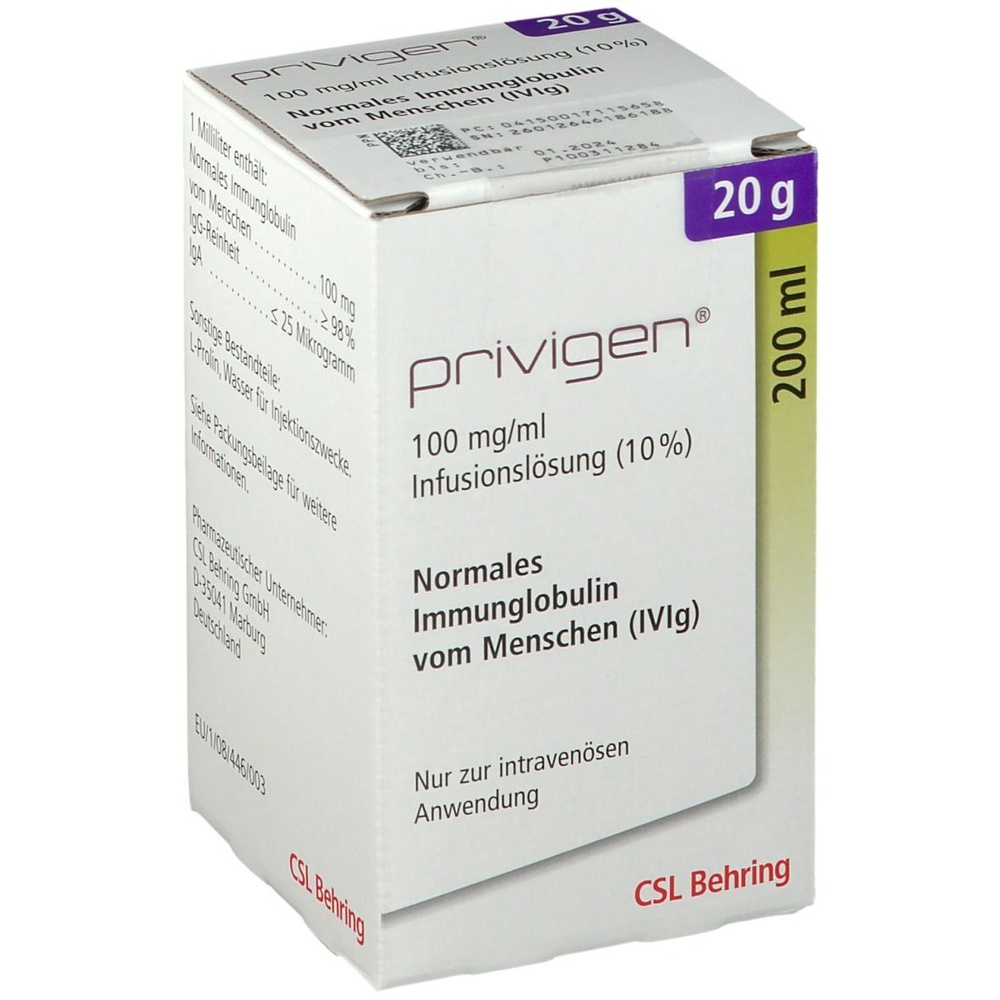
PRIVIGEN 100 mg /Ml Инфузионный Раствор

Рассмотрение рецепта онлайн
Врач рассмотрит ваш случай и примет решение о назначении рецепта, если это медицински оправдано.

Поговорите с врачом об этом лекарстве
Обсудите симптомы и возможные дальнейшие шаги на онлайн-консультации.



Инструкция по применению PRIVIJEN
Содержание инструкции
Privigen 100 mg/ml (10%) solution for infusion
Normal human immunoglobulin (IVIg)
Read this leaflet carefully before using this medicine as it contains important
information for you.
- Keep this leaflet. You may need to read it again.
- If you have any questions, ask your doctor or healthcare professionals.
- If any side effects occur, including those not listed in this leaflet, tell your doctor or healthcare professionals.
Contents of this leaflet:
- 1. What Privigen is and what it is used for
- 2. What you need to know before Privigen is administered to you
- 3. How to use Privigen
- 4. Possible side effects
- 5. How to store Privigen
- 6. Contents of the pack and other information
1. What is Privigen and what is it used for
What is Privigen
Privigen belongs to a class of medicines called normal human immunoglobulins. Immunoglobulins, also known as antibodies, are blood proteins that help the body
fight infections.
How Privigen works
Privigen contains immunoglobulins prepared from the blood of healthy people. The medicine
works exactly like the immunoglobulins naturally present in human blood.
What Privigen is used for
Privigen is used for the treatment of adults and children (0-18 years) in the following situations:
A) To increase to normal levels excessively low levels of immunoglobulins in your
blood (replacement therapy):
- 1. Patients born with reduced ability or inability to produce immunoglobulins (primary immunodeficiencies (PID).
- 2. Patients with acquired immunodeficiency (AIDS) who suffer from severe or recurrent infections, ineffective antimicrobial treatment and with confirmed specific antibody deficiency or serum IgG levels <4 g/l.
B) To treat certain inflammatory diseases (immunomodulation). 4
categories of patients are distinguished:
- 1. Patients who do not have enough platelets in the blood (primary immune thrombocytopenia (ITP) and who are at high risk of bleeding or who will undergo surgery in the near future.
- 2. Patients with Guillain Barré syndrome. This is an acute disease, characterized by inflammation of the peripheral nerves, which causes severe muscle weakness, especially in the legs and upper limbs.
- 3. Patients with Kawasaki disease. This is an acute disease that mainly affects young children. It is characterized by inflammation of blood vessels throughout the body.
- 4. Patients with chronic inflammatory demyelinating polyneuropathy (CIDP). This is a chronic disease characterized by inflammation of the peripheral nerves that causes muscle weakness and/or numbness especially in the legs and upper limbs.
- 5. Patients with multifocal motor neuropathy (MMN). This is a slowly progressive disease of the motor nerves that causes weakness of the arms and legs
2. What you need to know before you are given Privigen
Read this section carefully. The information contained herein must be taken into consideration by you and your doctor before the administration of Privigen.
DO NOTtake Privigen
- if you are allergic to human immunoglobulins or to proline.
- if you have developed antibodies against IgA-type immunoglobulins in your blood.
- if you suffer from type I or II hyperprolinemia (a genetic disease that causes an increase in the levels of the amino acid proline in the blood). This is an extremely rare disease. Only a few families worldwide are known to be affected by this disease.
Warnings and precautions
Circumstances that increase the risk of adverse effects
Before treatment, inform your doctor or healthcare professionals if any of the following circumstances apply to you:
- you receive the medicine at high doses for 1 day or for several days and you have blood type A, B or AB and/or you have an underlying inflammatory disease. In these cases, it has been commonly observed that immunoglobulins increase the risk of red blood cell destruction (hemolysis).
- you are overweight, elderly, diabetic, have been confined to bed for a long time, have high blood pressure, have a reduced blood volume (hypovolemia), have problems with blood vessels (vascular diseases), have an increased tendency to blood clotting (thrombophilia or thrombotic events) or have a disease or condition that makes the blood thicker (hyperviscosity). In these cases, immunoglobulins may increase the risk of heart attack (myocardial infarction), stroke, formation of blood clots in the lungs (pulmonary embolism) or in the legs, although very rarely.
- you are diabetic. Although Privigen does not contain sugars, it may be diluted with a particular sugar solution (5% glucose), which may affect your blood sugar level.
- you have, or have had in the past, kidney problems or are taking medicines that can damage the kidneys (nephrotoxic medicines). In these cases, immunoglobulins may increase the risk of rapid and severe loss of kidney function (acute renal failure), even if only very rarely. Loss of kidney function that has caused death has occurred in isolated cases associated with hemolysis.
Checks necessary during the infusion
For your safety, treatment with Privigen will be carried out under the supervision of the doctor or healthcare professionals. Generally, you will be monitored throughout the duration of the intravenous infusion and for at least 20 minutes afterwards. In certain circumstances, particular precautions may be necessary. These circumstances may occur:
if you receive Privigen at a high infusion rate, or
if you receive Privigen for the first time or after a long interruption of treatment (e.g.
several months).
In these cases, you will be observed carefully throughout the duration of the infusion and for at least 1 hour
after the infusion.
Need to slow down or stop the infusion rate
- You may be allergic (hypersensitive) to immunoglobulins without knowing it. However, true allergic reactions are rare. These reactions can occur even if you have received human immunoglobulins in the past and have tolerated them well. This possibility may occur in particular if you have developed antibodies against IgA-type immunoglobulins. In these rare cases, allergic reactions may occur, such as a sudden drop in blood pressure or shock (see also section 4 “Possible side effects”).
- In very rare cases, acute lung injury associated with transfusion (TRALI) may occur after receiving immunoglobulins. This will cause fluid to accumulate in the air spaces of the lung not associated with heart function (non-cardiogenic pulmonary edema). You will recognize TRALI from severe difficulty in breathing (respiratory distress), bluish skin color (cyanosis) from excessively low oxygen levels in the blood (hypoxia), reduced blood pressure (hypotension) and increased body temperature (fever). Symptoms typically appear during or within 6 hours of treatment. Immediately inform your doctor or healthcare professionals if you notice these reactions during the infusion of Privigen. They will decide whether to reduce the infusion rate or stop the infusion altogether.
Blood tests
Before undergoing any blood tests, inform your doctor about the treatment with Privigen.
After the administration of Privigen, the results of certain blood tests (serological tests)
may be altered for a certain period of time.
Safety information regarding infections
Privigen is produced from human blood plasma (plasma is the liquid part of blood).
For medicines derived from blood or human plasma, certain safety measures are adopted,
to prevent the transmission of infections to the patient. The safety measures include:
careful selection of plasma and blood donors, in order to exclude subjects who
may be carriers of infections,
analysis of each donation and of the pooled plasma from multiple donors for signs of
viruses/infections.
The inclusion in the blood and plasma processing of inactivation or removal steps for any viruses.
Despite these measures, in the case of administration of medicines derived from blood or human plasma,
the risk of transmission of infections can never be completely excluded. This is valid
also for unknown or new viruses or for other types of infection.
The measures taken are considered effective against enveloped viruses, such as the human immunodeficiency virus (HIV), the hepatitis B virus and the hepatitis C virus, and against non-enveloped viruses such as the hepatitis A virus and Parvovirus B19.
Immunoglobulins have not been associated with hepatitis A or parvovirus B19 infections, perhaps because
the antibodies against these infections, which are contained in the medicine, are protective.
- It is recommended to record the trade name and batch number whenever you are given a dose of Privigen, in order to have documentation on the batches used.
Other medicines and Privigen
Inform your doctor or healthcare professionals if you are taking, have recently taken or might take
any other medicines.
The concomitant use of medicines that increase water elimination from the body (loop diuretics)
should be avoided during treatment with Privigen. Your doctor will decide whether to use
or continue therapy with loop diuretics.
Vaccinations
Before a vaccination, inform the doctor performing the vaccination about the treatment with
Privigen.
After the administration of Privigen, the effectiveness of certain vaccinations may be
compromised. This applies to vaccinations with live attenuated viruses, such as vaccinations against
measles, mumps, rubella and varicella. These vaccinations should be postponed for at least three
months after the last infusion of Privigen. In the case of measles, the compromise of vaccine effectiveness may persist for up to 1 year. Therefore, the doctor performing the vaccination must check
the effectiveness of the measles vaccination.
Pregnancy and breastfeeding
Inform your doctor or healthcare professionals if you are pregnant, planning a
pregnancy or breastfeeding. The doctor will decide whether Privigen can be given to you during
pregnancy or breastfeeding.
However, medicines containing antibodies have been used during pregnancy and breastfeeding. Long-term experience has shown that no harmful effects during pregnancy or on
the newborn are expected.
If you are given Privigen during breastfeeding, the antibodies contained in the medicine
will pass into breast milk. Therefore, the baby will also receive the protective antibodies.
Driving and operating machinery
During treatment with Privigen, patients may experience effects such as dizziness or nausea, which
may impair the ability to drive vehicles and operate machinery. In this case, do not drive and
do not operate machinery until these effects have disappeared.
Privigen contains proline
You must not take this medicine if you suffer from hyperprolinemia (see also section 2 “What
you need to know before you are given Privigen”).
Inform your doctor before treatment.
Sodium content
This medicine contains less than 2.3 mg of sodium (the main component of table salt) in
100 mL. This is equivalent to 0.12% of the recommended maximum daily intake in the diet
of an adult.
3. How to use Privigen
Privigen is intended exclusively for intravenous infusion (intravenous infusion). It is normally
administered by the doctor or healthcare professionals.
The doctor will calculate the correct dose based on your body weight, the specific circumstances listed in
section 2 “Warnings and precautions” and your response to treatment. The dose calculation for
children and adolescents is not different from that for adults. At the beginning of the infusion you will receive Privigen
with a low infusion rate. If you tolerate it well, the doctor may gradually increase the
infusion rate.
If you receive more Privigen than you should
It is very unlikely that an overdose will occur, because Privigen is generally administered
under medical supervision. However, if you should receive more Privigen than
necessary, the blood may become too thick (hyperviscous) and this may increase the risk of
developing clots. This can happen especially in patients at risk, such as the elderly or
patients with heart or kidney disease. Inform your doctor if you have any known medical problems.
4. Possible side effects
Like all medicines, this medicine can cause side effects, although not everyone will experience them.
Possible side effects may be reduced or even avoided if Privigen is infused at a low
infusion rate. These side effects may occur even if you have previously received human
immunoglobulins and tolerated them well.
In rare and isolated cases, the following side effects related to immunoglobulin-based
preparations have been reported:
severe hypersensitivity reactions, such as a sudden drop in blood pressure or anaphylactic shock
(i.e., dizziness, vertigo, fainting upon standing, cold hands and feet, a feeling of abnormal
heartbeat or chest pain, or blurred vision), even if you have not shown hypersensitivity
reactions to previous infusions,
Immediately inform your doctor or healthcare professionals if you notice these signs during
the infusion of Privigen. They will decide whether to reduce the infusion rate or stop
the infusion altogether.
formation of blood clots that can be carried in the bloodstream
(thromboembolic reactions) and which can cause, for example, myocardial infarction (e.g., sudden
chest pain or shortness of breath), stroke (e.g., sudden muscle weakness,
loss of sensation and/or balance, reduced alertness or difficulty speaking), blood clots in the
pulmonary arteries (e.g., chest pain, difficulty breathing or coughing up blood), deep vein thrombosis (e.g., redness, warmth, pain,
increased sensitivity or swelling in one or both legs),
chest pain, chest discomfort, painful breathing due to acute lung injury
associated with transfusion (TRALI)
Immediately inform your doctor or healthcare professionals if you experience any of
these symptoms. Anyone experiencing these symptoms should be immediately transferred to the
hospital emergency department for diagnosis and treatment.
- temporary non-infectious meningitis (reversible aseptic meningitis). Immediately inform your doctor or healthcare professionals if you have a stiff neck and one or more of the following symptoms: fever, nausea, vomiting, headache, excessive sensitivity to light, mental disorders.
- increased creatinine levels in the blood,
- proteinuria
- acute renal failure, transient reduction of red blood cells (reversible hemolytic anemia/hemolysis), anemia, leukopenia, anisocytosis (including microcytosis).
Adverse reactions observed in controlled clinical trials and in post-marketing experience are presented
in decreasing order of frequency:
Very common(may affect more than 1 in 10 people):
Headache (including sinus headache, migraine, feeling of discomfort in the head, tension headache), pain
(including back pain, limb pain, joint and bone pain (arthralgia), neck pain, facial pain], fever (including chills) flu-like illness (including runny nose (rhinorrhea),
sore throat (pharyngolaryngodynia), blisters in the mouth and throat (oropharyngeal vesicles), sore
throat.
Common(may affect up to 1 in 10 people):
Temporary decrease in the number of red blood cells (anemia), lysis of red blood cells (hemolysis, including
hemolytic anemia), decrease in the number of white blood cells (leukopenia), hypersensitivity, dizziness
(including vertigo), high blood pressure (hypertension), flushing (including hot flashes,
hyperemia), hypotension (including decreased blood pressure), shortness of breath (dyspnea including
chest pain, chest discomfort, painful breathing), stomach upset (nausea), vomiting,
loose stools (diarrhea), stomach pain, skin disorders (including rash,
itching, hives, maculopapular rash, skin redness (erythema), skin peeling (exfoliation), muscle pain
(including muscle cramps and stiffness), fatigue
(asthenia), physical weakness (asthenia), muscle weakness.
Routine laboratory tests may reveal, commonly, changes in liver function (hyperbilirubinemia), as well as in the number of blood cells (for example, positive direct Coombs' test, increased alanine aminotransferase, increased aspartate aminotransferase,
increased blood lactate dehydrogenase).
Uncommon(may affect up to 1 in 100 people):
Temporary non-infectious meningitis (reversible aseptic meningitis), irregularity in the shape of
red blood cells (microscopic detection), presence of a high number of platelets in the blood
(thrombocytosis), drowsiness, chills (tremor), palpitations, tachycardia, thromboembolic events,
lack of blood supply to the lower extremities with consequences such as pain when walking
(peripheral vascular disorder), presence of excess serum protein in the urine (proteinuria
including increased blood creatinine), pain at the injection site (including discomfort at the
infusion site).
In isolated cases (post-marketing experience), the following have been observed in patients treated with Privigen: abnormally low levels of specific white blood cells called neutrophils (decreased neutrophil count), anaphylactic shock, painful breathing due to lung injury related to transfusion
(TRALI) and acute renal failure.
Cases of hemolytic anemia after completion of controlled studies have been observed with a
significantly reduced frequency due to improvements in the Privigen manufacturing process.
If you experience any side effect, including those not listed in this leaflet, tell your
doctor or healthcare professionals.
For more detailed information on the circumstances that increase the risk of side effects, please also
refer to section 2 “What you need to know before Privigen is administered to you”.
Reporting of side effects
If you get any side effects, talk to your doctor, nurse or pharmacist. You can also report side effects directly
through the national reporting system listed in Annex V.
By reporting side effects you can help provide more information on the safety of
this medicine.
5. How to store Privigen
- Keep this medicine out of the sight and reach of children.
- Do not use this medicine after the expiry date which is stated on the outer carton and on the vial label after “Exp.”. The expiry date refers to the last day of that month.
- Since the solution does not contain preservatives, the healthcare professional must infuse it as soon as possible after opening the vial.
- Do not store at a temperature above 25 °C.
- Do not freeze.
- Store the vial in the outer packaging to protect it from light.
- Do not use this medicine if you notice that the solution is cloudy or contains particles.
6. Contents of the pack and other information
What Privigen contains
The active substanceis normal human immunoglobulin (IgG type antibodies). Privigen
contains 100 mg/ml (10%) of human proteins, of which at least 98% consists of IgG.
The approximate percentage of IgG subclasses is as follows:
IgG ....................... 69 %
IgG ....................... 26 %
IgG ......................... 3 %
IgG ......................... 2 %
This medicine contains traces of IgA (not more than 25 micrograms/ml).
The other ingredients(excipients )are the amino acid proline, water for injections and
hydrochloric acid or sodium hydroxide (for pH adjustment).
Description of Privigen and contents of the pack
Privigen is an infusion solution.
The solution is clear or slightly opalescent, from colorless to pale yellow.
Pack:
1 vial (2.5 g/25 ml, 5 g/50 ml, 10 g/100 ml, 20 g/200 ml or 40 g/400 ml),
3 vials (10 g/100 ml or 20 g/200 ml).
Not all pack sizes may be marketed.
Marketing Authorisation Holder and Manufacturer
CSL Behring GmbH
Emil-von-Behring-Strasse 76
D-35041 Marburg
Germany
For further information on Privigen, contact the local representative of the Marketing Authorisation
Holder:
België/Belgique/Belgien
CSL Behring NV
Tél/Tel: +32 15 28 89 20
Luxembourg/Luxemburg
CSL Behring NV
Tél/Tel: +32 15 28 89 20
България
МагнаФарм България
Тел: +359 2 810 3949
Magyarország
CSL Behring Kft.
Tel: +36 1 213 4290
Česká republika
CSL Behring s.r.o.
Tel: +42 702 137 233
Malta
AM Mangion Ltd.
Tel: +356 2397 6333
Danmark
CSL Behring ApS
Tlf: +45 4520 1420
Nederland
CSL Behring B.V.
Tel: + 31 85 111 96 00
Deutschland
CSL Behring GmbH
Tel: +49 69 30584437
Norge
CSL Behring AB
Tlf: +46 8 544 966 70
Eesti
CSL Behring GmbH
Tel: +49 69 30584437
Österreich
CSL Behring GmbH
Tel: +43 1 80101 2463
Ελλάδα
CSL Behring ΕΠΕ
Τηλ: +30 210 7255 660
Polska
CSL Behring Sp. z o.o.
Tel: +48 22 213 22 65
España
CSL Behring S.A.
Tel: +34 933 67 1870
Portugal
CSL Behring Lda
Tel: +351 21 782 62 30
France
CSL Behring SA
Tél: + 33 1 53 58 54 00
Hrvatska
Marti Farm d.o.o.
Tel: +385 1 5588297
România
Prisum International Trading srl
Tel: +40 21 322 01 71
Slovenija
NEOX s.r.o.Tel: +386 41 42 0002
Slovenská republika
CSL Behring s.r.o.
Tel: +421 911 653 862
Ísland
CSL Behring AB
Sími: +46 8 544 966 70
Ireland
CSL Behring GmbH
Tel: +49 69 30517254
Suomi/Finland
CSL Behring AB
Puh/Tel: +46 8 544 966 70
Italia
CSL Behring S.p.A.
Tel: +39 02 34964 200
Sverige
CSL Behring AB
Tel: +46 8 544 966 70
Κύπρος
CSL Behring ΕΠΕ
Τηλ: +30 210 7255 660
United Kingdom
CSL Behring UK Ltd.
Tel: +44 1444 447405
Latvija
CSL Behring GmbH
Tel: +49 69 30584437
Lietuva
CSL Behring GmbH
Tel: +49 69 30584437
More detailed information on this medicine is available on the European Medicines Agency website:
http://www.ema.europa.eu/.
---------------------------------------------------------------------------------------------------------------------------
The following information is intended for healthcare professionals:
Dosage and administration
The recommended dosages are summarised in the following table:
| Indication | Dose | Frequency of injections |
| Replacement therapy | ||
| Primary Immunodeficiency Syndromes (PID) | initial dose: 0.4 - 0.8 g/kg body weight maintenance dose: 0.2 - 0.8 g/kg body weight | or c every 3-4 weeks to achieve a minimum IgG concentration of m at least -6 g/l |
| Secondary immunodeficiencies (as described in section 4.1) | 0.2 - 0.4 g/kg body weight | r every 3-4 weeks to achieve a minimum IgG concentration of a at least 6 g/l F |
| Immunomodulation | ||
| Primary Immune Thrombocytopenia (ITP) | e 0.8 - 1 g/kg body weight d or 0.4 g/kg body weight/day . | l on day 1, possibly repeated once within 3 days for 2-5 days |
| Guillain-Barré syndrome | a n 0.4 g/kg body weight/day | for 5 days |
| Kawasaki disease i l a t | a 2 g/kg body weight | as a single dose in association with acetylsalicylic acid |
| I Chronic Inflammatory Demyelinating Polyneuropathy (CIDP)* i | initial dose: 2 g/kg body weight maintenance dose: 1 g/kg body weight | in divided doses over 2-5 days every 3 weeks over 1-2 days |
| z Multifocal Motor Neuropathy (MMN) n e g A | initial dose: 2 g/kg body weight maintenance dose: 1 g/kg body weight o 2 g/kg body weight | in divided doses over 2-5 days consecutively every 2-4 weeks or every 4-8 weeks over 2-5 consecutive days |
Method of administration
For intravenous use.
Infuse normal human immunoglobulin intravenously, at an initial infusion rate
of 0.3 ml/kg body weight/hour, for approximately 30 minutes. If well tolerated, the administration rate may be
gradually increased to 4.8 ml/kg/hour.
In patients with primary immunodeficiency syndromes (PID) who have tolerated the infusion
at a rate of 4.8 ml/kg/hour well, the rate may be further gradually increased to a
maximum of 7.2 ml/kg/hour.
If dilution is desired before infusion, Privigen can be diluted with a solution of
5% glucose up to a final concentration of 50 mg/ml (5%).
Special precautions
If adverse reactions occur, reduce the infusion rate or stop the infusion.
It is recommended to record the trade name and batch number whenever Privigen is administered
to a patient, so that the patient can be linked to the product batch.
Incompatibilities
This medicine must not be mixed with other medicines except those mentioned
in the following paragraph.
Special precautions for disposal and handling
Bring the product to room temperature or body temperature before use. Use an infusion line with a
drip chamber equipped with an air vent for the administration of Privigen. Puncture the
centre of the cap, within the marked area.
The solution must be clear or slightly opalescent and colorless or pale yellow. Turbid solutions or those containing deposits must not be used.
If dilution is desired, a 5% glucose solution is recommended. To obtain a
solution of immunoglobulins of 50 mg/ml (5%), 100 mg/ml of Privigen (10%) must be diluted
with an equal volume of the glucose solution. Operate under strictly aseptic conditions
during the dilution of Privigen.
Once the vial has been punctured under aseptic conditions, the contents must be
used promptly. As the solution does not contain preservatives, Privigen must be infused
as soon as possible.
Unused medicine and waste derived from such medicine must be disposed of in accordance with
current local regulations.

Не уверены, подходит ли вам это лекарство?
Обсудите симптомы и варианты лечения с врачом онлайн.

Уже начали прием и появились вопросы?
Обсудите свое состояние и дальнейшие шаги с врачом онлайн.
- Страна регистрации
- Форма выпускаInfusion solution, 100 MG/ML
- Код АТХJ06BA02
- Действующее вещество
- Отпускается по рецептуДа
- Производитель
- Информация на этой странице носит справочный характер и не является медицинской консультацией. Перед началом приема лекарства обязательно проконсультируйтесь с врачом.
- Аналоги PRIVIJENФорма выпуска: Infusion solution, 100 mg/mlДействующее вещество: immunoglobulins, normal human, for intravascular adm.Производитель: TAKEDA MANUFACTURING AUSTRIA AGОтпускается по рецептуФорма выпуска: Infusion solution, 50 MG/MLДействующее вещество: immunoglobulins, normal human, for intravascular adm.Производитель: INSTITUTO GRIFOLS S.A.Отпускается по рецептуФорма выпуска: Powder and solvent for intravenous infusion solution, 50 MG/MLДействующее вещество: immunoglobulins, normal human, for intravascular adm.Производитель: BAXALTA INNOVATIONS GMBHОтпускается по рецепту
Аналоги PRIVIJEN в других странах
Лекарства с тем же действующим веществом, доступные в других странах.
Аналог PRIVIJEN в Испания
Аналог PRIVIJEN в Польша
Аналог PRIVIJEN в Украина
Врачи онлайн по PRIVIJEN
Обсудите применение PRIVIJEN и возможные следующие шаги — по оценке врача.









Получите рецепт на PRIVIJEN онлайн
Заполните форму за 2 минуты
Расскажите о симптомах, истории болезни и нужном препарате.
Выберите врача или мы назначим
Выберите специалиста или мы подберём ближайшего доступного врача.
Врач рассматривает ваш случай
Обычно в течение 30 минут. Может задать уточняющие вопросы в чате.
Получите в любой аптеке
Электронный рецепт отправляется на вашу почту — действителен по всей Польше.
Часто задаваемые вопросы
PRIVIJEN требует рецепта в Италия. Вы можете уточнить у врача онлайн, подходит ли это лекарство для вашей ситуации.
Действующее вещество PRIVIJEN — immunoglobulins, normal human, for intravascular adm.. Эта информация помогает определить лекарства с тем же составом под другими торговыми названиями.
PRIVIJEN производится компанией CSL BEHRING GMBH. Упаковка и торговое название могут отличаться в зависимости от дистрибьютора.
Врачи, включая Семейные врачи, Психиатры, Дерматологи, Кардиологи, Эндокринологи, Гастроэнтерологи, Пульмонологи, Нефрологи, Ревматологи, Гематологи, Инфекционисты, Аллергологи, Гериатры, Педиатры, Онкологи, могут оценить целесообразность применения PRIVIJEN с учетом вашей ситуации и местных правил. Вы можете записаться на онлайн-консультацию, чтобы обсудить возможные варианты.
Польша имеет хорошо развитую систему здравоохранения в крупных городах, таких как Варшава, Краков, Вроцлав и Гданьск. Аптеки широко доступны и работают в соответствии с действующим законодательством, обеспечивая доступ к рецептурным препаратам.
Вы можете купить PRIVIJEN в Варшаве, Кракове, Вроцлаве или Гданьске в любой аптеке при наличии действующего рецепта.
Чтобы получить рецепт, вы можете воспользоваться Oladoctor:
Другие лекарства с тем же действующим веществом (immunoglobulins, normal human, for intravascular adm.) включают DEQSIGA, FLEBOGAMMA DIF, GAMMAGARD. Они могут отличаться торговым названием или формой выпуска, но содержат одинаковый терапевтический компонент. Перед изменением лечения рекомендуется проконсультироваться с врачом.
