



KIOVIG 100 mg /Ml Инфузионный Раствор

Рассмотрение рецепта онлайн
Врач рассмотрит ваш случай и примет решение о назначении рецепта, если это медицински оправдано.

Поговорите с врачом об этом лекарстве
Обсудите симптомы и возможные дальнейшие шаги на онлайн-консультации.



Инструкция по применению KIOVIG
Содержание инструкции
- What is KIOVIG and what is it used for
- What you need to know before using KIOVIG
- How to use KIOVIG
- Possible side effects
- How to store KIOVIG
- Package Contents and Other Information
- KIOVIG (10%) with an equal amount of glucose solution. It is recommended to minimize the risk of microbial contamination during dilution.
KIOVIG, 100 mg/ml solution for infusion
Normal human immunoglobulin
Read this leaflet carefully before you use this medicine as it contains important
information for you.
- Keep this leaflet. You may need to read it again.
- If you have any questions, ask your doctor, pharmacist or nurse.
- This medicine has been prescribed for you only. Do not pass it on to others, even if their symptoms are the same as yours, as it may be harmful.
- If you get any side effects, even those not listed in this leaflet, tell your doctor, pharmacist or nurse. See section 4.
Contents of this leaflet
- 1. What KIOVIG is and what it is used for
- 2. What you need to know before you use KIOVIG
- 3. How to use KIOVIG
- 4. Possible side effects
- 5. How to store KIOVIG
- 6. Contents of the pack and other information
1. What is KIOVIG and what is it used for
KIOVIG belongs to a class of medicines called immunoglobulins. These medicines contain
human antibodies that are also present in the blood. Antibodies help the body to
fight infections and medicines like KIOVIG are used in patients who do not have enough
antibodies in their blood and are prone to frequent infections. They can also be
used in patients who need additional antibodies for the treatment of certain inflammatory
diseases (autoimmune diseases).
KIOVIG is used for
Treatment of patients who do not have enough antibodies (replacement therapy). There are five
groups:
- 1. Patients with congenital deficiency of antibody synthesis (primary immunodeficiency syndromes).
- 2. Patients with blood cancer (chronic lymphocytic leukemia) leading to failure of antibody synthesis and recurrent infections when they do not respond to preventive antibiotic therapy.
- 3. Patients with bone marrow cancer (multiple myeloma) and failure of antibody synthesis, prone to recurrent infections who have not responded to vaccination against certain bacteria (pneumococci).
- 4. Children and adolescents (0–18 years of age) with AIDS from birth and prone to recurrent bacterial infections.
- 5. Patients with poor antibody synthesis due to allogeneic bone marrow transplantation.
Treatment of patients with certain inflammatory diseases (immunomodulation). There are
five groups:
- 1. Patients who do not have enough platelets (primary immune thrombocytopenia, ITP) and who are at high risk of bleeding or who will undergo surgery soon.
- 2. Patients with a disease associated with multiple inflammations of the nerves throughout the body (Guillain Barré syndrome).
- 3. Patients with a disease that leads to inflammation of various organs of the body (Kawasaki disease).
- 4. Patients affected by a rare condition characterized by asymmetrical and slowly progressive limb weakness without loss of sensation (multifocal motor neuropathy, MMN).
- 5. Patients affected by chronic inflammatory demyelinating polyradiculoneuropathy (CIDP).
2. What you need to know before using KIOVIG
Do not use KIOVIG
If you are allergic to immunoglobulins or to any of the other ingredients of this medicine
(listed in section 6).
For example, if you suffer from immunoglobulin A deficiency, this may indicate the presence of antibodies
against immunoglobulin A in the blood. Since KIOVIG contains very small amounts of
immunoglobulin of type A (less than 0.14 mg/ml), an allergic reaction may occur.
Warnings and precautions
Talk to your doctor, pharmacist or nurse before using KIOVIG.
Duration of monitoring during infusion
- You will be carefully monitored during the infusion period with KIOVIG to check for reactions. The doctor will be careful to verify the infusion rate of KIOVIG suitable for your case.
- If KIOVIG is administered at a high rate, if you suffer from a condition with low levels of antibodies in the blood (hypo- or agammaglobulinemia), if you have never taken this medicine before, or if a long period (for example, several weeks) has passed since the last dose, the risk of side effects is greater. In these cases, you will be carefully monitored during the infusion and for one hour after the infusion is finished.
- If you have taken KIOVIG before and the last dose was recent, you will be observed only during the infusion and for at least 20 minutes after the infusion itself.
When it is necessary to slow down or stop the infusion
In rare cases, the body may have previously reacted to specific antibodies, therefore it is
sensitive to medicines containing antibodies. This occurs especially if you suffer from immunoglobulin A deficiency. In these rare cases, you may experience allergic reactions, such as sudden
lowering of blood pressure or shock, even if you have already been treated with medicines
containing antibodies in the past.
If you experience a reaction during the KIOVIG infusion, inform your treating doctor immediately.
Depending on the doctor's decision, the infusion rate may be decreased or the infusion
interrupted.
Particular groups of patients
- The doctor will pay particular attention if you are overweight, elderly, diabetic, suffer from high blood pressure, decreased blood volume (hypovolemia), or have problems with blood vessels (vascular diseases). In these conditions, immunoglobulins increase the risk of myocardial infarction, stroke, pulmonary embolism, or deep vein thrombosis, even if only in very rare cases. Tell your doctor if you have diabetes. Even if KIOVIG does not contain glucose or sucrose, it can be diluted in a particular sugar-based solution (5% glucose) which may affect blood sugar levels.
- The doctor will also be particularly careful if you have or have had kidney problems in the past, or if you are taking medicines that can damage the kidneys (nephrotoxic medicines), as there is a slight possibility of acute renal failure. Tell your doctor if you have a kidney disease. The doctor will choose the intravenous immunoglobulin suitable for your case.
Information about the active ingredient of KIOVIG
KIOVIG is a medicine derived from human plasma (the liquid component of blood). When
medicines are produced from human blood or plasma, a number of safety measures are applied to prevent the transmission of infections to patients. These include careful
selection of plasma and blood donors to ensure that potential carriers of infection are
excluded, and analysis of each donation and plasma pool to reveal the possible presence of viruses and
infections. Manufacturers of these medicines apply procedures during the processing of blood
or plasma that inactivate or remove viruses. Nevertheless, whenever you take
medicines prepared from human blood or plasma, the possibility of transmitting an infection cannot
be completely excluded. This also applies to unknown or emerging viruses or other types of infections.
The measures taken for the production of KIOVIG are considered effective for viruses with a lipid envelope, such as the human immunodeficiency virus (HIV), the hepatitis B virus and the hepatitis C virus, and for viruses without a lipid envelope, such as hepatitis A virus and parvovirus B19. KIOVIG also contains
specific antibodies that can prevent infection from hepatitis A virus and parvovirus B19.
Other medicines and KIOVIG
Tell your doctor or pharmacist if you are taking, have recently taken or might take
any other medicines.
If you have received a vaccination in the last six to three months, the infusion of immunoglobulins
such as KIOVIG compromises the effect of some vaccines with live viruses, such as those against measles,
mumps, rubella and chickenpox. Therefore, after taking immunoglobulins, you should wait up to
three months before taking a live attenuated virus vaccine. Before taking the vaccine against
measles, you should wait up to a year after taking immunoglobulins.
Effects on blood tests
KIOVIG contains a wide variety of antibodies, some of which affect the results of blood tests. If you are undergoing a blood test after taking KIOVIG, inform the person
performing the test or your treating doctor that you have taken the medicine.
Pregnancy, breastfeeding and fertility
- If you are pregnant, suspect you are pregnant, are planning to become pregnant, or are breastfeeding, ask your doctor or pharmacist for advice before taking this medicine.
- Clinical studies with KIOVIG have not been conducted in pregnant or breastfeeding women. However, medicines containing antibodies have been used in pregnant or breastfeeding women and have been shown not to be expected to have harmful effects on the course of pregnancy or the baby.
- If you are breastfeeding and are being treated with KIOVIG, the antibodies contained in the product may also be present in breast milk. Therefore, the baby may be protected from any infections.
Driving and operating machinery
During treatment with KIOVIG, patients may experience reactions (for example, dizziness
or nausea), which may affect the ability to drive vehicles or operate machinery. If this happens
wait until these manifestations have disappeared.
3. How to use KIOVIG
KIOVIG must be administered intravenously (infusion into a vein). It is administered by the
treating physician or a nurse. The dose and frequency of the infusion depend on the general state of
health and body weight.
At the beginning of the infusion, KIOVIG is administered at a low rate. Depending on the reaction, the physician
may gradually increase the infusion rate.
Use in children and adolescents
The same indications, dose and frequency of
infusion used in adults apply to children and adolescents (age: 0–18 years).
If you use more KIOVIG than you should
If you take more KIOVIG than you should, the blood becomes too thick (hyperviscous). This occurs in
particular in at-risk patients, such as elderly patients or those with kidney problems. Ensure you drink
enough fluids to avoid dehydration and notify your doctor if any
medical problems arise.
4. Possible side effects
Like all medicines, this medicine can cause side effects, although not everybody gets them. Some side effects, such as headache or flushing, can be reduced by decreasing the infusion rate.
Below is a list of side effects reported with KIOVIG:
- Very common side effects (may affect more than 1 in 10 people): headache, high blood pressure, nausea, rash, local reactions (e.g., pain and swelling or other reactions at the infusion site), fever, fatigue.
- Common side effects (may affect up to 1 in 10 people): bronchitis, common cold, low red blood cell count, swollen lymph nodes, decreased appetite, difficulty sleeping, anxiety, dizziness, migraine, numbness or tingling of the skin or a limb, reduced sense of touch, eye inflammation, rapid heartbeat, flushing, cough, runny nose, chronic cough or wheezing (asthma), nasal congestion, sore throat, shortness of breath, diarrhea, vomiting, abdominal pain, indigestion, bruising, itching, hives, dermatitis, skin redness, back pain, joint pain, arm or leg pain, muscle pain, muscle cramps, muscle weakness, chills, fluid accumulation under the skin, flu-like illness, chest pain or discomfort, lack of energy or feeling weak, malaise, shaking chills.
- Uncommon side effects (may affect up to 1 in 100 people): chronic nasal infection, fungal infection, various infections (of the nose and throat, kidneys or bladder), sterile inflammation of the membranes lining the brain, severe allergic reactions, thyroid disorders, excessive response to stimuli, memory impairment, speech difficulty, unusual taste in mouth, impaired balance, involuntary tremor, eye pain or swelling, vertigo, middle ear effusion, feeling of coldness in the extremities, venous inflammation, swelling of the throat and ear, abdominal distension, rapid skin swelling, acute skin inflammation, cold sweat, increased skin reaction to sunlight, excessive sweating even during sleep, muscle contraction, excess serum proteins in urine, chest tightness, feeling of heat, burning sensation, swelling, increased breathing rate, changes in blood test results
- Side effects with unknown frequency (cannot be estimated from available data): destruction of red blood cells, life-threatening allergic shock, transient ischemic attack, stroke, low blood pressure, heart attack, blood clot in a major vein, blood clot in a major artery, fluid accumulation in the lungs, positive Coombs test results, decreased blood oxygen saturation, acute transfusion-related lung injury.
Reporting of side effects
If you get any side effects, talk to your doctor, pharmacist or nurse. You can also report side effects directly
through the national reporting system listed in Annex V. By reporting side effects you can help provide
more information on the safety of this medicine.
5. How to store KIOVIG
- Keep this medicine out of the sight and reach of children.
- Do not use this medicine after the expiry date which is stated on the label and the packaging box after “Exp.” The expiry date refers to the last day of the month.
- Do not use this medicine if you notice particulate matter or discoloration.
- Do not store at a temperature above 25°C.
- Do not freeze.
- Keep the container in the outer packaging to protect the medicine from light.
6. Package Contents and Other Information
What KIOVIG contains
- The active substance of KIOVIG is normal human immunoglobulin.
- 1 ml of KIOVIG contains 100 mg of human protein (100 mg/ml), of which at least 98% is immunoglobulin G (IgG)
- The other ingredients (excipients) are glycine and water for injections
Description of KIOVIG appearance and package contents
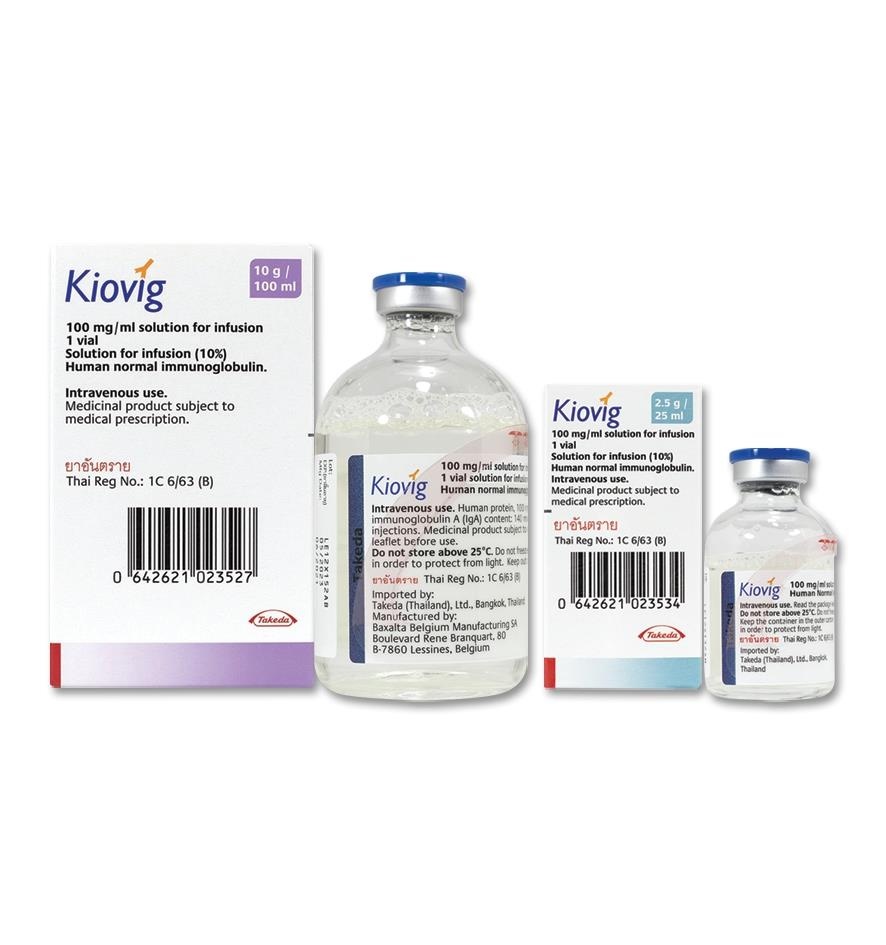
KIOVIG is an infusion solution contained in glass vials
of 10, 25, 50, 100, 200 or 300 ml. The solution is clear or slightly opalescent and colorless
or pale yellow.
Not all presentations may be marketed.
Marketing Authorisation Holder
Baxter AG
Industriestrasse 67
A-1221 Vienna
Austria
Tel.: +44(0)1256 894 959
E-mail: [email protected]
Manufacturer
Baxalta Belgium Manufacturing SA
Boulevard René Branquart, 80
B-7860 Lessines
Belgium
Baxter SA
Boulevard René Branquart 80
B-7860 Lessines
Belgium
Other sources of information
More detailed information on this medicine is available on the European Medicines Agency website: http://www.ema.europa.eu.
The following information is intended exclusively for healthcare professionals:
Method of administration
- KIOVIG must be administered exclusively intravenously. Other routes of administration have not been evaluated.
- KIOVIG must be infused intravenously at an initial rate of 0.5 ml/kg body weight/hour for 30 minutes. If well tolerated, the administration rate may be gradually increased to a maximum of 6 ml/kg body weight/hour. Clinical data from a limited number of patients confirm that adult patients with PID can tolerate an infusion rate of up to 8 ml/kg body weight/hour.
- If dilution to lower concentrations is necessary before infusion, KIOVIG may be diluted with 5% glucose solution to reach a final concentration of 50 mg/ml (5% immunoglobulin).
- Only adverse events related to the infusion should be treated by reducing the infusion rate or stopping the infusion.
Special precautions
- Any adverse event related to the infusion must be treated by reducing the infusion rate or stopping the infusion.
- It is recommended to record the name and batch number of the product whenever KIOVIG is administered.
Incompatibilities
The medicinal product must not be mixed with other medicines.
Special storage precautions
- After dilution to lower concentrations, the product is recommended to be used immediately. The stability of KIOVIG after dilution with 5% glucose solution to a final concentration of 50 mg/ml (5% immunoglobulin) has been demonstrated for 21 days at a temperature between 2° C and 8° C as well as between 28° C and 30° C, however these studies did not include microbial contamination and safety aspects.
Instructions for handling and disposal
- The product must be brought to room or body temperature before use.
- KIOVIG must be visually inspected for particulate matter or discoloration before administration. Only clear or slightly opalescent and colorless or pale yellow solutions should be administered. Do not use if particulate matter or discoloration is present.
- If dilution is necessary, a 5% glucose solution is recommended. To obtain a 50 mg/ml (5%) immunoglobulin solution, 100 mg/ml of
KIOVIG (10%) with an equal amount of glucose solution. It is recommended to minimize the risk of microbial contamination during dilution.
Any unused product or waste material must be disposed of in accordance with local regulations.
- Any unused product or waste material must be disposed of in accordance with local regulations.
Recommendations for dosage
| Indication | Dose | Infusion frequency |
| Replacement therapy in primary immunodeficiency syndromes | initial dose: 0.4 – 0.8 g/kg maintenance dose: 0.2 – 0.8 g/kg | m r a every 3 – 4 weeks to achieve (minimum) IgG levels of at least 5 – 6 g/l |
| Replacement therapy in secondary immunodeficiency syndromes | 0.2 – 0.4 g/kg l e | every 3 – 4 weeks to achieve minimum IgG levels of at least 5 – 6 g/l |
| Congenital AIDS | d 0.2 – 0.4 g/kg | every 3 – 4 weeks |
| Hypogammaglobulinemia (<4 g l) in patients following allogeneic hematopoietic stem cell transplantation< td> | 0.2 – 0.4 g/kg a | every 3 – 4 weeks to achieve minimum IgG levels greater than 5 g/l |
| Immunomodulation | n | |
| Primary immune thrombocytopenia | a 0.8 – 1 g/kg i l or a 0.4 g/kg/day | on day 1, possibly repeated once within 3 days for 2 – 5 days |
| t I Guillain Barré syndrome | 0.4 g/kg/day | for 5 days |
| a Kawasaki disease i | 2 g/kg | as a single dose in association with acetylsalicylic acid |
| z Chronic inflammatory demyelinating polyradiculoneuropathy (CIDP) n e | initial dose: 2 g/kg maintenance dose: 1 g/kg | in divided doses over 2-5 days every 3 weeks over 1- 2 days |
| Indication | Dose | Infusion frequency |
| Multifocal motor neuropathy (MMN) | initial dose: 2 g/kg maintenance dose: 1 g/kg o 2 g/kg | administered over 2 – o 5 days c every 2 – 4 weeks a or every 4 – 8 weeks over 2-5 days |
dì = day

Не уверены, подходит ли вам это лекарство?
Обсудите симптомы и варианты лечения с врачом онлайн.

Уже начали прием и появились вопросы?
Обсудите свое состояние и дальнейшие шаги с врачом онлайн.
- Страна регистрации
- Форма выпускаInfusion solution, 100 MG/ML
- Код АТХJ06BA02
- Действующее вещество
- Отпускается по рецептуДа
- Производитель
- Информация на этой странице носит справочный характер и не является медицинской консультацией. Перед началом приема лекарства обязательно проконсультируйтесь с врачом.
- Аналоги KIOVIGФорма выпуска: Infusion solution, 100 mg/mlДействующее вещество: immunoglobulins, normal human, for intravascular adm.Производитель: TAKEDA MANUFACTURING AUSTRIA AGОтпускается по рецептуФорма выпуска: Infusion solution, 50 MG/MLДействующее вещество: immunoglobulins, normal human, for intravascular adm.Производитель: INSTITUTO GRIFOLS S.A.Отпускается по рецептуФорма выпуска: Powder and solvent for intravenous infusion solution, 50 MG/MLДействующее вещество: immunoglobulins, normal human, for intravascular adm.Производитель: BAXALTA INNOVATIONS GMBHОтпускается по рецепту
Аналоги KIOVIG в других странах
Лекарства с тем же действующим веществом, доступные в других странах.
Аналог KIOVIG в Испания
Аналог KIOVIG в Польша
Аналог KIOVIG в Украина
Врачи онлайн по KIOVIG
Обсудите применение KIOVIG и возможные следующие шаги — по оценке врача.









Получите рецепт на KIOVIG онлайн
Заполните форму за 2 минуты
Расскажите о симптомах, истории болезни и нужном препарате.
Выберите врача или мы назначим
Выберите специалиста или мы подберём ближайшего доступного врача.
Врач рассматривает ваш случай
Обычно в течение 30 минут. Может задать уточняющие вопросы в чате.
Получите в любой аптеке
Электронный рецепт отправляется на вашу почту — действителен по всей Польше.
Часто задаваемые вопросы
KIOVIG требует рецепта в Италия. Вы можете уточнить у врача онлайн, подходит ли это лекарство для вашей ситуации.
Действующее вещество KIOVIG — immunoglobulins, normal human, for intravascular adm.. Эта информация помогает определить лекарства с тем же составом под другими торговыми названиями.
KIOVIG производится компанией TAKEDA MANUFACTURING AUSTRIA AG. Упаковка и торговое название могут отличаться в зависимости от дистрибьютора.
Врачи, включая Семейные врачи, Психиатры, Дерматологи, Кардиологи, Эндокринологи, Гастроэнтерологи, Пульмонологи, Нефрологи, Ревматологи, Гематологи, Инфекционисты, Аллергологи, Гериатры, Педиатры, Онкологи, могут оценить целесообразность применения KIOVIG с учетом вашей ситуации и местных правил. Вы можете записаться на онлайн-консультацию, чтобы обсудить возможные варианты.
Польша имеет хорошо развитую систему здравоохранения в крупных городах, таких как Варшава, Краков, Вроцлав и Гданьск. Аптеки широко доступны и работают в соответствии с действующим законодательством, обеспечивая доступ к рецептурным препаратам.
Вы можете купить KIOVIG в Варшаве, Кракове, Вроцлаве или Гданьске в любой аптеке при наличии действующего рецепта.
Чтобы получить рецепт, вы можете воспользоваться Oladoctor:
Другие лекарства с тем же действующим веществом (immunoglobulins, normal human, for intravascular adm.) включают DEQSIGA, FLEBOGAMMA DIF, GAMMAGARD. Они могут отличаться торговым названием или формой выпуска, но содержат одинаковый терапевтический компонент. Перед изменением лечения рекомендуется проконсультироваться с врачом.
