



IQYMUNE 100 mg /Ml Инфузионный Раствор

Рассмотрение рецепта онлайн
Врач рассмотрит ваш случай и примет решение о назначении рецепта, если это медицински оправдано.

Поговорите с врачом об этом лекарстве
Обсудите симптомы и возможные дальнейшие шаги на онлайн-консультации.



Инструкция по применению IQYMUNE
Содержание инструкции
IQYMUNE 100 mg/mL solution for infusion
Normal human immunoglobulin (IVIg)
Read this leaflet carefully before you use this medicine because it contains important
information for you.
- Keep this leaflet. You may need to read it again.
- If you have any questions, ask your doctor, pharmacist or nurse.
- This medicine has been prescribed only for you. Do not give it to other people, even if their symptoms are the same as yours, because it could be dangerous.
- If any side effects occur, including those not listed in this leaflet, tell your doctor, pharmacist or nurse. See section 4. Contents of this leaflet:
- 1. What IQYMUNE is and what it is used for
- 2. What you need to know before you use IQYMUNE
- 3. How to use IQYMUNE
- 4. Possible side effects
- 5. How to store IQYMUNE
- 6. Contents of the pack and other information
1. What is IQYMUNE and what is it used for
What is IQYMUNE
This medicine contains human antibodies, produced by our immune system. It belongs to the class of
medicines called immunoglobulins.
How does IQYMUNE work
- The human antibodies contained in this medicine allow the body to fight infections or to maintain the immune system in balance.
- If you do not have a sufficient amount of antibodies, those provided by the medicine can replace the missing antibodies. Since they have been isolated from human plasma, the antibodies of IQYMUNE act exactly as if they were your own antibodies.
- This type of medicine can also be used if your immune system is unbalanced and you need additional antibodies in some inflammatory diseases (autoimmune diseases). The medicine provides you with these antibodies What is IQYMUNE used forThis medicine is used for:
The treatment of patients who do not have sufficient antibodies (replacement therapy). There are two groups:
- 1. Patients with congenital deficiency in antibody synthesis (primary immunodeficiency syndromes).
- 2. Patients with acquired antibody deficiency (secondary immunodeficiency) due to specific diseases and/or treatments and subject to severe or recurrent infections
The treatment of patients with certain inflammatory diseases (immunomodulation). There are five
groups:
- 1. Patients who do not have enough platelets (immune thrombocytopenia, ITP) and who are at high risk of bleeding or who will undergo surgery soon.
- 2. Patients with a disease associated with multiple inflammations of the nerves throughout the body (Guillain Barré syndrome).
- 3. Patients with a disease that leads to multiple inflammations of different organs of the body (Kawasaki disease). IQYMUNE must be administered in association with acetylsalicylic acid.
- 4. Patients who suffer from an inflammation of the peripheral nerves that causes weakness and/or muscle numbness, mainly in the arms and legs (chronic inflammatory demyelinating polyneuropathy, CIDP).
- 5. Patients who suffer from a rare disease characterized by a slowly progressive and asymmetrical weakening of the arms and legs, without loss of sensation (multifocal motor neuropathy, MMN).
2. What you need to know before using IQYMUNE
Do not use IQYMUNE
- If you are allergic to immunoglobulins or any of the other ingredients of this medicine (listed in section 6).
- If you suffer from IgA immunoglobulin deficiency, you may have antibodies against IgA immunoglobulin in your blood. Because this medicine contains small amounts of IgA type immunoglobulin, an allergic reaction may occur.
Warnings and precautions
Talk to your doctor, pharmacist or nurse before using IQYMUNE.
Some adverse reactions may occur more frequently:
- in case of high infusion rate
- if you receive IQYMUNE for the first time or it has been a long time since the last infusion. In these cases, you will be closely monitored for up to 1 hour after the infusion to detect potential side effects.
To avoid the risk of a reaction, the doctor will check the infusion rate and adjust it
to suit you. During the infusion, the doctor will perform clinical monitoring to
identify any signs of allergy or other reactions.
Allergic reactions are rare. If an allergy develops, you will recognize its initial signs such as dizziness,
swelling of the face/legs, shortness of breath, skin rashes and/or itching. Immediately inform the doctor or
nurse if you notice such reactions during or after the IQYMUNE infusion.
Based on your adverse reaction, the doctor may decide to reduce the infusion rate or stop it.
They may also start treatment for the adverse event, if they deem it necessary. If you have any doubts, do not
hesitate to ask the doctor or nurse for advice.
Patients with pre-existing risk factors
In very rare cases, this medicine may cause or worsen kidney disease (acute renal failure),
heart and/or blood vessel disease (myocardial infarction, stroke, including cerebral infarction,
pulmonary embolism or deep vein thrombosis). Patients who already suffer from any disease or have
certain risk factors should be careful when using this medicine.
Tell the doctor about all the medicines you are taking and any illnesses you suffer from or have suffered from. The doctor will
subject you to careful monitoring:
- if you already have kidney disease (renal failure),
- if you are taking certain medicines that may be dangerous for the kidneys,
- if you have high blood sugar levels (diabetes),
- if the volume of blood in your body is insufficient (hypovolemia),
- if your weight is excessive (obesity),
- if you are over 65 years of age,
- if you already have heart or blood vessel disease,
- if you have high blood pressure (hypertension),
- if you are at risk of prolonged immobilization,
- if you suffer from a disease that causes an increase in blood viscosity (hyperviscosity).
White blood cells
A temporary reduction in the number of certain white blood cells (leukopenia/neutropenia) is common. Usually it occurs within hours or days of the infusion and resolves spontaneously within 7-14 days.
Before using this medicine, you must inform the doctor if you know:
- that you have a low number of white blood cells, or
- that you are taking a medicine that may reduce the number of white blood cells.
Aseptic meningitis syndrome
Cases of aseptic meningitis syndrome (reversible and non-infectious) have been reported in association with treatments with immunoglobulins, such as IQYMUNE. This generally begins within a period ranging from
several hours to two days after treatment and may manifest with the following symptoms: fever, headache,
stiff neck, nausea, vomiting.
If you experience these symptoms, inform your treating physician, who will perform a thorough neurological examination to
rule out other causes of meningitis.
Hemolytic anemia/hemolysis
Following therapy with immunoglobulins such as IQYMUNE, particularly if you have blood type A,
B or AB, hemolytic anemia (transient decrease in the number of red blood cells due to
their destruction) may develop. Reversible hemolytic anemia may be characterized by the following symptoms: pallor,
fatigue, weakness, yellowish discoloration of the skin or eyes, dark urine. If you are administered immunoglobulins such as IQYMUNE, you will be monitored for any signs
clinical and symptoms of hemolysis.
Transfusion-related acute lung injury (TRALI)
Rare cases of transfusion-related acute lung injury (TRALI) have been reported in patients receiving immunoglobulins such as IQYMUNE. This disorder is characterized by a decrease in the level of
oxygen in the body (hypoxemia), difficulty breathing (dyspnea), increased respiratory rate
(tachypnea), bluish discoloration of the skin (cyanosis), fever and decreased blood pressure (hypotension). The
symptoms of transfusion-related acute lung injury generally appear during the infusion of
immunoglobulins or within 6 hours afterwards, often within 1 or 2 hours. Consequently, if you observe such
reactions during the IQYMUNE infusion, immediately warn the doctor, who will decide whether to decrease
the infusion rate or stop it.
Viral safety information
When medicines are produced from human blood or plasma, a number of
safety measures are applied to prevent the transmission of infections to patients. These include:
- careful selection of plasma and blood donors, to ensure that potential carriers of infection are excluded,
- analysis of each donation and plasma pool to reveal the possible presence of viruses and infections,
- the inclusion of procedures during the processing of blood or plasma that can inactivate or remove viruses. Despite these measures, whenever medicines prepared from human blood or plasma are administered, the possibility of transmitting an infection cannot be completely excluded. This also applies to unknown or emerging viruses and other types of infections. The measures taken are considered effective for viruses such as the human immunodeficiency virus (HIV), hepatitis B virus, hepatitis C virus, hepatitis A virus and parvovirus B19. No association has been observed between immunoglobulins and hepatitis A or parvovirus B19 infections, probably because the antibodies against these infections contained in the product have a protective function. It is strongly recommended that, each time you are administered a dose of IQYMUNE, the name and batch number of the product are recorded to maintain documentation of the batches used. Children and adolescentsThere are no specific or additional warnings or precautions for children and adolescents. Other medicines and IQYMUNETell your doctor or pharmacist if you are taking, have recently taken or might take any other medicines. Effects on vaccines The use of immunoglobulins such as IQYMUNE may reduce the effectiveness of vaccines against measles, rubella, mumps and/or varicella for 3 months. It is recommended to allow a period of 3 months to pass between the last administration of immunoglobulins and the administration of these vaccines. For the measles vaccine, it may be necessary to wait 1 year after the last administration of immunoglobulins. Before getting vaccinated by the doctor, inform them that you are being treated with IQYMUNE. Loop diuretics Avoid concomitant use of loop diuretics with IQYMUNE.
Effects on blood tests
Some antibodies contained in IQYMUNE may invalidate the results of certain blood tests (serological tests).
If the doctor or the person taking your blood sample does not know that you have received
IQYMUNE, inform them before undergoing the blood test.
Pregnancy, breastfeeding and fertility
- If you are pregnant, suspect you are pregnant, are planning a pregnancy, or are breastfeeding, ask your doctor or pharmacist for advice before taking this medicine.
- Reproduction studies have not been conducted with IQYMUNE in animals and experience in pregnant women is limited. Although no adverse effects on the fetus have been reported, IQYMUNE should not be administered to pregnant women unless the need for treatment has been clearly established.
- The antibodies contained in IQYMUNE are excreted in breast milk and may help protect the baby from certain infections. Driving and operating machineryDuring treatment with IQYMUNE, patients may experience reactions (e.g. dizziness or nausea) that may affect their ability to drive vehicles or operate machinery. In such cases, do not drive or operate machinery until these effects have disappeared.
IQYMUNE contains sodium
This medicine contains less than 1 mmol (23 mg) of sodium per dose, i.e. essentially “sodium-free”.
3. How to use IQYMUNE
This medicine must be administered intravenously (infusion into a vein).
It is administered by the treating physician or a nurse.
The dose and frequency of the infusion depend on your general health status and body weight.
At the beginning of the infusion, IQYMUNE will be administered at a low rate. Depending on how you tolerate the
administration, the doctor may gradually increase the infusion rate.
Use in children and adolescents
The same indications, dose and infusion frequency used in adults apply to children and adolescents (age: 0-18 years).
If you use more IQYMUNE than you should
Since the medicine is usually administered under the supervision of a doctor, it is very
unlikely that an overdose will occur. However, if you receive more IQYMUNE than you should, your blood
may become too thick (hyperviscous). This can occur particularly if you are a risk patient, for
example if you are elderly or if you have heart or kidney problems. Make sure to drink enough fluids so as
not to become dehydrated and inform your doctor if you know you have medical problems.
4. Possible side effects
Like all medicines, IQYMUNE can cause side effects, although not everybody gets them.
Contact your doctor immediately if you experience any of the side effects listed below.
Depending on the type and severity of the reaction, your doctor will immediately stop treatment with
IQYMUNE and/or initiate appropriate treatment:
- Allergic reaction:skin rash, itching, hives, shortness of breath, low blood pressure, dizziness, wheezing (like asthma), fast heartbeat
- Swelling of the face, throat or mouthwith difficulty breathing
- Heart attack:chest pain or shortness of breath
- Stroke:sudden onset of muscle weakness, loss of sensation and/or balance, decreased alertness or difficulty speaking
- Blood clots in the lungs (Pulmonary embolism):chest pain, difficulty breathing or blood in sputum
- Thrombosis/blood clots:pain and swelling of the limbs, redness
- Acute transfusion-related acute lung injury (TRALI): difficulty breathing, shortness of breath, skin mottling, fever and low blood pressure
- Aseptic meningitis:severe headache, fever, stiff neck, nausea, vomiting, photosensitivity
- Hemolytic anemia:paleness, fatigue, weakness, yellowish skin or eyes, reddish-brown urine
- Severe kidney failure:dark-colored urine during or after the infusion, difficulty urinating and/or reduced urine output The following side effects have been reported during clinical studies with IQYMUNE (in decreasing order of frequency):The following adverse reactions are common (up to 1 in 10 infusions):
- reduced number of a type of white blood cells (neutropenia). See also “white blood cells” in
section 2.
- headache,
- high blood pressure (hypertension),
- fever, fatigue, chills.
The following adverse reactions are uncommon (up to 1 in 100 infusions):
- reduced number of other types of white blood cells (leukopenia, lymphopenia, monocytopenia),
- temporary decrease in the number of red blood cells (anemia),
- allergic reaction (anaphylactic reaction),
- dizziness (including feeling faint), migraine,
- stomach problems (nausea), vomiting, abdominal pain, oral pain,
- skin rash, itching, excessive sweating (hyperhidrosis), skin redness (erythema),
- back pain, joint pain, bone pain (arthralgia), limb pain, muscle pain (myalgia),
- reaction at the injection site, malaise, flu-like illness, swelling (peripheral edema),
- blood tests showing changes in kidney function (decreased creatinine clearance).
The following adverse reactions are rare (up to 1 in 1000 infusions):
- transient ischemic attack,
- inflammation of the membranes lining the brain and spinal cord (reversible aseptic meningitis),
- feeling of numbness (paresthesia),
- inflammation of the eyelids (allergic blepharitis), eye irritation,
- bluish discoloration of the skin (peripheral cyanosis), hot flashes,
- sore throat,
- loose stools (diarrhea),
- cramps (muscle spasms),
- feeling unwell,
- blood tests showing changes in kidney function (increased serum creatinine), increased body temperature, increased fibrin D-dimer,
- infusion-related reaction.
The following side effects have been reported spontaneously with IQYMUNE:
- anaphylactic shock,
- excessive breakdown of red blood cells (hemolytic anemia),
- thromboembolic events including stroke, heart attack (myocardial infarction), blood clot in the lung vessel (pulmonary embolism), blood clot in a deep vein (deep vein thrombosis),
- acute kidney injury.
Reporting of side effects
If you get any side effects, talk to your doctor, pharmacist or nurse. This includes any possible side effects not listed in this leaflet. You can also report side effects directly through the
national reporting system at: https://www.aifa.gov.it/content/segnalazioni-reazioni-avverse
By reporting side effects you can help provide more information on the safety of this medicine.
5. How to store IQYMUNE
Keep this medicine out of the sight and reach of children.
Do not use this medicine after the expiry date which is reported on the outer packaging and on the label of the
vial after Exp. The expiry date refers to the last day of that month.
Do not use this medicine if you notice that the solution is cloudy or contains suspended particles.
Do not store at a temperature above 25 °C. Do not freeze.
Keep the vial in the outer packaging to protect the medicine from light.
Do not dispose of any medicine in wastewater and/or household waste. Ask your pharmacist how to eliminate the
medicines that you no longer use. This will help protect the environment.
6. Contents of the pack and other information
What IQYMUNE contains
- The active substance of IQYMUNE is normal human immunoglobulin.
- 1 mL of IQYMUNE contains 100 mg of human proteins, of which at least 95% are immunoglobulin G.
- The other components are: glycine, polysorbate 80 and water for injections.
Description of the appearance of IQYMUNE and contents of the pack
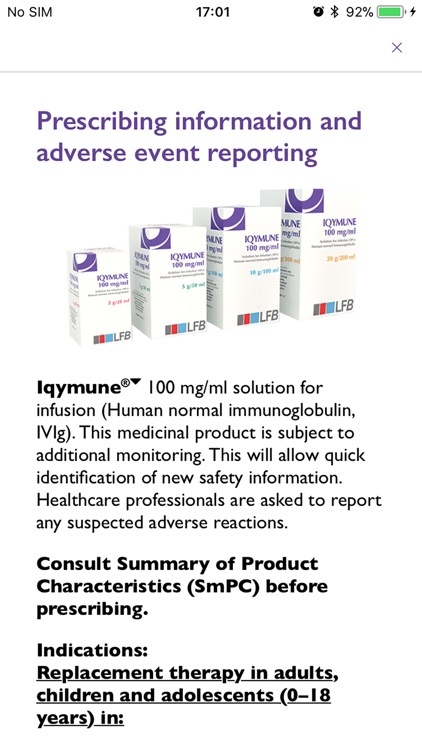
IQYMUNE is a solution for infusion in vials of 20 mL, 50 mL, 100 mL or 200 mL.
The solution is clear or slightly opalescent, colourless or light brown or light yellow.
Not all pack sizes may be marketed.
Marketing authorisation holder and manufacturer
Marketing authorisation holder:
Laboratoire Français du Fractionnement et des Biotechnologies
Tour W, 102 Terrasse Boieldieu 19ème Étage, 92800 Puteaux, FRANCE
Tel: + 33(0) 1 69 82 70 10
Manufacturer:
LFB BIOMEDICAMENTS
59 rue de Trévise
59000 Lille
FRANCE
Wholesale distributor:
BIOVIIIx srl
Via A. Manzoni, 1
- 80123 - Napoli ITALY This medicinal product is authorised in the Member States of the European Economic Area under the followingdenominations:Austria: IQYMUNE 100 mg/mL Infusionslösung Belgium and Netherlands: IQYMUNE 100 mg/mL oplossing voor infusie
Czech Republic: IQYMUNE 100 mg/ml infuzní roztok
Denmark: IQYMUNE 100 mg/mL infusionsvæske, opløsning
Finland: IQYMUNE 100 mg/mL infuusioneste, liuos
Germany: IQYMUNE
Greece: IQYMUNE 100 mg/mL διάλυμα για έγχυση
Hungary: IQYMUNE 100 mg/mL oldatos infúzió
Luxembourg: IQYMUNE 100 mg/mL solution pour perfusion
Spain: IQYMUNE 100 mg/mL solución para perfusión
Sweden: IQYMUNE 100 mg/mL infusionsvätska, lösning
The following information is intended exclusively for physicians or healthcare professionals:
Dosage
The recommended doses are summarised in the following table.
| Indication | Dose | Frequency of infusions |
| r Replacement therapy: | ||
| Primary immunodeficiency syndromes | Initial dose: 0.4-0.8 g/kg Maintenance dose: 0.2-0.8 g/kg | a F every 3-4 weeks |
| Secondary immunodeficiencies | l e 0.2-0.4 g/kg | every 3-4 weeks |
| d Immunomodulation: | ||
| Primary immune thrombocytopenia | a 0.8-1 g/kg n or 0.4 g/kg/day | day 1, possibly repeated once within 3 days for 2-5 days |
| Guillain Barré syndrome | a i 0.4 g/kg/day | for 5 days |
| a Kawasaki disease | l 2 g/kg | as a single dose in association with acetylsalicylic acid |
| t I Chronic inflammatory demyelinating polyneuropathy (CIDP) a | Dose initiale: 2 g/kg Maintenance dose: 1 g/kg | in fractions over 2-5 days every 3 weeks in fractions over 1-2 days |
| i z Multifocal motor neuropathy (MMN) n e g | Initial dose: 2 g/kg Maintenance dose: 1 g/kg or 2 g/kg | In fractions over 2-5 consecutive days every 2-4 weeks or every 4-8 weeks in fractions over 2-5 consecutive days |
Route of administration
For intravenous use only.
Normal human immunoglobulin must be administered intravenously at an initial rate
of 0.5 mL/kg/hour for 30 minutes. If well tolerated, the administration rate may be gradually
increased to a maximum of 6 mL/kg/hour.
Clinical data obtained on a limited number of patients with PID and ITP also indicate that adult and
paediatric patients can tolerate an infusion rate of up to 8 mL/kg/hour.
Special precautions
- Certain adverse reactions may be related to the infusion rate. The recommended infusion rate must be carefully observed. If adverse effects occur, the administration rate must be reduced or the infusion must be stopped. In patients at risk of acute renal failure or thromboembolic reactions, IQYMUNE must be administered at the minimum infusion rate and dose.
- It is strongly recommended that, whenever IQYMUNE is administered to a patient, the name and batch number of the product are recorded to maintain a link between the patient and the batch of the product. Incompatibilities In the absence of compatibility studies, this product must not be mixed with other medicinal products, or with any other IVIg product. Instructions for handling and disposal Before administration, the solution must be visually inspected. The solution must be clear or slightly opalescent and colourless, or light brown or light yellow. Do not use solutions that are cloudy or contain deposits. Unused medicinal product and waste derived from such medicinal product must be disposed of in accordance with local regulations.

Не уверены, подходит ли вам это лекарство?
Обсудите симптомы и варианты лечения с врачом онлайн.

Уже начали прием и появились вопросы?
Обсудите свое состояние и дальнейшие шаги с врачом онлайн.
- Страна регистрации
- Форма выпускаInfusion solution, 100 MG/ML
- Код АТХJ06BA02
- Действующее вещество
- Отпускается по рецептуДа
- Производитель
- Информация на этой странице носит справочный характер и не является медицинской консультацией. Перед началом приема лекарства обязательно проконсультируйтесь с врачом.
- Аналоги IQYMUNEФорма выпуска: Infusion solution, 100 mg/mlДействующее вещество: immunoglobulins, normal human, for intravascular adm.Производитель: TAKEDA MANUFACTURING AUSTRIA AGОтпускается по рецептуФорма выпуска: Infusion solution, 50 MG/MLДействующее вещество: immunoglobulins, normal human, for intravascular adm.Производитель: INSTITUTO GRIFOLS S.A.Отпускается по рецептуФорма выпуска: Powder and solvent for intravenous infusion solution, 50 MG/MLДействующее вещество: immunoglobulins, normal human, for intravascular adm.Производитель: BAXALTA INNOVATIONS GMBHОтпускается по рецепту
Аналоги IQYMUNE в других странах
Лекарства с тем же действующим веществом, доступные в других странах.
Аналог IQYMUNE в Испания
Аналог IQYMUNE в Польша
Аналог IQYMUNE в Украина
Врачи онлайн по IQYMUNE
Обсудите применение IQYMUNE и возможные следующие шаги — по оценке врача.









Получите рецепт на IQYMUNE онлайн
Заполните форму за 2 минуты
Расскажите о симптомах, истории болезни и нужном препарате.
Выберите врача или мы назначим
Выберите специалиста или мы подберём ближайшего доступного врача.
Врач рассматривает ваш случай
Обычно в течение 30 минут. Может задать уточняющие вопросы в чате.
Получите в любой аптеке
Электронный рецепт отправляется на вашу почту — действителен по всей Польше.
Часто задаваемые вопросы
IQYMUNE требует рецепта в Италия. Вы можете уточнить у врача онлайн, подходит ли это лекарство для вашей ситуации.
Действующее вещество IQYMUNE — immunoglobulins, normal human, for intravascular adm.. Эта информация помогает определить лекарства с тем же составом под другими торговыми названиями.
IQYMUNE производится компанией LABORATOIRE FRANCAIS DU FRACTIONNEMENT ET DES BIOTECHNOLOGIES. Упаковка и торговое название могут отличаться в зависимости от дистрибьютора.
Врачи, включая Семейные врачи, Психиатры, Дерматологи, Кардиологи, Эндокринологи, Гастроэнтерологи, Пульмонологи, Нефрологи, Ревматологи, Гематологи, Инфекционисты, Аллергологи, Гериатры, Педиатры, Онкологи, могут оценить целесообразность применения IQYMUNE с учетом вашей ситуации и местных правил. Вы можете записаться на онлайн-консультацию, чтобы обсудить возможные варианты.
Польша имеет хорошо развитую систему здравоохранения в крупных городах, таких как Варшава, Краков, Вроцлав и Гданьск. Аптеки широко доступны и работают в соответствии с действующим законодательством, обеспечивая доступ к рецептурным препаратам.
Вы можете купить IQYMUNE в Варшаве, Кракове, Вроцлаве или Гданьске в любой аптеке при наличии действующего рецепта.
Чтобы получить рецепт, вы можете воспользоваться Oladoctor:
Другие лекарства с тем же действующим веществом (immunoglobulins, normal human, for intravascular adm.) включают DEQSIGA, FLEBOGAMMA DIF, GAMMAGARD. Они могут отличаться торговым названием или формой выпуска, но содержат одинаковый терапевтический компонент. Перед изменением лечения рекомендуется проконсультироваться с врачом.
