



КЛИНИМИКС 1000 МЛ Раствор для инфузий

Рассмотрение рецепта онлайн
Врач рассмотрит ваш случай и примет решение о назначении рецепта, если это медицински оправдано.

Поговорите с врачом об этом лекарстве
Обсудите симптомы и возможные дальнейшие шаги на онлайн-консультации.



Инструкция по применению KLINIMIX
Содержание инструкции
- CLINIMIX N9G15E, solution for infusion
- What is CLINIMIX and why is it administered
- What you need to know before CLINIMIX is administered to you
- How CLINIMIX is administered
- Possible side effects
- How to store CLINIMIX
- Package contents and other information
- QUANTITATIVE COMPOSITION
- DOSAGE AND ADMINISTRATION
- SPECIAL WARNINGS AND PRECAUTIONS FOR USE
- INFORMAZIONI PRATICHE SU PREPARAZIONE E MANIPOLAZIONE
- SHELF LIFE
- CLINIMIX N9G20E, solution for infusion
- What is CLINIMIX and why is it administered
- What you need to know before CLINIMIX is administered to you
- How CLINIMIX is administered
- Possible side effects
- How to store CLINIMIX
- Package Contents and Other Information
- QUANTITATIVE COMPOSITION
- DOSAGE AND ADMINISTRATION
- SPECIAL WARNINGS AND PRECAUTIONS FOR USE
- INFORMAZIONI PRATICHE SU PREPARAZIONE E MANIPOLAZIONE
- SHELF LIFE
- CLINIMIX N12G20, solution for infusion
- What is CLINIMIX and why is it administered
- What you need to know before CLINIMIX is administered to you
- How CLINIMIX is administered
- Possible side effects
- How to store CLINIMIX
- Package Contents and Other Information
- QUANTITATIVE COMPOSITION
- DOSAGE AND METHOD OF ADMINISTRATION
- SPECIAL WARNINGS AND PRECAUTIONS FOR USE
- PRACTICAL INFORMATION ON PREPARATION AND HANDLING
- SHELF LIFE
- CLINIMIX N12G20E, solution for infusion
- What is CLINIMIX and why is it administered
- What you need to know before CLINIMIX is administered to you
- How CLINIMIX is administered
- Possible side effects
- How to store CLINIMIX
- Package contents and other information
- QUANTITATIVE COMPOSITION
- DOSAGE AND ADMINISTRATION
- SPECIAL WARNINGS AND PRECAUTIONS FOR USE
- PRACTICAL INFORMATION ON PREPARATION AND HANDLING
- SHELF LIFE
- CLINIMIX N14G30, solution for infusion
- What is CLINIMIX and why is it administered
- What you need to know before CLINIMIX is administered to you
- How CLINIMIX is administered
- Possible side effects
- How to store CLINIMIX
- Package contents and other information
- QUANTITATIVE COMPOSITION
- DOSAGE AND ADMINISTRATION
- SPECIAL WARNINGS AND PRECAUTIONS FOR USE
- PRACTICAL INFORMATION ON PREPARATION AND HANDLING
- SHELF LIFE
- CLINIMIX N14G30E, solution for infusion
- What is CLINIMIX and why is it administered
- What you need to know before CLINIMIX is administered to you
- How CLINIMIX is administered
- Possible side effects
- How to store CLINIMIX
- Contents of the pack and other information
- QUANTITATIVE COMPOSITION
- DOSAGE AND ADMINISTRATION
- SPECIAL WARNINGS AND PRECAUTIONS FOR USE
- INFORMAZIONI PRATICHE SU PREPARAZIONE E MANIPOLAZIONE
- SHELF LIFE
- CLINIMIX N17G35, solution for infusion
- What is CLINIMIX and why is it administered
- What you need to know before CLINIMIX is administered to you
- How CLINIMIX is administered
- Possible side effects
- How to store CLINIMIX
- Package Contents and Other Information
- QUANTITATIVE COMPOSITION
- DOSAGE AND ADMINISTRATION METHOD
- SPECIAL WARNINGS AND PRECAUTIONS FOR USE
- PRACTICAL INFORMATION ON PREPARATION AND HANDLING
- SHELF LIFE
- CLINIMIX N17G35E, infusion solution
- What is CLINIMIX and why is it administered
- What you need to know before CLINIMIX is administered to you
- How CLINIMIX is administered
- Possible side effects
- How to store CLINIMIX
- Package contents and other information
- QUANTITATIVE COMPOSITION
- DOSAGE AND ADMINISTRATION
- SPECIAL WARNINGS AND PRECAUTIONS FOR USE
- PRACTICAL INFORMATION ON PREPARATION AND HANDLING
- SHELF LIFE
Clinimix FI Apr 2021
CLINIMIX N9G15E, solution for infusion
Read this leaflet carefully before you are given this medicine, as it contains
important information for you.
- Keep this leaflet. You may need to read it again.
- If you have any questions, ask your doctor or nurse.
- If any side effect occurs, including any not listed in this leaflet, tell your doctor or nurse. See section 4.
Contents of this leaflet:
- 1. What CLINIMIX is and why it is given
- 2. What you need to know before CLINIMIX is given to you
- 3. How CLINIMIX is given
- 4. Possible side effects
- 5. How to store CLINIMIX
- 6. Contents of the pack and other information
1. What is CLINIMIX and why is it administered
CLINIMIX is an infusion solution. It is packaged in a two-compartment bag. One compartment
contains a solution of amino acids with electrolytes while the second contains a solution of glucose with
calcium chloride. The compartments are separated by a non-permanent membrane. Just before
administration, the contents of the two compartments are mixed by rolling the upper end of the
bag to activate the membranes.
CLINIMIX is administered to provide nutrition in adults and children via a tube into a vein, when
normal oral feeding is not suitable.
CLINIMIX must be administered exclusively under medical supervision.
2. What you need to know before CLINIMIX is administered to you
CLINIMIX must not be administered if:
- you are allergic to any of the ingredients of this medicine (listed in section 6).
- the use of certain amino acids creates problems for your body.
- you have too much sugar in your blood (severe hyperglycemia).
- your blood is excessively acidic (metabolic acidosis due to an excess of lactate).
- the levels of sodium, potassium, magnesium, calcium and/or phosphorus in your blood are too high (hypernatremia, hyperkalemia, hypermagnesemia, hypercalcemia and/or hyperphosphatemia).
- In children under 28 days of age, ceftriaxone must not be co-administered with intravenous solutions containing calcium due to the risk of particle formation.
In all cases, the doctor will decide whether you should receive this medicine based on factors such as age, weight and
clinical condition, together with the results of the tests performed.
Warnings and precautions
Talk to your doctor or nurse before CLINIMIX is administered to you.
If you develop any signs or symptoms of an allergic reaction such as fever, chills, skin rashes or
difficulty breathing, excessive sweating, nausea or headache, inform your doctor or nurse: the infusion
must be stopped immediately. The doctor will monitor your condition while you receive this medicine and
may change the dosage or give you nutrients in addition such as lipids, vitamins, electrolytes and trace elements
if they deem it appropriate.
Page 1 of 96
Clinimix FI Apr 2021
Some medicines and certain diseases can increase the risk of infection or sepsis (presence of bacteria in
the blood). The risk of infection or sepsis is particularly high when a tube (central venous catheter) is inserted into
a vein. The doctor will carefully examine you to identify any signs of infection. The risk of infection can
be reduced by using an "aseptic" ("germ-free") technique when placing and maintaining the catheter and when
preparing the nutritional formula.
CLINIMIX with electrolytes contains calcium. It must not be administered together with the antibiotic ceftriaxone due to
the risk of particle formation.
If you are severely malnourished, to the point of needing to receive nutrition intravenously, it is recommended to
start parenteral nutrition slowly and with caution.
The doctor will monitor your condition at the beginning of the infusion, especially if you have liver, kidney,
adrenal, heart or circulation problems. The doctor must also be informed of any serious condition regarding how
your body manages sugars, fats, proteins or salts (metabolic disorders). The infusion
must be stopped if signs of abnormalities develop, including venous irritation.
To verify the effectiveness and safety of administration, the doctor will perform clinical and laboratory tests
while you receive this medicine. If you receive this medicine for several weeks, your blood will be
examined regularly. In particular, in case of glucose intolerance, blood and urine glucose levels must be
regularly monitored, and if you are diabetic, the insulin dosage may be adjusted.
When used in children under 2 years of age, the solution (in bags and administration sets) must be protected from
exposure to light until the administration is completed.
Exposure of Clinimix to ambient light, especially after the addition of trace elements and/or vitamins,
generates peroxides and other degradation products that can be reduced by protecting it from exposure to
light.
Other medicines and CLINIMIX
Tell your doctor if you are taking or have recently taken, or might take any other medicines.
CLINIMIX with electrolytes contains calcium. It must not be given together with the antibiotic ceftriaxone due to
the risk of particle formation.
Due to its potassium content, CLINIMIX must be administered with caution in patients treated with
potassium-sparing diuretics (e.g. amiloride, spironolactone, triamterene), with angiotensin-converting enzyme (ACE) inhibitors, angiotensin II receptor antagonists, or the immunosuppressants
tacrolimus and cyclosporine in relation to the risk of hyperkalemia.
Pregnancy, breastfeeding and fertility
If you are pregnant, suspect you are pregnant, are planning to become pregnant or are breastfeeding, ask your doctor for advice before this medicine is administered to you.
3. How CLINIMIX is administered
Before administering the product, the non-permanent membrane between the two compartments must be broken and the contents of the two compartments must be mixed.
CLINIMIX can be given to adults and children.
It is a solution for infusion to be administered via a tube into a vein in your arm or into a large vein in your chest.
Page 2 of 96
Clinimix FI Apr 2021
When used in children under 2 years of age, the solution (in bags and administration sets) must be protected from light exposure until the administration is complete
(see section 2).
Dosage – adults and children
Your doctor will decide the amount to be administered to you and for how long. This will depend on age, weight and height, your clinical condition, daily fluid volume and your energy and nitrogen needs.
Take CLINIMIX following exactly the instructions of the doctor. If you have any doubts, consult your doctor.
The prescription may be continued for as long as necessary, depending on your clinical condition.
The infusion of a bag usually lasts between 8 and 24 hours.
If you are given too much CLINIMIX
If the dose given is too high or the infusion is too fast, it may increase the amount of blood in circulation or your blood may become too acidic. It is possible that the glucose content may increase the levels of glucose present in your blood and urine. Administering too large a volume can cause nausea, vomiting, chills and electrolyte imbalances; in such conditions the infusion must be stopped immediately.
In some severe cases, your doctor may temporarily subject you to renal dialysis to help your kidneys eliminate the excess product.
To prevent such events from occurring, your doctor will regularly monitor your condition and analyze your blood parameters.
If you have any doubts about the use of this product, please consult your doctor.
4. Possible side effects
Like all medicines, this medicine can cause side effects, although not everybody gets them.
If you notice any changes in the way you feel during or after treatment, tell your doctor or nurse promptly.
The tests your doctor will perform while you are receiving the medicine are intended to reduce the risk of
side effects.
In the event of the development of any abnormal sign or symptom of an allergic reaction such as blood pressure
excessively low or high, appearance of blue or red discoloration of the skin, heart rate too high,
difficulty breathing, nausea, vomiting, skin rashes, increased body temperature, excessive
sweating, chills and tremors, the infusion must be stopped immediately.
Other side effects have been observed, which occur with greater or lesser frequency:
- Anaphylaxis (serious allergic reaction that occurs rapidly and can be fatal).
- High concentrations of glucose, ammonia and nitrogen-containing compounds in the blood.
- Impairment of liver function, abnormal blood tests for liver function.
- Inflammation of the gallbladder, presence of gallstones in the gallbladder.
- Venous inflammation at the injection site, venous irritation, pain, irritation, heat, swelling.
- Presence of glucose in the urine.
- Diabetic coma.
- Formation of small particles that block the pulmonary blood vessels.
Reporting of side effects
Page 3 of 96
Clinimix FI Apr 2021
If you get any side effects, even those not listed in this leaflet, tell your doctor or
nurse. You can also report side effects directly through the national reporting system at:
https://www.aifa.gov.it/content/segnalazioni-reazioni-avverse
By reporting side effects you can help provide more information on the safety of this
medicine.
5. How to store CLINIMIX
Keep this medicine out of the sight and reach of children.
When used in children under 2 years of age, the solution (in bags and administration sets) must be protected from light exposure until the administration is completed
(see section 2).
This medicine must not be administered after the expiry date stated on the container and the outer packaging (MM/YYYY). The expiry date refers to the last day of that month.
Do not freeze.
Keep the container in the outer packaging.
Do not dispose of any medicine in wastewater or household waste. Ask your pharmacist how to dispose of medicines you no longer use. This will help protect the environment.
6. Package contents and other information
What CLINIMIX contains
The active ingredients for each bag of the reconstituted solution are:
The other components are:
- acetic acid, hydrochloric acid (for pH adjustment of the solution),
- water for injections. Page 4 of 96
| Active ingredients | n 1 l | 1,5 l | 2 l |
| L-alanine L-arginine Glycine l L-histidine a L-isoleucine L-leucine t L-lysine I (as lysine hydrochloride) L-methionine L-phenylalanine a L-proline i L-serine L-threonine z L-tryptophan L-tyrosine n L-valine Sodium acetate, 3H O and 2 Potassium dibasic phosphate Sodium chloride g Magnesium chloride, 6H O 2 Anhydrous glucose (as glucose monohydrate) Calcium chloride, 2H O 2 | a 5.70 g i 3.17 g 2.84 g 1.32 g 1.65 g 2.01 g 1.60 g (2.00 g) 1.10 g 1.54 g 1.87 g 1.38 g 1.16 g 0.50 g 0.11 g 1.60 g 2.16 g 2.61 g 1.12 g 0.51 g 75 g (83 g) 0.33 g | 8.54 g 4.75 g 4.25 g 1.98 g 2.48 g 3.02 g 2.39 g (2.99 g) 1.65 g 2.31 g 2.81 g 2.06 g 1.73 g 0.74 g 0.17 g 2.39 g 3.23 g 3.92 g 1.68 g 0.77 g 113 g (124 g) 0.50 g | 11.39 g 6.33 g 5.67 g 2.64 g 3.30 g 4.02 g 3.19 g (3.99 g) 2.20 g 3.08 g 3.74 g 2.75 g 2.31 g 0.99 g 0.22 g 3.19 g 4.31 g 5.22 g 2.24 g 1.02 g 150 g (165 g) 0.66 g |
Clinimix FI Apr 2021
Description of the appearance of CLINIMIX and contents of the pack
CLINIMIX is a solution for infusion packaged in a two-compartment bag, which is a bag made of
multi-layer plastic. The material of the inner (contact) layer of the bag is based on polymers (a mixture of
polyolefin copolymers) compatible with the constituents and authorized additives. Other layers are made of EVA
(poly(ethylene-vinyl acetate) and a copolyester.
Before reconstitution, the amino acid and glucose solutions are clear and colorless or slightly yellow.
After reconstitution the solution is still clear and colorless or slightly yellow.
To prevent contact with atmospheric oxygen, the bag is packaged in an outer shell with an oxygen
barrier, which contains an oxygen absorber sachet.
Pack sizes
1000 ml bag: carton with 8 bags
1000 ml: 1 bag
1500 ml bag: carton with 6 bags
1500 ml: 1 bag
2000 ml bag: carton with 4 bags
2000 ml: 1 bag
Not all pack sizes may be marketed.
Marketing authorization holder
For further information on CLINIMIX, contact the marketing authorization holder:
BAXTER S.p.A.
Via del Serafico 89 00142 ROMA
Manufacturers
Baxter S.A., Boulevard René Branquart, 80, 7860 Lessines, Belgium
This medicinal product is authorised in the Member States of the European Economic Area with the following
denominations:
CLINIMIX N9G15E, solution for infusion
In some countries it is registered with other denominations as described below:
Austria: Clinimix 3% G-E
---------------------------------------------------------------------------------------------------------------------------
Page 5 of 96
Clinimix FI Apr 2021
The following information is intended exclusively for healthcare professionals:
1. QUANTITATIVE COMPOSITION
After mixing the contents of the two compartments, the composition of the binary mixture, for all available formats for the bag ,is as follows:
2. DOSAGE AND ADMINISTRATION
Administer the product only after breaking the non-permanent membrane between the two compartments and mixing the contents of the two compartments.
Dosage and infusion rate
The dosage must be individualized based on the patient's nutritional / fluid needs, energy expenditure, clinical condition, body weight, and ability to metabolize the constituents of Clinimix, as well as any additional energy or protein administered orally / enterally. Furthermore, the daily requirement for fluids, nitrogen and energy continuously decreases with age.
In adults, the requirement ranges from 0.16 g of nitrogen/kg/day (approximately 1 g of amino acids/kg/day) to 0.32 g of nitrogen/kg/day (approximately 2 g of amino acids/kg/day).
In children, the requirement ranges from 0.16 g of nitrogen/kg/day (approximately 1.0 g of amino acids/kg/day) to 0.40 g of nitrogen/kg/day (approximately 2.5 g of amino acids/kg/day).
In adults and patients between 12 and 18 years of age, the caloric requirement ranges from 25 kcal/kg/day to 40 kcal/kg/day, depending on the patient's nutritional status and degree of catabolism. Patients under 12 years of age may have higher requirements.
Clinical situations may exist in which patients require amounts of nutrients that vary from the composition of Clinimix. In this situation, any adjustment of the volume (dose) must take into consideration the resulting effect that this will have on the dosage of all other nutritional components of Clinimix. The rate and volume of infusion must be determined by the consulting physician experienced in pediatric intravenous fluid therapy.
This product does not contain the amino acids cysteine and taurine, considered conditionally essential for neonates and infants.
This medicine is not recommended for premature and full-term newborns and for children under 2 years of age.
The infusion rate must be adjusted according to the dosage, characteristics of the infused solution, total volume to be infused in 24 hours and the duration of the infusion.
| 1 l | 1,5 l | c 2 l | |
| Nitrogen (g) Amino acids (g) Glucose(g) | 4.6 28 75 | 6.8 41 113 | a 9.1 55 150 |
| Total calories (kcal) Calories from glucose (kcal) | 410 300 | m 615 450 | 820 600 |
| Sodium (mmol) Potassium (mmol) Magnesium (mmol) Calcium (mmol) Acetate (mmol) Chlorides (mmol) Phosphates as HPO 2- (mmol) 4 | 35 30 2.5 2.3 50 40 15 | r 53 a 45 3.8 F 3.4 75 60 23 | 70 60 5.0 4.5 100 80 30 |
| pH Osmolarity (mOsm/l) | l 6 845 | ||
Page 6 of 96
Clinimix FI Apr 2021
The infusion time must be greater than 8 hours. Normally, the flow rate is gradually increased during the first hour, without exceeding 3 ml per kilogram of body weight per hour, and the maximum dose is 40 ml per kilogram of body weight per day.
Method of administration
When used in children under 2 years of age, the solution (in bags and administration sets) must be protected from light exposure until the administration is completed.
Route of administration
The choice of a central or peripheral vein depends on the final osmolarity of the mixture. The generally accepted limit for a peripheral infusion is about 800 mOsm/l but this varies considerably with age and the patient's general condition and the characteristics of the peripheral veins.
3. SPECIAL WARNINGS AND PRECAUTIONS FOR USE
WARNINGS
Reactions of hypersensitivity to the infusion, including hypotension, hypertension, peripheral cyanosis, tachycardia, dyspnea, vomiting, nausea, urticaria, skin rash, pruritus, erythema, hyperhidrosis, pyrexia and chills, have been reported with CLINIMIX formulations.
Anaphylaxis has been reported with other parenteral nutrition products.
Before initiating an intravenous infusion, accurate clinical monitoring is necessary. In case of signs or abnormal symptoms, e.g. hypersensitivity or infusion reaction, the latter must be immediately stopped.
Glucose-containing solutions must be used with caution, if at all, in patients with a known allergy to corn or its derivatives.
Pulmonary vascular precipitates have been reported in patients receiving parenteral nutrition. In some cases, the outcomes have been fatal. Excessive addition of calcium and phosphate increases the risk of calcium phosphate precipitate formation. Precipitates have been reported in solution even in the absence of phosphate salts. Precipitates have also been reported away from the in-line filter and suspected precipitate formation in vivo. In cases where signs of pulmonary distress occur, the infusion must be stopped and medical evaluation must be initiated. In addition to solution inspection, the infusion set and catheter must also be checked periodically for precipitates.
In patients over 28 days of age (including adults), ceftriaxone should not be administered simultaneously with intravenous solutions containing calcium, including CLINIMIX N9G15E, through the same infusion line (e.g. through a Y-connector).
If the same infusion line is used for sequential administration, the line must be thoroughly flushed with a compatible liquid between infusions.
Infection and sepsis can occur as a result of the use of intravenous catheters for the administration of parenteral formulations, inadequate catheter maintenance or contaminated solutions.
Immunosuppression and other factors such as hyperglycemia, malnutrition and/or their underlying disease state may predispose patients to infection complications.
Careful symptomatic and laboratory monitoring for fever/chills, leukocytosis, device-related technical complications and hyperglycemia can help to recognize infections early.
The occurrence of septic complications can be reduced by paying attention to adopting aseptic techniques in catheter placement and maintenance, as well as aseptic techniques in the preparation of the nutritional formula.
Page 7 of 96
Clinimix FI Apr 2021
Refeeding severely malnourished patients can cause refeeding syndrome, which is characterized by intracellular shifts of potassium, phosphorus and magnesium when the patient enters an anabolic phase. Thiamine deficiency and fluid retention can also develop. Careful monitoring and a slow increase in nutrient intake, as well as avoiding overfeeding, can prevent these complications.
Hypertonic solutions, if infused into a peripheral vein, can cause venous irritation. The choice of peripheral or central venous administration depends on the final osmolarity of the mixture to be infused.
The generally accepted osmolarity limit for peripheral vein administration is 800 mOsm/l, but can vary considerably depending on age, the subject's general condition and the characteristics of the peripheral veins.
Do not connect bags in series to avoid gas embolism due to any residual air contained in the primary bag.
PRECAUTIONS
Before starting the infusion, severe disturbances of water and electrolyte balance, severe fluid overload and severe metabolic disorders must be corrected.
Metabolic complications can occur if nutrient intake is not adapted to the patient's needs or if the metabolic value of a dietary component is not accurately assessed. Undesirable metabolic effects can result from the administration of insufficient or excessive nutrients or from the composition of a mixture unsuitable for a particular patient's needs.
Frequent clinical evaluations and laboratory tests are necessary for proper monitoring during administration. These must include electrolyte levels and tests of liver and kidney function.
Electrolyte requirements in patients treated with the solutions must be carefully determined and monitored, especially for solutions lacking electrolytes.
Glucose intolerance is a common metabolic complication in severely depleted patients. Hyperglycemia, glycosuria and hyperosmolar syndrome can occur following infusion of the products. Blood and urine glucose levels should be routinely monitored and, for diabetic patients, insulin dosage, if necessary, should be adjusted accordingly.
Use with caution in patients with renal insufficiency, especially in the presence of hyperkalemia, due to the risk of developing or worsening metabolic acidosis and azotemia, unless extrarenal removal of waste products is performed. In these patients, fluid status and electrolyte balance must be closely monitored. In cases of severe renal insufficiency, appropriately formulated amino acid solutions should be preferred.
Use CLINIMIX with caution in patients with adrenal insufficiency.
Avoid circulatory overload, especially in patients with pulmonary edema, insufficiency and/or heart failure. Fluid status must be closely monitored.
In patients with pre-existing liver disease or hepatic insufficiency, in addition to routine liver function tests, any symptoms of hyperammonemia should be monitored.
It is known that hepatobiliary disorders including cholestasis, hepatic steatosis, fibrosis and cirrhosis potentially leading to hepatic failure, as well as cholecystitis and cholelithiasis, can develop in some patients receiving parenteral nutrition. The etiology of these disorders is believed to be due to multiple factors and may differ between patients.
Patients showing abnormal laboratory parameters or other signs of hepatobiliary disorders should be immediately referred to a physician specializing in liver dysfunction who can identify triggering and contributing factors, as well as identify therapeutic and prophylactic interventions.
Page 8 of 96
Clinimix FI Apr 2021
An increase in blood ammonia and hyperammonemia can occur in patients receiving amino acid solutions. In some patients, this may indicate the presence of a congenital amino acid metabolism disorder (see section 4.3 of the SmPC) or hepatic insufficiency.
Blood ammonia should be measured frequently in neonates and children to detect hyperammonemia, which may indicate the presence of a congenital amino acid metabolism anomaly.
Hyperammonemia, depending on the severity and etiology, may require immediate intervention.
Too rapid infusion of amino acids can cause nausea, vomiting and chills. If these symptoms occur, stop the infusion immediately.
In general, use caution when choosing the dose for elderly patients, in order to take into account the higher frequency of decreased hepatic, renal or cardiac function and the presence of concomitant diseases or other drug therapies.
Paediatric population
- No studies have been conducted in the paediatric population.
- See above regarding monitoring of hyperammonemia in paediatric patients.
Exposure to light of parenteral nutrition solutions, especially after the addition of trace elements and/or vitamins, can cause the generation of peroxides and other degradation products. When used in children under 2 years of age, Clinimix must be protected from ambient light until the completion of administration.
4. INFORMAZIONI PRATICHE SU PREPARAZIONE E MANIPOLAZIONE
Attenzione: Somministrare il prodotto solo dopo la rottura della membrana di separazione e la miscelazione del
contenuto di entambi i compartimenti.


Strappare dall’alto per
aprire l’involucro esterno.
Strappare la parte
anteriore dell’involucro
esterno per mostrare la
sacca di CLINIMIX.
Gettare l’involucro
esterno e l’assorbitore di
ossigeno.
Collocare la sacca di
piatto, su una superficie
orizzontale e pulita e con
la maniglia rivolta verso
di sé.



Sollevare l’area
dell’occhiello di
sospensione per rimuovere
Mescolare la sacca
capovolgendola per circa
3 volte.
Appendere la sacca.
Staccare, con un
movimento rotatorio, la
Pagina 9 di 96
Clinimix FI Apr 2021
la soluzione dalla parte
superiore della sacca.
Arrotolare saldamente la
sacca, finché la membrana
di separazione non sia
completamente aperta
(circa per metà).
protezione dal punto di
somministrazione.
Collegare saldamente il
connettore dello spike.
Utilizzare solo se la soluzione è limpida, incolore o leggermente gialla e se la sacca non è danneggiata.
CLINIMIX deve essere a temperatura ambiente prima dell’uso.
L’attivazione di CLINIMIX può essere effettuata nell’involucro esterno o dopo la sua rimozione.
Solo per uso singolo.
Non conservare eventuali residui inutilizzati e gettare tutti i dispositivi dopo l’uso.
Non riconnettere sacche parzialmente utilizzate.
Non utilizzare in collegamenti in serie.
Quando impiegato in bambini di età inferiore a 2 anni, proteggere dall’esposizione alla luce fino al
completamento della somministrazione. L’esposizione di Clinimix alla luce ambientale, specialmente dopo
l’aggiunta di oligoelementi e/o vitamine, genera perossidi e altri prodotti di degradazione che possono essere
ridotti con la protezione dall’esposizione alla luce.
Integrazione
Lipidi, vitamine ed oligoelementi devono essere somministrati a pazienti sottoposti a nutrizione parenterale
prolungata.
Se sono necessarie integrazioni, verificarne le compatibilità e controllare la stabilità delle miscele.
L’integrazione può essere effettuata dopo aver rotto la membrana di separazione (dopo che le due soluzioni sono
state miscelate) per tutti gli altri additivi. CLINIMIX può essere integrato con:
- Emulsioni lipidiche (per esempio ClinOleic) in un quantitativo da 50 a 250 ml per litro di CLINIMIX
| l CLINIMIX N9G15E a 1 l + 100 ml di lipidi al 20% | CLINIMIX N9G15E 1,5 l + 100 ml di lipidi al 20% | CLINIMIX N9G15E 2 l + 250 ml di lipidi al 20% | |
| Azoto (g) Amminoacidi (g) Glucosio (g) Lipidi (g) | t 4,6 I 28 75 20 | 6,8 41 113 20 | 9,1 55 150 50 |
| Calorie totali (kcal) Calorie da glucosio (kcal) Calorie da lipidi (kcal) Rapporto glucosio/lipidi | a 610 i 300 z 200 60/40 | 815 450 200 69/31 | 1320 600 500 55/45 |
| Sodio (mmol) Potassio (mmol) e Magnesio (mmol) g Calcio (mmol) Acetato (mmol) A Cloruri (mmol) Fosfati come HPO 2- 4 (mmol) | n 35 30 2,5 2,3 50 40 15 | 53 45 3,8 3,4 75 60 23 | 70 60 5,0 4,5 100 80 30 |
| pH Osmolarità (mOsm/l) | 6 795 | 6 810 | 6 785 |
Pagina 10 di 96
Clinimix FI Apr 2021
- Elettroliti: per litro di CLINIMIX
- Oligoelementi: per litro di CLINIMIX
- Vitamine: per litro di CLINIMIX
I dati di stabilità in seguito a miscelazione di CLINIMIX con altre emulsioni lipidiche in commercio ed altri
additivi o nutrienti sono disponibili su richiesta.
Se si osserva una leggera opalescenza, mescolare accuratamente la miscela, agitando delicatamente, in modo da
ottenere una emulsione omogenea prima dell’infusione.
Le eventuali aggiunte devono essere effettuate in condizioni asettiche.
Le aggiunte devono essere fatte con una siringa o mediante un set di trasferimento.
- Aggiunta con una siringa o set di trasferimento con ago
- Preparare il punto d’iniezione (il punto d’accesso singolo, vedere la figura 1 nell’RCP).
- Perforare la membrana ed iniettare.
- Miscelare la soluzione e gli additivi.
- Aggiunta mediante set di trasferimento munito di punta
- Fare riferimento alle “Istruzioni per l’uso” del set di trasferimento per lipidi utilizzato.
- Connettere la punta al sito di accesso ai lipidi (punto d’accesso più lungo).
Incompatibilità
Alcune integrazioni possono essere incompatibili, fare riferimento al produttore per maggiori dettagli.
Se le integrazioni si rendono necessarie, la compatibilità e la stabilità delle miscele finali devono essere
controllate.
La soluzione non deve essere somministrata prima, contemporaneamente o dopo una infusione di sangue tramite
lo stesso set d’infusione per la possibilità di pseudoagglutinazione.
CLINIMIX N9G15E contiene ioni calcio che aumentano il rischio della formazione di precipitati coagulati nel
sangue o componenti del sangue trattati con citrato come anticoagulante/conservante.
| Sodio | Potassio | Magnesio | Calcio | |
| Fino ad una concentrazione finale di | 80 mmol | 60 mmol | 5,6 mmol | o 3,0 mmol |
| Fino ad una concentrazione finale di | Rame | 10 mol | Zinco | 77 mol |
| Cromo | 0,14 mol | Manganese | 2,5 mol | |
| Fluoro | 38 mol | Cobalto | m 0,0125 mol | |
| Selenio | 0,44 mol | Molibdeno | 0,13 mol | |
| Iodio | 0,5 mol | r Ferro | 10 mol |
| Fino ad una concentrazione finale di | Vitamina A | 1750 U.I. | Biotina | 35g |
| Vitamina B6 | 2,27 mg | Vitamina B1 | 1,76 mg | |
| Vitamina D | 110 U.I. | l Acido folico | 207g | |
| Vitamina B12 | e 3,0 g | Vitamina B2 | 2,07 mg | |
| Vitamina E | 5,1 mg | Vitamina C | 63 mg | |
| Vitamina PP | d 23 mg | Vitamina B5 | 8,63 mg | |
| Vitamina K | 75g |
Pagina 11 di 96
Clinimix FI Apr 2021
Come per altre miscele per nutrizione parenterale, devono essere considerati i rapporti tra calcio e fosfato. Una
aggiunta eccessiva di calcio e fosfato, specialmente sotto forma di sali minerali, può portare alla formazione di
precipitati di fosfato di calcio.
Come per altre soluzioni per infusione contenenti calcio, il trattamento concomitante di ceftriaxone e CLINIMIX
N9G15E è controindicato nei neonati (≤28 giorni di età), anche in caso di infusione con linee separate (vi è il
rischio di precipitazione fatale del sale di calcio ceftriaxone nel flusso sanguigno del neonato).
In pazienti con età superiore ai 28 giorni (inclusi gli adulti) ceftriaxone non deve essere somministrato
simultaneamente per via endovenosa con soluzioni contenenti calcio, incluso CLINIMIX N9G15E tramite la
stessa linea di infusione (vedere il paragrafo “Avvertenze”)
Se viene utilizzata la stessa linea di infusione per somministrazioni susseguenti, la linea deve essere lavata
internamente con un fluido compatibile tra le infusioni.
5. SHELF LIFE
2 years if stored in the outer packaging.
It is recommended to use the product immediately after opening the non-permanent separating membrane between the two compartments. However, once reconstituted (internal non-permanent separating membrane opened), the reconstituted emulsion has been shown to be stable at a temperature between 2°C and 8°C for a maximum of 7 days, followed by a maximum of 48 hours at temperatures not exceeding 25°C.
Once supplements have been made, from a microbiological point of view, the mixture must be used immediately. If not used immediately, the storage times and conditions before use are the responsibility of the user and should not exceed 24 hours between 2 and 8 °C, unless the mixtures have been carried out in a controlled area and under validated aseptic conditions. If longer storage times are required in exceptional circumstances, the manufacturer can be contacted as information relating to chemical and physical stability in use for 7 days at a temperature between 2 and 8 °C followed by 48 hours at a temperature below 25 C is available for the products listed in the previous paragraph.
CLINIMIX N9G20E, solution for infusion
Read this leaflet carefully before you are given this medicine, as it contains
important information for you.
- Keep this leaflet. You may need to read it again.
- If you have any questions, ask your doctor or nurse.
- If you experience any side effects, including those not listed in this leaflet, ask your doctor or nurse. See section 4.
Contents of this leaflet:
- 1. What CLINIMIX is and why it is given
- 2. What you need to know before CLINIMIX is given to you
- 3. How CLINIMIX is given
- 4. Possible side effects
- 5. How to store CLINIMIX
- 6. Contents of the pack and other information
1. What is CLINIMIX and why is it administered
CLINIMIX is an infusion solution. It is packaged in a two-compartment bag. One compartment
contains a solution of amino acids with electrolytes while the second contains a solution of glucose with
calcium chloride. The compartments are separated by a non-permanent membrane. Just before
Page 12 of 96
Clinimix FI Apr 2021
administration, the contents of the two compartments are mixed by rolling the upper end of the
bag to activate the membranes.
CLINIMIX is administered to provide nutrition in adults and children via a tube into a vein, when
normal oral feeding is not suitable.
CLINIMIX must be administered exclusively under medical supervision.
2. What you need to know before CLINIMIX is administered to you
CLINIMIX must not be administered if:
- you are allergic to any of the ingredients of this medicine (listed in section 6).
- the use of certain amino acids causes problems for your body.
- you have too much sugar in your blood (severe hyperglycemia).
- your blood is excessively acidic (metabolic acidosis due to an excess of lactate).
- the levels of sodium, potassium, magnesium, calcium and/or phosphorus in your blood are too high (hypernatremia, hyperkalemia, hypermagnesemia, hypercalcemia and/or hyperphosphatemia).
- In children under 28 days of age, ceftriaxone must not be co-administered with intravenous solutions containing calcium due to the risk of particle formation.
In all cases, the doctor will decide whether you should receive this medicine based on factors such as age, weight and
clinical condition, together with the results of the tests performed.
Warnings and precautions
Talk to your doctor or nurse before CLINIMIX is administered to you.
If any signs or symptoms of an allergic reaction such as fever, chills, skin rashes or
difficulty breathing, excessive sweating, nausea or headache develop, inform your doctor or nurse: the infusion
must be stopped immediately. The doctor will monitor your condition while you receive this medicine and
may change the dosage or give you nutrients in addition, such as lipids, vitamins, electrolytes and trace elements
if they deem it appropriate.
Some medications and certain diseases can increase the risk of infection or sepsis (presence of bacteria in
the blood). The risk of infection or sepsis is particularly high when a tube (central venous catheter) is inserted into
a vein. The doctor will carefully examine you to identify any signs of infection. The risk of infection can
be reduced by using an "aseptic" ("germ-free") technique when placing and maintaining the catheter and when
preparing the nutritional formula.
CLINIMIX with electrolytes contains calcium. It must not be administered together with the antibiotic ceftriaxone due to
the risk of particle formation.
If you are severely malnourished, to the point of needing to receive nutrition intravenously, it is recommended to
start parenteral nutrition slowly and with caution.
The doctor will monitor your condition at the beginning of the infusion, especially if you have liver, kidney,
adrenal, heart or circulatory problems. The doctor must also be informed of any serious condition regarding how your body manages sugars, fats, proteins or salts (metabolic disorders). The infusion
must be stopped if any abnormal signs develop, including venous irritation.
To verify the effectiveness and safety of administration, the doctor will perform clinical and laboratory tests
while you receive this medicine. If you receive this medicine for several weeks, your blood will be
examined regularly. In particular, in case of glucose intolerance, blood and urine glucose must be regularly monitored, and if you are diabetic, the insulin dosage may be modified.
When used in children under 2 years of age, the solution (in bags and administration sets) must be protected from exposure to light until the administration is completed.
Exposure of Clinimix to ambient light, especially after the addition of trace elements and/or vitamins,
Page 13 of 96
Clinimix FI Apr 2021
generates peroxides and other degradation products that can be reduced by protecting it from exposure to
light.
Other medicines and CLINIMIX
Tell your doctor if you are taking or using, have recently taken or used, or might take or
use any other medicine.
CLINIMIX with electrolytes contains calcium. It must not be given together with the antibiotic ceftriaxone due to
the risk of particle formation.
Due to its potassium content, CLINIMIX must be administered with caution in patients treated with
potassium-sparing diuretics (e.g. amiloride, spironolactone, triamterene), with angiotensin-converting enzyme (ACE) inhibitors, angiotensin II receptor antagonists, or the immunosuppressants
tacrolimus and cyclosporine in relation to the risk of hyperkalemia.
Pregnancy, breastfeeding and fertility
If you are pregnant, suspect you are pregnant, are planning to become pregnant or are breastfeeding with breast milk
ask your doctor for advice before this medicine is administered to you.
3. How CLINIMIX is administered
Before administering the product, the non-permanent membrane between the two compartments must be broken and the contents of the two compartments must be mixed.
CLINIMIX can be given to adults and children.
It is a solution for infusion to be administered via a tube into a vein in your arm or into a large vein in your chest.
When used in children under 2 years of age, the solution (in the bags and administration sets) must be protected from light exposure until the administration is complete
(see section 2).
Dosage – adults and children
Your doctor will decide the amount to be administered to you and for how long. This will depend on age, weight and height, your clinical condition, daily fluid volume and your energy and nitrogen needs.
Take CLINIMIX following your doctor's instructions exactly. If you have any doubts, consult your doctor.
The prescription may be continued for as long as necessary, depending on your clinical condition.
The infusion of a bag usually lasts between 8 and 24 hours.
If you are given too much CLINIMIX
If the dose given is too high or the infusion is too fast, it may increase the amount of blood in circulation or your blood may become too acidic. It is possible that the glucose content may increase the levels of glucose present in your blood and urine. Administration of too large a volume may cause nausea, vomiting, chills and electrolyte imbalances; in such conditions the infusion must be stopped immediately.
In some severe cases, your doctor may temporarily subject you to renal dialysis to help your kidneys eliminate the excess product.
To prevent such events from occurring, your doctor will regularly monitor your condition and analyze your blood parameters.
Page 14 of 96
Clinimix FI Apr 2021
If you have any doubts about the use of this product, ask your doctor.
4. Possible side effects
Like all medicines, this medicine can cause side effects, although not everybody gets them.
If you notice any changes in the way you feel during or after treatment, tell your doctor or nurse promptly.
The tests your doctor will perform while you are receiving the medicine are intended to reduce the risk of
side effects.
In case of development of any abnormal sign or symptom of an allergic reaction such as blood pressure
excessively low or high, appearance of blue or red discoloration of the skin, heart rate too high,
difficulty breathing, nausea, vomiting, skin rashes, increased body temperature, excessive
sweating, chills and tremors, the infusion must be stopped immediately.
Other side effects have been observed, which occur with greater or lesser frequency:
- Anaphylaxis (serious allergic reaction that occurs rapidly and can be fatal).
- High concentrations of glucose, ammonia and nitrogen-containing compounds in the blood.
- Impaired liver function, abnormal blood tests for liver function.
- Inflammation of the gallbladder, presence of gallstones in the gallbladder.
- Venous inflammation at the injection site, venous irritation, pain, irritation, heat, swelling.
- Presence of glucose in the urine.
- Diabetic coma.
- Formation of small particles that block the pulmonary blood vessels.
Reporting of side effects
If you get any side effects, even if not listed in this leaflet, tell your doctor or
nurse. You can also report side effects directly through the national reporting system at
https://www.aifa.gov.it/content/segnalazioni-reazioni-avverse
By reporting side effects you can help provide more information on the safety of this
medicine.
5. How to store CLINIMIX
Keep this medicine out of the sight and reach of children.
When used in children under 2 years of age, the solution (in bags and administration sets) must be protected from light exposure until the administration is completed
(see section 2).
This medicine must not be administered after the expiry date stated on the container and the outer packaging (MM/YYYY). The expiry date refers to the last day of that month.
Do not freeze.
Keep the container in the outer packaging.
Do not dispose of any medicine in wastewater or household waste. Ask your pharmacist how to dispose of medicines you no longer use. This will help protect the environment.
6. Package Contents and Other Information
Page 15 of 96
Clinimix FI Apr 2021
What CLINIMIX contains
The active ingredients for each bag of the reconstituted solution are:
The other ingredients are:
- acetic acid, hydrochloric acid (for pH adjustment of the solution),
- water for injections.
Description of the appearance of CLINIMIX and contents of the pack
CLINIMIX is a solution for infusion packaged in a two-compartment bag, which is a bag made of
multi-layer plastic. The material of the inner (contact) layer of the bag is based on polymers (a mixture of
polyolefin copolymers) compatible with the constituents and authorised additives. Other layers are made of EVA
(poly(ethylene-vinyl acetate) and a copolyester.
Before reconstitution, the amino acid and glucose solutions are clear and colourless or slightly yellow.
After reconstitution the solution is still clear and colourless or slightly yellow.
To prevent contact with atmospheric oxygen, the bag is packaged in an outer package with an oxygen
barrier, which contains an oxygen absorber sachet.
Pack sizes
1000 ml bag: box with 8 bags
1000 ml: 1 bag
1500 ml bag: box with 6 bags
1500 ml: 1 bag
2000 ml bag: box with 4 bags
2000 ml: 1 bag
It is possible that not all pack sizes are marketed.
Marketing Authorisation Holder
Page 16 of 96
| Active ingredients | 1 l | 1.5 l | or 2 l |
| L-alanine L-arginine Glycine L-histidine L-isoleucine L-leucine L-lysine (as lysine hydrochloride) L-methionine L-phenylalanine L-proline L-serine L-threonine L-tryptophan L-tyrosine L-valine Sodium acetate, 3H O 2 Potassium dibasic phosphate Sodium chloride Magnesium chloride, 6H O 2 Glucose anhydrous (as glucose monohydrate) Calcium chloride, 2H O 2 | 5.70 g 3.17 g 2.84 g 1.32 g 1.65 g 2.01 g 1.60 g (2.00 g) 1.10 g 1.54 g 1.87 g 1.38 g 1.16 g 0.50 g 0.11 g and 1.60 g 2.16 g d 2.61 g 1.12 g 0.51 g a 100 g (110 g) 0.33 g | 8.54 g 4.75 g 4.25 g 1.98 g m 2.48 g 3.02 g 2.39 g r (2.99 g) a 1.65 g 2.31 g F 2.81 g 2.06 g 1.73 g 0.74 g l 0.17 g 2.39 g 3.23 g 3.92 g 1.68 g 0.77 g 150 g (165 g) 0.50 g | c 11.39 g 6.33 g a 5.67 g 2.64 g 3.30 g 4.02 g 3.19 g (3.99 g) 2.20 g 3.08 g 3.74 g 2.75 g 2.31 g 0.99 g 0.22 g 3.19 g 4.31 g 5.22 g 2.24 g 1.02 g 200 g (220 g) 0.66 g |
Clinimix FI Apr 2021
For further information on CLINIMIX, contact the marketing authorisation holder:
BAXTER S.p.A.
Via del Serafico 89 00142 ROMA
Manufacturers
Baxter S.A., Boulevard René Branquart, 80, 7860 Lessines, Belgium
This medicinal product is authorised in the Member States of the European Economic Area with the following
names:
CLINIMIX N9G20E, solution for infusion
---------------------------------------------------------------------------------------------------------------------------
Page 17 of 96
Clinimix FI Apr 2021
The following information is intended exclusively for healthcare professionals:
1. QUANTITATIVE COMPOSITION
After mixing the contents of the two compartments, the composition of the binary mixture, for all available formats for the bag ,is as follows:
2. DOSAGE AND ADMINISTRATION
Administer the product only after breaking the non-permanent membrane between the two compartments and mixing the contents of the two compartments.
Dosage and infusion rate
.
The dosage must be individualized based on the patient's nutritional / fluid needs, energy expenditure, clinical status, body weight, and ability to metabolize the constituents of Clinimix, as well as any additional energy or protein administered orally / enterally. Furthermore, the daily requirement for fluids, nitrogen and energy continuously decreases with age.
In adults, the requirement ranges from 0.16 g of nitrogen/kg/day (approximately 1 g of amino acids/kg/day) to 0.32 g of nitrogen/kg/day (approximately 2 g of amino acids/kg/day).
In children, the requirement ranges from 0.16 g of nitrogen/kg/day (approximately 1.0 g of amino acids/kg/day) to 0.40 g of nitrogen/kg/day (approximately 2.5 g of amino acids/kg/day).
In adults and patients between the ages of 12 and 18 years, the caloric requirement ranges from 25 kcal/kg/day to 40 kcal/kg/day, depending on the patient's nutritional status and degree of catabolism. Patients under 12 years of age may have higher requirements.
Clinical situations may exist where patients require nutrient amounts that vary from the composition of Clinimix. In this situation, any adjustment of the volume (dose) must take into consideration the resulting effect that it will have on the dosage of all other nutritional components of Clinimix. The rate and volume of infusion must be determined by the consulting physician experienced in pediatric intravenous fluid therapy.
This product does not contain the amino acids cysteine and taurine, considered conditionally essential for neonates and infants.
This medicine is not recommended for premature and full-term newborns and for children under 2 years of age.
The infusion rate must be adjusted according to the dosage, the characteristics of the infused solution, the total volume to be infused in 24 hours, and the duration of the infusion.
Page 18 of 96
| 1 l | 1,5 l | 2 l | |
| Nitrogen (g) Amino acids (g) Glucose (g) | 4.6 28 100 | 6.8 41 150 | 9.1 55 200 |
| Total calories (kcal) Calories from glucose (kcal) | 510 400 | 765 600 | 1020 800 |
| Sodium (mmol) Potassium (mmol) Magnesium (mmol) Calcium (mmol) Acetate (mmol) Chlorides (mmol) Phosphates as HPO 2- (mmol) 4 | 35 30 2.5 2.3 50 40 15 | 53 45 3.8 3.4 75 60 23 | 70 60 5.0 4.5 100 80 30 |
| pH Osmolarity (mOsm/l) | 6 980 | ||
Clinimix FI Apr 2021
The infusion time must be greater than 8 hours. Normally, the flow rate is gradually increased during the first hour, without exceeding 2.5 ml per kilogram of body weight per hour, and the maximum dose is 40 ml per kilogram of body weight per day.
Method of administration
When used in children under 2 years of age, the solution (in bags and administration sets) must be protected from light exposure until administration is complete.
Route of administration
The choice of a central or peripheral vein depends on the final osmolarity of the mixture. The generally accepted limit for a peripheral infusion is approximately 800 mOsm/l but this varies considerably with age and the patient's general condition and the characteristics of the peripheral veins.
3. SPECIAL WARNINGS AND PRECAUTIONS FOR USE
WARNINGS
Hypersensitivity reactions to infusion, including hypotension, hypertension, peripheral cyanosis, tachycardia, dyspnea, vomiting, nausea, urticaria, rash, pruritus, erythema, hyperhidrosis, pyrexia and chills, have been reported with CLINIMIX formulations.
Anaphylaxis has been reported with other parenteral nutrition products.
Before initiating an intravenous infusion, accurate clinical monitoring is necessary. In case of signs or symptoms of abnormality, e.g. hypersensitivity or infusion reaction, the latter must be immediately discontinued.
Glucose-containing solutions must be used with caution, if at all, in patients with a known allergy to corn or its derivatives.
Pulmonary vascular precipitates have been reported in patients receiving parenteral nutrition. In some cases, the outcomes have been fatal. Excessive addition of calcium and phosphate increases the risk of calcium phosphate precipitate formation. Precipitates have been reported in solution even in the absence of phosphate salts. Precipitates have also been reported distally from the in-line filter and suspected precipitate formation in vivo. In cases where signs of pulmonary distress occur, the infusion must be stopped and medical evaluation must be initiated. In addition to solution inspection, the infusion set and catheter must also be periodically checked for precipitates.
In patients over 28 days of age (including adults), ceftriaxone must not be administered simultaneously with intravenous solutions containing calcium, including CLINIMIX N9G20E, through the same infusion line (e.g. via a Y-connector).
If the same infusion line is used for sequential administration, the line must be flushed thoroughly with a compatible fluid between infusions.
Infection and sepsis can occur as a result of the use of intravenous catheters for the administration of parenteral formulations, inadequate catheter maintenance, or contaminated solutions.
Immunosuppression and other factors such as hyperglycemia, malnutrition and/or their underlying disease state may predispose patients to infection complications.
Careful symptomatic and laboratory monitoring for fever/chills, leukocytosis, device access complications and hyperglycemia can help to recognize infections early.
The occurrence of septic complications can be reduced by increasing attention to adopting aseptic techniques in catheter placement and maintenance, as well as aseptic techniques in the preparation of the nutritional formula.
Page 19 of 96
Clinimix FI Apr 2021
Refeeding severely malnourished patients can cause refeeding syndrome, which is characterized by intracellular shifts of potassium, phosphorus and magnesium when the patient enters an anabolic phase. Thiamine deficiency and fluid retention may also develop. Careful monitoring and a slow increase in nutrient intake, as well as avoiding overfeeding, can prevent these complications.
Hypertonic solutions, if infused into a peripheral vein, can cause venous irritation. The choice of peripheral or central administration depends on the final osmolarity of the mixture to be infused.
The generally accepted osmolarity limit for peripheral vein administration is 800 mOsm/l but can vary considerably depending on age, the subject's general condition and the characteristics of the peripheral veins.
Do not connect bags in series to avoid gaseous embolism due to any residual air contained in the primary bag.
PRECAUTIONS
Before starting the infusion, severe disturbances of water and electrolyte balance, severe fluid overload and severe metabolic disorders must be corrected.
Metabolic complications can occur if nutrient intake is not adjusted to the patient's needs or if the metabolic value of a dietary component is not accurately assessed. Undesirable metabolic effects can result from the administration of insufficient or excessive nutrients or from the composition of a mixture unsuitable for a particular patient's needs.
Frequent clinical assessments and laboratory tests are necessary for proper monitoring during administration. These must include electrolyte levels and tests of liver and kidney function.
Electrolyte requirements in patients treated with the solutions must be carefully determined and monitored, especially for solutions without electrolytes.
Glucose intolerance is a common metabolic complication in severely depleted patients. Hyperglycemia, glycosuria and hyperosmolar syndrome may occur following infusion of the products. Blood and urine glucose levels should be monitored routinely and, for diabetic patients, insulin dosage, if necessary, should be adjusted accordingly.
Use with caution in patients with renal insufficiency, particularly in the presence of hyperkalemia, due to the risk of developing or worsening metabolic acidosis and hyperazotemia, unless extrarenal waste removal is performed. In these patients, fluid status and electrolyte balance must be closely monitored. In cases of severe renal insufficiency, appropriately formulated amino acid solutions should be preferred.
Use CLINIMIX with caution in patients with adrenal insufficiency.
Avoid circulatory overload, particularly in patients with pulmonary edema, insufficiency and/or heart failure. Fluid status must be closely monitored.
In patients with pre-existing liver disease or hepatic insufficiency, in addition to routine liver function tests, any symptoms of hyperammonemia should be monitored.
It is known that hepatobiliary disorders including cholestasis, hepatic steatosis, fibrosis and cirrhosis potentially leading to hepatic failure, as well as cholecystitis and cholelithiasis, can develop in some patients receiving parenteral nutrition. The etiology of these disorders is believed to be due to multiple factors and may differ between patients.
Patients showing abnormal laboratory parameters or other signs of hepatobiliary disorders should be immediately referred to a physician specializing in liver dysfunction who can identify triggering and contributing factors, as well as identify therapeutic and prophylactic interventions.
Page 20 of 96
Clinimix FI Apr 2021
Increased blood ammonia and hyperammonemia can occur in patients receiving amino acid solutions. In some patients, this may indicate the presence of a congenital amino acid metabolism disorder (see section 4.3 of the SmPC) or liver failure.
Blood ammonia should be measured frequently in neonates and children to detect hyperammonemia, which may indicate the presence of a congenital amino acid metabolism anomaly.
Hyperammonemia, depending on the severity and etiology, may require immediate intervention.
Too rapid infusion of amino acids can cause nausea, vomiting and chills. If these symptoms occur, stop the infusion immediately.
In general, use caution when choosing the dose for elderly patients, in order to take into account the increased frequency of decreased hepatic, renal or cardiac function and the presence of concomitant diseases or other pharmacological therapies.
Paediatric population
- No studies have been conducted in the paediatric population.
- See above regarding monitoring hyperammonemia in paediatric patients. Exposure to light of parenteral nutrition solutions, especially after the addition of trace elements and/or vitamins, can cause the generation of peroxides and other degradation products. When used in children under 2 years of age, Clinimix must be protected from ambient light until the completion of administration.
4. INFORMAZIONI PRATICHE SU PREPARAZIONE E MANIPOLAZIONE
Attenzione: Somministrare il prodotto solo dopo la rottura della membrana di separazione e la miscelazione del
contenuto di entambi i compartimenti.


Strappare dall’alto per
aprire l’involucro esterno.
Strappare la parte
anteriore dell’involucro
esterno per mostrare la
sacca di CLINIMIX.
Gettare l’involucro
esterno e l’assorbitore di
ossigeno.
Collocare la sacca di
piatto, su una superficie
orizzontale e pulita e con
la maniglia rivolta verso
di sé.



Sollevare l’area
dell’occhiello di
sospensione per rimuovere
la soluzione dalla parte
Mescolare la sacca
capovolgendola per circa
3 volte.
Appendere la sacca.
Staccare, con un
movimento rotatorio, la
protezione dal punto di
Pagina 21 di 96
Clinimix FI Apr 2021
superiore della sacca.
Arrotolare saldamente la
sacca, finché la membrana
di separazione non sia
completamente aperta
(circa per metà).
somministrazione.
Collegare saldamente il
connettore dello spike.
Utilizzare solo se la soluzione è limpida, incolore o leggermente gialla e se la sacca non è danneggiata.
CLINIMIX deve essere a temperatura ambiente prima dell’uso.
L’attivazione di CLINIMIX può essere effettuata nell’involucro esterno o dopo la sua rimozione.
Solo per uso singolo.
Non conservare eventuali residui inutilizzati e gettare tutti i dispositivi dopo l’uso.
Non riconnettere sacche parzialmente utilizzate.
Non utilizzare in collegamenti in serie.
Quando impiegato in bambini di età inferiore a 2 anni, proteggere dall’esposizione alla luce fino al
completamento della somministrazione. L’esposizione di Clinimix alla luce ambientale, specialmente dopo
l’aggiunta di oligoelementi e/o vitamine, genera perossidi e altri prodotti di degradazione che possono essere
ridotti con la protezione dall’esposizione alla luce.
Integrazione
Lipidi, vitamine ed oligoelementi devono essere somministrati a pazienti sottoposti a nutrizione parenterale
prolungata.
Se sono necessarie integrazioni, verificarne le compatibilità e controllare la stabilità delle miscele.
L’integrazione può essere effettuata dopo aver rotto la membrana di separazione (dopo che le due soluzioni sono
state miscelate) per tutti gli altri additivi. CLINIMIX può essere integrato con:
- Emulsioni lipidiche (per esempio ClinOleic) in un quantitativo da 50 a 250 ml per litro di CLINIMIX
| l CLINIMIX N9G20E a 1 l + 100 ml di lipidi al 20% | CLINIMIX N9G20E 1,5 l + 250 ml di lipidi al 20% | CLINIMIX N9G20E 2 l + 250 ml di lipidi al 20% | |
| Azoto (g) Amminoacidi (g) Glucosio (g) Lipidi (g) | t 4,6 I 28 100 20 | 6,8 41 150 50 | 9,1 55 200 50 |
| Calorie totali (kcal) Calorie da glucosio (kcal) Calorie da lipidi (kcal) Rapporto glucosio/lipidi | a 710 i 400 z 200 67/33 | 1265 600 500 55/45 | 1520 800 500 62/38 |
| Sodio (mmol) Potassio (mmol) e Magnesio (mmol) g Calcio (mmol) Acetato (mmol) A Cloruri (mmol) Fosfati come HPO 2- 4 (mmol) | n 35 30 2,5 2,3 50 40 15 | 53 45 3,8 3,4 75 60 23 | 70 60 5,0 4,5 100 80 30 |
| pH Osmolarità (mOsm/l) | 6 915 | 6 880 | 6 900 |
Pagina 22 di 96
Clinimix FI Apr 2021
- Elettroliti: per litro di CLINIMIX
- Oligoelementi: per litro di CLINIMIX
- Vitamine: per litro di CLINIMIX
I dati di stabilità in seguito a miscelazione di CLINIMIX con altre emulsioni lipidiche in commercio ed altri
additivi o nutrienti sono disponibili su richiesta.
Se si osserva una leggera opalescenza, mescolare accuratamente la miscela, agitando delicatamente, in modo da
ottenere una emulsione omogenea prima dell’infusione.
Le eventuali aggiunte devono essere effettuate in condizioni asettiche.
Le aggiunte devono essere fatte con una siringa o mediante un set di trasferimento.
- Aggiunta con una siringa o set di trasferimento con ago
- Preparare il punto d’iniezione (il punto d’accesso singolo, vedere la figura 1 nell’RCP).
- Perforare la membrana ed iniettare.
- Miscelare la soluzione e gli additivi.
- Aggiunta mediante set di trasferimento munito di punta
- Fare riferimento alle “Istruzioni per l’uso” del set di trasferimento per lipidi utilizzato.
- Connettere la punta al sito di accesso ai lipidi (punto d’accesso più lungo).
Incompatibilità
Alcune integrazioni possono essere incompatibili, fare riferimento al produttore per maggiori dettagli.
Se le integrazioni si rendono necessarie, la compatibilità e la stabilità delle miscele finali devono essere
controllate.
La soluzione non deve essere somministrata prima, contemporaneamente o dopo una infusione di sangue tramite
lo stesso set d’infusione per la possibilità di pseudoagglutinazione.
CLINIMIX N9G15E contiene ioni calcio che aumentano il rischio della formazione di precipitati coagulati nel
sangue o componenti del sangue trattati con citrato come anticoagulante/conservante.
Pagina 23 di 96
| Sodio | Potassio | Magnesio | Calcio | |
| Fino ad una concentrazione finale di | 80 mmol | 60 mmol | 5,6 mmol | o 3,0 mmol |
| Fino ad una concentrazione finale di | Rame | 10 mol | Zinco | 77 mol |
| Cromo | 0,14 mol | Manganese | 2,5 mol | |
| Fluoro | 38 mol | Cobalto | m 0,0125 mol | |
| Selenio | 0,44 mol | Molibdeno | 0,13 mol | |
| Iodio | 0,5 mol | r Ferro | 10 mol |
| Fino ad una concentrazione finale di | Vitamina A | 1750 U.I. | Biotina | 35g |
| Vitamina B6 | 2,27 mg | l Vitamina B1 | 1,76 mg | |
| Vitamina D | e 110 U.I. | Acido folico | 207g | |
| Vitamina B12 | 3,0 g | Vitamina B2 | 2,07 mg | |
| Vitamina E | d 5,1 mg | Vitamina C | 63 mg | |
| Vitamina PP | 23 mg | Vitamina B5 | 8,63 mg | |
| Vitamina K | 75g |
Clinimix FI Apr 2021
Come per altre miscele per nutrizione parenterale, devono essere considerati i rapporti tra calcio e fosfato. Una
aggiunta eccessiva di calcio e fosfato, specialmente sotto forma di sali minerali, può portare alla formazione di
precipitati di fosfato di calcio.
Come per altre soluzioni per infusione contenenti calcio, il trattamento concomitante di ceftriaxone e CLINIMIX
N9G20E è controindicato nei neonati (≤28 giorni di età), anche in caso di infusione con linee separate (vi è il
rischio di precipitazione fatale del sale di calcio ceftriaxone nel flusso sanguigno del neonato).
In pazienti con età superiore ai 28 giorni (inclusi gli adulti) ceftriaxone non deve essere somministrato
simultaneamente per via endovenosa con soluzioni contenenti calcio, incluso CLINIMIX N9G20E tramite la
stessa linea di infusione (vedere il paragrafo “Avvertenze”).
Se viene utilizzata la stessa linea di infusione per somministrazioni susseguenti, la linea deve essere lavata
internamente con un fluido compatibile tra le infusioni.
5. SHELF LIFE
2 years if stored in the outer packaging.
It is recommended to use the product immediately after opening the non-permanent separating membrane between the two compartments. However, once reconstituted (internal non-permanent separating membrane opened), the reconstituted emulsion has been shown to be stable at a temperature between 2°C and 8°C for a maximum of 7 days, followed by a maximum of 48 hours at temperatures not exceeding 25°C.
Once supplements have been made, from a microbiological point of view, the mixture must be used immediately. If not used immediately, the storage times and conditions prior to use are the responsibility of the user and should not exceed 24 hours between 2 and 8 °C, unless the mixtures have been prepared in a controlled area and under validated aseptic conditions. If longer storage times are required in exceptional circumstances, the manufacturer can be contacted as information relating to chemical and physical stability in use for 7 days at a temperature between 2 and 8 °C followed by 48 hours at a temperature below 25 C is available for the products listed in the previous paragraph.

Не уверены, подходит ли вам это лекарство?
Обсудите симптомы и варианты лечения с врачом онлайн.
CLINIMIX N12G20, solution for infusion
Read this leaflet carefully before you are given this medicine, as it contains
important information for you.
- Keep this leaflet. You may need to read it again.
- If you have any questions, ask your doctor or nurse.
- If any undesirable effect occurs, including any not listed in this leaflet, ask your doctor or nurse. See section 4.
Contents of this leaflet:
- 1. What CLINIMIX is and why it is given
- 2. What you need to know before CLINIMIX is given to you
- 3. How CLINIMIX is given
- 4. Possible side effects
- 5. How to store CLINIMIX
- 6. Contents of the pack and other information
1. What is CLINIMIX and why is it administered
CLINIMIX is an infusion solution. It is packaged in a two-compartment bag. One compartment
contains an amino acid solution while the second contains a glucose solution. The compartments
are separated by a non-permanent membrane. Just before administration, the contents of the two
compartments are mixed by rolling the upper end of the bag to activate the membranes.
Page 24 of 96
Clinimix FI Apr 2021
CLINIMIX is administered to provide nutrition in adults and children via a tube into a vein, when
normal oral feeding is not suitable.
CLINIMIX must be administered exclusively under medical supervision.
2. What you need to know before CLINIMIX is administered to you
CLINIMIX must not be administered if:
- you are allergic to any of the ingredients of this medicine (listed in section 6).
- the use of certain amino acids causes problems for your body.
- you have too much sugar in your blood (severe hyperglycemia).
- your blood is excessively acidic (metabolic acidosis due to an excess of lactate).
In all cases, the doctor will decide whether you should receive this medicine based on factors such as age, weight and
clinical condition, together with the results of the tests performed.
Warnings and precautions
Talk to your doctor or nurse before CLINIMIX is administered to you.
If any sign or symptom of an allergic reaction develops, such as fever, chills, skin rashes or
difficulty breathing, excessive sweating, nausea or headache, inform your doctor or nurse: the infusion
must be stopped immediately. The doctor will monitor your condition while you receive this medicine and
may change the dosage or give you nutrients in addition, such as lipids, vitamins, electrolytes and trace elements
if they deem it appropriate.
Some medicines and certain diseases can increase the risk of infection or sepsis (presence of bacteria in
the blood). The risk of infection or sepsis is particularly high when a tube (central venous catheter) is inserted into
a vein. The doctor will carefully examine you for any signs of infection. The risk of infection can
be reduced by using an "aseptic" ("germ-free") technique when placing and maintaining the catheter and when
preparing the nutritional formula.
If you are severely malnourished, to the point of needing to receive nutrition intravenously, it is recommended to
start parenteral nutrition slowly and with caution.
The doctor will monitor your condition at the beginning of the infusion, especially if you have liver, kidney,
adrenal, heart or circulatory problems. The doctor must also be informed of any serious condition regarding how
your body manages sugars, fats, proteins or salts (metabolic disorders). The infusion
must be stopped if abnormal signs develop, including venous irritation.
To verify the effectiveness and safety of administration, the doctor will perform clinical and laboratory
tests while you receive this medicine. If you receive this medicine for several weeks, your blood will be
examined regularly. In particular, in case of glucose intolerance, blood and urine glucose must be regularly monitored, and if you are diabetic, the insulin dosage may be adjusted.
When used in children under 2 years of age, the solution (in bags and administration sets) must be protected from exposure to light until the administration is completed.
Exposure of Clinimix to ambient light, especially after the addition of trace elements and/or vitamins,
generates peroxides and other degradation products that can be reduced by protecting it from exposure to
light.
Other medicines and CLINIMIX
Page 25 of 96
Clinimix FI Apr 2021
Tell your doctor if you are taking or using, have recently taken or used, or may take or
use any other medicine.
Pregnancy, breastfeeding and fertility
If you are pregnant, suspect you are pregnant, are planning a pregnancy or are breastfeeding
ask your doctor for advice before this medicine is administered to you.
3. How CLINIMIX is administered
Before administering the product, the non-permanent membrane between the two compartments must be broken and the
contents of the two compartments must be mixed.
CLINIMIX can be given to adults and children.
It is a solution for infusion to be administered via a tube into a vein in your arm or into a large vein
in your chest.
When used in children under 2 years of age, the solution (in the bags and administration sets) must be protected from
exposure to light until the administration is complete (see section 2).
Dosage – adults and children
Your doctor will decide the amount to be administered to you and for how long. This will depend on age, weight and
height, your clinical condition, daily fluid volume and your energy and nitrogen needs.
Take CLINIMIX following your doctor's instructions exactly. If you have any doubts, consult your doctor.
The prescription may be continued for as long as necessary, depending on your clinical condition.
The infusion of a bag usually lasts between 8 and 24 hours.
If you are given too much CLINIMIX
If the dose given is too high or the infusion is too fast, it may increase the amount of blood in circulation or
your blood may become too acidic. It is possible that the glucose content may increase the levels of glucose
present in your blood and urine. Administration of too large a volume may cause nausea,
vomiting, chills and electrolyte imbalances; in such conditions the infusion must be stopped immediately.
In some severe cases, your doctor may temporarily subject you to renal dialysis to help your kidneys
eliminate the excess product.
To prevent such events from occurring, your doctor will regularly monitor your condition and analyze your
blood parameters.
If you have any doubts about the use of this product, consult your doctor.
4. Possible side effects
Like all medicines, this medicine can cause side effects, although not everyone will experience them.
If you notice any changes in how you feel during or after treatment, tell your doctor or nurse promptly.
Page 26 of 96
Clinimix FI Apr 2021
The tests that your doctor will perform while the medicine is being administered are intended to reduce the risk of
side effects.
In case of development of any abnormal sign or symptom of allergic reaction such as blood pressure
excessively low or high, appearance of bluish or reddish discoloration of the skin, heart rate too high,
difficulty breathing, nausea, vomiting, skin rashes, increased body temperature, excessive
sweating, chills and tremors, the infusion must be stopped immediately.
Other side effects have been observed, which occur with greater or lesser frequency:
- Anaphylaxis (serious allergic reaction that occurs rapidly and can be fatal).
- High concentrations of glucose, ammonia and nitrogen-containing compounds in the blood.
- Impaired liver function, abnormal blood tests for liver function.
- Inflammation of the gallbladder, presence of gallstones in the gallbladder.
- Venous inflammation at the injection site, venous irritation, pain, irritation, heat, swelling.
- Presence of glucose in the urine.
- Diabetic coma.
- Formation of small particles that block the pulmonary blood vessels.
Reporting of side effects
If you experience any side effect, including those not listed in this leaflet, tell your doctor or
nurse. You can also report side effects directly through the national reporting system at:
https://www.aifa.gov.it/content/segnalazioni-reazioni-avverse
By reporting side effects you can help provide more information on the safety of this
medicine.
5. How to store CLINIMIX
Keep this medicine out of the sight and reach of children.
When used in children under 2 years of age, the solution (in bags and administration sets) must be protected from light exposure until the administration is completed
(see section 2).
This medicine must not be administered after the expiry date stated on the container and the outer packaging (MM/YYYY). The expiry date refers to the last day of that month.
Do not freeze.
Keep the container in the outer packaging.
Do not dispose of any medicine in wastewater or household waste. Ask your pharmacist how to dispose of medicines you no longer use. This will help protect the environment.
6. Package Contents and Other Information
What CLINIMIX contains
The active ingredients for each bag of the reconstituted solution are:
Page 27 of 96
| Active ingredients | 1 l | 1,5 l | 2 l |
| L-alanine L-arginine | 7.25 g 4.03 g | 10.87 g 6.04 g | 14.49 g 8.05 g |
Clinimix FI Apr 2021
The other components are:
- acetic acid, hydrochloric acid (for pH adjustment of the solution),
- water for injections.
Description of the appearance of CLINIMIX and contents of the pack
CLINIMIX is a solution for infusion packaged in a two-compartment bag, which is a bag made of
multi-layer plastic. The material of the inner (contact) layer of the bag is based on polymers (a mixture of
polyolefin copolymers) compatible with the constituents and authorised additives. Other layers are made of EVA
(poly(ethylene-vinyl acetate) and a copolyester.
Before reconstitution, the amino acid and glucose solutions are clear and colourless or slightly yellow.
After reconstitution, the solution is still clear and colourless or slightly yellow.
To prevent contact with atmospheric oxygen, the bag is packaged in an outer oxygen-barrier wrapper, which contains an oxygen absorber sachet.
Pack sizes
1000 ml bag: box with 8 bags
1000 ml: 1 bag
1500 ml bag: box with 6 bags
1500 ml: 1 bag
2000 ml bag: box with 4 bags
2000 ml: 1 bag
Not all pack sizes may be marketed.
Marketing Authorisation Holder
For further information on CLINIMIX, contact the marketing authorisation holder:
BAXTER S.p.A.
Via del Serafico 89 00142 ROMA
Manufacturers
Baxter S.A.,, Boulevard René Branquart, 80, 7860 Lessines, Belgium
| Glycine L-histidine L-isoleucine L-leucine L-lysine (as lysine hydrochloride) L-methionine L-phenylalanine L-proline L-serine L-threonine L-tryptophan L-tyrosine L-valine Glucose anhydrous (as glucose monohydrate) | 3.61 g 1.68 g 2.10 g 2.56 g 2.03 g (2.54 g) 1.40 g 1.96 g 2.38 g 1.75 g 1.47 g 0.63 g 0.14 g 2.03 g 100 g (110 g) | 5.41 g 2.52 g 3.15 g 3.83 g 3.05 g (3.80 g) 2.10 g 2.94 g 3.57 g m 2.63 g 2.21 g 0.95 g r 0.21 g 3.05 g a 150 g (165 g) | 7.21 g 3.36 g 4.20 g o 5.11 g 4.06 g c (5.07 g) 2.80 g a 3.92 g 4.76 g 3.50 g 2.94 g 1.26 g 0.28 g 4.06 g 200 g (220 g) |
Page 28 of 96
Clinimix FI Apr 2021
This medicinal product is authorised in the Member States of the European Economic Area with the following
denominations:
CLINIMIX N12G20, solution for infusion
---------------------------------------------------------------------------------------------------------------------------
Page 29 of 96
Clinimix FI Apr 2021
The following information is intended exclusively for healthcare professionals:
1. QUANTITATIVE COMPOSITION
After mixing the contents of the two compartments, the composition of the binary mixture, for all available formats
for the bag ,is as follows:
2. DOSAGE AND METHOD OF ADMINISTRATION
Administer the product only after breaking the non-permanent membrane between the two compartments and mixing the contents of the two compartments.
Dosage and infusion rate
The dosage must be individualized based on the patient's nutritional / fluid needs, energy expenditure, clinical status, body weight, and ability to metabolize the constituents of Clinimix, as well as
additional energy or protein administered orally / enterally. Furthermore, the daily requirement for
fluids, nitrogen and energy continuously decreases with age
In adults, the requirement ranges from 0.16 g of nitrogen/kg/day (approximately 1 g of amino acids/kg/day) to 0.32 g of
nitrogen/kg/day (approximately 2 g of amino acids/kg/day).
In children, the requirement ranges from 0.16 g of nitrogen/kg/day (approximately 1.0 g of amino acids/kg/day) to 0.40 g of
nitrogen/kg/day (approximately 2.5 g of amino acids/kg/day).
In adults and patients between the ages of 12 and 18 years, the caloric requirement ranges from 25 kcal/kg/day to 40
kcal/kg/day, depending on the patient's nutritional status and the degree of catabolism. Patients under the age of
12 years may have higher requirements
Clinical situations may exist where patients require amounts of nutrients that vary from the
composition of Clinimix. In this situation, any adjustment of the volume (dose) must take into account the resulting effect that will have on the dosage of all other nutritional components of Clinimix. The
infusion rate and volume must be determined by the consulting physician experienced in pediatric intravenous fluid therapy.
This product does not contain the amino acids cysteine and taurine, considered conditionally essential for
newborns and infants
This medicine is not recommended for premature and full-term newborns and for children under 2
years of age.
The infusion rate must be adjusted according to the dosage, the characteristics of the solution being infused,
the total volume to be infused in 24 hours, and the duration of the infusion.
The infusion time must be longer than 8 hours. Normally, the flow rate is gradually increased
during the first hour, without exceeding 2.5 ml per kilogram of body weight per hour, and the maximum dose is 40 ml per kilogram of body weight per day.
Page 30 of 96
| 1 l | 1,5 l | a 2 l | |
| Nitrogen (g) Amino acids (g) Glucose (g) | 5.8 35 100 | m 8.7 53 150 | 11.6 70 200 |
| Total calories (kcal) Calories from glucose (kcal) | 540 400 | r 810 600 | 1080 800 |
| Acetate (mmol) Chlorides (mmol) | 27 15 | a 41 22 | 54 29 |
| pH Osmolarity (mOsm/l) | F 6 920 | ||
Clinimix FI Apr 2021
Method of administration
When used in children under 2 years of age, the solution (in bags and administration sets) must be protected from exposure to light until the administration is completed.
Route of administration
The choice of a central or peripheral vein depends on the final osmolarity of the mixture. The generally accepted limit
for a peripheral infusion is approximately 800 mOsm/l but this varies considerably with age and with the general
condition of the patient and the characteristics of the peripheral veins.
3. SPECIAL WARNINGS AND PRECAUTIONS FOR USE
WARNINGS
Reactions of hypersensitivity to the infusion, including hypotension, hypertension, peripheral cyanosis, tachycardia, dyspnea, vomiting, nausea, urticaria, skin rash, pruritus, erythema, hyperhidrosis, pyrexia and chills, have been reported with CLINIMIX formulations.
Anaphylaxis has been reported with other parenteral nutrition products.
Before initiating an intravenous infusion, accurate clinical monitoring is necessary. In case of signs or abnormal symptoms, e.g. hypersensitivity or reaction to the infusion, the latter must be immediately interrupted.
Glucose-containing solutions must be used with caution, if at all, in patients with a known allergy to corn or its derivatives.
Pulmonary vascular precipitates have been reported in patients receiving parenteral nutrition. In some cases, the outcomes have been fatal. Excessive addition of calcium and phosphate increases the risk of calcium phosphate precipitate formation. Precipitates have been reported in solution even in the absence of phosphate salts. Precipitates have also been reported distally from the in-line filter and suspected precipitate formation in vivo. In cases where signs of pulmonary distress occur, the infusion must be stopped and medical evaluation must be initiated. In addition to inspecting the solution, the infusion set and catheter must also be checked periodically for precipitates.
Infection and sepsis may occur as a result of the use of intravenous catheters for the administration of parenteral formulations, inadequate catheter maintenance or contaminated solutions.
Immunosuppression and other factors such as hyperglycemia, malnutrition and/or their underlying disease state may predispose patients to infection complications.
Careful symptomatic and laboratory monitoring for fever/chills, leukocytosis, device access complications and hyperglycemia can help to recognize infections early.
The occurrence of septic complications can be reduced by paying increased attention to adopting aseptic techniques in catheter placement and maintenance, as well as aseptic techniques in the preparation of the nutritional formula.
Refeeding severely malnourished patients can cause refeeding syndrome, which is characterized by intracellular shifts of potassium, phosphorus and magnesium when the patient enters an anabolic phase. Thiamine deficiency and fluid retention may also develop. Careful monitoring and a slow increase in nutrient intake, as well as avoiding overfeeding, can prevent these complications.
Hypertonic solutions, if infused into a peripheral vein, can cause venous irritation. The choice of peripheral or central vein administration depends on the final osmolarity of the mixture to be infused.
The generally accepted osmolarity limit for peripheral vein administration is 800 mOsm/l but can vary considerably depending on age, the subject's general condition and the characteristics of the peripheral veins.
Do not connect bags in series to avoid gaseous embolism due to any residual air contained in the primary bag.
PRECAUTIONS
Before starting the infusion, severe disturbances of water and electrolyte balance, severe fluid overload and severe metabolic disorders must be corrected.
Metabolic complications may occur if nutrient intake is not adjusted to the patient's needs or if the metabolic value of a dietary component is not accurately assessed. Undesirable metabolic effects may result from the administration of insufficient or excessive nutrients or from the composition of a mixture unsuitable for a particular patient's needs.
Frequent clinical assessments and laboratory tests are necessary for proper monitoring during administration. These must include electrolyte levels and tests of liver and kidney function.
Electrolyte requirements in patients treated with the solutions must be carefully determined and monitored, especially for solutions without electrolytes.
Glucose intolerance is a common metabolic complication in severely depleted patients. Hyperglycemia, glycosuria and hyperosmolar syndrome may occur following infusion of the products. Blood and urine glucose levels should be routinely monitored and, for diabetic patients, insulin dosage, if necessary, should be adjusted accordingly.
Use with caution in patients with renal insufficiency, particularly in the presence of hyperkalemia, due to the risk of developing or worsening metabolic acidosis and hyperazotemia, unless extrarenal removal of waste products is performed. In these patients, fluid status and electrolyte balance must be closely monitored. In cases of severe renal insufficiency, appropriately formulated amino acid solutions should be preferred.
Use CLINIMIX with caution in patients with adrenal insufficiency.
Avoid circulatory overload, particularly in patients with pulmonary edema, insufficiency and/or heart failure. Fluid status must be closely monitored.
In patients with pre-existing liver disease or hepatic insufficiency, in addition to routine liver function tests, any symptoms of hyperammonemia should be monitored.
It is known that hepatobiliary disorders including cholestasis, hepatic steatosis, fibrosis and cirrhosis potentially leading to hepatic failure, as well as cholecystitis and cholelithiasis, can develop in some patients receiving parenteral nutrition. The etiology of these disorders is believed to be due to multiple factors and may differ between patients.
Patients showing abnormal laboratory parameters or other signs of hepatobiliary disorders should be immediately referred to a physician specializing in liver dysfunction who can identify the triggering and contributing factors, as well as identify therapeutic and prophylactic interventions.
Increased blood ammonia and hyperammonemia may occur in patients receiving amino acid solutions. In some patients, this may indicate the presence of a congenital amino acid metabolism disorder (see section 4.3 of the SmPC) or hepatic insufficiency.
Blood ammonia should be measured frequently in neonates and children to detect hyperammonemia, which may indicate the presence of a congenital amino acid metabolism anomaly.
Hyperammonemia, depending on the severity and etiology, may require immediate intervention.
Too rapid infusion of amino acids can cause nausea, vomiting and chills. If these symptoms occur, stop the infusion immediately.
In general, use caution when choosing the dose for elderly patients, in order to take into account the higher frequency of decreased hepatic, renal or cardiac function and the presence of concomitant diseases or other pharmacological therapies.
Paediatric population
- No studies have been conducted in the paediatric population.
- See above regarding monitoring hyperammonemia in paediatric patients.
Exposure to light of parenteral nutrition solutions, especially after the addition of trace elements and/or vitamins, can cause the generation of peroxides and other degradation products. When used in children under 2 years of age, Clinimix must be protected from ambient light until the completion of administration.
4. PRACTICAL INFORMATION ON PREPARATION AND HANDLING
Caution: Administer the product only after breaking the separation membrane and mixing the contents of both compartments.


Tear from the top to open the outer packaging.
Tear the front part of the outer packaging to reveal the bag of CLINIMIX.
Discard the outer packaging and the oxygen absorber.
Place the bag flat on a horizontal, clean surface with the handle facing towards you.



Lift the suspension eyelet area to remove.
Mix the bag by inverting it approximately 3 times.
Hang the bag.
Detach, with a rotational movement, the solution from the top of the bag.
Roll the bag tightly until the separation membrane is completely open (approximately halfway).
protection from the administration point.
Securely connect the spike connector.
Use only if the solution is clear, colorless or slightly yellow and if the bag is not damaged.
CLINIMIX must be at room temperature before use.
Activation of CLINIMIX can be performed in the outer packaging or after its removal.
For single use only.
Do not store any unused residue and discard all devices after use.
Do not reconnect partially used bags.
Do not use in series connections.
When used in children under 2 years of age, protect from exposure to light until the administration is complete. Exposure of Clinimix to ambient light, especially after the addition of trace elements and/or vitamins, generates peroxides and other degradation products that can be reduced by protecting from exposure to light.
Supplementation
Lipids, vitamins and trace elements must be administered to patients undergoing prolonged parenteral nutrition.
If supplementation is necessary, verify their compatibility and check the stability of the mixtures.
Supplementation can be performed after breaking the separation membrane (after the two solutions have been mixed) for all other additives. CLINIMIX can be supplemented with:
- Lipid emulsions (for example ClinOleic) in an amount of 50 to 250 ml per liter of CLINIMIX
- Electrolytes: per liter of CLINIMIX
| a CLINIMIX N12G20 1 l + 100 ml of 20% lipids t | CLINIMIX N12G20 1.5 l + 250 ml of 20% lipids | CLINIMIX N12G20 2 l + 250 ml of 20% lipids | |
| Nitrogen (g) Amino acids (g) Glucose (g) Lipids (g) | I 5.8 35 a 100 20 | 8.7 53 150 50 | 11.6 70 200 50 |
| Total calories (kcal) Calories from glucose (kcal) Calories from lipids (kcal) Glucose/Lipid ratio | i 740 z 400 200 67/33 | 1310 600 500 55/45 | 1580 800 500 62/38 |
| n Acetate (mmol) and Chlorides (mmol) | 27 15 | 41 22 | 54 29 |
| g pH Osmolarity (mOsm/l) | 6 860 | 6 830 | 6 850 |
| Sodium | Potassium | Magnesium | Calcium | |
| Up to a final concentration of | 80 mmol | 60 mmol | 5.6 mmol | 3.0 mmol |
Page 34 of 96
Clinimix FI Apr 2021
- Trace elements: per liter of CLINIMIX
- Vitamins: per liter of CLINIMIX
Stability data following mixing of CLINIMIX with other commercially available lipid emulsions and other additives or nutrients are available on request.
If slight opalescence is observed, mix the mixture thoroughly, gently shaking, to obtain a homogeneous emulsion before infusion.
Any additions must be made under aseptic conditions.
Additions must be made with a syringe or via a transfer set.
- Addition with a syringe or transfer set with needle
- Prepare the injection site (the single access point, see figure 1 in the SmPC).
- Puncture the membrane and inject.
- Mix the solution and additives.
- Addition via transfer set equipped with a tip
- Refer to the “Instructions for Use” of the lipid transfer set used.
- Connect the tip to the lipid access site (longer access point).
Incompatibilities
Some supplements may be incompatible, refer to the manufacturer for more details.
If supplementation is necessary, the compatibility and stability of the final mixtures must be checked.
The solution should not be administered before, concurrently with, or after a blood transfusion through the same infusion set due to the possibility of pseudoagglutination.
5. SHELF LIFE
Page 35 of 96
| Up to a final concentration of | Copper | 10 mol | Zinc | 77 mol |
| Chromium | 0.14 mol | Manganese | o 2.5 mol | |
| Fluorine | 38 mol | Cobalt | c 0.0125 mol | |
| Selenium | 0.44 mol | Molybdenum | 0.13 mol | |
| Iodine | 0.5 mol | Iron | a 10 mol |
| Up to a final concentration of | Vitamin A | 1750 I.U. | Biotin | 35g |
| Vitamin B6 | 2.27 mg | l Vitamin B1 | 1.76 mg | |
| Vitamin D | 110 I.U. | Folic acid | 207g | |
| Vitamin B12 | e 3.0 g | Vitamin B2 | 2.07 mg | |
| Vitamin E | 5.1 mg | Vitamin C | 63 mg | |
| Vitamin PP | d 23 mg | Vitamin B5 | 8.63 mg | |
| Vitamin K | 75g |
Clinimix FI Apr 2021
2 years if stored in the outer packaging.
The product is recommended for immediate use after opening the non-permanent separating membrane between the two
compartments. However, once reconstituted (internal non-permanent separating membrane opened), the reconstituted
emulsion has been shown to be stable at a temperature between 2°C and 8°C for a maximum of 7 days, followed by a
maximum of 48 hours at temperatures not exceeding 25°C.
Once supplements have been added, from a microbiological point of view, the mixture must be used
immediately. If not used immediately, the storage times and conditions before use are
the responsibility of the user and should not exceed 24 hours between 2 and 8 °C, unless the
mixtures have been prepared in a controlled area and under validated aseptic conditions. If
longer storage times are required in exceptional circumstances, the manufacturer can be contacted as
information relating to chemical and physical stability in use for 7 days at a temperature between 2
and 8 °C followed by 48 hours at a temperature below 25 C is available for the products listed in the
previous paragraph.
CLINIMIX N12G20E, solution for infusion
Read this leaflet carefully before you are given this medicine, as it contains
important information for you.
- Keep this leaflet. You may need to read it again.
- If you have any questions, ask your doctor or nurse.
- If any side effect occurs, including any not listed in this leaflet, tell your doctor or nurse. See section 4.
Contents of this leaflet:
- 1. What CLINIMIX is and why it is given
- 2. What you need to know before CLINIMIX is given to you
- 3. How CLINIMIX is given
- 4. Possible side effects
- 5. How to store CLINIMIX
- 6. Contents of the pack and other information
1. What is CLINIMIX and why is it administered
CLINIMIX is an infusion solution. It is packaged in a two-compartment bag. One compartment
contains a solution of amino acids with electrolytes while the second contains a solution of glucose with
calcium chloride. The compartments are separated by a non-permanent membrane. Just before
administration, the contents of the two compartments are mixed by rolling the upper end of the
bag to activate the membranes.
CLINIMIX is administered to provide nutrition in adults and children via a tube into a vein, when
normal oral feeding is not suitable.
CLINIMIX must be administered exclusively under medical supervision.
2. What you need to know before CLINIMIX is administered to you
CLINIMIX should not be administered if:
- you are allergic to any of the ingredients of this medicine (listed in section 6).
- the use of certain amino acids causes problems for your body.
- you have too much sugar in your blood (severe hyperglycemia). Page 36 of 96
Clinimix FI Apr 2021
- your blood is excessively acidic (metabolic acidosis due to an excess of lactate).
- the levels of sodium, potassium, magnesium, calcium and/or phosphorus in your blood are too high (hypernatremia, hyperkalemia, hypermagnesemia, hypercalcemia and/or hyperphosphatemia).
- In children under 28 days of age, ceftriaxone should not be co-administered with intravenous solutions containing calcium due to the risk of particle formation.
In all cases, the doctor will decide whether you should receive this medicine based on factors such as age, weight and
clinical condition, together with the results of the tests performed.
Warnings and precautions
Talk to your doctor or nurse before CLINIMIX is administered to you.
If you develop any sign or symptom of an allergic reaction such as fever, chills, skin rashes or
difficulty breathing, excessive sweating, nausea or headache, inform your doctor or nurse: the infusion
must be stopped immediately. The doctor will monitor your condition while you receive this medicine and
may change the dosage or give you nutrients in addition such as lipids, vitamins, electrolytes and trace elements
if they deem it appropriate.
Some medicines and certain diseases can increase the risk of infection or sepsis (presence of bacteria in
the blood). The risk of infection or sepsis is particularly high when a tube (central venous catheter) is inserted into
a vein. The doctor will carefully examine you to identify any signs of infection. The risk of infection can
be reduced by using an "aseptic" ("germ-free") technique when placing and maintaining the catheter and when
preparing the nutritional formula.
CLINIMIX with electrolytes contains calcium. It should not be administered together with the antibiotic ceftriaxone due to
the risk of particle formation.
If you are severely malnourished, to the point of needing to receive nutrition intravenously, it is recommended to
start parenteral nutrition slowly and with caution.
The doctor will monitor your condition at the beginning of the infusion, especially if you have liver, kidney,
adrenal, heart or circulation problems. The doctor must also be informed of any serious condition regarding how your body manages sugars, fats, proteins or salts (metabolic disorders). The infusion
must be stopped if signs of abnormalities develop, including venous irritation.
To verify the effectiveness and safety of administration, the doctor will perform clinical and laboratory tests
while you receive this medicine. If you receive this medicine for several weeks, your blood will be
examined regularly. In particular, in case of glucose intolerance, blood and urine glucose must be regularly monitored, and if you are diabetic, the insulin dosage may be modified.
When used in children under 2 years of age, the solution (in bags and administration sets) must be protected from exposure to light until the administration is completed.
Exposure of Clinimix to ambient light, especially after the addition of trace elements and/or vitamins,
generates peroxides and other degradation products that can be reduced by protecting it from exposure to
light.
Other medicines and CLINIMIX
Tell your doctor if you are taking or using, have recently taken or used, or might take or
use any other medicine.
CLINIMIX with electrolytes contains calcium. It should not be given together with the antibiotic ceftriaxone due to
the risk of particle formation.
Due to its potassium content, CLINIMIX must be administered with caution in patients treated with
potassium-sparing diuretics (e.g. amiloride, spironolactone, triamterene), with angiotensin-converting enzyme (ACE) inhibitors, angiotensin II receptor antagonists, or the immunosuppressants
tacrolimus and cyclosporine due to the risk of hyperkalemia.
Page 37 of 96
Clinimix FI Apr 2021
Pregnancy, breastfeeding and fertility
If you are pregnant, suspect you are pregnant, are planning a pregnancy or are breastfeeding, ask your doctor for advice before this medicine is administered to you.
3. How CLINIMIX is administered
Before administering the product, the non-permanent membrane between the two compartments must be broken and the
contents of the two compartments must be mixed.
CLINIMIX can be given to adults and children.
It is a solution for infusion to be administered via a tube into a vein in your arm or into a large vein
in your chest.
When used in children under 2 years of age, the solution (in the bags and administration sets) must be protected from
exposure to light until the administration is complete (see section 2).
Dosage – adults and children
Your doctor will decide the amount to be administered to you and for how long. This will depend on age, weight and
height, your clinical condition, daily fluid volume and your energy and nitrogen needs.
Take CLINIMIX following your doctor's instructions exactly. If you have any doubts, consult your doctor.
The prescription can be continued for as long as necessary, depending on your clinical condition.
The infusion of a bag usually lasts between 8 and 24 hours.
If you are given too much CLINIMIX
If the dose given is too high or the infusion is too fast, it may increase the amount of blood in circulation or
your blood may become too acidic. It is possible that the glucose content may increase the levels of glucose
present in your blood and urine. Administration of too large a volume may cause nausea,
vomiting, chills and electrolyte imbalances; in such conditions the infusion must be stopped immediately.
In some severe cases, your doctor may temporarily subject you to renal dialysis to help your kidneys
eliminate the excess product.
To prevent such events from occurring, your doctor will regularly monitor your condition and analyze your
blood parameters.
If you have any doubts about the use of this product, consult your doctor.
4. Possible side effects
Like all medicines, this medicine can cause side effects, although not everybody gets them.
If you notice any changes in the way you feel during or after treatment, tell your doctor or nurse promptly.
The tests your doctor will perform while you are receiving the medicine are intended to reduce the risk of
side effects.
In case of development of any abnormal sign or symptom of an allergic reaction such as blood pressure
excessively low or high, appearance of blue or red discoloration of the skin, heart rate too high,
Page 38 of 96
Clinimix FI Apr 2021
difficulty breathing, nausea, vomiting, skin rashes, increased body temperature, excessive
sweating, chills and tremors, the infusion must be stopped immediately.
Other side effects have been observed, which occur with greater or lesser frequency:
- Anaphylaxis (serious allergic reaction that occurs rapidly and can be fatal).
- High concentrations of glucose, ammonia and nitrogen-containing compounds in the blood.
- Impairment of liver function, abnormal blood tests for liver function.
- Inflammation of the gallbladder, presence of gallstones in the gallbladder.
- Venous inflammation at the injection site, venous irritation, pain, irritation, heat, swelling.
- Presence of glucose in the urine.
- Diabetic coma.
- Formation of small particles that block the pulmonary blood vessels.
Reporting of side effects
If you get any side effects, even those not listed in this leaflet, tell your doctor or
nurse. You can also report side effects directly through the national reporting system at
https://www.aifa.gov.it/content/segnalazioni-reazioni-avverse
.
By reporting side effects you can help provide more information on the safety of this
medicine.
5. How to store CLINIMIX
Keep this medicine out of the sight and reach of children.
When used in children under 2 years of age, the solution (in bags and administration sets) must be protected from light exposure until the administration is completed
(see section 2).
This medicine must not be administered after the expiry date stated on the container and the outer packaging (MM/YYYY). The expiry date refers to the last day of that month.
Do not freeze.
Keep the container in the outer packaging.
Do not dispose of any medicine in wastewater or household waste. Ask your pharmacist how to dispose of medicines you no longer use. This will help protect the environment.
6. Package contents and other information
What CLINIMIX contains
The active ingredients per bag of the reconstituted solution are:
Page 39 of 96
| and Active ingredients | 1 l | 1.5 l | 2 l |
| g L-alanine L-arginine A Glycine L-histidine L-isoleucine L-leucine L-lysine (as lysine hydrochloride) | 7.25 g 4.03 g 3.61 g 1.68 g 2.10 g 2.56 g 2.03 g (2.54 g) | 10.87 g 6.04 g 5.41 g 2.52 g 3.15 g 3.83 g 3.05 g (3.80 g) | 14.49 g 8.05 g 7.21 g 3.36 g 4.20 g 5.11 g 4.06 g (5.07 g) |
Clinimix FI Apr 2021
Other components are:
- acetic acid, hydrochloric acid (for pH adjustment of the solution),
- water for injections. Description of the appearance of CLINIMIX and contents of the packageCLINIMIX is a solution for infusion packaged in a two-compartment bag, which is a multi-layer plastic bag. The material of the inner (contact) layer of the bag is based on polymers (a mixture of polyolefin copolymers) compatible with the constituents and authorized additives. Other layers are made of EVA (poly(ethylene-vinyl acetate) and a copolyester.
Before reconstitution, the amino acid and glucose solutions are clear and colorless or slightly yellow.
After reconstitution the solution is still clear and colorless or slightly yellow.
To prevent contact with air oxygen, the bag is packaged in an outer barrier envelope
to oxygen, which contains an oxygen-absorbing sachet.
Package sizes
1000 ml bag: box with 8 bags
1000 ml: 1 bag
1500 ml bag: box with 6 bags
1500 ml: 1 bag
2000 ml bag: box with 4 bags
2000 ml: 1 bag
Not all package sizes may be marketed.
Marketing authorization holder
For further information on CLINIMIX, contact the marketing authorization holder:
BAXTER S.p.A.
Via del Serafico 89 00142 ROMA
Manufacturers
Baxter S.A., Boulevard René Branquart, 80, 7860 Lessines, Belgium
This medicinal product is authorised in the Member States of the European Economic Area with the following
denominations:
Page 40 of 96
| L-methionine L-phenylalanine L-proline L-serine L-threonine L-tryptophan L-tyrosine L-valine Sodium acetate, 3H O 2 Dipotassium phosphate Sodium chloride Magnesium chloride, 6H O 2 Glucose anhydrous (as glucose monohydrate) Calcium chloride, 2H O 2 | 1.40 g 1.96 g 2.38 g 1.75 g 1.47 g 0.63 g 0.14 g 2.03 g 2.58 g 2.61 g 0.94 g 0.52 g 100 g (110 g) 0.33 g | 2.10 g 2.94 g 3.57 g 2.63 g 2.21 g 0.95 g 0.21 g 3.05 g 3.86 g m 3.92 g 1.41 g 0.77 g r 150 g (165 g) 0.50 g | 2.80 g 3.92 g 4.76 g o 3.50 g 2.94 g c 1.26 g 0.28 g a 4.06 g 5.15 g 5.22 g 1.88 g 1.02 g 200 g (220 g) 0.66 g |
Clinimix FI Apr 2021
CLINIMIX N12G20E, solution for infusion
In some countries it is registered with other denominations as described below:
Germany: CLINIMIX 3.5% G-E
---------------------------------------------------------------------------------------------------------------------------
Page 41 of 96
Clinimix FI Apr 2021
The following information is intended exclusively for healthcare professionals:
1. QUANTITATIVE COMPOSITION
After mixing the contents of the two compartments, the composition of the binary mixture, for all available formats
for the bag ,is as follows:
2. DOSAGE AND ADMINISTRATION
Administer the product only after breaking the non-permanent membrane between the two compartments and mixing the contents of the two compartments.
Dosage and infusion rate
The dosage must be individualized based on the patient's nutritional / fluid needs, energy expenditure, clinical status, body weight, and ability to metabolize the constituents of Clinimix, as well
as any additional energy or protein administered orally / enterally. Furthermore, the daily requirement for
fluids, nitrogen and energy continuously decreases with age.
In adults, the requirement ranges from 0.16 g of nitrogen/kg/day (approximately 1 g of amino acids/kg/day) to 0.32 g of
nitrogen/kg/day (approximately 2 g of amino acids/kg/day).
In children, the requirement ranges from 0.16 g of nitrogen/kg/day (approximately 1.0 g of amino acids/kg/day) to 0.40 g of
nitrogen/kg/day (approximately 2.5 g of amino acids/kg/day).
In adults and patients between 12 and 18 years of age, the caloric requirement ranges from 25 kcal/kg/day to 40
kcal/kg/day, depending on the patient's nutritional status and degree of catabolism. Patients under the age of
12 years may have higher requirements. The caloric requirement ranges from 25 kcal/kg/day to 40 kcal/kg/day, depending
on the patient's nutritional status and degree of catabolism.
Clinical situations may exist where patients require amounts of nutrients that vary from the
composition of Clinimix. In this situation, any adjustment of the volume (dose) must take into consideration the resulting effect that will have on the dosage of all other nutritional components of Clinimix. The
infusion rate and volume must be determined by the consultant physician experienced in pediatric intravenous fluid therapy.
This product does not contain the amino acids cysteine and taurine, considered conditionally essential for
neonates and infants
This medicine is not recommended for premature and full-term newborns and for children under 2
years of age.
Page 42 of 96
| 1 l | 1,5 l | a 2 l | |
| Nitrogen (g) Amino Acids (g) Glucose (g) | 5.8 35 100 | m 8.7 53 150 | 11.6 70 200 |
| Total calories (kcal) Calories from glucose (kcal) | 540 400 | r 810 600 | 1080 800 |
| Sodium (mmol) Potassium (mmol) Magnesium (mmol) Calcium (mmol) Acetate (mmol) Chlorides (mmol) Phosphates as HPO 2- (mmol) 4 | 35 30 2.5 2.3 60 40 15 | a 53 F 45 3.8 3.4 90 l 60 23 | 70 60 5.0 4.5 120 80 30 |
| pH Osmolarity (mOsm/l) | e 6 1060 | ||
Clinimix FI Apr 2021
The infusion rate must be adjusted according to the dosage, characteristics of the solution being infused,
the total volume to be infused in 24 hours and the duration of the infusion.
The infusion time must be greater than 8 hours. Normally, the flow rate is gradually increased
during the first hour, without exceeding 2.5 ml per kilogram of body weight per hour, and the maximum dose is 40 ml per kilogram of body weight per day.
Method of administration
When used in children under 2 years of age, the solution (in bags and administration sets) must be protected from exposure to light until the administration is completed.
Route of administration
The choice of a central or peripheral vein depends on the final osmolarity of the mixture. The generally accepted limit
for a peripheral infusion is around 800 mOsm/l but this varies considerably with age and with the general
condition of the patient and the characteristics of the peripheral veins.
3. SPECIAL WARNINGS AND PRECAUTIONS FOR USE
WARNINGS
Reactions of hypersensitivity to the infusion, including hypotension, hypertension, peripheral cyanosis, tachycardia, dyspnea, vomiting, nausea, urticaria, skin rash, pruritus, erythema, hyperhidrosis, pyrexia and chills, have been reported with CLINIMIX formulations.
Anaphylaxis has been reported with other parenteral nutrition products.
Before initiating an intravenous infusion, accurate clinical monitoring is necessary. In case of signs or abnormal symptoms, e.g. hypersensitivity or infusion reaction, the latter must be immediately interrupted.
Glucose-containing solutions must be used with caution, if at all, in patients with a known allergy to corn or its derivatives.
Pulmonary vascular precipitates have been reported in patients receiving parenteral nutrition. In some cases, the outcomes have been fatal. Excessive addition of calcium and phosphate increases the risk of calcium phosphate precipitate formation. Precipitates have been reported in solution even in the absence of phosphate salts. Precipitates have also been reported distally from the in-line filter and suspected precipitate formation in vivo. In cases where signs of pulmonary distress occur, the infusion must be stopped and medical evaluation must be initiated. In addition to inspecting the solution, the infusion set and catheter must also be checked periodically for the presence of precipitates.
In patients over 28 days of age (including adults), ceftriaxone should not be administered simultaneously with intravenous solutions containing calcium, including CLINIMIX N12G20E, through the same infusion line (e.g. through a Y-connector).
If the same infusion line is used for sequential administration, the line must be thoroughly flushed with a compatible liquid between infusions.
Infection and sepsis can occur as a result of using intravenous catheters for the administration of parenteral formulations, inadequate catheter maintenance or contaminated solutions.
Immunosuppression and other factors such as hyperglycemia, malnutrition and/or their underlying latent disease state can predispose patients to infection complications.
Careful symptomatic and laboratory monitoring for fever/chills, leukocytosis, complications regarding device access and hyperglycemia can help to recognize infections early.
Page 43 of 96
Clinimix FI Apr 2021
The occurrence of septic complications can be reduced by paying increased attention to adopting aseptic techniques in catheter placement and maintenance, as well as aseptic techniques in the preparation of the nutritional formula.
Refeeding severely malnourished patients can cause refeeding syndrome, which is characterized by intracellular shifts of potassium, phosphorus and magnesium when the patient enters an anabolic phase. Thiamine deficiency and fluid retention can also develop. Careful monitoring and a slow increase in nutrient intake, as well as avoiding overfeeding, can prevent these complications.
Hypertonic solutions, if infused into a peripheral vein, can cause venous irritation. The choice of peripheral or central vein administration depends on the final osmolarity of the mixture to be infused.
The generally accepted osmolarity limit for peripheral vein administration is 800 mOsm/l but can vary considerably depending on age, the subject's general condition and the characteristics of the peripheral veins.
Do not connect bags in series to avoid gas embolism due to any residual air contained in the primary bag.
PRECAUTIONS
Before starting the infusion, severe disturbances of water and electrolyte balance, severe fluid overload and severe metabolic disorders must be corrected.
Metabolic complications can occur if nutrient intake is not adjusted to the patient's needs or if the metabolic value of a dietary component is not accurately assessed. Undesirable metabolic effects can result from the administration of insufficient or excessive nutrients or from the composition of a mixture unsuitable for a particular patient's needs.
Frequent clinical assessments and laboratory tests are necessary for proper monitoring during administration. These must include electrolyte levels and tests of liver and kidney function.
Electrolyte requirements in patients treated with the solutions must be carefully determined and monitored, especially for solutions without electrolytes.
Glucose intolerance is a common metabolic complication in severely depleted patients. Hyperglycemia, glycosuria and hyperosmolar syndrome can occur following infusion of the products. Blood and urine glucose levels should be routinely monitored and, for diabetic patients, insulin dosage, if necessary, should be adjusted accordingly.
Use with caution in patients with renal insufficiency, especially in the presence of hyperkalemia, due to the risk of developing or worsening metabolic acidosis and hyperazotemia, unless extrarenal removal of waste products is performed. In these patients, fluid status and electrolyte balance must be closely monitored. In cases of severe renal insufficiency, appropriately formulated amino acid solutions should be preferred.
Use CLINIMIX with caution in patients with adrenal insufficiency.
Avoid circulatory overload, especially in patients with pulmonary edema, insufficiency and/or heart failure. Fluid status must be closely monitored.
In patients with pre-existing liver disease or hepatic insufficiency, in addition to routine liver function tests, any symptoms of hyperammonemia should be monitored.
It is known that hepatobiliary disorders including cholestasis, hepatic steatosis, fibrosis and cirrhosis potentially leading to hepatic failure, as well as cholecystitis, cholelithiasis, can develop in some patients receiving parenteral
Page 44 of 96
Clinimix FI Apr 2021
nutrition. The etiology of these disorders is believed to be due to multiple factors and may differ between patients.
Patients showing abnormal laboratory parameters or other signs of hepatobiliary disorders should be immediately referred to a physician specializing in liver dysfunction who can identify triggering and contributing factors, as well as identify therapeutic and prophylactic interventions.
An increase in blood ammonia and hyperammonemia can occur in patients receiving amino acid solutions. In some patients, this may indicate the presence of a congenital amino acid metabolism disorder (see section 4.3 of the SmPC) or hepatic insufficiency.
Blood ammonia should be measured frequently in neonates and children to detect hyperammonemia, which may indicate the presence of a congenital amino acid metabolism anomaly.
Hyperammonemia, depending on the severity and etiology, may require immediate intervention.
Too rapid an infusion of amino acids can cause nausea, vomiting and chills. If these symptoms occur, stop the infusion immediately.
In general, use caution when choosing the dose for elderly patients, in order to take into account the increased frequency of decreased hepatic, renal or cardiac function and the presence of concomitant diseases or other pharmacological therapies.
Paediatric population
- No studies have been conducted in the paediatric population.
- See above regarding monitoring hyperammonemia in paediatric patients.
Exposure to light of parenteral nutrition solutions, especially after the addition of trace elements and/or vitamins, can cause the generation of peroxides and other degradation products. When used in children under 2 years of age, Clinimix must be protected from ambient light until the completion of administration.
4. PRACTICAL INFORMATION ON PREPARATION AND HANDLING
Caution: Administer the product only after breaking the separation membrane and mixing the contents of both compartments.


Tear from the top to open the outer packaging.
Tear the front part of the outer packaging to reveal the bag of CLINIMIX.
Discard the outer packaging and the oxygen absorber.
Place the bag flat on a horizontal and clean surface with the handle facing towards you.
Page 45 of 96
Clinimix FI Apr 2021



Lift the suspension eyelet area to remove the solution from the top of the bag.
Roll the bag tightly until the separation membrane is completely open (approximately halfway).
Mix the bag by inverting it about 3 times.
Hang the bag.
Detach the protection from the administration point with a rotational movement.
Firmly connect the spike connector.
Use only if the solution is clear, colorless or slightly yellow and if the bag is not damaged.
CLINIMIX must be at room temperature before use.
Activation of CLINIMIX can be performed in the outer packaging or after its removal.
For single use only.
Do not store any unused residue and discard all devices after use.
Do not reconnect partially used bags.
Do not use in series connections.
When used in children under 2 years of age, protect from light exposure until the administration is complete. Exposure of Clinimix to ambient light, especially after the addition of trace elements and/or vitamins, generates peroxides and other degradation products that can be reduced by protection from light exposure.
Supplementation
Lipids, vitamins and trace elements must be administered to patients undergoing prolonged parenteral nutrition.
If supplementation is necessary, check their compatibility and control the stability of the mixtures.
Supplementation can be performed after breaking the separation membrane (after the two solutions have been mixed) for all other additives. CLINIMIX can be supplemented with:
- Lipid emulsions (for example ClinOleic) in an amount of 50 to 250 ml per liter of CLINIMIX
| e | CLINIMIX N12G20E 1 l + 100 ml of 20% lipids | CLINIMIX N12G20E 1.5 l + 250 ml of 20% lipids | CLINIMIX N12G20E 2 l + 250 ml of 20% lipids |
| g Nitrogen (g) A Amino acids (g) Glucose (g) Lipids (g) | 5.8 35 100 20 | 8.7 53 150 50 | 11.6 70 200 50 |
| Total calories (kcal) Calories from glucose (kcal) | 740 400 | 1310 600 | 1580 800 |
Page 46 of 96
Clinimix FI Apr 2021
- Electrolytes: per liter of CLINIMIX
| Calories from lipids (kcal) Glucose/lipids ratio | 200 67/33 | 500 55/45 | 500 62/38 |
| Sodium (mmol) Potassium (mmol) Magnesium (mmol) Calcium (mmol) Acetate (mmol) Chlorides (mmol) Phosphates as HPO 2- 4 (mmol) | 35 30 2.5 2.3 60 30 15 | 53 45 3.8 3.4 90 60 23 | o 70 60 c 5.0 4.5 a 120 80 m 30 |
| pH Osmolarity (mOsm/l) | 6 990 | 6 950 | 6 975 |
| Sodium | Potassium | F Magnesium | Calcium | |
| Up to a final concentration of | 80 mmol | 60 mmol | 5.6 mmol | 3.0 mmol |
- Trace elements: per liter of CLINIMIX
- Vitamins: per liter of CLINIMIX
Stability data following mixing of CLINIMIX with other commercially available lipid emulsions and other additives or nutrients are available upon request.
If slight opalescence is observed, mix the mixture thoroughly, gently shaking, to obtain a homogeneous emulsion before infusion.
Any additions must be made under aseptic conditions.
Additions must be made with a syringe or via a transfer set.
- Addition with a syringe or transfer set with needle
- Prepare the injection point (the single access point, see figure 1 in the SPC).
- Puncture the membrane and inject.
- Mix the solution and additives.
- Addition via transfer set equipped with a tip
- Refer to the "Instructions for Use" of the lipid transfer set used.
- Connect the tip to the lipid access site (the longer access point). Page 47 of 96
| Up to a final concentration of | Copper | d 10 mol | Zinc | 77 mol |
| Chromium | 0.14 mol | Manganese | 2.5 mol | |
| Fluorine | 38 mol | Cobalt | 0.0125 mol | |
| Selenium | a 0.44 mol | Molybdenum | 0.13 mol | |
| Iodine | 0.5 mol | Iron | 10 mol |
| Up to a final concentration of | Vitamin A | a 1750 U.I. | Biotin | 35g |
| i Vitamin B6 | 2.27 mg | Vitamin B1 | 1.76 mg | |
| l Vitamin D | 110 U.I. | Folic acid | 207g | |
| Vitamin B12 | 3.0 g | Vitamin B2 | 2.07 mg | |
| a Vitamin E | 5.1 mg | Vitamin C | 63 mg | |
| t Vitamin PP | 23 mg | Vitamin B5 | 8.63 mg | |
| I Vitamin K | 75g |
Clinimix FI Apr 2021
Incompatibilities
Some supplements may be incompatible, refer to the manufacturer for more details.
If supplementation is necessary, the compatibility and stability of the final mixtures must be checked.
The solution should not be administered before, simultaneously with, or after a blood transfusion through the same infusion set due to the possibility of pseudoagglutination.
CLINIMIX N12G20E contains calcium ions which increase the risk of formation of coagulated precipitates in the blood or blood components treated with citrate as an anticoagulant/preservative.
As with other parenteral nutrition mixtures, the calcium and phosphate ratio must be considered. Excessive addition of calcium and phosphate, especially in the form of mineral salts, can lead to the formation of calcium phosphate precipitates.
As with other infusion solutions containing calcium, the concomitant treatment of ceftriaxone and CLINIMIX N12G20E is contraindicated in neonates (≤28 days of age), even in case of infusion with separate lines (there is a risk of fatal calcium ceftriaxone salt precipitation in the neonate's bloodstream).
In patients over 28 days of age (including adults), ceftriaxone should not be administered simultaneously intravenously with solutions containing calcium, including CLINIMIX N12G20E through the same infusion line (see section “Warnings”).
If the same infusion line is used for subsequent administrations, the line must be flushed internally with a compatible fluid between infusions.
5. SHELF LIFE
2 years if stored in the outer packaging.
It is recommended to use the product immediately after opening the non-permanent separating membrane between the two compartments. However, once reconstituted (internal non-permanent separating membrane opened), the reconstituted emulsion has been shown to be stable at a temperature between 2°C and 8°C for a maximum of 7 days, followed by a maximum of 48 hours at temperatures not exceeding 25°C.
Once additions have been made, from a microbiological point of view, the mixture must be used immediately. If not used immediately, the storage times and conditions before use are the responsibility of the user and should not exceed 24 hours between 2 and 8 °C, unless the mixtures have been prepared in a controlled area and under validated aseptic conditions. If longer storage times are required in exceptional circumstances, the manufacturer can be contacted as information relating to chemical and physical stability in use for 7 days at a temperature between 2 and 8 °C followed by 48 hours at a temperature below 25 C is available for the products listed in the previous paragraph.

Уже начали прием и появились вопросы?
Обсудите свое состояние и дальнейшие шаги с врачом онлайн.
CLINIMIX N14G30, solution for infusion
Read this leaflet carefully before you are given this medicine, as it contains
important information for you.
- Keep this leaflet. You may need to read it again.
- If you have any questions, ask your doctor or nurse.
- If any side effect occurs, including any not listed in this leaflet, tell your doctor or nurse. See section 4.
Contents of this leaflet:
- 1. What CLINIMIX is and why it is given Page 48 of 96
Clinimix FI Apr 2021
- 2. What you need to know before CLINIMIX is given to you
- 3. How CLINIMIX is given
- 4. Possible side effects
- 5. How to store CLINIMIX
- 6. Contents of the pack and other information
1. What is CLINIMIX and why is it administered
CLINIMIX is an infusion solution. It is packaged in a two-compartment bag. One compartment
contains a solution of amino acids while the second contains a glucose solution. The compartments
are separated by a non-permanent membrane. Just before administration, the contents of the two
compartments are mixed by rolling the upper end of the bag to activate the membranes.
CLINIMIX is administered to provide nutrition in adults and children through a tube into a vein, when
normal oral feeding is not suitable.
CLINIMIX must be administered exclusively under medical supervision.
2. What you need to know before CLINIMIX is administered to you
CLINIMIX must not be administered if:
- you are allergic to any of the ingredients of this medicine (listed in section 6).
- the use of certain amino acids causes problems for your body.
- you have too much sugar in your blood (severe hyperglycemia).
- your blood is excessively acidic (metabolic acidosis due to an excess of lactate).
In all cases, the doctor will decide whether you should receive this medicine based on factors such as age, weight and
clinical condition, together with the results of the tests performed.
Warnings and precautions
Talk to your doctor or nurse before CLINIMIX is administered to you.
If any sign or symptom of an allergic reaction develops, such as fever, chills, skin rashes or
difficulty breathing, excessive sweating, nausea or headache, inform your doctor or nurse: the infusion
must be stopped immediately. The doctor will monitor your condition while you receive this medicine and
may change the dosage or give you nutrients in addition, such as lipids, vitamins, electrolytes and trace elements
if they deem it appropriate.
Some medicines and certain diseases can increase the risk of infection or sepsis (presence of bacteria in
the blood). The risk of infection or sepsis is particularly high when a tube (central venous catheter) is inserted into
a vein. The doctor will carefully examine you to identify any signs of infection. The risk of infection can
be reduced by using an "aseptic" ("germ-free") technique when placing and maintaining the catheter and when
preparing the nutritional formula.
If you are severely malnourished, to the point of needing to receive nutrition intravenously, it is recommended to
start parenteral nutrition slowly and with caution.
The doctor will monitor your condition at the beginning of the infusion, especially if you have liver, kidney,
adrenal, heart or circulation problems. The doctor must also be informed of any serious condition that
concerns how your body manages sugars, fats, proteins or salts (metabolic disorders). The infusion
must be stopped if abnormal signs develop, including venous irritation.
Page 49 of 96
Clinimix FI Apr 2021
To verify the effectiveness and safety of administration, the doctor will perform clinical and laboratory tests
while you receive this medicine. If you receive this medicine for several weeks, your blood will be
examined regularly. In particular, in case of glucose intolerance, blood and urine glucose must be regularly checked, and if you are diabetic, the insulin dosage may be modified.
When used in children under 2 years of age, the solution (in bags and administration sets) must be protected from exposure to light until the administration is completed.
Exposure of CLINIMIX to ambient light, especially after the addition of trace elements and/or vitamins,
generates peroxides and other degradation products that can be reduced by protecting it from exposure to
light.
Other medicines and CLINIMIX
Tell your doctor if you are taking or using, have recently taken or used, or might take or
use any other medicine.
Pregnancy, breastfeeding and fertility
If you are pregnant, suspect you are pregnant, are planning a pregnancy or are breastfeeding with breast milk
ask your doctor for advice before this medicine is administered to you.
3. How CLINIMIX is administered
Before administering the product, the non-permanent membrane between the two compartments must be broken and the
contents of the two compartments must be mixed.
CLINIMIX can be given to adults and children.
It is a solution for infusion to be administered through a tube into a vein in your arm or into a large vein
in your chest.
When used in children under 2 years of age, the solution (in bags and administration sets) must be protected from
light exposure until the administration is complete (see section 2).
Dosage – adults and children
Your doctor will decide the amount to be administered to you and for how long. This will depend on age, weight and
height, your clinical condition, daily fluid volume and your energy and nitrogen needs.
Take CLINIMIX following your doctor's instructions exactly. If you have any doubts, consult your doctor.
The prescription may be continued for as long as necessary, depending on your clinical condition.
The infusion of a bag usually lasts between 8 and 24 hours.
If you are given too much CLINIMIX
If the dose given is too high or the infusion is too fast, it may increase the amount of blood in circulation or
your blood may become too acidic. It is possible that the glucose content may increase the levels of glucose
present in your blood and urine. Administering too large a volume can cause nausea,
vomiting, chills and electrolyte imbalances; in such conditions the infusion must be stopped immediately.
Page 50 of 96
Clinimix FI Apr 2021
In some severe cases, your doctor may temporarily subject you to renal dialysis to help your kidneys
eliminate the excess product.
To prevent such events from happening, your doctor will regularly monitor your condition and analyze your
blood parameters.
If you have any doubts about the use of this product, please consult your doctor.
4. Possible side effects
Like all medicines, this medicine can cause side effects, although not everybody gets them.
If you notice any changes in the way you feel during or after treatment, tell your doctor or nurse promptly.
The tests your doctor will perform while you are receiving the medicine are intended to reduce the risk of
side effects.
In the event of the development of any abnormal sign or symptom of an allergic reaction such as blood
pressure that is excessively low or high, the appearance of blue or red discoloration of the skin, a heart rate that is too
high, difficulty breathing, nausea, vomiting, skin rashes, increased body temperature, excessive
sweating, chills and tremors, the infusion must be stopped immediately.
Other side effects have been observed, which occur with greater or lesser frequency:
- Anaphylaxis (serious allergic reaction that occurs rapidly and can be fatal).
- High concentrations of glucose, ammonia and nitrogen-containing compounds in the blood.
- Impaired liver function, abnormal blood tests for liver function.
- Inflammation of the gallbladder, presence of gallstones in the gallbladder.
- Venous inflammation at the injection site, venous irritation, pain, irritation, heat, swelling.
- Presence of glucose in the urine.
- Diabetic coma.
- Formation of small particles that block pulmonary blood vessels.
Reporting of side effects
If you get any side effects, even if not listed in this leaflet, tell your doctor or
nurse. You can also report side effects directly through the national reporting system at:
https://www.aifa.gov.it/content/segnalazioni-reazioni-avverse
By reporting side effects you can help provide more information on the safety of this
medicine.
5. How to store CLINIMIX
Keep this medicine out of the sight and reach of children.
When used in children under 2 years of age, the solution (in bags and administration sets) must be protected from light exposure until the administration is completed
(see section 2).
This medicine must not be administered after the expiry date stated on the container and the outer packaging (MM/YYYY). The expiry date refers to the last day of that month.
Do not freeze.
Keep the container in the outer packaging.
Page 51 of 96
Clinimix FI Apr 2021
Do not dispose of any medicine in wastewater or household waste. Ask your pharmacist how to dispose of medicines you no longer use. This will help protect the environment.
6. Package contents and other information
What CLINIMIX contains
The active ingredients for each bag of the reconstituted solution are:
| Active ingredients | 1 l | 1,5 l | 2 l |
| L-alanine L-arginine Glycine L-histidine L-isoleucine L-leucine L-lysine (as lysine hydrochloride) L-methionine L-phenylalanine L-proline L-serine L-threonine L-tryptophan L-tyrosine L-valine Anhydrous glucose (as glucose monohydrate) | 8.80 g 4.89 g 4.38 g 2.04 g 2.55 g 3.11 g 2.47 g (3.08 g) and 1.70 g 2.38 g d 2.89 g 2.13 g 1.79 g a 0.77 g 0.17 g n 2.47 g 150 g (165 g) | r 13.20 g a 7.34 g 6.57 g F 3.06 g 3.83 g 4.66 g 3.70 g l (4.62 g) 2.55 g 3.57 g 4.34 g 3.19 g 2.68g 1.15 g 0.26 g 3.70 g 225 g (248 g) | 17.60 g 9.78 g 8.76 g 4.08 g 5.10 g 6.21 g 4.93 g (6.16 g) 3.40 g 4.76 g 5.78 g 4.25 g 3.57 g 1.53 g 0.34 g 4.93 g 300 g (330 g) |
The other ingredients are:
- acetic acid, hydrochloric acid (for pH adjustment of the solution),
- water for injections.
Description of the appearance of CLINIMIX and contents of the pack
CLINIMIX is a solution for infusion packaged in a two-compartment bag, which is a bag made of
multi-layer plastic. The material of the inner (contact) layer of the bag is based on polymers (a mixture of
polyolefin copolymers) compatible with the constituents and authorised additives. Other layers are made of EVA
(poly(ethylene-vinyl acetate) and a copolyester.
Before reconstitution, the amino acid and glucose solutions are clear and colourless or slightly yellow.
After reconstitution the solution is still clear and colourless or slightly yellow.
To prevent contact with atmospheric oxygen, the bag is packaged in an outer oxygen-barrier wrapper, which contains an oxygen absorber sachet.
Pack sizes
1000 ml bag: pack of 8 bags
1000 ml: 1 bag
1500 ml bag: pack of 6 bags
1500 ml: 1 bag
2000 ml bag: pack of 4 bags
2000 ml: 1 bag
Not all pack sizes may be marketed.
Page 52 of 96
Clinimix FI Apr 2021
Marketing Authorisation Holder
For further information on CLINIMIX, contact the marketing authorisation holder:
BAXTER S.p.A.
Via del Serafico 89
00142 ROMA
Manufacturers
Baxter S.A. , Boulevard René Branquart, 80, 7860 Lessines, Belgium
This medicinal product is authorised in the Member States of the European Economic Area under the following
denominations:
CLINIMIX N14G30, solution for infusion
---------------------------------------------------------------------------------------------------------------------------
Page 53 of 96
Clinimix FI Apr 2021
The following information is intended for healthcare professionals only:
1. QUANTITATIVE COMPOSITION
After mixing the contents of the two compartments, the composition of the binary mixture, for all available formats
for the bag ,is as follows:
2. DOSAGE AND ADMINISTRATION
Administer the product only after breaking the non-permanent membrane between the two compartments and mixing the contents of the two compartments.
Dosage and infusion rate
The dosage must be personalized based on the patient's nutritional / fluid needs, energy expenditure, clinical condition, body weight and ability to metabolize the constituents of Clinimix, as well
as any additional energy or protein administered orally / enterally. Furthermore, the daily requirement for
fluids, nitrogen and energy continuously decreases with age.
In adults, the requirement ranges from 0.16 g of nitrogen/kg/day (approximately 1 g of amino acids/kg/day) to 0.32 g of
nitrogen/kg/day (approximately 2 g of amino acids/kg/day).
In children, the requirement ranges from 0.16 g of nitrogen/kg/day (approximately 1.0 g of amino acids/kg/day) to 0.40 g of
nitrogen/kg/day (approximately 2.5 g of amino acids/kg/day).
In adults and patients between 12 and 18 years of age, the caloric requirement ranges from 25 kcal/kg/day to 40
kcal/kg/day, depending on the patient's nutritional status and degree of catabolism. Patients under the age of
12 may have higher requirements. The caloric requirement ranges from 25 kcal/kg/day to 40 kcal/kg/day, depending on the patient's nutritional status and degree of catabolism.
Clinical situations may exist where patients require amounts of nutrients that vary from the
composition of Clinimix. In this situation, any adjustment of the volume (dose) must take into
consideration the resulting effect that this will have on the dosage of all other nutritional components of Clinimix. The
infusion rate and volume must be determined by the consultant physician experienced in pediatric intravenous fluid therapy.
This product does not contain the amino acids cysteine and taurine, considered conditionally essential for
newborns and infants.
This medicine is not recommended for premature and full-term newborns and for children under 2
years of age.
The infusion rate must be adjusted according to the dosage, the characteristics of the infused solution,
the total volume to be infused in 24 hours and the duration of the infusion.
Page 54 of 96
| 1 l | 1,5 l | a 2 l | |
| Nitrogen (g) Amino acids (g) Glucose (g) | 7,0 43 150 | m 10,5 64 225 | 14,0 85 300 |
| Total calories (kcal) Calories from glucose (kcal) | 770 600 | r 1155 900 | 1540 1200 |
| Acetate (mmol) Chlorides (mmol) | 34 17 | a 51 26 | 68 34 |
| pH Osmolarity (mOsm/l) | F 6 1270 | ||
Clinimix FI Apr 2021
The infusion time must be greater than 8 hours. Normally, the flow rate is gradually increased
during the first hour, without exceeding 1.7 ml per kilogram of body weight per hour, and the maximum dose is 40 ml per kilogram of body weight per day.
Method of administration
When used in children under 2 years of age, the solution (in bags and administration sets) must be protected from exposure to light until the administration is completed.
Route of administration
The choice of a central or peripheral vein depends on the final osmolarity of the mixture. The generally accepted limit
for a peripheral infusion is around 800 mOsm/l but this varies considerably with age and with the general condition
of the patient and the characteristics of the peripheral veins.
3. SPECIAL WARNINGS AND PRECAUTIONS FOR USE
WARNINGS
Reactions of hypersensitivity to the infusion, including hypotension, hypertension, peripheral cyanosis, tachycardia, dyspnea, vomiting, nausea, urticaria, skin rash, pruritus, erythema, hyperhidrosis, pyrexia and chills, have been reported with CLINIMIX formulations.
Anaphylaxis has been reported with other parenteral nutrition products.
Before initiating an intravenous infusion, accurate clinical monitoring is necessary. If signs or abnormal symptoms occur, e.g. hypersensitivity or reaction to the infusion, the latter must be immediately stopped.
Glucose-containing solutions must be used with caution, if at all, in patients with a known allergy to corn or its derivatives.
Pulmonary vascular precipitates have been reported in patients receiving parenteral nutrition. In some cases, the outcomes have been fatal. Excessive addition of calcium and phosphate increases the risk of calcium phosphate precipitate formation. Precipitates have been reported in solution even in the absence of phosphate salts. Precipitates have also been reported distally to the in-line filter and suspected precipitate formation in vivo. In cases where signs of pulmonary distress occur, the infusion must be stopped and medical evaluation must be initiated. In addition to solution inspection, the infusion set and catheter must also be periodically checked for precipitates.
Infection and sepsis can occur as a result of the use of intravenous catheters for the administration of parenteral formulations, inadequate catheter maintenance or contaminated solutions.
Immunosuppression and other factors such as hyperglycemia, malnutrition and/or their underlying disease state, can predispose patients to infection complications.
Careful symptomatic and laboratory monitoring for fever/chills, leukocytosis, device access-related technical complications and hyperglycemia can help to recognize infections early.
The occurrence of septic complications can be reduced by paying increased attention to adopting aseptic techniques in catheter placement and maintenance, as well as aseptic techniques in the preparation of the nutritional formula.
Page 55 of 96
Clinimix FI Apr 2021
Refeeding severely malnourished patients can cause refeeding syndrome, which is characterized by intracellular shifts of potassium, phosphorus and magnesium when the patient enters an anabolic phase. Thiamine deficiency and fluid retention may also develop. Careful monitoring and a slow increase in nutrient intake, as well as avoiding overfeeding, can prevent these complications.
Hypertonic solutions, if infused into a peripheral vein, can cause venous irritation. The choice of peripheral or central venous administration depends on the final osmolarity of the mixture to be infused.
The generally accepted osmolarity limit for peripheral vein administration is 800 mOsm/l but can vary considerably depending on age, the subject's general condition and the characteristics of the peripheral veins.
Do not connect bags in series to avoid gas embolism due to any residual air contained in the primary bag.
PRECAUTIONS
Before starting the infusion, severe disturbances of water and electrolyte balance, severe fluid overload and severe metabolic disorders must be corrected.
Metabolic complications can occur if nutrient intake is not adapted to the patient's needs or if the metabolic value of a dietary component is not accurately assessed. Undesirable metabolic effects can result from the administration of insufficient or excessive nutrients or from the composition of a mixture unsuitable for a particular patient's needs.
Frequent clinical assessments and laboratory tests are necessary for proper monitoring during administration. These must include electrolyte levels and liver and kidney function tests.
Electrolyte requirements in patients treated with the solutions must be carefully determined and monitored, especially for solutions lacking electrolytes.
Glucose intolerance is a common metabolic complication in severely depleted patients. Hyperglycemia, glycosuria and hyperosmolar syndrome may occur following infusion of the products. Blood and urine glucose levels should be routinely monitored and, for diabetic patients, insulin dosage, if necessary, should be adjusted accordingly.
Use with caution in patients with renal insufficiency, particularly in the presence of hyperkalemia, due to the risk of developing or worsening metabolic acidosis and hyperazotemia, unless extrarenal removal of waste products is performed. In these patients, fluid status and electrolyte balance must be closely monitored. In cases of severe renal insufficiency, adequately formulated amino acid solutions should be preferred.
Use CLINIMIX with caution in patients with adrenal insufficiency.
Avoid circulatory overload, particularly in patients with pulmonary edema, insufficiency and/or heart failure. Fluid status must be closely controlled.
In patients with pre-existing liver disease or hepatic insufficiency, in addition to routine liver function tests, any symptoms of hyperammonemia should be monitored.
It is known that hepatobiliary disorders including cholestasis, hepatic steatosis, fibrosis and cirrhosis potentially leading to hepatic failure, as well as cholecystitis and cholelithiasis, can develop in some patients receiving parenteral nutrition. The etiology of these disorders is believed to be due to multiple factors and may differ between patients.
Patients showing abnormal laboratory parameters or other signs of hepatobiliary disorders should immediately be
Page 56 of 96
Clinimix FI Apr 2021
referred to a physician specializing in liver dysfunction who can identify triggering and contributing factors, as well as identify therapeutic and prophylactic interventions.
Increased blood ammonia and hyperammonemia can occur in patients receiving amino acid solutions. In some patients, this may indicate the presence of a congenital amino acid metabolism disorder (see section 4.3 of the SmPC) or hepatic insufficiency.
Blood ammonia should be measured frequently in neonates and children to detect hyperammonemia, which may indicate the presence of a congenital amino acid metabolism anomaly.
Hyperammonemia, depending on the severity and etiology, may require immediate intervention.
Too rapid infusion of amino acids can cause nausea, vomiting and chills. If these symptoms occur, immediately stop the infusion.
In general, carefully choose the dose for elderly patients, taking into account the increased frequency of decreased hepatic, renal or cardiac function and the presence of concomitant diseases or other drug therapies.
Paediatric population
- No studies have been conducted in the paediatric population.
- See above regarding monitoring hyperammonemia in paediatric patients.
Exposure to light of parenteral nutrition solutions, especially after the addition of trace elements and/or vitamins, can cause the generation of peroxides and other degradation products. When used in children under 2 years of age, Clinimix must be protected from ambient light until the completion of administration.
4. PRACTICAL INFORMATION ON PREPARATION AND HANDLING
Caution: Administer the product only after breaking the separation membrane and mixing the contents of both compartments.


Tear from the top to open the outer packaging.
Tear the front part of the outer packaging to reveal the bag of CLINIMIX.
Discard the outer packaging and the oxygen absorber.
Place the bag flat on a clean, horizontal surface with the handle facing towards you.
Page 57 of 96
Clinimix FI Apr 2021



Lift the suspension eyelet area to remove the solution from the top of the bag.
Roll the bag tightly until the separation membrane is completely open (about halfway).
Mix the bag by inverting it approximately 3 times.
Hang the bag.
Detach, with a rotational movement, the protection from the administration point.
Securely connect the spike connector.
Use only if the solution is clear, colorless or slightly yellow and if the bag is not damaged.
CLINIMIX must be at room temperature before use.
Activation of CLINIMIX can be performed in the outer packaging or after its removal.
For single use only.
Do not store any unused residue and discard all devices after use.
Do not reconnect partially used bags.
Do not use in series connections.
When used in children under 2 years of age, protect from light exposure until the administration is complete. Exposure of Clinimix to ambient light, especially after the addition of trace elements and/or vitamins, generates peroxides and other degradation products that can be reduced by protection from light exposure.
Supplementation
Lipids, vitamins and trace elements must be administered to patients undergoing prolonged parenteral nutrition.
If supplementation is necessary, verify their compatibility and check the stability of the mixtures.
Supplementation can be performed after breaking the separation membrane (after the two solutions have been mixed) for all other additives. CLINIMIX can be supplemented with:
- Lipid emulsions (for example ClinOleic) in an amount of 50 to 250 ml per liter of CLINIMIX
| n CLINIMIX N14G30 1 l + 250 ml of 20% lipids | CLINIMIX N14G30 1.5 l + 250 ml of 20% lipids | CLINIMIX N14G30 2 l + 500 ml of 20% lipids | |
| e Nitrogen (g) g Amino acids (g) Glucose (g) Lipids (g) | 7.0 43 150 50 | 10.5 64 225 50 | 14.0 85 300 100 |
| A Total calories (kcal) Calories from glucose (kcal) Calories from lipids (kcal) Glucose/Lipid ratio | 1270 600 500 55/45 | 1655 900 500 64/36 | 2540 1200 1000 55/45 |
Page 58 of 96
Clinimix FI Apr 2021
- Electrolytes: per liter of CLINIMIX
- Trace elements: per liter of CLINIMIX
- Vitamins: per liter of CLINIMIX
Stability data following mixing of CLINIMIX with other commercially available lipid emulsions and other additives or nutrients are available upon request.
If slight opalescence is observed, carefully mix the mixture, gently shaking, to obtain a homogeneous emulsion before infusion.
Any additions must be made under aseptic conditions.
Additions must be made with a syringe or via a transfer set.
- Addition with a syringe or transfer set with needle
- Prepare the injection point (the single access point, see section 1 of the SmPC).
- Puncture the membrane and inject.
- Mix the solution and additives.
- Addition using a transfer set equipped with a tip
- Refer to the “Instructions for Use” of the lipid transfer set used.
- Connect the tip to the lipid access site (the longer access point).
Incompatibilities
Page 59 of 96
| Acetate (mmol) Chlorides (mmol) | 34 17 | 51 26 | 68 34 |
| pH Osmolarity (mOsm/l) | 6 1075 | 6 1130 | o 6 1075 |
| Sodium | Potassium | Magnesium | a Calcium | |
| Up to a final concentration of | 80 mmol | 60 mmol | m 5.6 mmol | 3.0 mmol |
| Up to a final concentration of | Copper | 10 mol | a Zinc | 77 mol |
| Chromium | 0.14 mol | Manganese | 2.5 mol | |
| Fluoride | 38 mol | F Cobalt | 0.0125 mol | |
| Selenium | 0.44 mol | Molybdenum | 0.13 mol | |
| Iodine | 0.5 mol | Iron | 10 mol |
| Up to a final concentration of | Vitamin A | n 1750 U.I. | Biotin | 35g |
| Vitamin B6 | a 2.27 mg | Vitamin B1 | 1.76 mg | |
| Vitamin D | 110 U.I. | Folic acid | 207g | |
| i Vitamin B12 | 3.0 g | Vitamin B2 | 2.07 mg | |
| l Vitamin E | 5.1 mg | Vitamin C | 63 mg | |
| a Vitamin PP | 23 mg | Vitamin B5 | 8.63 mg | |
| Vitamin K | 75g |
Clinimix FI Apr 2021
Some supplements may be incompatible, refer to the manufacturer for more details.
If supplementation is necessary, the compatibility and stability of the final mixtures must be checked.
The solution must not be administered before, simultaneously with, or after a blood infusion through the same infusion set due to the possibility of pseudoagglutination.
5. SHELF LIFE
2 years if stored in the outer packaging.
It is recommended to use the product immediately after opening the non-permanent separation membrane between the two compartments. However, once reconstituted (internal non-permanent separation membrane opened), the reconstituted emulsion has been shown to be stable at a temperature between 2°C and 8°C for a maximum of 7 days, followed by a maximum of 48 hours at temperatures not exceeding 25°C.
Once additions have been made, from a microbiological point of view, the mixture must be used immediately. If not used immediately, the storage times and conditions before use are the responsibility of the user and should not exceed 24 hours between 2 and 8 °C, unless the mixtures have been carried out in a controlled area and under validated aseptic conditions. If longer storage times are required in exceptional circumstances, the manufacturer can be contacted as information relating to chemical and physical stability in use for 7 days at a temperature between 2 and 8 °C followed by 48 hours at a temperature below 25 C is available for the products listed in the previous paragraph.
CLINIMIX N14G30E, solution for infusion
Read this leaflet carefully before you are given this medicine, as it contains
important information for you.
- Keep this leaflet. You may need to read it again.
- If you have any questions, ask your doctor or nurse.
- If any side effect occurs, including any not listed in this leaflet, ask your doctor or nurse. See section 4.
Contents of this leaflet:
- 1. What CLINIMIX is and why it is given
- 2. What you need to know before CLINIMIX is given to you
- 3. How CLINIMIX is given
- 4. Possible side effects
- 5. How to store CLINIMIX
- 6. Contents of the pack and other information
1. What is CLINIMIX and why is it administered
CLINIMIX is an infusion solution. It is packaged in a two-compartment bag. One compartment
contains a solution of amino acids with electrolytes while the second contains a glucose solution with
calcium chloride. The compartments are separated by a non-permanent membrane. Just before
administration, the contents of the two compartments are mixed by rolling the upper end of the
bag to activate the membranes.
CLINIMIX is administered to provide nutrition in adults and children via a tube into a vein, when
normal oral feeding is not suitable.
Page 60 of 96
Clinimix FI Apr 2021
CLINIMIX must be administered exclusively under medical supervision.
2. What you need to know before CLINIMIX is administered to you
CLINIMIX must not be administered if:
- you are allergic to any of the ingredients of this medicine (listed in section 6).
- the use of certain amino acids creates problems for your body.
- you have too much sugar in your blood (severe hyperglycemia).
- your blood is excessively acidic (metabolic acidosis due to an excess of lactate).
- the levels of sodium, potassium, magnesium, calcium and/or phosphorus in your blood are too high (hypernatremia, hyperkalemia, hypermagnesemia, hypercalcemia and/or hyperphosphatemia).
- In children under 28 days of age, ceftriaxone must not be co-administered with intravenous solutions containing calcium due to the risk of particle formation.
In all cases, the doctor will decide whether you should receive this medicine based on factors such as age, weight and
clinical condition, together with the results of the tests performed.
Warnings and precautions
Talk to your doctor or nurse before CLINIMIX is administered to you.
If you develop any signs or symptoms of an allergic reaction such as fever, chills, skin rashes or
difficulty breathing, excessive sweating, nausea or headache, inform your doctor or nurse: the infusion
must be stopped immediately. The doctor will monitor your condition while you receive this medicine and
may change the dosage or give you nutrients in addition such as lipids, vitamins, electrolytes and trace elements
if they deem it appropriate.
Some medicines and certain diseases can increase the risk of infection or sepsis (presence of bacteria in
the blood). The risk of infection or sepsis is particularly high when a tube (central venous catheter) is inserted into
a vein. The doctor will carefully examine you to identify any signs of infection. The risk of infection can
be reduced by using an "aseptic" ("germ-free") technique when placing and maintaining the catheter and when
preparing the nutritional formula.
CLINIMIX with electrolytes contains calcium. It must not be administered together with the antibiotic ceftriaxone due to
the risk of particle formation.
If you are severely malnourished, to the point of needing to receive nutrition intravenously, it is recommended to
start parenteral nutrition slowly and with caution.
The doctor will monitor your condition at the beginning of the infusion, especially if you have liver, kidney,
adrenal, heart or circulation problems. The doctor must also be informed of any serious condition regarding how your body manages sugars, fats, proteins or salts (metabolic disorders). The infusion
must be stopped if signs of abnormalities develop, including venous irritation.
To verify the effectiveness and safety of administration, the doctor will perform clinical and laboratory tests
while you receive this medicine. If you receive this medicine for several weeks, your blood will be
examined on a regular basis. In particular, in case of glucose intolerance, blood and urine glucose must be regularly checked, and if you are diabetic, the insulin dosage may be modified.
When used in children under 2 years of age, the solution (in bags and administration sets) must be protected from exposure to light until the administration is complete.
Exposure of Clinimix to ambient light, especially after the addition of trace elements and/or vitamins,
generates peroxides and other degradation products that can be reduced by protection from light exposure.
Other medicines and CLINIMIX
Page 61 of 96
Clinimix FI Apr 2021
Tell your doctor if you are taking or have recently taken, or might take any other medicine.
CLINIMIX with electrolytes contains calcium. It must not be given together with the antibiotic ceftriaxone due to
the risk of particle formation.
Due to its potassium content, CLINIMIX must be administered with caution in patients treated with
potassium-sparing diuretics (e.g. amiloride, spironolactone, triamterene), with angiotensin-converting enzyme (ACE) inhibitors, angiotensin II receptor antagonists, or the immunosuppressants
tacrolimus and cyclosporine in relation to the risk of hyperkalemia.
Pregnancy, breastfeeding and fertility
If you are pregnant, suspect you are pregnant, are planning to become pregnant or are breastfeeding, ask your doctor for advice before this medicine is administered to you.
3. How CLINIMIX is administered
Before administering the product, the non-permanent membrane between the two compartments must be broken and the
contents of the two compartments must be mixed.
CLINIMIX can be given to adults and children.
It is a solution for infusion to be administered via a tube into a vein in your arm or into a large vein
in your chest.
When used in children under 2 years of age, the solution (in the bags and administration sets) must be protected from
exposure to light until the administration is complete (see section 2).
Dosage – adults and children
Your doctor will decide the amount to administer to you and for how long. This will depend on age, weight and
height, your clinical condition, daily fluid volume and your energy and nitrogen needs.
Take CLINIMIX following your doctor’s instructions exactly. If you have any doubts, consult your doctor.
The prescription may be continued for as long as necessary, depending on your clinical condition.
The infusion of a bag usually lasts between 8 and 24 hours.
If you are given too much CLINIMIX
If the dose given is too high or the infusion is too fast, it may increase the amount of blood in circulation or
your blood may become too acidic. It is possible that the glucose content may increase the levels of glucose
present in your blood and urine. Administering too large a volume can cause nausea,
vomiting, chills and electrolyte imbalances; in such conditions the infusion must be stopped immediately.
In some severe cases, your doctor may temporarily subject you to renal dialysis to help your kidneys
eliminate the excess product.
To prevent such events from happening, your doctor will regularly monitor your condition and analyze your
blood parameters.
Page 62 of 96
Clinimix FI Apr 2021
If you have any doubts about the use of this product, ask your doctor.
4. Possible side effects
Like all medicines, this medicine can cause side effects, although not everyone gets them.
If you notice any changes in the way you feel, during or after treatment, tell your doctor or nurse promptly.
The tests that your doctor will perform while you are receiving the medicine are intended to reduce the risk of
side effects.
In the event of the development of any abnormal sign or symptom of an allergic reaction such as blood pressure
that is excessively low or high, appearance of blue or red discoloration of the skin, heart rate that is too high,
difficulty breathing, nausea, vomiting, skin rashes, increased body temperature, excessive
sweating, chills and tremors, the infusion must be stopped immediately.
Other side effects have been observed, which occur with greater or lesser frequency:
- Anaphylaxis (serious allergic reaction that occurs rapidly and can be fatal).
- High concentrations of glucose, ammonia and nitrogen-containing compounds in the blood.
- Impaired liver function, abnormal blood tests for liver function.
- Inflammation of the gallbladder, presence of gallstones in the gallbladder.
- Venous inflammation at the injection site, venous irritation, pain, irritation, heat, swelling.
- Presence of glucose in the urine.
- Diabetic coma.
- Formation of small particles that block the pulmonary blood vessels.
Reporting of side effects
If you experience any side effect, including those not listed in this leaflet, tell your doctor or
nurse. You can also report side effects directly through the national reporting system at
https://www.aifa.gov.it/content/segnalazioni-reazioni-avverse
By reporting side effects you can help provide more information on the safety of this
medicine.
5. How to store CLINIMIX
Keep this medicine out of the sight and reach of children.
When used in children under 2 years of age, the solution (in bags and administration sets) must be protected from light exposure until the administration is complete
(see section 2).
This medicine must not be administered after the expiry date stated on the container and the outer packaging (MM/YYYY). The expiry date refers to the last day of that month.
Do not freeze.
Keep the container in the outer packaging.
Do not dispose of any medicine in wastewater or household waste. Ask your pharmacist how to dispose of medicines you no longer use. This will help protect the environment.
6. Contents of the pack and other information
What CLINIMIX contains
Page 63 of 96
Clinimix FI Apr 2021
The active ingredients for each bag of the reconstituted solution are:
The other ingredients are:
- acetic acid, hydrochloric acid (for pH adjustment of the solution),
- water for injections.
Description of the appearance of CLINIMIX and contents of the pack
CLINIMIX is an infusion solution packaged in a two-compartment bag, which is a bag made of
multi-layer plastic. The material of the inner (contact) layer of the bag is based on polymers (a mixture of
polyolefin copolymers) compatible with the constituents and authorised additives. Other layers are made of EVA
(poly(ethylene-vinyl acetate) and a copolyester.
Before reconstitution, the amino acid and glucose solutions are clear and colourless or slightly yellow.
After reconstitution the solution is still clear and colourless or slightly yellow.
To prevent contact with atmospheric oxygen, the bag is packaged in an outer oxygen-barrier wrapper, which contains an oxygen absorber sachet.
Pack sizes
1000 ml bag: box with 8 bags
1000 ml: 1 bag
1500 ml bag: box with 6 bags
1500 ml: 1 bag
2000 ml bag: box with 4 bags
2000 ml: 1 bag
Not all pack sizes may be marketed.
Marketing Authorisation Holder
For further information on CLINIMIX, contact the marketing authorisation holder:
Page 64 of 96
| Active ingredients | 1 l | 1,5 l | 2 l |
| L-alanine L-arginine Glycine L-histidine L-isoleucine L-leucine L-lysine (as lysine hydrochloride) L-methionine L-phenylalanine L-proline L-serine L-threonine L-tryptophan L-tyrosine L-valine Sodium acetate 3H O 2 Potassium dibasic phosphate Sodium chloride Magnesium chloride 6H O 2 Glucose anhydrous (as glucose monohydrate) Calcium chloride 2H O 2 | 8.80 g 4.89 g 4.38 g 2.04 g 2.55 g 3.11 g 2.47 g (3.08 g) 1.70 g 2.38 g 2.89 g 2.13 g 1.79 g 0.77 g 0.17 g 2.47 g 2.97 g and 2.61 g 0.77 g d 0.51 g 150 g (165 g) 0.33 g | 13.20 g 7.34 g 6.57 g 3.06 g 3.83 g 4.66 g m 3.70 g (4.62 g) 2.55 g r 3.57 g a 4.34 g 3.19 g F 2.68g 1.15 g 0.26 g 3.70 g l 4.46 g 3.92 g 1.16 g 0.77 g 225 g (248 g) 0.50 g | o 17.60 g 9.78 g c 8.76 g 4.08 g a 5.10 g 6.21 g 4.93 g (6.16 g) 3.40 g 4.76 g 5.78 g 4.25 g 3.57 g 1.53 g 0.34 g 4.93 g 5.94 g 5.22 g 1.54 g 1.02 g 300 g (330g) 0.66 g |
Clinimix FI Apr 2021
BAXTER S.p.A.
Via del Serafico 89 00142 ROMA
Manufacturers
Baxter S.A., Boulevard René Branquart, 80, 7860 Lessines, Belgium
This medicinal product is authorised in the Member States of the European Economic Area with the following
denominations:
CLINIMIX N14G30E, solution for infusion
In some countries it is registered with other denominations as described below:
Germany: CLINIMIX 4,5% G-E
---------------------------------------------------------------------------------------------------------------------------
Page 65 of 96
Clinimix FI Apr 2021
The following information is intended exclusively for healthcare professionals:
1. QUANTITATIVE COMPOSITION
After mixing the contents of the two compartments, the composition of the binary mixture, for all available formats
for the bag ,is as follows:
2. DOSAGE AND ADMINISTRATION
Administer the product only after breaking the non-permanent membrane between the two compartments and mixing the contents of the two compartments.
Dosage and infusion rate
The dosage must be individualized based on the patient's nutritional / fluid needs, energy expenditure, clinical condition, body weight and ability to metabolize the constituents of Clinimix, as well as
additional energy or protein administered orally / enterally. Furthermore, the daily requirement for
fluids, nitrogen and energy continuously decreases with age
In adults, the requirement ranges from 0.16 g of nitrogen/kg/day (approximately 1 g of amino acids/kg/day) to 0.32 g of
nitrogen/kg/day (approximately 2 g of amino acids/kg/day).
In children, the requirement ranges from 0.16 g of nitrogen/kg/day (approximately 1.0 g of amino acids/kg/day) to 0.40 g of
nitrogen/kg/day (approximately 2.5 g of amino acids/kg/day).
In adults and patients between 12 and 18 years of age, the caloric requirement ranges from 25 kcal/kg/day to 40
kcal/kg/day, depending on the patient's nutritional status and degree of catabolism. Patients under the age of
12 years may have higher requirements. The caloric requirement ranges from 25 kcal/kg/day to 40 kcal/kg/day, depending on
the patient's nutritional status and degree of catabolism.
Clinical situations may exist where patients require amounts of nutrients that vary from
the composition of Clinimix. In this situation, any adjustment of the volume (dose) must take into account the resulting effect that will have on the dosage of all other nutritional components of Clinimix. The
infusion rate and volume must be determined by the consultant physician experienced in pediatric intravenous fluid therapy.
This product does not contain the amino acids cysteine and taurine, considered conditionally essential for
newborns and infants
This medicine is not recommended for premature and full-term newborns and for children under 2
years of age.
Page 66 of 96
| 1 l | 1,5 l | a 2 l | |
| Nitrogen (g) Amino acids (g) Glucose(g) | 7,0 43 150 | m 10,5 64 225 | 14,0 85 300 |
| Total calories (kcal) Calories from glucose (kcal) | 770 600 | r 1155 900 | 1540 1200 |
| Sodium (mmol) Potassium (mmol) Magnesium (mmol) Calcium (mmol) Acetate (mmol) Chlorides (mmol) Phosphates as HPO 2- (mmol) 4 | 35 30 2,5 2,3 70 40 15 | a 53 F 45 3,8 3,4 105 l 60 23 | 70 60 5,0 4,5 140 80 30 |
| pH Osmolarity (mOsm/l) | e 6 1415 | ||
Clinimix FI Apr 2021
The infusion rate must be adjusted according to the dosage, characteristics of the infused solution,
total volume to be infused in 24 hours and the duration of the infusion.
The infusion time must be longer than 8 hours. Normally, the flow rate is gradually increased
during the first hour, without exceeding 1.7 ml per kilogram of body weight per hour, and the maximum dose is 40 ml per kilogram of body weight per day.
Method of administration
When used in children under 2 years of age, the solution (in bags and administration sets) must be protected from exposure to light until the administration is completed.
Route of administration
The choice of a central or peripheral vein depends on the final osmolarity of the mixture. The generally accepted limit
for a peripheral infusion is approximately 800 mOsm/l but this varies considerably with age and with the general conditions
of the patient and the characteristics of the peripheral veins.
3. SPECIAL WARNINGS AND PRECAUTIONS FOR USE
WARNINGS
Hypersensitivity reactions to infusion, including hypotension, hypertension, peripheral cyanosis, tachycardia, dyspnea, vomiting, nausea, urticaria, skin rash, pruritus, erythema, hyperhidrosis, pyrexia and chills, have been reported with CLINIMIX formulations.
Anaphylaxis has been reported with other parenteral nutrition products.
Before initiating an intravenous infusion, accurate clinical monitoring is necessary. If signs or abnormal symptoms occur, e.g. hypersensitivity or reaction to the infusion, the latter must be immediately discontinued.
Glucose-containing solutions must be used with caution, if at all, in patients with a known allergy to corn or its derivatives.
Pulmonary vascular precipitates have been reported in patients receiving parenteral nutrition. In some cases, the outcomes have been fatal. Excessive addition of calcium and phosphate increases the risk of calcium phosphate precipitate formation. Precipitates have been reported in solution even in the absence of phosphate salts. Precipitates have also been reported away from the in-line filter and suspected precipitate formation in vivo. In cases where signs of pulmonary distress occur, the infusion must be stopped and medical evaluation must be initiated. In addition to inspecting the solution, the infusion set and catheter must also be checked periodically for precipitates.
In patients over 28 days of age (including adults), ceftriaxone must not be administered simultaneously with intravenous solutions containing calcium, including CLINIMIX N14G30E, through the same infusion line (e.g. through a Y-connector).
If the same infusion line is used for sequential administration, the line must be flushed thoroughly with a compatible liquid between infusions.
Infection and sepsis can occur as a result of the use of intravenous catheters for the administration of parenteral formulations, inadequate catheter maintenance or contaminated solutions.
Immunosuppression and other factors such as hyperglycemia, malnutrition and/or their underlying disease state can predispose patients to infection complications.
Careful symptomatic and laboratory monitoring for fever/chills, leukocytosis, device access complications and hyperglycemia can help to recognize infections early.
Page 67 of 96
Clinimix FI Apr 2021
The occurrence of septic complications can be reduced by increasing attention to adopting aseptic techniques in catheter placement and maintenance, as well as aseptic techniques in the preparation of the nutritional formula.
Refeeding severely malnourished patients can cause refeeding syndrome, which is characterized by intracellular shifts of potassium, phosphorus and magnesium when the patient enters an anabolic phase. Thiamine deficiency and fluid retention can also develop. Careful monitoring and a slow increase in nutrient intake, as well as avoiding overfeeding, can prevent these complications.
Hypertonic solutions, if infused into a peripheral vein, can cause venous irritation. The choice of peripheral or central vein administration depends on the final osmolarity of the mixture to be infused.
The generally accepted osmolarity limit for peripheral vein administration is 800 mOsm/l but can vary considerably depending on age, the subject's general condition and the characteristics of the peripheral veins.
Do not connect bags in series to avoid gas embolism due to any residual air contained in the primary bag.
PRECAUTIONS
Before starting the infusion, severe disturbances of water and electrolyte balance, severe fluid overload and severe metabolic disorders must be corrected.
Metabolic complications can occur if nutrient intake is not adjusted to the patient's needs or if the metabolic value of a dietary component is not accurately assessed. Undesirable metabolic effects can result from the administration of insufficient or excessive nutrients or from the composition of a mixture unsuitable for a particular patient's needs.
Frequent clinical assessments and laboratory tests are necessary for proper monitoring during administration. These must include electrolyte levels and tests of liver and kidney function.
Electrolyte requirements in patients treated with the solutions must be carefully determined and monitored, especially for solutions lacking electrolytes.
Glucose intolerance is a common metabolic complication in severely depleted patients. Hyperglycemia, glucosuria and hyperosmolar syndrome may occur following infusion of the products. Blood and urine glucose levels should be routinely monitored and, for diabetic patients, insulin dosage, if necessary, should be adjusted accordingly.
Use with caution in patients with renal insufficiency, particularly in the presence of hyperkalemia, due to the risk of developing or worsening metabolic acidosis and hyperazotemia, unless extrarenal removal of waste products is performed. In these patients, fluid status and electrolyte balance must be closely monitored. In cases of severe renal insufficiency, appropriately formulated amino acid solutions should be preferred.
Use CLINIMIX with caution in patients with adrenal insufficiency.
Avoid circulatory overload, especially in patients with pulmonary edema, insufficiency and/or heart failure. Fluid status must be closely monitored.
In patients with pre-existing liver disease or hepatic insufficiency, in addition to routine liver function tests, any symptoms of hyperammonemia should be monitored.
Page 68 of 96
Clinimix FI Apr 2021
It is known that hepatobiliary disorders including cholestasis, hepatic steatosis, fibrosis and cirrhosis potentially leading to hepatic failure, as well as cholecystitis, cholelithiasis, can develop in some patients receiving parenteral nutrition. The etiology of these disorders is believed to be multifactorial and may differ between patients.
Patients showing abnormal laboratory parameters or other signs of hepatobiliary disorders should be immediately referred to a physician specializing in liver dysfunction who can identify triggering and contributing factors, as well as identify therapeutic and prophylactic interventions.
Increased blood ammonia and hyperammonemia can occur in patients receiving amino acid solutions. In some patients, this may indicate the presence of a congenital amino acid metabolism disorder (see section 4.3 of the SmPC) or hepatic insufficiency.
Blood ammonia should be measured frequently in neonates and children to detect hyperammonemia, which may indicate the presence of a congenital amino acid metabolism anomaly.
Hyperammonemia, depending on the severity and etiology, may require immediate intervention.
Too rapid infusion of amino acids can cause nausea, vomiting and chills. If these symptoms occur, immediately stop the infusion.
In general, use caution when choosing the dose for elderly patients, taking into account the increased frequency of decreased hepatic, renal or cardiac function and the presence of concomitant diseases or other drug therapies.
Paediatric population
- No studies have been conducted in the paediatric population.
- See above regarding monitoring for hyperammonemia in paediatric patients.
Exposure to light of parenteral nutrition solutions, especially after the addition of trace elements and/or vitamins, can cause the generation of peroxides and other degradation products. When used in children under 2 years of age, Clinimix must be protected from ambient light until the completion of administration.
4. INFORMAZIONI PRATICHE SU PREPARAZIONE E MANIPOLAZIONE
Attenzione: Somministrare il prodotto solo dopo la rottura della membrana di separazione e la miscelazione del
contenuto di entambi i compartimenti.


Strappare dall’alto per
aprire l’involucro esterno.
Strappare la parte
anteriore dell’involucro
esterno per mostrare la
sacca di CLINIMIX.
Gettare l’involucro
esterno e l’assorbitore di
ossigeno.
Collocare la sacca di
piatto, su una superficie
orizzontale e pulita e con
la maniglia rivolta verso
di sé.
Pagina 69 di 96
Clinimix FI Apr 2021



Sollevare l’area
dell’occhiello di
sospensione per rimuovere
la soluzione dalla parte
superiore della sacca.
Arrotolare saldamente la
sacca, finché la membrana
di separazione non sia
completamente aperta
(circa per metà).
Mescolare la sacca
capovolgendola per circa
3 volte.
Appendere la sacca.
Staccare, con un
movimento rotatorio, la
protezione dal punto di
somministrazione.
Collegare saldamente il
connettore dello spike.
Utilizzare solo se la soluzione è limpida, incolore o leggermente gialla e se la sacca non è danneggiata.
CLINIMIX deve essere a temperatura ambiente prima dell’uso.
L’attivazione di CLINIMIX può essere effettuata nell’involucro esterno o dopo la sua rimozione.
Solo per uso singolo.
Non conservare eventuali residui inutilizzati e gettare tutti i dispositivi dopo l’uso.
Non riconnettere sacche parzialmente utilizzate.
Non utilizzare in collegamenti in serie.
Quando impiegato in bambini di età inferiore a 2 anni, proteggere dall’esposizione alla luce fino al
completamento della somministrazione. L’esposizione di Clinimix alla luce ambientale, specialmente dopo
l’aggiunta di oligoelementi e/o vitamine, genera perossidi e altri prodotti di degradazione che possono essere
ridotti con la protezione dall’esposizione alla luce.
Integrazione
Lipidi, vitamine ed oligoelementi devono essere somministrati a pazienti sottoposti a nutrizione parenterale
prolungata.
Se sono necessarie integrazioni, verificarne le compatibilità e controllare la stabilità delle miscele.
L’integrazione può essere effettuata dopo aver rotto la membrana di separazione (dopo che le due soluzioni sono
state miscelate) per tutti gli altri additivi. CLINIMIX può essere integrato con:
- Emulsioni lipidiche (per esempio ClinOleic) in un quantitativo da 50 a 250 ml per litro di CLINIMIX
| e | CLINIMIX N14G30E 1 l + 250 ml di lipidi al 20% | CLINIMIX N14G30E 1,5 l + 250 ml di lipidi al 20% | CLINIMIX N14G30E 2 l + 500 ml di lipidi al 20% |
| g Azoto (g) A Amminoacidi (g) Glucosio (g) Lipidi (g) | 7,0 43 150 50 | 10,5 64 225 50 | 14,0 85 300 100 |
| Calorie totali (kcal) Calorie da glucosio (kcal) | 1270 600 | 1655 900 | 2540 1200 |
Pagina 70 di 96
Clinimix FI Apr 2021
- Elettroliti: per litro di CLINIMIX
| Calorie da lipidi (kcal) Rapporto glucosio/lipidi | 500 55/45 | 500 64/36 | 1000 55/45 |
| Sodio (mmol) Potassio (mmol) Magnesio (mmol) Calcio (mmol) Acetato (mmol) Cloruri (mmol) Fosfati come HPO 2- 4 (mmol) | 35 30 2,5 2,3 70 40 15 | 53 45 3,8 3,4 105 60 23 | o 70 60 c 5,0 4,5 a 140 80 m 30 |
| pH Osmolarità (mOsm/l) | 6 1190 | 6 1255 | 6 1190 |
| Sodio | Potassio | F Magnesio | Calcio | |
| Fino ad una concentrazione finale di | 80 mmol | 60 mmol | 5,6 mmol | 3,0 mmol |
- Oligoelementi: per litro di CLINIMIX
- Vitamine: per litro di CLINIMIX
I dati di stabilità in seguito a miscelazione di CLINIMIX con altre emulsioni lipidiche in commercio ed altri
additivi o nutrienti sono disponibili su richiesta.
Se si osserva una leggera opalescenza, mescolare accuratamente la miscela, agitando delicatamente, in modo da
ottenere una emulsione omogenea prima dell’infusione.
Le eventuali aggiunte devono essere effettuate in condizioni asettiche.
Le aggiunte devono essere fatte con una siringa o mediante un set di trasferimento.
- Aggiunta con una siringa o set di trasferimento con ago
- Preparare il punto d’iniezione (il punto d’accesso singolo, vedere la figura 1 nell’RCP).
- Perforare la membrana ed iniettare.
- Miscelare la soluzione e gli additivi.
- Aggiunta mediante set di trasferimento munito di punta
- Fare riferimento alle “Istruzioni per l’uso” del set di trasferimento per lipidi utilizzato.
- Connettere la punta al sito di accesso ai lipidi (punto d’accesso più lungo). Pagina 71 di 96
| Fino ad una concentrazione finale di | Rame | d 10 mol | Zinco | 77 mol |
| Cromo | 0,14 mol | Manganese | 2,5 mol | |
| Fluoro | 38 mol | Cobalto | 0,0125 mol | |
| Selenio | a 0,44 mol | Molibdeno | 0,13 mol | |
| Iodio | 0,5 mol | Ferro | 10 mol |
| Fino ad una concentrazione finale di | Vitamina A | a 1750 U.I. | Biotina | 35g |
| i Vitamina B6 | 2,27 mg | Vitamina B1 | 1,76 mg | |
| l Vitamina D | 110 U.I. | Acido folico | 207g | |
| Vitamina B12 | 3,0 g | Vitamina B2 | 2,07 mg | |
| a Vitamina E | 5,1 mg | Vitamina C | 63 mg | |
| t Vitamina PP | 23 mg | Vitamina B5 | 8,63 mg | |
| I Vitamina K | 75g |
Clinimix FI Apr 2021
Incompatibilità
Alcune integrazioni possono essere incompatibili, fare riferimento al produttore per maggiori dettagli.
Se le integrazioni si rendono necessarie, la compatibilità e la stabilità delle miscele finali devono essere
controllate.
La soluzione non deve essere somministrata prima, contemporaneamente o dopo una infusione di sangue tramite
lo stesso set d’infusione per la possibilità di pseudoagglutinazione.
CLINIMIX N14G30E contiene ioni calcio che aumentano il rischio della formazione di precipitati coagulati nel
sangue o componenti del sangue trattati con citrato come anticoagulante/conservante.
Come per altre miscele per nutrizione parenterale, devono essere considerati i rapporti tra calcio e fosfato. Una
aggiunta eccessiva di calcio e fosfato, specialmente sotto forma di sali minerali, può portare alla formazione di
precipitati di fosfato di calcio.
Come per altre soluzioni per infusione contenenti calcio, il trattamento concomitante di ceftriaxone e CLINIMIX
N14G30E è controindicato nei neonati (≤28 giorni di età), anche in caso di infusione con linee separate (vi è il
rischio di precipitazione fatale del sale di calcio ceftriaxone nel flusso sanguigno del neonato).
In pazienti con età superiore ai 28 giorni (inclusi gli adulti) ceftriaxone non deve essere somministrato
simultaneamente per via endovenosa con soluzioni contenenti calcio, incluso CLINIMIX N14G30E tramite la
stessa linea di infusione (vedere il paragrafo “Avvertenze”).
Se viene utilizzata la stessa linea di infusione per somministrazioni susseguenti, la linea deve essere lavata
internamente con un fluido compatibile tra le infusioni.
5. SHELF LIFE
2 years if stored in the outer packaging.
It is recommended to use the product immediately after opening the non-permanent separating membrane between the two compartments. However, once reconstituted (internal non-permanent separating membrane opened), the reconstituted emulsion has been shown to be stable at a temperature between 2°C and 8°C for a maximum of 7 days, followed by a maximum of 48 hours at temperatures not exceeding 25°C.
Once additions have been made, from a microbiological point of view, the mixture must be used immediately. If not used immediately, the storage times and conditions before use are the responsibility of the user and should not exceed 24 hours between 2 and 8 °C, unless the mixtures have been prepared in a controlled area and under validated aseptic conditions. If longer storage times are required in exceptional circumstances, the manufacturer can be contacted as information is available regarding chemical and physical stability in use for 7 days at a temperature between 2 and 8 °C followed by 48 hours at a temperature below 25 C for the products listed in the previous paragraph.
CLINIMIX N17G35, solution for infusion
Read this leaflet carefully before you are given this medicine, as it contains
important information for you.
- Keep this leaflet. You may need to read it again.
- If you have any questions, ask your doctor or nurse.
- If any side effects occur, including those not listed in this leaflet, ask your doctor or nurse. See section 4.
Contents of this leaflet:
- 1. What is CLINIMIX and why is it given to you Page 72 of 96
Clinimix FI Apr 2021
- 2. What you need to know before CLINIMIX is given to you
- 3. How CLINIMIX is given to you
- 4. Possible side effects
- 5. How to store CLINIMIX
- 6. Contents of the pack and other information
1. What is CLINIMIX and why is it administered
CLINIMIX is an infusion solution. It is packaged in a two-compartment bag. One compartment
contains an amino acid solution while the second contains a glucose solution. The compartments
are separated by a non-permanent membrane. Just before administration, the contents of the two
compartments are mixed by rolling the upper end of the bag to activate the membranes.
CLINIMIX is administered to provide nutrition in adults and children via a tube into a vein, when
normal oral feeding is not suitable.
CLINIMIX must be administered exclusively under medical supervision.
2. What you need to know before CLINIMIX is administered to you
CLINIMIX must not be administered if:
- you are allergic to any of the ingredients of this medicine (listed in section 6).
- the use of certain amino acids causes problems for your body.
- you have too much sugar in your blood (severe hyperglycemia).
- your blood is excessively acidic (metabolic acidosis due to excess lactate).
In all cases, the doctor will decide whether you should receive this medicine based on factors such as age, weight and
clinical condition, together with the results of the tests performed.
Warnings and precautions
Talk to your doctor or nurse before CLINIMIX is administered to you.
If any sign or symptom of an allergic reaction such as fever, chills, skin rashes or
difficulty breathing, excessive sweating, nausea or headache develops, inform your doctor or nurse: the infusion
must be stopped immediately. The doctor will monitor your condition while you receive this medicine and
may change the dosage or give you nutrients in addition, such as lipids, vitamins, electrolytes and trace elements
if they deem it appropriate.
Some medicines and certain diseases can increase the risk of infection or sepsis (presence of bacteria in
the blood). The risk of infection or sepsis is particularly high when a tube (central venous catheter) is inserted into
a vein. The doctor will carefully examine you to identify any signs of infection. The risk of infection can
be reduced by using an "aseptic" ("germ-free") technique when placing and maintaining the catheter and when
preparing the nutritional formula.
If you are severely malnourished, to the point of needing to receive nutrition intravenously, it is recommended to
start parenteral nutrition slowly and with caution.
The doctor will monitor your condition at the beginning of the infusion, especially if you have liver, kidney,
adrenal, heart or circulatory problems. The doctor must also be informed of any serious condition regarding how your body manages sugars, fats, proteins or salts (metabolic disorders). The infusion
must be stopped if any abnormal signs develop, including venous irritation.
Page 73 of 96
Clinimix FI Apr 2021
To verify the effectiveness and safety of administration, the doctor will perform clinical and laboratory tests
while you receive this medicine. If you receive this medicine for several weeks, your blood will be
examined regularly. In particular, in case of glucose intolerance, blood and urine glucose must be regularly checked, and if you are diabetic, the insulin dosage may be adjusted.
When used in children under 2 years of age, the solution (in bags and administration sets) must be protected from exposure to light until the administration is completed.
Exposure of Clinimix to ambient light, especially after the addition of trace elements and/or vitamins,
generates peroxides and other degradation products that can be reduced by protection from exposure to
light.
Other medicines and CLINIMIX
Tell your doctor if you are taking or using, have recently taken or used, or might take or
use any other medicine.
Pregnancy, breastfeeding and fertility
If you are pregnant, suspect you are pregnant, are planning a pregnancy or are breastfeeding
ask your doctor for advice before this medicine is administered to you.
3. How CLINIMIX is administered
Before administering the product, the non-permanent membrane between the two compartments must be broken and the
contents of the two compartments must be mixed.
CLINIMIX can be given to adults and children.
It is a solution for infusion to be administered via a tube into a vein in your arm or into a large vein
in your chest.
When used in children under 2 years of age, the solution (in the bags and administration sets) must be protected from
exposure to light until the administration is completed (see section 2).
Dosage – adults and children
Your doctor will decide the amount to be administered to you and for how long. This will depend on age, weight and
height, your clinical condition, daily fluid volume and your energy and nitrogen needs.
Take CLINIMIX following your doctor’s instructions exactly. If you have any doubts, consult your doctor.
The prescription can be continued for as long as necessary, depending on your clinical condition.
The infusion of a bag usually lasts between 8 and 24 hours.
If you are given too much CLINIMIX
If the dose given is too high or the infusion is too fast, it may increase the amount of blood in circulation or
your blood may become too acidic. It is possible that the glucose content may increase the levels of glucose
present in your blood and urine. Administration of too large a volume may cause nausea,
vomiting, chills and electrolyte imbalances; in such conditions the infusion must be stopped immediately.
Page 74 of 96
Clinimix FI Apr 2021
In some severe cases, your doctor may temporarily subject you to renal dialysis to help your kidneys
eliminate the excess product.
To prevent such events from occurring, your doctor will regularly monitor your condition and analyze your
blood parameters.
If you have any doubts about the use of this product, please consult your doctor.
4. Possible side effects
Like all medicines, this medicine can cause side effects, although not everyone gets them.
If you notice any changes in how you feel, during or after treatment, tell your doctor or nurse promptly.
The tests your doctor will perform while you are receiving the medicine are intended to reduce the risk of
side effects.
If any abnormal signs or symptoms of an allergic reaction develop, such as excessively low or high blood
pressure, the appearance of blue or red discoloration of the skin, a heart rate that is too high, breathing
difficulty, nausea, vomiting, skin rashes, increased body temperature, excessive sweating, chills and tremors, the
infusion must be stopped immediately.
Other side effects have been observed, which occur with greater or lesser frequency:
- Anaphylaxis (a serious allergic reaction that comes on quickly and can be fatal).
- High concentrations of glucose, ammonia and nitrogen-containing compounds in the blood.
- Impaired liver function, abnormal blood tests for liver function.
- Inflammation of the gallbladder, presence of gallstones in the gallbladder.
- Venous inflammation at the injection site, venous irritation, pain, irritation, heat, swelling.
- Presence of glucose in the urine.
- Diabetic coma.
- Formation of small particles that block the pulmonary blood vessels.
Reporting of side effects
If you get any side effects, even if not listed in this leaflet, tell your doctor or
nurse. You can also report side effects directly through the national reporting system at
https://www.aifa.gov.it/content/segnalazioni-reazioni-avverse
By reporting side effects you can help provide more information on the safety of this
medicine.
5. How to store CLINIMIX
Keep this medicine out of the sight and reach of children.
When used in children under 2 years of age, the solution (in bags and administration sets) must be protected from light exposure until the administration is completed
(see section 2).
This medicine must not be administered after the expiry date stated on the container and the outer packaging (MM/YYYY). The expiry date refers to the last day of that month.
Do not freeze.
Keep the container in the outer packaging.
Page 75 of 96
Clinimix FI Apr 2021
Do not dispose of any medicine in wastewater or household waste. Ask your pharmacist how to dispose of medicines you no longer use. This will help protect the environment.
6. Package Contents and Other Information
What CLINIMIX contains
The active ingredients for each bag of the reconstituted solution are:
| Active ingredients | 1 l | 1.5 l | 2 l |
| L-alanine L-arginine Glycine L-histidine L-isoleucine L-leucine L-lysine (as lysine hydrochloride) L-methionine L-phenylalanine L-proline L-serine L-threonine L-tryptophan L-tyrosine L-valine Anhydrous glucose (as glucose monohydrate) | 10.35 g 5.75 g 5.15 g 2.40 g 3.00 g 3.65 g 2.90 g (3.63 g) and 2.00 g 2.80 g d 3.40g 2.50 g 2.10 g a 0.90 g 0.20 g n 2.90 g 175 g (193 g) | r 15.53 g a 8.63 g 7.73 g F 3.60 g 4.50 g 5.48 g 4.35 g l (5.44 g) 3.00 g 4.20 g 5.10 g 3.75 g 3.15 g 1.35 g 0.30 g 4.35 g 263 g (289 g) | 20.70 g 11.50 g 10.30 g 4.80 g 6.00 g 7.30 g 5.80 g (7.25 g) 4.00 g 5.60 g 6.80 g 5.00 g 4.20 g 1.80 g 0.40 g 5.80 g 350 g (385 g) |
The other components are:
- acetic acid, hydrochloric acid (for pH adjustment of the solution),
- water for injections.
Description of the appearance of CLINIMIX and contents of the pack
CLINIMIX is a solution for infusion packaged in a two-compartment bag, which is a bag made of
multi-layer plastic. The material of the inner (contact) layer of the bag is based on polymers (a mixture of
polyolefin copolymers) compatible with the constituents and authorized additives. Other layers are made of EVA
(poly(ethylene-vinyl acetate) and a copolyester.
Before reconstitution, the amino acid and glucose solutions are clear and colorless or slightly yellow.
After reconstitution, the solution is still clear and colorless or slightly yellow.
To prevent contact with air oxygen, the bag is packaged in an outer oxygen barrier wrapper, which contains an oxygen absorber bag.
Pack sizes
1000 ml bag: carton with 8 bags
1000 ml: 1 bag
1500 ml bag: carton with 6 bags
1500 ml: 1 bag
2000 ml bag: carton with 4 bags
2000 ml: 1 bag
Not all pack sizes may be marketed.
Page 76 of 96
Clinimix FI Apr 2021
Marketing Authorisation Holder
For further information on CLINIMIX, contact the marketing authorisation holder:
BAXTER S.p.A.
Via del Serafico 89 00142 ROMA
Manufacturers
Baxter S.A.,, Boulevard René Branquart, 80, 7860 Lessines, Belgium
This medicinal product is authorised in the Member States of the European Economic Area with the following
denominations:
CLINIMIX N17G35, solution for infusion
---------------------------------------------------------------------------------------------------------------------------
Page 77 of 96
Clinimix FI Apr 2021
The following information is intended exclusively for healthcare professionals:
1. QUANTITATIVE COMPOSITION
After mixing the contents of the two compartments, the composition of the binary mixture, for all available formats
for the bag ,is as follows:
2. DOSAGE AND ADMINISTRATION METHOD
Administer the product only after breaking the non-permanent membrane between the two compartments and mixing the contents of the two compartments.
Dosage and infusion rate
The dosage must be individualized based on the patient's nutritional / fluid needs, energy expenditure, clinical condition, body weight, and ability to metabolize the constituents of Clinimix, as well
as any additional energy or protein administered orally / enterally. Furthermore, the daily requirement for
fluids, nitrogen and energy continuously decreases with age.
In adults, the requirement ranges from 0.16 g of nitrogen/kg/day (approximately 1 g of amino acids/kg/day) to 0.32 g of
nitrogen/kg/day (approximately 2 g of amino acids/kg/day).
In children, the requirement ranges from 0.16 g of nitrogen/kg/day (approximately 1.0 g of amino acids/kg/day) to 0.40 g of
nitrogen/kg/day (approximately 2.5 g of amino acids/kg/day).
In adults and patients between 12 and 18 years of age, the caloric requirement ranges from 25 kcal/kg/day to 40
kcal/kg/day, depending on the patient's nutritional status and degree of catabolism. Patients under the age of
12 years may have higher requirements. The caloric requirement ranges from 25 kcal/kg/day to 40 kcal/kg/day, depending on
the patient's nutritional status and degree of catabolism.
Clinical situations may exist where patients require amounts of nutrients that vary from the
composition of Clinimix. In this situation, any adjustment of the volume (dose) must take into consideration the resulting effect that will have on the dosage of all other nutritional components of Clinimix. The
infusion rate and volume must be determined by the consultant physician experienced in pediatric intravenous fluid therapy.
This product does not contain the amino acids cysteine and taurine, considered conditionally essential for
newborns and infants.
This medicine is not recommended for premature and full-term newborns and for children under 2
years of age.
The infusion rate must be adjusted according to the dosage, the characteristics of the infused solution,
the total volume to be infused in 24 hours and the duration of the infusion.
Page 78 of 96
| 1 l | 1,5 l | a 2 l | |
| Nitrogen (g) Amino acids (g) Glucose (g) | 8.3 50 175 | m 12.4 75 263 | 16.5 100 350 |
| Total calories (kcal) Calories from glucose (kcal) | 900 700 | r 1350 1050 | 1800 1400 |
| Acetate (mmol) Chlorides (mmol) | 43 20 | a 65 30 | 86 40 |
| pH Osmolarity (mOsm/l) | F 6 1490 | ||
Clinimix FI Apr 2021
The infusion time must be greater than 8 hours. Normally, the flow rate is gradually increased
during the first hour, without exceeding 1.4 ml per kilogram of body weight per hour, and the maximum dose is 30 ml per kilogram of body weight per day.
Administration method
When used in children under 2 years of age, the solution (in bags and administration sets) must be protected from exposure to light until the administration is completed.
Route of administration
The choice of a central or peripheral vein depends on the final osmolarity of the mixture. The generally accepted limit
for a peripheral infusion is approximately 800 mOsm/l, but this varies considerably with age and general conditions
of the patient and the characteristics of the peripheral veins.
3. SPECIAL WARNINGS AND PRECAUTIONS FOR USE
WARNINGS
Reactions of hypersensitivity to the infusion, including hypotension, hypertension, peripheral cyanosis, tachycardia, dyspnea, vomiting, nausea, urticaria, rash, pruritus, erythema, hyperhidrosis, pyrexia and chills have been reported with CLINIMIX formulations.
Anaphylaxis has been reported with other parenteral nutrition products.
Before initiating an intravenous infusion, accurate clinical monitoring is necessary. In case of signs or abnormal symptoms, e.g. hypersensitivity or reaction to the infusion, the latter must be immediately stopped.
Glucose-containing solutions must be used with caution, if at all, in patients with a known allergy to corn or its derivatives.
Pulmonary vascular precipitates have been reported in patients receiving parenteral nutrition. In some cases, the outcomes have been fatal. Excessive addition of calcium and phosphate increases the risk of calcium phosphate precipitate formation. Precipitates have been reported in solution even in the absence of phosphate salts. Precipitates have also been reported away from the in-line filter and suspected precipitate formation in vivo. In cases where signs of pulmonary distress occur, the infusion must be stopped and medical evaluation must be initiated. In addition to inspecting the solution, the infusion set and catheter must also be checked periodically for precipitates.
Infection and sepsis may occur as a result of the use of intravenous catheters for the administration of parenteral formulations, inadequate catheter maintenance or contaminated solutions.
Immunosuppression and other factors such as hyperglycemia, malnutrition and/or their underlying disease state may predispose patients to infection complications.
Careful symptomatic and laboratory monitoring for fever/chills, leukocytosis, device access complications and hyperglycemia can help to recognize infections early.
The occurrence of septic complications can be reduced by paying increased attention to adopting aseptic techniques in catheter placement and maintenance, as well as aseptic techniques in the preparation of the nutritional formula.
Page 79 of 96
Clinimix FI Apr 2021
Refeeding severely malnourished patients can cause refeeding syndrome, which is characterized by intracellular shifts of potassium, phosphorus and magnesium when the patient enters an anabolic phase. Thiamine deficiency and fluid retention can also develop. Careful monitoring and a slow increase in nutrient intake, as well as avoiding overfeeding, can prevent these complications.
Hypertonic solutions, if infused into a peripheral vein, can cause venous irritation. The choice of peripheral or central vein administration depends on the final osmolarity of the mixture to be infused.
The generally accepted osmolarity limit for peripheral vein administration is 800 mOsm/l but can vary considerably depending on age, general condition of the subject and characteristics of the peripheral veins.
Do not connect bags in series to avoid gas embolism due to any residual air contained in the primary bag.
PRECAUTIONS
Before starting the infusion, severe disturbances of water and electrolyte balance, severe fluid overload and severe metabolic disorders must be corrected.
Metabolic complications may occur if nutrient intake is not adjusted to the patient's needs or if the metabolic value of a dietary component is not accurately assessed. Undesirable metabolic effects may result from the administration of insufficient or excessive nutrients or from the composition of a mixture unsuitable for a particular patient's needs.
Frequent clinical assessments and laboratory tests are necessary for proper monitoring during administration. These must include electrolyte levels and liver and kidney function tests.
Electrolyte requirements in patients treated with the solutions must be carefully determined and monitored, especially for solutions without electrolytes.
Glucose intolerance is a common metabolic complication in severely depleted patients. Hyperglycemia, glycosuria and hyperosmolar syndrome may occur following infusion of the products. Blood and urine glucose levels should be routinely monitored and, for diabetic patients, insulin dosage, if necessary, should be adjusted accordingly.
Use with caution in patients with renal insufficiency, especially in the presence of hyperkalemia, due to the risk of developing or worsening metabolic acidosis and hyperazotemia, unless extrarenal removal of waste products is performed. In these patients, fluid status and electrolyte balance must be closely monitored. In cases of severe renal insufficiency, appropriately formulated amino acid solutions should be preferred.
Use CLINIMIX with caution in patients with adrenal insufficiency.
Avoid circulatory overload, especially in patients with pulmonary edema, insufficiency and/or heart failure. Fluid status must be closely monitored.
In patients with pre-existing liver disease or hepatic insufficiency, in addition to routine liver function tests, any symptoms of hyperammonemia should be monitored.
It is known that hepatobiliary disorders including cholestasis, hepatic steatosis, fibrosis and cirrhosis potentially leading to hepatic failure, as well as cholecystitis and cholelithiasis, can develop in some patients receiving parenteral nutrition. The etiology of these disorders is believed to be due to multiple factors and may differ between patients.
Patients showing abnormal laboratory parameters or other signs of hepatobiliary disorders should be immediately referred to a physician specializing in liver dysfunction who can identify triggering and contributing factors, as well as identify therapeutic and prophylactic interventions.
Increased blood ammonia and hyperammonemia can occur in patients receiving amino acid solutions. In some patients, this may indicate the presence of a congenital amino acid metabolism disorder (see section 4.3 of the SmPC) or hepatic insufficiency.
Blood ammonia should be measured frequently in neonates and children to detect hyperammonemia, which may indicate the presence of a congenital amino acid metabolism anomaly.
Hyperammonemia, depending on the severity and etiology, may require immediate intervention.
Too rapid an infusion of amino acids can cause nausea, vomiting and chills. If these symptoms occur, stop the infusion immediately.
In general, carefully choose the dose for elderly patients, taking into account the increased frequency of decreased hepatic, renal or cardiac function and the presence of concomitant diseases or other pharmacological therapies.
Paediatric population
- No studies have been conducted in the paediatric population.
- See above regarding monitoring hyperammonemia in paediatric patients.
Exposure to light of parenteral nutrition solutions, especially after the addition of trace elements and/or vitamins, can cause the generation of peroxides and other degradation products. When used in children under 2 years of age, Clinimix must be protected from ambient light until the completion of administration.
4. PRACTICAL INFORMATION ON PREPARATION AND HANDLING
Caution: Administer the product only after breaking the separation membrane and mixing the contents of both compartments.


Tear from the top to open the outer packaging.
Tear the front part of the outer packaging to show the bag of CLINIMIX.
Discard the outer packaging and the oxygen absorber.
Place the bag flat on a horizontal, clean surface with the handle facing towards you.
Page 81 of 96
Clinimix FI Apr 2021



Lift the suspension eye area to remove the solution from the top of the bag.
Roll the bag tightly until the separation membrane is completely open (approximately halfway).
Mix the bag by inverting it about 3 times.
Hang the bag.
Detach the protection from the administration point with a rotating motion.
Firmly connect the spike connector.
Use only if the solution is clear, colorless or slightly yellow and if the bag is not damaged.
CLINIMIX must be at room temperature before use.
Activation of CLINIMIX can be performed in the outer packaging or after its removal.
For single use only.
Do not store any unused residue and discard all devices after use.
Do not reconnect partially used bags.
Do not use in series connections.
When used in children under 2 years of age, protect from light exposure until the administration is complete. Exposure of Clinimix to ambient light, especially after the addition of trace elements and/or vitamins, generates peroxides and other degradation products that can be reduced by protecting it from light exposure.
Supplementation
Lipids, vitamins and trace elements must be administered to patients undergoing prolonged parenteral nutrition.
If supplementation is necessary, check their compatibility and control the stability of the mixtures.
Supplementation can be carried out after breaking the separation membrane (after the two solutions have been mixed) for all other additives. CLINIMIX can be supplemented with:
- Emulsions lipids (for example ClinOleic) in an amount of 50 to 250 ml per liter of CLINIMIX
| n CLINIMIX N17G35 1 l + 250 ml of 20% lipids | CLINIMIX N17G35 1.5 l + 500 ml of 20% lipids | CLINIMIX N17G35 2 l + 500 ml of 20% lipids | |
| e Nitrogen (g) g Amino acids (g) Glucose (g) Lipids (g) | 8.3 50 175 50 | 12.4 75 263 100 | 16.5 100 350 100 |
| A Total calories (kcal) Calories from glucose (kcal) Calories from lipids (kcal) Glucose/Lipid ratio | 1400 700 500 58/42 | 2350 1050 1000 51/49 | 2800 1400 1000 58/42 |
Page 82 of 96
Clinimix FI Apr 2021
- Electrolytes: per liter of CLINIMIX
- Trace elements: per liter of CLINIMIX
- Vitamins: per liter of CLINIMIX
Stability data following mixing of CLINIMIX with other commercially available lipid emulsions and other additives or nutrients are available upon request.
If slight opalescence is observed, mix the mixture thoroughly, gently shaking, to obtain a homogeneous emulsion before infusion.
Any additions must be made under aseptic conditions.
Additions must be made with a syringe or using a transfer set.
- Addition with a syringe or transfer set with needle
- Prepare the injection site (single access point, see Figure 1 in the SmPC).
- Puncture the membrane and inject.
- Mix the solution and additives.
- Addition using a transfer set equipped with a tip
- Refer to the “Instructions for Use” of the lipid transfer set used.
- Connect the tip to the lipid access site (longer access point).
Incompatibilities
Page 83 of 96
| Acetate (mmol) Chlorides (mmol) | 43 20 | 65 30 | 86 40 |
| pH Osmolarity (mOsm/l) | 6 1255 | 6 1195 | o 6 1255 |
| Sodium | Potassium | Magnesium | a Calcium | |
| Up to a final concentration of | 80 mmol | 60 mmol | m 5.6 mmol | 3.0 mmol |
| Up to a final concentration of | Copper | 10 mol | a Zinc | 77 mol |
| Chromium | 0.14 mol | Manganese | 2.5 mol | |
| Fluorine | 38 mol | F Cobalt | 0.0125 mol | |
| Selenium | 0.44 mol | Molybdenum | 0.13 mol | |
| Iodine | 0.5 mol | Iron | 10 mol |
| Up to a final concentration of | Vitamin A | n 1750 U.I. | Biotin | 35g |
| Vitamin B6 | a 2.27 mg | Vitamin B1 | 1.76 mg | |
| Vitamin D | 110 U.I. | Folic acid | 207g | |
| i Vitamin B12 | 3.0 g | Vitamin B2 | 2.07 mg | |
| l Vitamin E | 5.1 mg | Vitamin C | 63 mg | |
| a Vitamin PP | 23 mg | Vitamin B5 | 8.63 mg | |
| Vitamin K | 75g |
Clinimix FI Apr 2021
Some supplements may be incompatible, refer to the manufacturer for more details.
If supplementation is necessary, the compatibility and stability of the final mixtures must be checked.
The solution should not be administered before, simultaneously with, or after a blood transfusion through the same infusion set due to the possibility of pseudoagglutination.
5. SHELF LIFE
2 years if stored in the outer packaging.
It is recommended to use the product immediately after opening the non-permanent separating membrane between the two compartments. However, once reconstituted (internal non-permanent separating membrane opened), the reconstituted emulsion has been shown to be stable at a temperature between 2°C and 8°C for a maximum of 7 days, followed by a maximum of 48 hours at temperatures not exceeding 25°C.
Once additions have been made, from a microbiological point of view, the mixture must be used immediately. If not used immediately, the storage times and conditions before use are the responsibility of the user and should not exceed 24 hours between 2 and 8 °C, unless the mixtures have been prepared in a controlled area and under validated aseptic conditions. If longer storage times are required in exceptional circumstances, the manufacturer can be contacted as information relating to chemical and physical stability in use for 7 days at a temperature between 2 and 8 °C followed by 48 hours at a temperature below 25 C is available for the products listed in the previous paragraph.
CLINIMIX N17G35E, infusion solution
Read this leaflet carefully before you are given this medicine, as it contains
important information for you.
- Keep this leaflet. You may need to read it again.
- If you have any questions, ask your doctor or nurse.
- If any side effect occurs, including any not listed in this leaflet, tell your doctor or nurse. See section 4.
Contents of this leaflet:
- 1. What CLINIMIX is and why it is given
- 2. What you need to know before CLINIMIX is given to you
- 3. How CLINIMIX is given
- 4. Possible side effects
- 5. How to store CLINIMIX
- 6. Contents of the pack and other information
1. What is CLINIMIX and why is it administered
CLINIMIX is an infusion solution. It is packaged in a two-compartment bag. One compartment
contains a solution of amino acids with electrolytes while the second contains a solution of glucose with
calcium chloride. The compartments are separated by a non-permanent membrane. Just before
administration, the contents of the two compartments are mixed by rolling the top end of the
bag to activate the membranes.
CLINIMIX is administered to provide nutrition in adults and children via a tube into a vein, when
normal oral feeding is not suitable.
Page 84 of 96
Clinimix FI Apr 2021
CLINIMIX must be administered exclusively under medical supervision.
2. What you need to know before CLINIMIX is administered to you
CLINIMIX must not be administered if:
- you are allergic to any of the ingredients of this medicine (listed in section 6).
- the use of certain amino acids creates problems for your body.
- you have too much sugar in your blood (severe hyperglycemia).
- your blood is excessively acidic (metabolic acidosis due to an excess of lactate).
- the levels of sodium, potassium, magnesium, calcium and/or phosphorus in your blood are too high (hypernatremia, hyperkalemia, hypermagnesemia, hypercalcemia and/or hyperphosphatemia).
- In children under 28 days of age, ceftriaxone must not be co-administered with intravenous solutions containing calcium due to the risk of particle formation.
In all cases, the doctor will decide whether you should receive this medicine based on factors such as age, weight and
clinical condition, together with the results of the tests performed.
Warnings and precautions
Talk to your doctor or nurse before CLINIMIX is administered to you.
If you develop any signs or symptoms of an allergic reaction such as fever, chills, skin rashes or
difficulty breathing, excessive sweating, nausea or headache, inform your doctor or nurse: the infusion
must be stopped immediately. The doctor will monitor your condition while you receive this medicine and
may change the dosage or give you nutrients in addition, such as lipids, vitamins, electrolytes and trace elements
if they deem it appropriate.
Some medicines and certain diseases can increase the risk of infection or sepsis (presence of bacteria in
the blood). The risk of infection or sepsis is particularly high when a tube (central venous catheter) is inserted into
a vein. The doctor will carefully examine you to identify any signs of infection. The risk of infection can
be reduced by using an "aseptic" ("germ-free") technique when placing and maintaining the catheter and when
preparing the nutritional formula.
CLINIMIX with electrolytes contains calcium. It must not be administered together with the antibiotic ceftriaxone due to
the risk of particle formation.
If you are severely malnourished, to the point of needing to receive nutrition intravenously, it is recommended to
start parenteral nutrition slowly and carefully.
The doctor will monitor your condition at the beginning of the infusion, especially if you have liver, kidney,
adrenal, heart or circulation problems. The doctor must also be informed of any serious condition regarding how your body manages sugars, fats, proteins or salts (metabolic disorders). The infusion
must be stopped if signs of abnormalities develop, including venous irritation.
To verify the effectiveness and safety of administration, the doctor will perform clinical and laboratory tests
while you receive this medicine. If you receive this medicine for several weeks, your blood will be
examined regularly. In particular, in case of glucose intolerance, blood and urine glucose must be regularly checked, and if you are diabetic, the insulin dosage may be modified.
When used in children under 2 years of age, the solution (in bags and administration sets) must be protected from exposure to light until the administration is complete.
Exposure of Clinimix to ambient light, especially after the addition of trace elements and/or vitamins,
generates peroxides and other degradation products that can be reduced by protection from light exposure.
Other medicines and CLINIMIX
Page 85 of 96
Clinimix FI Apr 2021
Tell your doctor if you are taking or have recently taken, or might take any other medicine.
CLINIMIX with electrolytes contains calcium. It must not be given together with the antibiotic ceftriaxone due to
the risk of particle formation.
Due to its potassium content, CLINIMIX must be administered with caution in patients treated with
potassium-sparing diuretics (e.g. amiloride, spironolactone, triamterene), with angiotensin-converting enzyme (ACE) inhibitors, angiotensin II receptor antagonists, or the immunosuppressants
tacrolimus and cyclosporine due to the risk of hyperkalemia.
Pregnancy, breastfeeding and fertility
If you are pregnant, suspect you are pregnant, are planning a pregnancy or are breastfeeding, ask your doctor for advice before this medicine is administered to you.
3. How CLINIMIX is administered
Before administering the product, the non-permanent membrane between the two compartments must be broken and the
contents of the two compartments must be mixed.
CLINIMIX can be given to adults and children.
It is a solution for infusion to be administered via a tube into a vein in your arm or into a large
vein in your chest.
When used in children under 2 years of age, the solution (in the bags and administration sets) must be protected from
exposure to light until the administration is complete
(see section 2).
Dosage – adults and children
Your doctor will decide the amount to be administered to you and for how long. This will depend on age, weight and
height, your clinical condition, daily fluid volume and your energy and
nitrogen needs.
Take CLINIMIX following your doctor’s instructions exactly. If you have any doubts, consult your doctor.
The prescription can be continued for as long as necessary, depending on your clinical condition.
The infusion of a bag usually lasts between 8 and 24 hours.
If you are given too much CLINIMIX
If the dose given is too high or the infusion is too fast, it may increase the amount of blood in circulation or
your blood may become too acidic. It is possible that the glucose content may increase the levels of glucose
present in your blood and urine. Administration of too large a volume may cause nausea,
vomiting, chills and electrolyte imbalances; in such conditions the infusion must be stopped immediately.
In some severe cases, your doctor may temporarily subject you to renal dialysis to help your kidneys
eliminate the excess product.
To prevent such events from happening, your doctor will regularly monitor your condition and analyze your
blood parameters.
If you have any doubts about the use of this product, consult your doctor.
Page 86 of 96
Clinimix FI Apr 2021
4. Possible side effects
Like all medicines, this medicine can cause side effects, although not everybody gets them.
If you notice any changes in the way you feel during or after treatment, tell your doctor or nurse promptly.
The tests your doctor will perform while you are receiving the medicine are intended to reduce the risk of
side effects.
In case of development of any abnormal sign or symptom of an allergic reaction such as blood pressure
excessively low or high, appearance of blue or red discoloration of the skin, heart rate too high,
difficulty breathing, nausea, vomiting, skin rashes, increased body temperature, excessive
sweating, chills and tremors, the infusion must be stopped immediately.
Other side effects have been observed, which occur with greater or lesser frequency:
- Anaphylaxis (serious allergic reaction that occurs rapidly and can be fatal).
- High concentrations of glucose, ammonia and nitrogen-containing compounds in the blood.
- Impaired liver function, abnormal blood tests for liver function.
- Inflammation of the gallbladder, presence of gallstones in the gallbladder.
- Venous inflammation at the injection site, venous irritation, pain, irritation, heat, swelling.
- Presence of glucose in the urine.
- Diabetic coma.
- Formation of small particles that block the pulmonary blood vessels.
Reporting of side effects
If you get any side effects, even if not listed in this leaflet, tell your doctor or
nurse. You can also report side effects directly through the national reporting system at:
https://www.aifa.gov.it/content/segnalazioni-reazioni-avverse
By reporting side effects you can help provide more information on the safety of this
medicine.
5. How to store CLINIMIX
Keep this medicine out of the sight and reach of children.
When used in children under 2 years of age, the solution (in bags and administration sets) must be protected from light exposure until the administration is completed
(see section 2).
This medicine must not be administered after the expiry date stated on the container and the outer packaging (MM/YYYY). The expiry date refers to the last day of that month.
Do not freeze.
Keep the container in the outer packaging.
Do not dispose of any medicine in wastewater or household waste. Ask your pharmacist how to dispose of medicines you no longer use. This will help protect the environment.
6. Package contents and other information
What CLINIMIX contains
Page 87 of 96
Clinimix FI Apr 2021
The active ingredients for each bag of the reconstituted solution are:
The other components are:
- acetic acid, hydrochloric acid (for pH adjustment of the solution),
- water for injections. Description of the appearance of CLINIMIX and contents of the packageCLINIMIX is a solution for infusion packaged in a two-compartment bag, which is a multi-layer plastic bag. The material of the inner (contact) layer of the bag is based on polymers (a mixture of polyolefin copolymers) compatible with the constituents and authorized additives. Other layers are made of EVA (poly(ethylene-vinyl acetate) and a copolyester. Before reconstitution, the amino acid and glucose solutions are clear and colorless or slightly yellow. After reconstitution, the solution is still clear and colorless or slightly yellow. To prevent contact with air oxygen, the bag is packaged in an outer oxygen barrier wrapper, which contains an oxygen absorber sachet.
Package sizes
1000 ml bag: box with 8 bags
1000 ml: 1 bag
1500 ml bag: box with 6 bags
1500 ml: 1 bag
2000 ml bag: box with 4 bags
2000 ml: 1 bag
Not all package sizes may be marketed.
Marketing authorization holder
For further information on CLINIMIX, contact the marketing authorization holder:
BAXTER S.p.A.
Page 88 of 96
| Active ingredients | 1 l | 1.5 l | 2 l |
| L-alanine L-arginine Glycine L-histidine L-isoleucine L-leucine L-lysine (as lysine hydrochloride) L-methionine L-phenylalanine L-proline L-serine L-threonine L-tryptophan L-tyrosine L-valine Sodium acetate, 3H O 2 Potassium dibasic phosphate Sodium chloride Magnesium chloride, 6H O 2 Glucose anhydrous (as glucose monohydrate) Calcium chloride, 2H O 2 | 10.35 g 5.75 g 5.15 g 2.40 g 3.00 g 3.65 g 2.90 g (3.63 g) 2.00 g 2.80 g 3.40g 2.50 g 2.10 g 0.90 g 0.20 g 2.90 g 3.40 g and 2.61 g 0.59 g d 0.51 g 175 g (193 g) 0.33 g | 15.53 g 8.63 g 7.73 g 3.60 g 4.50 g 5.48 g m 4.35 g (5.44 g) 3.00 g r 4.20 g a 5.10 g 3.75 g F 3.15 g 1.35 g 0.30 g 4.35 g l 5.10 g 3.92g 0.88 g 0.77 g 263 g (289 g) 0.50 g | o 20.70 g 11.50 g c 10.30 g 4.80 g a 6.00 g 7.30 g 5.80 g (7.25 g) 4.00 g 5.60 g 6.80 g 5.00 g 4.20 g 1.80 g 0.40 g 5.80 g 6.80 g 5.22 g 1.18 g 1.02 g 350 g (385 g) 0.66 g |
Clinimix FI Apr 2021
Via del Serafico 89 00142 ROMA
Manufacturers
Baxter S.A., Boulevard René Branquart, 80, 7860 Lessines, Belgium
This medicinal product is authorized in the Member States of the European Economic Area with the following
denominations:
CLINIMIX N17G35E, solution for infusion
In some countries it is registered with other denominations as described below:
Austria: CLINIMIX 5% G-E
Germany CLINIMIX 5% G-E
---------------------------------------------------------------------------------------------------------------------------
Page 89 of 96
Clinimix FI Apr 2021
The following information is intended exclusively for healthcare professionals:
1. QUANTITATIVE COMPOSITION
After mixing the contents of the two compartments, the composition of the binary mixture, for all available formats
of the bag ,is as follows:
2. DOSAGE AND ADMINISTRATION
Administer the product only after breaking the non-permanent membrane between the two compartments and mixing the contents of the two compartments.
Dosage and infusion rate
The dosage must be individualized based on the patient's nutritional / fluid needs, energy expenditure, clinical status, body weight, and ability to metabolize the constituents of Clinimix, as well
as any additional energy or protein administered orally / enterally. Furthermore, the daily requirement for
fluids, nitrogen and energy continuously decreases with age.
In adults, the requirement ranges from 0.16 g of nitrogen/kg/day (approximately 1 g of amino acids/kg/day) to 0.32 g of
nitrogen/kg/day (approximately 2 g of amino acids/kg/day).
In children, the requirement ranges from 0.16 g of nitrogen/kg/day (approximately 1.0 g of amino acids/kg/day) to 0.40 g of
nitrogen/kg/day (approximately 2.5 g of amino acids/kg/day).
In adults and patients between 12 and 18 years of age, the caloric requirement ranges from 25 kcal/kg/day to 40
kcal/kg/day, depending on the patient's nutritional status and degree of catabolism. Patients under the age of
12 years may have higher requirements. The caloric requirement ranges from 25 kcal/kg/day to 40 kcal/kg/day, depending on the patient's nutritional status and degree of catabolism.
Clinical situations may exist where patients require amounts of nutrients that vary from the
composition of Clinimix. In this situation, any adjustment of the volume (dose) must take into consideration the resulting effect that this will have on the dosage of all other nutritional components of Clinimix. The
infusion rate and volume must be determined by the consultant physician experienced in pediatric intravenous fluid therapy.
This product does not contain the amino acids cysteine and taurine, considered conditionally essential for
newborns and infants.
This medicine is not recommended for premature and full-term newborns and for children under 2
years of age.
Page 90 of 96
| 1 l | 1,5 l | a 2 l | |
| Nitrogen (g) Amino acids (g) Glucose (g) | 8,3 50 175 | m 12,4 75 263 | 16,5 100 350 |
| Total calories (kcal) Calories from glucose (kcal) | 900 700 | r 1350 1050 | 1800 1400 |
| Sodium (mmol) Potassium (mmol) Magnesium (mmol) Calcium (mmol) Acetate (mmol) Chlorides (mmol) Phosphates as HPO 2- (mmol) 4 | 35 30 2,5 2,3 75 40 15 | a 53 F 45 3,8 3,4 113 l 60 23 | 70 60 5,0 4,5 150 80 30 |
| pH Osmolarity (mOsm/l) | e 6 1625 | ||
Clinimix FI Apr 2021
The infusion rate must be adjusted according to the dosage, the characteristics of the solution being infused,
the total volume to be infused in 24 hours, and the duration of the infusion.
The infusion time must be greater than 8 hours. Normally, the flow rate is gradually increased
during the first hour, without exceeding 1.4 ml per kilogram of body weight per hour, and the maximum dose is 30 ml per kilogram of body weight per day.
Method of administration
When used in children under 2 years of age, the solution (in bags and administration sets) must be protected from exposure to light until the administration is completed.
Route of administration
The choice of a central or peripheral vein depends on the final osmolarity of the mixture. The generally accepted limit
for peripheral infusion is approximately 800 mOsm/l, but this varies considerably with age and the patient's general condition and the characteristics of the peripheral veins.
3. SPECIAL WARNINGS AND PRECAUTIONS FOR USE
WARNINGS
Reactions of hypersensitivity to the infusion, including hypotension, hypertension, peripheral cyanosis, tachycardia, dyspnea, vomiting, nausea, urticaria, rash, pruritus, erythema, hyperhidrosis, pyrexia and chills, have been reported with CLINIMIX formulations.
Anaphylaxis has been reported with other parenteral nutrition products.
Before initiating an intravenous infusion, accurate clinical monitoring is necessary. In case of signs or abnormal symptoms, e.g. hypersensitivity or infusion reaction, the latter must be immediately interrupted.
Glucose-containing solutions must be used with caution, if at all, in patients with a known allergy to corn or its derivatives.
Pulmonary vascular precipitates have been reported in patients receiving parenteral nutrition. In some cases, the outcomes have been fatal. Excessive addition of calcium and phosphate increases the risk of calcium phosphate precipitate formation. Precipitates have been reported in solution even in the absence of phosphate salts. Precipitates have also been reported distally from the in-line filter and suspected precipitate formation in vivo. In cases where signs of pulmonary distress occur, the infusion must be stopped and medical evaluation initiated. In addition to inspecting the solution, the infusion set and catheter must also be checked periodically for precipitates.
In patients over 28 days of age (including adults), ceftriaxone must not be administered simultaneously with intravenous solutions containing calcium, including CLINIMIX N17G35E, through the same infusion line (e.g. through a Y-connector).
If the same infusion line is used for sequential administration, the line must be thoroughly flushed with a compatible fluid between infusions.
Infection and sepsis can occur as a result of using intravenous catheters for the administration of parenteral formulations, inadequate catheter maintenance, or contaminated solutions.
Immunosuppression and other factors such as hyperglycemia, malnutrition and/or their underlying disease state may predispose patients to infection complications.
Careful symptomatic and laboratory monitoring for fever/chills, leukocytosis, device access complications and hyperglycemia can help to recognize infections early.
Page 91 of 96
Clinimix FI Apr 2021
The occurrence of septic complications can be reduced by increasing attention to adopting aseptic techniques in catheter placement and maintenance, as well as aseptic techniques in the preparation of the nutritional formula.
Refeeding severely malnourished patients can cause refeeding syndrome, which is characterized by intracellular shifts of potassium, phosphorus and magnesium when the patient enters an anabolic phase. Thiamine deficiency and fluid retention may also develop. Careful monitoring and a slow increase in nutrient intake, as well as avoiding overfeeding, can prevent these complications.
Hypertonic solutions, if infused into a peripheral vein, can cause venous irritation. The choice of peripheral or central venous administration depends on the final osmolarity of the mixture to be infused.
The generally accepted osmolarity limit for peripheral vein administration is 800 mOsm/l, but may vary considerably depending on age, the subject's general condition and the characteristics of the peripheral veins.
Do not connect bags in series to avoid gas embolism due to any residual air contained in the primary bag.
PRECAUTIONS
Before starting the infusion, severe disturbances of water and electrolyte balance, severe fluid overload and severe metabolic disorders must be corrected.
Metabolic complications can occur if nutrient intake is not adjusted to the patient's needs or if the metabolic value of a dietary component is not accurately assessed. Undesirable metabolic effects may result from the administration of insufficient or excessive nutrients or from the composition of a mixture unsuitable for a particular patient's needs.
Frequent clinical assessments and laboratory tests are necessary for proper monitoring during administration. These must include electrolyte levels and tests of liver and kidney function.
Electrolyte requirements in patients treated with the solutions must be carefully determined and monitored, especially for solutions without electrolytes.
Glucose intolerance is a common metabolic complication in severely depleted patients. Hyperglycemia, glycosuria and hyperosmolar syndrome may occur following infusion of the products. Blood and urine glucose levels should be routinely monitored, and for diabetic patients, insulin dosage, if necessary, should be adjusted accordingly.
Use with caution in patients with renal insufficiency, particularly in the presence of hyperkalemia, due to the risk of developing or worsening metabolic acidosis and azotemia, unless extrarenal removal of waste products is performed. In these patients, fluid status and electrolyte balance should be closely monitored. In cases of severe renal insufficiency, appropriately formulated amino acid solutions should be preferred.
Use CLINIMIX with caution in patients with adrenal insufficiency.
Avoid circulatory overload, especially in patients with pulmonary edema, insufficiency and/or heart failure. Fluid status must be closely monitored.
In patients with pre-existing liver disease or hepatic insufficiency, in addition to routine liver function tests, any symptoms of hyperammonemia should be monitored.
Page 92 of 96
Clinimix FI Apr 2021
It is known that hepatobiliary disorders including cholestasis, hepatic steatosis, fibrosis and cirrhosis potentially leading to hepatic failure, as well as cholecystitis, cholelithiasis, can develop in some patients receiving parenteral nutrition. The etiology of these disorders is believed to be due to multiple factors and may differ between patients.
Patients showing abnormal laboratory parameters or other signs of hepatobiliary disorders should be immediately referred to a physician specializing in liver dysfunction who can identify triggering and contributing factors, as well as identify therapeutic and prophylactic interventions.
Increased blood ammonia and hyperammonemia can occur in patients receiving amino acid solutions. In some patients, this may indicate the presence of a congenital amino acid metabolism disorder (see section 4.3 of the SmPC) or hepatic insufficiency.
Blood ammonia should be measured frequently in neonates and children to detect hyperammonemia, which may indicate the presence of a congenital amino acid metabolism anomaly.
Hyperammonemia, depending on the severity and etiology, may require immediate intervention.
Too rapid infusion of amino acids can cause nausea, vomiting and chills. If these symptoms occur, stop the infusion immediately.
In general, use caution when choosing the dose for elderly patients, in order to take into account the greater frequency of decreased hepatic, renal or cardiac function and the presence of concomitant diseases or other pharmacological therapies.
Paediatric population
- No studies have been conducted in the paediatric population.
- See above regarding monitoring hyperammonemia in paediatric patients.
Exposure to light of parenteral nutrition solutions, especially after the addition of trace elements and/or vitamins, can cause the generation of peroxides and other degradation products. When used in children under 2 years of age, Clinimix must be protected from ambient light until the completion of administration.
4. PRACTICAL INFORMATION ON PREPARATION AND HANDLING
Caution: Administer the product only after breaking the separation membrane and mixing the contents of both compartments.


Tear from the top to open the outer packaging.
Tear the front part of the outer packaging to reveal the bag of CLINIMIX.
Discard the outer packaging and the oxygen absorber.
Place the bag flat on a horizontal and clean surface with the handle facing towards you.
Page 93 of 96
Clinimix FI Apr 2021



Lift the suspension eyelet area to remove the solution from the top of the bag.
Roll the bag tightly until the separation membrane is completely open (approximately halfway).
Mix the bag by inverting it about 3 times.
Hang the bag.
Detach the protection from the administration point with a rotational movement.
Securely connect the spike connector.
Use only if the solution is clear, colorless or slightly yellow and if the bag is not damaged.
CLINIMIX must be at room temperature before use.
Activation of CLINIMIX can be performed in the outer packaging or after its removal.
For single use only.
Do not store any unused residues and discard all devices after use.
Do not reconnect partially used bags.
Do not use in series connections.
When used in children under 2 years of age, protect from light exposure until the administration is complete. Exposure of Clinimix to ambient light, especially after the addition of trace elements and/or vitamins, generates peroxides and other degradation products that can be reduced by protecting from light exposure.
Supplementation
Lipids, vitamins and trace elements must be administered to patients undergoing prolonged parenteral nutrition.
If supplementation is necessary, check their compatibility and control the stability of the mixtures.
Supplementation can be performed after breaking the separation membrane (after the two solutions have been mixed) for all other additives. CLINIMIX can be supplemented with:
- Lipid emulsions (for example ClinOleic) in an amount of 50 to 250 ml per liter of CLINIMIX
| n CLINIMIX N17G35E 1 l + 250 ml of 20% lipids | CLINIMIX N17G35E 1.5 l + 500 ml of 20% lipids | CLINIMIX N17G35E 2 l + 500 ml of 20% lipids | |
| e Nitrogen (g) g Amino acids (g) Glucose (g) Lipids (g) | 8.3 50 175 50 | 12.4 75 263 100 | 16.5 100 350 100 |
| A Total calories (kcal) Calories from glucose (kcal) Calories from lipids (kcal) Glucose/Lipids ratio | 1400 700 500 58/42 | 2350 1050 1000 51/49 | 2800 1400 1000 58/42 |
Page 94 of 96
Clinimix FI Apr 2021
- Electrolytes: per liter of CLINIMIX
| Sodium (mmol) Potassium (mmol) Magnesium (mmol) Calcium (mmol) Acetate (mmol) Chlorides (mmol) Phosphates as HPO 2- 4 (mmol) | 35 30 2.5 2.3 75 40 15 | 53 45 3.8 3.4 113 60 23 | 70 60 o 5.0 4.5 c 150 80 a 30 |
| pH Osmolarity (mOsm/l) | 6 1360 | 6 1290 | m 6 1360 |
| Sodium | Potassium | a Magnesium | Calcium | |
| Up to a final concentration of | 80 mmol | 60 mmol | F 5.6 mmol | 3.0 mmol |
- Trace elements: per liter of CLINIMIX
- Vitamins: per liter of CLINIMIX
Stability data following mixing of CLINIMIX with other commercially available lipid emulsions and other additives or nutrients are available upon request.
If slight opalescence is observed, carefully mix the mixture by gently shaking to obtain a homogeneous emulsion before infusion.
Any additions must be made under aseptic conditions.
Additions must be made with a syringe or via a transfer set.
- Addition with a syringe or transfer set with needle
- Prepare the injection point (the single access point, see Figure 1 in the SmPC).
- Puncture the membrane and inject.
- Mix the solution and additives.
- Addition using a transfer set equipped with a tip
- Refer to the "Instructions for Use" of the lipid transfer set used.
- Connect the tip to the lipid access site (the longer access point).
Page 95 of 96
| Up to a final concentration of | Copper | 10 mol | Zinc | 77 mol |
| Chromium | e 0.14 mol | Manganese | 2.5 mol | |
| Fluorine | d 38 mol | Cobalt | 0.0125 mol | |
| Selenium | 0.44 mol | Molybdenum | 0.13 mol | |
| Iodine | 0.5 mol | Iron | 10 mol |
| Up to a final concentration of | Vitamin A | 1750 U.I. | Biotin | 35g |
| Vitamin B6 | a 2.27 mg | Vitamin B1 | 1.76 mg | |
| i Vitamin D | 110 U.I. | Folic acid | 207g | |
| l Vitamin B12 | 3.0 g | Vitamin B2 | 2.07 mg | |
| Vitamin E | 5.1 mg | Vitamin C | 63 mg | |
| a Vitamin PP | 23 mg | Vitamin B5 | 8.63 mg | |
| t Vitamin K | 75g |
Clinimix FI Apr 2021
Incompatibilities
Some supplements may be incompatible, refer to the manufacturer for more details.
If supplementation is necessary, the compatibility and stability of the final mixtures must be checked.
The solution should not be administered before, simultaneously with or after a blood transfusion through the same infusion set due to the possibility of pseudoagglutination.
CLINIMIX N17G35E contains calcium ions which increase the risk of formation of coagulated precipitates in the blood or blood components treated with citrate as an anticoagulant/preservative.
As with other parenteral nutrition mixtures, the ratios between calcium and phosphate must be considered. Excessive addition of calcium and phosphate, especially in the form of mineral salts, can lead to the formation of calcium phosphate precipitates.
As with other infusion solutions containing calcium, the concomitant treatment of ceftriaxone and CLINIMIX N17G35E is contraindicated in neonates (≤28 days of age), even in case of infusion with separate lines (there is a risk of fatal precipitation of ceftriaxone calcium salt in the neonate's bloodstream).
In patients over 28 days of age (including adults), ceftriaxone should not be administered simultaneously intravenously with solutions containing calcium, including CLINIMIX N17G35E through the same infusion line (see section “Warnings”).
If the same infusion line is used for subsequent administrations, the line must be flushed internally with a compatible fluid between infusions.
5. SHELF LIFE
2 years if stored in the outer packaging.
It is recommended to use the product immediately after opening the non-permanent separating membrane between the two compartments. However, once reconstituted (internal non-permanent separating membrane opened), the reconstituted emulsion has been shown to be stable at a temperature between 2°C and 8°C for a maximum of 7 days, followed by a maximum of 48 hours at temperatures not exceeding 25°C.
Once additions have been made, from a microbiological point of view, the mixture must be used immediately. If not used immediately, the storage times and conditions before use are the responsibility of the user and should not exceed 24 hours between 2 and 8 °C, unless the mixtures have been prepared in a controlled area and under validated aseptic conditions. If longer storage times are required in exceptional circumstances, the manufacturer can be contacted as information is available regarding chemical and physical stability in use for 7 days at a temperature between 2 and 8 °C followed by 48 hours at a temperature below 25 C for the products listed in the previous paragraph.
Page 96 of 96
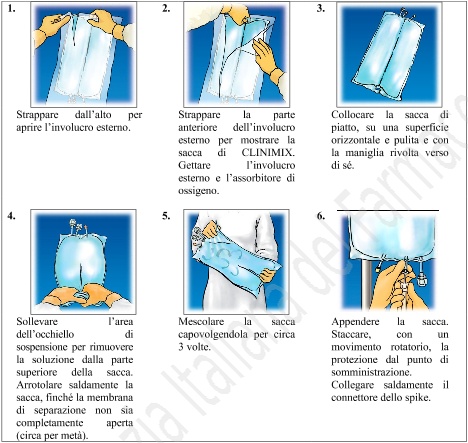
- Страна регистрации
- Форма выпускаInfusion solution, 1000 ML
- Код АТХB05BA10
- Действующее вещество
- Отпускается по рецептуДа
- Производитель
- Информация на этой странице носит справочный характер и не является медицинской консультацией. Перед началом приема лекарства обязательно проконсультируйтесь с врачом.
- Аналоги KLINIMIXФорма выпуска: Infusion solution, 10%Действующее вещество: combinationsПроизводитель: B. BRAUN MELSUNGEN AGОтпускается по рецептуФорма выпуска: Infusion solution, 1000 MLДействующее вещество: combinationsПроизводитель: B. BRAUN MELSUNGEN AGОтпускается по рецептуФорма выпуска: Emulsion for intravenous infusion, 1085 MLДействующее вещество: combinationsПроизводитель: BAXTER S.P.A.Отпускается по рецепту
Аналоги KLINIMIX в других странах
Лекарства с тем же действующим веществом, доступные в других странах.
Аналог KLINIMIX в Испания
Аналог KLINIMIX в Польша
Аналог KLINIMIX в Украина
Врачи онлайн по KLINIMIX
Обсудите применение KLINIMIX и возможные следующие шаги — по оценке врача.









Получите рецепт на KLINIMIX онлайн
Заполните форму за 2 минуты
Расскажите о симптомах, истории болезни и нужном препарате.
Выберите врача или мы назначим
Выберите специалиста или мы подберём ближайшего доступного врача.
Врач рассматривает ваш случай
Обычно в течение 30 минут. Может задать уточняющие вопросы в чате.
Получите в любой аптеке
Электронный рецепт отправляется на вашу почту — действителен по всей Польше.
Часто задаваемые вопросы
KLINIMIX требует рецепта в Италия. Вы можете уточнить у врача онлайн, подходит ли это лекарство для вашей ситуации.
Действующее вещество KLINIMIX — combinations. Эта информация помогает определить лекарства с тем же составом под другими торговыми названиями.
KLINIMIX производится компанией BAXTER S.P.A.. Упаковка и торговое название могут отличаться в зависимости от дистрибьютора.
Врачи, включая Семейные врачи, Психиатры, Дерматологи, Кардиологи, Эндокринологи, Гастроэнтерологи, Пульмонологи, Нефрологи, Ревматологи, Гематологи, Инфекционисты, Аллергологи, Гериатры, Педиатры, Онкологи, могут оценить целесообразность применения KLINIMIX с учетом вашей ситуации и местных правил. Вы можете записаться на онлайн-консультацию, чтобы обсудить возможные варианты.
Польша имеет хорошо развитую систему здравоохранения в крупных городах, таких как Варшава, Краков, Вроцлав и Гданьск. Аптеки широко доступны и работают в соответствии с действующим законодательством, обеспечивая доступ к рецептурным препаратам.
Вы можете купить KLINIMIX в Варшаве, Кракове, Вроцлаве или Гданьске в любой аптеке при наличии действующего рецепта.
Чтобы получить рецепт, вы можете воспользоваться Oladoctor:
Другие лекарства с тем же действующим веществом (combinations) включают AMIXAL, BASALFLEX, FINOMEL. Они могут отличаться торговым названием или формой выпуска, но содержат одинаковый терапевтический компонент. Перед изменением лечения рекомендуется проконсультироваться с врачом.
