



VISIPAQUE 150 mg /Ml Roztwór Do Wstrzykiwań

Ocena recepty online
Lekarz przeanalizuje Twój przypadek i zdecyduje, czy wystawienie recepty jest medycznie uzasadnione.

Porozmawiaj z lekarzem o tym leku
Omów swoje objawy i opcje leczenia podczas szybkiej konsultacji online.



Jak stosować VISIPAQUE
Treść ulotki
Visipaque 270 mg I/ml injectable solution, 320 mg I/ml injectable solution
Iodixanol
Read this leaflet carefully before using this medicine as it contains important
information for you.
- Keep this leaflet. You may need to read it again.
- If you have any questions, ask the doctor who will perform the procedure.
- If any side effects occur, including those not listed in this leaflet, tell your doctor. See section 4.
Contents of this leaflet:
- 1. What Visipaque is and what it is used for
- 2. What you need to know before using Visipaque
- 3. How to use Visipaque
- 4. Possible side effects
- 5. How to store Visipaque
- 6. Contents of the pack and other information
1. What is Visipaque and what is it used for
- Visipaque is a “contrast agent” for diagnostic use only. It is used to help identify a disease.
- It is administered before X-rays, to make the image clearer for the doctor.
- Visipaque can help your doctor distinguish between normal and abnormal appearance and shape of some organs in your body.
- Visipaque is used for X-rays of your urinary system, spine, or blood vessels, including the blood vessels of your heart.
- Some people are given this medicine before or during a scan of their head or body, using a “Computed Tomography” (also called a CT scan).
- Visipaque is used to examine your throat (esophagus), stomach and intestines, or to examine body cavities, such as your joints, uterus or fallopian tubes.
Your doctor will explain which part of your body will be scanned.
2. What you need to know before using Visipaque
Do not use Visipaque
- if you suffer from severe thyroid problems
- if you are allergic (hypersensitive) to iodixanol or any of the other ingredients of this medicine (listed in section 6).
Warnings and precautions
Talk to your doctor before using Visipaque:
- if you have had an allergic reaction to a medicine similar to Visipaque, called a “contrast agent”.
- if you have or have had problems with your thyroid.
- if you have had allergies.
- if you have asthma.
- if you have diabetes.
- if you have brain or tumor conditions.
- if you have severe heart or lung problems.
- if you have kidney or kidney and liver problems
- if you have a disease called “myasthenia gravis”, a condition that causes severe muscle weakness.
- if you have “pheochromocytoma” (constantly high blood pressure or spikes in high blood pressure due to a rare tumor of the adrenal glands).
- If you have homocystinuria (a condition involving increased excretion of the amino acid cysteine in the urine)
- if you have blood or bone marrow problems.
- if you have suffered from alcohol or drug addiction.
- if you have epilepsy, blood clots in the brain, or stroke.
- if you are going to undergo thyroid function tests in the coming weeks.
- if you need to take blood or urine samples on the same day.
Tell your doctor before using Visipaque if you are not sure whether the above cases apply to you.
A temporary brain disorder may occur during or shortly after the imaging procedure
called encephalopathy. Immediately inform your doctor if you notice any of the symptoms related to
this condition described in section 4.
Thyroid disorders may be observed after the administration of Visipaque in both children and
adults. Children may also be exposed through the mother during pregnancy. Your doctor may
need to perform thyroid function tests before and/or after the administration of Visipaque.
Other medicines and Visipaque
Tell your doctor if you are taking, have recently taken, or might take any other
medicines, including those available without a prescription. This is because some medicines may interfere
with Visipaque.
Tell your doctor
- If you are taking metformin for the treatment of diabetes
- If you are taking or have recently taken (within the two weeks prior to the examination with an iodinated contrast agent such as Visipaque) interleukin-2,a medicine used to reduce the immune defenses, as you may have a higher risk of late reactions (flu-like symptoms or skin reactions).
- If you are taking medicines to lower blood pressure, beta-blockers, as there is evidence that the use of beta-blockers is a risk factor for anaphylactoid reactions to radiographic contrast agents such as Visipaque
Pregnancy and breastfeeding
If you are pregnant, suspect you are pregnant, are planning a pregnancy, or are breastfeeding with breast
milk, ask your doctor for advice before using this medicine. Your doctor will only use this medicine
if the benefit of its use outweighs the risk.
If you are pregnant, Visipaque should not be administered into body cavities such as the uterus and
fallopian tubes.
If this medicine is administered to you during pregnancy, it is recommended to monitor the
thyroid function of the child.
Breastfeeding
Breastfeeding can continue normally after the examination with Visipaque.
Driving and operating machinery
Do not drive vehicles or operate machinery for 24 hours after the last administration of Visipaque
in the spinal cord.
This is because you may experience dizziness or other signs of a subsequent reaction.
Visipaque contains sodium
Visipaque 270 mg I/ml: 0.03 mmol (0.76 mg) of sodium per ml.
Visipaque 320 mg I/ml: 0.02 mmol (0.45 mg) of sodium per ml.
To be taken into consideration in people with reduced kidney function or who are following a low-sodium
diet
3. How to use Visipaque
Use this medicine following the instructions of your doctor exactly. If you have any doubts, ask your doctor.
Dosage and administration
Visipaque will always be administered by a suitably trained and qualified healthcare professional.
- Visipaque will always be used in hospital or clinic.
- Medical personnel will inform you of everything you need to know for safe use of the medicine.
The usual dose is:
- A single injection or you may be asked to drink it. In children, the dose may be administered rectally
After administration of Visipaque
You will be asked:
- to drink plenty of fluids (to help eliminate the medicine from your body),
- to remain in the area where you underwent the scan or X-ray or nearby for at least 30 minutes.
- to remain in the clinic or hospital for one hour. Immediately inform your doctor if you experience any adverse effects during this period (see section 4 “Possible side effects”). The above advice applies to all patientswho have been administered Visipaque. If you are unsure about the above, ask your doctor. Visipaque can be administered in many different ways; below is a description of how it is usually administered.
Injection into an artery or a vein
Visipaque will usually be injected into a vein in the arm or leg.
Sometimes it will be administered through a thin plastic tube (catheter) inserted into an artery,
usually in the arm or groin.
Injection into the spinal column
Visipaque will be injected into the space around the spinal cord, to view your spinal canal.
After administration of Visipaque you will need to rest for 1 hour with your head and chest raised to 20°,
after which you may move cautiously, but you must avoid bending over. If you are lying in bed, your head and
chest must remain raised for the first 6 hours.
You will be asked not to be completely alone for the first 24 hours after administration of
Visipaque, if you are an outpatient.
The above advice applies onlyif Visipaque has been administeredinto your spinal column.
If you are unsure about the above, ask your doctor.
Use in body cavities or joints
Body cavities may be joints, the uterus and fallopian tubes (see paragraph "Pregnancy and
Breastfeeding"). The methods and location of Visipaque administration may vary.
Oral use
Visipaque is usually given by mouth to examine: throat, stomach and small intestine.
If you have been given more Visipaque than you should
Because Visipaque will be administered by a qualified healthcare professional, an overdose is unlikely.
If necessary, hemodialysis can be used to remove excess iodixanol. There is no
specific antidote. Treatment of overdose is symptomatic.
4. Possible side effects
Like all medicines, this medicine can cause side effects, although not everyone gets them.
Serious or fatal reactions occur only in very rare cases. These can affect kidney or
cardiac function. The cardiac reaction may be favored by a pre-existing condition or the procedure.
Allergic reactions
If you have had an allergic reaction following the administration of Visipaque in hospital or clinic
immediately inform your doctor. Symptoms may include:
- shortness of breath, difficulty breathing, feeling of oppression or chest pain
- skin rashes, swelling, itchy patches, blisters on the skin and in the mouth or other allergic symptoms
- swelling of the face
- vasculitis and Stevens-Johnson-like syndrome (SJS) if you have autoimmune diseases.
- dizziness or fainting (caused by low blood pressure)
The side effects described above can also appear several hours or days after you have been
administered Visipaque. If any of these side effects occur after you have left
the hospital or clinic, go immediately to the emergency room of the nearest hospital.
Other side effects may occur, which depend on how and why Visipaque was administered to you. Ask your doctor if you are not sure how Visipaque was administered to you.
After injection into an artery or a vein
Uncommon(affects less than 1 in 100 people)
- allergic reaction, also known as a hypersensitivity reaction, see the “ Allergicreactions” section for symptoms
- headache,
- nausea, vomiting,
- kidney damage
- feeling of warmth, chest pain
- skin rash, itching, hives
- redness
Rare(affects less than 1 in 1,000 people)
- feeling of dizziness
- altered sensation (including different tastes, or a different smell, tingling or numbness or burning sensation)
- irregular heartbeat
- low blood pressure
- heart attack
- acute kidney damage
- cough
- chills, fever
- feeling of cold
- redness of the skin or mucous membranes
- pain, and local reactions (at the site where the drug is injected)
- malaise
Very rare(affects less than 1 in 10,000 people)
- vision changes,
- cortical blindness (transient)
- tremor
- transient vision loss (including double vision, blurred vision)
- swelling of the eyelids
- reduced sense of touch
- high blood pressure and other vascular diseases
- difficulty breathing, feeling of cold and reduced muscle strength
- swelling of the throat
- sore throat
- pain or discomfort in the area around the stomach (abdominal pain)
- kidney problems
- cardiac arrest
- short-term memory loss
- extreme fatigue
- redness of the skin
- skin swelling
- agitation
- anxiety
- fainting
- stroke
- back pain
- swelling of the face or other localized swelling
- muscle contraction
- diarrhea
- excessive sweating (hyperhidrosis)
Not known (the number of people affected is not known)
- allergic reaction, anaphylactic shock leading to shock and collapse, see “Allergic reactions” for other symptoms
- feeling of confusion, difficulty moving, convulsions, altered consciousness, cramps
- temporary brain disorders (encephalopathy) including feeling of confusion, memory loss, hallucinations, difficulty with vision, loss of vision, convulsions, loss of coordination, loss of movement on one side of the body, speech problems, and loss of consciousness
- blood clots (thrombosis), pain and swelling of the veins, constriction of the arteries
- severe breathing difficulties (caused by fluid in the lungs)
- joint pain, swelling and tenderness (pain) of the salivary glands
- iodine poisoning
- cardiac and pulmonary arrest
- coma
- formation of thrombi in the coronary arteries, constriction of the coronary arteries
- chest pain (angina pectoris)
- reduction of the movements of the ventricular walls, myocardial ischemia
- decrease in platelets
- respiratory failure, cessation of breathing
- acute inflammation of the pancreas or worsening of inflammation of the pancreas (pancreatitis)
- enlargement of the salivary glands
- hyperactivity of the thyroid
- transient hypoactivity of the thyroid
- swelling
- increased creatinine (a sign that your kidneys are not working properly)
- palpitations
- diseases of the skin and/or mucous membranes such as various types of lesions and inflammatory skin disorders of an allergic nature (bullous dermatitis, erythema multiforme, toxic epidermal necrolysis, acute generalized pustulosis, drug eruption with eosinophilia and systemic symptoms, drug eruption, allergic dermatitis), acute allergic reactions (Stevens-Johnson syndrome), skin exfoliation
- shock
- Temporarily inactive thyroid in newborns.
- Bronchospasm
- Constriction of the throat
After injection into the spinal cord
Uncommon(affects less than 1 in 100 people)
- headache (may be severe and last for hours)
- vomiting
Not known(the number of people affected is not known)
- feeling of dizziness, vertigo
- convulsions
- tremor
- nausea
- pain (at the injection site)
- allergic reaction, see “Allergic reactions”for symptoms
- temporary brain disorders (encephalopathy) including feeling of confusion, memory loss, hallucinations, difficulty with vision, loss of vision, convulsions, loss of coordination, loss of movement on one side of the body, speech problems, and loss of consciousness
- muscle contraction
After use in body cavities (such as uterus and fallopian tubes)
Uncommon(affects less than 1 in 100 people)
- vomiting
Very common(affects more than 1 in 10 people)
- pain in the area around the stomach
- vaginal bleeding
Common(affects less than 1 in 10 people)
- headache, nausea, fever
Not known(the number of people affected is not known)
- tremor
- allergic reaction, see “Allergic reactions”for symptoms
- local reactions (at the injection site)
After injection into the joints
Common(affects less than 1 in 10 people)
- pain at the injection site
Not known(the number of people affected is not known)
- allergic reactions, see “Allergic reactions”for symptoms
- tremor
After oral administration
Common(affects less than 1 in 10 people)
- diarrhea, nausea
- pain in the area around the stomach
Uncommon(affects less than 1 in 100 people)
- vomiting
Not known(the number of people affected is not known)
- allergic reaction, see “Allergic reactions”for symptoms
- tremor
Reporting of side effects
If you get any side effects, talk to your doctor or pharmacist.
You can also report side effects directly through the national reporting system
By reporting side effects you can help provide more information on the safety of
this medicine.
5. How to store Visipaque
Keep this medicine out of the sight and reach of children.
Do not use this medicine after the expiry date which is stated on the label.
Store in the package in order to protect the medicine from light.
Store at a temperature not exceeding 30°C.
The product may be stored for one month at 37°C.
6. Contents of the pack and other information
What Visipaque contains
The active ingredient is iodixanol.
Visipaque 270 mg I/ml contains 550 mg of iodixanol per ml (equivalent to 270 mg of iodine per ml).
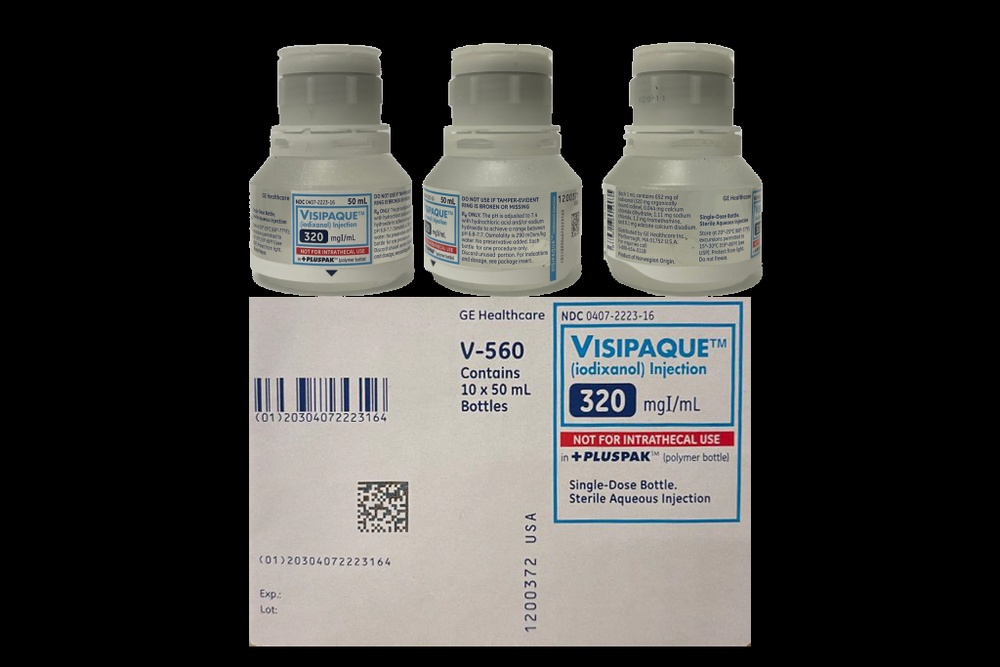
Visipaque 320 mg I/ml contains 652 mg of iodixanol per ml (equivalent to 320 mg of iodine per ml).
The other components are small amounts of trometamol, sodium chloride, calcium chloride, sodium calcium
edetate, hydrochloric acid (pH adjustment) and water. The product is isotonic and has a pH between 6.8
and 7.6.
Description of the appearance of Visipaque and contents of the pack
Visipaque is an injectable solution. The medicine is presented as a transparent aqueous solution, from
colourless to pale yellow.
Visipaque is distributed in the following packs:
270 mg I/ml 1 vial of 20 ml
1 vial of 50 ml
1 vial of 100 ml
1 vial of 200 ml
1 vial of 500 ml
1 polypropylene vial of 50 ml
1 polypropylene vial of 100 ml
1 polypropylene vial of 200ml
1 polypropylene vial of 500 ml
320 mg I/ml 1 vial of 20 ml
1 vial of 50 ml
1 vial of 100 ml
1 vial of 200 ml
1 vial of 500 ml
1 polypropylene vial of 50 ml
1 polypropylene vial of 100 ml
1 polypropylene vial of 200ml
1 polypropylene vial of 500 ml
Not all pack sizes may be marketed.
Marketing Authorisation Holder
GE Healthcare S.r.l.
Via Galeno 36,
20126 Milan - Italy
Manufacturers
GE Healthcare AS
Nycoveien 1,
0485 Oslo, Norway
GE Healthcare Ireland Limited
IDA Business Park
Carrigtohill
Cork, Ireland

Nie jesteś pewien, czy ten lek jest odpowiedni dla ciebie?
Omów swoje objawy i leczenie z lekarzem online.

Zacząłeś przyjmować lek i masz pytania?
Omów swoje objawy i leczenie z lekarzem online.
- Kraj rejestracji
- Postać farmaceutycznaInjectable solution, 150 MG/ML
- Kod ATCV08AB09
- Substancja czynna
- Wymaga receptyTak
- Producent
- Te treści mają charakter wyłącznie informacyjny i nie zastępują konsultacji lekarskiej.
- Zamienniki VISIPAQUEPostać farmaceutyczna: Infusion solution, 150 MG/MLSubstancja czynna: iomeprolProducent: BRACCO IMAGING S.P.A.Wymaga receptyPostać farmaceutyczna: Infusion solution, 200 MG/MLSubstancja czynna: iopamidolProducent: BRACCO IMAGING S.P.A.Wymaga receptyPostać farmaceutyczna: Infusion solution, 408 MG/MLSubstancja czynna: iopamidolWymaga recepty
Odpowiedniki VISIPAQUE w innych krajach
Leki z tą samą substancją czynną dostępne w innych krajach.
Odpowiednik VISIPAQUE w Polska
Odpowiednik VISIPAQUE w Ukraina
Odpowiednik VISIPAQUE w Hiszpania
Lekarze online w sprawie VISIPAQUE
Omów stosowanie VISIPAQUE, bezpieczeństwo i ocenę zasadności recepty zgodnie z obowiązującymi przepisami.









Uzyskaj receptę na VISIPAQUE online
Wypełnij 2-minutowy formularz
Opisz swoje objawy, historię choroby i lek, o który prosisz.
Wybierz lekarza lub pozwól nam przydzielić
Wybierz specjalistę lub dopasujemy Cię do najbliższego dostępnego lekarza.
Lekarz analizuje Twój przypadek
Zazwyczaj w ciągu 30 minut. Może zadawać dodatkowe pytania przez czat.
Odbierz w dowolnej aptece
Recepta elektroniczna wysłana na Twój e-mail — ważna w całej Polsce.
Często zadawane pytania
VISIPAQUE wymaga recepty w Włochy. Możesz skonsultować się z lekarzem online, aby sprawdzić, czy ten lek może być odpowiedni w Twojej sytuacji.
Substancją czynną w VISIPAQUE jest iodixanol. Informacja ta pomaga rozpoznać leki o tym samym składzie, ale pod różnymi nazwami handlowymi.
VISIPAQUE jest produkowany przez GE HEALTHCARE S.R.L.. Nazwy handlowe i opakowania mogą się różnić w zależności od dystrybutora.
Lekarze, tacy jak Lekarze rodzinni, Psychiatrzy, Dermatolodzy, Kardiolodzy, Endokrynolodzy, Gastroenterolodzy, Pulmonolodzy, Nefrolodzy, Reumatolodzy, Hematolodzy, Zakaźnicy, Alergolodzy, Geriatrzy, Pediatrzy, Onkolodzy, mogą ocenić, czy stosowanie VISIPAQUE jest odpowiednie w Twoim przypadku, w zależności od sytuacji klinicznej i lokalnych przepisów. Możesz umówić konsultację online, aby omówić objawy i możliwe dalsze kroki.
Polska posiada dobrze rozwiniętą infrastrukturę ochrony zdrowia w dużych miastach, takich jak Warszawa, Kraków, Wrocław i Gdańsk. Apteki są łatwo dostępne i działają zgodnie z obowiązującymi przepisami, zapewniając dostęp do leków na receptę.
Możesz kupić VISIPAQUE w Warszawie, Krakowie, Wrocławiu lub Gdańsku w każdej aptece, posiadając ważną receptę.
Aby uzyskać receptę, możesz skorzystać z Oladoctor:
Inne leki zawierające tę samą substancję czynną (iodixanol) to m.in. IOMERON, IOPAMIRO, IOPASEN. Mogą one różnić się nazwą handlową lub postacią, ale zawierają ten sam składnik terapeutyczny. Przed zmianą lub rozpoczęciem nowego leku skonsultuj się z lekarzem.
