



TRUVINUT 700 mg Plaster Transdermalny

Ocena recepty online
Lekarz przeanalizuje Twój przypadek i zdecyduje, czy wystawienie recepty jest medycznie uzasadnione.

Porozmawiaj z lekarzem o tym leku
Omów swoje objawy i opcje leczenia podczas szybkiej konsultacji online.



Jak stosować TRUVINUT
Treść ulotki
Truvinut 700 mg medicated patch
Lidocaine
Read this leaflet carefully before using this medicine as it contains important
information for you.
- Keep this leaflet. You may need to read it again.
- If you have any questions, ask your doctor or pharmacist.
- This medicine has been prescribed for you only. Do not pass it on to others, even if their symptoms are the same as yours, as it could be harmful.
- If any side effects occur, including those not listed in this leaflet, tell your doctor or pharmacist. See section 4.
Contents of this leaflet:
- 1. What Truvinut is and what it is used for
- 2. What you need to know before you use Truvinut
- 3. How to use Truvinut
- 4. Possible side effects
- 5. How to store Truvinut
- 6. Contents of the pack and other information
1. What is Truvinut and what is it used for
Truvinut contains lidocaine, a local analgesic, which works by reducing pain at the skin level.
It has been prescribed to you to treat pain caused by post-herpetic neuralgia. This condition
is generally characterized by localized symptoms such as burning, stabbing or lancinating pain.
2. What you need to know before you use Truvinut
Do not use Truvinut
- if you are allergic to lidocaine or any of the other ingredients of this medicine (listed in section 6)
- if you have had an allergic reaction to other products similar to lidocaine, such as bupivacaine, etidocaine, mepivacaine or prilocaine
- on damaged skin or on open wounds.
Warnings and precautions
Talk to your doctor or pharmacist before using Truvinut
If you suffer from a severe liver disorder or have serious heart or kidney problems, you should talk to your
doctor before using Truvinut.
Truvinut should be applied to the skin after the herpes zoster lesions have healed. It should not
be applied to or near the eyes or mouth.
Lidocaine is metabolized into numerous compounds in the liver. One of these compounds is 2,6
xylidine, which has been shown to cause tumors in rats when administered continuously at very
high doses. The relevance of this data to humans is unknown.
Children and adolescents
Truvinut has not been studied in patients under the age of 18 years. Therefore, use in these patients
is not recommended.
Other medicines and Truvinut
Tell your doctor or pharmacist if you are taking or have recently taken or might take
any other medicines.
Pregnancy, breastfeeding and fertility
If you are pregnant, suspect you are pregnant or are planning a pregnancy, or if you are breastfeeding
with breast milk, ask your doctor or pharmacist for advice before using this medicine.
Truvinut should not be used during pregnancy unless strictly necessary.
There are no studies on the use of the patch during breastfeeding. When using Truvinut, only a small
amount of the active ingredient, lidocaine, may be present in the blood. An effect on
breastfed infants is unlikely.
Driving and operating machinery
It is unlikely that Truvinut will affect your ability to drive or operate machinery. Therefore you
can drive or work on machinery while using Truvinut.
Truvinut contains propylene glycol,methyl parahydroxybenzoate and propyl parahydroxybenzoate.
The patches contain propylene glycol (E1520) which may cause skin irritation. In addition,
they contain methyl parahydroxybenzoate (E218) and propyl parahydroxybenzoate (E216) which may
cause allergic reactions. Sometimes allergic reactions can occur after using the patches
for a certain period of time.
3. How to use Truvinut
Use this medicine following the instructions of your doctor exactly. If you have any doubts, consult your
doctor or pharmacist.
The usual daily dose is one to three patches the size of the painful skin area.
Truvinut can be cut into smaller pieces to cover the affected area. You should not use more than 3
patches at the same time.
The patches should be removed after 12 hours of application; this will give you a 12-hour
period without a patch. You can choose to apply Truvinut during the day or during the night.
You will generally start to feel some pain relief from the first day of use, but it may also take
2-4 weeks before the pain-relieving effect of Truvinut is complete. If
after this period the pain is still very intense, inform your doctor, as the benefit of
treatment must be assessed against potential risks (see paragraph 2 “Warnings and
Precautions”).
Your doctor will check at regular intervals whether Truvinut is working.
Before applying Truvinut to the affected area
- If the painful skin area is covered with hair, it must be trimmed with scissors. It should not be shaved.
- The skin must be clean and dry.
- Creams or lotions can only be used on the treated skin during the period when the patch is not applied.
- If you have just had a bath or shower, you must wait for the skin to cool down before applying the patch.
Apply the patch
Step 1: open the sachet and remove one or more patches
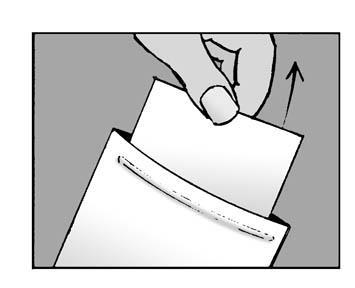
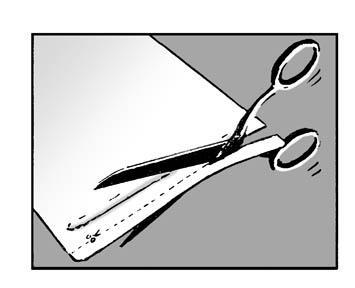
- tear or cut the sachet along the dashed line
- if using scissors, be careful not to damage the patches
- take one or more patches, depending on the size of the painful skin area
Step 2: close the sachet
- close the sachet very well after use
- the patch contains water and may dry out if the sachet is not closed correctly
Step 3: cut the patch, if necessary
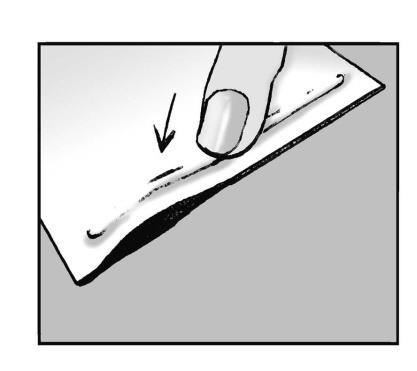
- if necessary, cut the patch to the size needed to cover the painful skin area before removing the protective film.
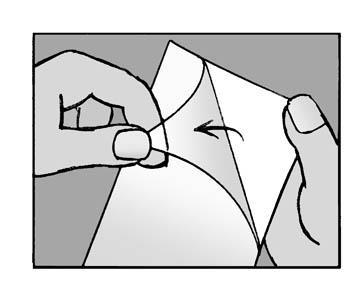
Step 4: remove the protective film
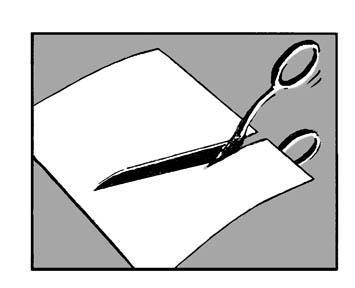
- remove the transparent film from the patch
- try not to touch the adhesive part of the patch
Step 5: apply the patch and press firmly onto the skin
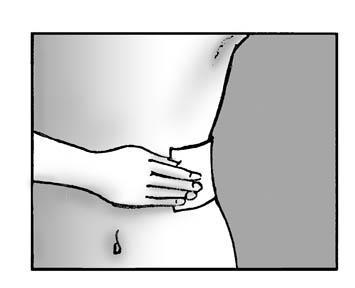
- apply up to three patches to the painful skin area
- press the patch onto the skin
- hold the patch pressed for at least 10 seconds so that the patch can adhere well to the skin
- make sure that the entire patch, including the edges, adheres to the skin.
Leave the patch applied for only 12 hours
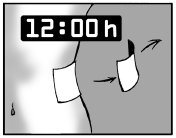
It is important that Truvinut remains applied to the skin for only 12 hours. For example, if you experience more
pain during the night, you can apply the patch at 7 pm and remove it at 7 am. If you experience more
pain during the day, you can apply Truvinut at 7 am and remove it at 7 pm.
Bathing, showering and swimming
Since contact of Truvinut with water must be avoided, any bathing, showering or swimming
can be done during the time when the patch is not applied. After bathing or
showering, wait for the skin to cool down before applying the patch.
If the patch comes off
Very rarely, the patch may come off or not adhere well. In this case, try to reattach it to the
same area. If it does not stay attached, remove it completely and apply a new
patch, always to the same area.
How to remove Truvinut
To change the patch, remove the old patch slowly. If it does not come off easily, you can
wet it with warm water for a few minutes before removing it.
If you forget to remove the patch after 12 hours
Remove the patch as soon as you remember. The new patch can be applied after 12 hours.
If you use more patches than you should
If you use more patches than necessary or keep them applied for too long, the risk of side effects may increase.
If you forget to apply Truvinut
If you have forgotten to apply a new patch after a 12-hour interval without the previous patch,
apply the new patch as soon as you remember.
If you have any further questions on the use of this medicine, ask your doctor or pharmacist.
4. Possible side effects
Like all medicines, this medicine can cause side effects, although not everybody gets them.
Important side effects or symptoms to be aware of and what to do in such cases
If irritation or a burning sensation occurs during application of the patch, the patch must be
removed. Do not apply another patch to that area until the irritation has healed.
Other side effects that may occur:
Very common(may affect more than 1 in 10 people) :
Skin changes in the area of patch application or nearby, which may
include redness, rash, itching, burning, dermatitis and blisters.
Uncommon(may affect up to 1 in 100 people):
Skin changes and wounds
Very rare(may affect up to 1 in 10,000) :
Open wounds, severe allergic reactions and allergy.
Reporting of side effects
If you experience any side effects, including those not listed in this leaflet, please
inform your doctor or pharmacist. You can also report side effects directly through
the national reporting system at www.agenziafarmaco.gov.it/content/come-segnalare-
una-sospetta-reazione-avversa . By reporting side effects you can help provide more
information on the safety of this medicine.
5. How to store Truvinut
Keep this medicine out of the sight and reach of children.
Do not use this medicine after the expiry date which is stated on the sachet and the box after
EXP. The expiry date refers to the last day of that month.
Do not refrigerate or freeze.
Close the sachet tightly after first opening.
Shelf life after first opening of the sachet: 14 days.
Do not use this medicine if you notice that the sachet is damaged. In this case the patch may have
dried out and therefore not adhere well.
How to dispose of Truvinut
Used patches still contain active substance which could be dangerous for others.
Fold the old patches in half, with the adhesive side inwards and throw them away so that they remain out
of the reach of children.
Do not dispose of any medicine in wastewater or household waste. Ask your pharmacist how to
dispose of medicines you no longer use. This will help protect the environment
6. Contents of the pack and other information
What Truvinut contains
- the active ingredient is lidocaine
- each 10 cm x14 cm patch contains 700 mg of lidocaine (equivalent to 5% w/w)
- the other components in the patch (excipients) are: glycerol, liquid sorbitol, sodium carboxymethylcellulose, propylene glycol (E1520), urea, heavy kaolin, tartaric acid, gelatin, polyvinyl alcohol, aluminum glycinate, disodium edetate, methyl parahydroxybenzoate (E218), propyl parahydroxybenzoate (E216), polyacrylic acid, sodium polyacrylate, purified water.
The backing layer and the adhesive layer: polyethylene terephthalate (PET).
Description of Truvinut and contents of the pack
The medicated patches are 14 cm long and 10 cm wide. They are white, made of soft material and bear the
inscription “lidocaine 5%”. The patches are packaged in resealable pouches, each containing 5 patches.
Each pack contains 5, 10, 20, 25 or 30 patches packaged in 1, 2, 4, 5 or 6 pouches, respectively.
Not all pack sizes may be marketed
Marketing Authorisation Holder:
GRÜNENTHAL ITALIA S.r.l. Via Vittor Pisani 16 20124 Milano
Manufacturer
Grünenthal GmbH –Zieglerstrasse 6 -52078 Aachen (Germany)
This medicinal product is authorised in the Member States of the European Economic Area under the
following denominations:
Finland, Germany, United Kingdom: Esliva
France: Wetso
Italy: Truvinut

Nie jesteś pewien, czy ten lek jest odpowiedni dla ciebie?
Omów swoje objawy i leczenie z lekarzem online.

Zacząłeś przyjmować lek i masz pytania?
Omów swoje objawy i leczenie z lekarzem online.
- Kraj rejestracji
- Postać farmaceutycznaTransdermal patch, 700 MG
- Kod ATCN01BB02
- Substancja czynna
- Wymaga receptyTak
- Producent
- Te treści mają charakter wyłącznie informacyjny i nie zastępują konsultacji lekarskiej.
- Zamienniki TRUVINUTPostać farmaceutyczna: Cream, 40 MG/GSubstancja czynna: lidocaineProducent: LOGOFARMA S.P.A.Wymaga receptyPostać farmaceutyczna: Gingival gel, 20 MG/GSubstancja czynna: lidocaineProducent: CHEMISCHE FABRIK KREUSSLER & CO. GMBHBez receptyPostać farmaceutyczna: Injectable solution, 20 MG/MLSubstancja czynna: lidocaineProducent: MOLTENI DENTAL S.R.L.Wymaga recepty
Odpowiedniki TRUVINUT w innych krajach
Leki z tą samą substancją czynną dostępne w innych krajach.
Odpowiednik TRUVINUT w Hiszpania
Odpowiednik TRUVINUT w Polska
Odpowiednik TRUVINUT w Ukraina
Lekarze online w sprawie TRUVINUT
Omów stosowanie TRUVINUT, bezpieczeństwo i ocenę zasadności recepty zgodnie z obowiązującymi przepisami.









Uzyskaj receptę na TRUVINUT online
Wypełnij 2-minutowy formularz
Opisz swoje objawy, historię choroby i lek, o który prosisz.
Wybierz lekarza lub pozwól nam przydzielić
Wybierz specjalistę lub dopasujemy Cię do najbliższego dostępnego lekarza.
Lekarz analizuje Twój przypadek
Zazwyczaj w ciągu 30 minut. Może zadawać dodatkowe pytania przez czat.
Odbierz w dowolnej aptece
Recepta elektroniczna wysłana na Twój e-mail — ważna w całej Polsce.
Często zadawane pytania
TRUVINUT wymaga recepty w Włochy. Możesz skonsultować się z lekarzem online, aby sprawdzić, czy ten lek może być odpowiedni w Twojej sytuacji.
Substancją czynną w TRUVINUT jest lidocaine. Informacja ta pomaga rozpoznać leki o tym samym składzie, ale pod różnymi nazwami handlowymi.
TRUVINUT jest produkowany przez GRUNENTHAL ITALIA S.R.L.. Nazwy handlowe i opakowania mogą się różnić w zależności od dystrybutora.
Lekarze, tacy jak Lekarze rodzinni, Psychiatrzy, Dermatolodzy, Kardiolodzy, Endokrynolodzy, Gastroenterolodzy, Pulmonolodzy, Nefrolodzy, Reumatolodzy, Hematolodzy, Zakaźnicy, Alergolodzy, Geriatrzy, Pediatrzy, Onkolodzy, mogą ocenić, czy stosowanie TRUVINUT jest odpowiednie w Twoim przypadku, w zależności od sytuacji klinicznej i lokalnych przepisów. Możesz umówić konsultację online, aby omówić objawy i możliwe dalsze kroki.
Polska posiada dobrze rozwiniętą infrastrukturę ochrony zdrowia w dużych miastach, takich jak Warszawa, Kraków, Wrocław i Gdańsk. Apteki są łatwo dostępne i działają zgodnie z obowiązującymi przepisami, zapewniając dostęp do leków na receptę.
Możesz kupić TRUVINUT w Warszawie, Krakowie, Wrocławiu lub Gdańsku w każdej aptece, posiadając ważną receptę.
Aby uzyskać receptę, możesz skorzystać z Oladoctor:
Inne leki zawierające tę samą substancję czynną (lidocaine) to m.in. ASENSIL, DYNEXAN, EKOKAIN. Mogą one różnić się nazwą handlową lub postacią, ale zawierają ten sam składnik terapeutyczny. Przed zmianą lub rozpoczęciem nowego leku skonsultuj się z lekarzem.
