



REGIOCIT 2X5000ML Solution for hemofiltration

Запит на рецепт онлайн
Лікар розгляне ваш випадок і визначить, чи є рецепт медично доцільним.

Поговоріть з лікарем про ці ліки
Обговоріть симптоми та можливі подальші кроки під час короткої онлайн-консультації.



Інструкція із застосування REJIOKIT
Зміст інструкції
Regiocit solution for hemofiltration
Citrate, sodium, chloride
Read this leaflet carefully before using this medicine as it contains important
information for you.
- Keep this leaflet. You may need to read it again.
- If you have any questions, ask your doctor, pharmacist or nurse.
- If any side effects occur, including those not listed in this leaflet, ask your doctor, pharmacist or nurse. See section 4.
Contents of this leaflet:
- 1. What this medicine is and what it is used for
- 2. What you need to know before you use this medicine
- 3. How to use this medicine
- 4. Possible side effects
- 5. How to store this medicine
- 6. Contents of the pack and other information
1. What this medicine is and what it is used for
This medicine is a hem filtration solution and prevents blood coagulation during continuous renal replacement therapy (CRRT), which is a form of dialysis treatment. This medicine is used for critically ill patients, particularly when the usual medicine administered to prevent blood coagulation (heparin) is not appropriate. Citrate induces anticoagulation by binding to calcium in the blood.
2. What you need to know before using this medicine
Do not use this medicine if:
- You are allergic to the active ingredients or to any of the other ingredients (listed in section 6)
- You have severely impaired liver function
- You have severely reduced blood flow to the muscles
Warnings and precautions
Talk to your doctor, pharmacist or nurse before using this medicine.
This medicine is not indicated for direct intravenous infusion. It must only be used with a
machine capable of performing continuous renal replacement therapy (CRRT), which is a type of dialysis
specifically reserved for critically ill patients with renal failure. The CRRT machine must
be suitable for anticoagulation with citrate.
Regiocit can be warmed to 37° C to improve patient comfort. The solution must be
warmed before use using dry heat only. Solutions must not be heated in water or
in a microwave oven. Before administration, Regiocit must be checked for
the presence of particulate matter and colour change. Do not administer if the solution
is not clear, free of visible particles and if the seal is not intact.
If the outer packaging or the solution bag is damaged, the solution may be contaminated and must not
be used.
In addition to this medicine, treatment involves the infusion of other fluids. The composition or rate
of administration of these other fluids may need to be adjusted to be compatible with this
medicine.
The doctor will carefully monitor haemodynamic status, fluid balance, glucose level,
electrolyte balance and acid/base balance before and during treatment. Sodium, magnesium, potassium, phosphate and calcium levels will be carefully monitored.
Adjustments to therapy will be made if necessary.
Regiocit does not contain calcium. Use of Regiocit may result in low blood calcium levels
(hypocalcaemia). Regiocit does not contain magnesium. Use of Regiocit may result in low blood magnesium
levels (hypomagnesaemia). Blood magnesium levels will be carefully monitored and magnesium infusion may be
necessary.
Regiocit does not contain glucose. Administration of Regiocit may result in low blood glucose levels
(hypoglycaemia). Blood glucose levels must be monitored regularly.
Regiocit does not contain potassium. Serum potassium concentration must be monitored before and during
treatment.
The doctor will pay particular attention to the rate of citrate infusion. Excessive amounts of
citrate cause low blood calcium levels and a high blood pH, which can cause neurological and
cardiac complications. The high blood pH can be corrected by adjusting the dialysis settings
and administering a 0.9% sodium chloride solution after the filter or by modifying the
composition of the CRRT solution. Low blood calcium levels can be treated with
a calcium infusion.
The doctor will need to pay particular attention if you suffer from liver failure or develop hepatic
shock. Citrate metabolism may be markedly reduced causing citrate accumulation
accompanied by a low blood pH. The doctor will decide whether treatment needs to be adjusted. If the
total/ionized calcium ratio increases beyond 2.3, the citrate buffer must be reduced or discontinued.
If Regiocit is administered to patients with impaired liver function, it is important to monitor
pH, electrolytes, the total/ionized calcium ratio and systemic ionized calcium frequently
to avoid electrolyte and/or acid-base imbalance. Do not use Regiocit in case of severe
liver impairment.
If there is an abnormally high volume of fluid in the body (hypervolaemia), it is possible to increase the
net ultrafiltration rate prescribed for the CRRT device and/or decrease the rate of
administration of solutions other than the reinfusion fluid and/or the dialysate.
If there is an abnormally low volume of fluid in the body (hypovolaemia), it is possible to decrease the
net ultrafiltration rate prescribed for the CRRT device and/or increase the rate of
administration of solutions other than the reinfusion fluid and/or the dialysate.
Regiocit is hypo-osmolar/hypotonic compared to standard CRRT reinfusion fluids and must be used with
caution in patients with brain damage, cerebral oedema or increased intracranial pressure.
Follow the instructions for use strictly. Incorrect use of venous access or other fluid flow limitations may cause an undesirable decrease in patient weight and activation of
machine alarms. Continuing treatment without resolving the triggering cause may
cause patient injury or death.
Other medicines and Regiocit
Tell your doctor, pharmacist or nurse if you are taking or have recently taken any other
medicines, including those available over the counter. This precaution is necessary because the
concentration of other medicines may be reduced during dialysis treatment. The doctor will decide if
changes to the dosage of the medicines are needed.
In particular, tell your doctor if you are using medicines containing any of the following substances:
- Vitamin D and other medicines containing calcium and medicines containing calcium chloride or calcium gluconate, because they can increase the risk of a high blood calcium concentration ( hypercalcemia) and can cause a reduction in the anticoagulant effect.
- Sodium bicarbonate, because it can increase the bicarbonate level in the blood.
Pregnancy, breastfeeding and fertility
Fertility:
No effects on fertility are expected as sodium, chloride and citrate are normal components
of the body.
Pregnancy and breastfeeding:
There are no clinical data documented on the use of this medicine during pregnancy and breastfeeding.
This medicine should only be administered to pregnant and breastfeeding women if strictly
necessary.
Driving and operating machinery
This medicine is not known to affect the ability to drive or operate machinery.
3. How to use this medicine
For intravenous use. This medicine must be used in hospital and must be administered
exclusively by medical personnel. The volume used, and therefore the dose of the medicine, will depend
on the patient's condition. The volume of the dose will be determined by the doctor.
Recommended flow rates for this medicine in adult and adolescent patients:
- In continuous veno-venous hemofiltration or 1-2.5 l/hour with a blood flow rate between 100 and 200 ml/min.
- In continuous veno-venous hemodiafiltration or 1-2 l/hour with a blood flow rate between 100 and 200 ml/min.
Use in the elderly:
The recommended flow rates are identical to those for adult and adolescent patients.
Use in children:
In neonates and children (from 0 to 23 months of age) Regiocit must be used at a dose of 3 mmol of citrate
per liter of blood flow in continuous veno-venous hemofiltration or hemodiafiltration. In children (from 2 to
11 years of age) the dosage must be adjusted to both the patient's weight and the blood flow rate.
Hepatic insufficiency or hepatic shock:
With these conditions, the initial dose of citrate must be reduced.
Instructions for use
Regiocit will be administered to you in hospital. The doctor will know how to use Regiocit.
See the instructions for use at the end of this leaflet.
4. Possible side effects
Like all medicines, this medicine can cause side effects, although not everybody gets them.
Blood will be checked regularly by a doctor or nurse to identify
possible side effects. The use of this solution may cause:
Common: may affect up to 1 in 10 people
- Acid/base imbalance in the blood
- Imbalances in the level of electrolytes in the blood (e.g. sudden reduction in the level of calcium, sodium, magnesium, potassium and/or phosphate in the blood or increase in the level of calcium in the blood)
Not known: frequency cannot be estimated based on the available data
- Imbalance of fluid levels in the body (dehydration, fluid retention in the body)
- Reduced blood pressure*
- Nausea*, vomiting*
- Cramps*
*Side effects related to dialysis treatment rather than to this medicine.
Reporting of side effects
If you get any side effects, even those not listed in this leaflet, tell your
doctor, pharmacist or nurse.
You can also report side effects directly through the national reporting system
at https://www.aifa.gov.it/content/segnalazioni-reazioni-avverse.
By reporting side effects you can help provide more information on the safety of
this medicine.
5. How to store this medicine
Keep this medicine out of sight and reach of children.
This medicine does not require any particular storage conditions.
Do not freeze.
Do not use this medicine after the expiry date which is stated on the label and the packaging. The expiry date refers to the last day of that month.
Do not use this medicine if you notice damage to the product or visible particles in the solution.
The solution can be disposed of in the drain without damaging the environment.
6. Content of the pack and other information
What this medicine contains
Composition:
Sodium chloride 5.03 g/l
Sodium citrate 5.29 g/l
The active ingredients are:
Sodium, Na 140 mmol/l
Chloride, Cl 86 mmol/l
Citrate, C H O 18 mmol/l
Theoretical osmolarity: 244 mOsm/l
pH ≈ 7.4
The other ingredients are:
Diluted hydrochloric acid (for pH adjustment) E 507
Water for injections
Description of the appearance of this medicine and contents of the pack
This medicine is a clear and colorless hemodiafiltration solution packaged in a
single-compartment bag made with a multilayer film containing polyolefins and elastomers. The solution is
sterile and free from bacterial endotoxins. Each bag contains 5000 ml of solution and the bag is wrapped
Marketing authorization holder
Manufacturer
Bieffe Medital S.p.A.
Via Stelvio, 94
23035 Sondalo (SO)
Italy
or
Vantive Manufacturing Limited
Moneen Road,
Castlebar
County Mayo
F23 XR63
Ireland
For further information on this medicine, please contact the local representative of the marketing
authorization holder.
The following information is intended exclusively for doctors or healthcare professionals:
Dosage
The rate at which Regiocit is administered depends on the prescribed citrate dose and the blood flow rate.
Prescribing Regiocit must take into account the flow rates of effluent and other therapeutic fluids, the patient’s
fluid removal needs, inputs and outputs of other fluids, and the desired acid/base and electrolyte balance. Regiocit
must be prescribed and the administration (dose, infusion rate and cumulative volume) must be established only
by a physician experienced in intensive care medicine and CRRT.
The pre-filter infusion rate of Regiocit must be prescribed and adjusted based on the blood flow rate to achieve the
target blood citrate concentration of 3-4 mmol/l of blood. Prescribing Regiocit must take into account the flow
rates of effluent and other therapeutic fluids, the patient’s fluid removal needs, inputs and outputs of other
fluids, and the desired acid-base and electrolyte balance.
The flow rate for extracorporeal circuit anticoagulation must be titrated to achieve a post-filter ionized calcium
concentration within the range of 0.25 to 0.35 mmol/l. The patient’s systemic ionized calcium concentration
must be maintained within the normal physiological range by adjusting calcium supplementation.
Citrate also acts as a buffer source (due to conversion to bicarbonate); the infusion rate of Regiocit must be
considered in relation to the rate of buffer administration from other sources (e.g. dialysate and/or reinfusion
fluid). Regiocit must be used in conjunction with a dialysis/reinfusion solution that has an appropriate bicarbonate
concentration.
Separate calcium infusion is always required. Adjust or discontinue calcium infusion based on the physician’s
prescription when discontinuing anticoagulation.
Monitoring post-filter ionized calcium (iCa) blood levels, systemic blood iCa and total calcium blood levels
along with monitoring other laboratory and clinical parameters are essential to achieve appropriate Regiocit dosing
based on the desired level of anticoagulation (see section 4.4).
Plasma levels of sodium, magnesium, potassium and phosphate must be monitored regularly and, if
necessary, supplemented.
Regiocit flow rates in adults and adolescents:
- In continuous veno-venous hemofiltration or 1-2.5 l/hour with a blood flow rate between 100 and 200 ml/min.
- In continuous veno-venous hemodiafiltration or 1-2 l/hour with a blood flow rate between 100 and 200 ml/min.
Paediatric population:
In neonates and infants (from 0 to 23 months of age) Regiocit should be used at a dose of 3 mmol of citrate
per liter of blood flow in continuous veno-venous hemofiltration or hemodiafiltration. In children (from 2 to
11 years of age) the dosage must be adjusted to both the patient’s weight and the blood flow rate.
Special populations:
No specific dosage adjustment is required in the elderly compared to adults.
Hepatic impairment or hepatic shock:
A dose reduction may be necessary in patients with mild to moderate hepatic impairment (e.g. Child-Pugh ≤12).
In case of hepatic impairment (including, for example, hepatic cirrhosis), the initial citrate dose should be
reduced because metabolism may be inadequate. Frequent monitoring of citrate accumulation is recommended. In
view of the limited metabolism of citrate, Regiocit should not be administered to patients with severely reduced
liver function or hepatic shock with muscle hypoperfusion (e.g. conditions such as septic shock and lactic acidosis).
Overdosage
Inadvertent administration of excessive volumes of reinfusion solution can lead to an
overdose that can cause a potentially life-threatening situation for the patient. Pulmonary edema and
congestive heart failure may develop due to fluid overload, as well as hypocalcemia and metabolic alkalosis due
to citrate overload relative to blood flow. This imbalance must be corrected immediately by stopping the
amount of reinfusion solution and administering calcium intravenously. Careful calcium supplementation can
reverse the effects of an overdose. The risk can be minimized with careful monitoring during treatment.
In patients with impaired citrate metabolism (hepatic insufficiency or hepatic shock),
overdosage may manifest as citrate accumulation, metabolic acidosis, total systemic hypercalcemia and
ionized hypocalcemia, along with an increased total/ionized calcium ratio.
Regiocit should therefore be reduced or discontinued.
To correct metabolic acidosis, bicarbonate must be reinfused. Continuous renal replacement
therapy can be continued without anticoagulation or other methods of anticoagulation should be considered.
Preparation and/or handling
The solution can be disposed of in the drain without harming the environment.
The following instructions for use must be followed:
Aseptic technique must be used throughout handling and administration to the patient.
Remove the outer wrapper from the bag immediately before use. Use only if the outer wrapper
is not damaged, all seals are intact and the solution is clear. Firmly press the bag to
check for leaks. If leaks are present, immediately discard the solution because
sterility can no longer be guaranteed. The solution must be used immediately after opening
to avoid microbiological contamination.
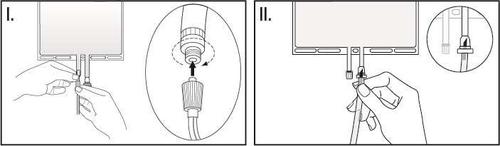
- I. If using a Luer connector, rotate and remove the cap. Connect the male Luer lock of the pre-blood pump line to the female Luer connector on the bag, pushing and rotating. Ensure the connection is fully secured and tight. The connector is now open. Verify that the liquid can flow freely (see Figure I below). When the pre-blood pump line is disconnected from the Luer connector, the connector will close and solution flow will stop. The Luer is a needle-free and disinfectable fitting. II. If using an injection connector (or piercing connector), remove the snap cap. The injection port is disinfectable. Insert the piercing device through the rubber septum. Verify that the liquid flows freely (see Figure II below).
Before adding a substance or medication, verify that it is soluble and stable in Regiocit and that
the pH range of the product is appropriate. Supplements for which incompatibility has been ascertained or determined
must not be added. Consult the instructions for use of the medication to be added
and other relevant literature.
Do not use if a change in color and/or the presence of precipitates, insoluble complexes or crystals is noted after addition.
Mix the solution thoroughly when additives have been introduced. The introduction and mixing
of additives must always be performed before connecting the solution bag to the extracorporeal
circuit.
The solution is for single use only. Discard any unused portion.

Не впевнені, чи підходить вам цей лікарський засіб?
Обговоріть симптоми та можливі варіанти лікування з лікарем онлайн.

Виникли питання під час прийому ліків?
Обговоріть свої симптоми та лікування з лікарем онлайн.

- Країна реєстрації
- Лікарська формаSolution for hemofiltration, 2X5000ML
- Потрібен рецептТак
- Виробник
- Ця інформація надана лише для ознайомлення і не є медичною порадою. Рішення щодо лікування завжди приймає лікар.
- Альтернативи до REJIOKITЛікарська форма: Infusion solution, 5% (50G/L)Діюча речовина: АльбуминВиробник: BIOTEST PHARMA GMBHПотрібен рецептЛікарська форма: Infusion solution, 250 G/LДіюча речовина: АльбуминВиробник: KEDRION S.P.A.Потрібен рецептЛікарська форма: Infusion solution, 200 G/LДіюча речовина: АльбуминВиробник: CSL BEHRING S.P.A.Потрібен рецепт
Аналоги REJIOKIT в інших країнах
Препарати з тією самою діючою речовиною, доступні в інших країнах.
Аналог REJIOKIT у Польща
Аналог REJIOKIT у Україна
Аналог REJIOKIT у Іспанія
Лікарі онлайн щодо REJIOKIT
Застосування, безпека та можливість призначення рецепта — за результатами медичної оцінки.









Отримайте рецепт на REJIOKIT онлайн
Заповніть форму за 2 хвилини
Розкажіть про симптоми, історію хвороби та потрібний препарат.
Оберіть лікаря або ми призначимо
Оберіть спеціаліста або ми підберемо найближчого доступного лікаря.
Лікар розглядає ваш випадок
Зазвичай протягом 30 хвилин. Може ставити уточнювальні запитання в чаті.
Отримайте в будь-якій аптеці
Електронний рецепт надсилається на вашу пошту — дійсний по всій Польщі.
Часті запитання
REJIOKIT потребує рецепта в Італія. Ви можете обговорити з лікарем онлайн, чи підходить цей лікарський засіб для вашої ситуації.
REJIOKIT виробляється компанією VANTIVE BELGIUM SRL. Назва бренду та упаковка можуть відрізнятися залежно від дистрибʼютора.
Лікарі, зокрема Сімейні лікарі, Психіатри, Дерматологи, Кардіологи, Ендокринологи, Гастроентерологи, Пульмонологи, Нефрологи, Ревматологи, Гематологи, Інфекціоністи, Алергологи, Геріатри, Педіатри, Онкологи, можуть оцінити доцільність застосування REJIOKIT з урахуванням вашого стану та місцевих правил. Ви можете записатися на онлайн-консультацію, щоб обговорити симптоми та можливі подальші кроки.
Польща має добре розвинену систему охорони здоров'я у великих містах, таких як Варшава, Краків, Вроцлав і Гданськ. Аптеки широко доступні та працюють відповідно до чинного законодавства, забезпечуючи доступ до рецептурних препаратів.
Ви можете придбати REJIOKIT у Варшаві, Кракові, Вроцлаві або Гданську в будь-якій аптеці за наявності дійсного рецепта.
Щоб отримати рецепт, ви можете скористатися Oladoctor:
Інші препарати з тією самою діючою речовиною () включають ALBIOMIN, ALBITAL, ALBUMEON. Вони можуть відрізнятися торговою назвою або формою випуску, але містять той самий терапевтичний компонент. Перед зміною або початком прийому нового препарату варто проконсультуватися з лікарем.
