



FLAREX 0.1% Eye drops

Запит на рецепт онлайн
Лікар розгляне ваш випадок і визначить, чи є рецепт медично доцільним.

Поговоріть з лікарем про ці ліки
Обговоріть симптоми та можливі подальші кроки під час короткої онлайн-консультації.



Інструкція із застосування FLAREX
Зміст інструкції
FLAREX
0.1% Eye drops, suspension
fluorometolone acetate
Read this leaflet carefully before using this medicine as it contains important
information for you.
- Keep this leaflet. You may need to read it again.
- If you have any questions, ask your doctor or pharmacist.
- This medicine has been prescribed for you only. Do not pass it on to others, even if they have the same symptoms as you, as it may be harmful.
- If any side effects occur, including those not listed in this leaflet, tell your doctor or pharmacist. See section 4.
Contents of this leaflet:
- 1. What FLAREX is and what it is used for
- 2. What you need to know before you use FLAREX
- 3. How to use FLAREX
- 4. Possible side effects
- 5. How to store FLAREX
- 6. Contents of the pack and other information
1. What is FLAREX and what is it used for
FLAREX contains the active ingredient fluometolone acetate, which acts against inflammation and belongs
to the class of drugs called corticosteroids.
FLAREX is indicated in the treatment of eye inflammations that require the use of a
corticosteroid.
2. What you need to know before you use FLAREX
Do not use FLAREX
- If you are allergic (hypersensitive) to the active ingredient or to any of the other ingredients of this medicine (listed in section 6). If you suffer from:
- untreated acute bacterial eye infections
- corneal (the transparent membrane covering the colored part of the eye) infections from Herpes simplex
- smallpox vaccination, chickenpox or other viral infections of the cornea and conjunctiva (the transparent membrane covering the white part of the eye and the inside of the eyelids)
- eye infections caused by fungi (eye mycosis)
- high pressure inside the eyes
- eye infections caused by mycobacteria (including tuberculosis of the eye)
- stye (infection that appears on the eyelid).
Warnings and precautions
- Consult your doctor before using FLAREX
- Use this medicine only for application to the eyes.
- Application of corticosteroids to the eyes for a long period can cause increased pressure in the eyes, vision problems and cataract formation (clouding of the lens inside the eye, called the crystalline lens).
- If you use FLAREX for a long period of time, you should check your eye pressure regularly and frequently. This is particularly important in pediatric patients, as the risk of increased eye pressure caused by corticosteroids may be greater in children and may appear sooner than in adults. The use of FLAREX in children should occur under strict medical supervision (see section “How to use FLAREX - Use in children”). The risk of
increased eye pressure induced by corticosteroids and/or cataract formation is
higher in predisposed patients (e.g. diabetic patients).
- With the use of this medicine you may become more susceptible to eye infections: if your symptoms worsen or suddenly reappear, consult your doctor.
- If you suffer from a corneal ulcer that does not heal, stop therapy and consult your doctor.
- Contact your doctor if you experience blurred vision or other visual disturbances.
- Corticosteroids administered to the eyes can delay the healing of eye wounds. NSAIDs (Non-Steroidal Anti-Inflammatory Drugs) applied to the eyes are also known to slow down or delay healing. The concomitant application of NSAIDs and corticosteroids to the eyes may potentially increase problems with eye wound healing (see section “Other medicines and FLAREX”)
- Consult your doctor before using this medicine if you have conditions that cause thinning of the eye tissues, as the administration of corticosteroids to the eyes can cause perforation.
- Do not wear contact lenses during the treatment of an eye inflammation.
- Prolonged use of corticosteroids can lead to inconveniences: do not apply this medicine continuously for more than one month.
- If you do not notice an improvement after two weeks of treatment, consult your doctor.
- The medicine must not be injected.
- After removing the cap, if the mobile protective ring is loose, remove it before using the product
Other medicines and FLAREX
Tell your doctor if you are taking or have recently taken other medicines, including over-the-counter medicines.
Some medicines can increase the effects of Flarex and your doctor may want to monitor you closely if you are taking these medicines (including some medicines for the treatment of HIV:
ritonavir, cobicistat).
Tell your doctor especially if you are taking other medicines for the eyes that contain drugs
belonging to the class of NSAIDs (Non-Steroidal Anti-Inflammatory Drugs). The concomitant application of
NSAIDs and corticosteroids to the eyes may potentially increase problems with healing of the
cornea.
If you are using other eye drops or ointments, allow at least 5 minutes between instillation of each
medicine. The ophthalmic ointment should be used last.
Pregnancy, breastfeeding and fertility
If you are pregnant, suspect or are planning a pregnancy, or if you are breastfeeding, ask your doctor or pharmacist for advice before using this medicine.
Fertility
There are no data on the effect of FLAREX on male or female fertility.
Pregnancy
Data relating to the use of FLAREX in pregnant women are non-existent or limited.
Studies on animals with corticosteroids have shown reproductive toxicity.
Breastfeeding
It is not known whether fluorometholone or its metabolites are excreted in breast milk after administration
to the eyes. Corticosteroids administered systemically (orally or by injection) are excreted in breast
milk. The risk to infants cannot be excluded.
In pregnant women and during breastfeeding, this medicine should only be used if
prescribed by your doctor, in cases of actual need.
Driving and using machines
For a certain period of time after instillation of FLAREX, you may experience
blurred vision or other visual disturbances that may impair your ability to drive vehicles or
operate machinery. If you experience these effects, wait until your vision returns to normal before driving
vehicles or using machinery.
FLAREX contains benzalkonium chloride
This medicine contains 0.5 mg of benzalkonium chloride per 5 ml, which is equivalent to 0.1 mg/ml.
Benzalkonium chloride can be absorbed by soft contact lenses and can lead to a change in
their color. Remove contact lenses before using this medicine and wait 15 minutes before
reapplying them.
Benzalkonium chloride can also cause eye irritation, especially if you have dry eyes or corneal disorders (the most superficial transparent layer of the eye). If you feel an abnormal sensation in your eye, burning or pain after using this medicine, talk to your doctor.
FLAREX contains phosphate buffer
This medicine contains 3.5 mg of phosphate buffer per 5 ml, which is equivalent to 0.7 mg/ml.
If you have severe damage to the outermost transparent layer of the eye (the cornea), phosphates may cause
very rare opaque spots on the cornea due to calcium buildup during treatment.
3. How to use FLAREX
Apply FLAREX only to the eyes.
Use this medicine following exactly the instructions of the doctor. If you have any doubts, consult your doctor
or pharmacist.
Recommended dose
Instill 1 or 2 drops into the affected eye four times a day, following the indications provided by your
doctor.
During the first 24-48 hours, the doctor may increase the dosage to 2 drops every two hours.
Use the medicine for the period of time prescribed by your doctor. Do not apply this medicine continuously
for more than one month. See your doctor if you do not feel better or if you feel worse after 2
weeks of treatment.
Use in children
In children, safety and efficacy have not been demonstrated, therefore use should be reserved to the
doctor's judgment for cases of absolute necessity.
How to apply FLAREX
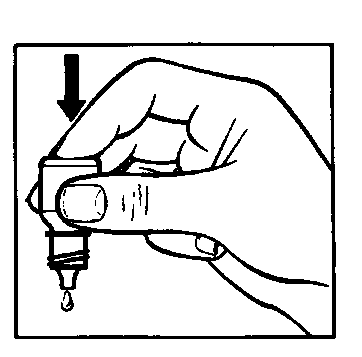
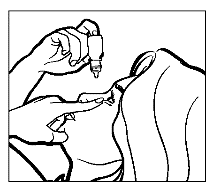
1 2
- Wash your hands.
- Take the bottle and shake it well before unscrewing the cap.
- If you are opening the bottle for the first time, remove the ring detached from the cap before using the product.
- Hold the bottle upside down between your thumb and middle finger.
- Tilt your head back. Lower the eyelid with a clean finger to form a pouch between the eyelid and the eye. The drop should be instilled in this area (figure 1).
- Bring the tip of the bottle close to the eye.
- Do not touch the eye, eyelid, surrounding areas or other surfaces with the dropper tip to avoid infecting the drops remaining in the bottle.
- Gently press the base of the bottle, releasing one drop of FLAREX at a time.
- Do not squeeze the bottle: it is designed so that only a gentle pressure on the bottom is sufficient (figure 2).
- If you are instilling drops in both eyes, repeat the same operation for the other eye.
- Immediately replace the cap after use, screwing it on properly.
- If a drop does not enter the eye, try again.
If you use more FLAREX than you should
If you instill more product than you should, wash your eye thoroughly with running water.
If you accidentally ingest FLAREX, immediately inform your doctor or go to the nearest
hospital.
If you forget to use FLAREX
If you forget to use FLAREX, do not worry and apply it as soon as you remember. However, if it is almost time to
administer the next dose, skip the missed dose and return to the regular dosing schedule.
Do not use a double dose to make up for a missed dose.
If you have any doubts about the use of this medicine, ask your doctor or pharmacist.
4. Possible side effects
Like all medicines, FLAREX can cause side effects, although not everybody gets them.
The following side effects have been reported with the use of FLAREX. Their frequency cannot
be defined based on available data.
- Effects on the eye: increased pressure inside the eye, eye pain, eye irritation, eye discomfort, feeling of a foreign body in the eye, blurred vision, redness of the eye, increased tear production.
- General side effects: bad taste in mouth.
Reporting of side effects
If you get any side effect, even if not listed in this leaflet, tell your
doctor or pharmacist. You can also report side effects directly through the national reporting system at: https://www.aifa.gov.it/content/segnalazioni-reazioni-avverse.
By reporting side effects you can help provide more information on the safety of
this medicine.
5. How to store FLAREX
Keep this medicine out of the sight and reach of children.
Do not store at a temperature above 25°C.
Do not use this medicine after the expiry date which is stated on the bottle and the carton after “Exp.”.
The expiry date refers to the last day of that month. The expiry date refers to the medicine
in intact packaging, correctly stored.
The medicine must not be used for more than 30 days after first opening the container.
Do not dispose of any medicine in wastewater or household waste. Ask your pharmacist how to dispose of
medicines you no longer use. This will help protect the environment.
6. Contents of the pack and other information
What FLAREX contains
- The active ingredient is fluorometolone acetate. 1 ml of eye drops contains 1 mg of fluorometolone acetate.
- The other components are: benzalkonium chloride, disodium edetate, sodium phosphate monobasic monohydrate, tyloxapol, sodium chloride, hydroxyethylcellulose, purified water.
Description of the appearance of FLAREX and contents of the pack
FLAREX eye drops is a suspension from white to off-white in color, contained in a 5 ml plastic dropper bottle
.
Marketing Authorisation Holder
Immedica Pharma AB
SE-113 29 Stockholm
Sweden
Manufacturer
SA ALCON COUVREUR NV, B-2870 Puurs (Belgium).

Не впевнені, чи підходить вам цей лікарський засіб?
Обговоріть симптоми та можливі варіанти лікування з лікарем онлайн.

Виникли питання під час прийому ліків?
Обговоріть свої симптоми та лікування з лікарем онлайн.

- Країна реєстрації
- Лікарська формаEye drops, 0.1%
- Код АТХS01BA07
- Діюча речовина
- Потрібен рецептНі
- Виробник
- Ця інформація надана лише для ознайомлення і не є медичною порадою. Рішення щодо лікування завжди приймає лікар.
- Альтернативи до FLAREXЛікарська форма: Eye drops, suspension, 1 MG/MLДіюча речовина: ФлуорометолонВиробник: BAUSCH & LOMB-IOM S.P.A.Рецепт не потрібенЛікарська форма: Eye drops, suspension, 0.2%Діюча речовина: ФлуорометолонВиробник: THEA FARMA S.P.A.Рецепт не потрібенЛікарська форма: Eye drops, solution, 0.1%Діюча речовина: clobetasoneВиробник: OMNIVISION ITALIA SRLРецепт не потрібен
Аналоги FLAREX в інших країнах
Препарати з тією самою діючою речовиною, доступні в інших країнах.
Аналог FLAREX у Польща
Аналог FLAREX у Іспанія
Лікарі онлайн щодо FLAREX
Застосування, безпека та можливість призначення рецепта — за результатами медичної оцінки.









Отримайте рецепт на FLAREX онлайн
Заповніть форму за 2 хвилини
Розкажіть про симптоми, історію хвороби та потрібний препарат.
Оберіть лікаря або ми призначимо
Оберіть спеціаліста або ми підберемо найближчого доступного лікаря.
Лікар розглядає ваш випадок
Зазвичай протягом 30 хвилин. Може ставити уточнювальні запитання в чаті.
Отримайте в будь-якій аптеці
Електронний рецепт надсилається на вашу пошту — дійсний по всій Польщі.
Часті запитання
FLAREX не потребує рецепта в Італія. Ви можете обговорити з лікарем онлайн, чи підходить цей лікарський засіб для вашої ситуації.
Діюча речовина у FLAREX — Флуорометолон. Це допомагає визначити препарати з тим самим складом, але під іншими торговими назвами.
FLAREX виробляється компанією IMMEDICA PHARMA AB. Назва бренду та упаковка можуть відрізнятися залежно від дистрибʼютора.
Лікарі, зокрема Сімейні лікарі, Психіатри, Дерматологи, Кардіологи, Ендокринологи, Гастроентерологи, Пульмонологи, Нефрологи, Ревматологи, Гематологи, Інфекціоністи, Алергологи, Геріатри, Педіатри, Онкологи, можуть оцінити доцільність застосування FLAREX з урахуванням вашого стану та місцевих правил. Ви можете записатися на онлайн-консультацію, щоб обговорити симптоми та можливі подальші кроки.
Польща має добре розвинену систему охорони здоров'я у великих містах, таких як Варшава, Краків, Вроцлав і Гданськ. Аптеки широко доступні та працюють відповідно до чинного законодавства, забезпечуючи доступ до рецептурних препаратів.
Ви можете придбати FLAREX у Варшаві, Кракові, Вроцлаві або Гданську в будь-якій аптеці за наявності дійсного рецепта.
Щоб отримати рецепт, ви можете скористатися Oladoctor:
Інші препарати з тією самою діючою речовиною (Флуорометолон) включають FLUATON, FLUMETOL, KLOBET. Вони можуть відрізнятися торговою назвою або формою випуску, але містять той самий терапевтичний компонент. Перед зміною або початком прийому нового препарату варто проконсультуватися з лікарем.
