



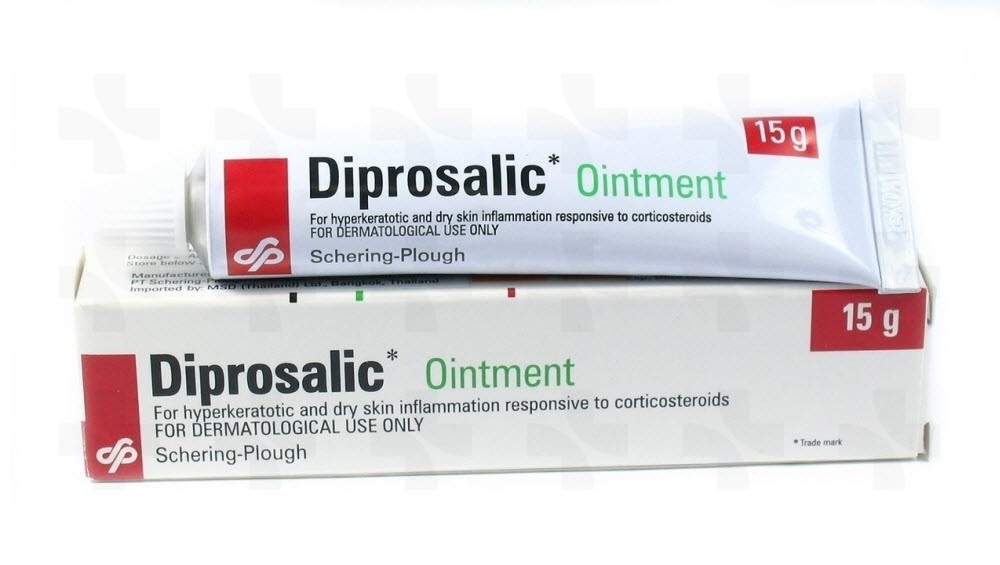
DIPROSALIC 0.05% + 3% Maść

Ocena recepty online
Lekarz przeanalizuje Twój przypadek i zdecyduje, czy wystawienie recepty jest medycznie uzasadnione.

Porozmawiaj z lekarzem o tym leku
Omów swoje objawy i opcje leczenia podczas szybkiej konsultacji online.



Jak stosować DIPROSALIK
Treść ulotki
Diprosalic 0.05%+2% cutaneous solution
betamethasone dipropionate and salicylic acid
Read this leaflet carefully before using this medicine as it contains important
information for you.
- Keep this leaflet. You may need to read it again.
- If you have any questions, ask your doctor or pharmacist.
- This medicine has been prescribed for you only. Do not pass it on to others, even if their symptoms are the same as yours, as it may be harmful.
- If you get any side effects, even those not listed in this leaflet, tell your doctor or pharmacist. See section 4.
Contents of this leaflet:
- 1. What Diprosalic is and what it is used for
- 2. What you need to know before using Diprosalic
- 3. How to use Diprosalic
- 4. Possible side effects
- 5. How to store Diprosalic
- 6. Contents of the pack and other information
1. What is Diprosalic and what is it used for
Diprosalic contains betamethasone dipropionate and salicylic acid.
Betamethasone belongs to a class of medicines called corticosteroids.
Corticosteroids are hormones that perform numerous activities, with an important function in
controlling inflammation.
Salicylic acid macerates the most superficial part of the skin (keratolytic activity), limits the growth of
bacteria (bacteriostatic activity) and kills fungi (fungicidal activity) at the skin level.
Diprosalic cutaneous solution is indicated in the treatment of the following diseases of the scalp and
hair-covered areas:
- psoriasis, characterized by red patches, thickening, silvery-white scaling and sometimes itching;
- seborrheic dermatitis, characterized by a skin rash affecting areas rich in sebaceous glands such as the scalp and hair-covered areas.
2. What you need to know before using Diprosalic
Do not use Diprosalic
- if you are allergic to betamethasone, other corticosteroids or salicylic acid, other salicylates or any of the other ingredients of this medicine (listed in section 6);
- if you have vaccinal pustules, characterized by skin elevations of various sizes containing pus;
- if you have infectious diseases such as chickenpox, Herpes simplex and skin tuberculosis.
Warnings and precautions
Consult your doctor or pharmacist before using Diprosalic.
Do not allow Diprosalic to come into contact with your eyes and mucous membranes (mouth or genitals). If you use Diprosalic in
the presence of skin infections, your doctor will prescribe adequate therapy against bacteria or
fungi. Your doctor will discontinue treatment with Diprosalic if it should not be effective.
All adverse effects that are reported after systemic use of corticosteroids (administered
for example by mouth) can also occur with corticosteroids applied locally to the skin
(topical use), especially in infants and children.
Do not use with occlusive (non-breathable, e.g. polyethylene) dressings.
The use, especially if prolonged, of products applied to the skin can cause allergic reactions. In this
case, your doctor will discontinue treatment and prescribe suitable therapy.
Your doctor will pay particular attention if you use Diprosalic on large areas of skin or if you apply it under a
occlusive dressing (non-breathable, e.g. polyethylene) or when long-term use is expected, especially in infants and children.
If during treatment you notice that the skin becomes excessively dry or further irritated,
discontinue therapy with Diprosalic.
Contact your doctor if you experience blurred vision or other visual disturbances.
Children
If you use Diprosalic in a child, more harmful effects may occur compared to those that
occur in adults.
Corticosteroids used locally in children can affect certain hormones (suppression
of the adrenal-hypothalamic-pituitary axis and Cushing's syndrome), cause growth retardation,
increase in weight and cause an increase in pressure inside the skull (intracranial
hypertension) characterized by bulging fontanelles and severe headache. The manifestations
of adrenal suppression in children include low levels of cortisol in the plasma and absence of
response to ACTH stimulation.
Other medicines and Diprosalic
Tell your doctor or pharmacist if you are taking, have recently taken or might take any other
medicines.
Betamethasone dipropionate and salicylic acid, administered to the skin at the recommended doses, do not
interact significantly with other medicines.
However, if you need to apply Diprosalic to large areas of the skin or for long periods, it may have some
interactions with other medicines.
The effectiveness of betamethasone is reduced by:
- barbiturates (medicines used mainly for the treatment of anxiety and to induce sleep);
- antihistamines (medicines used for the treatment of allergies);
- diphenylhydantoin (medicine used for the treatment of epilepsy).
The effectiveness of betamethasone is increased by:
- salicylates and phenylbutazone (medicines used for the treatment of inflammation).
Betamethasone reduces the effect of:
- oral hypoglycemic agents and insulin (medicines used for the treatment of diabetes). Salicylic acid increases the effect of:
- oral antidiabetics;
- sulfonamides (medicines used for the treatment of bacterial infections);
- methotrexate (medicine used for the treatment of some types of cancer and diseases of the body's defense system);
- probenecid (medicine used for the treatment of gout).
In addition, an interaction of salicylic acid with heparin (medicine used for
fluidifying the blood) and with naproxen (medicine used for the treatment of inflammation and
fever) has also been reported. In the first case, bleeding induction occurred, in the second case an
increased elimination of the medicine through the kidneys.
Pregnancy and breastfeeding
If you are pregnant, suspect you are pregnant or are planning a pregnancy, or if you are breastfeeding with
breast milk, ask your doctor or pharmacist for advice before using this medicine.
Pregnancy
If you are pregnant, use Diprosalic only if your doctor believes that the potential benefit for
you justifies the possible risk to the fetus.
Do not use Diprosalic in large areas of the body, in large quantities or for prolonged periods.
Breastfeeding
It is not known whether the medicine passes into breast milk. Your doctor will decide whether to discontinue
breastfeeding or discontinue treatment with Diprosalic, taking into account how
important the therapy with this medicine is for you.
As with any other medicine similar to this one, if you are pregnant or breastfeeding, the
doctor will prescribe Diprosalic only when necessary and will monitor you.
Driving and operating machinery
This medicine does not affect the ability to drive vehicles and operate machinery.
3. How to use Diprosalic
Use this medicine following exactly the instructions of your doctor or pharmacist. If you have
any doubts, consult your doctor or pharmacist.
Apply Diprosalic cutaneous solution 2 times a day.
Apply a few drops of cutaneous solution, in a sufficient quantity to cover the entire affected area and
gently massage until completely absorbed.
Sometimes, adequate maintenance therapy can be achieved with a single application a day.
If you use more Diprosalic than you should
Avoid excessive and prolonged use on large areas of the skin of Diprosalic, as it may cause a
incorrect functioning of the adrenal glands (manifestations due to an excessive functioning of the
adrenal glands, including Cushing's syndrome) and may manifest symptoms
due to excess salicylic acid (increased breathing, liver damage, nausea, vomiting,
heartburn, ringing in the ears, excessive sleepiness and confusion). In this case, your doctor will
advise you to stop treatment, reduce the frequency of applications or replace Diprosalic
with another medicine.
If you forget to use Diprosalic
Do not use a double dose to make up for a missed dose.
If you stop using Diprosalic
If you have any doubts about the use of this medicine, consult your doctor or pharmacist.
4. Possible side effects
Like all medicines, this medicine can cause side effects, although not everyone will experience them.
Systemic side effects (affecting the whole body) are very rare; however, their occurrence may be favored when applying the medicine to extensive areas of the skin, with high doses and for prolonged periods, especially if you use the medicine in infants and children.
In the treatment area, the following may occur:
- burning sensation;
- irritation;
- dryness of the skin;
- infection involving the upper part of the hair follicle (folliculitis);
- development of acne;
- increased hair growth (hypertrichosis);
- alteration of skin color (hypopigmentation);
- thinning of the skin (skin atrophy);
- inflammation with red skin rashes around the mouth (perioral dermatitis);
- allergic skin reaction due to contact (allergic contact dermatitis);
- skin inflammation (dermatitis). The following effects may be more frequent with the use of occlusive dressings:
- skin maceration;
- infection;
- thinning of the skin (skin atrophy);
- skin striae;
- itchy rash with sweat retention (miliaria).
The following effects may occur with unknown frequency:
- blurred vision.
Reporting of side effects
If you experience any side effects, including those not listed in this leaflet, please inform your doctor or pharmacist. You can also report side effects directly through the national reporting system at https://www.aifa.gov.it/content/segnalazioni-reazioni-avverse.
By reporting side effects, you can help provide more information on the safety of this medicine.
5. How to store Diprosalic
Do not store at a temperature above 25°C.
Keep the bottle in the outer packaging to protect the medicine from light.
After first opening, Diprosalic cutaneous solution is valid for 6 weeks.
Being a hydroalcoholic solution, the preparation is flammable.
Keep this medicine out of the sight and reach of children.
Do not use this medicine after the expiry date which is reported on the pack after “Exp”.
The expiry date refers to the last day of that month.
Do not dispose of any medicine in the wastewater or household waste. Ask your pharmacist how
to eliminate medicines that you no longer use. This will help protect the environment.
6. Contents of the pack and other information
What Diprosalic contains
- The active ingredients are betamethasone dipropionate and salicylic acid. 100 g of cutaneous solution contains betamethasone dipropionate 0.064 g and salicylic acid 2 g;
- The other ingredients are: sodium edetate, hypromellose, sodium hydroxide, isopropyl alcohol, purified water.
Description of the appearance of Diprosalic and contents of the pack
Diprosalic cutaneous solution, bottle of 30 g.
Marketing authorisation holder and manufacturer
Marketing authorisation holder:
Organon Italia S.r.l.
Piazza Carlo Magno, 21
00162 Roma
Manufacturer:
Cenexi HSC - 2, rue Louis Pasteur - 14200 Hérouville Saint-Clair, France

Nie jesteś pewien, czy ten lek jest odpowiedni dla ciebie?
Omów swoje objawy i leczenie z lekarzem online.

Zacząłeś przyjmować lek i masz pytania?
Omów swoje objawy i leczenie z lekarzem online.
- Kraj rejestracji
- Postać farmaceutycznaOintment, 0.05% + 3%
- Kod ATCD07XC01
- Substancja czynna
- Wymaga receptyTak
- Producent
- Te treści mają charakter wyłącznie informacyjny i nie zastępują konsultacji lekarskiej.
- Zamienniki DIPROSALIKPostać farmaceutyczna: Ointment, 0.5 mg/g, 30 mg/gSubstancja czynna: betamethasoneProducent: LABORATOIRES MEDGEN SASWymaga receptyPostać farmaceutyczna: Ointment, 15 MG/G + 15 MG/G + 0,5 MG/GSubstancja czynna: betamethasoneProducent: IDI FARMACEUTICI S.R.L.Wymaga receptyPostać farmaceutyczna: Topical solution, 0.5 MG/G AND 20 MG/GSubstancja czynna: betamethasoneProducent: MIBE PHARMA ITALIA S.R.L.Wymaga recepty
Odpowiedniki DIPROSALIK w innych krajach
Leki z tą samą substancją czynną dostępne w innych krajach.
Odpowiednik DIPROSALIK w Polska
Odpowiednik DIPROSALIK w Ukraina
Odpowiednik DIPROSALIK w Hiszpania
Lekarze online w sprawie DIPROSALIK
Omów stosowanie DIPROSALIK, bezpieczeństwo i ocenę zasadności recepty zgodnie z obowiązującymi przepisami.



Uzyskaj receptę na DIPROSALIK online
Wypełnij 2-minutowy formularz
Opisz swoje objawy, historię choroby i lek, o który prosisz.
Wybierz lekarza lub pozwól nam przydzielić
Wybierz specjalistę lub dopasujemy Cię do najbliższego dostępnego lekarza.
Lekarz analizuje Twój przypadek
Zazwyczaj w ciągu 30 minut. Może zadawać dodatkowe pytania przez czat.
Odbierz w dowolnej aptece
Recepta elektroniczna wysłana na Twój e-mail — ważna w całej Polsce.
Często zadawane pytania
DIPROSALIK wymaga recepty w Włochy. Możesz skonsultować się z lekarzem online, aby sprawdzić, czy ten lek może być odpowiedni w Twojej sytuacji.
Substancją czynną w DIPROSALIK jest betamethasone. Informacja ta pomaga rozpoznać leki o tym samym składzie, ale pod różnymi nazwami handlowymi.
DIPROSALIK jest produkowany przez ORGANON ITALIA S.R.L.. Nazwy handlowe i opakowania mogą się różnić w zależności od dystrybutora.
Lekarze, tacy jak Lekarze rodzinni, Psychiatrzy, Dermatolodzy, Kardiolodzy, Endokrynolodzy, Gastroenterolodzy, Pulmonolodzy, Nefrolodzy, Reumatolodzy, Hematolodzy, Zakaźnicy, Alergolodzy, Geriatrzy, Pediatrzy, Onkolodzy, mogą ocenić, czy stosowanie DIPROSALIK jest odpowiednie w Twoim przypadku, w zależności od sytuacji klinicznej i lokalnych przepisów. Możesz umówić konsultację online, aby omówić objawy i możliwe dalsze kroki.
Polska posiada dobrze rozwiniętą infrastrukturę ochrony zdrowia w dużych miastach, takich jak Warszawa, Kraków, Wrocław i Gdańsk. Apteki są łatwo dostępne i działają zgodnie z obowiązującymi przepisami, zapewniając dostęp do leków na receptę.
Możesz kupić DIPROSALIK w Warszawie, Krakowie, Wrocławiu lub Gdańsku w każdej aptece, posiadając ważną receptę.
Aby uzyskać receptę, możesz skorzystać z Oladoctor:
Inne leki zawierające tę samą substancję czynną (betamethasone) to m.in. BELASIK, DERMATAR, SODERM. Mogą one różnić się nazwą handlową lub postacią, ale zawierają ten sam składnik terapeutyczny. Przed zmianą lub rozpoczęciem nowego leku skonsultuj się z lekarzem.
