



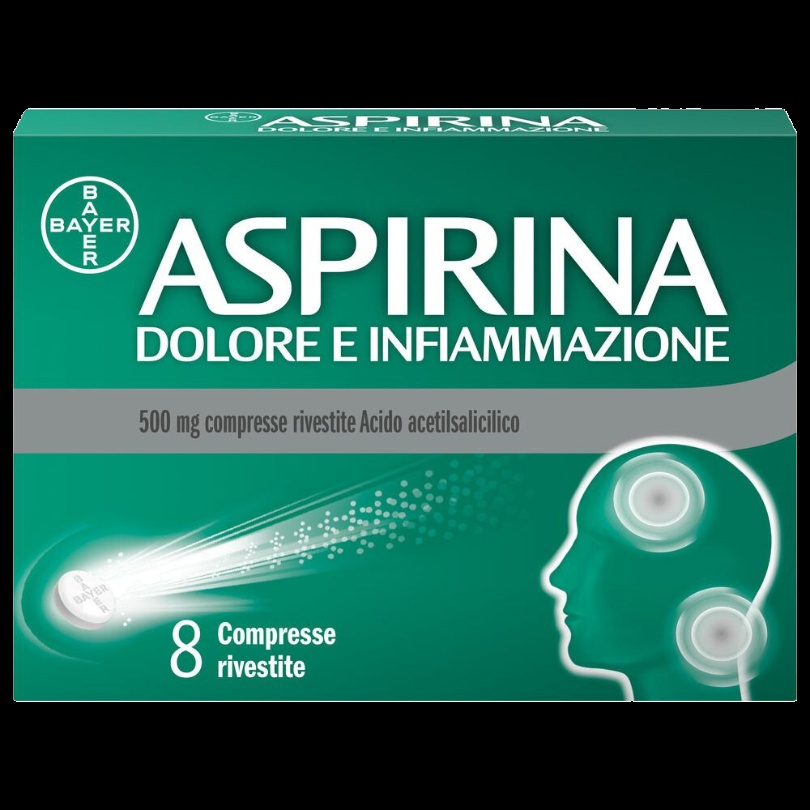
ASPIRINA 500 mg Tabletka Powlekana

Ocena recepty online
Lekarz przeanalizuje Twój przypadek i zdecyduje, czy wystawienie recepty jest medycznie uzasadnione.

Porozmawiaj z lekarzem o tym leku
Omów swoje objawy i opcje leczenia podczas szybkiej konsultacji online.



Jak stosować ASPIRINA DOLORE E INFIAMMATSIONE
Treść ulotki
- What is Aspirina Dolore e Infiammazione and what is it for
- What you need to know before taking Aspirina Dolore e Infiammazione
- How to take Aspirina Dolore e Infiammazione
- Possible side effects
- How to store Aspirina Dolore e Infiammazione
- Contents of the pack and other information
Aspirina Dolore e Infiammazione
500 mg coated tablets
Acetylsalicylic acid
contains important information for you.
doctor or pharmacist told you to do.
- If you want more information or advice, consult your pharmacist.
- If any undesirable effect occurs, consult your doctor or pharmacist. This advice applies even in the case of any possible undesirable effect not listed in
- Consult your doctor if you do not notice any improvement or if you notice a worsening of symptoms after 3 days (for fever) or 3-4 days (for pain)
Over-the-counter medicine
- 1. What is Aspirina Dolore e Infiammazione and what is it used for
- 2. What you need to know before taking Aspirina Dolore e Infiammazione
- 3. How to take Aspirina Dolore e Infiammazione
- 4. Possible side effects
- 5. How to store Aspirina Dolore e Infiammazione
- 6. Contents of the pack and other information
1. What is Aspirina Dolore e Infiammazione and what is it for
Aspirina Dolore e Infiammazione contains acetylsalicylic acid. Acetylsalicylic acid is an
analgesic (reduces pain) and antipyretic (reduces fever).
Aspirina Dolore e Infiammazione is used for the symptomatic treatment of fever and/or
mild to moderate pain, such as headache, flu syndrome, toothache, muscle pain.
Aspirina Dolore e Infiammazione is specifically reserved for adults and adolescents aged 16 years or
over.
Consult your doctor or pharmacist for other forms of acetylsalicylic acid for patients weighing
less than 40 kg.
Consult your doctor if you do not notice any improvement or if your symptoms worsen after 3 days
(for fever) or 3 - 4 days (for pain).
2. What you need to know before taking Aspirina Dolore e Infiammazione
Do not take Aspirina Dolore e Infiammazione:
- if you are allergic to acetylsalicylic acid or other salicylates or to any of the other ingredients of this medicine (listed in section 6);
- if you have suffered from asthma or allergic reactions (e.g. urticaria, angioedema, severe rhinitis, shock) induced by the administration of acetylsalicylic acid or related medicines (particularly non-steroidal anti-inflammatory drugs);
- if you suffer from gastric or intestinal ulcer (including duodenal ulcer);
- if you suffer from a bleeding condition or are at risk of bleeding;
- if you suffer from severe hepatic, renal or cardiac insufficiency;
- if you are taking methotrexate therapy at doses higher than 15 mg/week;
- if you are taking oral anticoagulants (medicines to “thin” the blood and prevent the formation of clots);
- if you are after the 5th month of pregnancy (more than 24 weeks of absence of menstruation);
- Children and adolescents under 16 years of age. If you have any doubts, ask your doctor or pharmacist before taking this medicine.
Warnings and precautions
Consult your doctor or pharmacist before taking Aspirina Dolore e Infiammazione:
- if you are taking other products containing acetylsalicylic acid, to avoid the risk of overdose
- if you experience headache while taking high doses of acetylsalicylic acid for a prolonged period of time, do not increase the dosage but rather ask your doctor or pharmacist for advice;
- if you use painkillers regularly, especially painkillers of different types in combination, this may lead to reduced kidney function;
- if you have a G6PD deficiency (Glucose-6-phosphate dehydrogenase), an inherited disease that affects red blood cells, because high doses of acetylsalicylic acid could lead to hemolysis (destruction of red blood cells);
- if you have a history of gastric or intestinal ulcers, or gastric or intestinal bleeding or gastritis;
- if you suffer from hepatic or renal insufficiency
- if you suffer from asthma: the occurrence of an asthma attack, in some patients, may be linked to an allergic reaction to non-steroidal anti-inflammatory drugs or acetylsalicylic acid. In this case, the use of this medicine is not recommended;
- in case of heavy menstrual bleeding
- if gastrointestinal bleeding occurs during treatment (blood from the mouth, blood in the stool, dark stools): stop treatment and call your doctor or emergency room immediately;
- if you are also taking medicines that thin the blood and prevent its coagulation (anticoagulants);
- if you suffer from mild or moderate impairment of renal function
- if you suffer from impaired cardiovascular circulation
- acetylsalicylic acid increases the risk of bleeding even at low doses and even several days after taking it. Inform your doctor, surgeon or anesthesiologist or dentist if surgery is planned, even minor surgery.
- acetylsalicylic acid modifies the amount of uric acid in the blood. This must be taken into consideration if you are taking a medicine for gout.
- It is recommended not to take this medicine during breastfeeding.
Children
In children with viral diseases and undergoing administration of acetylsalicylic acid, Reye's syndrome has been observed (a rare but very serious disease mainly associated with neurological damage and liver damage). Consequently:
- in case of viral illness such as influenza or chickenpox, the administration of acetylsalicylic acid to a child should not occur without first consulting a doctor;
- if signs of dizziness or fainting, behavioral changes or vomiting occur in a child taking acetylsalicylic acid, immediately notify your doctor.
Other medicines and Aspirina Dolore e Infiammazione
Tell your doctor or pharmacist if you are taking, have recently taken or might take any other medicines.
In the following text, the following definitions are used:
acetylsalicylic acid can be used for the treatment of rheumatic diseases at high doses (called “anti-inflammatory doses”)defined as: 1 g or more as a single dose and/or 3 g or more per day.
Acetylsalicylic acid can be used for the treatment of pain and fever in dosesdefined as follows: 500 mg or more as a single dose and/or no more than 3 g per day.
Do not take Aspirina Dolore e Infiammazione:
- if you are being treated with methotrexate at doses higher than 15 mg/week. In this case, acetylsalicylic acid should be avoided when used at high doses (anti-inflammatory) or for the treatment of pain and fever.
- if you are being treated with oral anticoagulants and have a history of gastroduodenal ulcer. In this case, acetylsalicylic acid should be avoided when used at high doses (anti-inflammatory) or for the treatment of pain and fever.
Consult your doctor or pharmacist before taking acetylsalicylic acid with any of the following medicines:
- oral anticoagulants, when acetylsalicylic acid is used for the treatment of pain and fever and there is no history of gastro-duodenal ulcers
- non-steroidal anti-inflammatory drugs when acetylsalicylic acid is used at high doses (anti-inflammatory) or for the treatment of pain and fever.
- heparins used at curative doses, or in elderly patients (≥ 65 years) when acetylsalicylic acid is used at high doses (anti-inflammatory) particularly for the treatment of rheumatic diseases or for the treatment of pain and fever.
- thrombolytics
- clopidogrel
- ticlopidine
- uricosuric medicines used for the treatment of gout (e.g.: benzobromarone, probenecid)
- glucocorticoids (except replacement therapy with hydrocortisone) when acetylsalicylic acid is used at high doses (anti-inflammatory);
- pemetrexed, in patients with mild to moderate renal impairment
- anagrelide
- medicines for the treatment of fluid retention (diuretics);
- angiotensin-converting enzyme inhibitors, angiotensin II receptor antagonists
- methotrexate used at doses equal to or less than 15 mg/week;
- gastrointestinal topical treatments, antacids and activated charcoal;
- deferasirox
- selective serotonin reuptake inhibitors (e.g.: citalopram, escitalopram, fluoxetine, fluvoxamine, paroxetine, sertraline).
To avoid any interaction effects between medicines, you must inform your doctor or pharmacist of any other medicine you are taking.
Aspirina Dolore e Infiammazione with alcohol
Do not take Aspirina Dolore e Infiammazione together with alcohol.
Pregnancy, breastfeeding and fertility
If you are pregnant or breastfeeding, suspect you are pregnant or are planning to have a baby, ask your doctor or pharmacist for advice before taking this or any other medicine.
Pregnancy
In the first five months of pregnancy, you should consult your doctor before taking this medicine or any other product containing acetylsalicylic acid. From the beginning of the 6th month of pregnancy (more than 24 weeks of absence of menstruation), you must not take this medicine for any reason because it can cause serious harm to you and your baby. If you have taken this medicine during pregnancy, you should contact your doctor immediately.
Breastfeeding
This medicine can pass into breast milk. As a precaution, Aspirina Dolore e Infiammazione is not recommended during breastfeeding.
Fertility
The product belongs to a group of medicines that can alter fertility in women. This effect is reversible once the use of the medicine is stopped.
Driving and using machines
Acetylsalicylic acid has no influence on the ability to drive vehicles and operate machinery.
Aspirina dolore e infiammazione contains sodium
This medicine contains 71.7mg of sodium (the main component of table salt) per dose.
This is equivalent to 3.6% of the recommended maximum daily intake with the diet of an adult.

Nie jesteś pewien, czy ten lek jest odpowiedni dla ciebie?
Omów swoje objawy i leczenie z lekarzem online.
3. How to take Aspirina Dolore e Infiammazione
as your doctor or pharmacist has told you. If you have any doubts, consult your doctor or pharmacist.
Dosage
For oral use only.
Adults and adolescents (over 16 years):
- The recommended single dose is 1 tablet, which, if necessary, can be taken again after at least 4 hours have elapsed. In case of more intense fever or pain, the dosage is 2 tablets, which can be taken again if necessary after at least 4 hours have elapsed.
- The total daily dosage should not exceed 6 tablets.
Elderly (65 years and over)
- The recommended single dose is 1 tablet, which can be taken again if necessary after at least 4 hours have elapsed.
- The total daily dosage should not exceed 4 tablets.
Particular groups of patients:
- Patients with abnormal liver or kidney function, or circulatory problems (e.g. with heart failure or major haemorrhagic events): ask your doctor or pharmacist for advice.
- Children and adolescents under 16 years of age: do not use the medicine without a prescription. Method of administrationTo open the blister, tear the inside from any edge. Take the tablets with an adequate amount of water.
Duration of use
Do not take this medicine for more than 3 days (in case of fever) or 3-4 days (in case of
pain) unless otherwise indicated by your doctor.
If you take more Aspirina Dolore e Infiammazione than you should:
During treatment, you may experience ringing in the ears, a feeling of
hearing loss, headache, dizziness: these are typical signs of overdose.
If you suspect an overdose of this product, stop treatment and seek immediate
medical attention.
If you forget to take Aspirina Dolore e Infiammazione:
Do not take a double dose to make up for a missed dose.
4. Possible side effects
Like all medicines, this medicine can cause side effects, although not everybody gets them.
Frequencies: not known: the frequency cannot be estimated from available data.
Possible side effects due to acetylsalicylic acid are:
These side effects are all very serious and you may urgently need medical attention or hospitalisation. Tell your doctor immediately or go to the nearest hospital if you notice any of the following symptoms:
- bleeding (nosebleeds or bleeding gums, red spots under the skin)
- allergic reactions such as skin rash, asthma attack or swelling of the face accompanied by difficulty breathing.
- headache, dizziness, feeling of hearing loss, tinnitus (ringing in the ears) which are usually signs of overdose
- cerebral haemorrhage
- stomach pain
- gastrointestinal bleeding. See section "Warnings and precautions". These occur more frequently when taking high doses.
- Increased liver enzymes, generally reversible with discontinuation of treatment, alteration
of liver function (particularly liver cells)
- urticaria, skin reactions
- Reye's syndrome (altered state of consciousness or abnormal behaviour, or vomiting) in children with viral illnesses who are taking acetylsalicylic acid (see Section 2: What you need to know before taking Aspirina Dolore e Infiammazione)
- impaired kidney function and acute kidney damage
- disease of the intestinal diaphragm (a narrowing of the intestine), especially with long-term treatment.
Reporting of side effects
If you get any side effects, talk to your doctor or pharmacist. This includes any possible side effects not listed in this leaflet.
You can also report side effects directly via the website:
https://www.aifa.gov.it/content/segnalazioni-reazioni-avverse.
By reporting side effects you can help provide more information on the safety of
this medicine.

Zacząłeś przyjmować lek i masz pytania?
Omów swoje objawy i leczenie z lekarzem online.
5. How to store Aspirina Dolore e Infiammazione
Keep this medicine out of the sight and reach of children.
Do not use this medicine after the expiry date which is stated on the label. The expiry date
refers to the last day of that month.
Do not store at a temperature above 30°C.
Do not use this product if you notice visible signs of deterioration.
Store in the original packaging to protect from light and moisture.
Do not dispose of any medicine in wastewater or household waste. Ask your pharmacist how
to dispose of medicines you no longer use. This will help protect the environment.
6. Contents of the pack and other information
What Aspirina Dolore e Infiammazione contains
The active ingredient is acetylsalicylic acid
Each coated tablet contains 500 mg of acetylsalicylic acid.
The other ingredients are:
Colloidal silicon dioxide, Sodium carbonate
Coating:
Carnauba wax, Hypromellose, Zinc stearate
Description of the appearance of Aspirina Dolore e Infiammazione and contents of the pack
This medicine is presented in the form of white or off-white, round biconvex coated tablets
of 12 mm. The tablets bear the inscription “BA 500” printed on one side and the Bayer cross printed
on the other.
The pack contains 8, 12, 20 or 24 tablets
Not all pack sizes may be marketed
Marketing authorisation holder and manufacturer
Marketing authorisation holder:
Bayer Spa Viale Certosa 130- 20156 Milan- Italy
Manufacturer:
Bayer Bitterfeld GmbH
Salegaster Chausee 1
06803 Bitterfeld-Wolfen
Germany
This medicine is authorised in the Member States of the European Union with the brand
Italy: Aspirina Dolore e Infiammazione
This leaflet was last revised on:
- Kraj rejestracji
- Postać farmaceutycznaCoated tablet, 500 MG
- Kod ATCN02BA01
- Substancja czynna
- Wymaga receptyNie
- Producent
- Te treści mają charakter wyłącznie informacyjny i nie zastępują konsultacji lekarskiej.
- Zamienniki ASPIRINA DOLORE E INFIAMMATSIONEPostać farmaceutyczna: Tablet, 500 MGSubstancja czynna: acetylsalicylic acidProducent: LABORATORIO FARMACOLOGICO MILANESE S.R.L.Bez receptyPostać farmaceutyczna: Powder and solvent for injectable solution, 500 mg/2.5 mlSubstancja czynna: acetylsalicylic acidProducent: PANMEDICAWymaga receptyPostać farmaceutyczna: Tablet, 500 MGSubstancja czynna: acetylsalicylic acidProducent: BAYER S.P.A.Bez recepty
Odpowiedniki ASPIRINA DOLORE E INFIAMMATSIONE w innych krajach
Leki z tą samą substancją czynną dostępne w innych krajach.
Odpowiednik ASPIRINA DOLORE E INFIAMMATSIONE w Polska
Odpowiednik ASPIRINA DOLORE E INFIAMMATSIONE w Ukraina
Odpowiednik ASPIRINA DOLORE E INFIAMMATSIONE w Hiszpania
Lekarze online w sprawie ASPIRINA DOLORE E INFIAMMATSIONE
Omów stosowanie ASPIRINA DOLORE E INFIAMMATSIONE, bezpieczeństwo i ocenę zasadności recepty zgodnie z obowiązującymi przepisami.









Uzyskaj receptę na ASPIRINA DOLORE E INFIAMMATSIONE online
Wypełnij 2-minutowy formularz
Opisz swoje objawy, historię choroby i lek, o który prosisz.
Wybierz lekarza lub pozwól nam przydzielić
Wybierz specjalistę lub dopasujemy Cię do najbliższego dostępnego lekarza.
Lekarz analizuje Twój przypadek
Zazwyczaj w ciągu 30 minut. Może zadawać dodatkowe pytania przez czat.
Odbierz w dowolnej aptece
Recepta elektroniczna wysłana na Twój e-mail — ważna w całej Polsce.
Często zadawane pytania
ASPIRINA DOLORE E INFIAMMATSIONE nie wymaga recepty w Włochy. Możesz skonsultować się z lekarzem online, aby sprawdzić, czy ten lek może być odpowiedni w Twojej sytuacji.
Substancją czynną w ASPIRINA DOLORE E INFIAMMATSIONE jest acetylsalicylic acid. Informacja ta pomaga rozpoznać leki o tym samym składzie, ale pod różnymi nazwami handlowymi.
ASPIRINA DOLORE E INFIAMMATSIONE jest produkowany przez BAYER S.P.A.. Nazwy handlowe i opakowania mogą się różnić w zależności od dystrybutora.
Lekarze, tacy jak Lekarze rodzinni, Psychiatrzy, Dermatolodzy, Kardiolodzy, Endokrynolodzy, Gastroenterolodzy, Pulmonolodzy, Nefrolodzy, Reumatolodzy, Hematolodzy, Zakaźnicy, Alergolodzy, Geriatrzy, Pediatrzy, Onkolodzy, mogą ocenić, czy stosowanie ASPIRINA DOLORE E INFIAMMATSIONE jest odpowiednie w Twoim przypadku, w zależności od sytuacji klinicznej i lokalnych przepisów. Możesz umówić konsultację online, aby omówić objawy i możliwe dalsze kroki.
Polska posiada dobrze rozwiniętą infrastrukturę ochrony zdrowia w dużych miastach, takich jak Warszawa, Kraków, Wrocław i Gdańsk. Apteki są łatwo dostępne i działają zgodnie z obowiązującymi przepisami, zapewniając dostęp do leków na receptę.
Możesz kupić ASPIRINA DOLORE E INFIAMMATSIONE w Warszawie, Krakowie, Wrocławiu lub Gdańsku w każdej aptece, posiadając ważną receptę.
Aby uzyskać receptę, możesz skorzystać z Oladoctor:
Inne leki zawierające tę samą substancję czynną (acetylsalicylic acid) to m.in. AKIDO AKETILSALIKILIKO L.F.M., AKIDO AKETILSALIKILIKO PANPARMA, ASPIRINA. Mogą one różnić się nazwą handlową lub postacią, ale zawierają ten sam składnik terapeutyczny. Przed zmianą lub rozpoczęciem nowego leku skonsultuj się z lekarzem.
