



SUMMAFLOX 250 mg Film-Coated Tablets

Запит на рецепт онлайн
Лікар розгляне ваш випадок і визначить, чи є рецепт медично доцільним.

Поговоріть з лікарем про ці ліки
Обговоріть симптоми та можливі подальші кроки під час короткої онлайн-консультації.



Інструкція із застосування SUMMAFLOX
Зміст інструкції
SUMMAFLOX 250 mg film-coated tablets, 500 mg film-coated tablets
Levofloxacin
Generic medicine
Read this leaflet carefully before taking this medicine as it contains
important information for you.
- Keep this leaflet. You may need to read it again.
- If you have any questions, ask your doctor or pharmacist.
- This medicine has been prescribed for you only. Do not pass it on to others, even if they have the same symptoms as you, as it may be harmful.
- If you get any side effects, even those not listed in this leaflet, tell your doctor or pharmacist. See section 4.
Contents of this leaflet:
- 1. What SUMMAFLOX tablets are and what they are used for
- 2. What you need to know before you take SUMMAFLOX tablets
- 3. How to take SUMMAFLOX tablets
- 4. Possible side effects
- 5. How to store SUMMAFLOX tablets
- 6. Contents of the pack and other information
1. What is SUMMAFLOX tablets and what it is used for
SUMMAFLOX tablets contains the active substance called levofloxacin. This medicine
belongs to the group of medicines called antibiotics. Levofloxacin is a “quinolone” antibiotic.
This medicine works by killing the bacteria that cause infections
in the body.
SUMMAFLOX tablets can be used for the treatment of infections:
- of the facial sinuses
- of the lungs, in patients suffering from chronic respiratory problems or pneumonia
- of the urinary tract, including kidneys and bladder
- of the prostate, where a persistent infection may develop
- of the skin and subcutaneous tissue, including muscles. These are sometimes called “soft tissues”.
2. Cosa deve sapere prima di prendere SUMMAFLOX compresse
Non prenda questo medicinale e informi il medico se:
- è allergico (ipersensibile) alla levofloxacina, a qualsiasi altro antibiotico chinolonico come moxifloxacina, ciprofloxacina o ofloxacina o ad uno qualsiasi degli altri componenti di questo medicinale (elencati al paragrafo 6).
- I segni di una reazione allergica comprendono: eruzione cutanea, problemi di deglutizione o respiratori, gonfiore delle labbra, del volto, della gola o della lingua.
- ha avuto l’ epilessia
- ha avuto problemi a carico dei tendini, come la tendinite, correlati al trattamento con un “antibiotico chinolonico”. I tendini sono delle strutture fibrose che uniscono i muscoli dello scheletro
- è un bambino o un adolescente nel periodo della crescita
- è in gravidanza, può rimanere incinta o pensa di esserlo
- sta allattando al seno
Non prenda questo medicinale se quanto sopra può in qualche modo riguardarla. Se ha qualsiasi
dubbio, si rivolga al medico o al farmacista prima di prendere SUMMAFLOX compresse.
Avvertenze e precauzioni
Si rivolga al medico o al farmacista prima di prendere questo medicinale se:
- ha 60 anni o è più anziano
- sta assumendo corticosteroidi, chiamati a volte steroidi (vedere “Altri medicinali e SUMMAFLOX compresse”)
- è stato sottoposto a trapianto
- ha avuto delle crisi epilettiche
- ha subito danni al cervello in seguito ad un ictus o ad altri danni cerebrali
- ha problemi ai reni
- se soffre di una malattia conosciuta come “carenza della glucosio-6-fosfato-deidrogenasi”. La somministrazione di questo medicinale rende più probabile lo sviluppo di problemi gravi a carico del sangue.
- ha sofferto di problemi mentali
- ha avuto problemi cardiaci: deve esercitare cautela quando usa questo tipo di medicinale se è nato/a con o ha una storia familiare di prolungamento dell’intervallo QT (visto all’elettrocardiogramma, il tracciato elettrico del cuore), ha uno sbilanciamento salino nel sangue (soprattutto bassi livelli di potassio o magnesio nel sangue), ha un ritmo cardiaco molto basso (chiamato “bradicardia”), ha un cuore debole (insufficienza cardiaca), ha avuto un attacco cardiaco (infarto del miocardio), è una donna o anziano/a o sta prendendo altri medicinali che possono alterare l’elettrocardiogramma (vedere paragrafo “Altri medicinali e SUMMAFLOX compresse ”)
- ha il diabete
- se ha il diabete ha avuto problemi al fegato
- ha la myastenia gravis.
- ha problemi ai nervi (neuropatia periferica)
- se le è stato diagnosticato un aumento delle dimensioni o “ingrossamento” di un grande vaso sanguigno (aneurisma dell’aorta o aneurisma periferico di un grande vaso sanguigno).
- se ha già subito in precedenza episodi di dissezione dell’aorta (una lacerazione della parete
dell’aorta).
- se le è stata diagnosticata l'insufficienza di una delle valvole cardiache (rigurgito aortico e mitralico);
- se ha precedenti familiari di aneurisma dell’aorta, di dissezione dell’aorta o malattia congenita delle valvole cardiache, o di altri fattori di rischio o condizioni predisponenti (ad esempio patologie del tessuto connettivo quali la sindrome di Marfan, la sindrome di Ehlers-Danlos vascolare, sindrome di Turner, sindrome di Sjögren [una malattia infiammatoria autoimmune], o se è affetto da patologie vascolari quali l’arterite di Takayasu, l’arterite a cellule giganti, la sindrome di Behcet, pressione del sangue elevata o aterosclerosi nota, artrite reumatoide [una malattia infiammatoria autoimmune] o endocardite [un’infiammazione del cuore]).
- ha sviluppato una grave reazione della pelle o desquamazione della pelle, vesciche e/o ulcere alla bocca dopo avere preso qualsiasi medicinale contenente levofloxacina.
Gravi reazioni della pelle
Con l’uso di levofloxacina sono state riportate gravi reazioni della pelle, inclusa sindrome di Steven-
Johnson (SJS), necrolisi epidermica tossica (TEN) e reazione da farmaco con eosinofilia e sintomi
sistemici (DRESS).
- SJS e TEN possono inizialmente comparire sul corpo come macchie rossastre o come chiazze circolari spesso con vesciche centrali. Possono anche verificarsi ulcere della bocca, della gola, del naso, dei genitali e degli occhi (occhi rossi e gonfi). Queste gravi eruzioni della pelle sono spesso precedute da febbre e/o sintomi simil-influenzali. Le eruzioni possono progredire fino ad un’ampia desquamazione della pelle e a complicazioni pericolose per la vita o che possono causare la morte.
- DRESS si presenta inizialmente come sintomi simil-influenzali e un’eruzione della pelle sul viso, poi un’eruzione della pelle estesa con febbre, un aumento dei livelli degli enzimi del fegato negli esami del sangue e un aumento di un tipo di globuli bianchi (eosinofilia) e linfonodi ingrossati.
Se lei sviluppa una grave reazione della pelle o un altro di questi sintomi della pelle, smetta di
prendere levofloxacina e contatti il medico o chieda assistenza medica immediatamente.
Non deve prendere medicinali antibatterici a base di chinoloni/fluorochinoloni, incluso SUMMAFLOX,
se in passato ha avuto una qualsiasi reazione avversa grave durante il trattamento con un chinolone
o fluorochinolone. In tal caso, informi il medico al più presto.
Quando sta prendendo questo medicinale:
Se avverte un dolore improvviso all’addome, al petto, o alla schiena, che può essere sintomo di
aneurisma e dissezione dell’aorta, si rechi immediatamente al pronto soccorso. Il rischio può essere
maggiore se lei sta assumendo farmaci corticosteroidi sistemici.
- Informi immediatamente il medico se nota una rapida insorgenza di affanno respiratorio, soprattutto in posizione distesa a letto, o gonfiore delle caviglie, dei piedi o dell’addome, oppure nuovi episodi di palpitazioni cardiache (sensazione di battito cardiaco rapido o irregolare).
- se inizia a manifestare improvvisi scatti involontari, fascicolazioni o contrazioni muscolari - si rivolga subito ad un medico perché potrebbero essere segni di mioclono. Il medico potrebbe dover interrompere il trattamento con levofloxacina e iniziare un trattamento appropriato .
- Se manifesta nausea, sensazione di malessere generale, disturbo grave o dolore persistente o peggioramento del dolore nella zona dello stomaco o vomito, contatti immediatamente il medico in quanto questi potrebbero essere un segno di un’infiammazione del pancreas (pancreatite acuta).
- in caso di stanchezza, pallore della pelle, lividi, sanguinamenti incontrollati, febbre, mal di gola e grave peggioramento delle sue condizioni generali, o se ha la sensazione che la sua resistenza alle infezioni sia diminuita - si rivolga subito ad un medico perché potrebbero essere segni di malattia del sangue. Il medico deve monitorare il sangue con l’emocromo. In caso di emocromo anormale, il medico potrebbe dover interrompere il trattamento.
Raramente possono manifestarsi dolore e gonfiore alle articolazioni e infiammazione o rottura dei
tendini. Il rischio è maggiore se lei è anziano (età superiore a 60 anni), se ha ricevuto un trapianto
d’organo, se ha problemi renali o se è in trattamento con corticosteroidi. L’infiammazione e la rottura
dei tendini possono manifestarsi nelle prime 48 ore di trattamento fino a diversi mesi dopo il
termine della terapia con SUMMAFLOX . Ai primi segni di dolore o infiammazione a un tendine (per
esempio alla caviglia, al polso, al gomito, alla spalla o al ginocchio), interrompa il trattamento con
SUMMAFLOX, si rivolga al medico e tenga la parte dolorante a riposo. Eviti qualsiasi movimento non
necessario, perché il rischio di rottura del tendine potrebbe aumentare.
Raramente possono manifestarsi sintomi di danni ai nervi (neuropatia), quali dolore, bruciore,
formicolio, intorpidimento e/o debolezza, in particolare ai piedi e alle gambe o alle mani e alle
braccia. In tal caso, interrompa il trattamento con SUMMAFLOX e contatti immediatamente il medico,
per evitare che il danno ai nervi diventi permanente.
Effetti indesiderati gravi, prolungati, disabilitanti e che possono non migliorare
I medicinali antibatterici a base di fluorochinoloni/chinoloni, incluso SUMMAFLOX, sono stati
associati a effetti indesiderati molto rari ma gravi, alcuni dei quali prolungati (che durano mesi o
anni), disabilitanti che possono non migliorare. Questi includono dolore ai tendini, ai muscoli e
alle articolazioni di braccia e gambe, difficoltà a camminare, sensazioni anomale quali pizzicore,
formicolio, solletico, intorpidimento o bruciore (parestesia), disturbi agli organi di senso come
alterazione della vista, del gusto, dell’olfatto e dell’udito, depressione, compromissione della
memoria, severo affaticamento e severi disturbi del sonno.
Se si manifesta uno qualsiasi di questi effetti indesiderati dopo avere assunto SUMMAFLOX, si
rivolga immediatamente al medico prima di proseguire il trattamento. Il medico deciderà insieme
a lei se proseguire il trattamento e prenderà in considerazione anche l’uso di un antibiotico di
un’altra classe.
Se ha qualsiasi dubbio che quanto sopra possa in qualche modo riguardarla, si rivolga al medico o
al farmacista prima di prendere SUMMAFLOX compresse.
Altri medicinali e SUMMAFLOX compresse
Informi il medico o il farmacista se sta assumendo o ha recentemente assunto o potrebbe assumere
qualsiasi altro medicinale, compresi quelli senza prescrizione medica, inclusi i fitoterapici. Ciò perché
SUMMAFLOX compresse può influire sul meccanismo d’azione di altri medicinali. Anche alcuni
medicinali possono influire sul meccanismo d’azione di SUMMAFLOX compresse.
In particolare, informi il medico se sta prendendo uno qualsiasi dei seguenti medicinali. Questo
perché la somministrazione di SUMMAFLOX compresse in associazione ad altri medicinali può
aumentare la possibilità che lei manifesti effetti indesiderati:
- corticosteroidi, a volte chiamati steroidi - utilizzati per il trattamento delle infiammazioni. La possibilità che lei sviluppi un’infiammazione e/o la rottura dei tendini è maggiore.
- warfarin - utilizzato per fluidificare il sangue. La possibilità che lei manifesti un’emorragia è maggiore. Il medico può chiederle di eseguire regolarmente degli esami del sangue per controllare la coagulazione del sangue.
- teofillina - utilizzata per problemi respiratori. La possibilità che lei manifesti una crisi (accesso epilettico) è maggiore se lei assume teofillina in associazione con SUMMAFLOX compresse.
- farmaci anti-infiammatori non steroidei (FANS) - usati per il dolore e l’infiammazione come aspirina, ibuprofen, fenbufene, ketoprofene e indometacina. La possibilità che lei manifesti una crisi (accesso epilettico) se presi in associazione con SUMMAFLOX compresse è maggiore.
- ciclosporina - utilizzata per i trapianti d’organo. La possibilità che lei manifesti gli effetti indesiderati tipici della ciclosporina è maggiore.
- medicinali noti per i loro effetti sul battito cardiaco. Questi includono i medicinali utilizzati per
trattare il ritmo cardiaco anormale: (antiaritmici quali chinidina, idrochinidina, disopiramide,
amiodarone, sotalolo, dofetilide, ibutilide), per la depressione (antidepressivi triciclici quali
amitriptilina e imipramina), per i disturbi psichiatrici (antipsicotici) e per le infezioni batteriche
(antibiotici “macrolidi” quali eritromicina, azitromicina e claritromicina).
- probenecid - utilizzato per trattare la gotta. Il medico può prescriverle un dosaggio più basso, se soffre di problemi ai reni.
- cimetidina - utilizzata per le ulcere e i bruciori di stomaco..Il medico può prescriverle un dosaggio più basso, se soffre di problemi ai reni
Non prenda SUMMAFLOX compresse in concomitanza con i seguenti medicinali. Questo perché il
meccanismo di azione di SUMMAFLOX compresse potrebbe esserne influenzato:
- sali di ferro in compresse (per l’anemia), integratori di zinco, antiacidi contenenti magnesio o alluminio (per l’acidità o i bruciori di stomaco), didanosina o sucralfato (per le ulcere gastriche). Vedere paragrafo 3 “Se sta assumendo sali di ferro in compresse, integratori di zinco, antiacidi, didanosina o sucralfato”.
Esame delle urine per oppiacei
Nei pazienti che assumono SUMMAFLOX compresse gli esami delle urine possono dare risultati
“falso-positivi” per forti antidolorifici chiamati “oppiacei”. Se il medico ritiene necessario farle
eseguire degli esami delle urine, lo informi che sta prendendo SUMMAFLOX compresse.
Test della tubercolosi
Questo medicinale può causare risultati “falsi negativi” in alcuni test di laboratorio che ricercano i
batteri che causano la tubercolosi.
Gravidanza e allattamento
Non prenda questo medicinale se:
- è in gravidanza, può rimanere incinta o pensa di esserlo
- sta allattando o pensa di allattare al seno
Chieda consiglio al medico o al farmacista prima di prendere qualsiasi medicinale se è in gravidanza
o se sta allattando.
Guida di veicoli e utilizzo di macchinari
Alcuni effetti indesiderati possono manifestarsi dopo l’assunzione di questo medicinale che
includono capogiri, sonnolenza, sensazione soggettiva di movimento (vertigine) o disturbi visivi.
Alcuni di questi effetti indesiderati possono alterare la capacità di concentrazione e la velocità di
reazione. Se ciò accade, non guidi veicoli o non svolga attività che richiedono un livello di attenzione
elevato.
3. How to take SUMMAFLOX tablets
Always take this medicine exactly as your doctor has instructed. If you have any doubts, consult your doctor or pharmacist.
How to take this medicine
If you are already taking iron salts in tablets, zinc supplements, antacids, didanosine or sucralfate
How much medicine to take
Adults and the elderly
Facial sinus infections
two SUMMAFLOX 250 mg tablets once a day
or, one SUMMAFLOX 500 mg tablet once a day
Lung infections, in patients with chronic respiratory problems
two SUMMAFLOX 250 mg tablets once a day
or, one SUMMAFLOX 500 mg tablet once a day
Pneumonia
two SUMMAFLOX 250 mg tablets once or twice a day
or, one SUMMAFLOX 500 mg tablet once or twice a day
Urinary tract infections including kidneys or bladder
Prostate infections
two SUMMAFLOX 250 mg tablets once a day
or, one SUMMAFLOX 500 mg tablet once a day
Skin and subcutaneous tissue infections, including muscles
two SUMMAFLOX 250 mg tablets once or twice a day
or, one SUMMAFLOX 500 mg tablet once or twice a day
Adults and the elderly with kidney problems
Your doctor may deem it necessary to reduce the dosage.
Children and adolescents
This medicine should not be given to children or adolescents.
Protect your skin from sunlight
Do not expose yourself to direct sunlight during treatment with this medicine. This is because
the skin will become much more sensitive to the sun and can burn, itch or serious lesions may occur if you do not observe the following precautions:
make sure to use a high-protection sunscreen;
- always wear a hat and clothes that cover your arms and legs;
- avoid sunbeds
If you take more SUMMAFLOX tablets than you should
If you accidentally take more tablets than you should, immediately inform your doctor or seek medical advice. Bring the medicine packaging with you. This will allow the doctor to know what you have taken. The following side effects may occur: seizures (epileptic fit), confusion, dizziness, feeling faint, tremor and heart problems – which can lead to irregular heartbeat and a feeling of unwellness (nausea) or heartburn.
If you forget to take SUMMAFLOX tablets
If you forget to take a dose, take it as soon as you remember unless it is time to take the next dose. Do not take a double dose to make up for a forgotten dose.
If you stop taking SUMMAFLOX tablets
Do not stop taking SUMMAFLOX tablets just because you feel better. It is important that you complete the course of tablets prescribed by your doctor. If you stop taking the tablets too early, the infection may return and your condition may worsen or bacteria may develop resistance to the medicine.
If you have any doubts about using this medicine, ask your doctor or pharmacist.
4. Possible side effects
Like all medicines, this medicine can cause side effects, although not everyone gets them. Usually, these effects are mild or moderate and often disappear after a short time.
Stop taking SUMMAFLOX tablets and seek immediate medical attention or go to hospital if you notice the following side effect:
Very rare(may affect up to 1 in 10,000 people)
- you have an allergic reaction. Signs may include: skin rash, difficulty swallowing or breathing, swelling of the lips, face, throat or tongue
Stop taking SUMMAFLOX and seek immediate medical attention if you notice any of the following side effects – you may need to receive urgent medical treatment:
Rare:(may affect up to 1 in 1,000)
- watery diarrhoea with possible blood, possibly accompanied by stomach cramps and high fever. This may be a sign of a serious intestinal problem
- pain and inflammation of tendons or ligaments which may rupture in some cases. The Achilles tendon is most commonly affected
- convulsions
- seeing or hearing things that are not there (hallucinations, paranoia)
- feeling of depression, mental problems, feeling restless (agitation), abnormal dreams or nightmares
- widespread rash, fever, increased liver enzymes, blood abnormalities (eosinophilia), swollen lymph nodes and involvement of other body organs (drug reaction with eosinophilia and systemic symptoms, also known as DRESS or drug hypersensitivity syndrome). See also section 2
- syndrome associated with insufficient water excretion and low sodium levels (SIADH)
- decrease in blood sugar levels (hypoglycaemia) or decrease in blood sugar levels leading to coma (hypoglycaemic coma). This is important for people who have diabetes. Very rare(may affect up to 1 in 10,000)
- burning, tingling, pain or numbness. These signs may be indicative of a disease called “neuropathy”
Not known(frequency cannot be estimated from the available data)
- severe skin rashes including Stevens-Johnson syndrome and toxic epidermal necrolysis. These may appear on the body as reddish spots or as circular patches often with central blisters, skin peeling, ulcers of the mouth, throat, nose, genitals and eyes and may be preceded by fever and flu-like symptoms. See also section 2
- loss of appetite, yellowing of the skin and eyes, dark urine, itching or a painful stomach (abdomen). These may be signs of liver problems which can include fatal liver failure (liver failure that can cause death)
- changes in opinion and thoughts (psychotic reactions) with the risk of having suicidal thoughts or suicidal actions
- nausea, general feeling of unwellness, discomfort or pain in the stomach area or vomiting. These may be signs of inflammation of the pancreas (acute pancreatitis). See section 2
If your vision becomes blurred or if you experience any eye discomfort while taking SUMMAFLOX, consult an ophthalmologist immediately.
Very rare cases of prolonged (lasting months or years) or permanent adverse drug reactions, such as inflammation of the tendons, tendon rupture, joint pain, pain in arms or legs, difficulty walking, abnormal sensations such as prickling, tingling, itching, burning, numbness or pain (neuropathy), fatigue, impaired memory and concentration, effects on mental health (which may include sleep disturbances, anxiety, panic attacks, depression and suicidal ideation), and changes in hearing, vision, taste and smell, have been associated with the use of antibiotics of the quinolone and fluoroquinolone type, in some cases independently of pre-existing risk factors.
Cases of dilation and weakening of the aortic wall or aortic dissection (aneurysms and dissections), with possible ruptures that can be fatal, as well as cases of backflow of blood through the heart valves, have been reported in patients treated with fluoroquinolones. See also section 2.
Tell your doctor if any of the following side effects worsen or last for more than a few days:
Common: (may affect up to 1 in 10 people)
- difficulty sleeping
- headache, dizziness
- feeling unwell (nausea, vomiting) and diarrhoea
- increased levels of liver enzymes in the blood
Uncommon:(may affect up to 1 in 100)
- changes in the number of other bacteria or fungi, fungal infection called Candida, which may require the initiation of treatment
- changes in the number of white blood cells shown in some blood tests (leukopenia, eosinophilia)
- feeling of stress (anxiety), feeling of confusion, feeling of nervousness, drowsiness, tremor, dizziness
- shortness of breath (dyspnoea) - change in the taste of things, loss of appetite, stomach upset or indigestion (dyspepsia), pain in the stomach area, feeling of fullness (flatulence), constipation
- itching and skin rash, severe itching or hives, excessive sweating (hyperhidrosis)
- joint or muscle pain
- blood tests may show abnormal results due to liver (increased bilirubin) or kidney (increased creatinine) problems
- general weakness
Rare:(may affect up to 1 in 1,000) - bruising and easy bleeding which depend on the reduction in the number of platelets in the blood (thrombocytopenia)
- low number of white blood cells (neutropenia)
- exaggerated immune response (hypersensitivity)
- feeling of tingling in the hands and feet (paresthesia)
- problems with hearing (tinnitus) or vision (blurred vision)
- unusually fast heartbeat (tachycardia) or low blood pressure (hypotension)
- muscle weakness. This is important for patients suffering from myasthenia gravis (a rare disease of the nervous system)
- changes in kidney function and occasional kidney failure which may be caused by an allergic reaction to the kidneys called interstitial nephritis
- fever
- clearly defined erythematous patches, with or without blister formation that develop within a few hours of levofloxacin administration and heal leaving the reddened part; usually reappear in the same area of the skin or mucosa after subsequent exposure to levofloxacin
- insufficient memory
Not known(frequency cannot be estimated from the available data)
- decrease in red blood cells (anaemia). This can lead to paleness or yellowish skin due to damage to red blood cells and a decrease in the number of all types of blood cells (pancytopenia)
- the bone marrow stops producing new blood cells, which can cause fatigue, reduced ability to fight infections and uncontrolled bleeding (bone marrow failure)
- fever, sore throat and a general feeling of unwellness that does not go away. This may be due to a decrease in the number of white blood cells in the blood (agranulocytosis)
- lack of blood flow (anaphylactic shock)
- increased blood sugar levels (hyperglycaemia). This is important for those who suffer from diabetes
- change in the smell of things, loss of smell or taste (parosmia, anosmia, ageusia)
- feeling very excited, euphoric, agitated or enthusiastic (mania)
- difficulty moving and walking (dyskinesia, extrapyramidal disorders)
- temporary loss of consciousness or posture (syncope)
- temporary loss of vision, eye inflammation
- worsening or loss of hearing
- unusually fast heartbeat, irregular heartbeat with life-threatening including cardiac arrest, changes in the heartbeat (called “prolongation of the QT interval” seen on the electrocardiogram, electrical activity of the heart)
- difficulty breathing or wheezing (bronchospasm)
- allergic reactions to the lungs
- pancreatitis
- inflammation of the liver (hepatitis)
- increased sensitivity of the skin to the sun or ultraviolet rays (photosensitivity), darker skin areas (hyperpigmentation)
- inflammation of the vessels carrying blood throughout the body due to an allergic reaction (vasculitis)
- inflammation of the inner tissues of the mouth (stomatitis)
- rupture and destruction of muscles (rhabdomyolysis)
- redness and swelling of the joints (arthritis)
- pain, including back pain, chest pain and limb pain, sudden involuntary jerks, fasciculations or muscle contractions (myoclonus)
- attacks of porphyria in patients already suffering from porphyria (a very rare metabolic disease)
- persistent headache with or without blurred vision (benign intracranial hypertension).
Reporting of side effects
If you get any side effects, even those not listed in this leaflet, tell your doctor or pharmacist. You can also report side effects directly through the national reporting system at https://www.aifa.gov.it/content/segnalazioni-reazioni-avverse
By reporting side effects you can help provide more information on the safety of this medicine.
5. How to store SUMMAFLOX tablets
Keep out of sight and reach of children.
This medicine does not require any particular storage conditions but it is better
to store SUMMAFLOX in the blister and in the original package and in a dry place.
Do not use this medicine after the expiry date which is reported on the package and on the foil after Exp. Do not dispose of any medicine in the wastewater and in household waste. Ask
your pharmacist how to eliminate medicines that you no longer use. This will help to protect
the environment.
6. Package Contents and Other Information
What SUMMAFLOX tablets contain
The active ingredient is levofloxacin. Each SUMMAFLOX 250 mg tablet contains
250 mg of levofloxacin and each SUMMAFLOX 500 mg tablet contains 500 mg of
levofloxacin.
The other ingredients are:
- for the tablet core: microcrystalline cellulose, crospovidone, hypromellose, talc, magnesium stearate.
- For the coating: hypromellose, titanium dioxide, macrogol 400, talc, yellow iron oxide, iron oxide
red.
Description of the appearance of SUMMAFLOX tablets and package contents
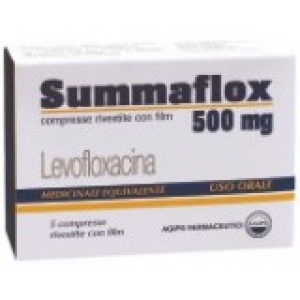
Pack containing a blister of 5 tablets.
Not all pack sizes may be marketed.
Marketing Authorisation Holder
AGIPS FARMACEUTICI srl – via Amendola, 4 – 16035 Rapallo
Manufacturer
Special Product’s Line S.p.A., Via Fratta Rotonda Vado Largo, 1 – 03012, Anagni (FR)
This was updated on:

Не впевнені, чи підходить вам цей лікарський засіб?
Обговоріть симптоми та можливі варіанти лікування з лікарем онлайн.

Виникли питання під час прийому ліків?
Обговоріть свої симптоми та лікування з лікарем онлайн.
- Країна реєстрації
- Лікарська формаFilm-coated tablet, 250 MG
- Код АТХJ01MA12
- Діюча речовина
- Потрібен рецептТак
- Виробник
- Ця інформація надана лише для ознайомлення і не є медичною порадою. Рішення щодо лікування завжди приймає лікар.
- Альтернативи до SUMMAFLOXЛікарська форма: Film-coated tablet, 250 MGДіюча речовина: левофлоксацинаВиробник: KONPHARMA S.R.L.Потрібен рецептЛікарська форма: Film-coated tablet, 500 MGДіюча речовина: левофлоксацинаВиробник: EURO-PHARMA S.R.L.Потрібен рецептЛікарська форма: Film-coated tablet, 250 MGДіюча речовина: левофлоксацинаВиробник: I.B.N. SAVIO S.R.LПотрібен рецепт
Аналоги SUMMAFLOX в інших країнах
Препарати з тією самою діючою речовиною, доступні в інших країнах.
Аналог SUMMAFLOX у Іспанія
Аналог SUMMAFLOX у Польща
Аналог SUMMAFLOX у Україна
Лікарі онлайн щодо SUMMAFLOX
Застосування, безпека та можливість призначення рецепта — за результатами медичної оцінки.









Отримайте рецепт на SUMMAFLOX онлайн
Заповніть форму за 2 хвилини
Розкажіть про симптоми, історію хвороби та потрібний препарат.
Оберіть лікаря або ми призначимо
Оберіть спеціаліста або ми підберемо найближчого доступного лікаря.
Лікар розглядає ваш випадок
Зазвичай протягом 30 хвилин. Може ставити уточнювальні запитання в чаті.
Отримайте в будь-якій аптеці
Електронний рецепт надсилається на вашу пошту — дійсний по всій Польщі.
Часті запитання
SUMMAFLOX потребує рецепта в Італія. Ви можете обговорити з лікарем онлайн, чи підходить цей лікарський засіб для вашої ситуації.
Діюча речовина у SUMMAFLOX — левофлоксацина. Це допомагає визначити препарати з тим самим складом, але під іншими торговими назвами.
SUMMAFLOX виробляється компанією A.G.I.P.S. FARMACEUTICI SRL. Назва бренду та упаковка можуть відрізнятися залежно від дистрибʼютора.
Лікарі, зокрема Сімейні лікарі, Психіатри, Дерматологи, Кардіологи, Ендокринологи, Гастроентерологи, Пульмонологи, Нефрологи, Ревматологи, Гематологи, Інфекціоністи, Алергологи, Геріатри, Педіатри, Онкологи, можуть оцінити доцільність застосування SUMMAFLOX з урахуванням вашого стану та місцевих правил. Ви можете записатися на онлайн-консультацію, щоб обговорити симптоми та можливі подальші кроки.
Польща має добре розвинену систему охорони здоров'я у великих містах, таких як Варшава, Краків, Вроцлав і Гданськ. Аптеки широко доступні та працюють відповідно до чинного законодавства, забезпечуючи доступ до рецептурних препаратів.
Ви можете придбати SUMMAFLOX у Варшаві, Кракові, Вроцлаві або Гданську в будь-якій аптеці за наявності дійсного рецепта.
Щоб отримати рецепт, ви можете скористатися Oladoctor:
Інші препарати з тією самою діючою речовиною (левофлоксацина) включають AJILEV, ALLGRAM, ALVAND. Вони можуть відрізнятися торговою назвою або формою випуску, але містять той самий терапевтичний компонент. Перед зміною або початком прийому нового препарату варто проконсультуватися з лікарем.
