



SCINORUS 7 MCG Inhalation powder, hard capsule

Запит на рецепт онлайн
Лікар розгляне ваш випадок і визначить, чи є рецепт медично доцільним.

Поговоріть з лікарем про ці ліки
Обговоріть симптоми та можливі подальші кроки під час короткої онлайн-консультації.



Інструкція із застосування SNORUS
Зміст інструкції
Scinorus 7 micrograms, powder for inhalation, hard capsule
Tiotropium
Generic medicine
Read this leaflet carefully before using this medicine as it contains important
information for you.
- Keep this leaflet. You may need to read it again.
- If you have any questions, ask your doctor or pharmacist.
- This medicine has been prescribed for you only. Do not pass it on to others, even if their symptoms are the same as yours, as it may be harmful.
- If you get any side effects, even those not listed in this leaflet, tell your doctor or pharmacist. See section 4.
Contents of this leaflet
- 1. What Scinorus is and what it is used for
- 2. What you need to know before you use Scinorus
- 3. How to use Scinorus
- 4. Possible side effects
- 5. How to store Scinorus
- 6. Contents of the pack and other information
1. What is Scinorus and what is it used for
Scinorus helps adults suffering from chronic obstructive pulmonary disease (COPD) to breathe more easily.
COPD is a chronic lung disease that causes shortness of breath and cough. The term COPD is associated with
chronic conditions of bronchitis and emphysema. Because COPD is a chronic disease, Scinorus must be
used every day and not only when breathing problems or other COPD symptoms occur.
Scinorus is a long-acting bronchodilator that helps to widen the airways and facilitates the entry and
exit of air from the lungs. Regular use of Scinorus can also be helpful when you develop shortness of breath
related to the disease and will help to minimize the effects of the disease on your daily life.
It also allows you to be active for longer. Daily use of Scinorus also helps to prevent
the sudden short-term worsening of COPD symptoms, which can last for several days.
The effect of this medicine lasts 24 hours, therefore it must be used once a day. For the correct
dosage of Scinorus see paragraph 3. How to use Scinorus and the instructions for use provided on the back of the
2. What you need to know before using Scinorus
Do not use Scinorus:
- if you are allergic to tiotropium or any of the other ingredients of this medicine (listed in section 6).
- if you are allergic to atropine or substances related to it, such as ipratropium or oxitropium.
Warnings and precautions
Talk to your doctor or pharmacist before using Scinorus
- Tell your doctor if you suffer from closed-angle glaucoma, prostate problems or if you have difficulty urinating.
- If you suffer from kidney problems, consult your doctor.
- This medicine is indicated for the maintenance therapy of chronic obstructive pulmonary disease, it should not be used to treat a sudden attack of shortness of breath or wheezing.
- Immediate allergic reactions such as skin rash, swelling, itching, wheezing or shortness of breath may occur after administration of this medicine. If this happens, consult your doctor immediately.
- Medicines taken by inhalation, such as Scinorus, can cause chest tightness, coughing, wheezing or shortness of breath immediately after inhalation. If this happens, consult your doctor immediately.
- Carefully avoid contact of the inhaled powder with the eyes, as this may cause precipitation or worsening of closed-angle glaucoma, which is an eye disease. Eye pain or a feeling of discomfort, blurred vision, seeing halos around lights or colored images in association with reddened eyes may be signs of an acute attack of closed-angle glaucoma. Ocular symptoms may be accompanied by headache, nausea or vomiting. Stop taking tiotropium bromide and consult your doctor immediately, preferably an eye specialist, if signs and symptoms of closed-angle glaucoma appear.
- Dry mouth, which has been observed with anticholinergic treatment, can be associated with dental caries in the long term. Therefore, careful dental hygiene is recommended.
- If you have had a myocardial infarction in the last 6 months, or any form of unstable or life-threatening irregular heartbeat, or severe heart failure in the past year, tell your doctor. This information is important to establish whether Scinorus is the right medicine for you.
Do not use Scinorus more frequently than once a day.
Children and adolescents
This medicine is not recommended for children and adolescents under 18 years of age.
Other medicines and Scinorus
Tell your doctor or pharmacist if you are taking, have recently taken or might take any
other medicines, including over-the-counter medicines.
Tell your doctor or pharmacist if you are using or have recently used similar medicines for your
lung disease, such as ipratropium or oxitropium.
No specific adverse effects have been reported following the use of Scinorus in combination with
other medicines used for the treatment of COPD, such as inhaled medicines that
relieve symptoms e.g. salbutamol, methylxanthines such as theophylline and/or steroids administered orally
or by inhalation such as prednisolone.
Pregnancy and breastfeeding
If you are pregnant, suspect you are pregnant or are planning a pregnancy, or if you are breastfeeding
ask your doctor or pharmacist for advice before using this medicine. You should not use
this medicine unless specifically recommended by your doctor.
Driving and using machines
Dizziness, blurred vision or headache may affect your ability to drive and use
machines.
Scinorus contains lactose
Each capsule provides up to 22 mg of lactose when the medicine is used in accordance with the recommended dosage of one capsule once a day. If your doctor has diagnosed you with intolerance to some
sugars or an allergy to milk proteins (which may be contained in small amounts in lactose),
contact him/her before taking this medicine.
3. How to use Scinorus
Use this medicine following exactly the instructions of your doctor or pharmacist. If you have any doubts
consult your doctor or pharmacist.
The recommended dose is the inhalation of the contents of 1 capsule (delivered dose of 7 micrograms of tiotropium)
once a day. Do not use a dose higher than the recommended one.
You should try to use the capsule at the same time each day. This is important because Scinorus is effective for
24 hours.
The capsules are for inhalation only and not for oral administration.
Do not swallow the capsules
The Vertical-Haler device, inside which the Scinorus capsule must be placed, punctures the capsule and
allows the inhalation of the powder.
Make sure you have a Vertical-Haler device and use it correctly. Instructions for use are
Make sure you do not blow into the device.
If you have problems using Vertical-Haler, ask your doctor, nurse or pharmacist to show you how
it works.
You should clean the inhaler once a month. Cleaning instructions are provided on the back of this leaflet
illustrative.
When taking Scinorus, make sure that the powder does not get into your eyes. If this should happen, you may
experience blurred vision, pain and/or redness of the eyes, in which case you should immediately rinse
your eyes with lukewarm water. Then immediately consult your doctor for further
advice.
If you notice that your breathing has worsened, inform your doctor as soon as possible.
If you use more Scinorus than you should
If you inhale the contents of more than 1 Scinorus capsule in a day, consult your doctor immediately. You may
be at a higher risk of experiencing undesirable effects such as dry mouth, constipation,
difficulty urinating, increased heartbeat or blurred vision.
If you forget to use Scinorus
If you forget to inhale a dose, take it as soon as you remember, but do not inhale a double dose at the
same time or on the same day. Then take the next dose as usual .
If you stop taking Scinorus
Before stopping treatment with Scinorus, consult your doctor or pharmacist.
If you stop treatment with Scinorus, the signs and symptoms of COPD may worsen.
If you have any doubts about the use of this medicine, consult your doctor or pharmacist.
4. Possible side effects
Like all medicines, this medicine can cause side effects, although not everybody gets them.
After the administration of Scinorus, serious side effectsmay occur, including allergic reactions that cause swelling of the face or throat (angioedema) or other hypersensitivity reactions (such as
sudden decrease in blood pressure or dizziness) that occur individually or as part
of a severe allergic reaction (anaphylactic reaction). Also, as with other inhaled medicines, some
patients may experience unexpected chest tightness, coughing, wheezing or shortness of breath
immediately after inhalation (bronchospasm). If any of these effects occur, seek
immediate medical attention.
The side effects described below have been reported by people who have used this medicine and
are listed by frequency, divided into common, uncommon ,rare or not known.
Common(may affect up to 1 in 10 people):
- Dry mouth: usually mild
Uncommon(may affect up to 1 in 100 people):
- Dizziness
- Headache
- Taste disturbances
- Blurred vision
- Irregular heartbeat (atrial fibrillation)
- Sore throat (pharyngitis)
- Hoarseness (dysphonia)
- Cough
- Heartburn (gastroesophageal reflux disease)
- Constipation
- Fungal infections of the mouth and throat (oropharyngeal candidiasis)
- Skin rash
- Difficulty urinating (urinary retention)
- Painful urination (dysuria)
Rare(may affect up to 1 in 1,000 people):
- Difficulty sleeping (insomnia)
- Halos around lights or colored images together with red eyes (glaucoma)
- Increased eye pressure measured
- Irregular heartbeat (supraventricular tachycardia)
- Fast heartbeat (tachycardia)
- Awareness of heartbeat (palpitations)
- Chest tightness, cough, wheezing or shortness of breath (bronchospasm)
- Nosebleeds (epistaxis)
- Inflammation of the larynx (laryngitis)
- Inflammation of the sinuses (sinusitis)
- Blockage of the intestine or absence of bowel movements (intestinal obstruction including paralytic ileus)
- Inflammation of the gums (gingivitis)
- Inflammation of the tongue (glossitis)
- Difficulty swallowing (dysphagia)
- Inflammation of the mouth (stomatitis)
- Feeling unwell (nausea)
- Hypersensitivity, including immediate reactions
- Hives
- Itching
- Swelling of the face or throat (angioedema)
- Urinary tract infections
Frequency not known(the frequency cannot be estimated from the available data):
- Loss of body fluids (dehydration)
- Dental caries
- Skin infections or ulcerations
- Dry skin
- Swelling of the joints
- Severe allergic reaction (anaphylactic reaction)
Reporting of side effects
If you get any side effects, talk to your doctor or pharmacist. This includes any possible side effects not listed
here. You can also report side effects directly through the national reporting system at
http://www.agenziafarmaco.gov.it/content/come-segnalare-una-sospetta-reazione-avversa. By reporting side
effects you can help provide more information on the safety of this medicine.
5. How to store Scinorus
Keep this medicine out of the sight and reach of children.
Do not use this medicine after the expiry date which is stated on the pack and on the label of the bottle.
The expiry date refers to the last day of that month.
Discard the Vertical-Haler device 6 months after first use.
Store in the original packaging (bottle in the aluminum pouch) to protect the medicine
from moisture and light.
After opening the pouch, keep the bottle tightly closed to protect the medicine from moisture and
light. Use the capsules within 60 days of opening.
Do not dispose of this medicine in wastewater or household waste. Ask your pharmacist how to dispose of
medicines you no longer use. This will help protect the environment.
6. Content of the pack and other information
What Scinorus contains
The active ingredient is tiotropium. Each capsule contains 8.8 micrograms of tiotropium. During inhalation
7.0 micrograms are delivered from the mouthpiece of the Vertical-Haler device.
The other ingredients are lactose and lactose monohydrate (which may contain small amounts of milk proteins). The capsule shell contains hypromellose.
Description of the appearance of Scinorus and content of the pack
Scinorus inhalation powder, hard capsule is a transparent hard capsule containing a white to off-white powder.
The product is available in the following pack sizes:
A pack containing 30 capsules (one bottle packaged in an aluminum pouch) and 1 Vertical-Haler.
A pack containing 60 capsules (two bottles packaged individually in an aluminum pouch) and 1 Vertical-Haler.
A pack containing 90 capsules (three bottles packaged individually in an aluminum pouch) and 1 Vertical-Haler.
Not all pack sizes may be marketed.
Marketing Authorization Holder and Manufacturer
Marketing Authorization Holder:
Laboratoires S.M.B. S.A.
Rue de la Pastorale, 26-28
1080 Brussels
Belgium
Manufacturer:
S.M.B. Technology S.A.
Rue du Parc Industriel 39
6900 Marche-en-Famenne
Belgium
This medicinal product is authorised in the Member States of the European Economic Area with the following
denominations:
Belgium, Greece, Luxembourg Tiotraxa
Denmark, Portugal, Sweden Tiolair
Italy, Netherlands Scinorus
Other sources of information
More detailed information on this medicinal product is available on the website
https://medicinali.aifa.gov.it/it/#/it/
Instructions for use:
Dear Patient,
The Vertical-Haler device allows you to inhale the medicine contained in the Scinorus capsule – which your
doctor has prescribed for your breathing problems.
- 1. Hold the Vertical-Haler device and remove the outer protective cap from the base by pushing upwards to expose the mouthpiece.
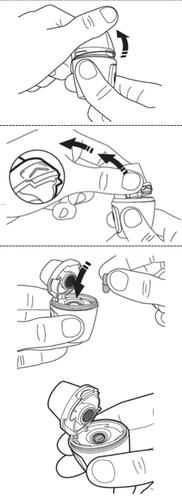
- 2. Hold the base of the inhaler and open the mouthpiece by pushing it upwards (press upwards on the area marked with “ ˄”).
- 3. Take one Scinorus capsule from the bottle just before use and close the bottle tightly. Insert one capsule into the central chamber as illustrated. Make sure the capsule is inserted correctly into the compartment.
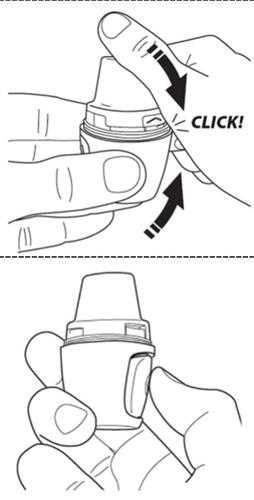
Close the mouthpiece firmly until you hear a “click”.
- 5. Hold the inhaler with the mouthpiece pointing upwards and press the piercing button down once firmly. Then release the button. This action will puncture the capsule and allow the medicine to be released during inhalation.
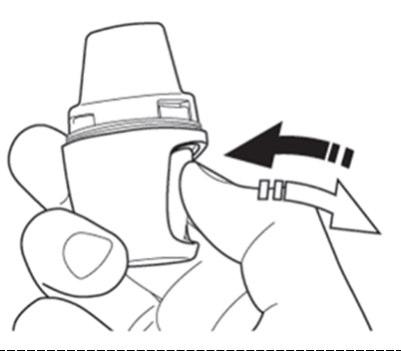
- 6. Hold the Vertical-Haler device away from your mouth and
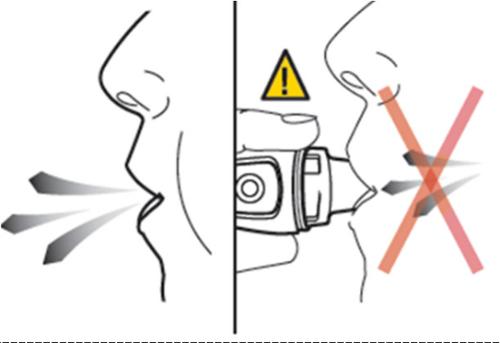
exhale completely to empty your lungs.
Do not breathe into the inhaler.
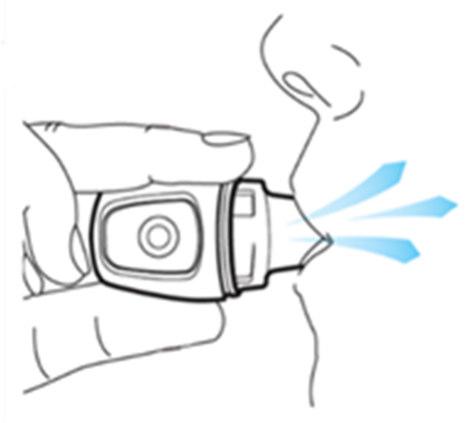
- 7. Bring the mouthpiece to your mouth and hold your head upright. Close your lips tightly around the mouthpiece. Do not press the side button. Inhale as quickly and deeply as possible until your lungs are full. During inhalation, you will hear or feel the capsule vibrate.
Hold your breath for as long as possible and at the same
time remove the Vertical-Haler device from your mouth.
Resume normal breathing. Repeat steps 6 and 7 once to
completely empty the capsule.
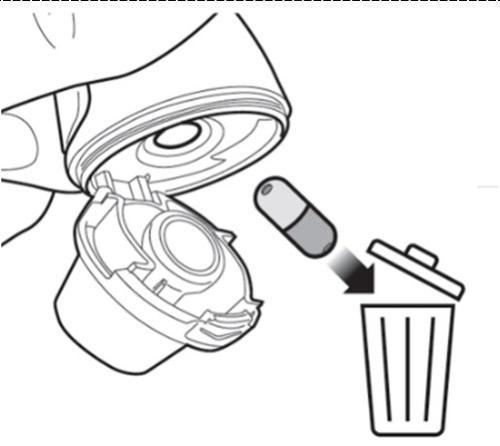
- 8. After use, open the mouthpiece and hold the inhaler downwards to remove the capsule from the cavity. Close the mouthpiece and replace the outer protective cap. This will keep it clean and dry.
Dispose of the Vertical-Haler device 6 months after first
use.
Cleaning instructions
Clean the Vertical-Haler device once a month. Open the outer protective cap and the mouthpiece.
Rinse the entire inhaler with lukewarm water to remove dust. Dry it thoroughly
by turning the excess water onto a paper towel and leaving it to air dry with the outer
protective cap and mouthpiece open.
It takes 24 hours to air dry, so the device should be cleaned immediately after use
so that it is ready for the next inhalation. If necessary, the outside of the mouthpiece can be cleaned
with a damp cloth but not wet.

Не впевнені, чи підходить вам цей лікарський засіб?
Обговоріть симптоми та можливі варіанти лікування з лікарем онлайн.

Виникли питання під час прийому ліків?
Обговоріть свої симптоми та лікування з лікарем онлайн.

- Країна реєстрації
- Лікарська формаInhalation powder, hard capsule, 7 MCG
- Код АТХR03BB04
- Діюча речовина
- Потрібен рецептТак
- Виробник
- Ця інформація надана лише для ознайомлення і не є медичною порадою. Рішення щодо лікування завжди приймає лікар.
- Альтернативи до SNORUSЛікарська форма: Inhalation powder, hard capsule, 18 MICROGRAMSДіюча речовина: tiotropium bromideВиробник: MYLAN S.P.A.Потрібен рецептЛікарська форма: Inhalation solution, 2.5 MICROGRAMSДіюча речовина: tiotropium bromideВиробник: BOEHRINGER INGELHEIM INTERNATIONAL GMBHПотрібен рецептЛікарська форма: Inhalation powder, hard capsule, 18 MICROGRAMSДіюча речовина: tiotropium bromideВиробник: BOEHRINGER INGELHEIM INTERNATIONAL GMBHПотрібен рецепт
Аналоги SNORUS в інших країнах
Препарати з тією самою діючою речовиною, доступні в інших країнах.
Аналог SNORUS у Польща
Аналог SNORUS у Україна
Аналог SNORUS у Іспанія
Лікарі онлайн щодо SNORUS
Застосування, безпека та можливість призначення рецепта — за результатами медичної оцінки.









Отримайте рецепт на SNORUS онлайн
Заповніть форму за 2 хвилини
Розкажіть про симптоми, історію хвороби та потрібний препарат.
Оберіть лікаря або ми призначимо
Оберіть спеціаліста або ми підберемо найближчого доступного лікаря.
Лікар розглядає ваш випадок
Зазвичай протягом 30 хвилин. Може ставити уточнювальні запитання в чаті.
Отримайте в будь-якій аптеці
Електронний рецепт надсилається на вашу пошту — дійсний по всій Польщі.
Часті запитання
SNORUS потребує рецепта в Італія. Ви можете обговорити з лікарем онлайн, чи підходить цей лікарський засіб для вашої ситуації.
Діюча речовина у SNORUS — tiotropium bromide. Це допомагає визначити препарати з тим самим складом, але під іншими торговими назвами.
SNORUS виробляється компанією LABORATOIRES SMB S.A.. Назва бренду та упаковка можуть відрізнятися залежно від дистрибʼютора.
Лікарі, зокрема Сімейні лікарі, Психіатри, Дерматологи, Кардіологи, Ендокринологи, Гастроентерологи, Пульмонологи, Нефрологи, Ревматологи, Гематологи, Інфекціоністи, Алергологи, Геріатри, Педіатри, Онкологи, можуть оцінити доцільність застосування SNORUS з урахуванням вашого стану та місцевих правил. Ви можете записатися на онлайн-консультацію, щоб обговорити симптоми та можливі подальші кроки.
Польща має добре розвинену систему охорони здоров'я у великих містах, таких як Варшава, Краків, Вроцлав і Гданськ. Аптеки широко доступні та працюють відповідно до чинного законодавства, забезпечуючи доступ до рецептурних препаратів.
Ви можете придбати SNORUS у Варшаві, Кракові, Вроцлаві або Гданську в будь-якій аптеці за наявності дійсного рецепта.
Щоб отримати рецепт, ви можете скористатися Oladoctor:
Інші препарати з тією самою діючою речовиною (tiotropium bromide) включають SIRKAVA, SPIRIVA RESPIMAT, SPIRIVA. Вони можуть відрізнятися торговою назвою або формою випуску, але містять той самий терапевтичний компонент. Перед зміною або початком прийому нового препарату варто проконсультуватися з лікарем.
