



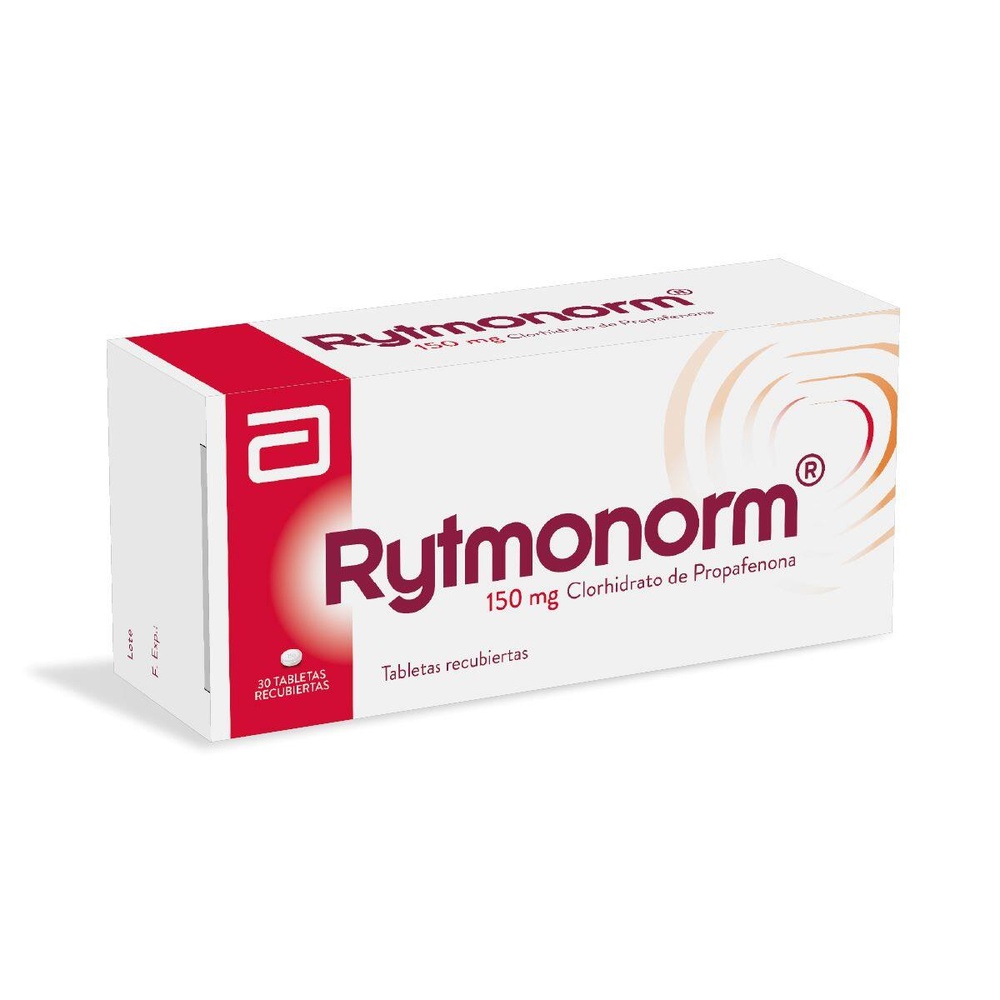
RYTMONORM <150 MG Coated tablet

Запит на рецепт онлайн
Лікар розгляне ваш випадок і визначить, чи є рецепт медично доцільним.

Поговоріть з лікарем про ці ліки
Обговоріть симптоми та можливі подальші кроки під час короткої онлайн-консультації.



Інструкція із застосування RYTMONORM
Зміст інструкції
- Rytmonorm 150 mg film-coated tablets, 300 mg film-coated tablets, 325 mg prolonged-release hard capsules, 425 mg prolonged-release hard capsules
- Rytmonorm 70 mg/20 ml injectable solution for intravenous use
Rytmonorm 150 mg film-coated tablets, 300 mg film-coated tablets, 325 mg prolonged-release hard capsules, 425 mg prolonged-release hard capsules
propafenone hydrochloride
Read this leaflet carefully before you start taking this medicine as it contains important
information for you.
Keep this leaflet. You may need to read it again.
If you have any questions, ask your doctor or pharmacist.
This medicine has been prescribed for you only. Do not pass it on to others, even if their symptoms
are the same as yours, as it could be harmful.
If you get any side effects, even those not listed in this leaflet, tell your doctor or pharmacist. See section 4.
Contents of this leaflet:
- 1. What Rytmonorm is and what it is used for
- 2. What you need to know before you take Rytmonorm
- 3. How to take Rytmonorm
- 4. Possible side effects
- 5. How to store Rytmonorm
- 6. Contents of the pack and other information
1. What is Rytmonorm and what is it used for
Rytmonorm contains the active substance propafenone hydrochloride, which belongs to a group of medicines
called antiarrhythmic agents. These medicines slow down and help to regulate the heartbeat.
Rytmonorm is used to treat and prevent heart rhythm disturbances (tachycardias and ventricular and supraventricular tachyarrhythmias,
including Wolff-Parkinson-White syndrome (W.P.W.), when associated
with disabling symptoms).
2. What you need to know before taking Rytmonorm
Do not take Rytmonorm if:
- you are allergic to propafenone hydrochloride or to other similar substances or to any of the other components of this medicine (listed in section 6);
- you are pregnant, unless specifically indicated by your doctor (see “ Pregnancy and breastfeeding”);
- you are breastfeeding (see “ Pregnancy and breastfeeding”);
- your heart is not functioning properly (manifest heart failure or congestive heart failure);
- you have had a heart attack in the last three months;
- you have a serious problem with blood circulation due to reduced activity of your heart (cardiogenic shock, except that caused by arrhythmia);
- you have Brugada syndrome, a defect or blockage in the heart's conduction system;
- you have an unusually slow heartbeat (severe symptomatic bradycardia) or very low blood pressure (marked hypotension);
- you suffer from other heart problems (severe pre-existing disorders of excitation conduction at the sinoatrial, atrioventricular and intraventricular level, sick sinus syndrome (bradycardia-tachycardia syndrome), atrial conduction defects, second or third degree atrioventricular block, bundle branch block or distal block in the absence of an artificial pacemaker);
- you have serious respiratory problems (severe obstructive lung diseases);
- you have been diagnosed with a serious muscle disease known as myasthenia gravis;
- you have an alteration of the levels of salts in the body (for example, potassium);
- you are taking a medicine called ritonavir used to treat AIDS (See section “Other medicines and Rytmonorm”).
Warnings and precautions
Talk to your doctor or pharmacist before taking Rytmonorm.
Before and during treatment with Rytmonorm, your doctor must perform periodic checks (ECG, clinical
tests) to assess your response to this medicine.
Take this medicine with caution and tell your doctor if:
- you have had a heart attack in the past. In this case, the doctor will prescribe this medicine only in cases of absolute necessity (ventricular arrhythmias that endanger the patient's life);
- you have problems with your liver or kidneys (impaired hepatic or renal function). In these cases, the doctor needs to reduce the dose of medicine to be taken and monitor it constantly via an electrocardiogram (see section “Use in people with liver or kidney problems”);
- you have problems with your airways (bronchopneumopathy obstructive, asthma);
- you have a serious heart problem (significant structural heart disease), as you are more exposed to the side effects of this medicine. During treatment with Rytmonorm, the following conditions may occur (see also section “Possible side effects”):
- worsening of the symptoms of a muscle disease called myasthenia gravis or your heart problems (conversion of paroxysmal atrial fibrillation to atrial flutter with consequent 2:1 or 1:1 conduction block);
- alterations in the functioning of your pace-maker. In this case, the doctor must carefully check and modify the operation of this device;
- Brugada syndrome (a defect or blockage in the heart's conduction system) or changes in the electrocardiogram (ECG) similar to Brugada in patients previously asymptomatic with the syndrome. In these cases, the doctor needs to monitor you constantly via an electrocardiogram. If Brugada syndrome occurs, treatment withpropafenone must be discontinued;
- agranulocytosis (reduction of the level of white blood cells in the blood), with increased risk of infections; if you experience fever or other symptoms of infection, contact your doctor. In these cases, treatment should be discontinued.
If you are going to have surgery (even dental surgery), it is important to tell the surgeon or dentist that
you are taking Rytmonorm because this medicine can affect the anesthetic (such as lidocaine) or other treatments used (see “ Other medicines and Rytmonorm”).
Other medicines and Rytmonorm
Tell your doctor if you are taking, have recently taken or might take any other medicine.
This is particularly important if you are taking:
- local anesthetics, medicines used to induce anesthesia during surgery (such as lidocaine);
- beta-blockers, medicines used to treat high blood pressure or heart problems (propranolol, metoprolol);
- tricyclic antidepressants, medicines used to treat depression (desipramine) or other antidepressants (venlafaxine, fluoxetine and paroxetine);
- medicines that have an effect on heart activity, such as amiodarone, digoxin, quinidine;
- anticoagulants, medicines used to prevent blood clots (e.g. warfarin, phenprocoumon);
- antibiotics (e.g. erythromycin or rifampicin);
- cimetidine, a medicine used to treat ulcers;
- cyclosporine, an immunosuppressant, used after transplant operations or for the treatment of arthritis or psoriasis;
- theophylline, a medicine used to treat asthma;
- ketoconazole, a medicine used to treat fungal infections;
- phenobarbital, a medicine used to treat epilepsy;
- ritonavir, a medicine used to treat HIV.
Rytmonorm with drinks
Avoid taking Rytmonorm with grapefruit juice as this can interact with your treatment.
Pregnancy, breastfeeding and fertility
If you are pregnant, suspect you are pregnant or are planning a pregnancy, this medicine should
be used under strict medical supervision.
If you are pregnant, do not take Rytmonorm (see section “Do not take Rytmonorm”) unless
otherwise indicated by your doctor.
If you are breastfeeding, do not take Rytmonorm.
Driving and operating machinery
Rytmonorm can alter your ability to drive vehicles and operate machinery, in fact, during
treatment blurred vision, dizziness, fatigue and low blood pressure may occur. If
you experience these symptoms, avoid driving vehicles or operating machinery or doing anything that
requires attention.
Rytmonorm contains sodium
This medicine contains less than 1 mmol (23 mg) of sodium per tablet/capsule, i.e. essentially
“sodium-free”.
3. How to take Rytmonorm
Take Rytmonorm following the doctor's instructions exactly. If you have any doubts, consult your doctor or
pharmacist.
Adults
Rytmonorm coated tablets
The recommended daily dose is 450-600 mg, which is 1 Rytmonorm 150 mg tablet, 3 times a day or 1 Rytmonorm 300 mg tablet, 2 times a day.
After 3-4 days of treatment, the doctor may assess the need to increase the dose up to the maximum
recommended dose of 900 mg, which is 2 Rytmonorm 150 mg tablets 3 times a day
or 1 Rytmonorm 300 mg coated tablet 3 times a day.
Rytmonorm prolonged-release hard capsules
The recommended daily dose is 650 mg, which is 1 Rytmonorm 325 mg capsule, 2 times a day.
After 5 days of treatment, the doctor may assess the need to increase the dose by advising you to
take 1 Rytmonorm 425 mg capsule, 2 times a day.
Use in the elderly and in people with severe heart problems
If you are elderly or if you have severe heart damage, the dose of Rytmonorm must be increased gradually and
the doctor must keep you under strict control, especially at the beginning of treatment.
Use in people with liver or kidney problems
If you suffer from liver or kidney problems (hepatic/renal insufficiency), the doctor must keep you under strict
control and reduce the dose of this medicine.
Use in children and adolescents
The safety and efficacy of Rytmonorm prolonged-release hard capsules have not yet been established.
Method of administration
This medicine must be taken by mouth.
Rytmonorm coated tablets: swallow the tablets whole with a little water and without chewing.
Rytmonorm prolonged-release hard capsules: swallow the capsules whole with a little water and without
chewing; do not crush or divide the contents of the capsules.
If you take more Rytmonorm than you should
Contact your doctor IMMEDIATELY or go to the nearest hospital.
High doses of this medicine can cause: changes in heart rhythm or
electrocardiogram (ECG), lowering of blood pressure, even suddenly, headache,
dizziness, blurred vision, changes in sensitivity (paresthesia), tremors, nausea, difficulty evacuating
(constipation), dry mouth, convulsions, drowsiness and, in severe cases, respiratory arrest, coma and even
death.
If you forget to take Rytmonorm
Do not take a double dose to make up for a missed dose.
If you stop taking Rytmonorm
It is important that you take this medicine for the entire duration of the therapy prescribed by the doctor. DO NOT
STOP TREATMENT just because you feel better, because your symptoms may
recur or worsen.
If you have any doubts about the use of this medicine, consult your doctor or pharmacist.
4. Possible side effects
Like all medicines, this medicine can cause side effects, although not everybody gets them.
Stop taking Rytmonorm immediately and contact your doctor if any of the following
conditions occur:
- allergic reactions manifesting with itching, more or less sudden appearance of skin lesions, for example changes in color in patches or widespread, swelling of the face, eyes, lips, tongue and throat, difficulty breathing, changes in blood, increased heart rate with possible sudden drop in blood pressure (anaphylactic reactions);
- weight loss, yellowish discoloration of the eyes or skin (jaundice), dark urine, pale stools, itching or abdominal pain, possible signs of allergy, liver damage, cholestasis or liver inflammation (hepatitis).
Very common side effects(may affect more than 1 in 10 people)
- dizziness;
- feeling of heart palpitations, changes in heart conduction.
Common side effects(may affect up to 1 in 10 people)
- alteration of the heartbeat such as decrease (sinus bradycardia, bradycardia) or increase (tachycardia) or strong increase (flutter);
- anxiety, sleep disorders, headache, altered taste;
- blurred vision;
- chest pain, difficulty breathing;
- abdominal pain, vomiting, nausea, diarrhea, difficulty with bowel movements (constipation), dry mouth;
- abnormal liver function tests (e.g. increased transaminases, gamma-glutamyltransferase, alkaline phosphatase in the blood);
- feeling unwell (asthenia), fatigue, fever.
Uncommon side effects(may affect up to 1 in 100 people)
- decrease in platelets in the blood (thrombocytopenia);
- decreased appetite;
- nightmares, vertigo, fainting (syncope), coordination problems (ataxia), altered sensation (paresthesia);
- increased heart rate (ventricular tachycardia);
- alterations in heart rhythm (arrhythmia), low blood pressure (hypotension);
- skin rashes such as hives, redness (erythema), itching;
- abdominal bloating, presence of gas in the intestine (flatulence);
- erectile dysfunction.
Other side effects with unknown frequency
- ventricular fibrillation (a type of heart rhythm disturbance), reduced heart function or rate, altered electrocardiogram (prolonged QRS complex of the electrocardiogram), abnormal cardiac conduction (first-degree atrioventricular block, increased pacing threshold);
- reduction in the level of white blood cells (leukopenia) or certain types of white blood cells (agranulocytosis, granulocytopenia) in the blood, with an increased risk of infections;
- sudden drop in blood pressure when suddenly moving from a sitting or lying position to an upright position (orthostatic hypotension);
- confusion, convulsions, absence or scarcity of movements with muscle rigidity (extrapyramidal disorder), restlessness, amnesia (memory loss);
- urge to vomit, stomach or intestinal disorders;
- lupus-like syndrome manifesting with rash on the face, joint pain, muscle disorders and fever, subacute cutaneous lupus erythematosus, syndrome manifesting with erythema on the skin;
- decrease in the number of sperm (which disappears after discontinuation of treatment);
- narrowing of the lumen of a main bronchus (bronchostenosis); pathological enlargement of the liver (hepatomegaly). Reporting of side effectsIf you get any side effects, talk to your doctor or pharmacist. You can also report side effects directly through the national reporting system at www.aifa.gov.it/content/segnalazioni-reazioni-avverse. By reporting side effects you can help provide more information on the safety of this medicine.
5. How to store Rytmonorm
Keep this medicine out of the sight and reach of children.
Do not use this medicine after the expiry date which is stated on the packaging. The expiry date refers to the last day of that month.
Rytmonorm coated tablets
This medicine does not require any particular storage conditions.
Rytmonorm prolonged-release hard capsules
Store the medicine at a temperature below 30 C.
Do not dispose of any medicine in wastewater or household waste. Ask your pharmacist how to dispose of
medicines you no longer use. This will help protect the environment.
6. Contents of the pack and other information
What Rytmonorm contains
The active ingredient is: propafenone hydrochloride.
Rytmonorm coated tablets
One 150 mg or 300 mg coated tablet contains: 150 mg or 300 mg of propafenone hydrochloride.
The other ingredients are: pregelatinized starch, copovidone, crospovidone, hypromellose, macrogol 6000,
magnesium stearate, sodium lauryl sulfate, talc, titanium dioxide.
Rytmonorm prolonged-release hard capsules
One 325 mg or 425 mg prolonged-release hard capsule contains: 325 mg or 425 mg of propafenone
hydrochloride.
The other ingredients are: hypromellose, magnesium stearate, gelatin, red iron oxide (E 172), sodium
lauryl sulfate, titanium dioxide (E 171).
Description of the appearance of Rytmonorm and contents of the pack
Rytmonorm coated tablets are available in packs of 30 or 60 coated tablets.
Rytmonorm prolonged-release hard capsules are available in packs of 28 capsules.
Marketing authorisation holder and manufacturer
Teva Italia S.r.l. – Piazzale Luigi Cadorna, 4 - 20123 Milan
Manufacturer
Rytmonorm coated tablets
ITC Farma S.r.l., Via Pontina km 29, 00071 Pomezia (Rome)
Rytmonorm prolonged-release hard capsules
ITC Farma S.r.l., Via Pontina km 29, 00071 Pomezia (Rome)
Famar A.V.E. Anthoussa Plant - Anthoussa Avenue 7, 15344 Anthoussa Attiki – Greece
Rytmonorm 70 mg/20 ml injectable solution for intravenous use
propafenone hydrochloride
Read this leaflet carefully before you use this medicine because it contains important
information for you.
Keep this leaflet. You may need to read it again.
If you have any questions, ask your doctor or pharmacist.
This medicine has been prescribed for you only. Do not pass it on to others, even if their symptoms
are the same as yours, as it may be harmful.
If you get any side effects, even those not listed in this leaflet, tell your doctor or pharmacist. See section 4.
Contents of this leaflet:
- 1. What Rytmonorm is and what it is used for
- 2. What you need to know before you use Rytmonorm
- 3. How to use Rytmonorm
- 4. Possible side effects
- 5. How to store Rytmonorm
- 6. Contents of the pack and other information
1. What is Rytmonorm and what is it used for
Rytmonorm contains the active substance propafenone hydrochloride, which belongs to a group of drugs
called antiarrhythmic agents. These medicines slow down and help to regulate the heartbeat.
Rytmonorm is used to quickly treat and prevent heart rhythm disturbances (tachycardias and
ventricular and supraventricular tachyarrhythmias, including Wolff-Parkinson-White syndrome (W.P.W.),
when associated with disabling symptoms).
2. What you need to know before using Rytmonorm
Do not use Rytmonorm if:
- you are allergic to propafenone hydrochloride or to other similar substances or to any of the other components of this medicine (listed in section 6);
- you are pregnant, unless specifically indicated by your doctor (see “ Pregnancy and breastfeeding”);
- you are breastfeeding (see “ Pregnancy and breastfeeding”);
- your heart is not functioning properly (heart failure or congestive heart failure)
- you have had a heart attack in the last three months;
- you have a serious problem with blood circulation due to reduced activity of your heart (cardiogenic shock, except that caused by arrhythmia);
- you have Brugada syndrome, a defect or block in the heart's conduction system;
- you have an unusually slow heartbeat (severe symptomatic bradycardia) or very low blood pressure (marked hypotension);
- you suffer from other heart problems (severe pre-existing disturbances of excitation conduction at the sinoatrial, atrioventricular and intraventricular level, sick sinus syndrome (bradycardia-tachycardia syndrome), atrial conduction defects, second-degree or greater atrioventricular block, bundle branch block or distal block in the absence of an artificial pacemaker);
- you have severe respiratory problems (severe obstructive pneumopathies), you have been diagnosed with a serious muscle disease known as myasthenia gravis;
- you have an alteration of the levels of salts in the body (for example, potassium);
- you are taking a medicine called ritonavir used to treat AIDS (See section “Other medicines and Rytmonorm”).
Warnings and precautions
Consult your doctor or pharmacist before using Rytmonorm.
Before and during treatment with Rytmonorm, your doctor must perform periodic checks (ECG, clinical
tests) to assess your response to this medicine.
Take this medicine with caution and inform your doctor if:
- you have had a heart attack in the past. In this case, the doctor will prescribe this medicine only in cases of absolute necessity (ventricular arrhythmias that endanger the patient's life);
- you have problems with the liver or kidneys (impaired hepatic or renal function). In these cases, the doctor needs to reduce the dose of medicine to be taken and monitor it constantly via an electrocardiogram (see section “Use in people with liver or kidney problems”);
- you have problems with the respiratory system (bronchopneumopathy obstructive, asthma);
- you have a serious heart problem (significant structural heart disease), as you are more exposed to the side effects of this medicine. During treatment with Rytmonorm, the following conditions may occur (see also section “Possible side effects”):
- worsening of the symptoms of a muscle disease called myasthenia gravis or your heart problems (conversion of paroxysmal atrial fibrillation to atrial flutter with subsequent 2:1 or 1:1 conduction block);
- alterations in the functioning of your pacemaker. In this case, the doctor must carefully check and modify the operation of this device
- Brugada syndrome (a defect or block in the heart's conduction system) or changes in the electrocardiogram (ECG) similar to Brugada in patients previously asymptomatic with the syndrome. In these cases, the doctor needs to monitor you constantly via an electrocardiogram. If Brugada syndrome occurs, treatment withpropafenone must be discontinued;
- agranulocytosis (reduction of the level of white blood cells in the blood), with increased risk of infections; if you experience fever or other symptoms of infection, contact your doctor. In these cases, treatment should be discontinued.
If you are going to have surgery (even dental), it is important to tell the surgeon or dentist that
you are taking Rytmonorm because this medicine can affect the anesthetic (such as lidocaine) or other treatments used (see “ Other medicines and Rytmonorm”).
Other medicines and Rytmonorm
Tell your doctor if you are taking, have recently taken or might take any other medicine.
This is particularly important if you are taking:
- local anesthetics, medicines used to induce anesthesia during surgery (such as lidocaine);
- beta-blockers, medicines used to treat high blood pressure or heart problems (propranolol, metoprolol);
- tricyclic antidepressants, medicines used to treat depression (desipramine) or other antidepressants (venlafaxine, fluoxetine and paroxetine);
- medicines that have an effect on heart activity, such as amiodarone, digoxin, quinidine;
- anticoagulants, medicines used to prevent blood clots (e.g. warfarin, phenprocoumon);
- antibiotics (e.g. erythromycin or rifampicin);
- cimetidine, a medicine used to treat ulcers;
- cyclosporine, an immunosuppressant, used after transplant operations or for the treatment of arthritis or psoriasis;
- theophylline, a medicine used to treat asthma;
- ketoconazole, a medicine used to treat fungal infections;
- phenobarbital, a medicine used to treat epilepsy;
- ritonavir, a medicine used to treat HIV.
Rytmonorm with drinks
Avoid taking Rytmonorm with grapefruit juice, as this can interact with therapy.
Pregnancy, breastfeeding and fertility
If you are pregnant, suspect you are pregnant or are planning to become pregnant, this medicine should
be used under strict medical supervision.
If you are pregnant, do not take Rytmonorm (see section “Do not take Rytmonorm”) unless
otherwise indicated by your doctor.
If you are breastfeeding, do not use Rytmonorm.
Driving and using machines
Rytmonorm can alter the ability to drive vehicles and operate machinery, in fact, during
treatment blurred vision, dizziness, fatigue and low blood pressure may occur. If
you experience these symptoms, avoid driving vehicles or operating machinery or doing anything that
requires attention.
3. How to use Rytmonorm
This medicine will be administered to you exclusively by medical personnel through an injection into a
vein (intravenous route). The doctor will establish the correct dose to use based on your body weight.
Adults
The recommended dose of Rytmonorm is 1 mg for each kilogram of body weight (approximately 1 vial for a
person weighing 70 kg).
Based on your condition (for example, liver or kidney problems) and your response to treatment, the
doctor may evaluate the need to decrease or increase the dose indicated above.
Further “Information intended exclusively for doctors or healthcare professionals” is available at the
If you use more Rytmonormthan you should
Rytmonorm is administered by medical personnel, an overdose is unlikely.
High doses of this medicine can cause: alterations in heart rhythm or
electrocardiogram (ECG), lowering of blood pressure, even sudden, headache,
dizziness, blurred vision, changes in sensitivity (paresthesia), tremors, nausea, difficulty evacuating
(constipation), dry mouth, convulsions, drowsiness and in severe cases, respiratory arrest, coma and even
death.
If you have any doubts about the use of this medicine, ask your doctor or pharmacist.
4. Possible side effects
Like all medicines, this medicine can cause side effects, although not everybody gets them.
Stop taking Rytmonorm immediately and contact your doctor if any of the following
conditions occur:
- allergic reactions manifesting with itching, more or less sudden appearance of skin lesions, for example changes in color in patches or widespread, swelling of the face, eyes, lips,
tongue and throat, difficulty breathing, blood changes, increased heart rate with possible sudden drop in blood pressure (anaphylactic reactions);
- weight loss, yellowish discoloration of the eyes or skin (jaundice), dark urine, pale stools, itching or abdominal pain, possible signs of allergy, liver damage, cholestasis or liver inflammation (hepatitis).
Very common side effects(may affect more than 1 in 10 people)
- dizziness;
- feeling of heart racing, changes in heart conduction.
Common side effects(may affect up to 1 in 10 people)
- irregular heartbeat such as decrease (sinus bradycardia, bradycardia) or increase (tachycardia) or strong increase (flutter);
- anxiety, sleep disorders, headache, altered taste;
- blurred vision;
- chest pain, difficulty breathing;
- abdominal pain, vomiting, nausea, diarrhea, difficulty passing stools (constipation), dry mouth;
- abnormal liver function tests (e.g. increased transaminases, gamma-glutamyltransferase, alkaline phosphatase in the blood);
- feeling unwell (asthenia), fatigue, fever.
Uncommon side effects(may affect up to 1 in 100 people)
- decrease in platelets in the blood (thrombocytopenia);
- loss of appetite;
- nightmares, vertigo, fainting (syncope), problems with coordination (ataxia), altered sensation (paresthesia);
- increased heart rate (ventricular tachycardia);
- irregular heart rhythm (arrhythmia), low blood pressure (hypotension);
- skin rashes such as hives, redness (erythema), itching;
- abdominal distension, presence of gas in the intestine (flatulence);
- erectile dysfunction.
Other side effects with unknown frequency
- ventricular fibrillation (a type of heart rhythm disturbance), reduced heart function or rate, altered electrocardiogram (prolonged QRS complex on the electrocardiogram), abnormal cardiac conduction (first-degree atrioventricular block, increased pacing threshold);
- reduction in the level of white blood cells (leukopenia) or certain types of white blood cells (agranulocytosis, granulocytopenia) in the blood, with an increased risk of infections;
- sudden drop in blood pressure when suddenly moving from a sitting or lying position to an upright position (orthostatic hypotension);
- confusion, convulsions, absence or scarcity of movements with muscle rigidity (extrapyramidal disorder), restlessness, amnesia (memory loss);
- urge to vomit, stomach or intestinal disorders;
- lupus-like syndrome manifesting with rash on the face, joint pain, muscle disorders and fever), subacute cutaneous lupus erythematosus, syndrome manifesting with erythema on the skin;
- decrease in the number of sperm (which disappears after discontinuation of treatment)
- narrowing of the lumen of a main bronchus (bronchostenosis);
- pathological enlargement of the liver (hepatomegaly).
Reporting of side effects
If you get any side effects, talk to your doctor or pharmacist. This includes any possible side effects not listed in this leaflet. You can also report side effects directly through the national reporting system at www.aifa.gov.it/content/segnalazioni-reazioni-avverse. By reporting side effects you can help provide more information on the safety of this
medicine.
5. How to store Rytmonorm
Keep this medicine out of the sight and reach of children.
Do not use this medicine after the expiry date which is stated on the packaging. The expiry date refers to the last day of that month.
Store the medicine at a temperature between 15°C and 25 C.
Do not dispose of any medicine in wastewater or household waste. Ask your pharmacist how to dispose of
medicines you no longer use. This will help protect the environment.
6. Package Contents and Other Information
What Rytmonorm contains
The active ingredient is: propafenone hydrochloride.
One 20 ml vial contains: 70 mg of propafenone hydrochloride.
The other ingredients are: water for injections, glucose.
Description of the appearance of Rytmonorm and contents of the pack
This medicine is available in packs containing 5 vials of 20 ml each.
Marketing Authorisation Holder and Manufacturer
Teva Italia S.r.l. – Piazzale Luigi Cadorna, 4 - 20123 Milan
Manufacturer
Famar Health Care Services Madrid S.A.U. – Madrid (Spain)
--------------------------------------------------------------------------------------------------------------------------------
Information intended exclusively for doctors or healthcare professionals.For more details,
consult the Summary of Product Characteristics.
Rytmonorm 70 mg/20 ml injectable solution for intravenous use
Posology
The dosage must be individualized and determined under ECG control and monitoring of blood pressure.
When administering infusion solutions, accurate monitoring of the ECG (QRS, PR and QTc intervals) and circulatory parameters is necessary.
Low doses of propafenone may be sufficient to produce the desired therapeutic response.
The single intravenous dose is 1 mg/kg of body weight (corresponding to one 20 ml vial in patients with a body weight of 70 kg).
Often the desired therapeutic effect can already be achieved with a dose of 0.5 mg/kg of body weight
(corresponding to 10 ml of solution). If necessary, the single dose may be increased to 2 mg/kg of body weight
(corresponding to 40 ml of solution).
Treatment should be started with the lowest possible dose, keeping the patient under close observation and strict electrocardiographic and blood pressure control.
Method of administration
The slow intravenous injection should be administered over a period of 3-5 minutes.
The interval between two injections should not be less than 90-120 minutes. If the QRS interval is prolonged or if an elongation of the corrected QT interval by more than 20% is observed, the administration must be stopped immediately.
Short-term infusion
For short-term infusion (1-3 hours) the infusion rate is 0.5-1 mg/min of Rytmonorm 70 mg/20 ml
injectable solution.
Slow intravenous infusion
For slow intravenous infusion, the maximum daily dose is generally 560 mg (corresponding to 160
ml of solution). A 5% glucose or fructose solution must be used for the preparation of the infusion. Due to the potential for precipitation, saline solution is not suitable for
preparing the infusion solution.
Special populations
Renal impairment
Propafenone hydrochloride should be administered with caution in patients with renal impairment.
Hepatic impairment
The dosage should be adjusted for patients with hepatic impairment.

Не впевнені, чи підходить вам цей лікарський засіб?
Обговоріть симптоми та можливі варіанти лікування з лікарем онлайн.

Виникли питання під час прийому ліків?
Обговоріть свої симптоми та лікування з лікарем онлайн.
- Країна реєстрації
- Лікарська формаCoated tablet, <150 MG
- Код АТХC01BC03
- Діюча речовина
- Потрібен рецептТак
- Виробник
- Ця інформація надана лише для ознайомлення і не є медичною порадою. Рішення щодо лікування завжди приймає лікар.
- Альтернативи до RYTMONORMЛікарська форма: Film-coated tablet, 150 MGДіюча речовина: propafenoneВиробник: ACCORD HEALTHCARE, S.L.U.Потрібен рецептЛікарська форма: Coated tablet, 150 MGДіюча речовина: propafenoneВиробник: DOC GENERICI SRLПотрібен рецептЛікарська форма: Film-coated tablet, 150 MGДіюча речовина: propafenoneВиробник: EG S.P.A.Потрібен рецепт
Аналоги RYTMONORM в інших країнах
Препарати з тією самою діючою речовиною, доступні в інших країнах.
Аналог RYTMONORM у Польща
Аналог RYTMONORM у Україна
Аналог RYTMONORM у Іспанія
Лікарі онлайн щодо RYTMONORM
Застосування, безпека та можливість призначення рецепта — за результатами медичної оцінки.
Отримайте рецепт на RYTMONORM онлайн
Заповніть форму за 2 хвилини
Розкажіть про симптоми, історію хвороби та потрібний препарат.
Оберіть лікаря або ми призначимо
Оберіть спеціаліста або ми підберемо найближчого доступного лікаря.
Лікар розглядає ваш випадок
Зазвичай протягом 30 хвилин. Може ставити уточнювальні запитання в чаті.
Отримайте в будь-якій аптеці
Електронний рецепт надсилається на вашу пошту — дійсний по всій Польщі.
Часті запитання
RYTMONORM потребує рецепта в Італія. Ви можете обговорити з лікарем онлайн, чи підходить цей лікарський засіб для вашої ситуації.
Діюча речовина у RYTMONORM — propafenone. Це допомагає визначити препарати з тим самим складом, але під іншими торговими назвами.
RYTMONORM виробляється компанією TEVA ITALIA S.R.L.. Назва бренду та упаковка можуть відрізнятися залежно від дистрибʼютора.
Лікарі, зокрема Сімейні лікарі, Психіатри, Дерматологи, Кардіологи, Ендокринологи, Гастроентерологи, Пульмонологи, Нефрологи, Ревматологи, Гематологи, Інфекціоністи, Алергологи, Геріатри, Педіатри, Онкологи, можуть оцінити доцільність застосування RYTMONORM з урахуванням вашого стану та місцевих правил. Ви можете записатися на онлайн-консультацію, щоб обговорити симптоми та можливі подальші кроки.
Польща має добре розвинену систему охорони здоров'я у великих містах, таких як Варшава, Краків, Вроцлав і Гданськ. Аптеки широко доступні та працюють відповідно до чинного законодавства, забезпечуючи доступ до рецептурних препаратів.
Ви можете придбати RYTMONORM у Варшаві, Кракові, Вроцлаві або Гданську в будь-якій аптеці за наявності дійсного рецепта.
Щоб отримати рецепт, ви можете скористатися Oladoctor:
Інші препарати з тією самою діючою речовиною (propafenone) включають PROPAFENONE AKKORD, PROPAFENONE DOK JENERIKI, PROPAFENONE EG. Вони можуть відрізнятися торговою назвою або формою випуску, але містять той самий терапевтичний компонент. Перед зміною або початком прийому нового препарату варто проконсультуватися з лікарем.
