



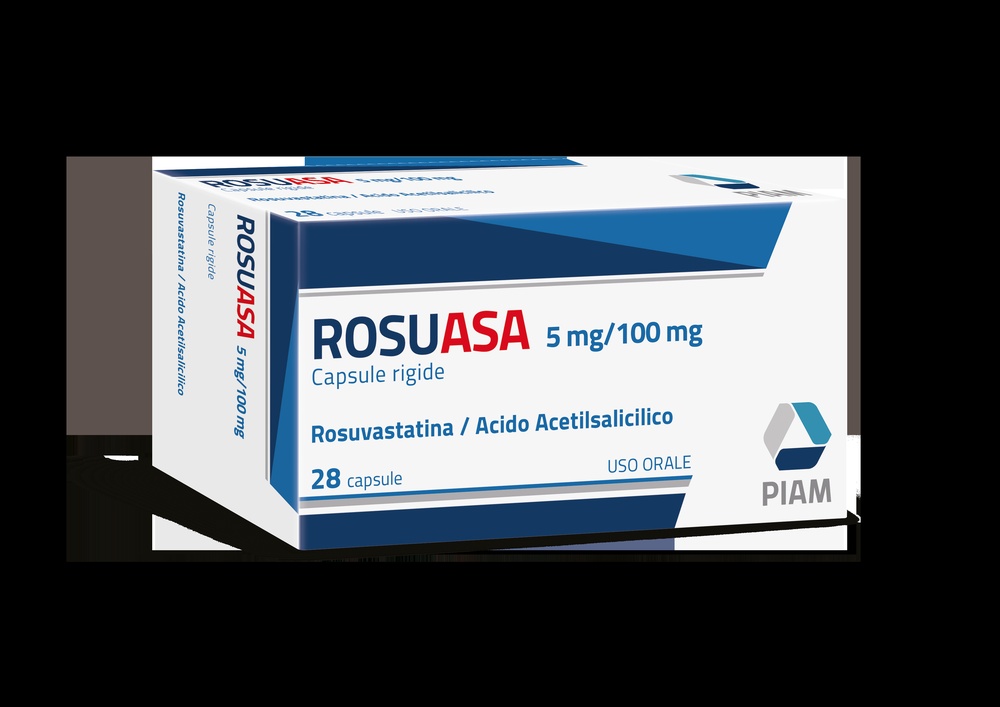
ROSUASA 5 mg/100 mg Hard Capsules

Запит на рецепт онлайн
Лікар розгляне ваш випадок і визначить, чи є рецепт медично доцільним.

Поговоріть з лікарем про ці ліки
Обговоріть симптоми та можливі подальші кроки під час короткої онлайн-консультації.



Інструкція із застосування ROSUASA
Зміст інструкції
ROSUASA 5 mg/100 mg hard capsules, 10 mg/100 mg hard capsules, 20 mg/100 mg hard capsules
rosuvastatin and acetylsalicylic acid
Read this leaflet carefully before you start taking this medicine as it contains important
information for you.
- Keep this leaflet. You may need to read it again.
- If you have any questions, ask your doctor or pharmacist.
- This medicine has been prescribed for you only. Do not pass it on to others, even if their symptoms are the same as yours, as it could be harmful.
- If you get any side effects, even those not listed in this leaflet, tell your doctor or pharmacist. See section 4.
Contents of this leaflet:
- 1. What ROSUASA is and what it is used for
- 2. What you need to know before you take ROSUASA
- 3. How to take ROSUASA
- 4. Possible side effects
- 5. How to store ROSUASA
- 6. Contents of the pack and other information
1. What is ROSUASA and what is it used for
ROSUASAcontains two active ingredients – rosuvastatin and acetylsalicylic acid.
Rosuvastatin belongs to a group of substances called statins, medicines that regulate lipids
(fats), which are used to reduce levels of lipids known as cholesterol and triglycerides in the blood
when a low-fat diet and lifestyle changes have not yielded results. Cholesterol is a fatty substance (lipid) that can cause narrowing of the blood vessels in the heart
causing coronary heart disease. If you are at risk of a possible heart attack, rosuvastatin may also
be used to reduce this risk even if your cholesterol levels are normal. You should
maintain a standard cholesterol-lowering diet during treatment.
- Acetylsalicylic acid at low doses belongs to a group of medicines called antiplatelet agents. Platelets are small cells in the blood that cause blood clotting and are involved in thrombosis. When a blood clot occurs in an artery, blood flow is blocked and oxygen supply is interrupted. When this happens in the heart, it can cause a heart attack or angina. These two active ingredients, taken together, reduce the possibility of having another heart attack if you have previously had a heart attack or if you suffer from attacks of chest pain (unstable angina pectoris).
ROSUASA is indicated in patients who are already taking rosuvastatin and acetylsalicylic acid at these
doses. Instead of taking rosuvastatin and acetylsalicylic acid separately, you will receive a ROSUASA capsule that contains both ingredients at the same dosage as before.
2. What you need to know before taking ROSUASA
Do not take ROSUASA
- If you are allergic to rosuvastatin, acetylsalicylic acid, other salicylates, or non-steroidal anti-inflammatory drugs (NSAIDs) or any of the other ingredients of this medicine (listed in section 6).
- If you are pregnant or breastfeeding. If you become pregnant while taking ROSUASA, stop taking it immediately and inform your doctor. Women must avoid pregnancy while taking ROSUASA by using appropriate contraceptive measures.
- If you have a liver disease
- If you have severe kidney problems
- If you have repeated or unexplained muscle aches or pains (myalgia)
- If you are taking a medicine called cyclosporine (used, for example, after organ transplantation)
- If you have had asthma attacks in the past or swelling of some parts of the body, such as the face, lips, throat or tongue (angioedema) after taking salicylates or non-steroidal anti-inflammatory drugs.
- If you currently have or have ever had a peptic ulcer or other type of bleeding, such as a stroke.
- If you have ever had problems with proper blood clotting.
- If you suffer from gout
- If you suffer from uncompensated heart failure
- If you are taking a medicine called methotrexate (used for cancer or rheumatoid arthritis) in doses
- greater than 15 mg per week;
- if you have ever developed a severe skin rash or scaling of the skin, blisters and/or mouth ulcers after taking ROSUASA or other related medicines.
Warnings and precautions
Talk to your doctor or pharmacist before taking ROSUASA
- If you have kidney problems
- If you have liver problems
- If you have had repeated or unexplained muscle aches or pains, a personal or family history of muscle problems, or have previously had muscle problems while taking other medicines to lower cholesterol. Immediately inform your doctor if you have unexplained muscle aches or pains, especially if accompanied by malaise or fever. Also, inform your doctor or pharmacist if you have persistent muscle weakness.
- If you regularly consume large amounts of alcohol
- If your thyroid is not functioning properly
- If you are taking other medicines to lower cholesterol called fibrates. Read this carefully
- If you are taking medicines used to treat HIV infections, for example ritonavir with lopinavir/ and/or atazanavir, read the section “Other medicines and ROSUASA”.
- If you are taking or have taken in the last 7 days a medicine containing fusidic acid (used to treat bacterial infections) orally or by injection. The combination of fusidic acid and ROSUASA can cause serious muscle problems (rhabdomyolysis), read the section “Other medicines and ROSUASA”.
- If you have severe respiratory failure
- If you are over 70 years of age
- If you are of Asian origin (Japanese, Chinese, Filipino, Vietnamese, Korean and Indian). Your doctor needs to choose the appropriate starting dose for you.
- If you have had ulcers or bleeding in the stomach or intestines in the past (gastrointestinal ulcers or bleeding)
- If your blood pressure is high
- If you suffer from bronchial asthma, hay fever, nasal polyps or other chronic respiratory diseases, acetylsalicylic acid
- can cause an asthma attack.
- In case of hypersensitivity (allergy) to other medicines for pain and anti-inflammatory drugs, other medicines for rheumatism or other allergy triggers.
- If you have other allergies (e.g. with skin reactions, itching).
- If you are taking other medicines called anticoagulants (e.g. coumarin derivatives, heparin - with the exception of treatments with low-dose heparins).
- With impaired renal function or reduced blood flow to the heart and blood vessels (e.g. renal vascular disease, weakness of the heart muscles, reduced blood volume, major operations, blood poisoning or increased bleeding): acetylsalicylic acid can further increase the risk of renal dysfunction and acute renal failure.
- If you have heavy menstrual cycles.
- If you have or have had myasthenia (a disease characterized by generalized muscle weakness including, in some cases, the muscles used for breathing) or ocular myasthenia (a disease that causes weakness of the eye muscles), as statins can sometimes worsen myasthenia or cause it to occur (see section 4).
Talk to your doctor if your symptoms worsen or serious or unexpected side effects occur such as
symptoms of bleeding, severe skin reactions or any other serious allergic reaction (read the
section “Possible side effects”).
In a small number of people, statins can have an effect on the liver, which can be identified with a
simple test that detects increased levels of liver enzymes in the blood. For this reason, your doctor
will ask you to have this test (liver function test) before and during treatment with
ROSUASA.
During treatment with this medicine, your doctor will carefully check that you do not have diabetes or
are at risk of developing diabetes. You are at risk of developing diabetes if you have high levels of sugars
and fats in your blood, if you are overweight and have high blood pressure.
You should be careful not to become dehydrated (you may feel thirsty and have a dry mouth) as taking
acetylsalicylic acid at the same time can worsen renal function.
Inform your doctor before operations (even minor procedures, such as a tooth extraction) because acetylsalicylic acid
may cause an increased tendency to bleed.
Acetylsalicylic acid can cause Reye's syndrome if given to children. Reye's syndrome is a
very rare disease that affects the brain and liver and can be fatal. For this reason, ROSUASA
should not be taken by children and adolescents under 18 years of age.
In patients with severe glucose-6-phosphate dehydrogenase deficiency: acetylsalicylic acid can cause
accelerated degradation or rupture of red blood cells or a certain form of anemia. This risk may be
caused by factors such as high dosage, fever or acute infections.
Acetylsalicylic acid reduces the excretion of uric acid at low doses. This can trigger a gout attack
in at-risk patients.
If you cut or injure yourself, it may take longer than usual to stop the bleeding. This is
related to the effect of acetylsalicylic acid. Small cuts and injuries (e.g. during shaving) usually do not
matter. In case of unusual bleeding (in an unusual place or of unusual duration), contact your
doctor.
Severe skin reactions, including Stevens-Johnson syndrome and drug reaction with eosinophilia and systemic symptoms (DRESS), have been reported in association with treatment with rosuvastatin.
Stop using ROSUASA and seek immediate medical attention if you notice any of the symptoms
described in section 4.
Children and adolescents
ROSUASA should not be taken by children and adolescents.
Other medicines and ROSUASA
Tell your doctor or pharmacist if you are taking, have recently taken or might take any
other medicines.
ROSUASA may influence or be influenced by other medicines, such as:
- fibrates (such as gemfibrozil, fenofibrate) or any other medicine used to lower cholesterol (such as ezetimibe);
- remedies for indigestion (used to neutralize acids in the stomach);
- an oral contraceptive (the pill);
- hormone replacement therapy;
- regorafenib (used to treat cancer);
- one of the following drugs used to treat viral infections, including HIV or hepatitis C infection, alone or in combination (see Warnings and precautions): ritonavir, lopinavir, atazanavir, simeprevir, ombitasvir, paritaprevir, dasabuvir, velpatasvir, grazoprevir, elbasvir, glecaprevir, pibrentasvir.
- ketoconazole, itraconazole (antifungal medicines)
- rifampicin, erythromycin, clarithromycin (antibiotics)
- medicines to thin the blood and prevent clots (warfarin, heparin, clopidogrel, ticagrelor, ticlopidine): acetylsalicylic acid can increase the risk of bleeding if taken before removing a blood clot or thinning the blood. Therefore, if you want to undergo such treatment, you should pay attention to signs of external or internal bleeding (e.g. bruising).
- cyclosporine, tacrolimus (used, for example, after organ transplantation);
- medicines for high blood pressure (e.g. diuretics and ACE inhibitors)
- medicines to regulate the heartbeat (digoxin)
- medicines for manic-depressive disorders (lithium)
- medicines for pain and inflammation (non-steroidal analgesics, such as ibuprofen, or steroids)
- medicines for gout (e.g. probenecid, benzbromarone)
- medicines for glaucoma (acetazolamide)
- Methotrexate (for the treatment of cancer and rheumatoid arthritis) in doses less than 15 mg per week
- Medicines to lower blood sugar (antidiabetics) (e.g. glibenclamide) - the blood sugar level may decrease
- Selective serotonin reuptake inhibitors (for the treatment of depression), such as sertraline and paroxetine
- Corticosteroids used as hormone replacement therapy when the adrenal glands or pituitary gland have been destroyed or removed (except for products applied to the skin or in therapy
replacement with cortisone for Addison's disease) or to treat inflammation, including
rheumatic diseases and intestinal inflammation
- Concomitant use increases the risk of gastrointestinal side effects.
- brain seizures [epilepsy] (valproic acid)
- drugs that cause increased urinary excretion (diuretics: so-called aldosterone antagonists such as spironolactone and canrenoate, loop diuretics, e.g. furosemide)
- Alcohol: increases the risk of gastrointestinal ulcers and bleeding.
Metamizole (a substance used to reduce pain and fever) can reduce the effect of acetylsalicylic acid
on platelet aggregation (blood cells that attach and form a blood clot) if taken
simultaneously. Therefore, this combination should be used with caution in patients who
are taking aspirin at low doses for cardioprotection.
If you need to take oral fusidic acid to treat a bacterial infection, you will need to
temporarily stop using ROSUASA. Your doctor will tell you when to safely restart ROSUASA. Taking ROSUASA with fusidic acid can rarely cause weakness,
soreness or muscle pain (rhabdomyolysis). See section 4 for more information
regarding rhabdomyolysis.
ROSUASA may further lower blood pressure if you are already taking other medicines to
treat high blood pressure.
ROSUASA with food, beverages and alcohol
ROSUASA should be taken with food. Do not drink grapefruit juice during treatment with
ROSUASA.
Drinking alcohol may potentially increase the risk of gastrointestinal bleeding and prolong the time
of bleeding.
Pregnancy and breastfeeding
Do not take ROSUASA if you are pregnant, suspect you are pregnant or are planning a pregnancy, or if you are
breastfeeding.
If you become pregnant while taking ROSUASA, you should stop taking it immediately and inform your
doctor.
Women must avoid pregnancy during treatment with ROSUASA by using appropriate
contraceptive measures.
Driving and using machines
Most people can drive vehicles and use machines while taking
ROSUASA – it has no effect on their ability to drive vehicles and use machines. However, some
people may experience dizziness while taking ROSUASA. If you experience dizziness, fatigue or
headache, do not drive vehicles or use machines and contact your doctor immediately
ROSUASA contains lactose
If your doctor has diagnosed you with intolerance to some sugars (lactose or milk sugar), contact your
doctor before taking this medicine.
3. How to take ROSUASA
Take this medicine following the instructions of your doctor exactly. If you have any doubts, consult your
doctor or pharmacist.
Adults
The doctor will determine the appropriate dosage for you, based on your condition, your current treatment and
your personal risk status.
This medicine is not suitable for starting treatment. The start of treatment must be carried out only by
taking the active ingredients separately and after defining the appropriate doses, it is possible to switch to
ROSUASA at the appropriate dosage.
The recommended dose is one capsule per day.
This medicine must be taken with food. You must take the medicine every day at the same time. The
capsules must be swallowed with plenty of liquid and must not be crushed or chewed.
Do not take ROSUASA with grapefruit juice.
If you go to hospital or receive care for another condition, inform the medical staff that you are taking
ROSUASA.
Use in elderly patients
It is not necessary to modify the dose for elderly patients
Use in children and adolescents
ROSUASA must not be used in children and adolescents.
Patients with renal impairment
It is not necessary to modify the dose if you suffer from mild or moderate renal impairment. The use of
ROSUASA in patients with severe renal impairment is contraindicated.
Patients with hepatic impairment
It is not necessary to modify the dose if you suffer from mild or moderate hepatic insufficiency. The use of
ROSUASA in patients with severe hepatic impairment is contraindicated.
If you take more ROSUASA than you should
Contact your doctor or go to the emergency department of the nearest hospital.
If you forget to take ROSUASA
Do not worry if you forget to take a capsule, do not take a new dose. Take the next dose
at the usual time. Do not take a double dose to make up for the forgotten capsule.
If you stop taking ROSUASA
The doctor will advise you how long to take the medicine. Cholesterol levels may increase
again if you stop taking ROSUASA. Your condition may return if you stop using the
medicine before you have been advised to do so.
If you have any doubts about the use of this medicine, ask your doctor or pharmacist.
4. Possible side effects
Like all medicines, this medicine can cause side effects, although not everybody gets them.
manifest.
Stop taking ROSUASA and seek medical advice immediatelyif you experience any of the
following allergic reactions:
- Sudden shortness of breath, abdominal pain, lack of breath or difficulty breathing
- Swelling of the eyelids, face or lips
- Swelling of the tongue and/or throat which may cause difficulty in breathing and/or swallowing
- Severe skin reactions including intense rash, hives, redness all over the body, itching, blistering, peeling and swelling of the skin, inflammation of the mucous membranes (Stevens Johnson Syndrome) or other allergic reactions
- If you experience black stools or blood in your vomit (signs of a severe stomach bleed);
- Reddish, non-raised, target-shaped or circular spots on the trunk, often with central blisters, skin peeling, ulcers of the mouth, throat, nose, genitals and eyes. These severe skin rashes may be preceded by fever and flu-like symptoms (Stevens-Johnson syndrome);
- Widespread rash, high body temperature and swollen lymph nodes (DRESS syndrome or drug hypersensitivity syndrome).
Also, stop taking ROSUASA and see your doctor immediately
- if you have unusual muscle aches or pains,that last longer than you would expect. As with other statins, a very small number of people have experienced muscle side effects and rarely these have progressed to a condition leading to muscle damage, potentially life-threatening, known as rhabdomyolysis.
- If you experience muscle tears
- If you have a lupus-like syndrome(including rash, joint disorders and effects on blood cells). The following side effectshave been reported. If any of these cause you problems or if they last for more than one week, you need to contact your doctor.
ROSUVASTATIN
Common(may affect up to 1 in 10 people)
- Headache
- Stomach pain
- Constipation
- Feeling unwell
- Muscle pain
- Feeling weak
- Dizziness
- Diabetes. This is more likely if you have high levels of sugars and fats in your blood, if you are overweight and have high blood pressure. Your doctor will monitor you during treatment with this medicine.
Uncommon(may affect up to 1 in 100 people)
- Skin rash, itching, hives and other skin reactions.
- Increased protein in urine - the situation usually normalizes without having to stop treatment with ROSUASA. (only 5 and 20 mg dosages).
Rare(may affect up to 1 in 1,000 people)
- Severe allergic reactions - whose signs include swelling of the face, lips, tongue and/or throat, difficulty swallowing and breathing, intense itching (with raised bumps). If you think you are having an allergic reaction, stop taking ROSUASAand contact your doctor immediately.
- Muscle damage in adults - as a precaution, stop taking ROSUASA and tell your doctor immediately if you have unusual muscle aches or pains,that last longer than you would expect.
- Severe stomach pain (inflammation of the pancreas)
- Increased liver enzymes in the blood
- Reduction in platelets in the blood, which increases the risk of bleeding or bruising (thrombocytopenia)
- Lupus-like illness syndrome (including rash, joint disorders and effects on blood cells)
Very rare(may affect up to 1 in 10,000 people)
- Jaundice (yellowing of the skin and eyes)
- Hepatitis (an inflammation of the liver)
- Traces of blood in the urine
- Nerve damage in arms and legs (numbness);
- Joint pain
- Memory loss
- Gynaecomastia (enlargement of the breasts in men)
Not known(frequency cannot be estimated from the available data)
- Diarrhoea (loose stools)
- Cough
- Shortness of breath
- Edema (swelling)
- Sleep disorders, including insomnia and nightmares
- Sexual dysfunction
- Depression
- Breathing problems, including persistent cough and/or wheezing or fever
- Tendon injury
- Nerve disorder that can cause weakness, tingling or numbness
- Persistent muscle weakness
- Myasthenia gravis (a disease that causes generalized muscle weakness including, in some cases, the muscles used for breathing).
- Ocular myasthenia (a disease that causes weakness of the eye muscles). See a doctor if you experience weakness in your arms or legs that worsens after periods of activity, double vision or drooping eyelids, difficulty swallowing or shortness of breath.
ACETYLSALICYLIC ACID
Common(may affect up to 1 in 10 people)
- Gastrointestinal disturbances such as heartburn, nausea, vomiting, abdominal pain and diarrhoea.
- Mild blood loss from the gastrointestinal tract (micro-bleeding).
- Bleeding such as nosebleeds, bleeding gums, skin bleeding or bleeding from the urinary and genital tract with a possible extension of the bleeding time. This effect can last from 4 to 8 days after ingestion.
Uncommon(may affect up to 1 in 100 people)
- Bleeding from the stomach or intestine. After long-term use of acetylsalicylic acid, anaemia (iron deficiency anaemia) may occur due to hidden blood loss from the stomach or intestine.
- Intracranial bleeding, blood in the urine.
- Gastric or intestinal ulcers, which very rarely can lead to perforation.
- Gastrointestinal inflammation.
- Skin reactions.
Rare(may affect up to 1 in 1,000 people)
- Hypersensitivity reactions of the skin, respiratory tract, gastrointestinal area and cardiovascular system, especially in asthmatics. The following characteristics of the disease may occur: drop in blood pressure, attacks of shortness of breath, inflammation of the nasal mucosa, nasal congestion, anaphylactic shock, swelling of the face, tongue and larynx (Quincke's edema).
- Severe bleeding such as brain bleeding, especially in patients with uncontrolled hypertension and/or concomitant treatment with anticoagulants (blood-thinning medications), which can be potentially life-threatening in individual cases.
- Confusion
- Headache, dizziness
- Impaired hearing or ringing in the ears (tinnitus), especially in children and the elderly, can be signs of an overdose (see also section "If you take more ROSUASA than you should").
Very rare(may affect up to 1 in 10,000):
- Increases in liver function tests.
- Renal dysfunction and acute renal failure.
- Decreased blood sugar (hypoglycaemia).
- Acetylsalicylic acid reduces the excretion of uric acid at low doses. This can trigger a gout attack in patients at risk.
- Febrile skin eruptions with involvement of the mucous membranes (erythema multiforme exudativum).
Not known(frequency cannot be estimated from the available data)
- Accelerated degradation or decay of red blood cells and a specific form of anaemia in patients with severe glucose-6-phosphate dehydrogenase deficiency. If any of the side effects becomes serious or if you notice side effects not listed in this leaflet, tell your doctor or pharmacist.
Reporting of side effects
If you get any side effects, talk to your doctor or pharmacist. This includes any possible side effects not listed in this leaflet. You can also report side effects directly through the national reporting system at https://www.aifa.gov.it/content/segnalazioni-reazioni-avverse. By reporting side effects you can help provide more information on the safety of this medicine.
5. How to store ROSUASA
Keep this medicine out of the sight and reach of children.
Do not use this medicine after the expiry date stated on the packaging and on the blister after Exp.
The expiry date refers to the last day of that month.
Store at a temperature below 30°C in the original packaging to protect the medicine from moisture.
Do not dispose of any medicine in wastewater or household waste. Ask your pharmacist how to dispose of
medicines you no longer use. This will help protect the environment.
6. Package Contents and Other Information What ROSUASA Contains
The active ingredients are rosuvastatin (as calcium salt) and acetylsalicylic acid.
ROSUASA hard capsules 5 mg/100 mg: each hard capsule contains 5 mg of rosuvastatin (as calcium salt) and 100 mg of acetylsalicylic acid.
ROSUASA hard capsules 10 mg/100 mg: each hard capsule contains 10 mg of rosuvastatin (as calcium salt) and 100 mg of acetylsalicylic acid.
ROSUASA hard capsules 20 mg/100 mg: each hard capsule contains 20 mg of rosuvastatin (as calcium salt) and 100 mg of acetylsalicylic acid.
The other ingredients are:
Film-coated tablet containing rosuvastatin:
Tablet core:lactose monohydrate, microcrystalline cellulose, heavy magnesium oxide,
crospovidone (Type A), anhydrous colloidal silica, magnesium stearate.
Film coating:polyvinyl alcohol, titanium dioxide (E 171), talc, yellow iron oxide (E 172), lecithin
(soy), red iron oxide (E 172), xanthan gum, black iron oxide (E 172).
Tablet containing acetylsalicylic acid:microcrystalline cellulose, corn starch, anhydrous colloidal
silica, stearic acid.
Gelatin capsule:Gelatin, titanium dioxide (E171), indigotine (E 132), yellow iron oxide (E172)
Black ink: Shellac, propylene glycol, concentrated ammonia solution, black iron oxide (E
172), potassium hydroxide.
Description of the appearance of ROSUASA and contents of the pack
ROSUASA 5 mg/100 mg: hard gelatin capsules, size 2, with an opaque white body and an opaque dark green cap.
Each capsule contains an uncoated tablet, white or almost white in color, biconvex, oval of acetylsalicylic acid and a film-coated tablet, brown in color, biconvex,
round of rosuvastatin 5 mg.
ROSUASA 10 mg/100 mg: hard gelatin capsules, size 1, with an opaque white body imprinted
in black “ASA 100” and an opaque light green cap imprinted in black “RSV 10 mg”. Each capsule
contains an uncoated tablet, white or almost white in color, biconvex, oval of acetyl
salicylic acid and a film-coated tablet, brown in color, biconvex, round of rosuvastatin 10
mg.
ROSUASA 20 mg/100 mg: hard gelatin capsules, size 0, with an opaque white body imprinted
in black “ASA 100” and an opaque green cap imprinted in black “RSV 20 mg. Each capsule contains
an uncoated tablet, white or almost white in color, biconvex, oval of acetylsalicylic acid and two
film-coated tablets, brown in color, biconvex, round of rosuvastatin 10 mg.
ROSUASA is available in blisters containing 28 hard capsules.
Not all pack sizes may be marketed.
Marketing Authorisation Holder
PIAM Farmaceutici S.p.A.
Via Fieschi 8
16121 Genoa (Italy)
Manufacturer
Adamed Pharma S.A.
ul. Marszalka Józefa Pilsudskiego 5, 95-200 Pabianice
Poland

Не впевнені, чи підходить вам цей лікарський засіб?
Обговоріть симптоми та можливі варіанти лікування з лікарем онлайн.

Виникли питання під час прийому ліків?
Обговоріть свої симптоми та лікування з лікарем онлайн.
- Країна реєстрації
- Лікарська формаHard capsule, 5 MG + 100 MG
- Код АТХC10BX05
- Діюча речовина
- Потрібен рецептТак
- Виробник
- Ця інформація надана лише для ознайомлення і не є медичною порадою. Рішення щодо лікування завжди приймає лікар.
- Альтернативи до ROSUASAЛікарська форма: Hard capsule, 5MG/100MGДіюча речовина: rosuvastatin and acetylsalicylic acidВиробник: ADAMED S.R.L.Потрібен рецептЛікарська форма: Hard capsule, 5 MG/100 MGДіюча речовина: rosuvastatin and acetylsalicylic acidВиробник: NEOPHARMED GENTILI S.P.A.Потрібен рецептЛікарська форма: Hard capsule, 5 MG/100 MGДіюча речовина: rosuvastatin and acetylsalicylic acidВиробник: DOC GENERICI SRLПотрібен рецепт
Аналоги ROSUASA в інших країнах
Препарати з тією самою діючою речовиною, доступні в інших країнах.
Аналог ROSUASA у Польща
Аналог ROSUASA у Україна
Аналог ROSUASA у Іспанія
Лікарі онлайн щодо ROSUASA
Застосування, безпека та можливість призначення рецепта — за результатами медичної оцінки.
Отримайте рецепт на ROSUASA онлайн
Заповніть форму за 2 хвилини
Розкажіть про симптоми, історію хвороби та потрібний препарат.
Оберіть лікаря або ми призначимо
Оберіть спеціаліста або ми підберемо найближчого доступного лікаря.
Лікар розглядає ваш випадок
Зазвичай протягом 30 хвилин. Може ставити уточнювальні запитання в чаті.
Отримайте в будь-якій аптеці
Електронний рецепт надсилається на вашу пошту — дійсний по всій Польщі.
Часті запитання
ROSUASA потребує рецепта в Італія. Ви можете обговорити з лікарем онлайн, чи підходить цей лікарський засіб для вашої ситуації.
Діюча речовина у ROSUASA — rosuvastatin and acetylsalicylic acid. Це допомагає визначити препарати з тим самим складом, але під іншими торговими назвами.
ROSUASA виробляється компанією PIAM FARMACEUTICI S.P.A.. Назва бренду та упаковка можуть відрізнятися залежно від дистрибʼютора.
Лікарі, зокрема Сімейні лікарі, Психіатри, Дерматологи, Кардіологи, Ендокринологи, Гастроентерологи, Пульмонологи, Нефрологи, Ревматологи, Гематологи, Інфекціоністи, Алергологи, Геріатри, Педіатри, Онкологи, можуть оцінити доцільність застосування ROSUASA з урахуванням вашого стану та місцевих правил. Ви можете записатися на онлайн-консультацію, щоб обговорити симптоми та можливі подальші кроки.
Польща має добре розвинену систему охорони здоров'я у великих містах, таких як Варшава, Краків, Вроцлав і Гданськ. Аптеки широко доступні та працюють відповідно до чинного законодавства, забезпечуючи доступ до рецептурних препаратів.
Ви можете придбати ROSUASA у Варшаві, Кракові, Вроцлаві або Гданську в будь-якій аптеці за наявності дійсного рецепта.
Щоб отримати рецепт, ви можете скористатися Oladoctor:
Інші препарати з тією самою діючою речовиною (rosuvastatin and acetylsalicylic acid) включають ASADROX, LUGAREXIA, ROSUKETIL. Вони можуть відрізнятися торговою назвою або формою випуску, але містять той самий терапевтичний компонент. Перед зміною або початком прийому нового препарату варто проконсультуватися з лікарем.
