



QUINSAIR 240 mg Solution For Nebulization

Запит на рецепт онлайн
Лікар розгляне ваш випадок і визначить, чи є рецепт медично доцільним.

Поговоріть з лікарем про ці ліки
Обговоріть симптоми та можливі подальші кроки під час короткої онлайн-консультації.



Інструкція із застосування QUINSAIR
Зміст інструкції
Quinsair 240 mg solution for nebulizer
levofloxacin
Read this leaflet carefully before using this medicine as it contains important
information for you.
- Keep this leaflet. You may need to read it again.
- If you have any questions, ask your doctor or pharmacist.
- This medicine has been prescribed for you only. Do not pass it on to others, even if their symptoms are the same as yours, as it may be harmful.
- If you get any side effects, even those not listed in this leaflet, tell your doctor or pharmacist. See section 4.
Contents of this leaflet:
- 1. What Quinsair is and what it is used for
- 2. What you need to know before you use Quinsair
- 3. How to use Quinsair
- 4. Possible side effects
- 5. How to store Quinsair
- 6. Contents of the pack and other information
1. What is Quinsair and what is it used for
Quinsair contains an antibiotic called levofloxacin. This medicine belongs to the group of
antibiotics called fluoroquinolones.
Quinsair is used to treat lung infectionscaused by Pseudomonas aeruginosain adults
with cystic fibrosis. It is an antibiotic to be breathed (inhaled) directly into the lungs,
where it kills the bacteria responsible for the infection. In this way it helps to improve breathing
in people with cystic fibrosis.
2. What you need to know before using Quinsair
Do not use Quinsair
- if you are allergicto levofloxacin, to any other antibiotic of the quinolone groupsuch as moxifloxacin, ciprofloxacin or ofloxacin, or to any of the other ingredients of this medicine (listed in section 6)
- if you have had tendon problems (inflammationof a tendonor tendon rupture) in the past during treatment with a quinolone or fluoroquinolone antibiotic
- if you suffer from epilepsy
- during pregnancyor breastfeeding
Warnings and precautions
Before taking this medicine
Do not take antibacterial medicines based on quinolones/fluoroquinolones, including Quinsair, if you have previously had any serious adverse reaction during treatment with a quinolone or fluoroquinolone. In this case, inform your doctor as soon as possible.
When taking this medicine
Pain and swelling in the joints and inflammation or rupture of the tendons can rarely occur. The risk is greater if you are elderly (over 60 years of age), if you have received an organ transplant, if you have kidney problems or if you are being treated with corticosteroids. Inflammation and rupture of the tendons can occur within the first 48 hours of treatment and up to several months after the end of therapy with Quinsair. At the first signs of pain or inflammation in a tendon (for example in the ankle, wrist, elbow, shoulder or knee), stop treatment with Quinsair, consult your doctor and keep the painful part at rest. Avoid any unnecessary movement, because the risk of tendon rupture could increase.
Inform your doctor before using Quinsair
if you suffer from or have suffered in the past from any of the following conditions:
- Serious, prolonged, disabling and potentially non-improving adverse effects Antibacterial medicines of the type of fluoroquinolones/quinolones, including Quinsair, have been associated with very rare but serious adverse effects, some of which are prolonged (lasting months or years), disabling or potentially non-improving. These include pain in the tendons, muscles and joints of arms and legs, difficulty walking, abnormal sensations such as tingling, prickling, itching, numbness or burning (paresthesia), disorders of the sense organs such as alteration of vision, taste, smell and hearing, depression, memory disorders, severe fatigue and severe sleep disorders. If you experience any of these adverse effects after taking Quinsair, consult your doctor immediately before continuing treatment. The doctor will decide together with you whether to continue treatment and will also consider the use of an antibiotic belonging to another class.
- Serious kidney problems.
- A severe allergic reaction. The symptoms are listed in section 4.
- Severe skin reactions If you are being treated with Quinsair, a severe skin reaction, such as blistering or lesions, may occur. Inform your doctor if you notice any skin reaction after using Quinsair.
- Liver problems. The symptoms are listed in section 4.
- Heart rhythm abnormalities Quinsair can alter the heart rhythm, especially if you are taking any medicine for the treatment of heart problems or low levels of potassium or magnesium in the blood. Women taking these types of medicines may be at greater risk. If you experience palpitations or an irregular heartbeat while using Quinsair, inform your doctor immediately.
- Seizures and convulsions Quinolone antibiotics, such as Quinsair, can cause seizures or convulsions (“fits”). In this case, stop using Quinsair and consult your doctor immediately.
- Depression or mental health problems.
- Nerve damage Rarely, symptoms of nerve damage (neuropathy) such as pain, burning, tingling, numbness and/or weakness may occur, particularly in the feet and legs or in the hands and arms. In this case, stop treatment with Quinsair and inform your doctor immediately, to prevent nerve damage from becoming permanent.
- A disease that causes muscle weakness and fatigue, called myasthenia gravis.
- Inflammation of a tendon that causes pain, stiffness and/or swelling of the joints (tendinitis).
- If, after receiving Quinsair, you have had difficulty breathing, which may range from mild to severe (bronchospasm).
- Emission of blood or mucus mixed with blood from the airways with coughing.
- Glucose-6-phosphate dehydrogenase deficiency Quinolone antibiotics, such as Quinsair, can predispose patients with glucose-6-phosphate dehydrogenase deficiency (a rare hereditary disease) to blood complications, resulting in a sudden increase in body temperature, yellowish discoloration of the skin and mucous membranes, dark urine, pallor, fatigue, rapid and shallow breathing, and a weak and rapid pulse. Consult your doctor if you have any questions about this.
- Diabetes Quinolone antibiotics, such as Quinsair, can increase or decrease blood glucose levels excessively. If you are diabetic, you should monitor your blood glucose very carefully.
- Diarrhea Diarrhea may occur during or after treatment with Quinsair. If the diarrhea is severe or persistent, or if you notice blood in the stool, stop using Quinsair immediately and consult your doctor. Do not take any medicine for diarrhea without consulting your doctor.
- Antibiotic resistance Over time, bacteria can become resistant to treatment with an antibiotic. This means that Quinsair should not be used to prevent lung infections. It should instead be used only to treat lung infections caused by Pseudomonas aeruginosa.Consult your doctor if you have any doubts or questions about this.
- Superinfections Sometimes, during a long antibiotic treatment, you can contract another infection caused by different bacteria against which the antibiotic in question is ineffective (superinfection). Consult your doctor if you have any doubts or questions about this and about the use of Quinsair.
- Eye problems If you notice any changes in vision or other eye problems while using Quinsair, consult an ophthalmologist immediately.
- Photosensitization Quinsair can make the skin more sensitive to sunlight. Avoid prolonged exposure to sunlight or intense sunlight and do not use tanning beds or other UV lamps while using Quinsair and for 48 hours after the end of treatment.
- False results in certain tests Certain tests (e.g. to confirm tuberculosis or to search for strong painkillers) can give false results during treatment with Quinsair:
- if you have been diagnosed with an increase in the size or “enlargement” of a large blood vessel (aortic aneurysm or peripheral aneurysm of a large blood vessel).
- if you have previously experienced episodes of aortic dissection (a tear in the wall of the aorta).
- if you have been diagnosed with insufficiency of one of the heart valves (aortic and mitral regurgitation);
- if you have a family history of aortic aneurysm or congenital heart valve disease, or aortic dissection or other predisposing risk factors or conditions (e.g. connective tissue diseases such as Marfan syndrome, Ehlers-Danlos syndrome, Turner syndrome, Sjögren's syndrome [an autoimmune inflammatory disease], or vascular disorders such as Takayasu arteritis, giant cell arteritis, Behcet's syndrome, high blood pressure or known atherosclerosis, rheumatoid arthritis [an autoimmune inflammatory disease] or endocarditis [an inflammation of the heart]).
If you experience sudden abdominal, chest, or back pain, which may be a symptom of aneurysm and aortic dissection, go to the emergency room immediately. The risk may be greater if you are taking systemic corticosteroids.
Inform your doctor immediately if you notice a rapid onset of shortness of breath, especially when lying down, or swelling of the ankles, feet or abdomen, or new episodes of palpitations (feeling of rapid or irregular heartbeat).
Children and adolescents
Quinsair should not be given to children and adolescents under 18 years of age, because there is not enough information about its use in this age group.
Other medicines and Quinsair
Tell your doctor or pharmacist if you are taking, have recently taken or might take any other medicines. These medicines could interfere with the effects of Quinsair.
Tell your doctorif you are taking any of the following medicines:
- Vitamin K antagonists such as warfarin(used to prevent blood clots). Taking these medicines with Quinsair may increase blood loss. Your doctor may need to perform periodic blood tests to check the blood's ability to clot.
- Theophylline(used to treat breathing problems) or non-steroidal anti-inflammatory drugs (NSAIDs) such as fenbufen, acetylsalicylic acid(a substance present in many medicines used to relieve pain and lower fever, as well as to prevent blood clotting) or ibuprofen. Taking Quinsair at the same time as these medicines may increase the risk of a seizure.
- Medicines such as probenecid(used to prevent gout) or cimetidine(used to treat ulcers). Taking Quinsair at the same time as these medicines may alter the kidneys' reaction to the medicine, which is particularly important if you have kidney problems.
- Cyclosporine(used after organ transplants) or medicines that modify the heartbeat(such as antiarrhythmics, tricyclic antidepressants, macrolide antibiotics or antipsychotics). Quinsair may interfere with the effects of these medicines. Your doctor will provide you with further information.
Pregnancy and breastfeeding
Quinsair should not be used during pregnancy or breastfeeding. If you are pregnant, suspect you may be pregnant, are planning to become pregnant or are breastfeeding, ask your doctor for advice before taking this medicine.
Driving and using machines
Quinsair can cause dizziness, fatigue or weakness or cause vision problems. If this happens, do not drive and do not use tools or machinery.
3. How to use Quinsair
Use this medicine following the doctor's instructions exactly at all times. If you have any doubts, consult your
doctor.
What dose should I use?
Inhale twice a daythe contents of one vial (240 mg), using the Zirela nebulizer.
Inhalation of the medicine with the nebulizer lasts about 5 minutes.
When should I inhale?
Inhaling Quinsair every day at the same time makes it easier to remember when to take the medicine. The
medicine should be inhaled as follows:
- 1 vial in the morning with the Zirela nebulizer
- 1 vial in the evening with the Zirela nebulizer It is best to allow almost 12 hours between doses.
How long should I use the medicine?
Use Quinsair every day for 28 days, followed by a 28-day break during which you should not inhale
Quinsair. After the break, start a new treatment cycle.
It is important to use the medicine twice a day for the 28 days of treatment and to alternate 28 days of treatment and 28 days without treatment for the entire time indicated by
your doctor.
If you have difficulty breathing when using Quinsair, what other medicine can your
doctor prescribe?
If you have difficulty breathing after using Quinsair, your doctor may prescribe inhalation of a
bronchodilator (e.g. salbutamol). You should inhale this medicine at least 15 minutes and up to 4 hours
before the next dose of Quinsair.
What if I am using several inhalation therapies and other treatments for cystic fibrosis?
If you are using several inhalation therapies and other treatments for cystic fibrosis, it is recommended to
use the medicines in the following order:
1 Bronchodilators
2 Dornase alfa
3 Airway clearance techniques
4 Quinsair
5 Inhaled steroids
How to use the medicine
Quinsair must be inhaled with the portable Zirela nebulizer(including a Zirela aerosol head). The nebulizer must be connected to an eBase Controller or eFlow
rapid control unit.
Repeat the cycle
Important information before starting
- Each vial is exclusively for single use. After opening the vial, the contents must beused immediately.
- Do not use Quinsair if you notice that the sealed foil pouch or the vials have been tampered with.
- Do not use Quinsair if you notice that it is cloudy or that the solution contains particles.
- Do not mix Quinsair with other medicinesin the portable Zirela nebulizer.
- Do not put any medicine other than Quinsair into the portable Zirela nebulizer.
- Do not attempt to inhale Quinsair with another type of portable nebulizer.
- Check that the Zirela nebulizer is working correctly before starting treatment.
- Do not swallow the liquid contained in the vial. Read the instructions for use provided with the portable Zirela nebulizer carefully.
How should I prepare the nebulizer for inhaling the medicine?
Keep the instructions for use of Zirela in a safe place, as they contain detailed information on assembling the device.
- 1) Check that the portable Zirela nebulizeris placed on a flat and stable surface.
- 2) Transfer the entire contents of one vialinto the drug reservoir of the portable Zirela nebulizer (Figure 1). Make sure you have emptied the vial completely, if necessary by gently tapping the side of the reservoir.
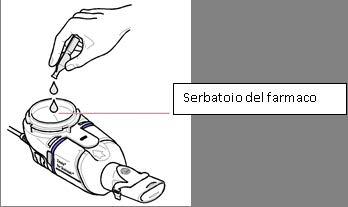
Figure 1
- 3) Close the drug reservoirby aligning the tabs on the drug closure cap with the grooves on the reservoir (a). Press and rotate the closure cap clockwise until it stops (b, Figure 2).
Figure 2
How should I use the Zirela nebulizer?
- 1) When you start treatment, sit comfortably with your back straight.
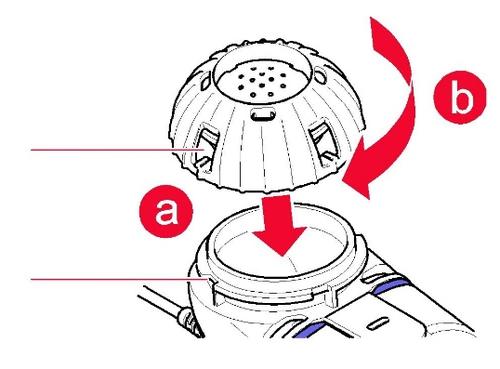
Tab
Groove
- 2) Keep the portable nebulizer uprightand press the on/off button on the control unit for a few seconds. You will hear a single beep and the indicator light will turn green.
- 3) After a few seconds, a mist of aerosol will begin to flowinto the aerosol chamber of the portable Zirela nebulizer. If the mist of aerosol does not start to flow, consult the instructions for use of Zirela.
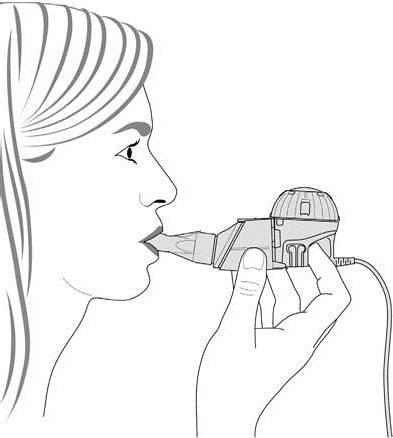
- 4) Continue to keep the portable nebulizer uprightand bring the mouthpiece to your mouth, sealing it with your lips (Figure 3).
Figure 3
- 5) Breathe normally(inhaling and exhaling) through the mouthpiece. Try not to breathe through your nose. Continue to inhale and exhale gently until the end of the treatment. Inhalation of the medicine with the nebulizer lasts about 5 minutes.
- 6) When all the medicine has been released,you will hear a beep consisting of two tones indicating the end of the treatment.
- 7) At this point, open the drug closure capto check that all the medicine has been used. Some drops of medicine may remain at the bottom of the reservoir at the end of the treatment. This is not a problem. However, if more than a few drops remain, close the drug closure cap and restart the treatment from step 1.
- 8) At the end of the treatment, disconnect the control unit from the portable Zirela nebulizer so that you can clean and disinfect it. The instructions for use contain detailed information on cleaning and disinfection.
What to do if I have to stop treatment before the end?
If, for any reason, you have to stop treatment before the end, press and hold the on/off button on the control unit for one second. After turning it off completely and when you are ready
to restart, press and hold the on/off button again for one second. The treatment will resume.
You should inhale and exhale through the mouthpiece as before.
How and when should I replace the portable Zirela nebulizer?
A portable nebulizer should be used for one treatment cycle of 28 days. For advice on
cleaning and storage, please refer to the manufacturer's instructions for use.
If you use more Quinsair than you should
If you have used more Quinsair than you should, inform your doctor as soon as possible. You may have symptoms such as
irregular heartbeat, which should be evaluated by your doctor. If you have swallowed the contents of the vial,
do not worry, but inform your doctor as soon as possible.
If you forget to use Quinsair
If you forget a dose, take it as soon as you remember, provided that 8 hours remain
until the inhalation of the next dose. If, on the other hand, it is almost time for the next dose, skip the missed dose.
Do not inhale the contents of more than one vial to make up for a missed dose.
If you stop treatment with Quinsair
Do not stop treatment with Quinsair without consulting your doctor, as otherwise
the lung infection may worsen.
If you have any doubts about using this medicine, ask your doctor or pharmacist.
4. Possible side effects
Like all medicines, this medicine can cause side effects, although not everybody gets them.
Some side effects can be serious.
Seek immediate medical attentionif you notice a severe allergic reaction
after inhaling Quinsair. Symptoms include:
- Generalised itching and a feeling of warmth, especially on the scalp, in the mouth, throat, palms of the hands or soles of the feet
- Severe wheezing or noisy breathing or difficulty breathing
- Severe hives
- Swelling of the lips, face, throat or tongue
- Paleness or greyish skin colour
- Fast heartbeat
- Fainting or loss of consciousness
Stop using Quinsair and tell your doctor immediately:
- if you experience pain, stiffness and/or swelling of the joints
- if you develop problems with your liver. Symptoms include:
- Loss of appetite
- Yellowing of the skin and eyes (jaundice)
- Dark coloured urine
- Itching
- Excessive sensitivity (pain) around the stomach (abdomen)
Other side effects may include:
Very common: may affect more than 1 in 10 people
- Cough
- Changes in taste
- Fatigue, weakness and poor exercise tolerance
- Loss of appetite
- Shortness of breath
- Changes in the amount and consistency of mucus/sputum
- Coughing up blood
- Reduced amount of air you can breathe out in one second (reduced FEV test)
Common: may affect up to 1 in 10 people
- Fungal infection around the vagina
- Insomnia or difficulty sleeping
- Headache
- Dizziness
- Ringing or noise in the ear (tinnitus)
- Changes in voice
- Nausea and vomiting
- Abdominal pain
- Diarrhoea
- Constipation
- Skin rash
- Joint or muscle pain
- Fever
- Abnormal blood tests (increased levels of certain liver enzymes or bilirubin in the blood and reduced kidney function)
- Reduced lung function
- Increased or decreased sugar (glucose) in the blood
- Abnormal breathing sounds
Uncommon: may affect up to 1 in 100 people
- Fungal infection of the mouth
- Reduction in the number of red blood cells in the blood (anaemia) or of the blood cells that help with clotting (platelets)
- Reduction or increase in the number of white blood cells in the blood
- Feeling anxious, restless or agitated and/or depression
- Reduced sense of smell
- Feeling sleepy
- Changes in vision
- Hearing loss
- Increased heart rate
- Difficulty breathing
- Nausea
- Digestive disorders
- Flatulence
- Hives and itching
- Chest pain
- Kidney failure
- Changes in heart rhythm
- Pain, burning, tingling, numbness and/or weakness in the limbs (neuropathy)
The following side effects have also been reported with levofloxacin tablets or intravenous infusion, and therefore may occur following use of Quinsair:
Uncommon: may affect up to 1 in 100 people
- Feeling confused or nervous
- Tremor
- Feeling dizzy, spinning or loss of balance (vertigo)
- Excessive sweating
Rare: may affect up to 1 in 1,000 people
- Hallucinations and/or feeling paranoid
- Feeling agitated
- Abnormal dreams or nightmares
- Convulsions (“fits”)
- Feeling of tingling and/or numbness
- Palpitations
- Low blood pressure
- Muscle weakness
- Syndrome associated with insufficient excretion of water and low sodium levels (SIADH)
- Widespread rash, fever, increased liver enzymes, blood abnormalities (eosinophilia), enlarged lymph nodes and involvement of other body organs (drug reaction with eosinophilia and systemic symptoms)
- Clearly defined, reddish patches, with or without blister formation.
Frequency not known: the frequency cannot be estimated from the available data
- Reduction in the number of all types of blood cells
- Diabetic coma
- Serious mental problems (which in very rare cases can lead to self-harm)
- Pain, burning, tingling, numbness and/or weakness in the limbs (neuropathy)
- Involuntary muscle movements, jerks or spasms
- Fainting
- Severe throbbing headache with loss of vision
- Temporary loss of vision
- Fast or abnormal heartbeat
- Lung inflammation
- Severe skin reactions, such as blisters or painful sores, possibly also in the mouth, nose or vagina
- Increased sensitivity of the skin to sunlight or UV (sunbeds or other UV lamps)
- Inflammation of blood vessels
- Inflammation of the mouth or lips
- Rapid breakdown of muscles
- Inflammation of a tendon or tendon rupture
- Pain including back pain, chest pain, arm and leg pain
Very rare cases of prolonged (lasting months or years) or permanent adverse drug reactions, such as tendon inflammation, tendon rupture, joint pain, pain in the extremities, difficulty walking, abnormal sensations such as prickling, tingling, itching, burning, depression, fatigue, sleep disorders, memory disorders and changes in hearing, vision, taste and smell, have been associated with the use of antibiotics of the quinolone and fluoroquinolone type, in some cases regardless of pre-existing risk factors. Cases of dilatation and weakening of the aortic wall or rupture of the aortic wall (aneurysms and dissections), with possible ruptures that can be fatal, as well as cases of backflow of blood through the heart valves, have been reported in patients treated with fluoroquinolones. See also section 2.
Reporting of side effects
If you get any side effects, talk to your doctor or pharmacist. This includes any possible side effects not listed in this leaflet. You can also report side effects directly through the national reporting system listed in Annex V. By reporting side effects you can help provide more information on the safety of this medicine.
5. How to store Quinsair
Keep this medicine out of the sight and reach of children.
Do not use this medicine after the expiry date which is stated on the vial, on the aluminium foil
sachet and on the cartons after EXP/Scad. The expiry date refers to the last day of that
month.
Each vial is for single use only. After opening the vial, the contents must be used
immediately. Any remaining product must be discarded. Return the unused and unopened vials from the strip
to the sachet to protect them from light.
Store in the original packaging to protect the medicine from light. This medicine does
not require any particular storage temperature.
Do not dispose of any medicine in wastewater or household waste. Ask your pharmacist how
to dispose of medicines you no longer use. This will help protect the environment.
6. Contents of the pack and other information
What Quinsair contains
- The active substance is levofloxacin. One vial contains levofloxacin hemihydrate equivalent to 240 mg of levofloxacin.
- The other ingredients are magnesium chloride hexahydrate and water for injections.
Description of the appearance of Quinsair and contents of the pack
Quinsair is a clear, light yellow colored nebulizer solution.
The medicine is supplied in small plastic vials of 3 mL. Four vials are sealed in a blister in
aluminum foil.
Quinsair is supplied in a pack sufficient for a 28-day cycle (this includes a
cardboard inner box containing 56 (14 blisters of 4) vials) or for a 4-day cycle (containing 8
(2 blisters of 4) vials) and a box containing a portable Zirela nebulizer with its
instructions for use.
Not all pack sizes may be marketed.
The text on the vial is exclusively in English. The following information is printed on the vial:
On the front side of the vial end
Quinsair 240 mg
Nebulizer solution
Levofloxacin
Inhalation use 2.4 mL
On the "corrugated" area on both sides of the vial end
Lot
EXP
Marketing Authorization Holder
Chiesi Farmaceutici S.p.A.
Via Palermo, 26/A
43122 Parma
Italy
Manufacturer
Adare Pharmaceuticals S.r.l.
Via Martin Luther King, 13
20060 Pessano con Bornago (MI)
Italy
For further information on this medicine, contact the local representative of the marketing
authorization holder.
België/Belgique/Belgien
Chiesi sa/nv
Tél/Tel: + 32 (0)2 788 42 00
Lietuva
Chiesi Pharmaceuticals GmbH
Tel: + 43 1 4073919
България
Chiesi Bulgaria EOOD
Teл.: + 359 29201205
Luxembourg/Luxemburg
Chiesi sa/nv
Tél/Tel: + 32 (0)2 788 42 00
Česká republika
Chiesi CZ s.r.o.
Tel: + 420 261221745
Magyarország
Chiesi Hungary Kft.
Tel.: + 36-1-429 1060
Danmark
Chiesi Pharma AB
Tlf: + 46 8 753 35 20
Malta
Chiesi Farmaceutici S.p.A.
Tel: + 39 0521 2791
Deutschland
Chiesi GmbH
Tel: + 49 40 89724-0
Nederland
Chiesi Pharmaceuticals B.V.
Tel: + 31 88 501 64 00
Eesti
Chiesi Pharmaceuticals GmbH
Tel: + 43 1 4073919
Norge
Chiesi Pharma AB
Tlf: + 46 8 753 35 20
Ελλάδα
Chiesi Hellas AEBE
Τηλ: + 30 210 6179763
Österreich
Chiesi Pharmaceuticals GmbH
Tel: + 43 1 4073919
España
Chiesi España, S.A.U.
Tel: + 34 93 494 8000
Polska
Chiesi Poland Sp. z.o.o.
Tel.: + 48 22 620 1421
France
Chiesi S.A.S.
Tél: + 33 1 47688899
Portugal
Chiesi Farmaceutici S.p.A.
Tel: + 351 211 246 807
Hrvatska
Chiesi Pharmaceuticals GmbH
Tel: + 43 1 4073919
România
Chiesi Romania S.R.L.
Tel: + 40 212023642
Ireland
Chiesi Farmaceutici S.p.A.
Tel: + 39 0521 2791
Slovenija
Chiesi Slovenija d.o.o.
Tel: + 386-1-43 00 901
Ísland
Chiesi Pharma AB
Sími: +46 8 753 35 20
Slovenská republika
Chiesi Slovakia s.r.o.
Tel: + 421 259300060
Italia
Chiesi Italia S.p.A.
Tel: + 39 0521 2791
Suomi/Finland
Chiesi Pharma AB
Puh/Tel: +46 8 753 35 20
Κύπρος
Chiesi Farmaceutici S.p.A.
Τηλ: + 39 0521 2791
Sverige
Chiesi Pharma AB
Tel: +46 8 753 35 20
Latvija
Chiesi Pharmaceuticals GmbH
Tel: + 43 1 4073919
United Kingdom (Northern Ireland)
Chiesi Farmaceutici S.p.A.
Tel: + 39 0521 2791
Other sources of information
More detailed information on this medicine is available on the website of the European Medicines
Agency: https://www.ema.europa.eu. Also, links to other websites on rare diseases
and related therapeutic treatments are provided.
Annex IV
Scientific conclusions and justification for the variation of the terms of the marketing
authorization
Scientific conclusions
Taking into account the assessment of the Pharmacovigilance and Risk Assessment Committee
(PRAC) of the final report of the non-interventional post-authorization safety study (PASS) mandated for the
above-mentioned medicine, the scientific conclusions of the Committee for Medicinal Products for Human Use
(CHMP) are as follows:
Annex II of the medicine’s information has been updated by removing the PASS, as the
study has been completed. Information relating to additional monitoring, including the
black triangle, must also be removed from the product characteristics (SmPC) and updated.
An updated RMP, version 3.2, has been adopted.
The CHMP agrees with the scientific conclusions of the PRAC.
Justification for the variation of the terms of the marketing authorization
Based on the scientific conclusions on the results of the study for the above-mentioned medicine, the
CHMP considers that the benefit/risk ratio of the medicine remains unchanged, subject to the proposed changes
to the medicine’s information.
The CHMP is of the opinion that the terms of the marketing authorization for the above-mentioned
medicine should be varied.

Не впевнені, чи підходить вам цей лікарський засіб?
Обговоріть симптоми та можливі варіанти лікування з лікарем онлайн.

Виникли питання під час прийому ліків?
Обговоріть свої симптоми та лікування з лікарем онлайн.
- Країна реєстрації
- Лікарська формаSolution for nebulization, 240 MG
- Код АТХJ01MA12
- Діюча речовина
- Потрібен рецептТак
- Виробник
- Ця інформація надана лише для ознайомлення і не є медичною порадою. Рішення щодо лікування завжди приймає лікар.
- Альтернативи до QUINSAIRЛікарська форма: Film-coated tablet, 250 MGДіюча речовина: левофлоксацинаВиробник: KONPHARMA S.R.L.Потрібен рецептЛікарська форма: Film-coated tablet, 500 MGДіюча речовина: левофлоксацинаВиробник: EURO-PHARMA S.R.L.Потрібен рецептЛікарська форма: Film-coated tablet, 250 MGДіюча речовина: левофлоксацинаВиробник: I.B.N. SAVIO S.R.LПотрібен рецепт
Аналоги QUINSAIR в інших країнах
Препарати з тією самою діючою речовиною, доступні в інших країнах.
Аналог QUINSAIR у Іспанія
Аналог QUINSAIR у Польща
Аналог QUINSAIR у Україна
Лікарі онлайн щодо QUINSAIR
Застосування, безпека та можливість призначення рецепта — за результатами медичної оцінки.









Отримайте рецепт на QUINSAIR онлайн
Заповніть форму за 2 хвилини
Розкажіть про симптоми, історію хвороби та потрібний препарат.
Оберіть лікаря або ми призначимо
Оберіть спеціаліста або ми підберемо найближчого доступного лікаря.
Лікар розглядає ваш випадок
Зазвичай протягом 30 хвилин. Може ставити уточнювальні запитання в чаті.
Отримайте в будь-якій аптеці
Електронний рецепт надсилається на вашу пошту — дійсний по всій Польщі.
Часті запитання
QUINSAIR потребує рецепта в Італія. Ви можете обговорити з лікарем онлайн, чи підходить цей лікарський засіб для вашої ситуації.
Діюча речовина у QUINSAIR — левофлоксацина. Це допомагає визначити препарати з тим самим складом, але під іншими торговими назвами.
QUINSAIR виробляється компанією CHIESI FARMACEUTICI S.P.A.. Назва бренду та упаковка можуть відрізнятися залежно від дистрибʼютора.
Лікарі, зокрема Сімейні лікарі, Психіатри, Дерматологи, Кардіологи, Ендокринологи, Гастроентерологи, Пульмонологи, Нефрологи, Ревматологи, Гематологи, Інфекціоністи, Алергологи, Геріатри, Педіатри, Онкологи, можуть оцінити доцільність застосування QUINSAIR з урахуванням вашого стану та місцевих правил. Ви можете записатися на онлайн-консультацію, щоб обговорити симптоми та можливі подальші кроки.
Польща має добре розвинену систему охорони здоров'я у великих містах, таких як Варшава, Краків, Вроцлав і Гданськ. Аптеки широко доступні та працюють відповідно до чинного законодавства, забезпечуючи доступ до рецептурних препаратів.
Ви можете придбати QUINSAIR у Варшаві, Кракові, Вроцлаві або Гданську в будь-якій аптеці за наявності дійсного рецепта.
Щоб отримати рецепт, ви можете скористатися Oladoctor:
Інші препарати з тією самою діючою речовиною (левофлоксацина) включають AJILEV, ALLGRAM, ALVAND. Вони можуть відрізнятися торговою назвою або формою випуску, але містять той самий терапевтичний компонент. Перед зміною або початком прийому нового препарату варто проконсультуватися з лікарем.
