



LIFOG 50 microgrammi/ml Eye drop

Запит на рецепт онлайн
Лікар розгляне ваш випадок і визначить, чи є рецепт медично доцільним.

Поговоріть з лікарем про ці ліки
Обговоріть симптоми та можливі подальші кроки під час короткої онлайн-консультації.



Інструкція із застосування LIFOG
Зміст інструкції
Lifog 50 micrograms/ml eye drops, solution
latanoprost
Generic medicine
Read this leaflet carefully before you start using this medicine as it contains important
information for you.
- Keep this leaflet. You may need to read it again.
- If you have any questions, ask your doctor or pharmacist.
- This medicine has been prescribed for you or for your child only. Do not pass it on to others, even if their symptoms are the same as yours, as it could be harmful.
- If you get any side effects, even those not listed in this leaflet, tell your doctor or pharmacist. See section 4.
Contents of this leaflet:
- 1. What Lifog is and what it is used for
- 2. What you need to know before you use Lifog
- 3. How to use Lifog
- 4. Possible side effects
- 5. How to store Lifog
- 6. Contents of the pack and other information
1. What Lifog is and what it is used for
Lifog contains latanoprost and belongs to a group of medicines known as prostaglandin analogues. It reduces the pressure inside the eye by increasing the natural outflow of fluid
from inside the eye into the bloodstream.
Lifog is used to treat a type of glaucoma called open-angle glaucomaand also a
condition known as ocular hypertensionin adults. Both of these conditions are linked
to an increase in pressure inside the eye that can affect vision.
Lifog is also used to treat increased ocular pressure and glaucoma in children and infants of
all ages.
2. What you need to know before using Lifog
Lifog can be used in adult men and women (including the elderly) and in children from birth up to 18 years of age. Lifog has not been studied in premature infants (less than 36 weeks of gestation).
Do not use Lifog
- if you are allergicto latanoprost or any of the other ingredients of this medicine (listed in section 6).
Warnings and precautions
Talk to your doctor, your child's doctor, or your pharmacist before using Lifog:
- if you or your child suffers from severe asthma or if asthma is not well controlled;
- if you or your child is about to or has undergone eye surgery (including cataract surgery);
- if you or your child suffers from eye problems (such as pain, irritation or inflammation, blurred vision);
- if you or your child suffers from dry eyes;
- if you or your child wears contact lenses. You can still use Lifog, but follow the instructions for contact lens wearers in section 3;
- if you have suffered or are currently suffering from a viral eye infection caused by the herpes simplex virus (HSV). Other medicines and LifogTell your doctor or your child's doctor or pharmacist if you or your child is taking, has recently taken, or might take any other medicines.
Lifog can interact with other medicines.
Pregnancy and breastfeeding
If you are pregnant, suspect you may be pregnant, are planning to become pregnant, or are breastfeeding, ask your doctor for advice before using this medicine.
Do not use Lifog during pregnancy or breastfeeding unless your doctor considers it necessary.
Driving and using machines
The use of eye drops can cause temporary blurred vision. If this side effect occurs, do not drive or operate machinery. Do not drive or operate heavy machinery until you are sure of the possible effects of this medicine.
Lifog contains phosphates
Lifog contains 0.2 mg of phosphates per drop, which is equivalent to 6.4 mg/ml. If you have severe damage to the outermost transparent layer of the eye (the cornea), phosphates may, in very rare cases, cause opaque spots on the cornea due to calcium accumulation during treatment.
3. How to use Lifog
Use this medicine following exactly as described in this leaflet or as instructed by your doctor or the doctor treating your child. If you have any doubts, consult your doctor, the doctor treating your child, or your pharmacist.
Dose
The recommended dose for adults (including the elderly) and children is one drop once a dayin the affected eye(s). The best time to do this is in the evening. Do not use Lifog more than once a day, as the effectiveness of the treatment may be reduced.
Use Lifog according to the instructions of your doctor or the doctor treating your child until they tell you to stop.
Contact lens wearers
- If you or your child wear contact lenses, they must be removed before using Lifog. After using Lifog, wait 15 minutes before putting the contact lenses back into your eyes. Instructions for correct useFollow these steps to use Lifog eye drops, solution (hereinafter referred to as eye drops) correctly:
- 1. Wash your hands and sit or stand in a comfortable position.
- 2. Remove the protective cap (Image 1).
- 3. Hold the bottle upside down with your thumb on the shoulder of the bottle and your other fingers on the bottom of the bottle (Image 2). Before first use, press the bottle repeatedly, about 10 times, until the first drop comes out.
- 4. Tilt your head back and gently lower the lower eyelid to form a pouch between your eye and your eyelid.
- 5. Bring the tip of the bottle close to your eye, but do not touch it.
- 6. Press the tube and the bottom of the bottle so that only one drop enters your eye, then release the lower eyelid (Image 3).
- 7. Press a finger against the inner corner of the affected eye near your nose (Image 4). Press for 1 minute keeping your eye closed.
- 8. If requested by your doctor, perform the same procedure on the other eye.
- 9. Replace the cap on the bottle.
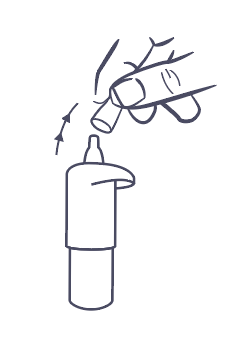
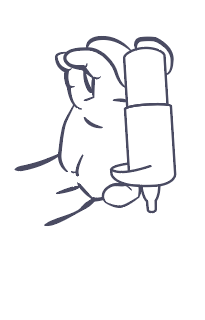
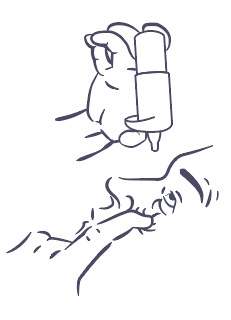
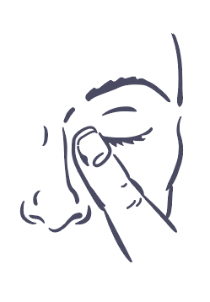
Image 1. Image 2. Image 3. Image 4.
Use only one bottle at a time. Do not open the cap until the next application.
After opening, discard the 2.5 ml bottle 30 days later, while the 7.5 ml bottle 90 days later, to prevent infection; then use a new bottle.
Note the date of opening the bottle on the box to be more certain about the shelf life.
If you use Lifog with other eye drops
If you need to use other eye drops, wait at least five minutes after applying Lifog. Use ophthalmic ointments at the end.
If you use more Lifog than you should
Be careful when pressing the bottle, so as to apply only one drop of product into the affected eye.
If you apply too many drops, it may cause mild irritation and your eyes may water and become red.
The effect should pass quickly, but if you are concerned, contact your doctor or the doctor treating your child.
If the child accidentally swallows Lifog, contact a doctor as soon as possible.
If you forget to use Lifog
If you forget to apply the eye drops at the usual time, wait until the next dose. Do not apply a double dose to make up for the forgotten dose.
If you stop using Lifog
If you want to stop using Lifog, consult your doctor or the doctor treating your child.
For any questions about the use of this medicine, consult your doctor, or the doctor treating your child, or your pharmacist.
4. Possible side effects
Like all medicines, this medicine can cause side effects, although not everyone will experience them.
Below are listed the most known side effects:
Very common(may affect more than 1 in 10 people):
- Gradual change in eye color, with an increase in brown pigment in the colored part, known as the iris. If you have mixed-color eyes (blue-brown, gray-brown, yellow-brown, or green-brown) you are likely to notice this change more than with single-colored eyes (blue, gray, green, or brown). Any changes in eye color may take years to develop, although they are usually observed within 8 months of treatment. The color change may be permanent and may be more noticeable if you apply Lifog to only one eye. There do not appear to be any problems associated with the change in eye color. The eye color change does not continue after stopping treatment with Lifog.
- Eye redness.
- Eye irritation (burning, grittiness, itching, or a feeling of something in the eye). If you experience eye irritation severe enough to cause excessive tearing or if you are considering stopping this medicine, contact your doctor, pharmacist, or nurse (within a week). You may need to have your treatment reviewed to ensure you continue to receive appropriate treatment for your condition.
- Gradual change in the eyelashes of the treated eye and the fine hairs around it, found mainly in people of Japanese origin. These changes involve an increase in color (darkening), length, thickness, and number of eyelashes.
Common(may affect up to 1 in 10 people):
- Irritation or discomfort on the surface of the eye, inflammation of the eyelids (blepharitis), eye pain, and sensitivity to light (photophobia), conjunctivitis. Uncommon(may affect up to 1 in 100 people):
- Swelling of the eyelids, dry eye, inflammation or irritation of the surface of the eye (keratitis), blurred vision, inflammation of the colored part of the eye (uveitis), swelling of the retina (macular edema).
- Skin rash.
- Chest pain (angina), irregular heartbeat (palpitations).
- Asthma, shortness of breath (dyspnea).
- Chest pain.
- Headache, dizziness.
- Muscle pain, joint pain.
- Nausea, vomiting.
Rare(may affect up to 1 in 1000 people):
- Inflammation of the iris (iritis), symptoms of swelling or scratching/damage to the surface of the eye, swelling around the eye (periorbital edema), bent eyelashes or an extra row of eyelashes, scarring on the surface of the eye, accumulation of fluid inside the colored part of the eye (iris cyst).
- Skin reactions on the eyelids, darkening of the skin of the eyelids.
- Worsening of asthma.
- Severe skin itching.
- Development of a viral eye infection caused by the herpes simplex virus (HSV).
Very rare(may affect up to 1 in 10,000 people):
- Worsening of angina in patients also suffering from heart disease, sunken appearance of the eye (deepening of the eye socket).
The side effects observed more frequently in children compared to adults are runny nose, itching
and fever.
In very rare cases, some patients with severe damage to the outermost transparent layer of the eye (the
cornea) have developed opaque spots on the cornea due to calcium accumulation during the
treatment.
Reporting of side effects
If you get any side effects, even those not listed in this leaflet, tell your
doctor, pharmacist or nurse. You can also report side effects directly
through the national reporting system at the address: https://www.aifa.gov.it/content/segnalazioni-
reazioni-avverse.
By reporting side effects you can help provide more information on the safety of
this medicine.
5. How to store Lifog
Keep this medicine out of the sight and reach of children.
Do not use this medicine after the expiry date which is stated on the packaging and on the label of the
vial after “EXP”. The expiry date refers to the last day of that month.
Do not freeze.
Do not store at a temperature above 25°C.
Opened 2.5 ml vial: use within 30 days.
Opened 7.5 ml vial: use within 90 days.
Note the date on which you opened the vial in the space on the cardboard box.
Do not dispose of any medicine in wastewater or household waste. Ask your pharmacist how to
dispose of medicines you no longer use. This will help protect the environment.
6. Contents of the pack and other information
What Lifog contains
- The active ingredient is latanoprost. Each ml of solution contains 50 micrograms of latanoprost. Each drop contains approximately 1.5 micrograms of latanoprost.
- The other ingredients are sodium chloride, disodium phosphate, sodium dihydrogen phosphate monohydrate, polysorbate 80, disodium edetate, sodium hydroxide (for pH adjustment), dilute hydrochloric acid (for pH adjustment), water for injections.
Description of the appearance of Lifog and contents of the pack
Lifog is a clear and colorless liquid.
The pack contains an HDPE bottle closed with a multi-dose pump applicator (PP, HDPE,
LDPE), an HDPE cap and a PP tube.
Lifog is available in the following pack sizes:
1 bottle of 2.5 ml
1 bottle of 7.5 ml
Not all pack sizes may be marketed.
Marketing Authorisation Holder
Alfa Intes Industria Terapeutica Splendore S.r.l.
Via Fratelli Bandiera 26 - 80026 Casoria (NA)
Italy
Manufacturer
Lomapharm GmbH
Langes Feld 5, Emmerthal
Niedersachsen, 31860
Germany
This medicinal product is authorised in the Member States of the European Economic Area under the
following denominations:
BG - Xalofree 50 μg/ml eye drops, solution
CZ - Xaloptic Neo
DE - Lifog 50 Mikrogramm/ml eye drops, solution
ES - Lifog 50 micrograms/ml eye drops, solution
FR - LIFOG 50 micrograms/mL, eye drops, solution
IE - Loravis 50 micrograms/ml eye drops, solution
LV - Xalvide 50 micrograms/ml eye drops, solution
LT - Xalvide 50 micrograms/ml eye drops (solution)
PT - Lifog 50 micrograms/ml eye drops, solution

Не впевнені, чи підходить вам цей лікарський засіб?
Обговоріть симптоми та можливі варіанти лікування з лікарем онлайн.

Виникли питання під час прийому ліків?
Обговоріть свої симптоми та лікування з лікарем онлайн.

- Країна реєстрації
- Лікарська формаEye drop, 50 microgrammi/ml
- Код АТХS01EE01
- Діюча речовина
- Потрібен рецептТак
- Виробник
- Ця інформація надана лише для ознайомлення і не є медичною порадою. Рішення щодо лікування завжди приймає лікар.
- Альтернативи до LIFOGЛікарська форма: Emulsion eye drops, 50 ?g / mlДіюча речовина: ЛатанопростВиробник: SANTEN OYПотрібен рецептЛікарська форма: Eye drops, solution, 50 MICROGRAMMI/MLДіюча речовина: ЛатанопростВиробник: OMNIVISION ITALIA SRLПотрібен рецептЛікарська форма: Eye drops, solution, 0.005 %Діюча речовина: ЛатанопростПотрібен рецепт
Аналоги LIFOG в інших країнах
Препарати з тією самою діючою речовиною, доступні в інших країнах.
Аналог LIFOG у Іспанія
Аналог LIFOG у Польща
Аналог LIFOG у Україна
Лікарі онлайн щодо LIFOG
Застосування, безпека та можливість призначення рецепта — за результатами медичної оцінки.









Отримайте рецепт на LIFOG онлайн
Заповніть форму за 2 хвилини
Розкажіть про симптоми, історію хвороби та потрібний препарат.
Оберіть лікаря або ми призначимо
Оберіть спеціаліста або ми підберемо найближчого доступного лікаря.
Лікар розглядає ваш випадок
Зазвичай протягом 30 хвилин. Може ставити уточнювальні запитання в чаті.
Отримайте в будь-якій аптеці
Електронний рецепт надсилається на вашу пошту — дійсний по всій Польщі.
Часті запитання
LIFOG потребує рецепта в Італія. Ви можете обговорити з лікарем онлайн, чи підходить цей лікарський засіб для вашої ситуації.
Діюча речовина у LIFOG — Латанопрост. Це допомагає визначити препарати з тим самим складом, але під іншими торговими назвами.
LIFOG виробляється компанією ALFA INTES INDUSTRIA TERAPEUTICA SPLENDORE S.R.L.. Назва бренду та упаковка можуть відрізнятися залежно від дистрибʼютора.
Лікарі, зокрема Сімейні лікарі, Психіатри, Дерматологи, Кардіологи, Ендокринологи, Гастроентерологи, Пульмонологи, Нефрологи, Ревматологи, Гематологи, Інфекціоністи, Алергологи, Геріатри, Педіатри, Онкологи, можуть оцінити доцільність застосування LIFOG з урахуванням вашого стану та місцевих правил. Ви можете записатися на онлайн-консультацію, щоб обговорити симптоми та можливі подальші кроки.
Польща має добре розвинену систему охорони здоров'я у великих містах, таких як Варшава, Краків, Вроцлав і Гданськ. Аптеки широко доступні та працюють відповідно до чинного законодавства, забезпечуючи доступ до рецептурних препаратів.
Ви можете придбати LIFOG у Варшаві, Кракові, Вроцлаві або Гданську в будь-якій аптеці за наявності дійсного рецепта.
Щоб отримати рецепт, ви можете скористатися Oladoctor:
Інші препарати з тією самою діючою речовиною (Латанопрост) включають KATIOLANTSE, DROPLATAN, GALAXIA. Вони можуть відрізнятися торговою назвою або формою випуску, але містять той самий терапевтичний компонент. Перед зміною або початком прийому нового препарату варто проконсультуватися з лікарем.
