



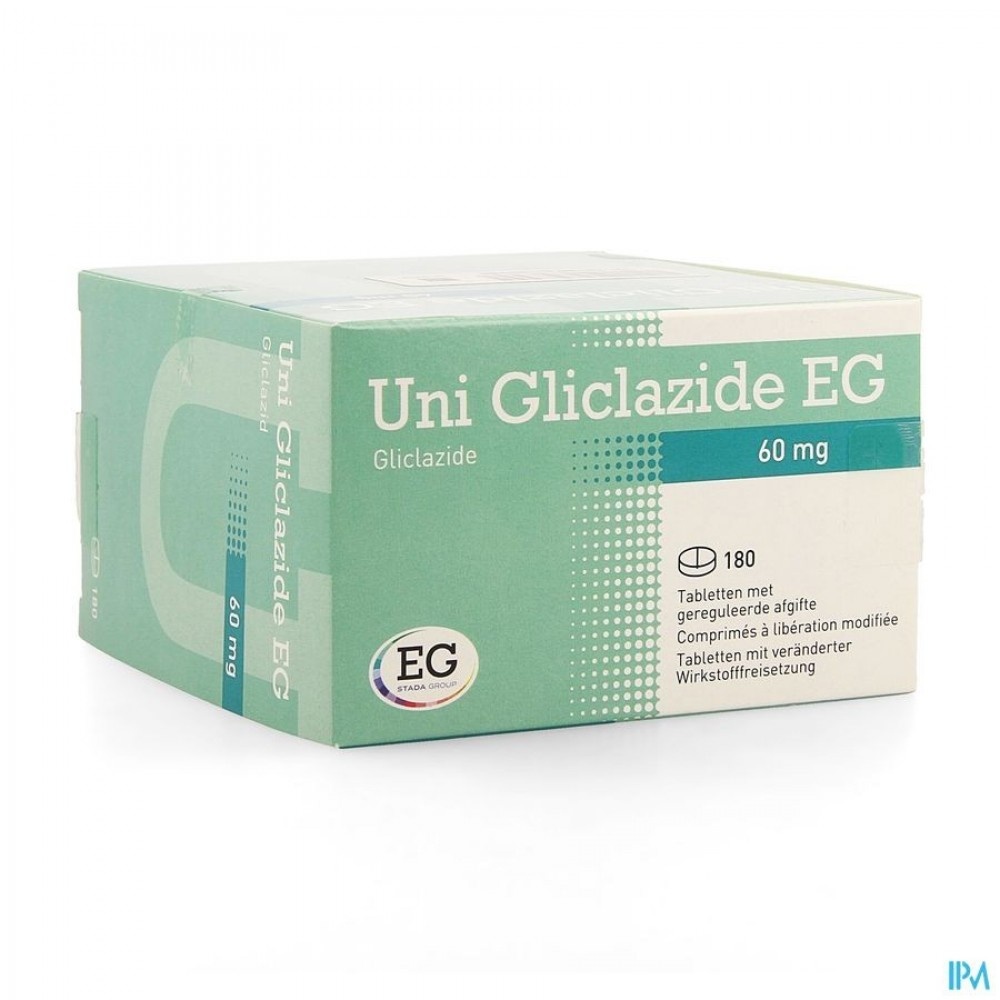
GLICLAZIDE 80 mg Coated Tablet

Запит на рецепт онлайн
Лікар розгляне ваш випадок і визначить, чи є рецепт медично доцільним.

Поговоріть з лікарем про ці ліки
Обговоріть симптоми та можливі подальші кроки під час короткої онлайн-консультації.



Інструкція із застосування LYKLATSIDE EG
Зміст інструкції
GLICLAZIDE EG 80 mg tablets
Generic medicine
Read this leaflet carefully before taking this medicine as it contains
important information for you.
- Keep this leaflet. You may need to read it again.
- If you have any questions, ask your doctor or pharmacist.
- This medicine has been prescribed only for you. Do not give it to other people, even if their symptoms are the same as yours, as it could be dangerous.
- If any side effects occur, including those not listed in this leaflet, tell your doctor or pharmacist. See section 4.
Contents of this leaflet:
- 1. What GLICLAZIDE EG is and what it is used for
- 2. What you need to know before you take GLICLAZIDE EG
- 3. How to take GLICLAZIDE EG
- 4. Possible side effects
- 5. How to store GLICLAZIDE EG
- 6. Contents of the pack and other information
1. WHAT IS GLICLAZIDE EG AND WHAT IS IT USED FOR
GLICLAZIDE EG contains the active ingredient gliclazide, which belongs to a group of medicines
called sulfonylureas, used to reduce blood sugar levels (oral hypoglycemic
drugs).
This medicine is used in adults for the treatment of a certain form of diabetes, which
cannot be controlled with diet and for which insulin administration is not indicated
(diabetes mellitus, non-insulin-dependent) also associated with problems at the level of blood vessels.
2. WHAT YOU NEED TO KNOW BEFORE YOU TAKE GLICLAZIDE EG
Do not take GLICLAZIDE EG
- If you are allergic to the active ingredient gliclazide, to sulfonylureas in general or to any of the other components of this medicine (listed in section 6).
- If you suffer from severe hepatic insufficiency (significant reduction of liver function).
- If you suffer from severe renal insufficiency (significant reduction of kidney function).
- If you suffer from juvenile and infantile diabetes (a particular form of the disease in which the pancreas is no longer able to produce insulin, a substance that regulates blood sugar levels).
- If you suffer from severe diabetes with malnutrition and acidosis (increased acidity of the blood).
- If you are in a state of diabetic coma and pre-coma (a complication of diabetes that causes loss of consciousness).
- If you have suffered severe trauma.
- If you have an infection.
- If you have severe ketosis (high presence of ketone bodies in the blood that cause a decrease in pH to very acidic values).
- If you are pregnant or breastfeeding (see “Pregnancy and breastfeeding”).
Warnings and precautions
Consult your doctor or pharmacist before taking GLICLAZIDE EG.
During treatment with gliclazide, you must be aware of the importance of following an appropriate diet and the need to avoid sources of infection.
You must adhere to your doctor's prescription regarding laboratory tests to be performed, in order to promptly report any altered data.
In particular situations (hospitalization after an accident, illness on vacation, etc.), always inform your doctor that you have diabetes.
In case of surgery, metabolic decompensation, infectious diseases and fever, it may be necessary to temporarily initiate therapy based on insulin (hormone produced by the pancreas that lowers blood sugar levels).
If you suffer from Favism, i.e. a disease caused by a deficiency of the glucose-6-phosphate dehydrogenase (G6PD) enzyme (an abnormality of red blood cells), a reduction in hemoglobin in the blood caused by the destruction of red blood cells (hemolytic anemia) may occur. Consult your doctor before taking this medicine.
Inform your doctor before taking Gliclazide EG if:
- Your kidney or adrenal function is reduced.
- You have severe liver (hepatic) diseases.
- You are malnourished.
- You are elderly.
The doctor will assess the possibility of reducing the dosage.
Other medicines and GLICLAZIDE EG
Tell your doctor or pharmacist if you are taking, have recently taken or might take any other medicines.
Discontinue any therapy based on miconazole (an antifungal medicine) before starting treatment with a sulfonylurea (such as gliclazide) as, following the association between miconazole and medicines belonging to the sulfonylurea group, hypoglycemia (reduction of blood sugar that manifests with irritability, headache, tremor, profuse sweating), even of considerable intensity, has been observed.
However, the association of gliclazide with biguanides (other medicines with hypoglycemic action used in type 2 diabetes) or with insulin is possible.
The blood sugar-lowering effect (hypoglycemic action) of gliclazide may be increased by:
- Alcohol (see “GLICLAZIDE EG with alcohol”).
- Sulfonamides (antibacterial medicines).
- Pyrazolones (anti-inflammatory, analgesic, antipyretic).
- Non-Steroidal Anti-Inflammatory Drugs (NSAIDs)
- Salicylates (medicines used as anti-inflammatory and analgesic).
- Diazepam (medicine with anxiolytic, sedative, anticonvulsant action).
- Tetracyclines (antibiotic medicines).
- Peregiline maleate (medicine used in cardiac pathologies).
- Chloramphenicol (antibiotic medicine).
- Clofibrate (medicine that reduces the level of fats in the blood).
- Monoamine oxidase inhibitors or MAOIs (medicines used as antidepressants).
- Beta-blockers (medicines used for various diseases including: angina, high blood pressure, heart attack, heart rhythm disturbance, heart failure).
- Dicoumarol and coumarin derivatives (medicines used to reduce blood coagulation).
Conversely, the blood sugar-lowering effect of gliclazide may be weak with a consequent increase in blood sugar levels, when one of the following medicines is taken:
- Thiazide diuretics (medicines used for the treatment of high blood pressure, which increase the elimination of fluids with urine).
- Adrenaline (substance used as an emergency medicine, for example for anaphylactic reactions, edema, bronchospasm and in some cases of low blood pressure).
- Corticosteroids (medicines used as anti-inflammatory and in some cases of allergic reactions).
- Oral contraceptives (birth control pill).
GLICLAZIDE EG with alcohol
During treatment with Gliclazide EG, avoid drinking alcohol as it may increase the hypoglycemic action of gliclazide (see “Other medicines and GLICLAZIDE”).
You should be aware of the possibility of photosensitization and disulfiram-like effects after ingestion of alcoholic beverages (see section 4 “Possible side effects”).
Pregnancy and breastfeeding
If you are pregnant, suspect you may be pregnant or are planning to become pregnant, or if you are breastfeeding, ask your doctor or pharmacist for advice before taking this medicine.
The use of GLICLAZIDE EG is contraindicated in pregnancy and during breastfeeding (see “Do not take GLICLAZIDE EG”).
Driving and operating machinery
GLICLAZIDE EG does not impair the ability to drive vehicles or operate machinery.
GLICLAZIDE EG contains lactose. If your doctor has diagnosed you with an intolerance to some sugars, contact him before taking this medicine.
3. HOW TO TAKE GLICLAZIDE EG
Take this medicine following exactly the instructions of your doctor or pharmacist.
If you have any doubts, consult your doctor or pharmacist.
The recommended dose is 2 tablets per day in one or two administrations.
The dose of Gliclazide EG that you must take will be established by the doctor in relation to your degree of
diabetes.
Swallow the tablet with water, without chewing, taking it preferably 30 minutes
before the meal.
If you take more GLICLAZIDE EGthan you should
Taking an excessive dose of the medicine essentially leads to manifestations of
hypoglycemia (decrease in blood sugar levels) whose first symptoms may
include headache, irritability, nervous depression, sleep disturbances, profuse sweating
(see “Warnings and precautions”).
In severe cases, disturbances of consciousness (i.e., a confused state) may occur if
this should happen, go to the emergency room of the nearest hospital.
If you forget to take GLICLAZIDE EG
If you forget to take a dose of the medicine, take it as soon as you remember, unless it is
almost time to take the next dose. Do not take a double dose to compensate for the
forgotten dose.
If you stop taking GLICLAZIDE EG
Do not stop treatment with GLICLAZIDE EG suddenly or without first having
agreed with your doctor.
If you have any doubts about the use of this medicine, ask your doctor or pharmacist.
4. POSSIBLE SIDE EFFECTS
Like all medicines, this medicine can cause side effects, although not everybody gets them.
A serious side effect that can rarely occur following the use of GLICLAZIDE
EG is hypoglycemia.
It is more likely that this effect occurs if you are debilitated, elderly, if you are undergoing unusual
physical exertion, if you have an irregular diet or consume alcoholic beverages, or if you have
impaired kidney and/or liver function.
Other side effects that may occur with the intake of GLICLAZIDE EG are:
- Photosensitization (exaggerated reaction to light) and disulfiram-like effects (feeling of general malaise, difficulty breathing, palpitations, headache, nausea and vomiting) after ingestion of alcoholic beverages.
- Transient disturbances at the level of the stomach and intestines.
- Transient skin eruptions (skin changes) of allergic origin.
- Generally, in subjects sensitive to sulfonamides, alterations in the number of blood cells may occur, such as leukopenia and agranulocytosis (diseases characterized by a decrease in the number of white blood cells and granulocytes in the blood), thrombocytopenia (decrease in the number of platelets in the blood), anemia (reduction of hemoglobin levels in the blood), generally reversible.
The following skin reactions have also been reported:
- skin rash (rash)
- itching
- urticaria
- swelling of the face, lips, mouth, tongue or throat that can cause difficulty swallowing and breathing (angioedema)
- redness of the skin (erythema)
- reaction causing skin eruptions with macules (flat, light-colored spots) and papules (small bumps);
- formation of blisters, bubbles or peeling of the skin or mucous membranes (toxic epidermal necrolysis and Stevens-Johnson syndrome).
Reporting of side effects
If you experience any side effects, including those not listed in this leaflet, please
consult your doctor or pharmacist. You can also report side effects directly
through the national reporting system at
www.agenziafarmaco.gov.it/it/responsabili.
By reporting side effects you can help provide more information on the
safety of this medicine.
5. HOW TO STORE GLICLAZIDE EG
Keep this medicine out of the sight and reach of children.
Do not use this medicine after the expiry date which is stated on the packaging after Exp. The
expiry date refers to the last day of that month and the product in intact packaging,
correctly stored.
This medicine does not require special storage precautions.
Do not dispose of any medicine in wastewater or household waste. Ask your pharmacist how to
dispose of medicines you no longer use. This will help protect the environment.
6. CONTENTS OF THE PACK AND OTHER INFORMATION
What GLICLAZIDE EG contains
The active ingredient isgliclazide. Each tablet contains 80 mg of gliclazide.
Other ingredients are:Lactose, polyvinylpyrrolidone, behenic acid glycerol, colloidal silica,
magnesium stearate.
Description of the appearance of GLICLAZIDE EG and contents of the pack
Tablets.
Blister of 40 divisible tablets inserted in cardboard box.
Marketing Authorisation Holder
EG S.p.A., Via Pavia 6 20136 MILAN
Manufacturer
DOPPEL Farmaceutici Srl- Via Volturno, 48 - 20089 Rozzano (MI)

Не впевнені, чи підходить вам цей лікарський засіб?
Обговоріть симптоми та можливі варіанти лікування з лікарем онлайн.

Виникли питання під час прийому ліків?
Обговоріть свої симптоми та лікування з лікарем онлайн.
- Країна реєстрації
- Лікарська формаCoated tablet, 80 MG
- Код АТХA10BB09
- Діюча речовина
- Потрібен рецептТак
- Виробник
- Ця інформація надана лише для ознайомлення і не є медичною порадою. Рішення щодо лікування завжди приймає лікар.
- Альтернативи до LYKLATSIDE EGЛікарська форма: Modified-release tablet, 30 MGДіюча речовина: гликлазидВиробник: LES LABORATOIRES SERVIERПотрібен рецептЛікарська форма: Modified-release tablet, 30 MGДіюча речовина: гликлазидВиробник: IST.FARM.BIOL.STRODER S.R.L.Потрібен рецептЛікарська форма: Modified-release tablet, 30 MGДіюча речовина: гликлазидВиробник: S.F. GROUP S.R.L.Потрібен рецепт
Аналоги LYKLATSIDE EG в інших країнах
Препарати з тією самою діючою речовиною, доступні в інших країнах.
Аналог LYKLATSIDE EG у Іспанія
Аналог LYKLATSIDE EG у Польща
Аналог LYKLATSIDE EG у Україна
Лікарі онлайн щодо LYKLATSIDE EG
Застосування, безпека та можливість призначення рецепта — за результатами медичної оцінки.


Отримайте рецепт на LYKLATSIDE EG онлайн
Заповніть форму за 2 хвилини
Розкажіть про симптоми, історію хвороби та потрібний препарат.
Оберіть лікаря або ми призначимо
Оберіть спеціаліста або ми підберемо найближчого доступного лікаря.
Лікар розглядає ваш випадок
Зазвичай протягом 30 хвилин. Може ставити уточнювальні запитання в чаті.
Отримайте в будь-якій аптеці
Електронний рецепт надсилається на вашу пошту — дійсний по всій Польщі.
Часті запитання
LYKLATSIDE EG потребує рецепта в Італія. Ви можете обговорити з лікарем онлайн, чи підходить цей лікарський засіб для вашої ситуації.
Діюча речовина у LYKLATSIDE EG — гликлазид. Це допомагає визначити препарати з тим самим складом, але під іншими торговими назвами.
LYKLATSIDE EG виробляється компанією EG S.P.A.. Назва бренду та упаковка можуть відрізнятися залежно від дистрибʼютора.
Лікарі, зокрема Сімейні лікарі, Психіатри, Дерматологи, Кардіологи, Ендокринологи, Гастроентерологи, Пульмонологи, Нефрологи, Ревматологи, Гематологи, Інфекціоністи, Алергологи, Геріатри, Педіатри, Онкологи, можуть оцінити доцільність застосування LYKLATSIDE EG з урахуванням вашого стану та місцевих правил. Ви можете записатися на онлайн-консультацію, щоб обговорити симптоми та можливі подальші кроки.
Польща має добре розвинену систему охорони здоров'я у великих містах, таких як Варшава, Краків, Вроцлав і Гданськ. Аптеки широко доступні та працюють відповідно до чинного законодавства, забезпечуючи доступ до рецептурних препаратів.
Ви можете придбати LYKLATSIDE EG у Варшаві, Кракові, Вроцлаві або Гданську в будь-якій аптеці за наявності дійсного рецепта.
Щоб отримати рецепт, ви можете скористатися Oladoctor:
Інші препарати з тією самою діючою речовиною (гликлазид) включають DIAMIKRON, DRAMION, LEUKOS. Вони можуть відрізнятися торговою назвою або формою випуску, але містять той самий терапевтичний компонент. Перед зміною або початком прийому нового препарату варто проконсультуватися з лікарем.
