



CUROSURF 80 mg /Ml Suspension For Endotracheobronchial Instillation

Запит на рецепт онлайн
Лікар розгляне ваш випадок і визначить, чи є рецепт медично доцільним.

Поговоріть з лікарем про ці ліки
Обговоріть симптоми та можливі подальші кроки під час короткої онлайн-консультації.



Інструкція із застосування KUROSURF
Зміст інструкції
CUROSURF 80 mg/ml
SUSPENSION FOR ENDOTRACHEAL-BRONCHIAL INSTILLATION
phospholipid fraction from porcine lung
Read this leaflet carefully before using this medicine as it contains important
information for you.
- Keep this leaflet. You may need to read it again.
- If you have any questions, ask your doctor.
- If any side effects occur, including any not listed in this leaflet, tell your doctor. (See section 4)
Contents of this leaflet:
- 1. What CUROSURF is and what it is used for
- 2. What you need to know before you use CUROSURF
- 3. How to use CUROSURF
- 4. Possible side effects
- 5. How to store CUROSURF
- 6. Contents of the pack and other information
1. What is CUROSURF and what is it used for
CUROSURF is a sterile suspension in single-dose vials for endotracheal or
endobronchial administration, used in premature infants to treat or prevent Respiratory Distress Syndrome.
The lungs are covered with a substance called surfactant, which prevents their collapse and facilitates
breathing. Some newborns, especially premature infants, do not have enough of this substance,
which causes Respiratory Distress Syndrome.
CUROSURF is a natural surfactant obtained from pig lungs, which behaves in the same way as
the surfactant naturally present in newborns, and is used to improve breathing in premature infants, until
their own surfactant production becomes autonomous.
2. What you need to know before using CUROSURF
Do not use CUROSURF
if you are allergic to the active ingredient or to any of the other ingredients of this medicine (listed in
section 6).
Warnings and precautions
CUROSURF must be used only in a hospital setting by trained and experienced medical personnel in the intensive care of premature infants, with adequate equipment available for ventilation
and monitoring of infants with Respiratory Distress Syndrome.
In almost all infants with a gestational age of less than 27 weeks, the doctor will administer CUROSURF
(within 15 minutes of birth) to prevent Respiratory Distress Syndrome (prophylaxis).
The doctor may implement prevention in infants with a gestational age greater than 26 weeks and less
than or equal to 30 weeks in the following cases:
- if intubation is required in the delivery room;
- if the mother has not received corticosteroid prophylaxis.
The doctor may administer CUROSURF in premature babies in cases of oxygen deficiency that occurs
during the last weeks of gestation and/or immediately after birth
(perinatal asphyxia), maternal diabetes, multiple pregnancies, male sex, cases of Respiratory Distress
Syndrome in the family, cesarean delivery.
In all other premature infants, the doctor will administer CUROSURF when the first signs of
Respiratory Distress Syndrome occur.
Before using CUROSURF, the doctor will assess that the general condition of the newborn is stabilized,
correcting, for example, acidic blood pH (acidosis), low blood pressure (hypotension), decreased
red blood cells (anemia), blood sugar levels (hypoglycemia), low body temperature
(hypothermia).
It is expected that the administration of surfactant will reduce the severity of Respiratory Distress
Syndrome but not eliminate the problems associated with premature birth (mortality and
morbidity), as premature infants may have other complications associated with their
immaturity.
Premature infants following prolonged rupture of the membranes (more than three weeks) may not
respond optimally to exogenous surfactant.
After administration of CUROSURF, a temporary decrease (transient depression) in brain electrical activity (electro-cerebral) has been recorded, between 2 and 10 minutes.
The administration of CUROSURF to premature infants with severe low blood pressure
(hypotension) has not been studied.
The administration of CUROSURF to premature infants with renal or hepatic insufficiency has not
been evaluated.
Children
This medicine is used only in premature infants.
Other medicines and CUROSURF
No interactions between CUROSURF and other medicines are known.
Pregnancy, breastfeeding and fertility
This medicine is used only in premature infants.
Driving and operating machinery
This medicine is used only in premature infants.
CUROSURF containssodium chloride.
This medicine contains less than 1 mmol (23 mg) of sodium per dose, i.e. it is practically ‘sodium-free’.
3. How to use CUROSURF
CUROSURF must be used only in a hospital setting by trained and experienced medical personnel in the intensive care of premature infants, with adequate equipment available for the ventilation and monitoring of infants with Respiratory Distress Syndrome.
CUROSURF is a medicine for endotracheal or endobronchial administration.
TREATMENT:
the recommended loading dose is 100-200 mg/Kg (1.25-2.5 ml/kg) of body weight, to be administered in a single dose, as soon as possible once the diagnosis of Respiratory Distress Syndrome is established.
Additional doses of 100 mg/Kg each can be administered at intervals of at least 12 hours in infants who still require assisted ventilation and supplemental oxygen. The maximum total dose is: 300-400 mg/kg.
PREVENTION (PROPHYLAXIS):
the recommended dose is 100-200 mg/Kg (1.25-2.5 ml/kg) of body weight, to be administered in a single dose, preferably within 15 minutes of birth.
If Respiratory Distress Syndrome occurs requiring mechanical ventilation, further doses of 100 mg/Kg may be administered 6-12 hours after the first dose and other doses at 12-hour intervals. The maximum total dose is: 300-400 mg/kg.
To use this medicine correctly, consult the “Instructions for use of CUROSURF” section at the
If you use more CUROSURF than you should
There are no reports of overdose following the administration of CUROSURF. If this should occur, and only in the presence of clear clinical effects on the infant's breathing, ventilation or oxygenation, it is recommended to aspirate as much suspension as possible and to subject the infant to supportive treatments, with particular attention to hydration and electrolyte balance.
4. Possible side effects
Like all medicines, this medicine can cause side effects, although not everybody gets them.
Treatment with CUROSURF may cause:
Uncommon side effects(may affect up to 1 in 100 people)
severe infection (sepsis); bleeding inside the skull (intracranial); presence of air in the pleura
(pneumothorax).
Rare side effects(may affect up to 1 in 1000 people)
low blood pressure (hypotension); slowed heart rate (bradycardia); chronic lung disease
(bronchopulmonary dysplasia); pulmonary hemorrhage; lower oxygen in the blood (reduced oxygen
saturation).
Side effects with unknown frequency(frequency cannot be estimated based on available data)
Difficulty breathing with pauses in breathing (apnea); oxygen toxicity (hyperoxia);
bluish discoloration of the skin and mucous membranes (neonatal cyanosis); abnormal
electroencephalogram; complications due to endotracheal intubation.
Some cases of persistent patent ductus arteriosus have been reported in neonates treated with CUROSURF.
During the administration of CUROSURF with a thin catheter, some transient and moderate adverse events
have occurred such as bradycardia, apnea, reduced oxygen saturation, foaming at the mouth,
coughing, choking and sneezing.
Reporting of side effects
If you get any side effects, even those not listed in this leaflet, tell your doctor or nurse. You can also
report side effects directly through the national reporting system at “www.agenziafarmaco.gov.it/it/responsabili”. By
reporting side effects you can help provide more information on the safety of this medicine.
5. How to store CUROSURF
Keep this medicine out of sight and reach of children.
CUROSURF is available in ready-to-use vials and should be stored in the original packaging to
protect it from light. Store in a refrigerator (+2 and +8°C).
Unused and unopened vials of CUROSURF that have been warmed to room temperature can
be returned to the refrigerator within 24 hours for future use. Do not warm to room temperature and
do not refrigerate more than once.
Do not use any remaining residue left in the vial after the first withdrawal.
Do not use this medicine after the expiry date which is stated on the packaging. The expiry date refers to
the last day of that month.
Do not dispose of any medicine in wastewater or household waste. Ask your pharmacist how to eliminate
medicines that you no longer use. This will help protect the environment.
6. Package contents and other information
What CUROSURF contains
The active ingredient is: lung surfactant phospholipid fraction from porcine lung.
One vial of 1.5 ml and 3 ml contains: 120 mg and 240 mg of lung surfactant phospholipid fraction from porcine lung.
The other ingredients are: sodium chloride, water for injections.
Description of the appearance of CUROSURF and contents of the pack
CUROSURF is a sterile suspension contained in single-dose glass neutral vials, with a volume of 5
ml, with a chlorobutyl rubber stopper and a plastic and aluminum crimp cap.
This medicinal product is available in the following packs:
- 1 vial of 3 ml suspension (80 mg/ml);
- 1 vial of 1.5 ml suspension (80 mg/ml);
- 2 vials of 1.5 ml suspension (80 mg/ml).
Marketing authorization holder
Chiesi Farmaceutici S.p.A.
Via Palermo, 26/A
43122 Parma
Manufacturer
Chiesi Farmaceutici S.p.A.
Via San Leonardo, 96
43122 Parma
-----------------------------------------------------------------------------------------------------------------------------------
THE FOLLOWING INFORMATION IS INTENDED EXCLUSIVELY FOR DOCTORS OR HEALTHCARE
PROFESSIONALS
REFER TO THE SUMMARY OF PRODUCT CHARACTERISTICS FOR
FURTHER INFORMATION
INSTRUCTIONS FOR USE OF CUROSURF
BEFORE using CUROSURF:
- aspirate the endotracheal tube before instillation, to decrease the risk of tube obstruction, as if ventilator parameters become markedly altered during or immediately after instillation, it may be due to mucus obstruction of the endotracheal tube, especially if pulmonary secretions were consistent before drug administration. If mucosal obstruction of the endotracheal tube is suspected and aspiration is unable to remove it, the endotracheal tube must be immediately replaced.
Method of administration
Bring the vial to room temperature, even by holding it in your hand for a few minutes.
It is necessary to gently invert it several times, WITHOUT SHAKING, until the suspension appears
homogeneous.
To withdraw the suspension, carefully follow these instructions:
- 1) Locate the notch (FLIP UP) on the colored plastic cap;
- 2) Lift the notch and pull upwards;
- 3) Pull down the plastic cap with the aluminum portion;
- 4) and 5) Completely remove the ring by pulling off the aluminum cover;
- 6) Remove the rubber stopper;
- 7) Withdraw the contents using a sterile needle and syringe, and administer CUROSURF according to the method deemed most appropriate from those expressed below.
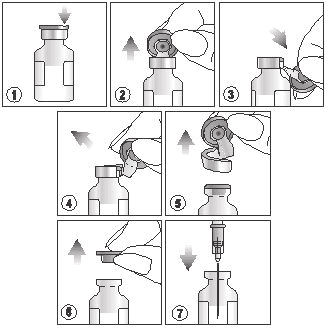
CUROSURF can be administered according to the following methods:
- 1. Disconnecting the infant from the mechanical ventilator Briefly disconnect the infant from the mechanical ventilator and administer 1.25-2.5 ml/kg (100-200 mg/kg) of suspension as a single bolus, directly into the lower part of the trachea through the endotracheal tube. Manually ventilate for about one minute then reconnect the infant to the mechanical ventilator with the same settings as before administration. Further doses (1.25 ml/kg equivalent to 100 mg/kg) that may be required can be administered in the same way;
- 2. Without disconnecting the infant from the mechanical ventilator Administer 1.25 – 2.5 ml/kg (100-200 mg/kg) of suspension as a single bolus, directly into the lower trachea by passing a catheter through the suction port in the endotracheal tube.
Further doses (1.25 ml/kg equivalent to 100 mg/kg) that may be eventually necessary can be
administered in the same way;
- 3. Surfactant-Extubation-Intubation (INSURE) Intubate the infant solely for the purpose of administering the surfactant. The doses are the same as indicated for methods 1) and 2). In this context, the infant is manually ventilated and after administering the surfactant and extubating, nasal CPAP (Continuous Positive Airway Pressure) can be applied.
- 4. Less invasive surfactant administration with a thin catheter (LISA) In premature infants with spontaneous breathing, CUROSURF can also be administered through a less invasive technique (LISA) using a thin catheter. The doses are the same as reported for the methods indicated in points 1), 2) and 3). Keeping the infant with spontaneous breathing in CPAP and with direct visualization of the vocal cords by laryngoscope, a small diameter catheter is positioned in the infant's trachea. CUROSURF is instilled through a single bolus over a period of time between 0.5 and 3 minutes. After instillation of CUROSURF, the catheter is immediately removed. CPAP treatment must be maintained throughout the procedure.
Thin catheters with CE marking for this
intended use must be used for surfactant administration.
DURING therapy, regardless of the method of administration, it is recommended:
- frequent monitoring of blood gases as, after administration, there is generally an immediate increase in PaO or oxygen saturation. To maintain adequate oxygen levels in the blood, monitor with periodic blood gas analysis, continuous transcutaneous PaO monitoring or oxygen saturation;
- monitoring to identify symptoms of infection. At the first signs of infection, appropriate antibiotic therapy must be immediately administered to the infant;
- to avoid high PaO peaks by adjusting the ventilator immediately after instillation. The onset of intracranial hemorrhages after CUROSURF instillation has been associated with a reduction in mean arterial blood pressure and early peaks in arterial oxygenation (PaO).
AFTER administration of the medicinal product:
- do not aspirate tracheal secretions for at least 6 hours, unless conditions occur that are life-threatening;
- it may be necessary:
- a reduction in peak inspiratory pressure (without waiting for confirmation from blood gas control, if lung expandability improves rapidly);
- a rapid adjustment of the inspired oxygen concentration (if there is a rapid increase in arterial oxygen concentration, to avoid hyperoxia).
DISCONTINUE therapy with CUROSURF in case of:
- bradycardia, hypotension and reduced oxygen saturation, in such situations established and adopted appropriate measures to normalize heart rate. After reaching stabilization, the infant can still be treated with appropriate monitoring of vital signs;
- reflux, if necessary, the peak inspiratory pressure must be increased until the obstruction of the endotracheal tube is removed.
To complete the picture of prematurity complications, the following disorders may occur directly related to the severity of the disease and the use of mechanical ventilation, necessary for reoxygenation: pneumothorax, interstitial pulmonary emphysema and pulmonary hemorrhage.
Finally, prolonged use of high oxygen concentrations and mechanical ventilation are associated with the development of bronchopulmonary dysplasia and retinopathy of prematurity.

Не впевнені, чи підходить вам цей лікарський засіб?
Обговоріть симптоми та можливі варіанти лікування з лікарем онлайн.

Виникли питання під час прийому ліків?
Обговоріть свої симптоми та лікування з лікарем онлайн.
- Країна реєстрації
- Лікарська формаSuspension for endotracheobronchial instillation, 80 MG/ML
- Код АТХR07AA02
- Діюча речовина
- Потрібен рецептНі
- Виробник
- Ця інформація надана лише для ознайомлення і не є медичною порадою. Рішення щодо лікування завжди приймає лікар.
- Альтернативи до KUROSURFЛікарська форма: Compressed medical gas, 400 PPMДіюча речовина: Оксид азота (II)Потрібен рецептЛікарська форма: Inhalation gas, 400 PPMДіюча речовина: Оксид азота (II)Виробник: LINDE HEALTHCARE ABПотрібен рецептЛікарська форма: Film-coated tablet, 100 MGДіюча речовина: ivacaftor, tezacaftor and elexacaftorВиробник: VERTEX PHARMACEUTICALS (IRELAND) LIMITEDПотрібен рецепт
Аналоги KUROSURF в інших країнах
Препарати з тією самою діючою речовиною, доступні в інших країнах.
Аналог KUROSURF у Польща
Аналог KUROSURF у Україна
Аналог KUROSURF у Іспанія
Лікарі онлайн щодо KUROSURF
Застосування, безпека та можливість призначення рецепта — за результатами медичної оцінки.








Отримайте рецепт на KUROSURF онлайн
Заповніть форму за 2 хвилини
Розкажіть про симптоми, історію хвороби та потрібний препарат.
Оберіть лікаря або ми призначимо
Оберіть спеціаліста або ми підберемо найближчого доступного лікаря.
Лікар розглядає ваш випадок
Зазвичай протягом 30 хвилин. Може ставити уточнювальні запитання в чаті.
Отримайте в будь-якій аптеці
Електронний рецепт надсилається на вашу пошту — дійсний по всій Польщі.
Часті запитання
KUROSURF не потребує рецепта в Італія. Ви можете обговорити з лікарем онлайн, чи підходить цей лікарський засіб для вашої ситуації.
Діюча речовина у KUROSURF — natural phospholipids. Це допомагає визначити препарати з тим самим складом, але під іншими торговими назвами.
KUROSURF виробляється компанією CHIESI FARMACEUTICI S.P.A.. Назва бренду та упаковка можуть відрізнятися залежно від дистрибʼютора.
Лікарі, зокрема Сімейні лікарі, Психіатри, Дерматологи, Кардіологи, Ендокринологи, Гастроентерологи, Пульмонологи, Нефрологи, Ревматологи, Гематологи, Інфекціоністи, Алергологи, Геріатри, Педіатри, Онкологи, можуть оцінити доцільність застосування KUROSURF з урахуванням вашого стану та місцевих правил. Ви можете записатися на онлайн-консультацію, щоб обговорити симптоми та можливі подальші кроки.
Польща має добре розвинену систему охорони здоров'я у великих містах, таких як Варшава, Краків, Вроцлав і Гданськ. Аптеки широко доступні та працюють відповідно до чинного законодавства, забезпечуючи доступ до рецептурних препаратів.
Ви можете придбати KUROSURF у Варшаві, Кракові, Вроцлаві або Гданську в будь-якій аптеці за наявності дійсного рецепта.
Щоб отримати рецепт, ви можете скористатися Oladoctor:
Інші препарати з тією самою діючою речовиною (natural phospholipids) включають INALOSSIN, INOMAX, KAFTRIO. Вони можуть відрізнятися торговою назвою або формою випуску, але містять той самий терапевтичний компонент. Перед зміною або початком прийому нового препарату варто проконсультуватися з лікарем.
