



CREON 25.000 U.PH.EUR. Modified-release hard capsule

Запит на рецепт онлайн
Лікар розгляне ваш випадок і визначить, чи є рецепт медично доцільним.

Поговоріть з лікарем про ці ліки
Обговоріть симптоми та можливі подальші кроки під час короткої онлайн-консультації.



Інструкція із застосування KREON
Зміст інструкції
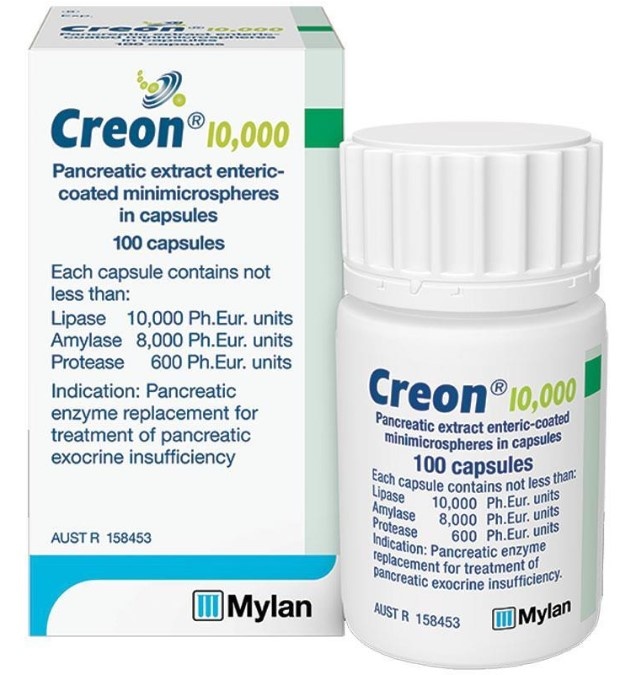
- CREON 10000 U.Ph.Eur hard capsules with modified release
- CREON 25000 U.Ph.Eur. hard capsules with modified release
- CREON 5000 U.Ph.Eur. gastro-resistant granules
CREON 10000 U.Ph.Eur hard capsules with modified release
pancrelipase
Read this leaflet carefully before you start using this medicine as it contains important
information for you.
- Keep this leaflet. You may need to read it again.
- If you have any questions, ask your doctor or pharmacist.
- This medicine has been prescribed for you only. Do not pass it on to others, even if they have the same symptoms as you, as it may be harmful.
- If you get any side effects, even those not listed in this leaflet, tell your doctor or pharmacist.
Contents of this leaflet:
- 1. What CREON is and what it is used for
- 2. What you need to know before you use CREON
- 3. How to use CREON
- 4. Possible side effects
- 5. How to store CREON
- 6. Contents of the pack and other information
1. What is CREON and what is it used for
- CREON is a product for oral use based on pancrelipase, that is, pancreatic enzymes (lipase, amylase, protease). Pancreatic enzymes are necessary for digestion, that is, the breakdown of fats, proteins and starch into simple substances.
- CREON is indicated in the treatment of exocrine pancreatic insufficiency (reduced or insufficient function of the pancreas) caused by cystic fibrosis (hereditary disease), chronic pancreatitis, pancreatectomy (total or partial resection of the pancreas), total gastrectomy and partial gastric resections (resections of the stomach), ductal obstruction due to neoplasms (tumors of the pancreas or common bile duct). Supplementation with pancreatic enzymes can also be helpful in exocrine pancreatic insufficiency of the elderly.
2. What you need to know before you use CREON
Do not use CREON
- if you are allergic to porcine pancreatic enzymes or any of the other ingredients of this medicine (listed in section 6).
- if you have acute pancreatitis (acute inflammatory disease of the pancreas).
Warnings and precautions
Talk to your doctor or pharmacist before using Creon
- if you experience unusual intestinal symptoms or changes in intestinal symptoms, especially if you are being treated with high doses of enzymes (more than 10,000 lipase units per kg body weight per day). In this case, inform your doctor immediately.
Additional information about pancreatic enzymes
Creon, like other pancreatic enzyme products, is produced from the glands of the pancreas
obtained from pigs for food use. These pigs may carry viruses. During the
production of Creon, many precautions are taken to reduce the risk of virus spread, including
their destruction and the control of specific viruses. The risk of infections caused by these or other
unknown or new viruses cannot be completely excluded. However, no cases have been reported in
which a patient has become infected.
Other medicines and Creon
Interaction studies of Creon with other medicines have not been conducted.
Tell your doctor or pharmacist if you are taking, have recently taken, or might take
any other medicines.
Creon with food, beverages and alcohol
It is recommended to take Creon during or immediately after main meals, with a sufficient
amount of liquid (see How to use Creon)
Pregnancy, breastfeeding and fertility
If you are pregnant, suspect you are pregnant, are planning a pregnancy, or are breastfeeding
ask your doctor or pharmacist for advice before taking this medicine.
Breastfeeding
Creon can be used during breastfeeding.
Driving and operating machinery
Creon does not or negligibly alters the ability to drive vehicles and operate machinery.
Creon contains sodium
This medicine contains less than 1 mmol (23 mg) of sodium per capsule, i.e. essentially ‘sodium-free’.
3. How to use CREON
Take this medicine following the instructions of your doctor or pharmacist exactly.
If you have any doubts, consult your doctor or pharmacist.
The dosage should be adjusted according to individual needs and depends on the severity of the disease and the
composition of the diet. It is recommended to take the capsules during or immediately after main
meals.
The capsules must be swallowed whole, without breaking or chewing them, during or immediately
after each meal or snack, with a sufficient amount of liquid. If it is difficult to swallow
the capsules (for example in small children or elderly patients), these can be carefully
opened and the microgranules added to semi-solid acidic foods (pH < 5.5, i.e. acidic) that do not require
chewing or taken with acidic liquids (pH < 5.5, i.e. acidic). For example, semi-acidic
foods can be applesauce or yogurt. Acidic liquids can be apple, orange or
pineapple juice.
This method should be used in patients who have undergone gastrectomy.
Any mixture of microgranules with food or liquids must be used immediately and must not
be stored.
Breaking or chewing the microgranules, as well as adding them to foods with a pH greater than
5.5 (i.e. basic) can destroy the gastro-protective membrane that coats the microgranules. This
can lead to premature release of the enzymes in the oral cavity and can lead to reduced efficacy
of the drug and irritation of the mucous membranes. Care must be taken to ensure that no medication
remains in the mouth.
It is important to ensure adequate hydration of patients, especially during periods of
increased fluid loss. Inadequate hydration can worsen constipation.
Dosage in Cystic Fibrosis (adults and children)
In cystic fibrosis, the following dosage is recommended for pancreatic enzyme replacement
therapy:
enzymatic treatment should be started with 1000 lipase units per meal per kg of body weight in
children up to 4 years and with 500 lipase units per meal per kg of body weight in children over
4 years of age;
the dosage should be adjusted according to the severity of the disease in order to ensure control
of steatorrhea and maintenance of good nutritional status;
most patients should not exceed 10000 lipase units per kg of body weight or
4000 lipase units per gram of ingested fat.
Dosage in other conditions associated with exocrine pancreatic insufficiency
The dosage should be adjusted according to individual needs based on the degree of maldigestion and the
fat content of the meal. The dosage per meal varies between 25000 and 80000 lipase units while it is
half for snacks.
If you take more CREON than you should:
In case of ingestion/taking an excessive dose of CREON, immediately inform your doctor
or go to the nearest hospital.
In case of taking an excessive dose of the medicine, an increase in the amount
of uric acid eliminated with the urine (hyperuricosuria) and an increase in uric acid in the blood
(hyperuricemia) may occur.
If you forget to take CREON:
Do not take a double dose to make up for a missed dose.
If you stop taking CREON:
Caution: Do not stop CREON without your doctor's advice. The symptoms of your illness may
worsen.
If you have any doubts about the use of this medicine, ask your doctor or pharmacist.
4. Possible side effects
Like all medicines, this medicine can cause side effects, although not everyone gets them.
The most commonly reported adverse reactions have been gastrointestinal disorders,
predominantly mild or moderate in severity. Gastrointestinal disorders are mostly associated with the
underlying disease. The following side effects have been reported during clinical studies:
Very common (affects more than 1 in 10 people):
- abdominal pain
Common (affects less than 1 in 10 people):
- nausea
- vomiting
- constipation
- abdominal bloating
- diarrhoea.
Uncommon (affects less than 1 in 100 people):
- skin redness (rash)
Not known (frequency cannot be estimated from available data)
- itching and hives
- other serious allergic reactions (hypersensitivity) that can include breathing problems or swelling of the lips.
- Narrowing of the intestine at the level of the ileo-cecal region and the large intestine (fibrosing colonopathy) has been reported in patients with cystic fibrosis who were taking high doses of pancreatic enzymes.
Reporting of side effects
If you get any side effects, even those not listed in this leaflet, tell your doctor or pharmacist or
nurse. You can also report side effects directly through the national reporting system www.aifa.gov.it/content/segnalazioni-
reazioni-avverse . By reporting side effects you can help provide more information on the safety of
this medicine.
5. How to store CREON
CREON should be stored at a temperature not exceeding 25°C, keeping the container tightly closed.
Use within 6 months after opening.
Keep this medicine out of sight and reach of children.
Do not use this medicine after the expiry date which is stated on the packaging and the bottle.
The expiry date refers to the last day of that month.
Do not dispose of any medicine in wastewater or household waste. Ask your pharmacist how
to dispose of medicines you no longer use. This will help protect the environment.
6. Contents of the pack and other information
What Creon 10000 U.Ph.Eur contains
The active ingredient is pancrelipase. One capsule contains 150 mg of pancrelipase (equivalent to: amylase 8,000
U.Ph.Eur., lipase 10,000 U.Ph.Eur., protease 600 U.Ph.Eur).
The other ingredients are: macrogol 4000, hypromellose phthalate, dimethicone 1000, cetyl alcohol,
triethyl citrate, gelatin, iron(III) oxide anhydrous E172, iron(III) oxide hydrate E172, iron(II, III)
oxide E172, sodium lauryl sulfate.
Description of the appearance of Creon 10000 U.Ph.Eur and contents of the pack
CREON 10000 U.Ph.Eur is presented as bicoloured capsules (brown opaque cap and transparent body) for oral use containing gastro-resistant granules packaged in polyethylene
(HDPE) containers with a polypropylene cap containing 50, 100 or 200 capsules.
Marketing authorisation holder and manufacturer
Marketing authorisation holder:
Viatris Italia S.r.l.
Via Vittor Pisani 20
20124 Milano
Manufacturer:
Abbott Laboratories GmbH, Neustadt - Germany.
CREON 25000 U.Ph.Eur. hard capsules with modified release
pancrelipase
Read this leaflet carefully before you start to use this medicine as it contains
important information for you.
- Keep this leaflet. You may need to read it again.
- If you have any questions, ask your doctor or pharmacist.
- This medicine has been prescribed for you only. Do not pass it on to others, even if they have the same symptoms as you, as it may be harmful.
- If you get any side effects, even those not listed in this leaflet, tell your doctor or pharmacist.
Contents of this leaflet:
- 1. What CREON is and what it is used for
- 2. What you need to know before you use CREON
- 3. How to use CREON
- 4. Possible side effects
- 5. How to store CREON
- 6. Contents of the pack and other information
1. What is CREON and what is it used for
- CREON is a product for oral use based on pancrelipase, that is, pancreatic enzymes (lipase, amylase, protease). Pancreatic enzymes are necessary for digestion, that is, the breakdown of fats, proteins and starch into simple substances.
- CREON is indicated in the treatment of exocrine pancreatic insufficiency (reduced or insufficient function of the pancreas) caused by cystic fibrosis (hereditary disease), chronic pancreatitis, pancreatectomy (total or partial resection of the pancreas), total gastrectomy and partial gastric resections (resections of the stomach), ductal obstruction due to neoplasms (tumors of the pancreas or common bile duct). Supplementation with pancreatic enzymes may also be helpful in exocrine pancreatic insufficiency of the elderly.
2. What you need to know before you use CREON
Do not use CREON
- if you are allergic to porcine pancreatic enzymes or to any of the other ingredients of this medicine (listed in section 6).
- if you have acute pancreatitis (acute inflammatory disease of the pancreas).
Warnings and precautions
Talk to your doctor or pharmacist before using Creon
- if unusual intestinal symptoms occur or intestinal symptoms change, especially if you are being treated with high doses of enzymes (more than 10000 lipase units per kg body weight per day). In this case, inform your doctor immediately.
Additional information about pancreatic enzymes
Creon, like other pancreatic enzyme products, is produced from the glands of the pancreas
from pigs for food use. These pigs may carry viruses. During the production
of Creon, many precautions are taken to reduce the risk of virus transmission, including their
destruction and the control of specific viruses. The risk of infection caused by these or other unknown or new viruses
cannot be completely excluded. However, no cases have been reported in which
a patient has become infected.
Other medicines and Creon
No interaction studies of Creon with other medicines have been conducted.
Tell your doctor or pharmacist if you are taking, have recently taken or might take
any other medicine.
Creon with food, drinks and alcohol
It is recommended to take Creon during or immediately after main meals, with a sufficient
amount of liquid (see How to use Creon)
Pregnancy, breastfeeding and fertility
If you are pregnant, suspect you are pregnant or are planning a pregnancy, or if you are breastfeeding
ask your doctor or pharmacist for advice before taking this medicine.
Breastfeeding
Creon can be used during breastfeeding.
Driving and operating machinery
Creon does not or negligibly alters the ability to drive and operate machinery.
Creon contains sodium
This medicine contains less than 1 mmol (23 mg) of sodium per capsule, i.e. essentially ‘sodium-free’.
3. How to use CREON
Take this medicine following exactly the instructions of your doctor or pharmacist.
If you have any doubts, consult your doctor or pharmacist.
The dosage should be adjusted according to individual needs and depends on the severity of the disease and the
composition of the diet. It is recommended to take the capsules during or immediately after the main
meals.
The capsules must be swallowed whole, without breaking or chewing them, during or immediately
after each meal or snack, with a sufficient amount of liquid. If it is difficult to swallow
the capsules (for example in young children or elderly patients), these can be carefully
opened and the microgranules added to semi-solid acidic foods (pH < 5.5, i.e. acidic) that do not require
chewing or taken with acidic liquids (pH < 5.5, i.e. acidic). For example, semi-acidic
foods may include applesauce or yogurt. Acidic liquids may include apple, orange or
pineapple juice.
This method should be adopted in patients who have undergone gastrectomy.
Any mixture of microgranules with food or liquids must be used immediately and must not
be stored.
Breaking or chewing the microgranules, as well as adding them to foods with a pH greater than
5.5 (i.e. basic) can destroy the gastro-protective membrane that coats the microgranules. This
may lead to premature release of the enzymes in the oral cavity and may lead to reduced efficacy
of the drug and irritation of the mucous membranes. Care must be taken to ensure that no drug
remains in the mouth.
It is important to ensure adequate hydration of patients at all times, especially during
periods of increased fluid loss. Inadequate hydration can worsen constipation.
Dosage in Cystic Fibrosis (adults and children)
In cystic fibrosis, the following dosage is recommended for pancreatic enzyme replacement therapy:
enzymatic treatment should be started with 1000 lipase units per meal per kg of body weight
in children up to 4 years of age and with 500 lipase units per meal per kg of body weight in children
over 4 years of age;
the dosage should be adjusted according to the severity of the disease in order to ensure
control of steatorrhea and maintenance of good nutritional status;
most patients should not exceed 10000 lipase units per kg of body weight
or 4000 lipase units per gram of ingested fat.
Dosage in other conditions associated with exocrine pancreatic insufficiency
The dosage should be adjusted according to individual needs based on the degree of maldigestion and
the fat content of the meal. The dosage per meal varies between 25000 and 80000 lipase units while
it is half for snacks.
If you take more CREON than you should:
In case of ingestion/taking an excessive dose of CREON, immediately inform your
doctor or go to the nearest hospital.
In case of taking an excessive dose of the medicine, an increase in the
amount of uric acid eliminated with the urine (hyperuricosuria) and an increase in uric acid in the
blood (hyperuricemia) may occur.
If you forget to take CREON:
Do not take a double dose to make up for a missed dose.
If you stop taking CREON:
Caution: Do not stop CREON without your doctor's advice. Your condition's symptoms
may worsen.
If you have any doubts about the use of this medicine, ask your doctor or pharmacist.
4. Possible side effects
Like all medicines, this medicine can cause side effects, although not everybody gets them.
The most commonly reported adverse reactions have been gastrointestinal disorders,
predominantly mild or moderate in severity. Gastrointestinal disorders are mostly associated
with the disease. The following side effects have been reported during clinical studies:
Very common (affects more than 1 in 10 people):
- abdominal pain
Common (affects less than 1 in 10 people):
- nausea
- vomiting
- constipation
- abdominal bloating
- diarrhoea
Uncommon (affects less than 1 in 100 people):
- skin redness (rash)
Not known (frequency cannot be estimated from available data)
- itching and hives
- other serious allergic reactions (hypersensitivity) that can include breathing problems or swelling of the lips.
- Narrowing of the intestine at the level of the ileo-cecal region and the large intestine (fibrosing colonopathy) has been reported in patients with cystic fibrosis who were taking high doses of pancreatic enzymes.
Reporting of side effects
If you get any side effects, even those not listed in this leaflet, tell your
doctor or pharmacist or nurse. You can also report side effects directly
through the national reporting system www.aifa.gov.it/content/segnalazioni-reazioni-avverse .
By reporting side effects you can help provide more information on the safety of
this medicine.
5. How to store CREON
CREON should be stored at a temperature not exceeding 25°C, keeping the container tightly closed.
Use within 6 months after opening.
Keep this medicine out of sight and reach of children.
Do not use this medicine after the expiry date which is stated on the packaging and the bottle.
The expiry date refers to the last day of that month.
Do not dispose of any medicine in wastewater or household waste. Ask your pharmacist how
to eliminate medicines that are no longer used. This will help protect the environment.
6. Contents of the pack and other information
What Creon 25000 U.Ph.Eur. contains
The active ingredient is pancrelipase. One capsule contains 300 mg of pancrelipase (equivalent to: amylase 18,000
- U. Ph. Eur., lipase 25,000 U. Ph. Eur., protease 1000 U. Ph.Eur.). The other ingredients are: macrogol 4000, hypromellose phthalate, dimethicone 1000, cetyl alcohol, triethyl citrate, gelatin, iron(III) oxide anhydrous E172, iron(III) oxide hydrate E172, sodium lauryl sulfate.
Description of the appearance of Creon 25000 U.Ph.Eur and contents of the pack
CREON 25000 U.Ph.Eur is presented as two-tone capsules (orange cap and transparent body) for oral use containing gastro-resistant granules packaged in polyethylene (HDPE) containers with a polypropylene cap containing 50 or 100 capsules.
Marketing Authorisation Holder and Manufacturer
Marketing Authorisation Holder:
Viatris Italia S.r.l.
Via Vittor Pisani 20
20124 Milano
Manufacturer:
Abbott Laboratories GmbH, Neustadt – Germany

Не впевнені, чи підходить вам цей лікарський засіб?
Обговоріть симптоми та можливі варіанти лікування з лікарем онлайн.
CREON 5000 U.Ph.Eur. gastro-resistant granules
pancrelipase
Read this leaflet carefully before you start using this medicine as it contains
important information for you.
- Keep this leaflet. You may need to read it again.
- If you have any questions, ask your doctor or pharmacist.
- This medicine has been prescribed for you only. Do not pass it on to others, even if their symptoms are the same as yours, as it may be harmful.
- If you get any side effects, even those not listed in this leaflet, tell your doctor or pharmacist.
Contents of this leaflet:
- 1. What CREON 5000 U.Ph.Eur. is and what it is used for
- 2. What you need to know before you use CREON 5000 U.Ph.Eur.
- 3. How to use CREON 5000 U.Ph.Eur.
- 4. Possible side effects
- 5. How to store CREON 5000 U.Ph.Eur.
- 6. Contents of the pack and other information
1. What is CREON 5000 U.Ph.Eur. and what is it used for
- CREON 5000 U.Ph.Eur. is a product for oral use based on pancrelipase, that is, pancreatic enzymes (lipase, amylase, protease). Pancreatic enzymes are necessary for digestion, that is, the breakdown of fats, proteins and starch into simple substances.
- CREON 5000 U.Ph.Eur. is indicated in the treatment of exocrine pancreatic insufficiency (reduced or insufficient function of the pancreas) caused by cystic fibrosis (hereditary disease), chronic pancreatitis, pancreatectomy (total or partial removal of the pancreas), total gastrectomy and partial gastric resections (stomach resections), ductal obstruction due to neoplasms (tumors of the pancreas or common bile duct). Supplementation with pancreatic enzymes may also be helpful in exocrine pancreatic insufficiency of the elderly.
2. WHAT YOU NEED TO KNOW BEFORE USING CREON 5000 U.Ph.Eur.
Do not use CREON 5000 U.Ph.Eur.
- if you are allergic to porcine pancreatic enzyme or to any of the other ingredients of this medicine (listed in section 6).
- if you have acute pancreatitis (acute inflammatory disease of the pancreas).
Warnings and precautions
Talk to your doctor or pharmacist before using Creon 5000 U.Ph.Eur.
- if unusual intestinal symptoms occur or intestinal symptoms change, especially if you are being treated with high doses of enzymes (more than 10,000 lipase units per kg of body weight per day). In this case, inform your doctor immediately.
Additional information about pancreatic enzymes
Creon 5000 U.Ph.Eur., like other pancreatic enzyme products, is produced from the
pancreatic glands of pigs for food use. These pigs may carry
viruses. During the production of Creon 5000 U.Ph.Eur., many precautions are taken to reduce the
risk of virus spread, including their destruction and the control of specific viruses.
The risk of infections caused by these or other unknown or new viruses cannot be completely
excluded. However, no cases have been reported in which a patient has become infected.
Other medicines and CREON 5000 U.Ph.Eur.
Interaction studies of Creon 5000 U.Ph.Eur. with other medicines have not been conducted.
Tell your doctor or pharmacist if you are taking, have recently taken, or might take
any other medicines.
Creon 5000 U.Ph.Eur. with food, drinks and alcohol
It is recommended to take Creon 5000 U.Ph.Eur. during or immediately after main meals,
with a sufficient amount of liquid (see How to use Creon 5000 U.Ph.Eur.)
Pregnancy, breastfeeding and fertility
If you are pregnant, suspect you are pregnant, are planning a pregnancy, or are breastfeeding with
breast milk, ask your doctor or pharmacist for advice before taking this medicine.
Breastfeeding
Creon 5000 U.Ph.Eur. can be used during breastfeeding.
Driving and operating machinery
Creon 5000 U.Ph.Eur. does not or negligibly alters the ability to drive vehicles and
operate machinery.
3. HOW TO USE CREON 5000 U.Ph.Eur.
Take this medicine following exactly the instructions of your doctor or pharmacist.
If you have doubts, consult your doctor or pharmacist.
Always use the measuring spoon provided in the package. The spoon contains 5000 units
lipolytic.
The dosage should be adjusted according to individual needs and depends on the severity of the disease and
the composition of the diet. It is recommended to take the enzymes during or immediately after
main meals.
Creon 5000 U.Ph.Eur. is a dosage form consisting of small microspheres particularly suitable for infants and children. Creon 5000 U.Ph.Eur. allows for better
individual dosage in cases where low doses of lipase are needed to adequately treat
small children.
The microspheres can be added to small amounts of semi-solid acidic foods (pH< 5.5,
i.e. acidic) that do not require chewing, such as apple puree or yogurt, or taken together
with acidic liquids (pH < 5.5, i.e. acidic) such as apple, orange or pineapple juice. This
mixture should not be stored.
Alternatively, the microspheres can be mixed with a small amount of milk in a
spoon (teaspoon) and administered immediately to the child. Do not add the
microspheres to the bottle.
The mixture of Creon 5000 U.Ph.Eur. with semi-solid foods should be taken immediately without
grinding or chewing it, and then drink water or juice to ensure complete
ingestion.
Breaking or chewing the microspheres, as well as adding them to foods with a pH
greater than 5.5 (i.e. basic) can destroy the gastro-protective membrane that coats the
microspheres. This can lead to premature release of the enzymes in the oral cavity and can lead to
reduced drug efficacy and irritation of the mucous membranes. Care should be taken to ensure that no
medicine remains in the mouth.
It is important to always ensure adequate hydration of patients, especially during
periods of increased fluid loss. Inadequate hydration can worsen constipation.
Dosage in Cystic Fibrosis (adult and pediatric patients)
In cystic fibrosis, the following dosage is recommended for pancreatic enzyme replacement therapy:
- In newborns and children under 2 years of age, the dosage should start with a dose of 2000 to 5000 lipolytic units per meal and adjusted to a dose not greater than 2500 lipolytic units per meal per kg of body weight with a maximum daily dose of 10000 lipolytic units per kg of body weight per day.
- Enzymatic treatment should start with 1000 lipolytic units per meal per kg of body weight in children up to 4 years and with 500 lipolytic units per meal per kg of body weight in children over 4 years of age;
- the dosage should be adjusted according to the severity of the disease in order to ensure control of steatorrhea and maintenance of good nutritional status;
- most patients should not exceed 10000 lipolytic units per kg of body weight or 4000 lipolytic units per gram of ingested fat.
Dosage in other conditions associated with exocrine pancreatic insufficiency
The dosage should be adjusted according to individual needs based on the degree of maldigestion and
the fat content of the meal. The dosage per meal varies between 25000 and 80000 lipolytic units while it is
half for snacks.
If you take more CREON 5000 U.Ph.Eur. than you should:
In case of ingestion/taking an excessive dose of CREON 5000 U.Ph.Eur., immediately inform
your doctor or go to the nearest hospital.
If you take an excessive dose of the medicine, an increase in
the amount of uric acid eliminated with the urine (hyperuricosuria) and an increase in uric acid in
the blood (hyperuricemia) may occur.
If you forget to take CREON 5000 U.Ph.Eur.:
Do not take a double dose to make up for the missed dose.
If you stop taking CREON 5000 U.Ph.Eur.:
Caution: do not stop CREON 5000 U.Ph.Eur. without your doctor's advice. The symptoms of your
disease may worsen.
If you have any doubts about the use of this medicine, consult your doctor or pharmacist.
4. POSSIBLE SIDE EFFECTS
Like all medicines, this medicine can cause side effects, although not everyone will experience them.
The most commonly reported adverse reactions have been gastrointestinal disorders,
predominantly mild or moderate in severity. Gastrointestinal disorders are mostly associated with the
disease. The following side effects have been reported during clinical studies:
Very common (affects more than 1 in 10 people):
- abdominal pain
Common (affects less than 1 in 10 people):
- nausea
- vomiting
- constipation
- abdominal bloating
- diarrhoea.
Uncommon (affects less than 1 in 100 people):
- skin redness (rash)
Not known (frequency cannot be estimated from available data)
- Itching and hives
- other serious allergic (hypersensitivity) reactions that may include breathing problems or swelling of the lips.
- constrictions of the intestine at the level of the ileo-cecal region and the large intestine (fibrosing colonopathy) have been reported in patients with cystic fibrosis who were taking high doses of pancreatic enzymes.
Reporting of side effects
If you experience any side effects, including those not listed in this leaflet, please
tell your doctor or pharmacist. You can also report side effects directly
through the national reporting system at
https://www.aifa.gov.it/content/segnalazioni-reazioni-avverse . By reporting side effects you
can help to provide more information on the safety of this medicine.
5. HOW TO STORE CREON 5000 U.Ph.Eur.
CREON 5000 U.Ph.Eur. must be stored keeping the container tightly closed.
After opening, store at a temperature not exceeding 25°C and use within 3 months.
Keep this medicine out of the sight and reach of children.
Do not use this medicine after the expiry date which is stated on the packaging and the vial.
The expiry date refers to the last day of that month.
Do not dispose of any medicine in wastewater or household waste. Ask your pharmacist how
to eliminate medicines that are no longer needed. This will help protect the environment.
6. CONTENTS OF THE PACK AND OTHER INFORMATION
What Creon 5000 U.Ph.Eur. contains
The active ingredient is pancrelipase. 100 mg of granules (equivalent to one measuring spoon)
contains 60.12 mg of pancrelipase (equivalent to: amylase 3600 U.Ph.Eur., lipase 5000 U.Ph.Eur.,
protease 200 U.Ph.Eur.).
The excipients of the granule core are: macrogol 4000
The excipients of the granule coating are: hypromellose phthalate, dimethicone 1000, cetyl alcohol,
triethyl citrate.
Description of the appearance of Creon 5000 U.Ph.Eur. and contents of the pack
CREON 5000 U.Ph.Eur. is presented as a gastro-resistant granular formulation for oral use consisting
of round granules (minimicrospheres), light brown in colour, packaged in a glass bottle of
20 g with a polyethylene (LDPE) closure. The pack contains a measuring spoon.
Marketing Authorisation Holder and Manufacturer
Marketing Authorisation Holder:
Viatris Italia S.r.l.
Via Vittor Pisani 20
20124 Milano
Manufacturer:
Abbott Laboratories GmbH, Neustadt - Germany.

Виникли питання під час прийому ліків?
Обговоріть свої симптоми та лікування з лікарем онлайн.
- Країна реєстрації
- Лікарська формаModified-release hard capsule, 25.000 U.PH.EUR.
- Код АТХA09AA02
- Діюча речовина
- Потрібен рецептТак
- Виробник
- Ця інформація надана лише для ознайомлення і не є медичною порадою. Рішення щодо лікування завжди приймає лікар.
- Альтернативи до KREONЛікарська форма: Enteric-coated hard capsule, 20000Діюча речовина: multienzymes (lipase, protease etc.)Виробник: Viatris Healthcare LimitedПотрібен рецепт
Аналоги KREON в інших країнах
Препарати з тією самою діючою речовиною, доступні в інших країнах.
Аналог KREON у Польща
Аналог KREON у Україна
Аналог KREON у Іспанія
Лікарі онлайн щодо KREON
Застосування, безпека та можливість призначення рецепта — за результатами медичної оцінки.









Отримайте рецепт на KREON онлайн
Заповніть форму за 2 хвилини
Розкажіть про симптоми, історію хвороби та потрібний препарат.
Оберіть лікаря або ми призначимо
Оберіть спеціаліста або ми підберемо найближчого доступного лікаря.
Лікар розглядає ваш випадок
Зазвичай протягом 30 хвилин. Може ставити уточнювальні запитання в чаті.
Отримайте в будь-якій аптеці
Електронний рецепт надсилається на вашу пошту — дійсний по всій Польщі.
Часті запитання
KREON потребує рецепта в Італія. Ви можете обговорити з лікарем онлайн, чи підходить цей лікарський засіб для вашої ситуації.
Діюча речовина у KREON — multienzymes (lipase, protease etc.). Це допомагає визначити препарати з тим самим складом, але під іншими торговими назвами.
KREON виробляється компанією VIATRIS ITALIA S.R.L.. Назва бренду та упаковка можуть відрізнятися залежно від дистрибʼютора.
Лікарі, зокрема Сімейні лікарі, Психіатри, Дерматологи, Кардіологи, Ендокринологи, Гастроентерологи, Пульмонологи, Нефрологи, Ревматологи, Гематологи, Інфекціоністи, Алергологи, Геріатри, Педіатри, Онкологи, можуть оцінити доцільність застосування KREON з урахуванням вашого стану та місцевих правил. Ви можете записатися на онлайн-консультацію, щоб обговорити симптоми та можливі подальші кроки.
Польща має добре розвинену систему охорони здоров'я у великих містах, таких як Варшава, Краків, Вроцлав і Гданськ. Аптеки широко доступні та працюють відповідно до чинного законодавства, забезпечуючи доступ до рецептурних препаратів.
Ви можете придбати KREON у Варшаві, Кракові, Вроцлаві або Гданську в будь-якій аптеці за наявності дійсного рецепта.
Щоб отримати рецепт, ви можете скористатися Oladoctor:
Інші препарати з тією самою діючою речовиною (multienzymes (lipase, protease etc.)) включають KREONIPE. Вони можуть відрізнятися торговою назвою або формою випуску, але містять той самий терапевтичний компонент. Перед зміною або початком прийому нового препарату варто проконсультуватися з лікарем.
