



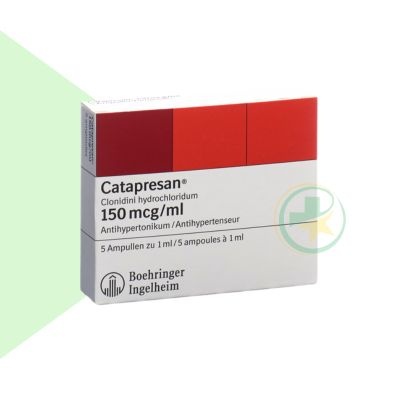
CATAPRESAN 150 MICROGRAMMI/ML Injectable solution

Запит на рецепт онлайн
Лікар розгляне ваш випадок і визначить, чи є рецепт медично доцільним.

Поговоріть з лікарем про ці ліки
Обговоріть симптоми та можливі подальші кроки під час короткої онлайн-консультації.



Інструкція із застосування KATAPRESAN
Зміст інструкції
Catapresan 150 micrograms/ml injectable solution
Clonidine hydrochloride
Read this leaflet carefully before you are given this medicine because
it contains important information for you.
- Keep this leaflet. You may need to read it again.
- If you have any questions, ask your doctor or nurse.
- If any side effects occur, including those not listed in this leaflet, tell your doctor or nurse. See section 4.
Contents of this leaflet:
- 1. What Catapresan is and what it is used for
- 2. What you need to know before you use Catapresan
- 3. How to use Catapresan
- 4. Possible side effects
- 5. How to store Catapresan
- 6. Contents of the pack and other information
1. What is Catapresan and what is it used for
Catapresan is a medicine containing the active substance clonidine hydrochloride, which works to reduce high
blood pressure (hypertension).
Catapresan is indicated for adultsaged 18 years or over in cases of:
- hypertensive crises (sudden increases in blood pressure)
- hypertension in which oral therapy is ineffective or cannot be used.
Consult your doctor if you do not feel better or if you feel worse.
2. What you need to know before using Catapresan
Do not use Catapresan
- if you are allergic to clonidine hydrochloride or any of the other ingredients of this medicine (listed in section 6)
- if you have a very slow and irregular heartbeat (severe bradyarrhythmia) due to heart rhythm disorders (sick sinus syndrome or severe atrioventricular block).
Warnings and precautions
This medicine will be administered to you in hospital under close supervision of qualified healthcare professionals.
Before using Catapresan, tell your doctor:
- if you suffer from a severe heart disease characterized by obstruction of the coronary arteries, the blood vessels that carry blood to the heart (severe coronary insufficiency)
- if you suffer from a severe kidney disease (chronic renal insufficiency)
- if you suffer from diseases that involve alterations in blood flow to the brain (cerebrovascular diseases)
- if you have recently had a heart attack
- if you suffer from a condition in which the rate at which your heart beats is slower than normal (mild or moderate bradyarrhythmia)
- if you suffer from constipation
- if you suffer from a disease characterized by a gradual and progressive loss of muscle strength and/or sensory alterations in the arms and legs (polyneuropathy)
- if you suffer from a disease that manifests with spasm of the arteries in the fingers of the hands and feet (Raynaud's disease) and/or other disorders involving alterations in blood flow in the body
- if you suffer from or have suffered from depression.
If you suffer from pheochromocytoma
If you suffer from a disease characterized by the release of substances into the body that increase blood pressure
(pheochromocytoma), the use of Catapresan is not effective.
If you have reduced kidney function (renal insufficiency)
If you suffer from renal insufficiency, the dosage of Catapresan must be defined by the doctor with particular
care (see section 3. “How to use Catapresan”).
If you have reduced heart function (heart failure or severe coronary disease)
If you suffer severely from heart failure or coronary disease (severe heart disease), treatment with Catapresan must be monitored by the doctor with particular attention,
as with other medicines that lower blood pressure.
Contact lenses
Treatment with Catapresan may cause a reduction in tear production, you should take this into account if
you use contact lenses.
Children and adolescents
Use in children and adolescents under the age of 18 is not recommended, as safety and
efficacy have not been established.
Although Catapresan is not recommended in children and adolescents, if your doctor prescribes it to your
child, keep in mind that the use of clonidine in children and adolescents under the age of 18 in
combination with a medicine used in children for the treatment of attention deficit and
hyperactivity syndrome (methylphenidate) can cause serious side effects including death.
Other medicines and Catapresan
Tell your doctor if you are taking, have recently taken or might take any other medicines.
Catapresan can interact with other medicines taken at the same time, such as:
- other medicines used to lower blood pressure, as they increase the effect of Catapresan. The doctor may exploit this interaction to lower your blood pressure
- medicines that cause an increase in blood pressure (such as non-steroidal anti-inflammatory drugs, medicines for pain and inflammation), as they reduce the effect of clonidine
- substances that can increase blood pressure (such as phentolamine or tolazoline), as they can hinder the effects of clonidine
- substances that slow down the heart rate or frequency (such as beta-blockers or digitalis glycosides), as, in situations where there is a reduction in the number of heartbeats per minute (bradycardia), these medicines can cause or worsen heart rhythm disorders
- beta-blockers, as they can cause or worsen disorders of the blood vessels that occur outside the heart and brain (peripheral vascular dysfunction)
- antidepressants (such as tricyclic antidepressants or neuroleptics), as they can decrease or eliminate the effect of Catapresan and can cause or worsen disorders in blood pressure regulation
blood pressure
- medicines that reduce the activity of the central nervous system (such as opioid agonists, analgesics, barbiturates, sedatives, anesthetics), as clonidine can enhance their effect.
Catapresan with alcohol
The effects of alcohol can be enhanced by clonidine, therefore the use of alcohol during treatment with
clonidine is not recommended.
It has been observed that in a state of alcohol excess and high doses of a medicine for treating mental disorders
(called haloperidol) administered intravenously, if you take high doses of clonidine, it can increase heart rhythm disturbances
(cardiac arrhythmia).
Pregnancy, breastfeeding and fertility
If you are pregnant, suspect or are planning a pregnancy, or if you are breastfeeding with breast milk
ask your doctor or nurse before this medicine is administered to you.
Pregnancy
The data available on the use of clonidine in pregnant women is limited.
During pregnancy, Catapresan, like any other medicine, should only be administered if absolutely
necessary and under the direct supervision of the doctor. In this case, the doctor must carefully monitor
the mother and the baby.
Clonidine crosses the barrier separating maternal blood from fetal blood (placental barrier) and can
slow down the fetal heart rate.
There is inadequate experience regarding the long-term effects of exposure to the medicine before
birth.
During pregnancy, oral clonidine medicines are preferable.
Intravenous administration of clonidine should be avoided.
Studies conducted on animals have not shown harmful effects on the fetus.
After delivery, a transient increase in blood pressure in the newborn may occur.
Breastfeeding
Clonidine passes into breast milk.
Due to the lack of sufficient data on the effects of clonidine on infants, the use of Catapresan is not
recommended during breastfeeding.
Fertility
Studies on the effects on fertility in humans have not been conducted. The available studies have not shown
harmful effects regarding fertility.
Driving and using machines
Studies have not been conducted to evaluate the effects on the ability to drive vehicles and use machinery.
However, during treatment with Catapresan, the following possible side effects may occur:
dizziness (vertigo), physical and mental relaxation (sedation) and difficulty focusing images (accommodation disorders) (see section 4. “Possible side effects”).
Therefore, take particular care when driving a vehicle or using machinery. If you experience any of the above side effects, you should avoid potentially dangerous activities such as driving or using
machinery.
The doctor will assess whether it is appropriate for you to be accompanied when leaving the hospital.
Catapresan contains sodium
This medicine contains less than 1 mmol of sodium (23 mg) per vial, i.e. it is practically “sodium-free”.
3. How to use Catapresan
Adults aged 18 years or older
This medication will be administered to you in hospital under close supervision of qualified healthcare professionals.
Treatment of hypertension requires constant monitoring by the doctor, who will assess the dosage of
Catapresan based on individual response.
Catapresan will be administered to you by qualified medical personnel through subcutaneous injection (under the
skin) or intramuscular injection (into a muscle) or slow intravenous injection (into a vein).
If you have reduced kidney function (renal insufficiency)
The dose must be defined by the doctor:
- based on the individual response to the medication
- based on the degree of impairment of kidney function. Continuous monitoring of kidney function by the doctor is necessary. Dialysis, which you usually undergo, eliminates only small amounts of clonidine from the blood, therefore no further doses of clonidine are required after you have undergone dialysis.
Use in children and adolescents
Use in children and adolescents under the age of 18 is not recommended, as safety and
efficacy have not been established.
If you use more Catapresan than you should
Symptoms
If you are given an excessive dose of Catapresan, you may experience: reduction in
pupil size (pupil constriction), a state of deep sleep with reduced response to normal stimuli
(lethargy), reduced heart rate (bradycardia), low
blood pressure (hypotension), low body temperature (hypothermia), drowsiness up to coma, difficulty
breathing including temporary cessation of breathing (apnea), unexpected increase in blood pressure
(paradoxical hypertension).
Treatment
If you are given an excessive dose of Catapresan, gastric lavage will be performed and you will be given appropriate therapy.
If you stop taking Catapresan
This medication will be administered to you by specialized medical personnel, therefore discontinuation will only occur
under the supervision of a doctor.
However, please note that:
- sudden discontinuation of treatment with Catapresan causes a sharp increase in blood pressure which manifests, for example, with agitation, a sensation of increased heartbeat (palpitations), nervousness, tremor, headache, nausea, etc. If discontinuation of treatment with Catapresan is necessary, the doctor will gradually reduce the dose over 2 - 4 days;
- immediately consult your doctor if you experience an excessive increase in blood pressure following discontinuation of treatment with Catapresan.
If you have any further questions, ask your doctor or nurse.
4. Possible side effects
Like all medicines, this medicine can cause side effects, although not everybody gets them.
Most side effects are mild and tend to decrease during therapy.
The side effects are listed below according to frequency:
Very common (may affect more than 1 in 10 people)
- dizziness (vertigo)
- physical and mental relaxation (sedation). Sedation may occur during the first week of treatment and usually subsides as therapy continues. If necessary, consult your doctor who may reduce the dose
- reduction of blood pressure when moving to an upright position, accompanied by symptoms such as dizziness/lightheadedness (orthostatic hypotension)
- dry mouth
Common (may affect up to 1 in 10 people)
- depression
- sleep disorders
- headache
- constipation
- nausea
- pain in the glands located in the mouth, face and neck (salivary glands)
- vomiting
- in men, difficulty achieving or maintaining an erection sufficient for sexual intercourse (erectile dysfunction)
- fatigue
Uncommon (may affect up to 1 in 100 people)
- abnormal interpretation of reality (delusional perception)
- perception of things that do not exist in reality (hallucinations)
- nightmares
- sensation of numbness and tingling in legs, arms or other parts of the body (paresthesia)
- slow and irregular heartbeat (sinus bradycardia)
- disease of altered blood circulation (Raynaud's syndrome)
- redness of the skin accompanied by itching (urticaria)
- itching
- skin rashes (rash)
- malaise
Rare (may affect up to 1 in 1,000 people)
- reduced tear production
- difficulty of the heart to pump blood to the body due to alteration of the heart's electrical conduction system (atrioventricular block)
- dry nose
- disease of the intestine characterized by slowed intestinal transit and reduced ability to push food through the intestine (large bowel pseudo-obstruction)
- hair loss (alopecia)
- enlargement of the breasts (gynecomastia)
- increased blood sugar (hyperglycemia)
Frequency not known (cannot be estimated from the available data)
- confusional state
- reduced sexual desire (decreased libido)
- difficulty focusing images (accommodation disorders)
- slow and irregular heartbeat (bradyarrhythmia)
Reporting of side effects
If you get any side effects, talk to your doctor or
nurse. You can also report side effects directly through the national adverse
reporting system. By reporting side effects you can help provide more information on the safety of
this medicine.
5. How to store Catapresan
Keep this medicine out of sight and reach of children.
This medicine does not require any special storage conditions.
Do not use this medicine after the expiry date that is stated on the pack after “Scad”. The expiry date
refers to the last day of that month.
Do not dispose of any medicine in waste water or household waste. Ask your pharmacist how to dispose of
medicines you no longer use. This will help protect the environment.
6. Contents of the pack and other information
What Catapresan contains
- the active ingredient is: clonidine hydrochloride (one vial contains 150 micrograms of clonidine hydrochloride)
- the other ingredients are: sodiumchloride (see section “Catapresan contains sodium”), hydrochloric acid, water for injections.
Description of the appearance of Catapresan and contents of the pack
Injectable solution. Each pack contains 5 clear glass vials of 1 ml.
Marketing Authorisation Holder
Glenwood GmbH
Pharmazeutische Erzeugnisse
Arabellastr. 17
81925 Munich
Germany
[email protected]
Manufacturer
Boehringer Ingelheim España S.A.
San Cugat del Vallès – Barcelona (Spain)
---------------------------------------------------------------------------------------------------------------------------
The following information is intended exclusively for doctors or healthcare professionals
The administration of Catapresan 150 micrograms/ml injectable solution by subcutaneous or intramuscular route must be carried out with the patient in a supine position to avoid occasional orthostatic phenomena.
The injection can be administered by subcutaneous, intramuscular or slow intravenous route (1 vial diluted in at least 10 ml of physiological saline solution, injection duration 10 minutes). For intravenous infusion, a dose of 0.2 micrograms/kg/min is recommended. The infusion rate should not exceed 0.5 micrograms/kg/min to avoid transient pressor increases. For infusion, the dose of 150 micrograms should not be exceeded.
If necessary, the vials can be administered parenterally 4 times a day.
This medicine must not be mixed with other products except for physiological saline solution.

Не впевнені, чи підходить вам цей лікарський засіб?
Обговоріть симптоми та можливі варіанти лікування з лікарем онлайн.

Виникли питання під час прийому ліків?
Обговоріть свої симптоми та лікування з лікарем онлайн.
- Країна реєстрації
- Лікарська формаInjectable solution, 150 MICROGRAMMI/ML
- Код АТХC02AC01
- Діюча речовина
- Потрібен рецептТак
- Виробник
- Ця інформація надана лише для ознайомлення і не є медичною порадою. Рішення щодо лікування завжди приймає лікар.
- Альтернативи до KATAPRESANЛікарська форма: Transdermal patch, 2,5 mgДіюча речовина: clonidineПотрібен рецептЛікарська форма: Injectable solution, 150 MCG/MLДіюча речовина: clonidineПотрібен рецептЛікарська форма: Film-coated tablet, 0.2 MGДіюча речовина: моксонидинаВиробник: VIATRIS ITALIA S.R.L.Потрібен рецепт
Аналоги KATAPRESAN в інших країнах
Препарати з тією самою діючою речовиною, доступні в інших країнах.
Аналог KATAPRESAN у Польща
Аналог KATAPRESAN у Україна
Аналог KATAPRESAN у Іспанія
Лікарі онлайн щодо KATAPRESAN
Застосування, безпека та можливість призначення рецепта — за результатами медичної оцінки.
Отримайте рецепт на KATAPRESAN онлайн
Заповніть форму за 2 хвилини
Розкажіть про симптоми, історію хвороби та потрібний препарат.
Оберіть лікаря або ми призначимо
Оберіть спеціаліста або ми підберемо найближчого доступного лікаря.
Лікар розглядає ваш випадок
Зазвичай протягом 30 хвилин. Може ставити уточнювальні запитання в чаті.
Отримайте в будь-якій аптеці
Електронний рецепт надсилається на вашу пошту — дійсний по всій Польщі.
Часті запитання
KATAPRESAN потребує рецепта в Італія. Ви можете обговорити з лікарем онлайн, чи підходить цей лікарський засіб для вашої ситуації.
Діюча речовина у KATAPRESAN — clonidine. Це допомагає визначити препарати з тим самим складом, але під іншими торговими назвами.
KATAPRESAN виробляється компанією GLENWOOD GMBH PHARMAZEUTISCHE ERZEUGNISSE. Назва бренду та упаковка можуть відрізнятися залежно від дистрибʼютора.
Лікарі, зокрема Сімейні лікарі, Психіатри, Дерматологи, Кардіологи, Ендокринологи, Гастроентерологи, Пульмонологи, Нефрологи, Ревматологи, Гематологи, Інфекціоністи, Алергологи, Геріатри, Педіатри, Онкологи, можуть оцінити доцільність застосування KATAPRESAN з урахуванням вашого стану та місцевих правил. Ви можете записатися на онлайн-консультацію, щоб обговорити симптоми та можливі подальші кроки.
Польща має добре розвинену систему охорони здоров'я у великих містах, таких як Варшава, Краків, Вроцлав і Гданськ. Аптеки широко доступні та працюють відповідно до чинного законодавства, забезпечуючи доступ до рецептурних препаратів.
Ви можете придбати KATAPRESAN у Варшаві, Кракові, Вроцлаві або Гданську в будь-якій аптеці за наявності дійсного рецепта.
Щоб отримати рецепт, ви можете скористатися Oladoctor:
Інші препарати з тією самою діючою речовиною (clonidine) включають KATAPRESAN TTS, KLONIDINA KLORIDRATO BIOINDUSTRIA L.I.M., FISIOTENS. Вони можуть відрізнятися торговою назвою або формою випуску, але містять той самий терапевтичний компонент. Перед зміною або початком прийому нового препарату варто проконсультуватися з лікарем.
