



ANTITROMBINA 500 IU/10 ML Powder and solvent for intravenous infusion solution

Запит на рецепт онлайн
Лікар розгляне ваш випадок і визначить, чи є рецепт медично доцільним.

Поговоріть з лікарем про ці ліки
Обговоріть симптоми та можливі подальші кроки під час короткої онлайн-консультації.



Інструкція із застосування ANTITROMBINA III BAXALTA
Зміст інструкції
- ANTITROMBINA III BAXALTA powder and solvent for infusion solution
- What is ANTITROMBINA III BAXALTA and what it is used for
- What you need to know before using ANTITROMBINA III BAXALTA
- How to use ANTITROMBINA III BAXALTA
- Possible side effects
- How to store ANTITROMBINA III BAXALTA
- Content of the pack and other information
- Specific indications for dosage in consumptive coagulopathy
- Specific indications for dosage in other antithrombin III deficiency states
ANTITROMBINA III BAXALTA powder and solvent for infusion solution
Antithrombin III derived from human plasma
Read this leaflet carefully before you use this medicine as it contains important
information for you.
- Keep this leaflet. You may need to read it again.
- If you have any questions, ask your doctor, pharmacist or nurse.
- If you experience any side effects, including those not listed in this leaflet, tell your doctor, pharmacist or nurse. See section 4.
Contents of this leaflet:
- 1. What ANTITROMBINA III BAXALTA is and what it is used for
- 2. What you need to know before you use ANTITROMBINA III BAXALTA
- 3. How to use ANTITROMBINA III BAXALTA
- 4. Possible side effects
- 5. How to store ANTITROMBINA III BAXALTA
- 6. Contents of the pack and other information
1. What is ANTITROMBINA III BAXALTA and what it is used for
ANTITROMBINA III BAXALTA is a medicine containing antithrombin III derived from human plasma.
Antithrombin has an anticoagulant action, meaning it makes the blood more fluid.
If you suffer from antithrombin deficiency, congenital or acquired, the level of antithrombin in your blood
is lower than normal and you may experience an increased tendency to form
blood clots in blood vessels, or a reduced or absent response to heparin.
ANTITROMBINA III BAXALTA is used in adult patients and in children 6 years of age and older
for the prevention and treatment of blood clot formation caused by:
- 1. Congenital antithrombin deficiency, particularly in case of surgery, pregnancy or childbirth
- 2. Acquired antithrombin deficiency, particularly in case of:
- Risk or obstruction of blood vessels in patients with kidney or liver disease (nephrotic syndrome or enteropathies).
- Surgery and massive bleeding in patients with severe liver disease, especially if this requires replacement therapy with coagulation factor concentrates (prothrombin complex).
2. What you need to know before using ANTITROMBINA III BAXALTA
Do not use ANTITROMBINA III BAXALTA
- if you are allergic to antitrombin III derived from human plasma or to any of the other ingredients of this medicine (listed in section 6),
- if you have had a decrease in the number of platelets (thrombocytopenia) induced by heparin, another medicine used to make blood more fluid.
Warnings and precautions
Traceability
In order to improve the traceability of biological medicines, the name and batch number of the
medicine administered must be clearly recorded.
Talk to your doctor before using ANTITROMBINA III BAXALTA.
The doctor will subject you to checks and tests during treatment with ANTITROMBINA III
BAXALTA.
Transmissible agents
ANTITROMBINA III BAXALTA is a medicine derived from human blood or plasma (the liquid component
of blood). When medicines are produced from human blood or plasma, certain safety measures are applied to prevent infections from being transmitted to
patients. These include:
- careful selection of blood and plasma donors, to ensure that potential carriers of infection are excluded,
- analysis of each donation and plasma pool to detect signs of the presence of viruses and infections,
- the inclusion of steps during the processing of blood or plasma that can inactivate or remove viruses. Despite these measures, whenever medicines prepared from human blood or plasma are administered, the possibility of transmitting an infection cannot be completely excluded. This also applies to unknown or emerging viruses or other types of infections.
The measures taken are considered effective for enveloped viruses such as the human immunodeficiency virus (HIV), hepatitis B virus (HBV) and hepatitis C virus (HCV), and
for non-enveloped viruses such as hepatitis A virus (HAV) and parvovirus B19.
The doctor, if you receive human plasma-derived medicines regularly/repeatedly, may
recommend that you undergo appropriate vaccination for hepatitis A and B.
Children
No data are available to support the use of ANTITROMBINA III BAXALTA in children
under the age of 6 years.
Other medicines and ANTITROMBINA III BAXALTA
Tell your doctor or pharmacist if you are taking, have recently taken or might take
any other medicines.
In particular, tell your doctor if you are taking heparin, a medicine used to make the
blood more fluid, as this increases the risk of bleeding, especially if you have a reduced
number of platelets (thrombocytopenia). The effect of antithrombin is strongly potentiated
by heparin. The doctor may ask you to undergo regular blood tests to check its
fluidity.
Pregnancy, breastfeeding and fertility
If you are pregnant, suspect you are pregnant or are planning a pregnancy, or if you are breastfeeding
ask your doctor for advice before using this medicine.
Experience regarding the safety of antithrombin-based products administered during
pregnancy or breastfeeding has not been evaluated in controlled clinical studies, and is therefore limited.
The doctor will administer ANTITROMBINA III BAXALTA during pregnancy and the breastfeeding
period only if absolutely necessary, bearing in mind that during pregnancy there is an
increased risk of thromboembolic events.
Driving and operating machinery
No effects on the ability to drive and operate machines have been observed.
ANTITROMBINA III BAXALTA contains sodium
500 IU/10 ml:
This medicine contains 37.7 mg of sodium (the main component of table salt) per
vial. This is equivalent to 1.9% of the maximum recommended daily intake with the diet
of an adult.
1000 IU/20ml:
This medicine contains 75.5 mg of sodium (the main component of table salt) per
vial. This is equivalent to 3.8% of the maximum recommended daily intake with the diet
of an adult.
3. How to use ANTITROMBINA III BAXALTA
Use this medicine following the instructions of your doctor or pharmacist exactly. If you have
any doubts, consult your doctor or pharmacist.
This medicine must be administered into a vein, always following the doctor's instructions
exactly.
The dose will be established by the doctor based on your family history and your state of health.
If you use more ANTITROMBINA III BAXALTA than you should
To date, no symptoms of antitrombin overdose are known.
4. Possible side effects
Like all medicines, this medicine can cause side effects, although not everybody gets them.
If you experience the following side effects during therapy with ANTITROMBINA III BAXALTA, inform your doctor or nurse immediately, who WILL IMMEDIATELYstop
administration at the first sign of alarm, and will administer the appropriate therapy to treat these
symptoms, which can be life-threatening, such as:
hypersensitivity and allergic reactions which, in some cases, can progress to become severe allergic reactions (anaphylaxis) affecting the whole body.
Allergic reactions may include the following symptoms:
o swelling of the face (angioedema), urticaria, feeling of tightness in the chest, difficulty
breathing (dyspnea), low blood pressure;
o reduced blood flow to the organs (shock);
o burning and irritation at the injection site, chills, redness,
o headache, drowsiness, nausea, restlessness, fast heartbeat (tachycardia),
fever, tingling, vomiting.
Immediate availability of equipment, medicines and suitable healthcare personnel for the emergency treatment of these side effects is necessary.
Side effects observed with unknown frequency (frequency cannot be defined on the basis of
available data):
- hypersensitivity, anaphylactic reaction
- tremor
- hot flushes
Side effects affecting the blood
A reduction in the number of platelets (thrombocytopenia) induced by an immune-mediated reaction against heparin is rarely observed.
In these cases, platelets may decrease by 50% or fall below 100,000/microliter.
Fever has been observed in rare cases.
Reporting of side effects
If you get any side effects, even those not listed in this leaflet, tell your
doctor or pharmacist or nurse. You can also report side effects directly to
https://www.aifa.gov.it/content/segnalazioni-reazioni-avverse. By reporting side effects you
can help provide more information on the safety of this medicine.
5. How to store ANTITROMBINA III BAXALTA
Store in a refrigerator (2 C–8 C).
Do not freeze.
Store in the original package to protect the medicine from light.
Keep this medicine out of the sight and reach of children.
Do not use this medicine after the expiry date which is stated on the pack after “Exp.:”.
The expiry date refers to the last day of that month.
Do not use this medicine if you notice solutions that are not clear or with deposits.
Do not dispose of any medicine in wastewater or household waste. Ask your pharmacist how
to eliminate medicines that you no longer use. This will help protect the environment.
6. Content of the pack and other information
What contains ANTITROMBINA III BAXALTA
- The active ingredient is antitrombin III derived from human plasma.
- The other excipients are glucose, sodiumchloride, sodiumcitrate dihydrate (see section 2 “ANTITROMBINA III BAXALTA contains sodium”), tris(hydroxymethyl)aminomethane, water for injections (solvent). ANTITROMBINA III BAXALTA is presented as powder and solvent for solution for infusion containing:
| e | ANTITROMBINA III BAXALTA 500 IU/10 ml | ANTITROMBINA III BAXALTA 1000 IU/20 ml |
| g Antitrombin from human plasma | 500 IU/vial | 1000 IU/vial |
| A Antitrombin from human plasma reconstituted with water for injections | 50 IU/ml (500 U.I./10 ml) | 50 IU/ ml (1000 IU/20 ml) |
| volume solvent | 10 ml | 20 ml |
This medicine contains 0.164 mmol (3.77 mg) of sodium per ml.
Description of the appearance of ANTITROMBINA III BAXALTA and contents of the pack
ANTITROMBINA III BAXALTA is a powder or friable solid of colour ranging from light yellow to light green.
The solvent (water for injections) is a clear and colourless liquid.
After reconstitution, the solution is yellow and clear or slightly opalescent.
ANTITROMBINA III BAXALTA powder and solvent is contained in vials closed with rubber stoppers and protective caps.
ANTITROMBINA III BAXALTA is available in the following packs:
- one vial of powder of 500 IU, one vial of solvent of 10 ml and reconstitution and injection set
- one vial of powder of 1000 IU, one vial of solvent of 20 ml and reconstitution and injection set Not all pack sizes may be marketed.
Marketing authorisation holder and manufacturer
Marketing authorisation holder
Baxalta Innovations GmbH
Industriestrasse 67, A - 1221 Vienna
Representative for Italy:
Takeda Italia S.p.A.
Tel. +39 06 502601
Manufacturer
Baxter AG, Industriestrasse 67, A - 1221 Vienna, Austria
Takeda Manufacturing Austria AG, Industriestrasse 67, A-1221 Vienna, Austria
---------------------------------------------------------------------------------------------------------------------------
The following information is intended exclusively for doctors or healthcare professionals:
Interactions with other medicines
Heparin: replacement therapy with antithrombin during the administration of heparin in therapeutic doses increases the risk of bleeding. The effect of antithrombin is strongly potentiated by heparin. The half-life of antithrombin may be considerably reduced by concomitant treatment with heparin due to an accelerated turnover of antithrombin. Therefore, the simultaneous administration of heparin and antithrombin to a patient with an increased risk of bleeding must be monitored clinically and biologically.
As a general rule, regular checks of the PTT (partial thromboplastin time) and corresponding adjustment of the heparin dosage are recommended for combined therapy with heparin.
In addition, patients with thrombocytopenia may have a deficiency of platelet factor 4, which contributes to reducing the neutralization of heparin, thus increasing the bleeding tendency.
Special warnings and precautions for use
As with any intravenous protein product, hypersensitivity reactions of an allergic type are possible. Patients must be closely monitored and carefully observed for any symptoms during the infusion period. Patients should be informed about the early signs of hypersensitivity reactions, which include urticaria, even widespread, a feeling of tightness in the chest, dyspnoea, hypotension and anaphylaxis. If such symptoms occur, patients should contact their doctor.
In case of shock, standard medical procedures for the treatment of shock must be observed.
In the event of allergic or anaphylactic reactions, administration must be stopped immediately.
Mild reactions can be controlled with the administration of antihistamines. The therapy for severe hypotonic reactions is that of modern shock treatment.
Appropriate vaccination (hepatitis A and B) should be considered for patients receiving antithrombin human regularly.
Traceability
In order to improve the traceability of biological medicines, the name and batch number of the medicine administered must be clearly recorded.
Clinical and biological monitoring when antithrombin is used together with heparin:
- to adjust the heparin dosage and to avoid excessive hypocoagulability, checks of the degree of anticoagulation (APPT and where appropriate anti-FXa activity) must be performed regularly, at close intervals and in particular in the first minutes/hours following the start of antithrombin administration;
- to adjust the individual dose, antithrombin levels should be checked daily, due to the risk of decreasing antithrombin levels due to prolonged treatment with unfractionated heparin.
Dosage and method of administration
Treatment must be initiated under the supervision of a physician specialising in the treatment of patients with antithrombin deficiency.
Dosage
In congenital deficiencies, the dosage must be individualised for each patient taking into account family history with particular regard to thromboembolic events, actual clinical risk factors and laboratory tests.
The dosage and duration of replacement therapy in acquired deficiencies depend on the plasma level of antithrombin, the presence of signs of increased turnover, the underlying disease and the severity of the clinical condition. The amount to be administered and the frequency of administrations must always be based for each individual case on clinical efficacy and laboratory tests.
The amount of antithrombin units administered is expressed in International Units (IU), which are correlated with the current WHO standard for antithrombin. The activity of antithrombin in plasma is expressed both as a percentage (relative to normal human plasma) and as International Units (relative to the international standard for plasma antithrombin).
1. Specific indications for dosage in consumptive coagulopathy
A prerequisite for sufficient dosage is the determination of antithrombin III activity to be performed before starting therapy and subsequently at short intervals of approximately 4-6 hours. The plasma level should be increased to at least 80-100% of the normal value. If the activity drops to a level below 70%, further administration is necessary. To calculate the dose, the following indicative formula can be applied:
Units of AT III to be infused = ID x Body weight (kg)
ID = Desired Increase in Antithrombin III (difference between the AT III activity to be achieved and its baseline value)
If heparin is administered simultaneously, it should be noted that the action of the latter is potentiated by antithrombin III (see the paragraph “Interactions with other medicines”).
2. Specific indications for dosage in other antithrombin III deficiency states
In general, an initial dose of approximately 1500 IU can be administered, followed by half the initial dose at intervals of 8-24 hours.
To establish the exact dose, determination of antithrombin III activity is essential:
The following indicative formula can be used to calculate the dose:
ID x Body weight (kg)
IU of AT III to be infused =
2
The initial antithrombin activity to be achieved depends on the clinical situation. When there is an indication for antithrombin replacement, the dosage must be sufficient to reach the desired antithrombin activity and to maintain an effective level. The dosage must be determined and controlled based on laboratory determinations of antithrombin activity; determinations that must be performed at least twice a day until the patient is stabilized, and then once a day, preferably immediately before the next infusion. Dosage correction must take into account both signs of increased antithrombin turnover, in accordance with laboratory tests, and the clinical course. Antithrombin activity must be maintained above 80% for the entire duration of treatment, unless clinical characteristics indicate a different effective level.
The usual initial dose in congenital deficiencies is 30-50 IU/kg.
Subsequently, the dose and frequency, as well as the duration of treatment, must be adjusted based on biological data and the clinical situation.
Paediatric population
The safety and efficacy of ANTITROMBINA III BAXALTA in children under 6 years of age have not yet been established. Therefore, the use of the product cannot be recommended in this patient group.
Method of Administration
Dissolve the lyophilized powder as described in the section “Special precautions for disposal and handling”.
The product must be administered intravenously.
The administration rate must not exceed 5 ml/min.
Special precautions for disposal and handling
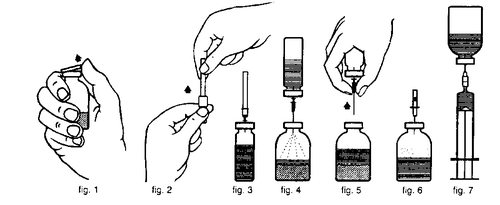
Scheme for reconstitution of the lyophilized powder and administration of the solution
ANTITROMBINA III BAXALTA must be stored in lyophilized form and reconstituted only immediately before administration. Use aseptic technique throughout the entire reconstitution process. The solution must be administered immediately, as it does not contain preservatives.
After reconstitution, the solution must be visually inspected for particulate matter or abnormal coloration before administration. Usually the solution is yellow and clear or slightly opalescent. Solutions that are not clear or contain deposits must not be administered.
Unused medicinal product and waste materials derived from such medicinal product must be disposed of in accordance with local regulations.
Reconstitution of the lyophilized powder:
- 1. Warm the vial containing the solvent to room temperature (not exceeding 37° C).
- 2. Remove the protective discs from the vials of the lyophilized powder and the solvent (fig. 1) and disinfect the rubber stoppers of both vials.
- 3. The two ends of the transfer needle are protected by two plastic caps joined by a weld point. Rotate one of the caps to break the weld point, release the needle (fig. 2) and insert it into the rubber stopper of the solvent vial (fig. 3).
- 4. Remove the other cap of the transfer needle, being careful not to touch the needle.
- 5. Invert the solvent vial and insert the free end of the transfer needle halfway into the rubber stopper of the lyophilized powder vial (fig. 4). Since the vial with the lyophilized substance is under vacuum, the solvent will be drawn inside.
- 6. Separate the solvent vial with the needle inserted from the lyophilized powder vial (fig. 5) and gently shake the latter to promote dissolution.
- 7. After complete dissolution of the lyophilized substance, insert the vent needle (fig. 6); any foam that forms will dissolve rapidly. Remove the vent needle.
Administration of the solution:
- 1. Rotate the protective cap of the filter needle to break the weld and remove it. Attach the filter needle to the disposable syringe and aspirate the solution into the syringe (fig. 7).
- 2. Remove the filter needle and attach the injection needle (or butterfly needle) to the syringe.
- 3. Administer the solution slowly (not exceeding 5ml/minute) intravenously.
If the solution is infused, it is advisable to use disposable infusion devices equipped with a filter.

Не впевнені, чи підходить вам цей лікарський засіб?
Обговоріть симптоми та можливі варіанти лікування з лікарем онлайн.

Виникли питання під час прийому ліків?
Обговоріть свої симптоми та лікування з лікарем онлайн.

- Країна реєстрації
- Лікарська формаPowder and solvent for intravenous infusion solution, 500 IU/10 ML
- Код АТХB01AB02
- Діюча речовина
- Потрібен рецептТак
- Виробник
- Ця інформація надана лише для ознайомлення і не є медичною порадою. Рішення щодо лікування завжди приймає лікар.
- Альтернативи до ANTITROMBINA III BAXALTAЛікарська форма: Powder and solvent for intravenous infusion solution, 500 IUДіюча речовина: Антитромбин IIIВиробник: INSTITUTO GRIFOLS S.A.Потрібен рецептЛікарська форма: Powder and solvent for intravenous infusion solution, 500 U.I./10 MLДіюча речовина: Антитромбин IIIВиробник: KEDRION S.P.A.Потрібен рецептЛікарська форма: Powder and solvent for intravenous infusion solution, 500 U.I./10 MLДіюча речовина: Антитромбин IIIВиробник: OCTAPHARMA (IP) SPRLПотрібен рецепт
Аналоги ANTITROMBINA III BAXALTA в інших країнах
Препарати з тією самою діючою речовиною, доступні в інших країнах.
Аналог ANTITROMBINA III BAXALTA у Польща
Аналог ANTITROMBINA III BAXALTA у Україна
Аналог ANTITROMBINA III BAXALTA у Іспанія
Лікарі онлайн щодо ANTITROMBINA III BAXALTA
Застосування, безпека та можливість призначення рецепта — за результатами медичної оцінки.









Отримайте рецепт на ANTITROMBINA III BAXALTA онлайн
Заповніть форму за 2 хвилини
Розкажіть про симптоми, історію хвороби та потрібний препарат.
Оберіть лікаря або ми призначимо
Оберіть спеціаліста або ми підберемо найближчого доступного лікаря.
Лікар розглядає ваш випадок
Зазвичай протягом 30 хвилин. Може ставити уточнювальні запитання в чаті.
Отримайте в будь-якій аптеці
Електронний рецепт надсилається на вашу пошту — дійсний по всій Польщі.
Часті запитання
ANTITROMBINA III BAXALTA потребує рецепта в Італія. Ви можете обговорити з лікарем онлайн, чи підходить цей лікарський засіб для вашої ситуації.
Діюча речовина у ANTITROMBINA III BAXALTA — Антитромбин III. Це допомагає визначити препарати з тим самим складом, але під іншими торговими назвами.
ANTITROMBINA III BAXALTA виробляється компанією BAXALTA INNOVATIONS GMBH. Назва бренду та упаковка можуть відрізнятися залежно від дистрибʼютора.
Лікарі, зокрема Сімейні лікарі, Психіатри, Дерматологи, Кардіологи, Ендокринологи, Гастроентерологи, Пульмонологи, Нефрологи, Ревматологи, Гематологи, Інфекціоністи, Алергологи, Геріатри, Педіатри, Онкологи, можуть оцінити доцільність застосування ANTITROMBINA III BAXALTA з урахуванням вашого стану та місцевих правил. Ви можете записатися на онлайн-консультацію, щоб обговорити симптоми та можливі подальші кроки.
Польща має добре розвинену систему охорони здоров'я у великих містах, таких як Варшава, Краків, Вроцлав і Гданськ. Аптеки широко доступні та працюють відповідно до чинного законодавства, забезпечуючи доступ до рецептурних препаратів.
Ви можете придбати ANTITROMBINA III BAXALTA у Варшаві, Кракові, Вроцлаві або Гданську в будь-якій аптеці за наявності дійсного рецепта.
Щоб отримати рецепт, ви можете скористатися Oladoctor:
Інші препарати з тією самою діючою речовиною (Антитромбин III) включають ANBINEX, AT III KEDRION, ATENATIV. Вони можуть відрізнятися торговою назвою або формою випуску, але містять той самий терапевтичний компонент. Перед зміною або початком прийому нового препарату варто проконсультуватися з лікарем.
