



TARGOSID 200 mg Порошок И Раствор Для Инъекционного Раствора

Рассмотрение рецепта онлайн
Врач рассмотрит ваш случай и примет решение о назначении рецепта, если это медицински оправдано.

Поговорите с врачом об этом лекарстве
Обсудите симптомы и возможные дальнейшие шаги на онлайн-консультации.



Инструкция по применению TARGOSID
Содержание инструкции
TARGOSID 200 mg powder and solvent for injectable/infusion solution or oral solution, 400 mg powder and solvent for injectable/infusion solution or oral solution
teicoplanin
Read this leaflet carefully before you start to use this medicine as it contains
important information for you.
- Keep this leaflet. You may need to read it again.
- If you have any questions, ask your doctor, pharmacist or nurse.
- If you get any side effects, even those not listed in this leaflet, tell your doctor, pharmacist or nurse. See section 4.
Contents of this leaflet:
- 1. What Targosid is and what it is used for
- 2. What you need to know before you are given Targosid
- 3. How to use Targosid
- 4. Possible side effects
- 5. How to store Targosid
- 6. Contents of the pack and other information
1. What is Targosid and what it is used for
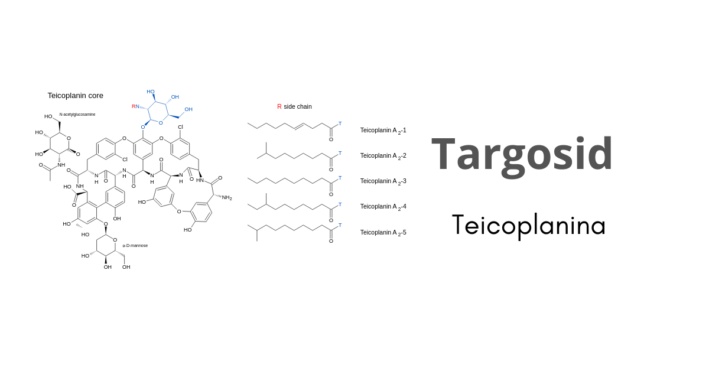
Targosid is an antibiotic that contains the active substance “teicoplanin”. It works by killing bacteria
responsible for infections in the body.
Targosid is used in adults and children (including newborns) to treat bacterial infections of:
skin and underlying tissues (sometimes called “soft tissues”)
bones and joints
lungs
urinary tract
heart (endocarditis)
abdominal area (peritonitis)
blood, when caused by one of the above conditions.
Targosid can be used to treat some infections caused by bacteria Clostridium difficile
in the intestine. For this, the solution is taken by mouth.
2. What you need to know before you are given Targosid
Do not use Targosid if:
- you are allergic to teicoplanin or any of the other ingredients of this medicine (listed in section 6).
Warnings and precautions
Talk to your doctor, pharmacist or nurse before you are given Targosid if:
- you are allergic to an antibiotic called “vancomycin”
- you have had reddening of the upper part of your body (red man syndrome)
- you have a decrease in the number of platelets (thrombocytopenia)
- you have kidney problems
- you are taking other medicines that could cause problems with your hearing and/or kidneys. You may need to have regular tests to check if your kidneys and/or liver are working properly (see “Other medicines and Targosid”). If any of the above applies to you (or if you are not sure), talk to your doctor, pharmacist or nurse before you are given Targosid.
Severe skin reactions including Stevens-Johnson syndrome, toxic epidermal necrolysis, drug reaction with eosinophilia and systemic symptoms (DRESS) and acute generalized exanthematous pustulosis (AGEP) have been reported with the use of teicoplanin. If you develop a severe rash or other skin symptoms as described in section 4, stop taking Targosid and contact your doctor or seek immediate medical advice.
Tests
During treatment, you may need to have tests to check your blood, kidneys, liver and/or hearing. This is more likely if:
- the treatment will last a long time
- you need to be treated with high loading doses (12 mg/kg twice a day)
- you have kidney problems
- you are taking or may take other medicines that can affect the nervous system, kidneys or hearing.
In patients who are given Targosid for a long time, bacteria that are not affected by the antibiotic may grow more than normal – your doctor will do checks to monitor this possibility.
Other medicines and Targosid
Tell your doctor, pharmacist or nurse if you are taking, have recently taken or might take any other medicines. This is because Targosid can affect the way other medicines work. Also, some medicines can affect the way Targosid works.
In particular, tell your doctor, pharmacist or nurse if you are taking any of the following medicines:
- aminoglycosides, which should not be mixed with Targosid in the same injection. They can also cause problems with your hearing and/or kidneys
- amphotericin B - a medicine to treat fungal infections that can cause problems with your hearing and/or kidneys
- cyclosporine - a medicine that affects the immune system that can cause problems with your hearing and/or kidneys
- cisplatin - a medicine to treat malignant tumors that can cause problems with your hearing and/or kidneys
- diuretic tablets (such as furosemide) that can cause problems with your hearing and/or kidneys.
If any of the above applies to you (or if you are not sure), talk to your doctor or pharmacist or nurse before you are given Targosid.
Pregnancy, breastfeeding and fertility
If you are pregnant, suspect you may be pregnant or are planning to become pregnant, ask your doctor, pharmacist or nurse for advice before you are given this medicine.
They will decide whether you will be given this medicine while you are pregnant. There may be a potential risk of problems with the inner ear and kidneys.
Tell your doctor if you are breastfeeding before you are given this medicine. They will decide whether you can continue or not to breastfeed while you are given Targosid.
Reproduction studies in animals have not shown evidence of fertility problems.
Driving and operating machinery
While you are being treated with Targosid you may experience headache or dizziness. If this happens, do not drive vehicles and do not use machinery.
Targosid contains sodium
This medicine contains less than 1 mmol of sodium (23 mg) per vial, i.e. it is essentially sodium-free.
3. How to use Targosid
The recommended dose is
Adults and children (12 years of age and older) without kidney problems
Skin and subcutaneous tissue infections, lungs, and urinary tract
- Initial dose (for the first 3 doses): 6 mg per each kg of body weight administered every 12 hours, with an injection into a vein or a muscle
- Maintenance dose: 6 mg per each kg of body weight administered once a day with an injection into a vein or a muscle.
Bone and joint infections, and heart infections
- Initial dose (for the first 3-5 doses): 12 mg per each kg of body weight administered every 12 hours, with an injection into a vein
- Maintenance dose: 12 mg per each kg of body weight administered once a day with an injection into a vein or a muscle.
To treat infections caused by Clostridium difficilebacteria
The recommended dose is 100-200 mg by mouth twice a day for 7 – 14 days.
Adults and elderly patients with kidney problems
If you have kidney problems, generally your dose will be reduced after the fourth day of treatment:
- For people with mild and moderate kidney problems the maintenance dose will be given every 2 days, or half of the maintenance dose will be given every day.
- For people with severe kidney problems or undergoing hemodialysis: the maintenance dose will be administered every 3 days, or one-third of the maintenance dose will be given every day.
Peritonitis in patients undergoing peritoneal dialysis
The initial dose is 6 mg per each kg of body weight, with a single injection into a vein, followed by:
- week one: 20 mg/L in each dialysis bag
- week two: 20 mg/L in alternate bags
- week three: 20 mg/L in the night bag.
Newborns (from birth to 2 months)
- Initial dose (first day): 16 mg per each kg of body weight, administered in a drip infusion into a vein
- Maintenance dose: 8 mg per each kg of body weight, administered in a drip infusion into a vein once a day.
Children (from 2 months to 12 years)
- Initial dose (for the first three doses): 10 mg per each kg of body weight, administered every 12 hours with injection into a vein
- Maintenance dose: 6 - 10 mg per each kg of body weight, administered once a day with injection into a vein
How Targosid is given
This medicine is usually given by a doctor or nurse
- it is given with an injection into a vein (intravenous) or into a muscle (intramuscular)
- it can also be given by drip infusion into a vein. For babies from birth to 2 months of age it must only be administered by infusion. To treat some infections, the solution can be taken by mouth (oral use).
If you receive more Targosid than you should
It is unlikely that the doctor or nurse will give you too much medicine. However, if you think that you have been given too much Targosid or if you feel agitated, tell your doctor or nurse immediately.
If you forget to receive Targosid
The doctor or nurse will have instructions on when to give you Targosid. It is unlikely that you will not be given the medicine as prescribed. However, if you are worried, tell your doctor or nurse.
If you stop taking Targosid
Do not stop taking this medicine without first talking to your doctor, pharmacist, or nurse.
If you have any questions about the use of this medicine, ask your doctor, pharmacist, or nurse.
4. Possible side effects
Like all medicines, this medicine can cause side effects, although not everybody gets them.
Serious side effects
Stop treatment and tell your doctor or nurse immediately if you notice any of the following
serious side effects – you may need urgent medical attention:
Uncommon(may affect up to 1 in 100 people)
- sudden allergic reaction which can be life-threatening - signs may include: difficulty breathing or wheezing, sweating, skin rash, itching, fever, chills
Rare(may affect up to 1 in 1,000 people)
- flushing in the upper part of the body
Not known(frequency cannot be estimated from the available data)
- skin, mouth, eyes or genital lesions - these may be signs of a condition called “toxic epidermal necrolysis” or “Stevens-Johnson syndrome”
- widespread red and scaly rash with bumps under the skin (including in the skin folds, chest, abdomen (including the stomach), back and arms) and blisters accompanied by fever - these may be symptoms of a condition called "Acute Generalized Exanthematous Pustulosis (AGEP)"
- “drug reaction with eosinophilia and systemic symptoms (DRESS)”. This reaction initially manifests with flu-like symptoms and a rash on the face followed by a widespread rash and high temperature, increased levels of liver enzymes observed in blood tests and an increase in cells belonging to the white blood cell family (eosinophilia) and swollen lymph nodes.
Tell your doctor or nurse immediately if you notice any of the side effects listed
above.
Tell your doctor or nurse immediately if you notice any of the following side
effects – you may need urgent medical attention:
Uncommon(may affect up to 1 in 100 people)
- swelling and clotting in a vein
- difficulty breathing or wheezing (bronchospasm)
- increased occurrence of infections - this could be a sign of a decrease in the number of blood cells
Not known(frequency cannot be estimated from the available data)
- lack of white blood cells - signs may include: fever, severe chills, sore throat or mouth ulcers (agranulocytosis)
- low levels of all types of blood cells
- kidney problems or changes in the way your kidneys work - highlighted by tests. Frequency or severity of kidney problems may be increased if you receive higher doses.
- seizures
Tell your doctor or nurse immediately if you notice any of the side effects listed
above.
Other side effects
Tell your doctor, or pharmacist or nurse if you notice any of the following:
Common(may affect up to 1 in 10 people)
- rash, erythema, itching
- pain
- fever Uncommon(may affect up to 1 in 100 people)
- decrease in the number of platelets
- increased levels of liver enzymes in the blood
- increased levels of creatinine in the blood (to check the kidneys)
- hearing loss, ringing in the ears or feeling that you, or things around you, are spinning
- feeling unwell or sick (vomiting), diarrhoea
- feeling dizzy or headache
Rare(may affect up to 1 in 1,000 people)
- infection (abscess)
Not known(frequency cannot be estimated from the available data)
- problems at the site where the injection was given - such as redness of the skin, pain or swelling
Reporting of side effects
If you get any side effects, talk to your doctor, pharmacist or nurse. You can also report side effects directly
through the national reporting system at www.agenziafarmaco.gov.it/content/come-
segnalare-una-sospetta-reazione-avversa. By reporting side effects you can help provide more
information on the safety of this medicine.
5. How to store Targosid
Keep this medicine out of the sight and reach of children.
Do not use this medicine after the expiry date which is stated on the package and on the
vial label after Scad/EXP. The expiry date refers to the last day of that month.
This medicine does not require any particular storage conditions.
Information on the storage and time of use of Targosid, after it has been reconstituted and
is ready for use, are described in “Practical information for healthcare professionals on the
preparation and handling of Targosid”.
6. Contents of the pack and other information
What Targosid contains
- The active ingredient is teicoplanin. Each vial contains 200 mg or 400 mg of teicoplanin.
- The other ingredients are sodium chloride and sodium hydroxide in the powder, and water for injections in the solvent.
Description of the appearance of Targosid and contents of the pack
Targosid is a powder and solvent for injectable/infusion solution or oral solution. The powder is
a homogeneous, spongy mass of ivory colour. The solvent is a clear and colourless liquid.
The powder is packaged:
- in colourless type I glass vials with a useful volume of 10 mL for 200 mg closed with a bromobutyl rubber stopper, a yellow aluminium crimp cap and a plastic tear-off tab
- in colourless type I glass vials with a useful volume of 22 mL for 400 mg closed with a bromobutyl rubber stopper, a green aluminium crimp cap and a plastic tear-off tab. The solvent is packaged in a colourless type I glass vial.
Packs:
- 1 vial of powder with 1 vial of solvent. Not all pack sizes may be marketed.
Marketing authorisation holder and manufacturer
Marketing authorisation holder
Sanofi S.r.l. – Viale L. Bodio, 37/B – Milan
Manufacturer
Sanofi S.r.l. - Via Valcanello, 4 - 03012 Anagni (FR)
This medicinal product is authorised in the Member States of the European Economic Area with the
following names:
Austria, Belgium, Czech Republic, Croatia, Germany, Hungary, Ireland, Luxembourg, Malta, Poland,
Slovak Republic, Slovenia: Targocid
Bulgaria, France, Greece, Netherlands, Romania, Spain: TARGOCID
Italy: TARGOSID
Portugal: Targosid
---------------------------------------------------------------------------------------------------------------------------
The following information is intended only for doctors or healthcare professionals:
Practical information for healthcare professionals on the preparation and handling of Targosid.
This medicinal product is for single use only.
Method of administration
The reconstituted solution can be injected directly or alternatively further diluted.
The injection can be administered as a bolus of 3-5 minutes or with an infusion of 30 minutes.
In children from birth to 2 months of age, it should only be administered via infusion.
The reconstituted solution can also be given orally (oral use).
Preparation of the reconstituted solution
Slowly inject the entire contents of the solvent vial into the powder vial
gently rotate the vial between your hands until the powder is completely
dissolved. If the solution becomes foamy, allow it to stand for approximately 15 minutes.
Reconstituted solutions contain 200 mg of teicoplanin in 3.0 mL and 400 mg in 3.0 mL.
Only transparent solutions should be used. The colour of the solution may range from yellowish to
dark yellow.
The final solution is isotonic with plasma and has a pH of 7.2-7.8.
| I Nominal content of the teicoplanin vial | 200 mg | 400 mg |
| a i Volume of the powder vial | 10 mL | 22 mL |
| z Volume withdrawable from the solvent vial for reconstitution | 3.14 mL | 3.14 mL |
| n e Volume containing the nominal dose of teicoplanin (withdrawn with a 5 mL syringe and 23 G needle) | 3.0 mL | 3.0 mL |
Preparation of the diluted solution before infusion
Targosid can be administered in the following infusion solutions:
- sodium chloride 9 mg/mL (0.9%) solution
- Ringer’s solution
- Ringer’s lactate solution
- 5% dextrose solution
- 10% dextrose solution
- solution containing 0.18% sodium chloride and 4% glucose
- solution containing 0.45% sodium chloride and 5% glucose
- peritoneal dialysis solution containing a 1.36% or 3.86% glucose solution. Stability of the reconstituted solution The chemical-physical stability in use of the reconstituted solution prepared according to the recommendations has been demonstrated for 24 hours at a temperature between 2 and 8°C.
From a microbiological point of view, the product must be used immediately. If this does not
happen, the user is responsible for the period and conditions of storage of the product
which should not normally exceed 24 hours at a temperature between 2 and 8°C, unless the
reconstitution is carried out under controlled and validated aseptic conditions.
Stability of the diluted medicinal product
The chemical-physical stability in use of the reconstituted solution prepared according to the recommendations has been
demonstrated for 24 hours at a temperature between 2 and 8°C.
From a microbiological point of view, the product must be used immediately. If this does not
happen, the user is responsible for the period and conditions of storage of the product and
should not normally exceed 24 hours at a temperature between 2 and 8°C, unless the
reconstitution/dilution is carried out under controlled and validated aseptic conditions.
Disposal
Unused medicinal product and waste derived from such medicinal product must be disposed of in accordance with
current local regulations.

Не уверены, подходит ли вам это лекарство?
Обсудите симптомы и варианты лечения с врачом онлайн.

Уже начали прием и появились вопросы?
Обсудите свое состояние и дальнейшие шаги с врачом онлайн.
- Страна регистрации
- Форма выпускаPowder and solvent for injectable solution, 200 MG
- Код АТХJ01XA02
- Действующее вещество
- Отпускается по рецептуДа
- Производитель
- Информация на этой странице носит справочный характер и не является медицинской консультацией. Перед началом приема лекарства обязательно проконсультируйтесь с врачом.
- Аналоги TARGOSIDФорма выпуска: Powder for injectable/infusion solution, 200 MGДействующее вещество: ТейкопланинПроизводитель: ELC GROUP S.R.O.Отпускается по рецептуФорма выпуска: Powder for injectable/infusion solution, 200 MGДействующее вещество: ТейкопланинПроизводитель: HIKMA FARMACEUTICA (PORTUGAL) S.A.Отпускается по рецептуФорма выпуска: Powder and solvent for injectable/infusion solution, 200 MGДействующее вещество: ТейкопланинПроизводитель: IBIGEN S.R.L.Отпускается по рецепту
Аналоги TARGOSID в других странах
Лекарства с тем же действующим веществом, доступные в других странах.
Аналог TARGOSID в Испания
Аналог TARGOSID в Польша
Аналог TARGOSID в Украина
Врачи онлайн по TARGOSID
Обсудите применение TARGOSID и возможные следующие шаги — по оценке врача.









Получите рецепт на TARGOSID онлайн
Заполните форму за 2 минуты
Расскажите о симптомах, истории болезни и нужном препарате.
Выберите врача или мы назначим
Выберите специалиста или мы подберём ближайшего доступного врача.
Врач рассматривает ваш случай
Обычно в течение 30 минут. Может задать уточняющие вопросы в чате.
Получите в любой аптеке
Электронный рецепт отправляется на вашу почту — действителен по всей Польше.
Часто задаваемые вопросы
TARGOSID требует рецепта в Италия. Вы можете уточнить у врача онлайн, подходит ли это лекарство для вашей ситуации.
Действующее вещество TARGOSID — Тейкопланин. Эта информация помогает определить лекарства с тем же составом под другими торговыми названиями.
TARGOSID производится компанией SANOFI S.R.L.. Упаковка и торговое название могут отличаться в зависимости от дистрибьютора.
Врачи, включая Семейные врачи, Психиатры, Дерматологи, Кардиологи, Эндокринологи, Гастроэнтерологи, Пульмонологи, Нефрологи, Ревматологи, Гематологи, Инфекционисты, Аллергологи, Гериатры, Педиатры, Онкологи, могут оценить целесообразность применения TARGOSID с учетом вашей ситуации и местных правил. Вы можете записаться на онлайн-консультацию, чтобы обсудить возможные варианты.
Польша имеет хорошо развитую систему здравоохранения в крупных городах, таких как Варшава, Краков, Вроцлав и Гданьск. Аптеки широко доступны и работают в соответствии с действующим законодательством, обеспечивая доступ к рецептурным препаратам.
Вы можете купить TARGOSID в Варшаве, Кракове, Вроцлаве или Гданьске в любой аптеке при наличии действующего рецепта.
Чтобы получить рецепт, вы можете воспользоваться Oladoctor:
Другие лекарства с тем же действующим веществом (Тейкопланин) включают PLANIKID, TEIKOPLANINA IKMA, TEIKOPLANINA IBIJEN. Они могут отличаться торговым названием или формой выпуска, но содержат одинаковый терапевтический компонент. Перед изменением лечения рекомендуется проконсультироваться с врачом.
