



PIASKY 340 mg Инъекционный Или Инфузионный Раствор

Рассмотрение рецепта онлайн
Врач рассмотрит ваш случай и примет решение о назначении рецепта, если это медицински оправдано.

Поговорите с врачом об этом лекарстве
Обсудите симптомы и возможные дальнейшие шаги на онлайн-консультации.



Инструкция по применению PIASKY
Содержание инструкции
Piasky 340 mg injectable solution or infusion
crovalimab
Medicinal product subject to additional monitoring. This will allow the rapid identification of
new safety information. You can contribute by reporting any adverse effects
experienced during the use of this medicine. See the end of section 4 for
information on how to report adverse effects.
Read this leaflet carefully before using this medicine as it contains
important information for you.
- Keep this leaflet. You may need to read it again.
- If you have any questions, ask your doctor, pharmacist or nurse.
- This medicine has been prescribed for you only. Do not pass it on to others, even if their symptoms are the same as yours, as it could be harmful.
- If any side effects occur, including those not listed in this leaflet, tell your doctor, pharmacist or nurse. See section 4.
of meningococcal infection and sepsis:
- always carry it with you during treatment and
- for 11 months after the last dose of Piasky
Contents of this leaflet
- 1. What Piasky is and what it is used for
- 2. What you need to know before you use Piasky
- 3. How to use Piasky
- 4. Possible side effects
- 5. How to store Piasky
- 6. Contents of the pack and other information
- 7. Instructions for use
1. What is Piasky and what is it used for
What is Piasky
Piasky contains the active substance crovalimab. This belongs to a class of medicines called
“monoclonal antibodies”, which are proteins designed to bind, in the body, to a specific
target. Piasky is also called a complement component 5 (C5) inhibitor.
What is Piasky used for
Piasky is used to treat a disease called paroxysmal nocturnal haemoglobinuria (PNH). It is
used in adults and children aged 12 years and over and weighing 40 kg or more, including patients with
haemolysis (red blood cell breakdown) and clinical symptoms indicating high disease activity and patients
with stable disease after treatment with a C5 inhibitor, for at least the last 6 months.
PNH can cause the immune system to attack the body's red blood cells, causing haemolysis which
can lead to:
- symptoms of anaemia (low levels of red blood cells), such as feeling tired or lacking energy and dark urine;
- stomach pain;
- difficulty swallowing;
- difficulty achieving or maintaining an erection (erectile dysfunction);
- kidneys that are not working properly;
- blood clots with symptoms such as progressive swelling of a leg or shortness of breath during strenuous activity.
Patients with PNH may need regular blood transfusions.
How Piasky works
The active substance in Piasky, crovalimab, binds to complement protein 5 (C5), which is part of the
body’s defence system called the “complement system”. In this way, it blocks the activation of C5, which
prevents the immune system from attacking and damaging red blood cells, thereby reducing red blood cell
breakdown. This helps to reduce the symptoms of PNH and the number of blood transfusions needed.
2. What you need to know before you use Piasky
Do not use Piasky
- if you are allergic to crovalimab or any of the other ingredients of this medicine (listed in section 6)
- if you have meningococcal infection (a serious infection caused by Neisseria meningitidisbacteria that can affect the membrane lining of the brain and spinal cord and spreads through the blood)
- if you have not been vaccinated against meningococcal infection, unless you are receiving preventative antibiotic treatment for up to 2 weeks after receiving this
Do not use Piasky if any of the above conditions apply to you. If you are unsure, ask your doctor, pharmacist or nurse before using Piasky.
Warnings and precautions
Talk to your doctor, pharmacist or nurse before using Piasky.
Serious meningococcal infections
Piasky may increase the risk of meningococcal infections caused by Neisseria meningitidisbacteria
because it blocks part of the immune system. These include serious infections such as sepsis
(blood poisoning) and meningitis (inflammation of the membranes surrounding the brain and
spinal cord).
- Tell your doctor immediately if you experience any of the following signs that may indicate a meningococcal infection:
- fever;
- feeling unwell (nausea);
- vomiting;
- headache;
- confusion or irritability;
- stiff neck or back;
- muscle aches, with flu-like signs or symptoms;
- eyes sensitive to light;
- rashes or spots on the skin.
Talk to your doctor before starting Piasky to make sure your vaccination against meningococcal infections
is up to date; this is necessary to be fully vaccinated at least
2 weeks before starting to use Piasky. Even if you were vaccinated as a child, your doctor may
decide that you should be vaccinated again.
If you are not fully vaccinated but need Piasky immediately, you should be vaccinated as soon as
possible. To reduce the risk of infection, your doctor will prescribe antibiotics from the time
you start Piasky until 2 weeks after vaccination.
Vaccination may not always prevent this type of infection. Your doctor may decide that
you need additional measures to prevent infection.
Patient card
Your doctor will give you a “Patient Card”listing the signs of meningococcal infection
and sepsis:
- always carry it with you during treatment with Piasky, and
- for 11 months after the last dose of Piasky
Other serious infections
Piasky may also increase the risk of other serious infections, such as infections caused by
Streptococcus pneumoniaeand by Haemophilus influenzae.
- Tell your doctor or pharmacist if you experience any of the following signs, which may indicate an infection:
- fever;
- cough;
- chest pain;
- fatigue;
- shortness of breath;
- painful rash;
- sore throat;
- pain/burning when urinating;
- feeling weak or unwell.
Tell your doctor before starting Piasky to make sure your vaccination against infections
caused by Streptococcus pneumoniaeand Haemophilus influenzaeis up to date (you must be
fully vaccinated at least 2 weeks before starting to use Piasky). Even if you were
vaccinated as a child, your doctor may decide that you should be vaccinated again.
If you are not fully vaccinated but need to start Piasky immediately, you should be vaccinated as soon as
possible. To reduce the risk of infection, your doctor will prescribe antibiotics from the time
you start using Piasky until 2 weeks after vaccination.
Your doctor may recommend that you receive other vaccinations before treatment. Check with your
doctor before starting treatment.
Reaction due to switching from another C5 inhibitor
Before taking Piasky, tell your doctor if you have ever been treated with any other C5 inhibitor. This is because you, during the first 30 days after switching from another C5 inhibitor to Piasky,
may experience a type of temporary reaction, known as type III immune complex-mediated reaction. This can also happen if you stop treatment with Piasky and switch to another inhibitor
of C5.
- Tell your doctor if you experience signs of this type of reaction, such as
- joint pain or other problems related to muscles, bones and tissues;
- numbness and tingling or a pins and needles sensation, especially in the hands and feet
- rash or other skin problems;
- fever.
Infusion- and injection-related reactions
When Piasky is given by intravenous infusion (a drip into a vein) or subcutaneous injection (an injection under the skin), it can cause infusion or injection reactions. Tell your doctor or nurse immediately if you experience any of the following signs, which may
be indicative of infusion or injection reactions:
- headache;
- lower back pain;
- pain at the infusion site and in other areas;
- swelling;
- bruising or bleeding;
- skin redness;
- itching and rash.
You may also experience an allergic reaction to the infusion or injection. Tell your doctor or nurse immediately if you experience any of the following signs of severe allergic reactions:
- tightness in the chest or wheezing;
- feeling short of breath;
- fever or chills;
- severe dizziness or mild confusion;
- swelling of the lips, tongue, face;
- skin itching, hives or rash.
If you have experienced an infusion or injection reaction, including an allergic reaction, you should
confirm with your doctor or nurse whether treatment with Piasky should continue or not.
Stopping treatment with Piasky
If you stop taking Piasky and do not switch to another treatment for EPN, tell your doctor
immediately if you develop symptoms that are signs of intravascular hemolysis (breakdown of red blood cells
in the blood vessels), including:
- symptoms of anemia (low levels of red blood cells), such as feeling tired or lacking energy and dark urine;
- abdominal pain;
- difficulty swallowing;
- difficulty achieving or maintaining an erection (erectile dysfunction);
- kidneys not working properly;
- blood clots, with symptoms such as progressive swelling of a leg or shortness of breath that prevents strenuous activity.
Antibody formation (immunogenicity)
The immune system may produce antibodies (proteins produced by the body against a foreign substance
) against crovalimab, potentially leading to a reduced or loss of response to
Piasky. Tell your doctor immediately if you experience any of the following symptoms:
- symptoms of anemia (low levels of red blood cells), such as feeling tired or lacking energy and dark urine;
- abdominal pain;
- difficulty swallowing;
- difficulty achieving or maintaining an erection (erectile dysfunction);
- kidneys not working properly;
- blood clots with symptoms such as progressive swelling of a leg or shortness of breath that prevents strenuous activity.
Children and adolescents
Do not give Piasky to children under 12 years of age or children weighing less than 40 kg.
This is because it has not been studied in these groups yet.
Other medicines and Piasky
Tell your doctor, pharmacist or nurse if you are taking, have recently taken or might take
any other medicines.
In particular, tell your doctor if you are currently being treated with or have ever been treated with
any other C5 inhibitor. This is because you may experience a type of temporary reaction, known
as type III immune complex-mediated reaction (see “Warnings and precautions”).
Pregnancy, breastfeeding and fertility
If you are pregnant, suspect you might be pregnant or are planning to become pregnant, ask your doctor for advice before taking this medicine.
There is no information on the use of Piasky in pregnant women and the effects on the
foetus are unknown. Your doctor will discuss with you the potential risks of using Piasky during
pregnancy.
If you are breastfeeding, it is not known whether Piasky passes into breast milk but, given its characteristics, it
is expected to pass into milk. Your doctor will discuss with you the potential risks of using Piasky during
breastfeeding.
Driving and using machines
Piasky has no or negligible effect on the ability to drive and operate machines.
3. How to use Piasky
Use this medicine following the doctor's instructions exactly at all times. If you have any doubts, consult your
doctor.
Vaccinations administered before using Piasky
At least 2 weeks before starting treatment with Piasky, your doctor will administer a
vaccine against meningococcal infections, if you have never received one before or if the
vaccination is no longer valid.
If you start treatment with Piasky less than 2 weeks after receiving this vaccination, your
doctor will prescribe antibiotics for at least 2 weeks after being vaccinated, to reduce the
risk of infection.
How to use Piasky
Piasky is administered as an intravenous infusion (drip into a vein) or as an injection under the
skin (subcutaneous injection).
Only the first dose will be administered by intravenous infusion by a healthcare professional. Subsequent
doses are administered through subcutaneous injection. After receiving instructions,
you or the person assisting you can perform the subcutaneous injection of Piasky at home without medical
supervision.
The doctor or nurse will provide you with instructions on how to prepare the medicine and administer it to yourself or
administer the subcutaneous injections to others. Read and follow the instructions carefully
When to use Piasky
The first dose will be administered on Day 1 by a healthcare professional. This is the first loading dose, which is higher than the doses administered subsequently during treatment. Further loading doses will be administered on Days 2, 8, 15 and 22.
Subsequently, Piasky will be administered on Day 29 and then every 4 weeks as a
subcutaneous injection. These are the maintenance doses.
If you have previously been treated with another medicine for PNH, known as a "complement inhibitor", the first loading dose of Piasky must be administered according to the schedule
established for administering the next dose of that medicine.
How much Piasky to use
The doctor will prescribe a dose and a treatment plan based on your weight.
If your weight is 40 kg or more, but less than 100 kg:
- the first loading dose on Day 1 will be 1,000 mg, administered through intravenous infusion, over 60 minutes;
- on Days 2, 8, 15 and 22, subsequent loading doses will be 340 mg administered as a single subcutaneous injection;
- you will be administered a maintenance dose of 680 mg, administered with two subcutaneous injections, on Day 29 and subsequently every 4 weeks.
If you weigh 100 kg or more:
- the first loading dose on Day 1 will be 1,500 mg, administered through intravenous infusion, over 90 minutes;
- on Days 2, 8, 15 and 22, subsequent loading doses will be 340 mg, administered as a single subcutaneous injection;
- you will be administered a maintenance dose of 1,020 mg, administered with three subcutaneous injections, on Day 29 and subsequently every 4 weeks.
The maintenance dose may change if your weight changes during treatment with Piasky.
Inform your doctor if your weight exceeds 100 kg or falls below it. The doctor or nurse
must monitor your body weight regularly.
If you use more Piasky than you should
If you think you have used more Piasky than prescribed, ask your doctor, pharmacist or
nurse for advice.
If you forget to use Piasky
For the treatment to be fully effective, it is very important to take Piasky as prescribed.
- If you miss an appointment with your doctor or nurse to receive the injections, schedule another one immediately.
- If you or the person assisting you forget to inject all or some of the doses of Piasky at home, take the forgotten dose or part of the dose as soon as possible and then take the next dose at the normally scheduled time. Do not double the dose to make up for the forgotten dose. If you have any doubts, consult your doctor, pharmacist or nurse.
If you stop treatment with Piasky
Do not stop treatment with Piasky before talking to your doctor. Stopping the
treatment will interrupt the effect of the medicine. This may cause the symptoms of PNH to recur or
worsen.
4. Possible side effects
Like all medicines, this medicine can cause side effects, although not everybody gets them.
Before treatment, your doctor will discuss possible side effects with you and explain the risks and
benefits of Piasky.
Piasky can cause some side effects that you need to inform your doctor about immediately.
The most serious side effects are meningococcal infection and severe allergic reaction.
- If you experience any of the following signs of meningococcal infection, you should inform your doctor immediately:
- fever
- feeling unwell (nausea or vomiting)
- headache
- confusion or irritability
- stiff neck or back
- muscle aches with flu-like symptoms
- eyes sensitive to light
- skin rash or spots
- If you experience any of the following signs of a severe allergic reaction, you should inform your doctor immediately:
- tight chest or wheezing
- feeling short of breath
- fever or chills
- severe dizziness
- slight confusion
- swelling of lips, tongue, face
- itchy skin, hives or rash
Very common(may affect more than 1 in 10 people):
- fever
- a reaction caused by switching from another C5 inhibitor (Type III immune complex-mediated reaction: symptoms may include skin redness, itching or pain)
- infection of the nose and throat (upper respiratory tract). Symptoms may include runny nose, sneezing, sore throat and cough
- infusion reactions
- headache
Common(may affect up to 1 in 10 people):
- allergic reactions (hypersensitivity)
- urinary tract infection
- lung infection
- injection site reaction
- sore throat and runny nose (nasopharyngitis)
- joint pain (arthralgia)
- abdominal pain
- diarrhoea
- extreme tiredness/weakness (asthenia)
- fatigue
- skin rash
Uncommon(may affect up to 1 in 100 people)
- bacterial infection (bacteremia)
- kidney infection (pyelonephritis)
- severe reaction to an infection (sepsis), which can be accompanied by a severe drop in blood pressure (septic shock)
- local reaction at the injection site
- respiratory tract infection
Tell your doctor, pharmacist or nurse if you notice any of the other side effects listed above.
If you are not sure about any of the side effects mentioned above, ask your doctor to
explain them to you.
Reporting of side effects
If you get any side effects, talk to your doctor, pharmacist or nurse. This includes any possible side effects not listed in this leaflet. You can also report side effects directly
through the national reporting system listed in Annex V. By reporting side effects you can help provide more information on the safety of this medicine.
5. How to store Piasky
Keep this medicine out of the sight and reach of children.
Do not use this medicine after the expiry date which is stated on the package and on the label of the
vial after “Expiry date/EXP.”. The expiry date refers to the last day of that month.
Store in a refrigerator (2 °C – 8 °C). Once removed from the refrigerator, the closed vials in the
original packaging can be stored at room temperature (not exceeding 30 °C) for
no more than 7 days. Do not freeze.
Keep the vial in the outer packaging to protect the medicine from light.
Do not store the syringes filled with this medicine. The syringes filled with Piasky must
be used immediately.
Do not use this medicine if you notice that it is cloudy, has changed colour or contains particles.
Do not dispose of any medicine in wastewater or household waste. Ask your pharmacist how to
dispose of medicines you no longer use. This will help protect the environment.
Further details are provided in the instructions for use. Read them carefully before using the
vial of Piasky.
6. Contents of the pack and other information
What Piasky contains
- The active substance is crovalimab. Each glass vial contains 340 mg of crovalimab in 2 mL of solution. Each mL of solution for injection or infusion contains 170 mg of crovalimab
- The other ingredients are histidine, aspartic acid, arginine hydrochloride, poloxamer 188 and water for injections.
Description of the appearance of Piasky and contents of the pack
Piasky is a solution for injection or infusion, from clear to strongly opalescent, and from almost
colorless to yellowish-brown.
Each pack of Piasky contains 1 glass vial of 2 mL.
Marketing authorisation holder and manufacturer
Roche Registration
GmbH Emil-Barell-Strasse 1
79639 Grenzach-Wyhlen
Germany
For further information on this medicinal product, contact the local representative of the marketing
authorisation holder:
België/Belgique/Belgien
N.V. Roche S.A.
Tél/Tel: +32 (0) 2 525 82 11
Lietuva
UAB “Roche Lietuva”
Tel: +370 5 2546799
България
Рош България ЕООД
Тел: +359 2 474 5444
Luxembourg/Luxemburg
(Voir/siehe Belgique/Belgien)
Česká republika
Roche s. r. O.
Tel: +420 - 2 20382111
Magyarország
Roche (Magyarország) Kft.
Tel: +36 1 279 4500
Danmark
Roche Pharmaceuticals A/S
Tlf: +45 - 36 39 99 99
Malta
Refer to Ireland
Deutschland
Roche Pharma AG
Tel: +49 (0) 7624 140
Nederland
Roche Nederland B.V.
Tel: +31 (0) 348 438050
Eesti
Roche Eesti OÜ
Tel: + 372 - 6 177 380
Norge
Roche Norge AS
Tlf: +47 - 22 78 90 00
Ελλάδα
Roche (Hellas) A.E.
Τηλ: +30 210 61 66 100
Österreich
Roche Austria GmbH
Tel: +43 (0) 1 27739
España
Roche Farma S.A.
Tel: +34 - 91 324 81 00
Polska
Roche Polska Sp.z o.o.
Tel: +48 - 22 345 18 88
France
Roche
Tél: +33 (0) 1 47 61 40 00
Portugal
Roche Farmacêutica Química, Lda
Tel: +351 - 21 425 70 00
Hrvatska
Roche d.o.o.
Tel: +385 1 4722 333
România
Roche România S.R.L.
Tel: +40 21 206 47 01
Ireland
Roche Products (Ireland) Ltd.
Tel: +353 (0) 1 469 0700
Slovenija
Roche farmacevtska družba d.o.o.
Tel: +386 - 1 360 26 00
Ísland
Roche Pharmaceuticals A/S
c/o Icepharma hf
Sími: +354 540 8000
Slovenská republika
Roche Slovensko, s.r.o.
Tel: +421 - 2 52638201
Italia
Roche S.p.A.
Tel: +39 - 039 2471
Suomi/Finland
Roche Oy
Puh/Tel: +358 (0) 10 554 500
Κύπρος
Roche (Hellas) A.E.Τηλ:
+30 210 61 66 100
Latvija
Roche Latvija SIA
Tel: +371 - 6 7039831
Sverige
Roche AB
Tel: +46 (0) 8 726 1200
United Kingdom (Northern Ireland)
Roche Products (Ireland) Ltd.
Tel: +44 (0) 1707 366000
Other sources of information
More detailed information on this medicinal product is available on the website of the European
Medicines Agency: https://www.ema.europa.eu .
This leaflet is available in all languages of the European Union/European Economic Area on the
website of the European Medicines Agency.
------------------------------------------------------------------------------------------------------------------------
7. Instructions for Use
Before using the vial
Read all instructions for usebefore you or your caregiver begins to use the Piasky vial and
each time you receive a new prescription. There may be new information. This
information will not replace a discussion with your doctor regarding your medical condition
or your treatment.
The doctor may decide that you can self-administer or your caregiver can administer the Piasky injections to you.
- In this case, the doctor or nurse will show you or your caregiver how to inject the dose of Piasky correctly.
- Do notuse the Piasky vial until the doctor or nurse has instructed you or your caregiver on how to perform the injection correctly.
- Do notinject the medicine into a vein (intravenous injection).
Storage and Handling
- Store the Piasky vial in its original packaging in a refrigerator (2 °C and 8 °C) until the time of use. The closed Piasky vial can be stored at room temperature not exceeding 30 °C, for no more than 7 days, in its original packaging.
- Keep the Piasky vial in the outer packaging to protect the medicine from light.
- After removing the Piasky vial from the packaging, keep Piasky away fromdirect sunlight.
- Keep the vials, syringes and needles of Piasky out of the reach of children.
- Each Piasky vial, syringe and needle can be used only 1 time.
- Keep your hands away from the needle tip during use and disposal.
- Do notfreeze the vial. Do notuse the vial if it has been frozen. Throw the vial away in a sharps container (see step 43) and contact your doctor or pharmacist.
- Do notuse the vial if it has been stored at room temperature, not exceeding 30 °C, for more than 7 days. Throw the vial away in a sharps container (see step
- 43) and contact your doctor or pharmacist.
- Do notstore syringes filled with Piasky. A syringe filled with the medicine must be used immediately.
- Do notshake the vial.
- Do notreuse the vial, syringe or needles for another injection.
- Do notshare the syringe and needles with other people.
Full Dose and Number of Injections
Your dose of Piasky may require up to 3 injections, one after the other. You may need a
maximum of 3 Piasky vials to receive the full dose.
- The doctor or pharmacist will tell you or your caregiver how many injections to perform and how often to administer the medicine.
- If the dose of Piasky prescribed to you is 680 mg, perform 2 separate injections oneafter the other.
- If the dose of Piasky prescribed to you is 1,020 mg, perform 3 separate injections oneafter the other.
- Always use a new Piasky vial for each injection.
- If you have any doubts about the dose, consult your doctor or pharmacist.
- Do notdivide the full dose if you do not have all the Piasky vials you need. Contact your doctor or pharmacist.
Materials needed for 1 injection
The list refers to a single injection.Adjust the quantity of materials based on the
number of injections needed (see the “Full Dose and Number of Injections” section above
reported).
Included in the package:
- 1 Piasky vial
Not included in the package:
- 18 gauge single bevel transfer needle or standard 21 gauge needle
- injection needle 25, 26 or 27 gauge with safety shield. The needle should be from / ” (9 mm) to ½” (13 mm) long.
- 2 mL or 3 mL syringe
- 2 alcohol-soaked swabs (1 for the skin and 1 for the vial)
- 1 sterile cotton ball or gauze
- 1 small bandage
- 1 sharps or puncture-proof waste disposal container (see step 43)
Open the package
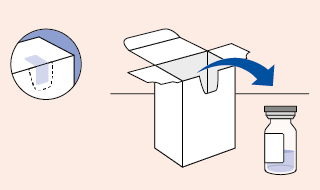
1Remove the Piasky package(s) from the refrigerator.
Open the package(s) and remove the vial(s).
Check the dose prescribed by the doctor. Up to 3 injections one after the other may be necessary for the entire dose.You may need up to 3 vials for
administering a full dose. Prepare all the necessary vials.
2Place the vial(s) on a flat and clean surface.
- Do notuse the vial if the packaging is damaged or if the opening seal is broken. Throw the vial away in a sharps container (see step 43) and contact your doctor or pharmacist.
Check the vial(s)

3Check the expiration date (EXP) on the vial(s).
4Check the appearance of the medicine.
The medicine should be from clear to strongly opalescent, from almost colorless to yellow-
brownish.
5Check that the vial(s) is/are not damaged, e.g., there are no cracks or
scratches.
- Do notuse the medicine if the expiration date (EXP) has passed.
- Do notuse the medicine if it appears cloudy, discolored, or if it contains particles.
- Do notuse the medicine if the vial is cracked or broken. If you notice any of the above, discard the vial in a sharps container (see step 43) and contact your doctor or pharmacist.
Warming time
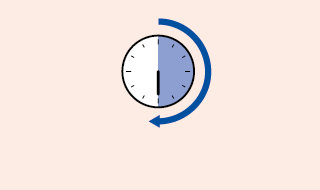
30 min
6Place the vial(s) on a flat and clean surface for 30 minutes, away from direct sunlight. This allows the medicine to reach room temperature.
If the vial is not at room temperature, the cold medicine may make it difficult to
withdraw and more difficult to inject. It may also cause discomfort.
- Do nottry to speed up the warming process in any way, such as in the microwave, in hot water or in direct sunlight.
- Do notremove the vial cap while the vial is reaching room temperature.
Gather the other materials
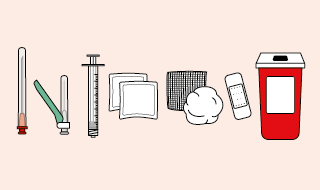
7Gather the other materials while the vial is reaching room temperature.
The list refers to a single injection.Adjust the quantity of materials based on
the number of injections you need.
Note: the color of the materials may differ from the illustrations.
- 1 transfer needle
- 1 injection needle with safety shield
- 1 syringe
- 2 alcohol-soaked swabs -1 for the skin and 1 for the vial
- 1 sterile cotton ball or gauze
- 1 small bandage
- 1 sharps waste disposal container
Choose the injection site
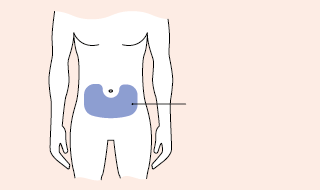
8Piasky must only be injected into the stomach area (abdomen).
Make sure you do not inject more than once in the same place.Each injection
must be made at least 5 cm apart from the previous one.
- Do notinject into the arm or thigh.
- Do notinject within 5 cm around the navel.
- Do notinject on moles, scars or in areas where the skin appears sore, bruised, red, hardened or broken.
Clean the injection site
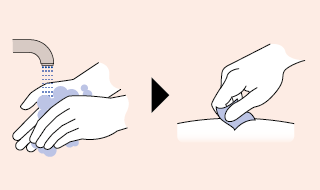
9Wash your hands with soap and water.
10Disinfect the injection area with an alcohol-soaked swab and let it air dry.
- Do nottouch, wave or blow on the freshly cleaned area.
Clean the vial cap
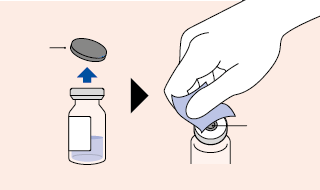
11Remove the colored cap from the vial. Throw the colored cap into the sharps container (see step 43).
12Clean the rubber cap with the other alcohol-soaked swab.
- Do nottouch the rubber cap after cleaning it.
Insert the transfer needle
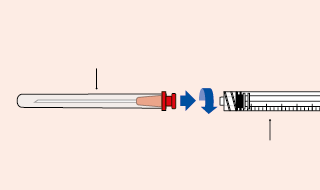
13Remove the syringe and transfer needle from the packaging.
14Push and screw the transfer needle onto the syringe until it is firmly attached.
Keep the cap on the needle.
- Do notuse the injection needle (with the safety shield) to withdraw the medicine.
Fill the syringe with air
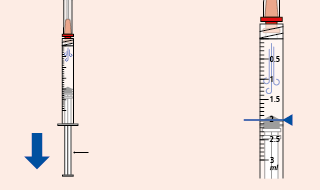
2 mL
15With the needle cap still inserted, slowly pull back the plunger and draw air into
the syringe up to the line indicating 2 mL.
Note: the vial does not contain air. Injecting air into the vial will make it easier to withdraw
the medicine and prevent the plunger from moving.
Remove the transfer needle cap
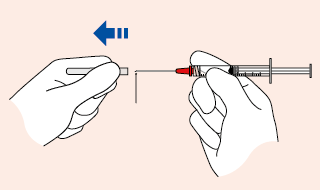
16Hold the syringe by the middle and carefully remove the protective cap from the needle
from the syringe.
17Keep the cap on a flat surface.
You will need to put it back on the needle after transferring the medicine.
- Do notthrow away the cap.
- After removing the cap, do nottouch the needle and do not let it come into contact with any surface.
Inject air into the vial
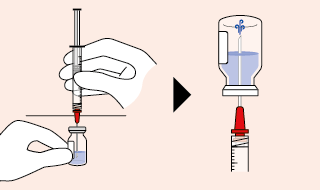
18Hold the vial on a flat surface and insert the needle vertically into the center of the
rubber cap.
19Turn the vial upside down, keeping the needle inserted into the vial.
20Make sure the needle tip is below the medicine.
21With the vial upside down, press the plunger to inject the air into the vial.
22Keep your fingers pressed on the plunger to prevent it from moving.
- Do notinject air into the medicine, as this may create air bubbles inside it.
Transfer all the medicine
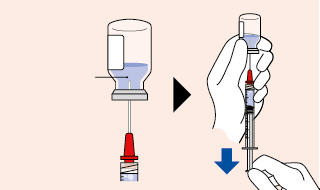
23Move the needle tip down so that it is inside the medicine.
24Slowly pull back the plunger to transfer all the medicineinto the syringe.
Make sure to always keep the needle tip inside the medicinewhile
transferring the medicine into the syringe. You may need to slide the needle
downor you may need to transfer some air into the syringe.
- Do notremove the needle completely from the vial.
- Do notpull the plunger completely out of the syringe.
Remove air bubbles
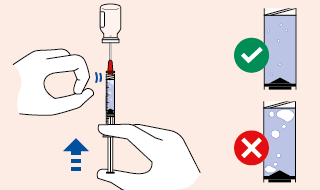
25If there are air bubbles or an air-filled space in the syringe, gently tap the side
of the syringe with your finger until the air bubbles rise to the top of the syringe.
26Slowly push the plunger upwards to push the air bubbles into the vial.
If you push medicine into the vial, slowly pull back the plunger (more slowly
this time) to transfer all the medicine from the entire vial (see steps 23 and 24).
Re-cap the transfer needle with the cap
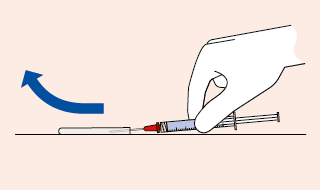
27Remove the syringe from the vial.
28Use one hand only, slide the needle into the cap placed on a flat surface.
29When the needle is covered, lift the syringe and push the cap to secure it completely
onto the needle.
- Do nothold the cap with your fingers while sliding the needle inside.
Warning: do notuse the transfer needle to inject the medicine. The transfer needle
is too large to inject the medicine.
Remove the transfer needle
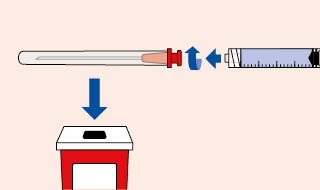
30Hold the syringe and rotate the transfer needle to remove it.
31Dispose of the transfer needle in a sharps disposal container (see
step 43).
- Do nottouch the tip of the syringe after removing the transfer needle.
Insert the injection needle
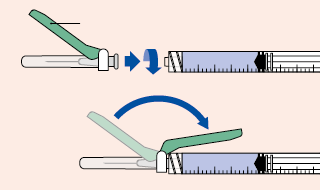
32Remove the injection needle from its packaging.
33Push and screw the injection needle on until it is firmly attached to the syringe.
34Move the safety shield back towards the syringe, as shown in the figure above.
Remove the injection needle cap
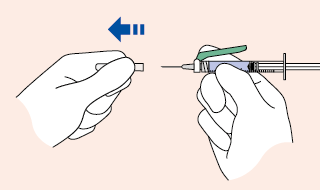
35Hold the syringe from the central part and carefully pull off the protective cap of the needle
from the syringe.
- Do notrotate or bend the cap while pulling it off.
- Do nottouch the needle or allow it to come into contact with any surface.
- Do notput the cap back on after removing it, as it could damage the needle.
- Do notuse the syringe if it has fallen or is damaged.
Adjust the plunger
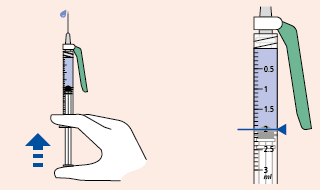
2 mL
36Slowly push the plunger up to the 2 mL line.
Insert the needle
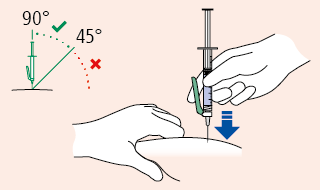
37With one hand, form a fold in the clean skin area.
38With the other hand, hold the syringe from the central part, at an angle of 45° to 90° to the skin.
39With a quick movement, insert the needle fully into the skin fold.
- Do nothold or press the plunger while inserting the needle.
Inject the medicine
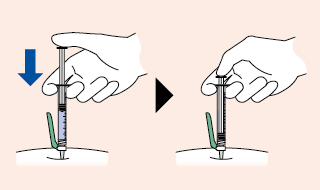
40Slowly push the plunger all the way down to inject all the medicine.
41Release the skin fold and remove the needle.
Cover the injection needle
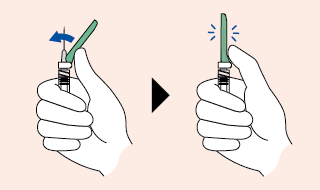
“click”
42After the injection, press the safety shield on the needle with your thumb until you hear or
feel a “click”.If you do not hear a “click”, check that the needle is completely covered
by the safety shield.
- Do notput the original cap back on the needle.
- Do notuse both hands to cover the needle.
- Do notremove the needle from the syringe.
Dispose of the syringe and vial
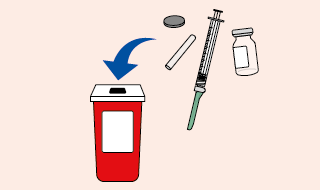
43Immediately after use, place the used Piasky vial, syringe, needles and residual material in a
sharps disposal container.
- Do notthrow needles, syringes and vials into household waste.
- Do nottry to disassemble the syringe.
Check the injection site
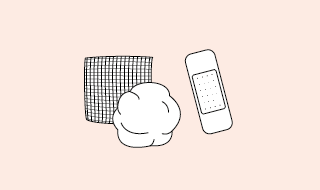
44There may be a small amount of blood or medicine at the injection site.
You can press a cotton ball or gauze until the bleeding stops. If
necessary, cover the injection site with a small bandage. If the bleeding does not stop,
contact your doctor.
The injection is now complete.
- Do notrub or massage the area where the injection was given.
Second or third injection
If the prescribed dose involves 2 or 3 consecutive injections, start again from step 8
with another vial of Piasky and new materials.Up to 3 vials may be needed for a complete dose. Make sure the next injection does not occur in the same site already
used previously.
Disposal of syringes and vials
Do notthrow any medicine into the drain and household waste.
Ask your pharmacist how to dispose of medicines you no longer use. This will help to
protect the environment.
When the container is full, be sure to dispose of it according to the instructions of your doctor,
nurse or pharmacist.


Не уверены, подходит ли вам это лекарство?
Обсудите симптомы и варианты лечения с врачом онлайн.

Уже начали прием и появились вопросы?
Обсудите свое состояние и дальнейшие шаги с врачом онлайн.

- Страна регистрации
- Форма выпускаInjectable or infusion solution, 340 mg
- Код АТХL04AJ07
- Действующее вещество
- Отпускается по рецептуДа
- Производитель
- Информация на этой странице носит справочный характер и не является медицинской консультацией. Перед началом приема лекарства обязательно проконсультируйтесь с врачом.
- Аналоги PIASKYФорма выпуска: Infusion solution, 1080 mgДействующее вещество: ПегцетакопланПроизводитель: SWEDISH ORPHAN BIOVITRUM AB (PUBL)Отпускается по рецептуФорма выпуска: Concentrate for infusion solution, 300 mgДействующее вещество: ЭкулизумабПроизводитель: AMGEN TECHNOLOGY (IRELAND) UCОтпускается по рецептуФорма выпуска: Infusion solution, 50 mg / mlДействующее вещество: sutimlimabПроизводитель: RECORDATI RARE DISEASES SARLОтпускается по рецепту
Аналоги PIASKY в других странах
Лекарства с тем же действующим веществом, доступные в других странах.
Аналог PIASKY в Испания
Получите рецепт на PIASKY онлайн
Заполните форму за 2 минуты
Расскажите о симптомах, истории болезни и нужном препарате.
Выберите врача или мы назначим
Выберите специалиста или мы подберём ближайшего доступного врача.
Врач рассматривает ваш случай
Обычно в течение 30 минут. Может задать уточняющие вопросы в чате.
Получите в любой аптеке
Электронный рецепт отправляется на вашу почту — действителен по всей Польше.
Часто задаваемые вопросы
PIASKY требует рецепта в Италия. Вы можете уточнить у врача онлайн, подходит ли это лекарство для вашей ситуации.
Действующее вещество PIASKY — crovalimab. Эта информация помогает определить лекарства с тем же составом под другими торговыми названиями.
PIASKY производится компанией ROCHE REGISTRATION GMBH. Упаковка и торговое название могут отличаться в зависимости от дистрибьютора.
Врачи, включая Семейные врачи, Психиатры, Дерматологи, Кардиологи, Эндокринологи, Гастроэнтерологи, Пульмонологи, Нефрологи, Ревматологи, Гематологи, Инфекционисты, Аллергологи, Гериатры, Педиатры, Онкологи, могут оценить целесообразность применения PIASKY с учетом вашей ситуации и местных правил. Вы можете записаться на онлайн-консультацию, чтобы обсудить возможные варианты.
Польша имеет хорошо развитую систему здравоохранения в крупных городах, таких как Варшава, Краков, Вроцлав и Гданьск. Аптеки широко доступны и работают в соответствии с действующим законодательством, обеспечивая доступ к рецептурным препаратам.
Вы можете купить PIASKY в Варшаве, Кракове, Вроцлаве или Гданьске в любой аптеке при наличии действующего рецепта.
Чтобы получить рецепт, вы можете воспользоваться Oladoctor:
Другие лекарства с тем же действующим веществом (crovalimab) включают ASPAVELI, BEKEMV, ENJAYMO. Они могут отличаться торговым названием или формой выпуска, но содержат одинаковый терапевтический компонент. Перед изменением лечения рекомендуется проконсультироваться с врачом.
