



МИТТОВАЛ 2.5 МГ Коированная таблетка

Рассмотрение рецепта онлайн
Врач рассмотрит ваш случай и примет решение о назначении рецепта, если это медицински оправдано.

Поговорите с врачом об этом лекарстве
Обсудите симптомы и возможные дальнейшие шаги на онлайн-консультации.



Инструкция по применению MITTOVAL
Содержание инструкции
Mittoval 2.5 mg coated tablets
Alfuzosin hydrochloride
Read this leaflet carefully before taking this medicine as it contains important information for you.
- Keep this leaflet. You may need to read it again.
- If you have any questions, ask your doctor or pharmacist.
- This medicine has been prescribed for you only. Do not pass it on to others, even if their symptoms are the same as yours, as it could be harmful.
- If you get any side effects, even those not listed in this leaflet, tell your doctor or pharmacist. See section 4.
Contents of this leaflet:
- 1. What Mittoval is and what it is used for
- 2. What you need to know before you take Mittoval
- 3. How to take Mittoval
- 4. Possible side effects
- 5. How to store Mittoval
- 6. Contents of the pack and other information
1. What is Mittoval and what is it used for
Mittoval contains alfuzosin hydrochloride which belongs to a class of medicines called
“Selective alpha 1 adrenergic receptor antagonists or alpha 1-blockers”.
It acts on the bladder, the urethra (the tube that allows urine to pass) and the
prostate.
Mittoval is indicated for the treatment of disorders caused by an enlarged prostate, a
condition called “benign prostatic hyperplasia”.
2. What you need to know before you take Mittoval
Do not take Mittoval
- If you are allergic to alfuzosin or any of the other ingredients of this medicine (listed in section 6);
- If you suffer from or have suffered from sudden drops in blood pressure when you get up quickly after being seated or lying down (orthostatic hypotension);
- If you are taking other medicines in the alpha 1-antagonist group;
- If you have severe liver problems (severe hepatic insufficiency).
- If you are taking ritonavir alone or in combination with ombitasvir/paritaprevir, lopinavir, nirmatrelvir. See section “Other medicines and Mittoval”.
Warnings and precautions
Talk to your doctor or pharmacist before taking Mittoval.
If you are taking medicines for the treatment of high blood pressure
(antihypertensives) or for chest pain (nitrates) your doctor will prescribe Mittoval with caution.
A few hours after taking Mittoval, sudden drops in blood pressure may occur when moving from a seated or lying position to
standing quickly (orthostatic hypotension), with or without symptoms (dizziness, fatigue,
sweating). If this happens to you, you should lie down until the symptoms have completely disappeared.
These effects usually occur at the beginning of therapy and last for a
short period and, as a rule, it is not necessary to stop treatment.
If you suffer from heart disease, take medicines to control your
blood pressure or are elderly, you have a greater risk of having a significant drop in blood
pressure (circulatory collapse) and experiencing side effects. Therefore your doctor will
prescribe Mittoval with caution.
If you have had a significant drop in blood pressure after taking another
medicine in the alpha 1-antagonist group or are being treated with antihypertensives or nitrates, your
doctor will prescribe Mittoval with care.
As with all alpha 1-blockers, if you suffer from acute heart failure (a condition in which the
heart fails to pump enough blood), your doctor will prescribe
Mittoval with caution.
If you are being treated for coronary insufficiency (a disorder of the heart arteries) and the
chest pain recurs or worsens, your doctor will stop treatment with Mittoval.
If you suffer from a heart rhythm defect or are taking medicines that can cause
a heart rhythm defect (prolongation of the QT interval), your doctor will subject you to
checks before and during therapy with Mittoval.
When taking Mittoval, as with other alpha 1-blockers, you may experience a persistent, painful and non-sexual related erection of the penis (priapism). In this case, inform your
doctor, as this condition, if not treated correctly, can lead to permanent impotence
(see “Possible side effects”).
If you are to undergo cataract surgery (clouding of the
lens) you must inform the ophthalmologist that you are taking or have been treated in the past
with Mittoval or another alpha 1-blocker. This is because Mittoval or another
alpha 1-blocker may cause complications during the operation that can be
managed if the specialist has been informed before the operation.
The tablets must be swallowed whole. Do not break, chew, grind or
reduce them to powder. This can lead to inappropriate release and absorption of the
active ingredient and therefore possible side effects.
If you have suffered from disorders of the blood vessels that carry blood to the brain, with or without
symptoms, Mittoval increases the risk of insufficient blood supply to the brain (cerebral ischemia).
Other medicines and Mittoval
Tell your doctor or pharmacist if you are taking, have recently taken or might
take any other medicines.
Do not take Mittoval if you are using:
- other medicines that belong to the group of alpha 1-antagonists (see "Do not take Mittoval"), because there is a risk of increasing the blood pressure lowering effect.
- Ritonavir alone or in combination with lopinavir (commonly used for the treatment of HIV) or ritonavir in combination with ombitasvir/paritaprevir (commonly used for the treatment of chronic hepatitis C infection) or ritonavir in combination with nirmatrelvir (commonly used for the treatment of mild to moderate COVID-19).
The effects of Mittoval may be influenced by or influence the following medicines:
- Medicines used to lower blood pressure (antihypertensives) (see “Warnings and precautions”).
- Medicines used to treat chest pain (nitrates) (see “Warnings and precautions”).
- Medicines used to treat fungal infections (such as itraconazole) as they increase the concentration of alfuzosin in the blood.
- Ketoconazole tablets (used to treat Cushing's syndrome, when the body produces an excess of cortisol).
If you are to undergo surgery that requires general anesthesia
tell your doctor that you are taking Mittoval because this medicine can change the
blood pressure.
Pregnancy, breastfeeding and fertility
Not applicable as the use of Mittoval is reserved for men only.
Driving and using machines
Side effects such as dizziness, lightheadedness and weakness may occur
especially at the beginning of treatment with Mittoval. Keep this in mind if you need to drive
vehicles or use machinery.
Mittoval contains lactose
This medicine contains lactose. If your doctor has diagnosed you with an intolerance to
some sugars, contact him before taking this medicine.
Mittoval contains sodium
This medicine contains less than 1 mmol (23 mg) of sodium per tablet, which is
essentially ‘sodium-free’.
3. How to take Mittoval
Take this medicine following exactly the instructions of your doctor or pharmacist. If you have any doubts, consult your doctor or pharmacist.
Adults
The recommended dose is: 1 Mittoval 2.5 mg tablet 3 times a day (for a total of
7.5 mg per day).
Take the first tablet before bedtime.
Use in the elderly and in patients treated with medicines to lower blood pressure
The recommended initial dose is: 1 tablet in the morning and 1 tablet in the evening.
The doctor may increase these doses, but without exceeding 4 tablets of 2.5 mg
(10 mg) per day.
Use in patients with kidney disease
If you suffer from kidney disease, the recommended initial dose is: 1 Mittoval 2.5
mg tablet 2 times a day. The dose may be modified by your doctor.
Use in patients with liver disease
If you suffer from mild to moderate liver disease, the recommended initial dose is: 1
tablet a day of Mittoval 2.5 mg, which may be increased by your doctor up to 2
tablets a day.
Use in children and adolescents
Mittoval should not be used in children and adolescents.
If you take more Mittoval than you should
In case of accidental ingestion/intake of an excessive dose of Mittoval, contact
your doctor immediately or go to the nearest hospital.
If you forget to take Mittoval
Do not take a double dose to make up for the missed tablet.
If you have any doubts about the use of this medicine, consult your doctor or pharmacist.
4. Possible side effects
Like all medicines, this medicine can cause side effects, although not everyone gets them.
The following side effects may occur with the following frequency:
Common(may affect up to 1 in 10 people):
- Weakness or fatigue (asthenia).
- Feeling unwell (malaise).
- Nausea.
- Abdominal pain.
- Diarrhoea.
- Dry mouth.
- Fainting.
- Dizziness (vertigo).
- Headache.
- Low blood pressure when getting up quickly from a sitting or lying position (orthostatic hypotension).
Uncommon (may affect up to 1 in 100):
- Increased heart rate (tachycardia).
- Irregular or strong heartbeat (palpitations).
- Vision disorders.
- Swelling (edema).
- Chest pain.
- Drowsiness.
- Loss of consciousness (syncope).
- Common cold (rhinitis).
- Skin redness (rash).
- Itching.
- Facial flushing.
- Vomiting.
Very rare (may affect up to 1 in 10,000):
- Chest pain that may spread to the arms, neck or jaw (angina). This happens if you already have problems with the blood vessels that carry blood to the heart (coronary artery disease).
- Hives.
- Swelling of the face, throat, limbs, with possible difficulty breathing (angioedema).
Frequency not known(the frequency cannot be estimated from the available data):
- Heart rhythm disorder (atrial fibrillation).
- Iris (the coloured part of the eye) becoming floppy during cataract surgery (iris floppy syndrome).
- Liver damage (hepatocellular lesions).
- Interruption or suppression of bile flow (cholestatic hepatopathy).
- Decreased or interruption of blood flow to the brain (cerebral ischemia) in patients with blood vessel problems that carry blood to the brain.
- Persistent and painful erection (priapism).
- Significant drop in blood pressure with various disturbances up to loss of consciousness (circulatory collapse).
- Reduced number of white blood cells (neutropenia).
- Reduced number of platelets (thrombocytopenia).
undesirable.
Reporting of side effects
If you get any side effects, talk to your doctor or pharmacist. This includes any possible side effects not listed in this leaflet.
You can also report side effects directly through the national reporting system at
https://www.aifa.gov.it/content/segnalazioni-reazioni-avverse.
By reporting side effects you can help provide more information on the safety of this medicine.
5. How to store Mittoval
Store at a temperature below 25°C.
Keep this medicine out of sight and reach of children.
Do not use this medicine after the expiry date which is stated on the package and on the blister
after “Exp.”. The expiry date refers to the last day of that month.
Do not dispose of any medicine in wastewater or household waste. Ask your pharmacist
how to dispose of medicines you no longer use. This will help protect the environment.
6. Contents of the pack and other information
What Mittoval contains
- The active ingredient is alfuzosin hydrochloride. Each tablet contains 2.5 mg of alfuzosin hydrochloride.
- The other ingredients are: tablet core:lactose, microcrystalline cellulose, povidone, sodium carboxymethylstarch, magnesium stearate. coating: hypromellose, macrogol 400, titanium dioxide (E171).
Description of the appearance of Mittoval and contents of the pack
Mittoval is presented in the form of coated tablets.
Packs of 30 tablets in blisters are available.
Marketing Authorisation Holder
Sanofi S.r.l.
Viale L. Bodio, 37/B - Milan
Manufacturer
Sanofi Winthrop Industrie – 30-36 Avenue Gustave Eiffel - Tours (France)
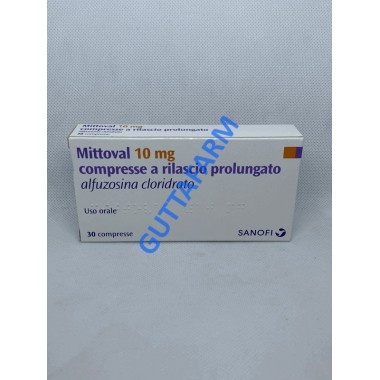
Mittoval 10 mg prolonged-release tablets
Alfuzosin hydrochloride
Read this leaflet carefully before taking this medicine as it contains important information for you.
- Keep this leaflet. You may need to read it again.
- If you have any questions, ask your doctor or pharmacist.
- This medicine has been prescribed for you only. Do not pass it on to others, even if they have the same symptoms as you, as it may be harmful.
- If you get any side effects, even those not listed in this leaflet, tell your doctor or pharmacist. See section 4.
Contents of this leaflet:
- 1. What Mittoval is and what it is used for
- 2. What you need to know before you take Mittoval
- 3. How to take Mittoval
- 4. Possible side effects
- 5. How to store Mittoval
- 6. Contents of the pack and other information
1. What is Mittoval and what it is used for
Medicines used in benign prostatic hyperplasia: Mittoval contains alfuzosin hydrochloride
which belongs to a class of medicines called “Selective alpha 1 adrenergic receptor antagonists or alpha 1-blockers”.
It acts on the bladder, the urethra (the tube that allows urine to pass) and the
prostate.
Mittoval is indicated in the treatment of disorders caused by an enlarged prostate, a
condition called “benign prostatic hyperplasia”.
Mittoval is also indicated as a therapy in addition to the use of a urethral catheter
(insertion of a tube into the bladder through the urethra to allow urine to pass) in the treatment of acute urinary retention (a condition in which the patient cannot
empty the bladder of urine) caused by enlargement of the prostate gland
(benign prostatic hyperplasia).
2. What you need to know before you take Mittoval
Do not use Mittoval
- If you are allergic to alfuzosin or any of the other ingredients of this medicine
(listed in section 6).
- If you suffer from or have suffered from sudden drops in blood pressure when you get up quickly after being seated or lying down (orthostatic hypotension).
- If you are taking other medicines from the alpha 1-antagonist group.
- If you have liver problems (hepatic insufficiency).
- If you are taking ritonavir alone or in combination with ombitasvir/paritaprevir, lopinavir, nirmatrelvir. See section “Other medicines and Mittoval”.
Warnings and precautions
Talk to your doctor or pharmacist before taking Mittoval.
If you are taking medicines for the treatment of high blood pressure
(antihypertensives) or for chest pain (nitrates) your doctor will prescribe Mittoval with caution.
A few hours after taking Mittoval, sudden drops in blood pressure may occur when moving quickly from a
sitting or lying position to a standing position (orthostatic hypotension), with or without symptoms (dizziness, fatigue,
sweating). If this happens to you, you should lie down until the symptoms completely disappear.
These effects usually occur at the beginning of therapy and last for a
short period and, as a rule, it is not necessary to stop treatment.
If you suffer from heart disease, take medicines to control blood
pressure or are elderly, you have a greater risk of having a significant drop in blood
pressure (circulatory collapse) and experiencing undesirable effects. Therefore your doctor will
prescribe Mittoval with caution.
If you have had a significant drop in blood pressure after taking another
medicine from the alpha 1-blocker group or are being treated with antihypertensives or nitrates, your
doctor will prescribe Mittoval with care.
As with all alpha 1-blockers, if you suffer from acute heart failure (a condition in which the
heart fails to pump enough blood), your doctor will prescribe
Mittoval with caution.
If you are being treated for coronary insufficiency (disorder of the heart arteries) and the
chest pain recurs or worsens, your doctor will stop treatment with Mittoval.
If you suffer from a heart rhythm defect or are taking medicines that can cause
a heart rhythm defect (prolongation of the QTc interval), your doctor will subject you to
checks before and during therapy with Mittoval.
When taking Mittoval, as with other alpha 1-blockers, you may experience a persistent, painful and non-sexually related erection of the penis (priapism). In this case, inform your
doctor, as this condition, if not treated correctly, can lead to permanent impotence
(see “Possible side effects”).
If you are to undergo cataract surgery (clouding of the
lens) you must inform the ophthalmologist that you are taking or have been treated in the past
with Mittoval or with another alpha 1-blocker medicine. This is because Mittoval or another
alpha 1-blocker may cause complications during surgery that can be
managed if the specialist has been informed before the operation.
If you suffer from a severe kidney disease (severe renal insufficiency, with creatinine clearance < 30 ml/min), you will not be given Mittoval 10 mg, because the prolonged-release tablets must not be given to patients with severe kidney problems.
The tablets must be swallowed whole. Do not break them, chew them, grind them or
reduce them to powder. This may lead to inappropriate release and absorption of the
active ingredient and therefore to possible undesirable effects.
Other medicines and Mittoval
Tell your doctor or pharmacist if you are taking, have recently taken or might
take any other medicines.
You must not take Mittoval if you are using:
- other medicines that belong to the group of alpha 1-antagonists (see "Do not take Mittoval"), because there is a risk of increasing the blood pressure lowering effect.
- Ritonavir alone or in combination with lopinavir (commonly used for the treatment of HIV) or ritonavir in combination with ombitasvir/paritaprevir (commonly used for the treatment of chronic hepatitis C infection) or ritonavir in combination with nirmatrelvir (commonly used for the treatment of mild to moderate COVID-19).
The effects of Mittoval may be influenced by or influence the following medicines:
- Medicines used to reduce blood pressure (antihypertensives), (see “Warnings and precautions”);
- Medicines used to treat chest pain (nitrates) (see “Warnings and precautions”);
- Medicines used to treat fungal infections (such as itraconazole) as they increase the concentration of alfuzosin in the blood;
- Ketoconazole tablets (used to treat Cushing's syndrome, when the body produces an excess of cortisol).
If you are to undergo surgery requiring general anesthesia
tell your doctor that you are taking Mittoval because this medicine may change the
blood pressure.
Pregnancy, breastfeeding and fertility
Not applicable as the use of Mittoval is reserved for men only.
Driving and using machines
Side effects such as dizziness, lightheadedness and weakness may occur
especially at the beginning of treatment with Mittoval. Take this into account if you need to drive
vehicles or use machinery.
Mittoval containshydrogenated castor oil
Hydrogenated castor oil may cause stomach upset and diarrhea.
3. How to take Mittoval
Take this medicine following exactly the instructions of your doctor or pharmacist. If you have any doubts, ask your doctor or pharmacist.
For the treatment of enlarged prostate (benign prostatic hyperplasia)
The recommended dose is: 1 tablet of 10 mg 1 time a day, to be taken after the
meal.
For the treatment of inability to empty the bladder of urine (acute urinary retention)
The recommended dose is: 1 tablet of 10 mg per day after the meal, to be taken from
the first day of catheter placement (a small tube inserted into the bladder through
the urethra to allow urine to drain).
The tablets must be swallowed whole.
Use in children and adolescents
Mittoval must not be used in children and adolescents.
If you take more Mittoval than you should
In case of accidental ingestion/intake of an excessive dose of Mittoval, contact
your doctor immediately or go to the nearest hospital.
If you forget to take Mittoval
Do not take a double dose to make up for the missed tablet.
If you have any doubts about the use of this medicine, ask your doctor or pharmacist.
4. Possible side effects
Like all medicines, this medicine can cause side effects, although not everyone gets them.
The following side effects may occur with the following frequency:
Common(may affect up to 1 in 10 people):
- Weakness or fatigue (asthenia).
- Nausea.
- Abdominal pain.
- Fainting.
- Dizziness.
- Headache.
Uncommon (may affect up to 1 in 100 people):
- Increased heart rate (tachycardia).
- Swelling (edema).
- Chest pain.
- Diarrhea.
- Feeling of loss of balance (vertigo).
- Loss of consciousness (syncope).
- Common cold (rhinitis).
- Skin redness (rash).
- Itching.
- Low blood pressure when getting up quickly from sitting or lying down (orthostatic hypotension).
- Facial flushing.
- Vomiting
Very rare(may affect up to 1 in 10,000 people):
- Chest pain that may spread to the arms, neck or jaw (angina). This happens if you already suffer from disorders of the blood vessels that carry blood to the heart (coronary artery disease).
- Hives.
- Swelling of the face, throat, limbs, with possible difficulty breathing (angioedema).
Frequency not known(the frequency cannot be estimated from available data):
- Irregular heartbeat (atrial fibrillation).
- Iris (the colored part of the eye) becoming floppy during eye surgery (iris flag syndrome).
- Liver damage (hepatocellular lesions).
- Interruption or suppression of bile flow (cholestatic hepatopathy).
- Persistent and painful erection (priapism).
- Significant drop in blood pressure with various disturbances up to loss of consciousness (circulatory collapse).
- Decreased number of white blood cells (neutropenia).
- Decreased number of platelets in the blood (thrombocytopenia).
side effects.
Reporting of side effects
If you get any side effects, talk to your doctor or pharmacist. You can also report side effects
directly through the national reporting system at
https://www.aifa.gov.it/content/segnalazioni-reazioni-avverse.
By reporting side effects you can help provide more information on the
safety of this medicine.
5. How to store Mittoval
This medicine does not require any particular storage conditions.
Keep this medicine out of the sight and reach of children.
Do not use this medicine after the expiry date which is stated on the package and on the blister
after “Exp.”. The expiry date refers to the last day of that month.
Do not dispose of any medicine in the wastewater or household waste. Ask your pharmacist
how to dispose of medicines you no longer use. This will help protect the environment.
6. Contents of the pack and other information
What Mittoval contains
- The active ingredient is alfuzosin hydrochloride. Each tablet contains 10 mg of alfuzosin hydrochloride.
- The other ingredients are: hypromellose, hydrogenated castor oil, ethylcellulose 20, yellow iron oxide (E172), hydrated colloidal silica, magnesium stearate, mannitol, povidone, microcrystalline cellulose.
Description of the appearance of Mittoval and contents of the pack
Mittoval is presented in the form of prolonged-release tablets.
Packs of 20 tablets and 30 tablets in blisters are available.
Marketing Authorisation Holder
Sanofi S.r.l.
Viale L. Bodio, 37/B - Milan
Manufacturer
Sanofi Winthrop Industrie – 30-36 Avenue Gustave Eiffel - Tours (France)

Не уверены, подходит ли вам это лекарство?
Обсудите симптомы и варианты лечения с врачом онлайн.

Уже начали прием и появились вопросы?
Обсудите свое состояние и дальнейшие шаги с врачом онлайн.
- Страна регистрации
- Форма выпускаCoated tablet, 2.5 MG
- Код АТХG04CA01
- Действующее вещество
- Отпускается по рецептуДа
- Производитель
- Информация на этой странице носит справочный характер и не является медицинской консультацией. Перед началом приема лекарства обязательно проконсультируйтесь с врачом.
- Аналоги MITTOVALФорма выпуска: Extended-release tablet, 10 MGДействующее вещество: alfuzosinПроизводитель: AUROBINDO PHARMA (ITALIA) S.R.L.Отпускается по рецептуФорма выпуска: Extended-release tablet, 10 MGДействующее вещество: alfuzosinПроизводитель: DOC GENERICI SRLОтпускается по рецептуФорма выпуска: Extended-release tablet, 10 MGДействующее вещество: alfuzosinПроизводитель: SANDOZ S.P.A.Отпускается по рецепту
Аналоги MITTOVAL в других странах
Лекарства с тем же действующим веществом, доступные в других странах.
Аналог MITTOVAL в Польша
Аналог MITTOVAL в Украина
Аналог MITTOVAL в Испания
Врачи онлайн по MITTOVAL
Обсудите применение MITTOVAL и возможные следующие шаги — по оценке врача.


Получите рецепт на MITTOVAL онлайн
Заполните форму за 2 минуты
Расскажите о симптомах, истории болезни и нужном препарате.
Выберите врача или мы назначим
Выберите специалиста или мы подберём ближайшего доступного врача.
Врач рассматривает ваш случай
Обычно в течение 30 минут. Может задать уточняющие вопросы в чате.
Получите в любой аптеке
Электронный рецепт отправляется на вашу почту — действителен по всей Польше.
Часто задаваемые вопросы
MITTOVAL требует рецепта в Италия. Вы можете уточнить у врача онлайн, подходит ли это лекарство для вашей ситуации.
Действующее вещество MITTOVAL — alfuzosin. Эта информация помогает определить лекарства с тем же составом под другими торговыми названиями.
MITTOVAL производится компанией SANOFI S.R.L.. Упаковка и торговое название могут отличаться в зависимости от дистрибьютора.
Врачи, включая Семейные врачи, Психиатры, Дерматологи, Кардиологи, Эндокринологи, Гастроэнтерологи, Пульмонологи, Нефрологи, Ревматологи, Гематологи, Инфекционисты, Аллергологи, Гериатры, Педиатры, Онкологи, могут оценить целесообразность применения MITTOVAL с учетом вашей ситуации и местных правил. Вы можете записаться на онлайн-консультацию, чтобы обсудить возможные варианты.
Польша имеет хорошо развитую систему здравоохранения в крупных городах, таких как Варшава, Краков, Вроцлав и Гданьск. Аптеки широко доступны и работают в соответствии с действующим законодательством, обеспечивая доступ к рецептурным препаратам.
Вы можете купить MITTOVAL в Варшаве, Кракове, Вроцлаве или Гданьске в любой аптеке при наличии действующего рецепта.
Чтобы получить рецепт, вы можете воспользоваться Oladoctor:
Другие лекарства с тем же действующим веществом (alfuzosin) включают ALFUTSOSINA AUROBINDO, ALFUTSOSINA DOK JENERIKI, ALFUTSOSINA EXAL. Они могут отличаться торговым названием или формой выпуска, но содержат одинаковый терапевтический компонент. Перед изменением лечения рекомендуется проконсультироваться с врачом.
