



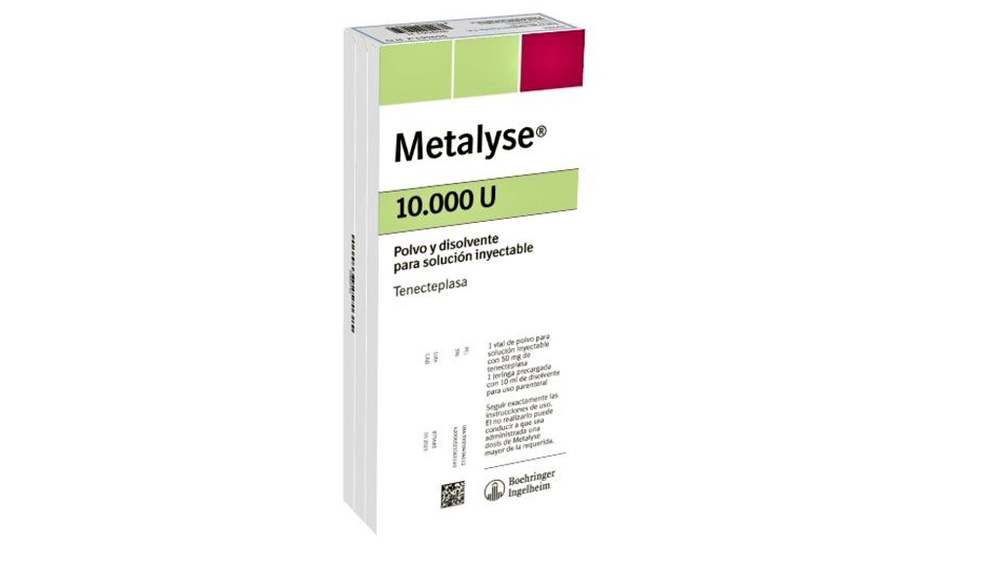
METALYSE 8000 U/8 ML Порошок и раствор для инъекционного раствора

Рассмотрение рецепта онлайн
Врач рассмотрит ваш случай и примет решение о назначении рецепта, если это медицински оправдано.

Поговорите с врачом об этом лекарстве
Обсудите симптомы и возможные дальнейшие шаги на онлайн-консультации.



Инструкция по применению METALYSE
Содержание инструкции
- Metalyse 8 000 units (40 mg) powder and solvent for injectable solution, 10 000 units (50 mg) powder and solvent for injectable solution
- Metalyse 5 000 units (25 mg) powder for injectable solution
Metalyse 8 000 units (40 mg) powder and solvent for injectable solution, 10 000 units (50 mg) powder and solvent for injectable solution
tenecteplase
Read this leaflet carefully before you receive this medicine as it contains
important information for you.
- Keep this leaflet. You may need to read it again.
- If you have any questions, ask your doctor or pharmacist.
- If any side effects occur, including any not listed in this leaflet, tell your doctor or pharmacist. See section 4.
Contents of this leaflet
- 1. What is Metalyse and what it is used for
- 2. What you need to know before you receive Metalyse
- 3. How Metalyse is administered
- 4. Possible side effects
- 5. How to store Metalyse
- 6. Contents of the pack and other information
1. What is Metalyse and what is it used for
Metalyse is a powder and solvent for injectable solution.
Metalyse belongs to a group of medicines called thrombolytic agents. These medicines
help to dissolve blood clots. Tenecteplase is a fibrin-specific plasminogen activator.
Metalyse is used for the treatment of myocardial infarction (heart attack) within 6 hours
of the onset of symptoms and helps to dissolve blood clots that have formed in the blood
vessels of the heart. This helps to prevent damage caused by the infarction by contributing to saving lives.
2. What you need to know before receiving Metalyse
Your doctor will not prescribe or give you Metalyse
- if you have had a previous life-threatening allergic reaction (severe hypersensitivity) to tenecteplase, to any of the other ingredients of this medicine (listed in section 6) or to gentamicin (a residual trace from the manufacturing process). However, if treatment with Metalyse is considered necessary, appropriate resuscitation facilities must be immediately available if needed;
- if you have or have recently had a condition that increases your risk of bleeding (hemorrhage), including:
- bleeding disorders or a tendency to bleed (hemorrhage)
- stroke (cerebrovascular event)
- very high uncontrolled blood pressure
- head injuries
- severe liver disease
- stomach ulcer (peptic ulcer)
- varicose veins in the esophagus (esophageal varices)
- blood vessel abnormalities (for example aneurysm)
- some cancers
- inflammation of the membrane lining the heart (pericarditis); inflammation or infection of the heart valves (endocarditis)
- dementia;
- if you are taking tablets/capsules used to “thin” the blood, such as coumarin derivatives such as warfarin (anticoagulants);
- if you have inflammation of the pancreas (pancreatitis);
- if you have recently had major surgery, including surgery on the brain or spinal cord;
- if you have undergone cardiopulmonary resuscitation (chest compressions) for more than 2 minutes in the last two weeks.
Warnings and precautions
Your doctor will pay particular attention with Metalyse
- if you have had any allergic reaction other than a life-threatening allergic reaction (severe hypersensitivity) to tenecteplase, to any of the other ingredients of this medicine (listed in section 6) or to gentamicin (a residual trace from the manufacturing process);
- if you have high blood pressure;
- if you have blood circulation disorders in the brain (cerebrovascular disease);
- if you have had gastrointestinal (intestinal) or genitourinary bleeding in the last ten days (this may cause blood in the stool or urine);
- if you have an abnormality of a heart valve (for example mitral valve stenosis) associated with an irregular heartbeat (for example atrial fibrillation);
- if you have received an intramuscular injection in the last 2 days;
- if you are over 75 years of age;
- if you weigh less than 60 kg;
- if you have received Metalyse previously.
Children and adolescents
The use of Metalyse in children and adolescents up to the age of 18 years is not recommended.
Other medicines and Metalyse
Tell your doctor or pharmacist if you are taking, have recently taken or might take
any other medicines.
Pregnancy and breastfeeding
If you are pregnant, suspect you may be pregnant, are planning to become pregnant or are breastfeeding
ask your doctor for advice before you are given this medicine.
3. How Metalyse is administered
The doctor calculates your dose of Metalyse based on your body weight, according to the following scheme:
| Body weight (kg) | Less than 60 | From 60 to 70 | From 70 to 80 | From 80 to 90 | More than 90 |
| g Metalyse (U) | 6,000 | 7,000 | 8,000 | 9,000 | 10,000 |
Your doctor will administer the medicine to prevent blood clotting in addition to
Metalyse, as soon as possible after the onset of chest pain.
Metalyse is administered with a single injection into a vein by a doctor specialized in the use of
this type of medicine.
The doctor will administer Metalyse as a single dose as soon as possible after the onset of chest
pain.
4. Possible side effects
Like all medicines, this medicine can cause side effects, although not everybody gets them.
The side effects listed below have occurred in patients treated with Metalyse:
Very common (may affect more than 1 in 10 people):
- Bleeding
Common (may affect up to 1 in 10 people):
- Bleeding at the site of injection or puncture
- Nosebleed
- Genitourinary bleeding (you may notice blood in your urine)
- Bruising
- Gastrointestinal bleeding (for example, bleeding of the stomach and intestines)
Uncommon (may affect up to 1 in 100 people):
- Irregular heartbeat (reperfusion arrhythmias), which sometimes leads to cardiac arrest. Cardiac arrest (of the heart) can be life-threatening.
- Internal bleeding in the abdomen (retroperitoneal bleeding)
- Bleeding in the brain (cerebral hemorrhage). Following cerebral hemorrhage or other serious bleeding episodes, death or permanent disability may occur
- Bleeding in the eye (eye hemorrhage)
Rare (may affect up to 1 in 1,000 people):
- Low blood pressure (hypotension)
- Bleeding in the lungs (pulmonary hemorrhage)
- Hypersensitivity (anaphylactoid reactions), for example, skin rash, hives, difficulty breathing (bronchospasm)
- Bleeding around the heart (hemopericardium)
- Blood clots in the lungs (pulmonary embolism) and in the vessels of other organs (thrombotic embolization)
Not known (frequency cannot be estimated from available data):
- Fat embolism (blood clots consisting of fat)
- Nausea
- Vomiting
- Increased body temperature (fever)
- Blood transfusions as a consequence of bleeding
As with other thrombolytic agents, the following events have been reported as consequences of myocardial infarction and/or
administration of thrombolytics:
Very common (may affect more than 1 in 10 people):
- Low blood pressure (hypotension)
- Irregular heartbeat
- Chest pain (angina pectoris)
Common (may affect up to 1 in 10 people):
- Further chest pain/angina (recurrent ischemia)
- Heart attack
- Heart failure
- Shock caused by heart failure
- Inflammation of the lining around the heart
- Fluid in the lungs (pulmonary edema)
Uncommon (may affect up to 1 in 100 people):
- Cardiac arrest
- Problems with the valve or lining of the heart (mitral valve incompetence, pericardial effusion)
- Blood clot in the veins (venous thrombosis)
- Fluid between the lining of the heart and the heart (cardiac tamponade)
- Rupture of the heart muscle (myocardial rupture)
Rare (may affect up to 1 in 1,000 people):
- Blood clot in the lungs (pulmonary embolism)
These cardiovascular events can be life-threatening and lead to death.
In case of bleeding into the brain, events related to the nervous system have been reported, for example, drowsiness (lethargy), speech disorders, paralysis of parts of the body (hemiparesis) and seizures
(convulsions).
Reporting of side effects
If you get any side effects, talk to your doctor or nurse. This includes any possible side effects not listed in this leaflet. You can also report side effects directly through the national reporting system listed in Annex V. By reporting side effects you can help provide more information on the safety of this medicine.
5. How to store Metalyse
Keep this medicine out of the sight and reach of children.
Do not use this medicine after the expiry date which is stated on the label and the packaging after
“Exp.”.
Do not store at a temperature above 30 °C.
Keep the container in the outer carton to protect the medicine from light.
Once reconstituted, Metalyse can be stored for 24 hours at 2‑8 °C and for 8 hours at 30 °C.
However, for microbiological reasons, your doctor, as a standard procedure, will use the
reconstituted injectable solution immediately.
Do not dispose of any medicine in wastewater or household waste. Ask your pharmacist how to
dispose of medicines you no longer use. This will help protect the environment.
6. Package contents and other information
What Metalyse contains
- The active substance is tenecteplase.
- Each vial contains 8,000 units (40 mg) of tenecteplase. Each pre-filled syringe contains 8 mL of solvent. When reconstituted with 8 mL of solvent, each mL contains 1,000 U of tenecteplase.
or
- Each vial contains 10,000 units (50 mg) of tenecteplase. Each pre-filled syringe contains 10 mL of solvent. When reconstituted with 10 mL of solvent, each mL contains 1,000 U of tenecteplase.
- The other ingredients are arginine, concentrated phosphoric acid, polysorbate 20.
- The solvent is water for injections.
- Gentamicin is contained as a residual trace from the manufacturing process.
Description of the appearance of Metalyse and contents of the pack
The pack contains:
- one vial with a lyophilized powder containing 40 mg of tenecteplase, one ready-to-use pre-filled syringe with 8 mL of solvent and a vial adapter or
- one vial with a lyophilized powder containing 50 mg of tenecteplase, one ready-to-use pre-filled syringe with 10 mL of solvent and a vial adapter.
Marketing authorization holder and manufacturer
Marketing authorization holder
Boehringer Ingelheim International GmbH
Binger Strasse 173
55216 Ingelheim am Rhein
Germany
Manufacturer
Boehringer Ingelheim Pharma GmbH & Co. KG
Birkendorfer Strasse 65
88397 Biberach/Riss
Germany
Boehringer Ingelheim France
100-104 avenue de France
75013 Paris
France
For further information on this medicine, contact the local representative of the marketing
authorization holder:
België/Belgique/Belgien
Boehringer Ingelheim SComm
Tél/Tel: +32 2 773 33 11
Lietuva
Boehringer Ingelheim RCV GmbH & Co KG
Lietuvos filialas
Tel: +370 5 2595942
България
Бьорингер Ингелхайм РЦВ ГмбХ и Ко. КГ -
клон България
Тел: +359 2 958 79 98
Luxembourg/Luxemburg
Boehringer Ingelheim SComm
Tél/Tel: +32 2 773 33 11
Česká republika
Boehringer Ingelheim spol. s r.o.
Tel: +420 234 655 111
Magyarország
Boehringer Ingelheim RCV GmbH & Co KG
Magyarországi Fióktelepe
Tel: +36 1 299 89 00
Danmark
Boehringer Ingelheim Danmark A/S
Tlf: +45 39 15 88 88
Malta
Boehringer Ingelheim Ireland Ltd.
Tel: +353 1 295 9620
Deutschland
Boehringer Ingelheim Pharma GmbH & Co. KG
Tel: +49 (0) 800 77 90 900
Nederland
Boehringer Ingelheim B.V.
Tel: +31 (0) 800 22 55 889
Eesti
Boehringer Ingelheim RCV GmbH & Co KG
Eesti filiaal
Tel: +372 612 8000
Norge
Boehringer Ingelheim Norway KS
Tlf: +47 66 76 13 00
Ελλάδα
Boehringer Ingelheim Ελλάς Μονοπρόσωπη A.E.
Τηλ: +30 2 10 89 06 300
Österreich
Boehringer Ingelheim RCV GmbH & Co KG
Tel: +43 1 80 105-7870
España
Boehringer Ingelheim España, S.A.
Tel: +34 93 404 51 00
Polska
Boehringer Ingelheim Sp. z o.o.
Tel: +48 22 699 0 699
France
Boehringer Ingelheim France S.A.S.
Tél: +33 3 26 50 45 33
Portugal
Boehringer Ingelheim Portugal, Lda.
Tel: +351 21 313 53 00
Hrvatska
Boehringer Ingelheim Zagreb d.o.o.
Tel: +385 1 2444 600
România
Boehringer Ingelheim RCV GmbH & Co KG
Viena - Sucursala Bucureşti
Tel: +40 21 302 28 00
Ireland
Boehringer Ingelheim Ireland Ltd.
Tel: +353 1 295 9620
Slovenija
Boehringer Ingelheim RCV GmbH & Co KG
Podružnica Ljubljana
Tel: +386 1 586 40 00
Ísland
Vistor hf.
Sími: +354 535 7000
Slovenská republika
Boehringer Ingelheim RCV GmbH & Co KG
organizačná zložka
Tel: +421 2 5810 1211
Italia
Boehringer Ingelheim Italia S.p.A.
Tel: +39 02 5355 1
Suomi/Finland
Boehringer Ingelheim Finland Ky
Puh/Tel: +358 10 3102 800
Κύπρος
Boehringer Ingelheim Ελλάς Μονοπρόσωπη A.E.
Τηλ: +30 2 10 89 06 300
Sverige
Boehringer Ingelheim AB
Tel: +46 8 721 21 00
Latvija
Boehringer Ingelheim RCV GmbH & Co KG
Latvijas filiāle
Tel: +371 67 240 011
United Kingdom (Northern Ireland)
Boehringer Ingelheim Ireland Ltd.
Tel: +353 1 295 9620
Other sources of information
More detailed information on this medicine is available on the website of the European Medicines
Agency, http://www.ema.europa.eu .
This leaflet is available in all official languages of the European Union/European Economic Area on the
website of the European Medicines Agency.
Metalyse 5 000 units (25 mg) powder for injectable solution
tenecteplase
Read this leaflet carefully before you receive this medicine as it contains
important information for you.
- Keep this leaflet. You may need to read it again.
- If you have any questions, ask your doctor or pharmacist.
- If any side effects occur, including those not listed in this leaflet, tell your doctor or pharmacist. See section 4.
Contents of this leaflet
- 1. What Metalyse is and what it is used for
- 2. What you need to know before you receive Metalyse
- 3. How Metalyse is administered
- 4. Possible side effects
- 5. How to store Metalyse
- 6. Contents of the pack and other information
1. What is Metalyse and what is it used for
Metalyse is a powder for injectable solution.
Metalyse belongs to a group of medicines called thrombolytic agents. These medicines
help to dissolve blood clots. Tenecteplase is a recombinant fibrin-specific plasminogen activator.
Metalyse is used in adults for the treatment of stroke caused by a blood clot in
an artery of the brain (acute ischemic stroke) if less than 4.5 hours have passed since the onset
of stroke symptoms.
2. What you need to know before you receive Metalyse
Your doctor will not prescribe or give you Metalyse
- if you have had a previous life-threatening, sudden allergic reaction (severe hypersensitivity) to tenecteplase, to any of the other ingredients of this medicine (listed in section 6) or to gentamicin (a residual trace from the manufacturing process). However, if treatment with Metalyse is considered necessary, appropriate resuscitation facilities must be immediately available if needed;
- if you have or have recently had a condition that increases your risk of bleeding (haemorrhage), including:
- bleeding disorders or a tendency to bleed (haemorrhage);
- very high, uncontrolled blood pressure;
- head injury;
- inflammation of the membrane surrounding the heart (pericarditis); inflammation or infection of the heart valves (endocarditis);
- severe liver disease;
- varicose veins in the oesophagus (oesophageal varices);
- stomach ulcer (peptic ulcer);
- abnormalities of blood vessels (for example aneurysm);
- certain cancers;
- bleeding inside the brain or skull;
- if you are taking tablets/capsules used to “thin” the blood (anticoagulants), unless a specific test confirms the absence of clinically relevant activity of that medicine;
- if you have a very severe stroke;
- if the stroke is causing only mild symptoms;
- if your symptoms are rapidly improving before receiving Metalyse;
- if the symptoms of the stroke started more than 4.5 hours ago or if it is possible that the symptoms started more than 4.5 hours ago because you do not know when they started;
- if you have had convulsions when the stroke started;
- if you have an abnormal thromboplastin time (a blood test that measures the blood's ability to clot). This test may be abnormal if you have received heparin (a medicine used to “thin” the blood) in the 48 hours before;
- if you have diabetes and have already had a stroke previously;
- if you have had a stroke in the last three months;
- if you have a very low number of platelets (thrombocytes) in your blood;
- if your blood pressure is very high (above 185/110) and can only be reduced by injecting medicines;
- if you have a very low (less than 50 mg/dL) or very high (more than 400 mg/dL) blood sugar (glycaemia) level;
- if you have recently had major surgery, including surgery on the brain or spinal cord;
- if you have recently had a biopsy (a procedure used to collect a tissue sample);
- if you have been given cardiopulmonary resuscitation (chest compressions) for more than 2 minutes in the last two weeks;
- if you have inflammation of the pancreas (pancreatitis).
Warnings and precautions
Your doctor will pay particular attention with Metalyse
- if you have had any allergic reaction other than a life-threatening, sudden allergic reaction (severe hypersensitivity) to tenecteplase, to any of the other ingredients of this medicine (listed in section 6) or to gentamicin (a residual trace from the manufacturing process);
- if you have or have recently had any other condition that increases the risk of bleeding, for example:
- an intramuscular injection;
- a minor injury, such as a puncture from a large vessel or external cardiac massage;
- if you weigh less than 60 kg;
- if you are over 80 years of age, you may have a less favourable outcome regardless of treatment with Metalyse. However, in general, the benefit/risk ratio of Metalyse in patients over 80 years of age is positive and age alone does not represent a contraindication to treatment with Metalyse;
- if you have received Metalyse previously.
Children and adolescents
The use of Metalyse in children and adolescents up to the age of 18 years is not recommended.
Other medicines and Metalyse
Tell your doctor or pharmacist if you are taking, have recently taken or might take
any other medicines. It is particularly important that you tell your doctor if you are taking or have
recently taken:
any medicine used to “thin” the blood;
certain medicines used to treat high blood pressure (ACE-inhibitors).
Pregnancy and breastfeeding
If you are pregnant, suspect you may be pregnant or are planning to become pregnant, or if you are breastfeeding
ask your doctor for advice before you are given this medicine.
3. How Metalyse is administered
The doctor calculates your dose of Metalyse based on your body weight, according to the following scheme:
| Body weight (kg) | Less than 60 | From 60 to 70 | From 70 to 80 | r From 80 to 90 | Greater than 90 |
| Metalyse (U) | 3 000 | 3 500 | 4 000 | a 4 500 | 5 000 |
Metalyse is administered with a single injection into a vein by a doctor specialized in the use of
this type of medicine.
The doctor will administer Metalyse to you as a single dose as soon as possible after the onset of stroke.
4. Possible side effects
Like all medicines, this medicine can cause side effects, although not everybody gets them.
The side effects listed below have occurred in patients treated with Metalyse:
Very common (may affect more than 1 in 10 people):
- Bleeding
- Bleeding in the brain (cerebral haemorrhage). Following cerebral haemorrhage or other serious bleeding episodes, death or permanent disability may occur
Common (may affect up to 1 in 10 people):
- Bleeding at the injection or puncture site
- Nosebleed
- Genitourinary bleeding (you may notice blood in your urine)
- Bruising
- Gastrointestinal bleeding (for example, bleeding from the stomach and intestines)
Uncommon (may affect up to 1 in 100 people):
- Internal bleeding in the abdomen (retroperitoneal bleeding)
- Eye bleeding (eye haemorrhage)
Rare (may affect up to 1 in 1,000 people):
- Low blood pressure (hypotension)
- Bleeding in the lungs (pulmonary haemorrhage)
- Hypersensitivity (anaphylactoid reactions), for example skin rash, hives, difficulty breathing (bronchospasm)
- Bleeding around the heart (hemopericardium)
- Blood clots in the lungs (pulmonary embolism) and in the vessels of other organs (thrombotic embolization)
Not known (frequency cannot be estimated from available data):
- Fat embolism (blood clots consisting of fat)
- Nausea
- Vomiting
- Increased body temperature (fever)
- Blood transfusions as a consequence of bleeding
In case of bleeding in the brain, events related to the nervous system have been reported, for example drowsiness (stupor), speech disorders, paralysis of parts of the body (hemiparesis) and seizures (convulsions).
Reporting of side effects
If you get any side effects, even those not listed in this leaflet, tell your doctor or nurse. You can also report side effects directly through the national reporting system listed in Annex V. By reporting side effects you can help provide more information on the safety of this medicine.
5. How to store Metalyse
Keep this medicine out of the sight and reach of children.
Do not use this medicine after the expiry date which is stated on the label and the packaging after
“Exp.”.
Do not store at a temperature above 30 °C.
Keep the container in the outer carton to protect the medicine from light.
Once reconstituted, Metalyse can be stored for 24 hours at 2‑8 °C and for 8 hours at 30 °C.
However, for microbiological reasons, your doctor, as a standard procedure, will use the
reconstituted injectable solution immediately.
Do not dispose of any medicine in wastewater or household waste. Ask your pharmacist how to
dispose of medicines you no longer use. This will help protect the environment.
6. Contents of the pack and other information
What Metalyse contains
- The active substance is tenecteplase.
- Each vial contains 5,000 units (25 mg) of tenecteplase. When reconstituted with 5 mL of water for injections, each mL contains 1,000 U of tenecteplase.
- The other components are arginine, concentrated phosphoric acid, polysorbate 20.
- Gentamicin is contained as a residual trace from the manufacturing process.
Description of the appearance of Metalyse and contents of the pack
The pack contains a vial with a lyophilized powder containing 25 mg of tenecteplase.
Marketing authorization holder and manufacturer
Marketing authorization holder
Boehringer Ingelheim International GmbH
Binger Strasse 173
55216 Ingelheim am Rhein
Germany
Manufacturer
Boehringer Ingelheim Pharma GmbH & Co. KG
Birkendorfer Strasse 65
88397 Biberach/Riss
Germany
Boehringer Ingelheim France
100-104 avenue de France
75013 Paris
France
For further information on this medicinal product, contact the local representative of the marketing
authorization holder:
België/Belgique/Belgien
Boehringer Ingelheim SComm
Tél/Tel: +32 2 773 33 11
Lietuva
Boehringer Ingelheim RCV GmbH & Co KG
Lietuvos filialas
Tel: +370 5 2595942
България
Бьорингер Ингелхайм РЦВ ГмбХ и Ко. КГ -
клон България
Тел: +359 2 958 79 98
Luxembourg/Luxemburg
Boehringer Ingelheim SComm
Tél/Tel: +32 2 773 33 11
Česká republika
Boehringer Ingelheim spol. s r.o.
Tel: +420 234 655 111
Magyarország
Boehringer Ingelheim RCV GmbH & Co KG
Magyarországi Fióktelepe
Tel: +36 1 299 89 00
Danmark
Boehringer Ingelheim Danmark A/S
Tlf: +45 39 15 88 88
Malta
Boehringer Ingelheim Ireland Ltd.
Tel: +353 1 295 9620
Deutschland
Boehringer Ingelheim Pharma GmbH & Co. KG
Tel: +49 (0) 800 77 90 900
Nederland
Boehringer Ingelheim B.V.
Tel: +31 (0) 800 22 55 889
Eesti
Boehringer Ingelheim RCV GmbH & Co KG
Eesti filiaal
Tel: +372 612 8000
Norge
Boehringer Ingelheim Norway KS
Tlf: +47 66 76 13 00
Ελλάδα
Boehringer Ingelheim Ελλάς Μονοπρόσωπη A.E.
Tηλ: +30 2 10 89 06 300
Österreich
Boehringer Ingelheim RCV GmbH & Co KG
Tel: +43 1 80 105-7870
España
Boehringer Ingelheim España, S.A.
Tel: +34 93 404 51 00
Polska
Boehringer Ingelheim Sp. z o.o.
Tel: +48 22 699 0 699
France
Boehringer Ingelheim France S.A.S.
Tél: +33 3 26 50 45 33
Portugal
Boehringer Ingelheim Portugal, Lda.
Tel: +351 21 313 53 00
Hrvatska
Boehringer Ingelheim Zagreb d.o.o.
Tel: +385 1 2444 600
România
Boehringer Ingelheim RCV GmbH & Co KG
Viena - Sucursala Bucureşti
Tel: +40 21 302 28 00
Ireland
Boehringer Ingelheim Ireland Ltd.
Tel: +353 1 295 9620
Slovenija
Boehringer Ingelheim RCV GmbH & Co KG
Podružnica Ljubljana
Tel: +386 1 586 40 00
Ísland
Vistor hf.
Sími: +354 535 7000
Slovenská republika
Boehringer Ingelheim RCV GmbH & Co KG
organizačná zložka
Tel: +421 2 5810 1211
Italia
Boehringer Ingelheim Italia S.p.A.
Tel: +39 02 5355 1
Suomi/Finland
Boehringer Ingelheim Finland Ky
Puh/Tel: +358 10 3102 800
Κύπρος
Boehringer Ingelheim Ελλάς Μονοπρόσωπη A.E.
Tηλ: +30 2 10 89 06 300
Sverige
Boehringer Ingelheim AB
Tel: +46 8 721 21 00
Latvija
Boehringer Ingelheim RCV GmbH & Co KG
Latvijas filiāle
Tel: +371 67 240 011
United Kingdom (Northern Ireland)
Boehringer Ingelheim Ireland Ltd.
Tel: +353 1 295 9620
Other sources of information
More detailed information on this medicinal product is available on the website of the European
Medicines Agency, http://www.ema.europa.eu .
This leaflet is available in all languages of the European Union/European Economic Area on the
website of the European Medicines Agency.

Не уверены, подходит ли вам это лекарство?
Обсудите симптомы и варианты лечения с врачом онлайн.

Уже начали прием и появились вопросы?
Обсудите свое состояние и дальнейшие шаги с врачом онлайн.
- Страна регистрации
- Форма выпускаPowder and solvent for injectable solution, 8000 U/8 ML
- Код АТХB01AD11
- Действующее вещество
- Отпускается по рецептуДа
- Производитель
- Информация на этой странице носит справочный характер и не является медицинской консультацией. Перед началом приема лекарства обязательно проконсультируйтесь с врачом.
- Аналоги METALYSEФорма выпуска: Powder and solvent for injectable/infusion solution, 10 MGДействующее вещество: АлтеплазаПроизводитель: BOEHRINGER INGELHEIM ITALIA S.P.A.Отпускается по рецептуФорма выпуска: Powder and solvent for injectable solution, 500 IUДействующее вещество: apadamtase alfa and cinaxadamtase alfaПроизводитель: TAKEDA MANUFACTURING AUSTRIA AGОтпускается по рецептуФорма выпуска: Powder and solvent for injectable solution, 500 IUДействующее вещество: Протеин СПроизводитель: TAKEDA MANUFACTURING AUSTRIA AGОтпускается по рецепту
Аналоги METALYSE в других странах
Лекарства с тем же действующим веществом, доступные в других странах.
Аналог METALYSE в Украина
Аналог METALYSE в Испания
Врачи онлайн по METALYSE
Обсудите применение METALYSE и возможные следующие шаги — по оценке врача.









Получите рецепт на METALYSE онлайн
Заполните форму за 2 минуты
Расскажите о симптомах, истории болезни и нужном препарате.
Выберите врача или мы назначим
Выберите специалиста или мы подберём ближайшего доступного врача.
Врач рассматривает ваш случай
Обычно в течение 30 минут. Может задать уточняющие вопросы в чате.
Получите в любой аптеке
Электронный рецепт отправляется на вашу почту — действителен по всей Польше.
Часто задаваемые вопросы
METALYSE требует рецепта в Италия. Вы можете уточнить у врача онлайн, подходит ли это лекарство для вашей ситуации.
Действующее вещество METALYSE — Тенектеплаза. Эта информация помогает определить лекарства с тем же составом под другими торговыми названиями.
METALYSE производится компанией BOEHRINGER INGELHEIM INTERNATIONAL GMBH. Упаковка и торговое название могут отличаться в зависимости от дистрибьютора.
Врачи, включая Семейные врачи, Психиатры, Дерматологи, Кардиологи, Эндокринологи, Гастроэнтерологи, Пульмонологи, Нефрологи, Ревматологи, Гематологи, Инфекционисты, Аллергологи, Гериатры, Педиатры, Онкологи, могут оценить целесообразность применения METALYSE с учетом вашей ситуации и местных правил. Вы можете записаться на онлайн-консультацию, чтобы обсудить возможные варианты.
Польша имеет хорошо развитую систему здравоохранения в крупных городах, таких как Варшава, Краков, Вроцлав и Гданьск. Аптеки широко доступны и работают в соответствии с действующим законодательством, обеспечивая доступ к рецептурным препаратам.
Вы можете купить METALYSE в Варшаве, Кракове, Вроцлаве или Гданьске в любой аптеке при наличии действующего рецепта.
Чтобы получить рецепт, вы можете воспользоваться Oladoctor:
Другие лекарства с тем же действующим веществом (Тенектеплаза) включают AKTILYSE, ADTSYNMA, KEPROTIN. Они могут отличаться торговым названием или формой выпуска, но содержат одинаковый терапевтический компонент. Перед изменением лечения рекомендуется проконсультироваться с врачом.
