



KLOTT 500 IU/10 ML Порошок и раствор для инфузионного раствора

Рассмотрение рецепта онлайн
Врач рассмотрит ваш случай и примет решение о назначении рецепта, если это медицински оправдано.

Поговорите с врачом об этом лекарстве
Обсудите симптомы и возможные дальнейшие шаги на онлайн-консультации.



Инструкция по применению KLOTT
Содержание инструкции
KLOTT 500 UI/10 ml Powder and solvent for infusion solution, 1000 UI/10 ml Powder and solvent for infusion solution
Human plasma coagulation factor VIII
Read this leaflet carefully before you use this medicine because it contains important
information for you.
- Keep this leaflet. You may need to read it again.
- If you have any questions, ask your doctor.
- This medicine has been prescribed for you only. Do not pass it on to others, even if their symptoms are the same as yours, as it could be harmful.
- If you get any side effects, even those not listed in this leaflet, tell your doctor or pharmacist. See section 4.
Contents of this leaflet:
- 1. What KLOTT is and what it is used for
- 2. What you need to know before you use KLOTT
- 3. How to use KLOTT
- 4. Possible side effects
- 5. How to store KLOTT
- 6. Contents of the pack and other information
1. What is KLOTT and what is it used for
KLOTT is a factor VIII coagulation solution derived from human plasma. Factor VIII is a protein that has an antihemorrhagic action.
KLOTT is used in the following therapies:
in the treatment and prevention of bleeding in patients with a hereditary deficiency
of factor VIII activity (hemophilia A);
in the treatment of bleeding in patients with a deficiency of factor VIII activity
secondary to other diseases;
in the treatment of hemophilic patients who have developed antibodies against factor VIII
(inhibitors).
2. What you need to know before using KLOTT
Do not use KLOTT
- if you are allergic to human Factor VIII or any of the other ingredients of this medicine (listed in section 6).
Warnings and precautions
Talk to your doctor before using KLOTT.
Allergic reaction
Hypersensitivity-type allergic reactions are possible with KLOTT.
KLOTT contains traces of human proteins other than Factor VIII. If you notice any of the symptoms listed below during the administration of the
product, you should immediately stop the administration and contact your doctor, as these symptoms may be early signs of
an allergic reaction. The symptoms that may occur are: hives, generalized hives,
a feeling of tightness in the chest, wheezing, low blood pressure and a severe
allergic reaction.
In case of shock, standard guidelines for shock should be followed.
Inhibitors
The formation of inhibitors (antibodies) is a known complication that can occur during treatment
with all Factor VIII-based medicines. Inhibitors, especially at high levels, prevent the
treatment from working correctly, and you or your child will be carefully monitored to
check for the development of these inhibitors. If KLOTT does not control bleeding in you or
your child, inform your doctor immediately.
Cardiovascular events
In patients with cardiovascular risk factors, replacement therapy with FVIII may
increase cardiovascular risk.
Complications related to catheter use
If a central venous access device is required, the risk of
device-related complications, including local infections, bacteremia, and thrombosis at the catheter site, must be considered.
Viral safety
When medicines are prepared from human blood or plasma, specific measures are put in place
to prevent the transmission of infections to patients. These measures include:
- careful selection of blood and plasma donors to ensure that potentially infected donors are excluded;
- testing of each donation and pool (a collection of multiple donations) of plasma to detect any presence of infections/viruses;
- the introduction of certain steps in the processing of blood and plasma capable of inactivating or removing viruses. Despite these measures, when medicines prepared from human blood or plasma are administered, the possibility of transmission of infectious agents cannot be completely excluded. This also applies to viruses, or other types of infectious agents, that are emerging or unknown. The measures taken are considered effective for enveloped viruses such as the human immunodeficiency virus (HIV), the hepatitis B virus (HBV), the hepatitis C virus (HCV) and the hepatitis A virus (HAV), which is non-enveloped. The measures taken may have a limited effect against non-enveloped viruses such as parvovirus B19. Parvovirus B19 infection can be severe in pregnancy (fetal infection) and in individuals with a weakened immune system or who have certain types of anemia (e.g. sickle cell anemia or hemolytic anemia).
It is strongly recommended that each time you receive a dose of KLOTT, the name and
batch number of the product are recorded, in order to maintain traceability of the batch
used.
Your doctor may advise you to consider vaccination against hepatitis A and B
if you regularly/repeatedly receive coagulation factor VIII derived from human plasma.
Children
No specific data are available for the pediatric population.
doctors or healthcare professionals.
Other medicines and KLOTT
Tell your doctor or pharmacist if you are taking, have recently taken or might take
any other medicines.
No interactions between human coagulation Factor VIII-based products and other
medicines have been reported.
No specific data are available for the pediatric population.
Pregnancy, breastfeeding and fertility
- If you are pregnant, suspect you are pregnant, are planning to become pregnant, or are breastfeeding, ask your doctor or pharmacist for advice before taking this medicine.
- No animal reproduction studies have been conducted with Factor VIII. Based on the rare occurrence of Hemophilia A in women, data on the use of Factor VIII during pregnancy and breastfeeding are not available. Therefore, Factor VIII should be used during pregnancy and breastfeeding only if clearly indicated.
Driving and using machines
KLOTT has no effect on the ability to drive and use machines.
KLOTT contains sodium
This medicine contains up to a maximum of 41 mg of sodium (the main component of table salt)
per 10 ml vial.
This is equivalent to 2.05% of the recommended daily intake of salt for an adult.
3. How to use KLOTT
Use this medicine following exactly the instructions of your doctor or pharmacist .If you have
any doubts, consult your doctor or pharmacist.
Dosage
The dose and duration of replacement therapy depend on the severity of factor VIII deficiency,
the location and extent of the haemorrhage and your clinical condition.
On-demand treatment
The amount of medicine and the frequency of administrations you must receive must be
established based on your clinical response.
Prophylaxis
For the long-term prevention of bleeding in patients with severe haemophilia A, the usual doses
are from 20 to 40 IU (International Units) of factor VIII per Kg of body weight at intervals of 2 – 3
days. In some cases, especially for younger patients, shorter therapeutic intervals or higher doses may be necessary.
You must be carefully monitored for the possible development of factor VIII inhibitors through
appropriate clinical observations and laboratory tests.
During the course of treatment, an appropriate determination of factor VIII levels is required
to adjust the dose and frequency of repeated infusions. In particular, in the case of major surgical
interventions, it is essential that your replacement therapy is precisely controlled by means of coagulation analysis (plasma factor VIII activity).
Use in children and adolescents
The safety and efficacy of KLOTT in children under 12 years of age have not yet been
established. For adolescents (12-18 years) the dose for each indication will be adjusted according to
body weight.
Further information regarding dosage and duration of therapy is included at the end
Instructions for correct use
The product must be administered intravenously, by injection or slow infusion.
In the case of intravenous injection, a administration time of between 3 and 5
minutes is recommended, check the pulse and stop or reduce the injection rate if the pulse rate
increases.
The infusion rate must be evaluated for each individual patient.
Only the injection/infusion devices included in the package must be used, as treatment failure may occur because some of the factor VIII may remain on the walls of some
devices.
Incompatibilities:in the absence of compatibility studies, KLOTT must not be mixed with other
medicines.
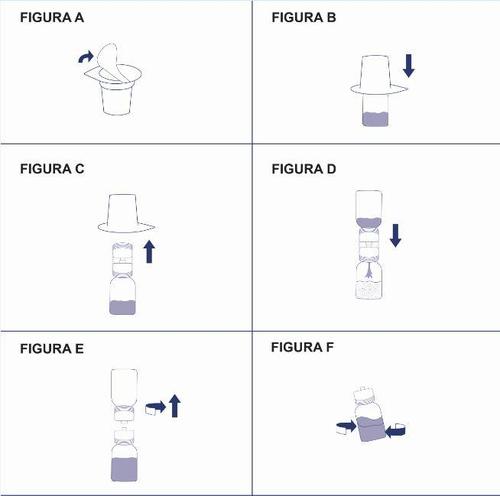
Reconstitution of the powder with the solvent:
- 1. bring the vial of powder and solvent to room temperature;
- 2. this temperature must be maintained throughout the reconstitution process (maximum 10 minutes);
- 3. remove the protective caps from the powder and solvent vials;
- 4. clean the surfaces of the caps of the two vials with alcohol;
- 5. open the device packaging by removing the top part; be careful not to touch the inside (fig. A);
- 6. do not remove the device from the packaging;
- 7. turn the device box over and insert the plastic tip through the solvent vial cap so that the blue part of the device is connected to the solvent vial (fig. B);
- 8. grasp the edge of the device box and pull it off, freeing the device without touching it (fig. C);
- 9. make sure that the vial containing the powder is positioned on a secure support surface; turn the system over so that the solvent vial is above the device; push the transparent/white adapter onto the cap of the vial containing the powder so that the plastic tip passes through the cap of the powder vial; the solvent will be automatically drawn into the powder vial (fig. D);
- 10. after transferring the solvent, unscrew the blue part of the transfer system with the solvent vial attached and remove it (fig. E);
- 11. gently rotate the vial until all the powder has dissolved. Do not shake the vial vigorously to avoid foaming (fig. F). Verify that the powder is completely dissolved otherwise there will be a loss of product activity.
Administration of the solution
After reconstitution, the solution may contain a few small filaments or particles.
The reconstituted medicine must be visually inspected before administration to
identify particles or color changes. The solution should be clear or slightly
opalescent. Do not use turbid solutions or those with deposits.
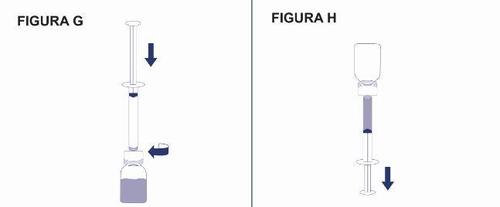
- 1. Fill the syringe with air by pulling back the plunger, attach it to the device and inject the air into the powder vial containing the reconstituted solution (fig. G);
- 2. holding the plunger steady, turn the system over so that the powder vial with the reconstituted solution is above the device and draw the concentrate into the syringe by slowly pulling back the plunger (fig. H);
- 3. disconnect the syringe by rotating it counterclockwise;
- 4. visually inspect the solution in the syringe, which should appear clear or slightly opalescent and free of particles;
- 5. attach the butterfly needle to the syringe and infuse or inject slowly intravenously.
If you use more KLOTT than you should
The consequences of excessive use of the product are unknown.
In case of ingestion/accidental intake of an excessive dose of KLOTT, immediately notify
your doctor or go to the nearest hospital.
If you have any doubts about the use of KLOTT, consult your doctor.
4. Possible side effects
Like all medicines, this medicine can cause side effects, although not everybody gets them.
If any of these side effects occur, contact your doctor immediately or go to the nearest hospital:
- Severe allergic reactions (hypersensitivity): rapid swelling of the skin and mucous membranes around the mouth and face (angioedema). This side effect has been observed rarely and in some cases can lead to severe acute allergic reactions (anaphylaxis) including shock.
- Patients with haemophilia A may develop neutralising antibodies to factor VIII (inhibitors). The presence of these inhibitors manifests as an insufficient clinical response. In such cases, it is advisable to contact a specialised centre for the treatment of haemophilia.
Other side effects:
Other allergic reactions (hypersensitivity) may include:
burning sensation and stinging pain at the infusion site;
chills, redness, rash all over the body (generalised urticaria), wheals;
headache;
low blood pressure (hypotension), restlessness, fast heartbeat (tachycardia), feeling of tightness in the chest, wheezing;
state of drowsiness (lethargy);
nausea, vomiting;
tingling (paresthesia).
These side effects have been observed rarely and in some cases can lead to severe acute allergic reactions (anaphylaxis) including shock.
- Fever has been observed.
For children not previously treated with factor VIII-based medicines, the formation of inhibitor antibodies (see section 2) may be very common (more than 1 in 10 patients); however, in patients who have received previous treatment with factor VIII (more than 150 days of treatment) the risk is uncommon (less than 1 in 100 patients). If this happens, the medicine for you or your child may stop working properly and you or your child may experience persistent bleeding. If this happens, you should contact your doctor immediately.
Additional side effects in children
Although specific data for the paediatric population are not available, the few published data relating to efficacy and safety studies have not shown significant differences between adults and children with the same condition.
Reporting of side effects
If you get any side effects, even those not listed in this leaflet, tell your doctor or pharmacist. You can also report side effects directly through the national reporting system at https://www.aifa.gov.it/content/segnalazioni-reazioni-avverse .
By reporting side effects you can help provide more information on the safety of this medicine.
For information on safety regarding transmissible agents see point 2 “ What you need to know
before using KLOTT”.
5. How to store KLOTT
Keep this medicine out of the sight and reach of children. Do not use KLOTT after the expiry date
stated on the label and the outer packaging after “Exp.”. The expiry date refers to the last day of that month.
Store in a refrigerator (2 C - 8 C). Do not freeze. Keep the vial in the outer packaging,
to protect the medicine from light.
Before use and within the expiry date, the vial containing the powder may be
stored at room temperature, not exceeding 25°C, for a maximum of 6 consecutive months.
After this period the vial containing the powder must be discarded. In any case, this
vial can no longer be placed in the refrigerator if stored at room temperature.
Record the date of the start of storage at room temperature on the outer box.
Once the infusion container has been opened, the contents must be used
immediately. The contents of the vial must be used in a single administration.
Do not dispose of any medicine in wastewater or household waste. Ask your pharmacist how to
dispose of medicines you no longer use. This will help protect the environment.
6. Package Contents and Other Information
What KLOTT contains
The active ingredient is human plasma coagulation factor VIII.
| F KLOTT 500 IU/10 ml | KLOTT 1000 IU/10 ml | |
| human plasma coagulation factor VIII | l 500 IU/vial | 1000 IU/ vial |
| human plasma coagulation factor VIII reconstituted with water for injectable preparations | e 50 IU/ ml (500 IU/10 ml) | 100 IU/ ml (1000 IU/10 ml) |
| solvent volume | d 10 ml | 10 ml |
The activity (IU) is determined using the chromogenic method of the European Pharmacopoeia.
The specific activity of KLOTT is approximately 80 IU/mg of protein.
Produced from human donor plasma.
This preparation contains human von Willebrand factor.
The powder vial contains human plasma coagulation factor VIII (active ingredient),
sodium chloride, trisodium citrate, glycine, calcium chloride (excipients).
The solvent vial contains water for injectable preparations.
Description of the appearance of KLOTT and contents of the pack
Powder and solvent for solution for infusion.
After reconstitution, the solution may contain a few small filaments or particles.
The reconstituted (dissolved) medicine must be visually inspected before administration
to identify suspended particles or abnormal coloration. The solution must be clear or
slightly opalescent. Do not use KLOTT if you notice that the solution is cloudy or has deposits.
The package of KLOTT contains a vial of powder, a vial of solvent with which the solution is prepared
for administration, and a sterile and apyrogenic, single-use set consisting of a
reconstitution device, an injection syringe, and a butterfly needle with a PVC tube.
Marketing Authorisation Holder
Kedrion S.p.A. – Loc. Ai Conti, 55051 Castelvecchio Pascoli, Barga (Lucca).
Manufacturer
Kedrion S.p.A. – 55027 Bolognana, Gallicano (Lucca).
------------------------------------------------------------------------------------------------------------------------
The following information is intended exclusively for doctors or healthcare professionals:
Treatment Monitoring
During the course of treatment, an appropriate determination of factor VIII levels is required
to adjust the dose to be administered and the frequency of repeat infusions. The response to factor
VIII may vary in individual patients, showing different half-lives and recoveries. The dosage calculated in
based on body weight may require adjustment in underweight or overweight patients.
In particular, in the case of major surgery, precise control of
substitute therapy by means of coagulation analysis (plasma factor VIII activity) is essential.
When using an in vitro “one-stage” coagulation test based on activated partial thromboplastin time
(aPTT) to determine factor VIII activity in patient blood samples, the results
of plasma factor VIII activity may be significantly affected by both the type
of aPTT reagent and the reference standard used in the test. In addition, there may be
significant discrepancies between test results obtained with a “one-stage” coagulation test based on
aPTT and the chromogenic test according to Ph. Eur. This is particularly important when
changing the laboratory and/or reagents used in the test.
Dosage
The dosage and duration of replacement therapy depend on the severity of the factor VIII deficiency,
the location and extent of the hemorrhage, and the patient's clinical condition.
The number of factor VIII units administered is expressed in International Units (IU), which are
correlated with the current WHO standard for factor VIII products. The activity of factor VIII in
plasma is expressed either as a percentage (relative to normal human plasma) or in International Units
(relative to an international standard for plasma factor VIII).
The activity of one International Unit of factor VIII is equivalent to the amount of factor VIII
contained in one millilitre of normal human plasma.
On-demand treatment
The calculation of the necessary factor VIII dose is based on the empirical observation that 1 International Unit (IU)
of factor VIII per Kg of body weight increases plasma factor VIII activity by 1.5% to 2% of normal activity. The necessary dose is determined using the
following formula:
Units required = body weight (Kg) x desired increase in factor VIII (%) (IU/dl) x 0.4
The amount to be administered and the frequency of applications must always be guided
by the clinical effectiveness of the individual case.
In the case of the following bleeding events, the factor VIII activity during the corresponding period must not
fall below the given level of plasma activity (in % of normal). The following table can
be used as a reference in bleeding and surgical episodes:
| A Grade of bleeding/ Type of surgical procedure | Necessary factor VIII level (%) (IU/dl) | Frequency of doses (hours)/ Duration of therapy (days) |
| Bleeding |
| Early hemarthrosis, muscle hemorrhage or oral hemorrhage More extensive hemarthrosis, muscle hemorrhage or hematoma Life-threatening hemorrhages |
| Repeat every 12 to 24 hours. At least 1 day, until the bleeding episode is resolved or pain relief is achieved. c Repeat the infusion every 12-24 hours for 3-4 days or more, until the pain and severe disability have subsided. m Repeat the infusion every 8 to 24 hours until the symptom has subsided. |
| Surgery Minor surgery including dental extractions |
| r a Every 24 hours, at least 1 day, until healing. |
| Major surgery |
| F Repeat the infusion every 8 to 24 hours until adequate wound healing is achieved, then therapy for at least another 7 l days to maintain a factor VIII activity of 30% to 60% (30 IU/dl
|
Prophylaxis
For long-term prophylaxis of bleeding in patients with severe hemophilia A, the usual doses are
20 to 40 IU of factor VIII per kg of body weight at intervals of 2 – 3 days. In some cases,
especially for younger patients, shorter therapeutic intervals or higher doses may be necessary.
Paediatric population
The safety and efficacy of KLOTT in children under the age of 12 have not yet been
established. For adolescents (12-18 years) the dosage for each indication is given by weight
body.
Route of administration
For intravenous use, by injection or slow infusion.
An administration time of between 3 and 5
minutes is recommended in the case of intravenous injection, monitoring the patient's pulse and stopping or reducing the rate of injection if the
pulse rate increases.
The infusion rate must be evaluated for each individual patient
Dissolve the powder as described in section “3. How to use KLOTT” in the paragraph “Instructions
for correct use”.
Inhibitors
In general, all patients treated with factor VIII coagulation products should be
carefully monitored for the development of inhibitors by appropriate clinical observation and laboratory
tests. If the expected plasma factor VIII activity levels are not reached, or if
bleeding is not controlled with an appropriate dose, a test for the presence of
factor VIII inhibitors should be performed. In patients with high levels of inhibitor, therapy with factor VIII may not
be effective and other therapeutic options should be considered. The treatment of
such patients should be directed by a physician experienced in the treatment of hemophilia and
factor VIII inhibitors.

Не уверены, подходит ли вам это лекарство?
Обсудите симптомы и варианты лечения с врачом онлайн.

Уже начали прием и появились вопросы?
Обсудите свое состояние и дальнейшие шаги с врачом онлайн.
- Страна регистрации
- Форма выпускаPowder and solvent for intravenous infusion solution, 500 IU/10 ML
- Код АТХB02BD02
- Действующее вещество
- Отпускается по рецептуДа
- Производитель
- Информация на этой странице носит справочный характер и не является медицинской консультацией. Перед началом приема лекарства обязательно проконсультируйтесь с врачом.
- Аналоги KLOTTФорма выпуска: Powder and solvent for injectable solution, 250 IUДействующее вещество: фактор свертывания крови VIIIПроизводитель: TAKEDA MANUFACTURING AUSTRIA AGОтпускается по рецептуФорма выпуска: Powder and solvent for injectable solution, 250 IUДействующее вещество: фактор свертывания крови VIIIПроизводитель: BAXALTA INNOVATIONS GMBHОтпускается по рецептуФорма выпуска: Powder and solvent for injectable solution, 1000 IUДействующее вещество: фактор свертывания крови VIIIПроизводитель: CSL BEHRING GMBHОтпускается по рецепту
Аналоги KLOTT в других странах
Лекарства с тем же действующим веществом, доступные в других странах.
Аналог KLOTT в Испания
Аналог KLOTT в Польша
Аналог KLOTT в Украина
Врачи онлайн по KLOTT
Обсудите применение KLOTT и возможные следующие шаги — по оценке врача.









Получите рецепт на KLOTT онлайн
Заполните форму за 2 минуты
Расскажите о симптомах, истории болезни и нужном препарате.
Выберите врача или мы назначим
Выберите специалиста или мы подберём ближайшего доступного врача.
Врач рассматривает ваш случай
Обычно в течение 30 минут. Может задать уточняющие вопросы в чате.
Получите в любой аптеке
Электронный рецепт отправляется на вашу почту — действителен по всей Польше.
Часто задаваемые вопросы
KLOTT требует рецепта в Италия. Вы можете уточнить у врача онлайн, подходит ли это лекарство для вашей ситуации.
Действующее вещество KLOTT — фактор свертывания крови VIII. Эта информация помогает определить лекарства с тем же составом под другими торговыми названиями.
KLOTT производится компанией KEDRION S.P.A.. Упаковка и торговое название могут отличаться в зависимости от дистрибьютора.
Врачи, включая Семейные врачи, Психиатры, Дерматологи, Кардиологи, Эндокринологи, Гастроэнтерологи, Пульмонологи, Нефрологи, Ревматологи, Гематологи, Инфекционисты, Аллергологи, Гериатры, Педиатры, Онкологи, могут оценить целесообразность применения KLOTT с учетом вашей ситуации и местных правил. Вы можете записаться на онлайн-консультацию, чтобы обсудить возможные варианты.
Польша имеет хорошо развитую систему здравоохранения в крупных городах, таких как Варшава, Краков, Вроцлав и Гданьск. Аптеки широко доступны и работают в соответствии с действующим законодательством, обеспечивая доступ к рецептурным препаратам.
Вы можете купить KLOTT в Варшаве, Кракове, Вроцлаве или Гданьске в любой аптеке при наличии действующего рецепта.
Чтобы получить рецепт, вы можете воспользоваться Oladoctor:
Другие лекарства с тем же действующим веществом (фактор свертывания крови VIII) включают ADVATE, ADYNOVI, AFSTYLA. Они могут отличаться торговым названием или формой выпуска, но содержат одинаковый терапевтический компонент. Перед изменением лечения рекомендуется проконсультироваться с врачом.
