



KALINOX 50%/50% Ингаляционный газ

Рассмотрение рецепта онлайн
Врач рассмотрит ваш случай и примет решение о назначении рецепта, если это медицински оправдано.

Поговорите с врачом об этом лекарстве
Обсудите симптомы и возможные дальнейшие шаги на онлайн-консультации.



Инструкция по применению KALINOX
Содержание инструкции
- KALINOX 50%/50% medicinal gas, compressed
- WHAT IS KALINOX 50%/50% medicinal gas, compressed, AND WHAT IS IT USED FOR
- WHAT YOU NEED TO KNOW BEFORE USING KALINOX 50%/50% medicinal gas, compressed
- HOW TO USE KALINOX 50%/50% medicinal gas, compressed.
- POSSIBLE SIDE EFFECTS
- HOW TO STORE KALINOX 50%/50% medicinal gas, compressed
- CONTENT OF THE PACK AND OTHER INFORMATION
KALINOX 50%/50% medicinal gas, compressed
Nitrous oxide, oxygen
Read this leaflet carefully before using this medicine as it contains important
information for you.
- Keep this leaflet. You may need to read it again.
- If you have any questions, ask your doctor or pharmacist.
- This medicine has been prescribed for you only. Do not pass it on to others, even if they have the same symptoms as you, as it may be harmful.
- If you get any side effects, even those not listed in this leaflet, tell your doctor or pharmacist. See section 4.
Contents of this leaflet:
- 1. What KALINOX 50%/50% medicinal gas, compressed is and what it is used for
- 2. What you need to know before using KALINOX 50%/50% medicinal gas, compressed
- 3. How to use KALINOX 50%/50% medicinal gas, compressed
- 4. Possible side effects
- 5. How to store KALINOX 50%/50% medicinal gas, compressed
- 6. Contents of the pack and other information
1. WHAT IS KALINOX 50%/50% medicinal gas, compressed, AND WHAT IS IT USED FOR
KALINOX is a mixture of two medicinal gases (nitrous oxide 50% and oxygen 50%). It belongs to the
class of general anesthetics.
At this concentration, KALINOX does not have anesthetic effects.
It works by reducing sensitivity to pain and makes you more relaxed during some healthcare procedures:
- Painful procedures of short duration in adults and children > 1 month, and in particular, lumbar puncture ( collection of fluid contained in the spinal column), myelogram ( bone marrow collection), superficial surgery, burn dressing, simple fracture reduction, reduction of some dislocations of the peripheral joints ( procedures for the repositioning of bones or joints) intravenous puncture ( blood sampling), emergency medical care for trauma, burns and transport.
- Dental procedures in children over 1 month of age, adolescents and anxious or disabled patients.
- Childbirth, exclusively in a hospital setting, before an epidural analgesia or if the same is refused or impossible to perform.
2. WHAT YOU NEED TO KNOW BEFORE USING KALINOX 50%/50% medicinal gas, compressed
DO NOT USE KALINOX:
- If you have been administered an ophthalmic gas (SF6, C2F6, C3F8) used in eye surgery, always inform your doctor so they can ensure that administration does not expose you to serious post-operative complications resulting from increased intraocular pressure.
- If your condition requires the administration of 100% oxygen.
- In case of intracranial hypertension (excessive pressure in the head).
- In case of altered state of consciousness (state of consciousness that is not entirely normal).
- If you are in the following situation where air is trapped inside the body:
- Head trauma,
- Maxillofacial traumas,
- Pneumothorax (accumulation of air between the lung and the chest wall),
- Emphysema bullae (disease of the lung alveoli that causes respiratory problems),
- Gaseous embolism (formation of air bubbles in the bloodstream, for example after an immersion accident),
- After a recent underwater immersion,
- Decompression sickness,
- Air due to encephalography,
- During surgery on the ear and paranasal sinuses,
- Presence of air in the abdomen,
- Known and untreated vitamin B12 or folic acid deficiency,
- Epidural anesthesia when air is injected into the epidural space,
- Unexplained recent-onset neurological abnormalities.
Warnings and precautions
- The gas must be administered by trained personnel. However, self-administration should be preferred to assess the level of consciousness. NEVER manipulate the KALINOX cylinder.
- Premises subject to frequent use of KALINOX must have adequate ventilation or a ventilation system that allows maintaining the concentration of nitrous oxide in the air to a minimum.
- Breathe normally during inhalation.
- Before administering KALINOX, no fatty substances (creams, ointments, etc.) should have been applied to the face.
- The success rate is lower in children under 3 years of age.
- In newborns, every adverse effect must be monitored, particularly respiratory depression.
- Prolonged and/or repeated administration can lead to abuse or dependence.
- In case of repeated and prolonged administration, the doctor may need to prescribe vitamin B12 due to the inactivation of vitamin B12 caused by KALINOX
- If you suffer from anemia, atrophic gastritis, intracranial disorders, if you have a vegetarian diet, or if you are an alcoholic, inform your doctor because these situations are at risk of vitamin B12 deficiency.
- Inform your doctor if you have an acute ear inflammation in progress.
Other medicines and KALINOX
- If you have been administered an ophthalmic gas (SF6, C2F6, C3F8) used in eye surgery, always inform your doctor so they can ensure that administration does not expose you to serious post-operative complications that may arise from increased intraocular pressure.
- The association with medicines that act on the central nervous system (such as morphine derivatives, benzodiazepines and other psychotropic medicines) increases the hypnotic effects. Association with this type of medicine requires more accurate monitoring.
The combination with medicines that interfere with vitamin B12 and/or with folate metabolism can increase the inactivation of vitamin B12. In case of association with this type of medicine, monitoring will be enhanced.
Inform your doctor or pharmacist if you are taking or have recently taken any other medicines, including those without a prescription.
Pregnancy and breastfeeding
If you are pregnant, suspect you are pregnant, are planning a pregnancy or are breastfeeding, ask your doctor or pharmacist for advice before taking this medicine
KALINOX can be used during pregnancy if clinically necessary.
Following short-term administration of nitrous oxide, discontinuation of breastfeeding is not necessary.
Driving and operating machinery
If you need to drive or operate machinery after administration of KALINOX (especially after prolonged administration), you must be monitored until any adverse effects that may have manifested disappear and until you return to the state of alertness prior to treatment.
3. HOW TO USE KALINOX 50%/50% medicinal gas, compressed.
Dosage
Only healthcare professionals are authorized to administer KALINOX. They will explain how the
inhalation is performed and will monitor you throughout the duration of treatment. A family member or
friend may also be present.
The administration of KALINOX will be immediately interrupted in case of loss of verbal contact.
Maximum efficacy is achieved after at least 3 minutes of inhalation.
Efficiency is lower in children under 3 years of age.
Method and route of administration
Administration must be carried out in clean and adequately ventilated environments.
KALINOX is a mixture of two medicinal gases that will be breathed, administered through a
maskapplied to the face and with a specific device.
The patient must breathe normallyduring inhalation.
After the procedure, the mask is removed and you should restuntil all effects
have disappeared.
Duration of treatment
The duration of inhalation of the mixture depends on the length of the treatment involved and must not
exceed 60 consecutive minutes per day. In case of repeated administrations, they should not be
prolonged for more than 15 days.
If more KALINOX has been administered than you should:
The skin may become bluish (cyanosis); in this case, the healthcare professional will immediately
interrupt the administration. If cyanosis does not regress very quickly, ventilation
will be performed with a hand-inflated balloon filled with ambient air or oxygen.
If you stop treatment with KALINOX:
As soon as inhalation is stopped, the return to the initial state is almost immediate and without residual effects.
If you have any doubts about the use of KALINOX, ask your doctor or pharmacist.
4. POSSIBLE SIDE EFFECTS
Like all medicines, this medicine can cause side effects, although not everybody gets them.
The following side effects may occur during treatment and most of them generally disappear within a few minutes of stopping the inhalation of the mixture:
Common (≥1/100, <1/10):
- nausea,
- vomiting
Uncommon (≥1/1,000, <1/100):
- Paresthesia (tingling),
- deepening of sedation (drowsiness),
- hallucinations,
- anxiety,
- agitation,
- euphoria,
- dreams.
Frequency not known (cannot be estimated from the available data):
- dizziness,
- headache,
- convulsions,
- increased intracranial pressure (in patients at risk of increased intracranial pressure - see paragraph “Do not use KALINOX”),
- ear pain
- disorientation
- respiratory depression (in young children)
- respiratory depression (in newborns when KALINOX is used near delivery - see the paragraph “Warnings and precautions”),
- cases of severe visual impairment have been reported in patients who have previously received intraocular gas injections for eye surgery (see the paragraph “Do not use KALINOX”).
After prolonged or repeated exposure:
Frequency not known (cannot be estimated from the available data):
- Abnormal movements, especially in a context of hyperventilation (increased breathing rate during inhalation)
- Neurological disorders such as myeloneuropathies (spinal cord disorders). These side effects are due to inactivation of vitamin B12.
- Megaloblastic anemia with leukopenia (reduction in the number of red blood cells accompanied by a reduction in the number of white blood cells). These side effects are due to inactivation of vitamin B12.
- Cases of abuse and dependence,
- Vitamin B12 deficiencies (see paragraphs “Do not use KALINOX”, “Warnings and precautions” and “Other medicines and KALINOX”).
Reporting of side effects
If any of these side effects gets worse, or if you notice any side effect not listed in this leaflet, please tell your doctor or pharmacist.
You can also report side effects directly through the national reporting system at https://www.aifa.gov.it/content/segnalazioni-reazioni-avverse.
By reporting side effects you can help provide more information on the safety of this medicine.
5. HOW TO STORE KALINOX 50%/50% medicinal gas, compressed
Keep this medicine out of the sight and reach of children.
Do not use this medicine after the expiry date which is stated on the label.
The expiry date refers to the last day of the month.
Protect from impacts, falls, sources of heat or ignition, flammable materials and weathering, in
particular from the cold.
Full cylinders must be stored IN A HORIZONTAL POSITION at temperatures between
10 and 30 °C for at least 48 hours before use, with the valves closed.
6. CONTENT OF THE PACK AND OTHER INFORMATION
What KALINOX 50%/50% medicinal gas, compressed contains
The active ingredient is:
Nitrous oxide ............................................................................. 50% (mole/mole)
Oxygen ........................................................................................ 50% (mole/mole)
The other ingredients are:
Not applicable
Description of the appearance of KALINOX 50%/50% medicinal gas, compressed and content of the
pack.
The cylinders have capacities of 2 l, 5 l, 11 l, 15 l and 20 l.
A 2-liter cylinder filled to 170 bar contains the equivalent of 0.59 m of gas at a pressure of 1
bar at 15°C, which corresponds to 943 g.
A 5-liter cylinder filled to 170 bar contains the equivalent of 1.47 m of gas at a pressure of 1
bar at 15°C, which corresponds to 2358 g.
An 11-liter cylinder filled to 170 bar contains the equivalent of 3.23 m of gas at a pressure of 1
bar at 15°C, which corresponds to 5187 g.
A 15-liter cylinder filled to 170 bar contains the equivalent of 4.4 m of gas at a pressure of 1
bar at 15°C, which corresponds to 7073 g.
A 20-liter cylinder filled to 170 bar contains the equivalent of 5.9 m of gas at a pressure of 1
bar at 15°C, which corresponds to 9431 g.
The cylinders are made of steel or aluminum and are equipped with a brass valve with residual pressure
and a standard outlet fitting or a brass valve with a pressure regulator and standard fitting.
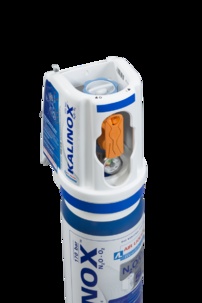
Standard color: white body and white ogive with a blue stripe.
Marketing Authorization Holder and Manufacturer
Marketing Authorization Holder
AIR LIQUIDE SANTE INTERNATIONAL
75, QUAI D’ORSAY
75007 PARIS - FRANCE
Manufacturer
AIR LIQUIDE SANTE FRANCE
6 RUE COGNACQ -JAY
75341 PARIS CEDEX 07 - FRANCE
and/or
AIR LIQUIDE MEDICAL
TOLHUISTRAAT 46-48
26-27 SCHELLE – BELGIUM
This medicinal product is authorized in the Member States of the European Economic Area with the following
names:
AUSTRIA: KALINOX
FRANCE: KALINOX
ITALY: KALINOX
POLAND: KALINOX
PORTUGAL: KALINOX
The following information is reserved for healthcare professionals:
Equimolar nitrous oxide-oxygen gas mixtures are reserved exclusively for medical use.
The SpO2 must never be less than 21%.
Rooms used frequently with KALINOX must be equipped with an adequate exhaust gas evacuation or ventilation system.
WHAT YOU NEED TO KNOW BEFORE USING KALINOX
- Personnel using the cylinders must be trained in gas handling.
- Do not use cylinders that may have been exposed to negative temperatures.
- If frost forms on the cylinder, do not use it and return it to the pharmacy.
- Do not handle a cylinder whose valve is not protected.
- Never use a cylinder that is leaking.
- Never lift a cylinder by the valve.
- Never attempt to repair a damaged cylinder.
- Secure the cylinders with appropriate means (chains, hooks) to keep them IN A VERTICAL POSITIONand prevent accidental falls.
- Never force a cylinder to fit into a holder.
PRECAUTIONS FOR THE HANDLER AND FOR THE PATIENT
- Never position yourself in front of the valve outlet but always on the opposite side of the pressure regulator, behind and at a slight distance from the cylinder. Never expose the patient to the direct flow of gas.
- Handle the connecting devices with clean, grease-free hands (without gloves and without using pliers).
- Do not use sprays (hair spray, deodorant), solvents (alcohol, gasoline) on the equipment or in its vicinity.
- Do not cover the patient's face with greasy substances (petroleum jelly, ointments, etc.).
WARNING
- Do not apply grease.
- Do not smoke.
- Do not place near a flame.
And in particular:
a) Never introduce gas into an apparatus that may have contained combustible materials and, in
particular, fatty substances,
b) Never clean with combustible products and, in particular, fatty substances, the equipment that
contains this gas, taps, joints, seals, closing devices and valves.
- In case of leakage, close the valve that has the leak, ventilate the area well and evacuate it.
- In case of fire, the risk of toxicity is greater as nitrous vapors are formed.
INSTRUCTIONS FOR USE AND HANDLING OF CYLINDERS
Follow the following rules to avoid accidents:
Connection:
- For cylinders equipped with a valve:
- Briefly open the cylinder valves before connecting the pressure regulator to allow dust or foreign bodies to escape. Always keep the interface between the cylinder and the pressure regulator clean.
- Ensure that the pressure regulation device is compliant and compatible with this gas mixture and that the seal of the pressure regulator-flowmeter is in good condition.
- Use a pressure regulator-flowmeter specifically for the equimolar medicinal mixture of nitrous oxide-oxygen filled to 170 bar (pressure regulator-flowmeter with double snap-on equipped with a specific L-shaped fitting conforming to the NF E 29-650 standard).
- Use a pressure regulator with flowmeter capable of admitting pressures at least equal to 1.5 times the maximum operating pressure of the cylinder.
- For cylinders equipped with an integrated pressure regulator:
- For safety reasons, these cylinders can only be used with a crimped tube to a specific fitting with a blue and white insert and connected to an on-demand valve, or with a flowmeter equipped with a specific fitting with a blue and white insert.
- A specific fitting for the medicinal mixture of nitrous oxide-oxygen conforming to the NF S 90-116 standard must be used.
- Never tighten the pressure regulator-flowmeter with pliers as this could damage the seal.
- Do not use an intermediate fitting to connect two devices that do not match.
- If frost forms on the pressure regulator, check that the gas is flowing (balloon inflated) as the pressure regulator may be blocked, ventilate the area of use (room, vehicle, etc.) after prolonged use and ensure that there is a possibility of evacuating the gas in case of accident or accidental leakage.
Opening the cylinder after connection
- Follow the instructions on the cylinder label.
- Never force the valve to open it or open it completely.
- Always open the valve slowly and gradually to avoid cooling which can cause demixing.
- Never proceed with multiple repressurizations of the pressure regulator.
- Never transfer gas under pressure from one cylinder to another.
After use
- Close the cylinder valve after use, lower the residual pressure in the pressure regulator by leaving the flowmeter open, then close the flowmeter and unscrew the regulator adjustment screw.
- Keep empty cylinders in a VERTICAL position with the valves closed (to prevent corrosion caused by humidity).

Не уверены, подходит ли вам это лекарство?
Обсудите симптомы и варианты лечения с врачом онлайн.

Уже начали прием и появились вопросы?
Обсудите свое состояние и дальнейшие шаги с врачом онлайн.
- Страна регистрации
- Форма выпускаInhalation gas, 50%/50%
- Код АТХN01AX63
- Действующее вещество
- Отпускается по рецептуДа
- Производитель
- Информация на этой странице носит справочный характер и не является медицинской консультацией. Перед началом приема лекарства обязательно проконсультируйтесь с врачом.
- Аналоги KALINOXФорма выпуска: Inhalation gas, 50%/50%Действующее вещество: nitrous oxide, combinationsПроизводитель: SOL S.P.A.Отпускается по рецептуФорма выпуска: Inhalation gas, 50%/50%Действующее вещество: nitrous oxide, combinationsПроизводитель: LINDE SVERIGE ABОтпускается по рецептуФорма выпуска: Inhalation gas, 3.75 KGДействующее вещество: Закись азотаПроизводитель: FARMA GAS - MEDICAL AND TECHNICAL GASES SRLОтпускается по рецепту
Аналоги KALINOX в других странах
Лекарства с тем же действующим веществом, доступные в других странах.
Аналог KALINOX в Польша
Аналог KALINOX в Испания
Врачи онлайн по KALINOX
Обсудите применение KALINOX и возможные следующие шаги — по оценке врача.









Получите рецепт на KALINOX онлайн
Заполните форму за 2 минуты
Расскажите о симптомах, истории болезни и нужном препарате.
Выберите врача или мы назначим
Выберите специалиста или мы подберём ближайшего доступного врача.
Врач рассматривает ваш случай
Обычно в течение 30 минут. Может задать уточняющие вопросы в чате.
Получите в любой аптеке
Электронный рецепт отправляется на вашу почту — действителен по всей Польше.
Часто задаваемые вопросы
KALINOX требует рецепта в Италия. Вы можете уточнить у врача онлайн, подходит ли это лекарство для вашей ситуации.
Действующее вещество KALINOX — nitrous oxide, combinations. Эта информация помогает определить лекарства с тем же составом под другими торговыми названиями.
KALINOX производится компанией AIR LIQUIDE SANTE (INTERNATIONAL). Упаковка и торговое название могут отличаться в зависимости от дистрибьютора.
Врачи, включая Семейные врачи, Психиатры, Дерматологи, Кардиологи, Эндокринологи, Гастроэнтерологи, Пульмонологи, Нефрологи, Ревматологи, Гематологи, Инфекционисты, Аллергологи, Гериатры, Педиатры, Онкологи, могут оценить целесообразность применения KALINOX с учетом вашей ситуации и местных правил. Вы можете записаться на онлайн-консультацию, чтобы обсудить возможные варианты.
Польша имеет хорошо развитую систему здравоохранения в крупных городах, таких как Варшава, Краков, Вроцлав и Гданьск. Аптеки широко доступны и работают в соответствии с действующим законодательством, обеспечивая доступ к рецептурным препаратам.
Вы можете купить KALINOX в Варшаве, Кракове, Вроцлаве или Гданьске в любой аптеке при наличии действующего рецепта.
Чтобы получить рецепт, вы можете воспользоваться Oladoctor:
Другие лекарства с тем же действующим веществом (nitrous oxide, combinations) включают DONOPA, LIVOPAN, ALFAPROT. Они могут отличаться торговым названием или формой выпуска, но содержат одинаковый терапевтический компонент. Перед изменением лечения рекомендуется проконсультироваться с врачом.
