



DOTIMIR 20 мг/мл + 5 мг/мл Глазные капли, раствор

Рассмотрение рецепта онлайн
Врач рассмотрит ваш случай и примет решение о назначении рецепта, если это медицински оправдано.

Поговорите с врачом об этом лекарстве
Обсудите симптомы и возможные дальнейшие шаги на онлайн-консультации.



Инструкция по применению DOTIMIR
Содержание инструкции
Dotimir 20 mg/mL+ 5 mg/mL eye drops, solution
Read this leaflet carefully before you start to use this medicine as it contains important
information for you.
- Keep this leaflet. You may need to read it again.
- If you have any questions, ask your doctor or pharmacist.
- This medicine has been prescribed for you only. Do not pass it on to others, even if their symptoms are the same as yours, as it could be harmful.
- If you get any side effects, even those not listed in this leaflet, tell your doctor or pharmacist. See section 4.
Contents of this leaflet:
- 1. What Dotimir is and what it is used for
- 2. What you need to know before you use Dotimir
- 3. How to use Dotimir
- 4. Possible side effects
- 5. How to store Dotimir
- 6. Contents of the pack and other information
1. What is Dotimir and what is it used for
Dotimir contains two medicinal products: dorzolamide and timolol.
- Dorzolamide belongs to a group of medicinal products called “carbonic anhydrase inhibitors”.
- Timolol belongs to a group of medicinal products called “beta-blockers”. These medicinal products lower the pressure in the eye in different ways.
Dotimir is prescribed to lower the pressure in the eye in the treatment of glaucoma when therapy with beta-blocking eye drops alone is not sufficient.
Dotimir eye drops is a sterile solution that does not contain preservatives.
2. What you need to know before using Dotimir
Do not use Dotimir
- if you are allergic (hypersensitive) to dorzolamide hydrochloride, timolol maleate or any of the other ingredients of this medicine (listed in section 6).
- if you currently have or have had in the past respiratory problems, such as asthma or severe chronic obstructive bronchitis (severe lung disease that can cause wheezing, difficulty breathing and/or persistent cough).
- if you have a slow heartbeat, heart failure or heart rhythm disorders (irregular heartbeat).
- if you have severe kidney disease or kidney problems, or a previous history of kidney stones.
- if you have excessive blood acidity caused by an accumulation of chloride in the blood (hyperchloremic acidosis).
If you are not sure whether you should use this medicine, contact your doctor or pharmacist.
Warnings and precautions
Talk to your doctor before using Dotimir. Talk to your doctor if you currently have or have had in the
past:
- coronary heart disease (symptoms may include chest pain or tightness, shortness of breath or suffocation), heart failure, low blood pressure.
- heart rate disorders such as slow heartbeat.
- respiratory problems, asthma or chronic obstructive lung disease.
- poor blood circulation (such as Raynaud's disease or syndrome).
- diabetes, because timolol may mask signs and symptoms of low blood sugar levels.
- hyperactivity of the thyroid gland, because timolol can mask its signs and symptoms.
- any allergies or anaphylactic reactions.
- muscle weakness or if you have been diagnosed with myasthenia gravis.
- if you wear soft contact lenses, Dotimir has not been studied in patients who wear contact lenses.
If you have a history of contact hypersensitivity to silver, you should not use this medicine because the
drops dispensed may contain traces of silver from the container closure.
Before undergoing surgery, tell your doctor that you are using Dotimir, because the
timolol may alter the effects of some medicines used during anesthesia.
When Dotimir is administered into the eye, it can affect the whole body.
Talk to your doctor if during treatment with Dotimir:
- you develop any eye irritation or any new eye problem such as redness of the eye or swelling of the eyelids.
- you suspect that Dotimir is causing an allergic reaction or hypersensitivity (for example, skin rash, severe skin reaction, or redness and itching of the eye). Stop using this medicine and contact your doctor immediately.
- you develop an eye infection, suffer an eye injury, undergo eye surgery, or develop a reaction that includes new or worsening symptoms.
Use in children
There is limited experience with dorzolamide-timolol (formulation with preservatives) in newborns and
children.
Use in the elderly
In studies with dorzolamide-timolol (formulation with preservatives), the effects were similar in
elderly patients and younger patients.
Use in patients with hepatic impairment
Tell your doctor about any liver problems you have or have suffered in the past.
Other medicines and Dotimir
Dotimir can interact with other medicines you are taking, including other
eye drops for the treatment of glaucoma.
Tell your doctor if you are taking or intend to take medicines to lower blood pressure,
medicines for the heart or medicines for the treatment of diabetes.
Tell your doctor or pharmacist if you are taking, have recently taken or might take any other
medicine.
This is particularly important especially if:
- you are taking medicines to lower blood pressure or for the treatment of heart disease (such as calcium antagonists, beta-blockers or digoxin).
- you are taking medicines for the treatment of heart rhythm disorders or irregularities such as calcium antagonists, beta-blockers or digoxin.
- you are using another eye drop that contains a beta-blocker.
- you are taking another carbonic anhydrase inhibitor, such as acetazolamide.
- you are taking monoamine oxidase inhibitors (MAOIs).
- you are taking a parasympathomimetic medicine that may have been prescribed to help you urinate. Parasympathomimetics are also a particular type of medicine that are sometimes used to help restore normal bowel movements.
- you are taking narcotics such as morphine used to treat moderate to severe pain.
- you are taking medicines for the treatment of diabetes.
- you are taking antidepressants known as fluoxetine and paroxetine.
- you are taking a sulfonamide medicine.
- you are taking quinidine (used to treat heart conditions and some types of malaria).
Pregnancy and breastfeeding
If you are pregnant, suspect you are pregnant or are planning a pregnancy, or if you are breastfeeding with breast
milk, ask your doctor for advice before taking this medicine.
Use during pregnancy
Do not use Dotimir during pregnancy, unless your doctor considers it necessary.
Use during breastfeeding
Do not use Dotimir if you are breastfeeding. Timolol can pass into breast milk. Consult your doctor before
taking any medicine during breastfeeding.
Driving and using machines
Studies have not been conducted on the effects of this medicine on the ability to drive or operate
machinery. However, there are side effects associated with Dotimir, such as blurred vision, which
may alter your ability to drive and/or operate machinery. Do not drive or operate
machinery until you feel well or your vision is clear.
For those who engage in sports: the use of the drug without therapeutic necessity constitutes doping and may
still result in a positive doping test.
3. How to use Dotimir
Use this medicine following the doctor's instructions exactly. If you have any doubts, consult your
doctor. The appropriate dose and duration of treatment will be established by the doctor.
The recommended doseis one drop in the eye or eyes to be treated in the morning and evening.
If you are using Dotimir with another eye drop, the drops must be used at intervals of at least 10
minutes.
Do not change the dose of the medicine without first consulting your doctor.
If you have difficulty administering the eye drops, ask a family member or caregiver for help.
Instructions for use
Avoid letting the tip of the multi-dose container touch the eye or the areas around the eye. This could
cause eye injury. The eye drops may also be contaminated with bacteria that can cause
eye infections leading to serious eye damage, up to loss of vision. To avoid possible
contamination of the multi-dose container, wash your hands before using this medicine and keep the
tip of the multi-dose container away from contact with any surface.
- 1. Before the first application, write the date of opening in the appropriate space on the bottle label. Remove the protective cap before each application. Do not touch anything with the tip of the bottle.
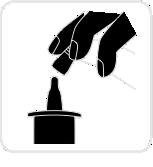
- 2. At the first application of the Dotimir bottle, press several times (up to 10 times) to activate the pumping mechanism until the first drop appears. Subsequently, also eliminate the first two drops. When doing so, hold the bottle upside down as shown in the figure. This only applies to the first application and is not necessary for all other applications. Please avoid any contact between the dropper tip, fingers and the eye.

- 3. Hold the bottle as shown in the image. Make sure your thumb rests on the large, circular, non-slip finger rest.

- 4. Tilt your head back slightly (neck position) and use your free hand to gently lower the lower eyelid. Apply one drop of Dotimir into the conjunctival sac of the affected eye by activating the pump mechanism once. Make sure the bottle is held vertically.
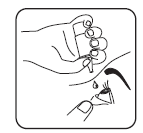
- 5. Close your eye and press on the inner corner of the eye with your finger for about two minutes. This helps prevent the medicine from entering the rest of your body.
- 6. Repeat as indicated in point 3 and 4 to administer one drop into the other eye, if your doctor has instructed you to do so. Sometimes it is necessary to treat only one eye and your doctor will inform you if this is your case and which eye needs treatment.
After use of the multi-dose container, replace the protective cap. Remove any excess liquid from the skin
around the eyes.
Once opened, the bottle can be used for 2 months. After this time, the bottle must be
discarded even if some solution remains.
If you use more Dotimir than you should
If you put too many drops in your eye or ingest the contents of the container, among other effects, you may feel
dizzy, have difficulty breathing, or feel a slowed heart rate. Seek immediate medical
attention.
If you forget to use Dotimir
It is important to use Dotimir as prescribed by your doctor.
If you miss a dose, proceed with the application as soon as possible. However, if it is almost time for the next
dose, skip the missed dose and return to your regular dosing schedule.
Do not use a double dose to make up for the missed dose.
If you stop using Dotimir
If you want to stop using this medicine, talk to your doctor first.
If you have any doubts about the use of this product, consult your doctor or pharmacist.
4. Possible side effects
Like all medicines, this medicine can cause side effects, although not everybody gets them.
Serious side effects:
If you experience any of the following side effects, stop using this medicine and consult a
doctor immediately as these could be signs of a reaction to the medicine.
Rare (may affect up to 1 in 1,000 people):
- chest pain, edema (fluid retention), changes in heart rate or rhythm, congestive heart failure (heart disease with shortness of breath and swelling of the feet and legs due to fluid retention), cardiac arrest, heart block, low blood pressure, cerebral ischemia (reduced blood supply to the brain), stroke.
- shortness of breath, respiratory failure, constriction of the airways in the lungs.
- signs and symptoms of systemic allergic reactions, including angioedema, urticaria, itching, skin rash, anaphylaxis.
- severe skin reactions, including swelling under the skin.
Other side effects:
You can usually continue to use the drops unless the effects are serious. If you are concerned, contact
your doctor or pharmacist. Do not stop using Dotimir without talking to your doctor.
The following side effects have been reported with dorzolamide/timolol or one of its components
during clinical trials or during post-marketing experience:
Very common (may affect more than 1 in 10 people):
- Burning sensation in the eye and stinging, altered taste.
Common (may affect up to 1 in 10 people):
- Effects on the eye: redness inside and around the eyes, tearing or itching of the eyes, corneal erosion (damage to the front layer of the eyeball), swelling and/or irritation inside and around the eyes, foreign body sensation in the eye, decreased corneal sensitivity (inability to realize you have something in your eyes and feel pain), eye pain, dry eyes, blurred vision.
- General side effects: headache, sinusitis (feeling of tension or fullness in the nose), nausea, weakness/fatigue and tiredness.
Uncommon (may affect up to 1 in 100 people):
- Effects on the eye: inflammation of the iris, visual disturbances including changes in refraction (due in some cases to discontinuation of miotic therapy).
- General side effects: dizziness, depression, slowed heartbeat, fainting, difficulty breathing (dyspnea), indigestion and kidney stones.
Rare (may affect up to 1 in 1,000 people):
- Effects on the eye: temporary myopia that may resolve with discontinuation of treatment, detachment of the layer beneath the retina containing blood vessels following filtering surgery which may cause visual disturbances, drooping of the eyelid (causing the eye to remain half-closed), double vision, crusting of the eyelids, corneal swelling (with symptoms of visual disturbances), low eye pressure.
- General side effects: strong heartbeat that may be fast or irregular, Raynaud's phenomenon, swelling or feeling of coldness in the hands and feet and reduced blood circulation in the arms and legs, leg cramps and/or leg pain when walking (claudication), cough, sore throat, dry mouth, insomnia, nightmares, memory loss, tingling or numbness in the hands or feet, increased signs and symptoms of myasthenia gravis (muscle disorder), decreased sexual desire, systemic lupus erythematosus (an autoimmune disease that can cause inflammation of internal organs), ringing in the ears, rhinitis, nosebleeds, diarrhea, contact dermatitis, hair loss, silvery-white skin rash (psoriasiform rash), Peyronie's disease (which can cause a curvature of the penis), allergic-type reactions such as rash, urticaria, itching, in rare cases possible swelling of the lips, eyes and mouth, wheezing or severe skin reactions (Stevens Johnson syndrome, toxic epidermal necrolysis).
As with other medicines applied to the eyes, timolol is absorbed into the blood. This can cause
side effects similar to those observed with oral beta-blockers. The incidence of side effects
after local ophthalmic administration is lower than when the medicines are taken, for
example, orally or by injection. Further side effects listed include reactions observed in the
betablocker class when used to treat eye conditions:
Not known (frequency cannot be estimated from available data):
Low blood glucose levels, abdominal pain, vomiting, muscle pain not caused
by exercise, sexual dysfunction, hallucinations, foreign body sensation in the eye
(feeling that something is in the eye), increased heart rate and increased blood
pressure.
Reporting of side effects
If you get any side effects, even those not listed in this leaflet, tell your
doctor or pharmacist. You can also report side effects directly through the national reporting system at: www.aifa.gov.it/content/segnalazioni-reazioni-avverse.
By reporting side effects you can help provide more information on the safety of
this medicine.
5. How to store Dotimir
Keep this medicine out of the sight and reach of children.
Do not use this medicine after the expiry date which is stated on the package and the vial after
“Exp.”. The expiry date refers to the last day of that month.
This medicine does not require any particular storage conditions.
After the first opening of the vial, the solution can be used for 2 months.
Do not dispose of any medicine in waste water or household waste. Ask your pharmacist how to
dispose of medicines you no longer use. This will help protect the environment.
6. Contents of the pack and other information
What Dotimir contains
- The active ingredients are dorzolamide and timolol.
- Each mL contains 20 mg of dorzolamide (equivalent to 22.26 mg of dorzolamide hydrochloride) and 5 mg of timolol (equivalent to 6.83 mg of timolol maleate). One drop (approximately 0.028 mL) contains approximately 0.56 mg of dorzolamide and 0.14 mg of timolol.
- The other ingredients are hydroxyethylcellulose, mannitol, sodium citrate, sodium hydroxide and water for injections.
Description of the appearance of Dotimir and contents of the pack
Dotimir is a clear, from colorless to almost colorless, slightly viscous solution supplied in a
white multi-dose container (HDPE) with droppers (PP, HDPE, LDPE) and cap (HDPE), as well as an
ergonomic application aid (PP).
Pack sizes:
1 x 5 mL bottle
1 x 9 mL bottle
2 x 9 mL bottle
Not all pack sizes may be marketed.
Marketing Authorisation Holder and Manufacturer
Marketing Authorisation Holder
OmniVision Italia S.r.l.
Via Montefeltro, 6
20156 Milan
Manufacturer
Tubilux Pharma S.p.A.
Via Costarica 20/22, 00071 Pomezia (Rome)
This medicinal product is authorised in the Member States of the European Economic Area under the
following denominations:
Austria DorzoComp-Vision sine 20 mg/mL + 5 mg/mL Augentropfen, Lösung
France Dotimir 20 mg/5 mg per mL, eye drops, solution
Germany DorzoComp-Vision sine 20 mg/mL+ 5 mg/mL Augentropfen, Lösung
Italy Dotimir 20 mg/mL + 5 mg/mL eye drops, solution
Spain Dotimir 20 mg/mL + 5 mg/mL colirio en solución

Не уверены, подходит ли вам это лекарство?
Обсудите симптомы и варианты лечения с врачом онлайн.

Уже начали прием и появились вопросы?
Обсудите свое состояние и дальнейшие шаги с врачом онлайн.
- Страна регистрации
- Форма выпускаEye drops, solution, 20 MG/ML + 5 MG/ML
- Код АТХS01ED51
- Действующее вещество
- Отпускается по рецептуДа
- Производитель
- Информация на этой странице носит справочный характер и не является медицинской консультацией. Перед началом приема лекарства обязательно проконсультируйтесь с врачом.
- Аналоги DOTIMIRФорма выпуска: Eye drops, solution, 40 MCG/ML + 5 MG/MLДействующее вещество: timolol, combinationsПроизводитель: GENETIC S.P.A.Отпускается по рецептуФорма выпуска: Eye drops, suspension, 10 MG/ML + 5 MG/MLДействующее вещество: timolol, combinationsПроизводитель: NOVARTIS EUROPHARM LIMITEDОтпускается без рецептаФорма выпуска: Eye drops, solution, 20 MG/ML + 5 MG/MLДействующее вещество: timolol, combinationsПроизводитель: OMNIVISION ITALIA SRLОтпускается по рецепту
Аналоги DOTIMIR в других странах
Лекарства с тем же действующим веществом, доступные в других странах.
Аналог DOTIMIR в Испания
Аналог DOTIMIR в Польша
Аналог DOTIMIR в Украина
Врачи онлайн по DOTIMIR
Обсудите применение DOTIMIR и возможные следующие шаги — по оценке врача.









Получите рецепт на DOTIMIR онлайн
Заполните форму за 2 минуты
Расскажите о симптомах, истории болезни и нужном препарате.
Выберите врача или мы назначим
Выберите специалиста или мы подберём ближайшего доступного врача.
Врач рассматривает ваш случай
Обычно в течение 30 минут. Может задать уточняющие вопросы в чате.
Получите в любой аптеке
Электронный рецепт отправляется на вашу почту — действителен по всей Польше.
Часто задаваемые вопросы
DOTIMIR требует рецепта в Италия. Вы можете уточнить у врача онлайн, подходит ли это лекарство для вашей ситуации.
Действующее вещество DOTIMIR — timolol, combinations. Эта информация помогает определить лекарства с тем же составом под другими торговыми названиями.
DOTIMIR производится компанией OMNIVISION ITALIA SRL. Упаковка и торговое название могут отличаться в зависимости от дистрибьютора.
Врачи, включая Семейные врачи, Психиатры, Дерматологи, Кардиологи, Эндокринологи, Гастроэнтерологи, Пульмонологи, Нефрологи, Ревматологи, Гематологи, Инфекционисты, Аллергологи, Гериатры, Педиатры, Онкологи, могут оценить целесообразность применения DOTIMIR с учетом вашей ситуации и местных правил. Вы можете записаться на онлайн-консультацию, чтобы обсудить возможные варианты.
Польша имеет хорошо развитую систему здравоохранения в крупных городах, таких как Варшава, Краков, Вроцлав и Гданьск. Аптеки широко доступны и работают в соответствии с действующим законодательством, обеспечивая доступ к рецептурным препаратам.
Вы можете купить DOTIMIR в Варшаве, Кракове, Вроцлаве или Гданьске в любой аптеке при наличии действующего рецепта.
Чтобы получить рецепт, вы можете воспользоваться Oladoctor:
Другие лекарства с тем же действующим веществом (timolol, combinations) включают ALDUOVITS, ATSARGA, BETAKLAR. Они могут отличаться торговым названием или формой выпуска, но содержат одинаковый терапевтический компонент. Перед изменением лечения рекомендуется проконсультироваться с врачом.
