



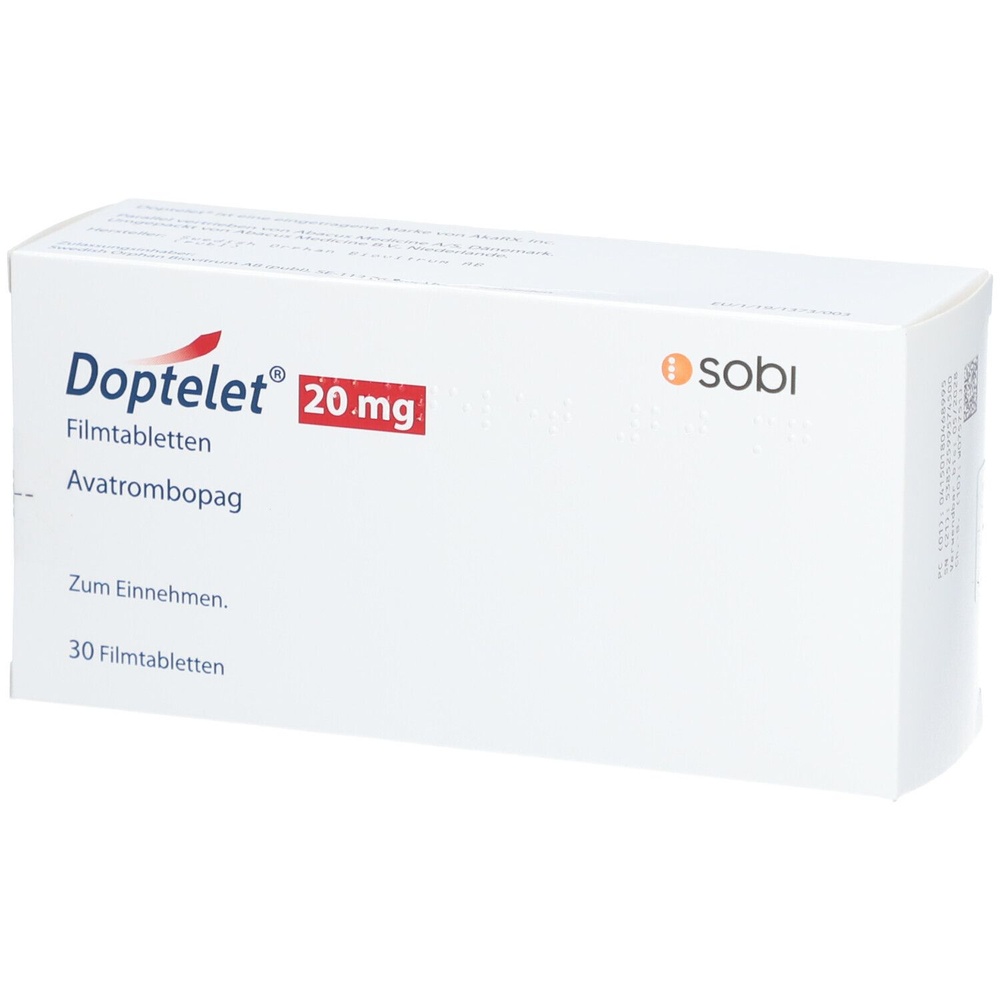
DOPTELET 20 мг Фильм-coated таблетки

Рассмотрение рецепта онлайн
Врач рассмотрит ваш случай и примет решение о назначении рецепта, если это медицински оправдано.

Поговорите с врачом об этом лекарстве
Обсудите симптомы и возможные дальнейшие шаги на онлайн-консультации.



Инструкция по применению DOPTELET
Содержание инструкции
Doptelet 20 mg film-coated tablets
avatrombopag
Read this leaflet carefully before you start taking this medicine as it contains important information for you.
- Keep this leaflet. You may need to read it again.
- If you have any questions, ask your doctor or pharmacist.
- This medicine has been prescribed for you only. Do not pass it on to others, even if they have the same symptoms as you, as it may be harmful.
- If you get any side effects, even those not listed in this leaflet, tell your doctor or pharmacist. See section 4.
Contents of this leaflet
- 1. What Doptelet is and what it is used for
- 2. What you need to know before you take Doptelet
- 3. How to take Doptelet
- 4. Possible side effects
- 5. How to store Doptelet
- 6. Contents of the pack and other information
1. What Doptelet is and what it is used for
Doptelet contains an active substance called avatrombopag, which belongs to a group of medicines called thrombopoietin receptor agonists.
Doptelet is used in adults with chronic liver disease, for the treatment of low platelet count (thrombocytopenia), before undergoing a medical procedure that carries a risk of bleeding.
Doptelet is used to treat adults with low platelet counts due to chronic primary immune thrombocytopenia (ITP) when a previous treatment for ITP (such as corticosteroids or immunoglobulins) has not worked well enough.
Doptelet works by helping to increase the number of platelets in the blood. Platelets are cells present in the blood that play a role in blood clotting, reducing or preventing bleeding.
2. What you need to know before taking Doptelet
Do not take Doptelet
- if you are allergic to avatrombopag or any of the other ingredients of this medicine (listed in section 6). If you are unsure, ask your doctor or pharmacist before taking Doptelet.
Warnings and precautions
Talk to your doctor or pharmacist before taking Doptelet:
- if you are at risk of developing blood clots in your veins or arteries (thrombosis), or if members of your family have had a thrombosis
- if you have another blood disease known as myelodysplastic syndrome (MDS); taking Doptelet may worsen MDS.
You may have an increased risk of thrombosiswith increasing age or:
- if you have been confined to bed for a long period of time
- if you have cancer
- if you are taking the birth control pill or hormone replacement therapy
- if you have recently had surgery or suffered a trauma
- if you are severely overweight
- if you smoke
- if you suffer from a chronic liver disease in an advanced stage.
If you fall into any of the above situations (or are unsure), talk to your doctor or pharmacist before using Doptelet.
Blood tests for platelet count
If you stop taking Doptelet, your platelet count is likely to decrease as it was before treatment or even more, with a risk of bleeding. This can happen within a few days.
Your platelet count will be monitored and your doctor will discuss appropriate precautions with you.
Tests to check your bone marrow
In people who have problems with their bone marrow, medicines like Doptelet can worsen the problem.
Signs of changes in the bone marrow may appear as abnormal results in your blood tests. Your doctor may also perform a test to directly check your bone marrow during treatment with Doptelet.
Children and adolescents
Doptelet should not be given to people under 18 years of age. In this age group, the safety and effectiveness of this medicine have not been established.
Other medicines and Doptelet
Tell your doctor or pharmacist if you are taking, have recently taken or might take any other medicines.
If you are taking other medicines for ITP, you may be able to take a lower dose or stop taking them while you are taking Doptelet.
Pregnancy and breastfeeding
If you are pregnant, suspect you may be pregnant, or are planning to become pregnant, ask your doctor or pharmacist for advice before taking this medicine. The use of Doptelet is not recommended during pregnancy and in women of childbearing potential who are not using reliable contraception.
If you are breastfeeding, ask your doctor or pharmacist for advice before taking Doptelet. This medicine may pass into breast milk. Your doctor will help you decide whether the benefit of breastfeeding outweighs any possible risk to your baby while you are breastfeeding.
Driving and using machines
Doptelet should not affect your ability to drive vehicles, ride a bicycle, or use tools or machines.
Doptelet contains lactose
Doptelet contains lactose (a type of sugar). If you have been told by your doctor that you have an intolerance to some sugars, contact your doctor before taking this medicine.
3. How to take Doptelet
Take this medicine following exactly the instructions of your doctor or pharmacist. If you
have any doubts, consult your doctor or pharmacist.
If you have chronic liver disease and a low platelet count, the medical procedure to which you must be
subjected must be scheduled 5 to 8 days after having taken the last dose of Doptelet.
If you suffer from chronic ITP, your doctor will tell you how much Doptelet to take and how often.
How much medicine to take
If you have chronic liver disease and a scheduled invasive procedure
- Doptelet is available in 20 mg tablets. The recommended dose is usually 40 mg (2 tablets) or 60 mg (3 tablets) per day, for 5 days in a row.
- The dose will depend on your platelet count.
- Your doctor or pharmacist will tell you how many tablets to take and when.
If you suffer from chronic ITP
- The usual recommended starting dose is 20 mg (1 tablet) per day. If you are taking certain other medicines, you may need a different starting dose.
- Your doctor or pharmacist will tell you how many tablets to take and when to take them.
- Your doctor will regularly monitor your platelet count and adjust the dose as needed.
How to take this medicine
- The tablets must be swallowed whole and taken with a meal at the same time each day of Doptelet administration.
If you have chronic liver disease and a low platelet count
- Start taking Doptelet 10 to 13 days before the date set for the medical procedure.
- Your doctor or pharmacist will tell you how many tablets to take and when to take them.
If you suffer from chronic ITP
- Your doctor or pharmacist will tell you how many tablets to take and when to take them.
If you take more Doptelet than you should
- Contact your doctor or pharmacist immediately.
If you forget to take Doptelet
- Take the forgotten dose as soon as you remember, then take the next dose at the scheduled time.
- Do not take a double dose to make up for a missed dose.
If you stop taking Doptelet
Take Doptelet for the period of time established by your doctor. Stop taking Doptelet
only if you are told to do so by your doctor.
If you have any doubts about the use of this medicine, ask your doctor or pharmacist.
4. Possible side effects
Like all medicines, this medicine can cause side effects, although not everybody gets them.
Contact your doctor or pharmacist if you notice any of the following side effects.
The following side effects have been reported in association with treatment with Doptelet in
adult patients with chronic liver disease:
Common(may affect up to 1 in 10 people)
- Feeling of tiredness
Uncommon(may affect up to 1 in 100 people)
- Low number of red blood cells (anemia)
- Formation of a blood clot in the portal vein (the blood vessel that carries blood from the intestine to the liver), which may cause upper abdominal pain or swelling
- Bone pain
- Muscle pain
- Fever
Not known(frequency cannot be estimated from the available data)
- Allergic reactions including swelling of the face, swollen tongue and skin changes such as rash and itching
The following side effects have been reported in association with treatment with Doptelet in
adult patients with chronic primary ITP:
Very common(may affect more than 1 in 10 people)
- Feeling of tiredness
- Headache
Common(may affect up to 1 in 10 people)
- Back pain, muscle pain, joint pain, pain in the arms or legs
- Discomfort or pain in bones, muscles, ligaments, tendons and nerves
- Nausea, diarrhea, vomiting, abdominal pain, flatulence
- Dizziness, discomfort in the head, migraine
- Decreased appetite
- Weakness
- Nosebleeds
- Rash, itching, acne, red spots on the skin
- Sensation of tingling, prickling or numbness, commonly called “pins and needles”
- Enlargement of the spleen
- Shortness of breath
- High blood pressure
- Tendency to bruise or bleed (low platelets)
Common side effects that can be revealed by blood tests
- Increased fats (cholesterol, triglycerides)
- Increase or decrease in blood sugar (glucose)
- Increase in a liver enzyme (alanine aminotransferase)
- Increased lactate dehydrogenase
- Increased gastrin
- Decreased number of red blood cells (anemia)
- Increase or decrease in the number of platelets
Uncommon(may affect up to 1 in 100 people)
- Redness, swelling and pain of a vein caused by a blood clot
- Pain, swelling and tenderness in one of the legs (usually the calf) with warm skin in the affected area (signs of a blood clot in a deep vein)
- Blood clots in the veins that carry blood from the brain
- Narrowing of blood vessels (vasoconstriction)
- Sudden shortness of breath, especially when accompanied by sharp chest pain and/or rapid breathing, which may be signs of a blood clot in the lungs
- Blockage or narrowing of the vein that carries blood to the liver
- Stroke or mini-stroke
- Heart attack
- Irregular heartbeat
- Hemorrhoids
- Dilatation of the veins of the rectum
- Inflammation (swelling) and infection of the nose, sinuses, throat, tonsils or middle ear (upper respiratory tract infection)
- Scarring of the bone marrow
- Loss of water or body fluids (dehydration)
- Increased appetite, hunger
- Mood swings
- Abnormal thoughts
- Changes in the senses of taste, smell, hearing, sight
- Eye problems including irritation, discomfort, itching, swelling, tearing, sensitivity to light, blurred vision, altered vision, loss of vision
- Ear pain
- Increased sensitivity to common sounds
- Coughing up blood
- Nasal congestion
- Abdominal pain, discomfort or swelling
- Constipation
- Belching
- Acid reflux
- Pungent or burning sensation in the mouth
- Numbness of the mouth, swelling of the tongue, problems with the tongue
- Numbness
- Hair loss
- Boils
- Dry skin
- Dark purple spots on the skin (blood leaking from blood vessels, bruising)
- Excessive sweating
- Changes in skin color
- Itchy rash
- Skin irritation
- Joint abnormality
- Muscle cramps, muscle weakness
- Blood in urine
- Heavy menstrual bleeding
- Breast pain
- Chest pain
- Pain
- Swelling of legs or arms
Uncommon side effects that can be revealed by blood tests
- Bacteria in the blood
- Increased white blood cells
- Decreased iron in the blood
- Increase in a liver enzyme (aspartate aminotransferase), abnormal liver tests
Not known(frequency cannot be estimated from the available data)
- Allergic reactions including swelling of the face, swelling of the tongue and skin changes such as rash and itching
Reporting of side effects
If you get any side effects, talk to your doctor or pharmacist. This includes any possible side effects not
listed in this leaflet. You can also report side effects directly through the national reporting system listed in
Annex V. By reporting side effects you can help provide more information on the safety of this medicine.
5. How to store Doptelet
Keep this medicine out of the sight and reach of children.
Do not use this medicine after the expiry date which is stated on the pack after “Scad.” and on
each blister after “EXP”. The expiry date refers to the last day of that month.
This medicine does not require any special storage conditions.
Do not dispose of any medicine in waste water or household waste. Ask your pharmacist how to
dispose of medicines you no longer use. This will help protect the environment.
6. Contents of the pack and other information
What Doptelet contains
- The active ingredient is avatrombopag. Each film-coated tablet contains avatrombopag maleate equivalent to 20 mg of avatrombopag.
- The other ingredients are: Tablet core: lactose monohydrate (see section 2 “Doptelet contains lactose”); microcrystalline cellulose [E460(i)]; crospovidone type B [E1202]; anhydrous colloidal silica [E551]; magnesium stearate [E470b]. Film coating: polyvinyl alcohol [E1203]; talc [E553b]; macrogol 3350 [E1521]; titanium dioxide [E171]; yellow iron oxide [E172].
Description of the appearance of Doptelet and contents of the pack
Doptelet 20 film-coated tablets (tablets) are pale yellow in color and round in shape,
rounded on both sides and marked with the inscription “AVA” on one side and the
number “20” on the other side.
The tablets are supplied in cardboard boxes containing one or two aluminum blisters. Each blister
contains 10 or 15 tablets.
Marketing Authorisation Holder
Swedish Orphan Biovitrum AB (publ)
SE-112 76 Stockholm
Sweden
Manufacturer
Swedish Orphan Biovitrum AB (publ)
Norra Stationsgatan 93
113 64 Stockholm
Sweden
More detailed information on this medicine is available on the European Medicines Agency website, http://www.ema.europa.eu .

Не уверены, подходит ли вам это лекарство?
Обсудите симптомы и варианты лечения с врачом онлайн.

Уже начали прием и появились вопросы?
Обсудите свое состояние и дальнейшие шаги с врачом онлайн.
- Страна регистрации
- Форма выпускаFilm-coated tablet, 20 MG
- Код АТХB02BX08
- Действующее вещество
- Отпускается по рецептуДа
- Производитель
- Информация на этой странице носит справочный характер и не является медицинской консультацией. Перед началом приема лекарства обязательно проконсультируйтесь с врачом.
- Аналоги DOPTELETФорма выпуска: Pre-filled pen injectable solution, 15 mg/1.5 mlДействующее вещество: concizumabПроизводитель: NOVO NORDISK A/SОтпускается по рецептуФорма выпуска: Film-coated tablet, 12.5 MGДействующее вещество: ЭлтромбопагПроизводитель: G.L. PHARMA GMBHОтпускается по рецептуФорма выпуска: Film-coated tablet, 12.5 mgДействующее вещество: ЭлтромбопагПроизводитель: ACCORD HEALTHCARE, S.L.U.Отпускается по рецепту
Аналоги DOPTELET в других странах
Лекарства с тем же действующим веществом, доступные в других странах.
Аналог DOPTELET в Испания
Аналог DOPTELET в Украина
Врачи онлайн по DOPTELET
Обсудите применение DOPTELET и возможные следующие шаги — по оценке врача.









Получите рецепт на DOPTELET онлайн
Заполните форму за 2 минуты
Расскажите о симптомах, истории болезни и нужном препарате.
Выберите врача или мы назначим
Выберите специалиста или мы подберём ближайшего доступного врача.
Врач рассматривает ваш случай
Обычно в течение 30 минут. Может задать уточняющие вопросы в чате.
Получите в любой аптеке
Электронный рецепт отправляется на вашу почту — действителен по всей Польше.
Часто задаваемые вопросы
DOPTELET требует рецепта в Италия. Вы можете уточнить у врача онлайн, подходит ли это лекарство для вашей ситуации.
Действующее вещество DOPTELET — avatrombopag. Эта информация помогает определить лекарства с тем же составом под другими торговыми названиями.
DOPTELET производится компанией SWEDISH ORPHAN BIOVITRUM AB (PUBL). Упаковка и торговое название могут отличаться в зависимости от дистрибьютора.
Врачи, включая Семейные врачи, Психиатры, Дерматологи, Кардиологи, Эндокринологи, Гастроэнтерологи, Пульмонологи, Нефрологи, Ревматологи, Гематологи, Инфекционисты, Аллергологи, Гериатры, Педиатры, Онкологи, могут оценить целесообразность применения DOPTELET с учетом вашей ситуации и местных правил. Вы можете записаться на онлайн-консультацию, чтобы обсудить возможные варианты.
Польша имеет хорошо развитую систему здравоохранения в крупных городах, таких как Варшава, Краков, Вроцлав и Гданьск. Аптеки широко доступны и работают в соответствии с действующим законодательством, обеспечивая доступ к рецептурным препаратам.
Вы можете купить DOPTELET в Варшаве, Кракове, Вроцлаве или Гданьске в любой аптеке при наличии действующего рецепта.
Чтобы получить рецепт, вы можете воспользоваться Oladoctor:
Другие лекарства с тем же действующим веществом (avatrombopag) включают ALEMO, ELREVOLAN, ELTROMBOPAG AKKORD. Они могут отличаться торговым названием или формой выпуска, но содержат одинаковый терапевтический компонент. Перед изменением лечения рекомендуется проконсультироваться с врачом.
