



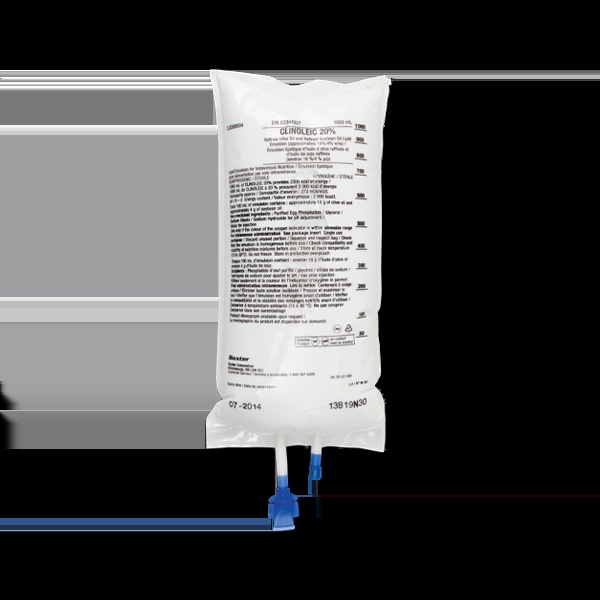
КЛИНОЛЕЙК 20 % Эмульсия для внутривенного введения

Рассмотрение рецепта онлайн
Врач рассмотрит ваш случай и примет решение о назначении рецепта, если это медицински оправдано.

Поговорите с врачом об этом лекарстве
Обсудите симптомы и возможные дальнейшие шаги на онлайн-консультации.



Инструкция по применению KLINOLEIK
Содержание инструкции
ClinOleic 20% Emulsion for Infusion
Purified olive oil and purified Soy oil
Read this leaflet carefully before you start using this medicine.
- Keep this leaflet. You may need to read it again.
- If you have any questions, ask your doctor or pharmacist.
- This medicine has been prescribed for you only. Do not pass it on to others, even if they have the same symptoms as you, as it may be harmful.
- If you get any side effects, even those not listed in this leaflet, tell your doctor or pharmacist.
Contents of this leaflet:
- 1. What ClinOleic is and what it is used for
- 2. What you need to know before you use ClinOleic
- 3. How to use ClinOleic
- 4. Possible side effects
- 5. How to store ClinOleic
- 6. Contents of the pack and other information
In this leaflet ClinOleic 20% will be called ClinOleic.
1. What is CLINOLEIC and what is it used for
ClinOleic is an emulsion for infusion of olive oil (80%) and soybean oil (20%).
ClinOleic is provided as a source of energy and essential fatty acids (fats or lipids) that cannot
be synthesized by the body. ClinOleic is given to the patient directly into the bloodstream bypassing
the digestive system. This method of nutrition (parenteral nutrition) is used when food and
drinks cannot be taken directly into the digestive system for medical reasons.
2. What you need to know before using CLINOLEIC
Do not use ClinOleic
- If you are allergic (hypersensitive) to egg, soy or peanut proteins or to any of the other ingredients (see section 6, at the end of this leaflet).
- If you have a high level of fats in the blood (severe dyslipidemia). If you suffer from uncorrected metabolic disorders including lactic acidosis and uncontrolled diabetes.
Warnings and precautions
Special clinical monitoring is required at the beginning of any infusion into your veins (intravenous infusion).
The infusion will be stopped immediately in case of any allergic symptoms. Signs such as sweating,
fever, chills, headache, rash, dyspnea (difficulty breathing).
This medicine contains soy oil and egg phospholipids. Soy and egg proteins can
cause hypersensitivity reactions.
Cross-allergic reactions between soy and peanut proteins have been observed.
Your doctor will check and monitor your triglyceride levels (a type of fat in the blood) and your
blood sugar level.
Some medicines and some diseases can increase the risk of developing an infection or sepsis (bacteria
in the blood). There is a particular risk of infection or sepsis when a tube (central venous catheter)
is inserted into a vein. Your doctor will carefully examine you for any signs of infection. Patients who
require parenteral nutrition (nutrition through a tube into a vein) may develop more
easily an infection due to their medical conditions. The risk of infection can be reduced
by using an "aseptic" ("germ-free") technique during catheter placement and maintenance and
during the preparation of the nutritional formula.
Liver diseases have been reported in patients undergoing total parenteral nutrition. If you suffer
from symptoms such as nausea, vomiting, abdominal pain, yellowing of the skin or eyes, contact
your doctor immediately.
Your doctor must be aware of:
- severe disorders that alter the way the body metabolizes sugars, fats, proteins or salts (metabolic disorders)
- severe blood infection (sepsis)
- severe liver disease
- blood coagulation disorder
- heart attack (myocardial infarction)
- heart failure
- kidney failure
- reduction of red blood cells (anemia)
- presence of fluid in the lungs
If the point where the needle is inserted into a blood vessel (vein) is swollen, painful and red, you should report it
to the doctor because it may be a sign of inflammation (thrombophlebitis).
Serious side effects such as respiratory disorders leading to a reduction of oxygen in the body
(respiratory distress) and conditions leading to a high amount of acid in the body (metabolic acidosis)
have been reported in neonates and young children (infants) after rapid administration of lipids into the blood
vessels (see also section 3, If you are given more ClinOleic than you should).
The doctor will monitor your condition at the beginning of the infusion, especially if you currently suffer from
problems with the liver, kidneys, adrenal glands, heart or circulation.
To verify the continued effectiveness and safety of the administration, the doctor will perform clinical and
laboratory tests while you are taking this medicine.
Children and adolescents
ClinOleic is suitable for use in young children if its use is strictly controlled. ClinOleic has been
used for up to 7 days in newborns (neonates) and up to 2 months in infants.
When used in neonates and children under 2 years of age, the solution (in bags and administration sets)
must be protected from exposure to light until the administration is completed. Exposure of Clinoleic to
ambient light, especially after the addition of trace elements and/or vitamins, generates peroxides and other
degradation products that can be reduced by protection from light exposure.
Other medicines and ClinOleic
Tell your doctor or pharmacist if you are taking, have recently taken or might take any
other medicine.
The olive and soy oils present in ClinOleic contain vitamin K. Normally this does not influence
the action of medicines that reduce blood density (anticoagulants) such as coumarin. However, if you
are using anticoagulants you should tell your doctor.
Pregnancy and breastfeeding
The safety of use of ClinOleic during pregnancy and breastfeeding has not been established.
Therefore, you should not take ClinOleic if you are pregnant or breastfeeding unless advised
by your doctor.
If you are pregnant, suspect you may be pregnant, are planning to become pregnant, or are breastfeeding with
breast milk, ask your doctor for advice before taking this medicine.
3. How to use CLINOLEIC
Clinoleic contains 200 mg/ml of lipids.
The doctor will prescribe the dose and the flow rate.
Dose
Use in adults
The doctor will decide the correct dose for your clinical condition.
The dose is from 1 up to a maximum of 2 g of lipids/kg/day.
Use in children
It is recommended not to exceed a daily dose of 3 g of lipids/kg.
Use in premature babies and newborns with low birth weight
The use of ClinOleic is limited to premature babies born with at least 28 weeks of gestational age
It is recommended not to exceed a daily dose of 2.0 g of lipids/kg.
Route and method of administration
You will receive ClinOleic through a plastic tube connected to a needle in one of your veins (intravenous
infusion).
When used in newborns and children under 2 years of age, the solution (in bags and administration sets) must be protected from exposure to light until the completion of
administration (see paragraph 2).
If you are given more ClinOleic than you should
An overdose may cause a reduced ability of your body to remove the lipids of ClinOleic
(fat overload syndrome). In newborn babies and young children (infants), an overdose
and/or a rapid administration of the lipids contained in ClinOleic into the blood vessels (increased infusion
rate) can cause serious side effects such as breathing difficulties leading to a reduction
of oxygen in the body (respiratory distress) and conditions leading to a high amount of acid in the
body (metabolic acidosis). The effects of an overdose are usually reversible when the infusion of
ClinOleic is stopped (see also paragraph 4. “Possible Side Effects”).
If the doctor or nurse forgets to give you ClinOleic
You should not take a double dose to make up for a missed dose.
If you have further questions about the use of this medicine, ask your doctor or pharmacist.
4. POSSIBLE UNDESIRABLE EFFECTS
Like all medicines, this medicine can cause undesirable effects, although not everyone will experience them.
If you notice the appearance of any abnormal signal in the early stages of the infusion, it must be
immediately interrupted.
These signals include sweating, chills, headache, and difficulty breathing (dyspnea).
Other undesirable effects have been observed more or less frequently:
The following undesirable effects are common and may occur in 1 to 10 patients out of 100:
- Feeling sick (nausea), being sick (vomiting)
- Decrease in blood pressure
- Increase in blood sugar level (hyperglycemia) The following undesirable effects are uncommon and may occur in 1 to 10 patients out of 1000:
- Reduction in the number of white blood cells (leukopenia).
- Difficulty breathing (dyspnea)
- Abdominal bloating (abdominal distension) or abdominal pain, and a feeling of discomfort around the stomach area
- Yellowing of the skin and eyes caused by problems with the gallbladder (cholestasis) or increased levels of bilirubin
- Increase in the level of liver enzymes or triglycerides in the blood
The following undesirable effects have been reported with an unknown frequency (the frequency cannot be
defined based on available data):
- Reduction in the number of platelets in the blood
- Chills
- Allergic reactions including itchy red skin rashes (urticaria), itching
- Diarrhea
If you have a reduced ability to remove the lipids contained in ClinOleic, this can lead to a
“fat overload syndrome”. This can be caused by an overdose of ClinOleic but can also
occur at the beginning of the infusion, even if ClinOleic is used correctly. It can cause an
sudden worsening of your clinical condition. Fat overload syndrome
can result in:
- Excess lipids in the blood (hyperlipidemia)
- fever
- fat infiltration of the liver
- increase in liver volume (hepatomegaly)
- reduction in the number of red blood cells (anemia)
- reduction in the number of white blood cells and platelets
- coagulation problems
- coma. All of these symptoms are usually reversible when the infusion is stopped. Reporting of undesirable effectsIf you experience any undesirable effect, including those not listed in this leaflet, tell your doctor or nurse. You can also report undesirable effects directly through the national reporting system at: https://www.aifa.gov.it/content/segnalazioni-reazioni-avverse. By reporting undesirable effects you can help provide more information on the safety of this medicine.
5. How to store CLINOLEIC
Keep out of sight and reach of children.
When used in newborns and children under 2 years of age, the solution (in bags and administration sets) must be protected from light exposure until the administration is completed (see section 2).
Do not use ClinOleic after the expiry date stated on the label after Exp. The expiry date refers to the last day of that month.
Store at a temperature below 25 °C
Do not freeze.
Store in the protective bag
Keep the container in the outer packaging to protect the medicine from moisture
Do not use ClinOleic if the container is damaged or if the emulsion is not uniformly milky.
Discard partially used containers. Any remaining emulsion must not be reused and must be disposed of by healthcare professionals.
An oxygen absorber/indicator bag is included in the outer packaging. Before opening the outer packaging, check the colour of the oxygen indicator on the oxygen absorber. It must match the reference colour printed next to the OK symbol and described in the printed area of the indicator label. The bag must be discarded after opening the outer packaging.
Once opened, use immediately
Do not use the product if the colour of the oxygen indicator does not match the reference colour.
Do not store an opened bag for later use
6. Contents of the pack and other information
What ClinOleic contains
- for 100 ml the active ingredients are: Purified olive oil (80%) and purified soybean oil (20%) ............... 20.00 g corresponding to a content of essential fatty acids ....................... 4.00 g
- Characteristics Energy content 2000 kcal/L (8.36 MJ/ L ) Osmolarity 270 mOsm/L pH 6-8 Density 0.986
- The excipients are egg phospholipids, glycerol, sodium oleate, sodium hydroxide, water for injections
- The phospholipids provide 47 milligrams or 1.5 mmol of phosphorus per 100 ml.
Description of the appearance of ClinOleic and contents of the pack
ClinOleic is a homogeneous milky liquid.
ClinOleic is supplied in plastic bags:
100 ml in bag: pack of 24 or 10 units.
250 ml in bag: pack of 20 or 10 units.
350 ml in bag: pack of 12 or 10 units.
500 ml in bag: pack of 12 or 10 units.
1000 ml in bag: pack of 6 units.
Not all pack sizes are marketed.
Marketing Authorisation Holder
BAXTER S.p.A.
Via Del Serafico 89
00142 ROMA
Manufacturers
Baxter
Boulevard Rene Branquart 80
B-7860 Lessines
Belgium
This medicinal product is authorised in the Member States of the European Economic Area with the following
denominations:
ClinOleic 20%
---------------------------------------------------------------------------------------------------------------------------
The following information is intended exclusively for doctors or healthcare professionals:
Special warnings and precautions for use
Exposure to light of solutions for intravenous parenteral nutrition, especially after mixing
with trace elements and/or vitamins, can have negative effects on clinical outcome in neonates, due to the
generation of peroxides and other degradation products. If used in neonates and children under 2 years of age, ClinOleic must be protected from ambient light until the completion of
administration
Special precautions for disposal and handling
If used in neonates and children under 2 years of age, protect from exposure to light until
completion of administration. Exposure of Clinoleic to ambient light, especially after
mixing with trace elements and/or vitamins, generates peroxides and other degradation products that can
be reduced by protecting from exposure to light.

Не уверены, подходит ли вам это лекарство?
Обсудите симптомы и варианты лечения с врачом онлайн.

Уже начали прием и появились вопросы?
Обсудите свое состояние и дальнейшие шаги с врачом онлайн.
- Страна регистрации
- Форма выпускаEmulsion for intravenous infusion, 20 %
- Код АТХB05BA02
- Действующее вещество
- Отпускается по рецептуДа
- Производитель
- Информация на этой странице носит справочный характер и не является медицинской консультацией. Перед началом приема лекарства обязательно проконсультируйтесь с врачом.
- Аналоги KLINOLEIKФорма выпуска: Emulsion for intravenous infusion, 200 MG/MLДействующее вещество: fat emulsionsПроизводитель: B. BRAUN MELSUNGEN AGОтпускается по рецептуФорма выпуска: Emulsion for intravenous infusion, 5 G + 5 G/100 MLДействующее вещество: fat emulsionsПроизводитель: B. BRAUN MELSUNGEN AGОтпускается по рецептуФорма выпуска: Emulsion for intravenous infusion, 50 MLДействующее вещество: fat emulsionsПроизводитель: FRESENIUS KABI DEUTSCHLAND GMBHОтпускается по рецепту
Аналоги KLINOLEIK в других странах
Лекарства с тем же действующим веществом, доступные в других странах.
Аналог KLINOLEIK в Польша
Аналог KLINOLEIK в Украина
Аналог KLINOLEIK в Испания
Врачи онлайн по KLINOLEIK
Обсудите применение KLINOLEIK и возможные следующие шаги — по оценке врача.









Получите рецепт на KLINOLEIK онлайн
Заполните форму за 2 минуты
Расскажите о симптомах, истории болезни и нужном препарате.
Выберите врача или мы назначим
Выберите специалиста или мы подберём ближайшего доступного врача.
Врач рассматривает ваш случай
Обычно в течение 30 минут. Может задать уточняющие вопросы в чате.
Получите в любой аптеке
Электронный рецепт отправляется на вашу почту — действителен по всей Польше.
Часто задаваемые вопросы
KLINOLEIK требует рецепта в Италия. Вы можете уточнить у врача онлайн, подходит ли это лекарство для вашей ситуации.
Действующее вещество KLINOLEIK — fat emulsions. Эта информация помогает определить лекарства с тем же составом под другими торговыми названиями.
KLINOLEIK производится компанией BAXTER S.P.A.. Упаковка и торговое название могут отличаться в зависимости от дистрибьютора.
Врачи, включая Семейные врачи, Психиатры, Дерматологи, Кардиологи, Эндокринологи, Гастроэнтерологи, Пульмонологи, Нефрологи, Ревматологи, Гематологи, Инфекционисты, Аллергологи, Гериатры, Педиатры, Онкологи, могут оценить целесообразность применения KLINOLEIK с учетом вашей ситуации и местных правил. Вы можете записаться на онлайн-консультацию, чтобы обсудить возможные варианты.
Польша имеет хорошо развитую систему здравоохранения в крупных городах, таких как Варшава, Краков, Вроцлав и Гданьск. Аптеки широко доступны и работают в соответствии с действующим законодательством, обеспечивая доступ к рецептурным препаратам.
Вы можете купить KLINOLEIK в Варшаве, Кракове, Вроцлаве или Гданьске в любой аптеке при наличии действующего рецепта.
Чтобы получить рецепт, вы можете воспользоваться Oladoctor:
Другие лекарства с тем же действующим веществом (fat emulsions) включают LIPIDEM, LIPOFUNDIN MKT, OMEGAVEN. Они могут отличаться торговым названием или формой выпуска, но содержат одинаковый терапевтический компонент. Перед изменением лечения рекомендуется проконсультироваться с врачом.
