



L-ЛІЗИНУ ЕСЦИНАТ 1 mg/ml Roztwór

Ocena recepty online
Lekarz przeanalizuje Twój przypadek i zdecyduje, czy wystawienie recepty jest medycznie uzasadnione.

Porozmawiaj z lekarzem o tym leku
Omów swoje objawy i opcje leczenia podczas szybkiej konsultacji online.



Jak stosować L-LIZINU ESCINAT
Treść ulotki
- INSTRUCTIONS FOR MEDICAL USE OF THE MEDICINAL PRODUCT BETMIGA (BETMIGA)
- Composition
- Pharmaceutical Form
- Main Physico-Chemical Properties
- Pharmacotherapeutic Group
- Pharmacological Properties
- Clinical Characteristics
- Interaction with Other Medicinal Products and Other Types of Interactions
- Special Warnings and Precautions
- Use During Pregnancy or Breastfeeding
- Fertility
- Ability to Affect Reaction Speed When Driving or Operating Other Mechanisms
- Method of Administration and Dosage
- Children
- Overdose
- Adverse Reactions
- Shelf Life
- Storage Conditions
- Packaging
- Release Category
- Manufacturer
- Manufacturer's Location and Address
- Applicant
- Applicant's Location
INSTRUCTIONS FOR MEDICAL USE OF THE MEDICINAL PRODUCT BETMIGA (BETMIGA)
Composition
active substance: mirabegron; 1 tablet contains 25 mg or 50 mg of mirabegron; excipients: macrogol 8000, macrogol 2000000, hydroxypropylcellulose, butylhydroxytoluene (E 321), magnesium stearate; film coating: for 25 mg tablets - Opadry 03F43159 (hypromellose, macrogol 8000, yellow iron oxide (E 172), red iron oxide (E 172)); for 50 mg tablets - Opadry 03F42192 (hypromellose, macrogol 8000, yellow iron oxide (E 172)).
Pharmaceutical Form
Prolonged-release tablets.
Main Physico-Chemical Properties
25 mg tablets - oval, biconvex tablet, film-coated, brown in color, with engraving "325" and a graphical representation of the Astellas company logo on one side; 50 mg tablets - oval, biconvex tablet, film-coated, yellow in color, with engraving "355" and a graphical representation of the Astellas company logo on one side.
Pharmacotherapeutic Group
Drugs used in urology. Drugs for the treatment of frequent urination and urinary incontinence. ATC code G04B D12.
Pharmacological Properties
Pharmacodynamics
Mechanism of Action
Mirabegron is a potent selective beta-3 adrenergic receptor agonist. Under the action of mirabegron, relaxation of the smooth muscles of the urinary bladder occurs in animals and in isolated human tissue, an increase in the concentration of cyclic adenosine monophosphate (cAMP) in the tissues of the urinary bladder of animals, and a relaxing effect on the urinary bladder is observed in a functioning model of the urinary bladder in animals.
Mirabegron increases the average volume of urine during urination and reduces the frequency of urination without reducing the muscles of the urinary bladder outside of urination, without affecting pressure or residual urine in the bladder, in models of hyperactive urinary bladder in animals. In animal bladder models, mirabegron showed a decrease in the frequency of urination. These results show that mirabegron increases the function of urine retention by stimulating beta-3 adrenergic receptors in the muscles of the urinary bladder.
Pharmacokinetics
Absorption
After oral administration in healthy volunteers, mirabegron is absorbed into the bloodstream and reaches a maximum concentration in plasma (Cmax) within 3-4 hours after administration. The absolute bioavailability increases from 29% to 35% with an increase in dose from 25 mg to 50 mg. At the same time, the average values of Cmax and AUC increased more than proportionally for the specified dose range. In the general population of men and women, with a 2-fold increase in the dose of mirabegron from 50 mg to 100 mg, an increase in Cmax and AUCtau of approximately 2.9 and 2.6 times, respectively, was observed, while a 4-fold increase in the dose of mirabegron from 50 mg to 200 mg induces an increase in Cmax and AUCtau of approximately 8.4 and 6.5 times. Steady-state concentration is achieved within 7 days (once-daily administration of mirabegron). After multiple administration once daily, the concentration of mirabegron in plasma at steady state is approximately 2 times higher than with single-dose administration.
Clinical Characteristics
Indications
Symptomatic treatment of urgent urination, increased frequency of urination, and/or urinary incontinence that may occur in adult patients with overactive bladder syndrome (OAB).
Contraindications
Increased sensitivity to the active substance or to any of the excipients. Severe uncontrolled hypertension (systolic blood pressure ≥ 180 mmHg and/or diastolic blood pressure ≥ 110 mmHg).
Interaction with Other Medicinal Products and Other Types of Interactions
In Vitro Study Data
Mirabegron is transported and metabolized by various pathways. Mirabegron is a substrate for cytochrome P450 (CYP) 3A4, CYP2D6, butyrylcholinesterase, uridine diphosphate glucuronosyltransferase (UGT), P-glycoprotein (P-gp), and organic cation transporters (OCT) OCT1, OCT2, and OCT3. Studies of mirabegron using human liver microsomes and recombinant human CYP enzymes showed that mirabegron is a moderate time-dependent inhibitor of CYP2D6 and a weak inhibitor of CYP3A. Mirabegron at high concentrations inhibited the transport of drugs mediated by P-glycoprotein.
In Vivo Study Data
CYP2D6 Polymorphism
Genetic polymorphism of CYP2D6 has a minimal effect on the average concentration of mirabegron in plasma (see "Pharmacokinetic Properties" section).
No interaction between mirabegron and the known CYP2D6 inhibitor is expected or has been studied. In patients taking CYP2D6 inhibitors and patients with slow CYP2D6 metabolism, there is no need to adjust the dose of mirabegron.
Interaction with Medicinal Products
The effect of concomitant administration of medicinal products on the pharmacokinetics of mirabegron and the effect of mirabegron on the pharmacokinetics of other products have been studied with single and multiple doses. Most drug interactions were studied with mirabegron at a dose of 100 mg, using oral controlled-release tablets (OCAS). In studies of the interaction between mirabegron and metoprolol and metformin, mirabegron was used in an immediate-release formulation (IR) at a dose of 160 mg. No clinically significant drug interaction between mirabegron and medicinal products that inhibit, induce, or are substrates or transporters of one of the CYP enzymes is expected, except for the inhibitory effect of mirabegron on the metabolism of CYP2D6 substrates.
Effect on Enzyme Inhibitors
In healthy volunteers, in the presence of ketoconazole, a strong inhibitor of CYP3A/P-glycoprotein, the exposure of mirabegron (AUC) increased by 1.8 times. When used concomitantly with CYP3A inhibitors and/or P-glycoprotein, no dose adjustment of the medicinal product Betmiga is required. However, for patients with renal impairment from mild to moderate severity (GFR from 30 to 89 mL/min/1.73 m2) or with hepatic impairment of mild severity (Child-Pugh class A), when used concomitantly with strong CYP3A inhibitors such as itraconazole, ketoconazole, ritonavir, and clarithromycin, the recommended dose is 25 mg once daily, regardless of food intake (see "Method of Administration and Dosage" section). Concomitant use with strong CYP3A inhibitors is not recommended for patients with severe renal impairment (GFR from 15 to 29 mL/min/1.73 m2) or patients with hepatic impairment of moderate severity (Child-Pugh class B) (see "Method of Administration and Dosage" and "Special Warnings and Precautions" sections).
Effect on Enzyme Inducers
Substances that are inducers of CYP3A or P-glycoprotein decrease the concentration of mirabegron in plasma. When used with rifampicin or other CYP3A inducers at therapeutic doses or P-glycoprotein, no dose adjustment of mirabegron is required.
Effect of Mirabegron on CYP2D6 Substrates
In healthy volunteers, mirabegron moderately inhibits CYP2D6, the activity of which is restored within 15 days after discontinuation of mirabegron. Daily single-dose administration of mirabegron in an immediate-release formulation (IR) at a dose of 160 mg resulted in an increase in Cmax and AUC of metoprolol, which was administered as a single dose, by 90% and 229%, respectively. Daily single-dose administration of mirabegron resulted in an increase in Cmax by 79% and AUC of desipramine by 241% when administered as a single dose.
Cautious use is recommended when mirabegron is used concomitantly with medicinal products with a narrow therapeutic index and a strong effect on CYP2D6 metabolism, such as thioridazine, antiarrhythmic drugs of class 1C (e.g., flecainide, propafenone), and tricyclic antidepressants (e.g., imipramine, desipramine). Also, cautious use of mirabegron is recommended when used concomitantly with CYP2D6 substrates that require individual dose titration.
Effect of Mirabegron on Enzyme Transporters
Mirabegron is a weak inhibitor of P-glycoprotein (P-GP). When digoxin was administered to healthy volunteers, mirabegron may increase its Cmax and AUC by 29% and 27%, respectively. For patients who start taking the medicinal product Betmiga and digoxin concomitantly, the lowest dose of digoxin should be prescribed. To achieve the desired clinical effect, it is necessary to monitor the concentration of digoxin in the blood and titrate the dose of digoxin. The potential for P-glycoprotein inhibition by mirabegron should be considered when the medicinal product Betmiga is used concomitantly with medicinal products that are sensitive P-GP substrates, such as dabigatran.
Other Interactions
No clinically significant interactions of mirabegron have been observed when used concomitantly with therapeutic doses of solifenacin, tamsulosin, warfarin, metformin, or combined oral contraceptives containing ethinyl estradiol and levonorgestrel. No dose adjustment is required.
Enhanced effect of mirabegron when used concomitantly with other medicinal products may result in an increased heart rate.
Special Warnings and Precautions
Renal Impairment
The use of the medicinal product Betmiga has not been studied in patients with terminal renal impairment (GFR <15 mL/min/1.73 m2 or patients requiring hemodialysis), and therefore, this medicinal product is not recommended for use in these patients (see "Special Warnings and Precautions", "Pharmacokinetic Properties").
There are limited data on the use of the medicinal product Betmiga in patients with severe renal impairment (GFR from 15 to 29 mL/min/1.73 m2); based on pharmacokinetic studies (see "Pharmacokinetic Properties"), a dose reduction to 25 mg is recommended for these patients. The medicinal product Betmiga is not recommended for use in patients with severe renal impairment (GFR from 15 to 29 mL/min/1.73 m2) when used concomitantly with strong CYP3A inhibitors (see "Interaction with Other Medicinal Products and Other Types of Interactions").
Hepatic Impairment
The use of the medicinal product Betmiga has not been studied in patients with severe hepatic impairment (Child-Pugh class C), and therefore, it is not recommended for use in these patients. The medicinal product Betmiga is not recommended for use in patients with hepatic impairment of moderate severity (Child-Pugh class B) when used concomitantly with strong CYP3A inhibitors ("Interaction with Other Medicinal Products and Other Types of Interactions").
Arterial Hypertension
Mirabegron may increase blood pressure. It is necessary to measure blood pressure before starting treatment and periodically throughout the entire course of treatment, especially in patients with arterial hypertension. Data on the use of the medicinal product in patients with arterial hypertension of the 2nd degree (systolic blood pressure ≥ 160 mmHg or diastolic blood pressure ≥ 100 mmHg) are limited.
Patients with Congenital or Acquired Prolongation of the QT Interval
When mirabegron was used in therapeutic doses during clinical trials, no clinically significant prolongation of the QT interval on the electrocardiogram was observed. Since the use of mirabegron has not been studied in patients taking medicinal products that may prolong the QT interval or in patients with a history of prolonged QT interval, the effect of mirabegron on these patients is unknown. Caution should be exercised when using mirabegron in these patients.
Patients with Obstruction of the Urinary Bladder and Patients Taking Antimuscarinic Medicinal Products for the Treatment of Overactive Bladder Syndrome
When mirabegron was used in the post-marketing period, there were reports of urinary retention in patients with obstruction of the urinary bladder and in patients taking antimuscarinic medicinal products for the treatment of overactive bladder syndrome. Controlled clinical trials on safety involving patients with obstruction of the urinary bladder did not show an increase in the number of cases of urinary retention in patients taking the medicinal product Betmiga; however, caution should be exercised when using the medicinal product Betmiga in patients with clinically significant obstruction of the urinary bladder. The medicinal product Betmiga should be used with caution in patients taking antimuscarinic medicinal products for the treatment of overactive bladder syndrome.
Use During Pregnancy or Breastfeeding
Data on the use of mirabegron during pregnancy are limited. Animal studies have shown reproductive toxicity. The medicinal product Betmiga is not recommended during pregnancy, as well as for women of reproductive age who do not use contraceptive measures.
In rodents, mirabegron is excreted in breast milk, and therefore, there is a risk of the medicinal product entering human breast milk. The effect of mirabegron on milk production in humans or its effect on breastfeeding has not been studied. Mirabegron should not be prescribed to women during breastfeeding.
Fertility
Animal studies did not show any effect of mirabegron on fertility when used at therapeutic doses. The effect of mirabegron on human fertility has not been evaluated.
Ability to Affect Reaction Speed When Driving or Operating Other Mechanisms
Betmiga does not affect or has a negligible effect on the ability to drive a car or work with other mechanisms.
Method of Administration and Dosage
Adults, Including Elderly Patients
The recommended dose is 50 mg once daily, regardless of food intake.
Renal and Hepatic Impairment
The use of the medicinal product Betmiga has not been studied in patients with terminal renal impairment (GFR <15 mL/min/1.73 m2 or patients requiring hemodialysis) or patients with severe hepatic impairment (Child-Pugh class C), and therefore, this medicinal product is not recommended for use in these patients (see "Special Warnings and Precautions", "Pharmacokinetic Properties").
Table 1 shows the recommendations for daily dosing of the medicinal product for patients with renal or hepatic impairment, with or without strong CYP3A inhibitors (see "Special Warnings and Precautions", "Interaction with Other Medicinal Products and Other Types of Interactions", "Pharmacokinetic Properties").
| Renal/Hepatic Impairment | Degree of Severity | Strong CYP3A Inhibitors(3) | |
| Without Inhibitor | With Inhibitor | ||
| Renal Impairment(1) | Mild | 50 mg | 25 mg |
| Moderate | 50 mg | 25 mg | |
| Severe | 25 mg | Not Recommended | |
| Hepatic Impairment(2) | Mild | 50 mg | 25 mg |
| Moderate | 25 mg | Not Recommended | |
1 Mild: GFR 60-89 mL/min/1.73 m2; moderate: GFR 30-59 mL/min/1.73 m2; severe: GFR 15-29 mL/min/1.73 m2.
2 Mild: Child-Pugh class A; moderate: Child-Pugh class B.
3 Strong CYP3A inhibitors, see "Interaction with Other Medicinal Products and Other Types of Interactions" section.
Tablets should be taken once daily, with a liquid; the tablet should be swallowed whole; it should not be chewed, divided, or crushed.
Sex
No dose adjustment is required based on sex.
Children
The safety and efficacy of mirabegron in children (under 18 years of age) have not been studied.
Overdose
Mirabegron was administered at a single dose of 400 mg to healthy volunteers, and palpitations (in 1 of 6 volunteers) and an increase in heart rate of more than 100 beats per minute (in 3 of 6 volunteers) were observed. With daily administration of mirabegron at a dose of 300 mg for 10 days in healthy volunteers, an increase in heart rate and systolic blood pressure was observed.
Treatment of overdose is symptomatic and supportive. In case of overdose, it is recommended to monitor heart rate, blood pressure, and perform ECG monitoring.
Adverse Reactions
Most adverse reactions were mild or moderate in severity.
The most common adverse reactions were tachycardia and urinary tract infections. The frequency of tachycardia was 1.2%, and it led to discontinuation of treatment in 0.1% of patients. The frequency of urinary tract infections was 2.9%. Urinary tract infections did not lead to discontinuation of treatment in any of the patients. Serious adverse reactions included atrial fibrillation (0.2%).
The frequency of adverse reactions is defined as follows: very common (≥ 1/10); common (≥ 1/100 to <1/10); uncommon (≥ 1/1000 to <1/100); rare (≥ 1/10,000 to <1/1000); very rare (<1/10,000); frequency not known (cannot be estimated due to insufficient data). In each group, adverse reactions are presented in order of decreasing severity.
| MedDRA Organ/System Class | Common | Uncommon | Rare | Very Rare | Frequency Not Known |
| Infections and Infestations | Urinary Tract Infection | Vaginal Infections Cystitis | |||
| Psychiatric Disorders | Insomnia* | ||||
| Eye Disorders | Eye Lid Edema | ||||
| Cardiac Disorders | Tachycardia | Palpitations Atrial Fibrillation | |||
| Vascular Disorders | Hypertensive Crisis* | ||||
| Gastrointestinal Disorders | Nausea* Constipation* Diarrhea* | Dyspepsia Gastritis | Lip Edema | ||
| Skin and Subcutaneous Tissue Disorders | Urticaria Rash Maculopapular Rash Papular Rash Pruritus | Leukocytoclastic Vasculitis Purpura Angioedema* | |||
| Musculoskeletal and Connective Tissue Disorders | Joint Swelling | ||||
| Reproductive System and Breast Disorders | Vulvovaginal Pruritus | ||||
| Changes in Laboratory Parameters | Increased Blood Pressure, Increased GGT, Elevated ALT/AST | ||||
| Renal and Urinary Disorders | Urinary Retention* | ||||
| Nervous System Disorders | Headache* Dizziness* |
*Observed during the post-marketing period.
Reporting of Suspected Adverse Reactions
Reporting of suspected adverse reactions after authorization of the medicinal product is important. It allows continued monitoring of the benefit/risk balance of the medicinal product. Healthcare professionals, as well as patients or their representatives, should report any suspected adverse reactions via the automated information system for pharmacovigilance at: https://aisf.dec.gov.ua.
Shelf Life
3 years.
Storage Conditions
Store at a temperature not exceeding 30°C.
Store in a place inaccessible to children.
Packaging
10 tablets in a blister pack. 1 or 3 blister packs in a carton box.
Release Category
Prescription only.
Manufacturer
Delpharm Meppel B.V., Netherlands / Delpharm Meppel B.V., the Netherlands.
Manufacturer's Location and Address
Hogemaat 2, 7942 DJ Meppel, Netherlands / Hogemaat 2, 7942 JG Meppel, the Netherlands.
Applicant
Astellas Pharma Europe B.V./Astellas Pharma Europe B.V.
Applicant's Location
Sylviusweg, 62, 2333 BE Leiden, Netherlands/Sylviusweg, 62, 2333 BE Leiden, the Netherlands.

Nie jesteś pewien, czy ten lek jest odpowiedni dla ciebie?
Omów swoje objawy i leczenie z lekarzem online.

Zacząłeś przyjmować lek i masz pytania?
Omów swoje objawy i leczenie z lekarzem online.
- Kraj rejestracji
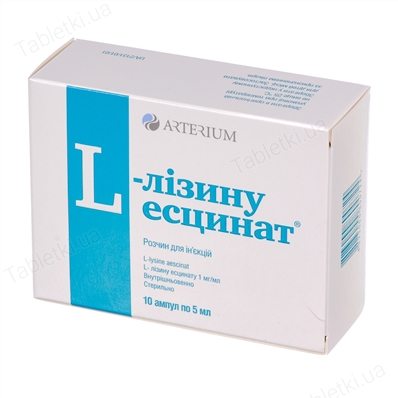
- Postać farmaceutycznasolution, 1 mg/ml in 5 ml ampoules
- Wymaga receptyTak
- Producent
- Te treści mają charakter wyłącznie informacyjny i nie zastępują konsultacji lekarskiej.
- Zamienniki L-LIZINU ESCINATPostać farmaceutyczna: tablets, 20 tablets in a blisterSubstancja czynna: Hippocastani semenProducent: Др. Вільмар Швабе ГмбХ і Ко. КГBez receptyPostać farmaceutyczna: gel, 1% in 30g or 50g tubeSubstancja czynna: Hippocastani semenProducent: ТОВ "ТернофармBez receptyPostać farmaceutyczna: tablets, 40 mgSubstancja czynna: Hippocastani semenProducent: ПАТ "КиївмедпрепаратBez recepty
Odpowiedniki L-LIZINU ESCINAT w innych krajach
Leki z tą samą substancją czynną dostępne w innych krajach.
Odpowiednik L-LIZINU ESCINAT w Włochy
Odpowiednik L-LIZINU ESCINAT w Hiszpania
Odpowiednik L-LIZINU ESCINAT w Polska
Lekarze online w sprawie L-LIZINU ESCINAT
Omów stosowanie L-LIZINU ESCINAT, bezpieczeństwo i ocenę zasadności recepty zgodnie z obowiązującymi przepisami.









Uzyskaj receptę na L-LIZINU ESCINAT online
Wypełnij 2-minutowy formularz
Opisz swoje objawy, historię choroby i lek, o który prosisz.
Wybierz lekarza lub pozwól nam przydzielić
Wybierz specjalistę lub dopasujemy Cię do najbliższego dostępnego lekarza.
Lekarz analizuje Twój przypadek
Zazwyczaj w ciągu 30 minut. Może zadawać dodatkowe pytania przez czat.
Odbierz w dowolnej aptece
Recepta elektroniczna wysłana na Twój e-mail — ważna w całej Polsce.
Często zadawane pytania
L-LIZINU ESCINAT wymaga recepty w Ukraina. Możesz skonsultować się z lekarzem online, aby sprawdzić, czy ten lek może być odpowiedni w Twojej sytuacji.
L-LIZINU ESCINAT jest produkowany przez PAT "Galicfarm. Nazwy handlowe i opakowania mogą się różnić w zależności od dystrybutora.
Lekarze, tacy jak Lekarze rodzinni, Psychiatrzy, Dermatolodzy, Kardiolodzy, Endokrynolodzy, Gastroenterolodzy, Pulmonolodzy, Nefrolodzy, Reumatolodzy, Hematolodzy, Zakaźnicy, Alergolodzy, Geriatrzy, Pediatrzy, Onkolodzy, mogą ocenić, czy stosowanie L-LIZINU ESCINAT jest odpowiednie w Twoim przypadku, w zależności od sytuacji klinicznej i lokalnych przepisów. Możesz umówić konsultację online, aby omówić objawy i możliwe dalsze kroki.
Polska posiada dobrze rozwiniętą infrastrukturę ochrony zdrowia w dużych miastach, takich jak Warszawa, Kraków, Wrocław i Gdańsk. Apteki są łatwo dostępne i działają zgodnie z obowiązującymi przepisami, zapewniając dostęp do leków na receptę.
Możesz kupić L-LIZINU ESCINAT w Warszawie, Krakowie, Wrocławiu lub Gdańsku w każdej aptece, posiadając ważną receptę.
Aby uzyskać receptę, możesz skorzystać z Oladoctor:
Inne leki zawierające tę samą substancję czynną () to m.in. ВЕНОПЛАНТ, ЕСКУВЕН, ЕСКУВІТ. Mogą one różnić się nazwą handlową lub postacią, ale zawierają ten sam składnik terapeutyczny. Przed zmianą lub rozpoczęciem nowego leku skonsultuj się z lekarzem.
